Investment Planning
Chapter 11
How Will This Affect Me?
Investing is the means by which many important financial goals in life are achieved. This chapter
discusses how to determine the amount of investment capital needed to reach common financial
goals and explains how to invest for retirement, to fund major expenditures, to earn needed
income, and to establish tax shelters. The market context in which investing occurs is described,
and how to buy and sell investments is explained. A framework for evaluating investments is
also presented, which includes how to describe, monitor, and manage a portfolio. Sources of
investment information are discussed, as well as some of the useful investing tools available
online. After reading this chapter you should be able to plan your investments to better meet your
financial goals.
LEARNING GOALS
Investing is a key element of personal financial planning because it allows the individual to meet
many of his or her long-term financial goals by saving and using the funds in such a way that an
additional return is earned. Once the level of savings in nearly riskless assets reaches an amount
that is sufficient for emergency and other short-term purposes, funds can be put into various
11-1 Discuss the role that investing plays in the personal financial planning process and
identify several different investment objectives.
Investing is the long-term process of purchasing securities wherein stability of value and level of
return are somewhat predictable. Speculating, on the other hand, is the short-term buying and
selling of securities in which future value and expected return are highly uncertain
How, then, do you get started? First, you need some money—not a lot; $500 to $1,000 will do.
And remember, this is investment capital we’re talking about here—money you’ve accumulated
above and beyond basic emergency savings.
11-2 Distinguish between primary and secondary markets, as well as between broker and
dealer markets.
In the primary market, new securities are sold to the public, and one party to the transaction is
always the issuer. In contrast, previously issued (outstanding) securities are bought and sold in
the secondary market, where the securities are “traded” between investors. For a summary of
the broker and dealer markets, see Exhibit 11.1, U.S. Broker and Dealer Markets. Section 11-2d
11-3 Explain the process of buying and selling securities and recognize the different types
of orders.
Stockbrokers, or account executives and financial consultants, as they’re also called,
buy and sell securities for their customers. Brokers are classified as full-service brokers,
discount brokers, and online brokers. Exhibit 11.3 reports Barron’s 2019 online broker rankings.
Interesting. Students may not be aware of the different types of orders. You can demonstrate the
short sales and stop loss orders and discuss who the exchanges allow to execute such orders. The
power point slides gives the basics of these types of orders. If you “play the game” the students
will learn more about these orders.
11-4 Develop an appreciation of how various forms of investment information can lead to
better investing skills and returns.
The use of the annual stockholders’ report is discussed. Market indices are discussed including
11-5 Gain a basic understanding of the impact of the Internet on the field of investments.
The Internet provides individual investors access to discount brokers as well as to investment
services, information, and tools to better select and monitor their own portfolios. The students
provide useful investor education.
11-6 Describe an investment portfolio and how you’d go about developing, monitoring, and
managing a portfolio of securities.
While you most likely do not want to discuss portfolio theory, the concept of not “having all of
your eggs in one basket” is intuitive and worthy of your time. I believe that with a volatile
market, a portfolio approach is even more useful. The importance of comparing the value of

your portfolio with the previous quarter’s (at least, if not monthly) is valuable and the students
need to understand the information to be gain from such comparisons. I suggest you spend some
class time explaining the importance of knowing how you are doing with your investments.
Financial Facts or Fantasies?
These may be used as “teasers” to get the students on the right page with you. Also, they may be
used as quizzes after you covered the material or as “pre–test questions” to get their attention.
• You would need to save $2,500 a year in order to end up with a $25,000 nest egg in 10
years.
• If you lose a lot of money because a broker gave you a poor investment recommendation,
you can recover most or all of your loss by filing a claim with the Securities Investor
Protection Corporation.
Fantasy: SIPC insurance applies only if you are dealing with a brokerage firm that goes out of
business. If the brokerage firm fails, you are protected against the loss of securities or cash held
by the broker. Importantly, that has nothing to do with getting bad advice from a broker; the
SIPC does not cover such situations.

Financial Facts or Fantasies?
These may be used as a quiz or as a pre-test to get the students interested.
1. True False You would need to save $2,500 a year in order to end up with a $25,000
nest egg in 10 years.
2. True False Stocks listed on the New York Stock Exchange are traded in the over-the-
counter market.
3. True False If you lose a lot of money because a broker gave you a poor
investment recommendation, you can recover most or all of your
loss by filing a claim with the Securities Investor Protection
Corporation.
4. True False An aggressive investor would short sell a stock if he or she expects
its price to go down.
5. True False You should pay little attention to annual stockholders’ reports
because they are so biased.
6. True False Coming up with a sound asset allocation plan will likely have more
of an impact on long-term investment return than the specific
securities you hold in your portfolio.

YOU CAN DO IT NOW
The “You Can Do It Now” cases may be assigned to the students as short cases or problems.
They will help make the topic more real or relevant to the students. In most cases, it will only
take about ten minutes to do, that is, until the student starts looking around at the web site. But
they will learn by doing so.
How’s the Market Doing Right Now?
It’s easy to find out how the stock market is doing anytime during trading hours as well as its
Get a Quick Perspective on Your Asset Allocation
Track Your Portfolio for Free
Financial Impact of Personal Choices
Read and think about the choices being made. Do you agree or not? Ask the students to discuss
the choices being made.
Emma and William Get Serious About Their Retirement Asset Allocation
Emma and William Hart are married and are both 32 years old. While they want to save for their
children’s future college educations, they also want to be plan carefully for their retirement. They
The online survey asked them to about their investment time horizon, how much risk they were
comfortable with, the flexibility of their retirement date, and whether they’re tempted to sell
stocks during a downturn or buy more. They indicated a 20+ year investment time horizon,
medium risk tolerance, flexible retirement dates, and an inclination to leave their investments
alone during a downturn. The recommended asset allocation was:
10% bonds
50% large stocks
Applying Personal Finance
Research Your Investments!
Investing involves making informed decisions, which means researching companies and
industries before plunking down your hard-earned money! An excellent source of information
about a company is the company itself, particularly its annual report to stockholders. In this
project, you’ll examine the annual stockholders’ report of a company in which you are interested.
a. Name of the company, its ticker symbol, and the exchange on which it trades
b. Current market price of the stock and its percentage change from 1, 3, and 5 years ago
(try to find a chart of its stock price)
c. Location of its corporate headquarters, names of its officers, and percentage of inside
ownership
Based on your findings, would you consider this company for a potential investment? Why or
why not?
Solutions to Financial Planning Exercises
1. Calculate amount to invest to meet objectives. Use Worksheet 11.1 Ashley Olson is early in
her career and is now employed as the managing editor of a well-known business journal.
Although she thoroughly enjoys her job and the people she works with, she would really
like to be a literary agent. She would like to go on her own in about 8 years and figures
she’ll need about $50,000 in capital to do so. Given that she thinks she can make about 10
percent on her money, use Worksheet 11.1 to answer the following questions
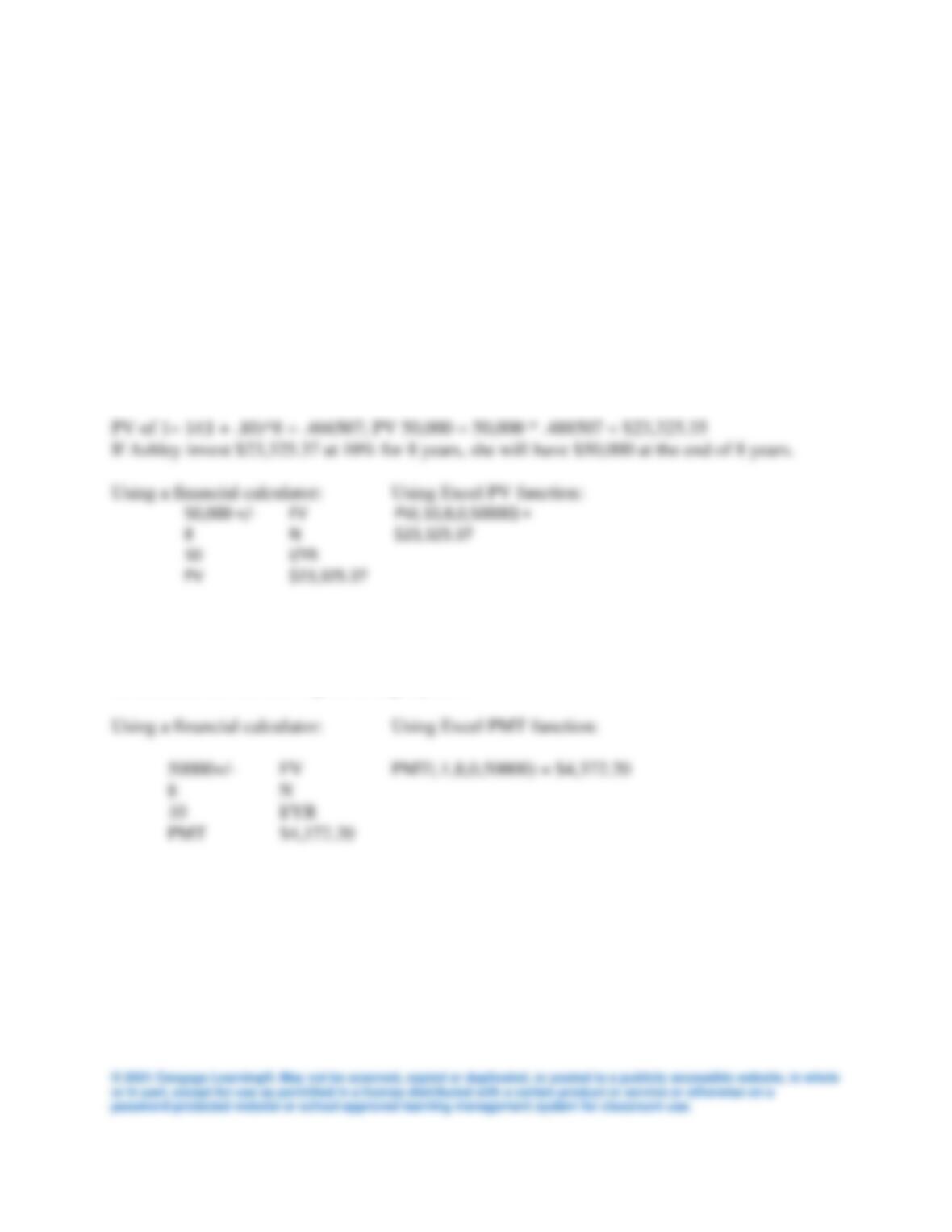
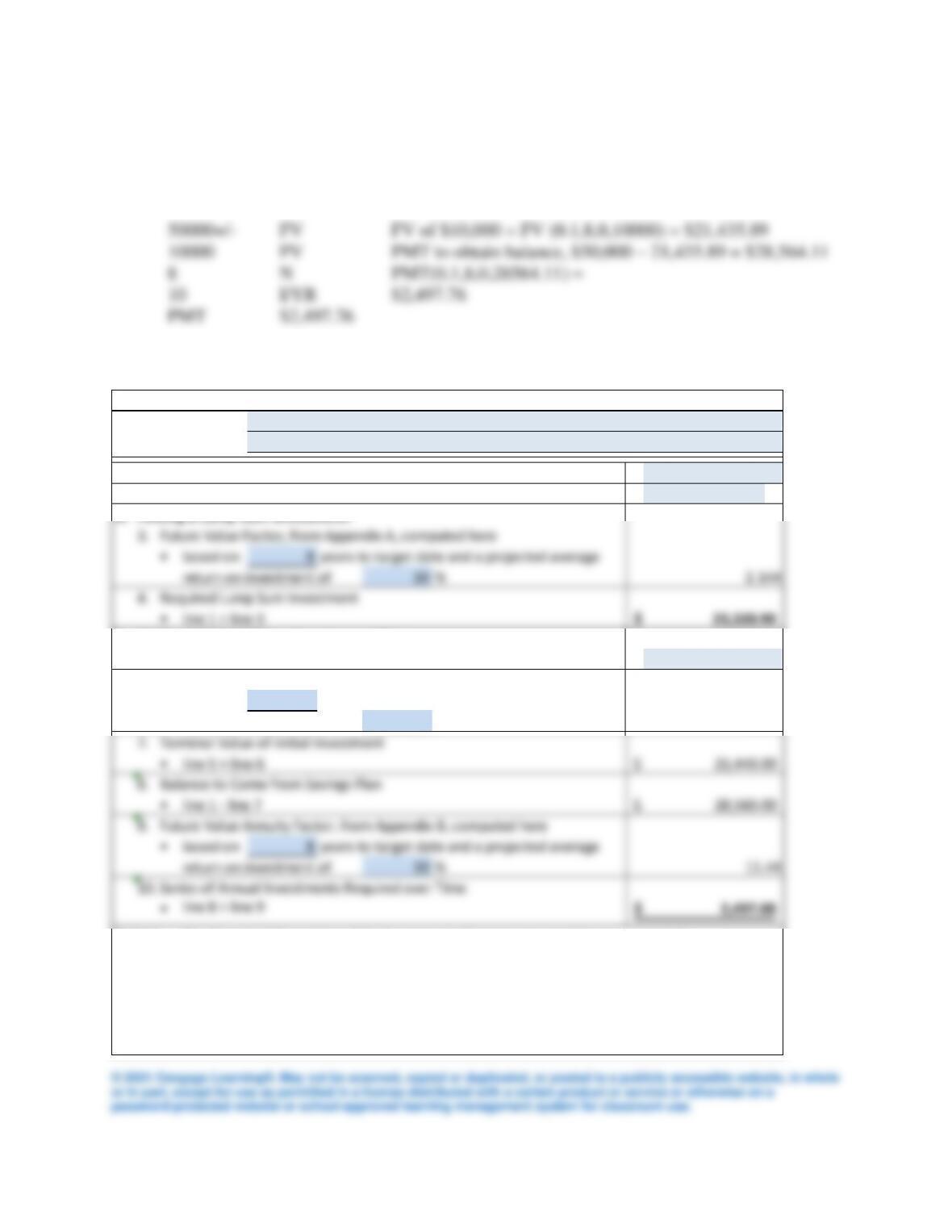
a. How much would Ashley have to invest today, in one lump sum, to end up with $50,000
in eight years?
See Worksheet 11.1 on next page.
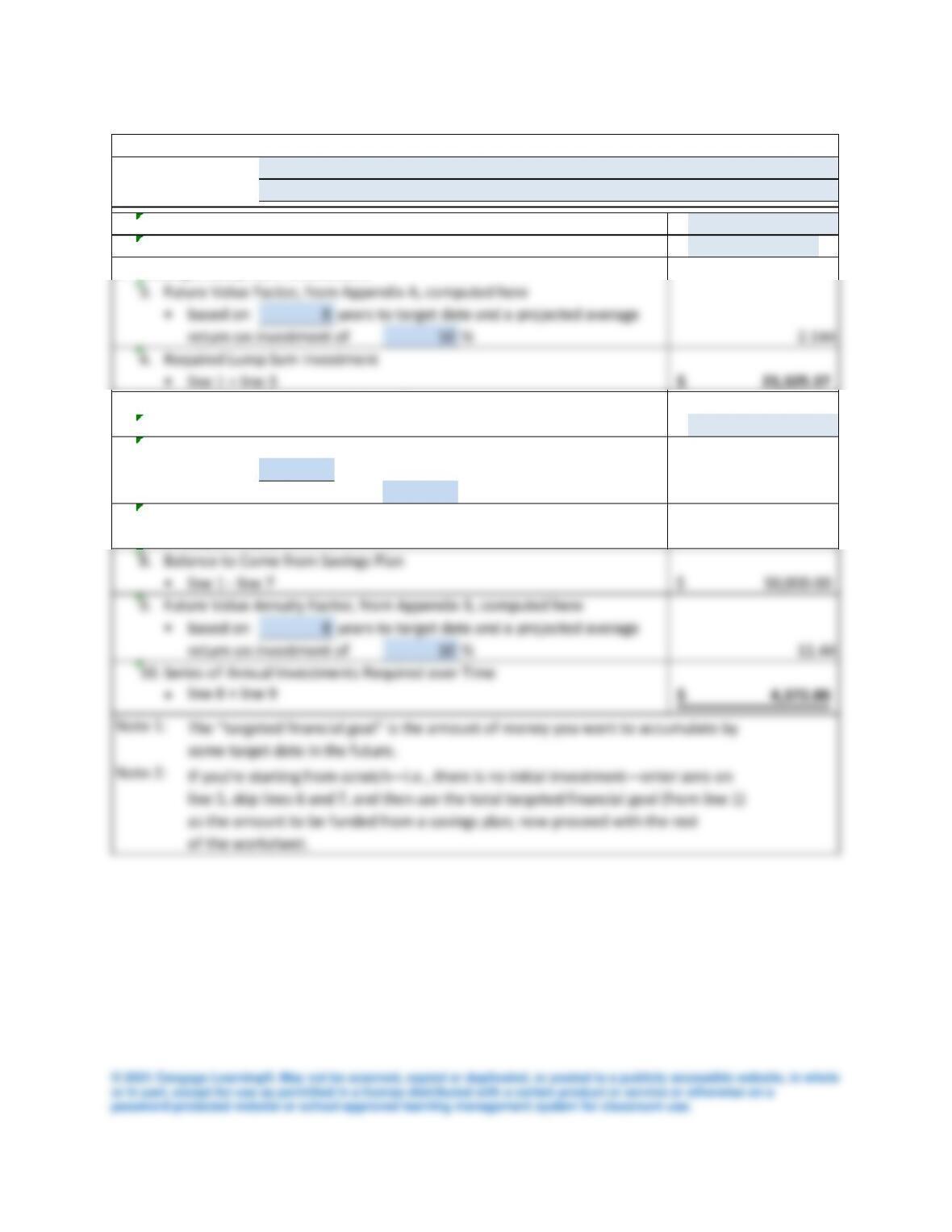
b. If she’s starting from scratch, how much would she have to put away annually to
accumulate the needed capital in eight years?
Balance to Come from Savings Plan
Future Value Annuity Factor, from Appendix B, computed here
years to target date and a projected average
return on investment of
Series of Annual Investments Required over Time
Worksheet 11.1, Chapter 11, Exercise1 Part a and b
1. $
2. 10 %
A.
Future Value Factor, from Appendix A, computed here
years to target date and a projected average
Required Lump Sum Investment
line 1 ÷ line 3
B.
5. $
6.
•based on 8
10 %
7.
•
Determining Amount of Investment Capital Needed
Financial goal:
Targeted Financial Goal (see Note 1)
50,000.00
Invest lump sum to end up with $50,000 in 8 years
Projected Average Return on Investments
Finding a Lump Sum Investment:
Making a Series of Investments over Time:
Amount of Initial Investment, if any (see Note 2)
Future Value Factor, from Appendix A, computed here
years of target date and a projected average
return on investment of
Terminal Value of Initial Investment
line 5 × line 6
–
2.144
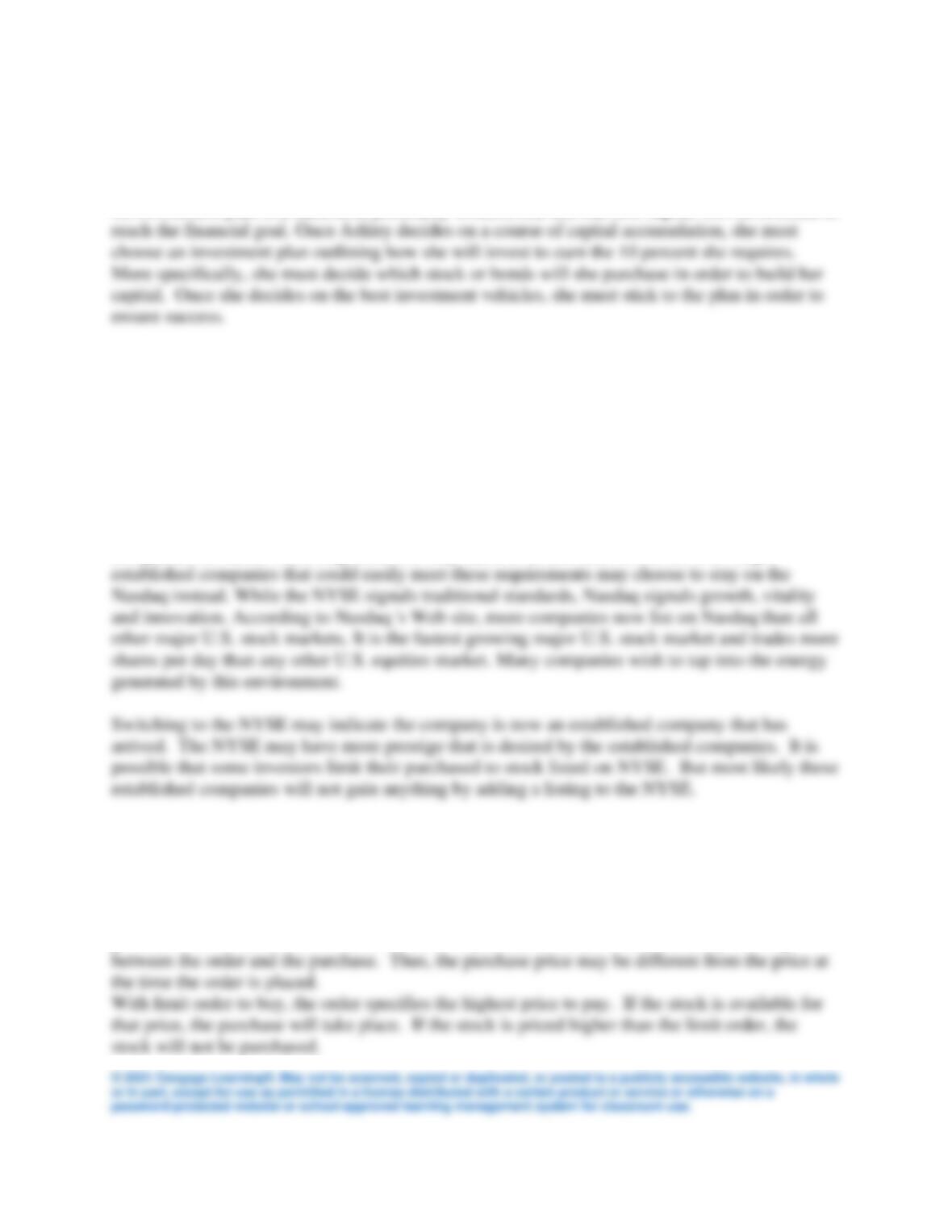
c. How about if she already has $10,000 socked away; how much would she have to put
away annually to accumulate the required capital in 8 years?
Using a financial calculator: Using Excel PMT and FV functions:
Worksheet amounts are rounded.
Worksheet 11.1, Chapter 11, Exercise1 Part c
1. $
2. 10 %
Finding a Lump Sum Investment:
Future Value Factor, from Appendix A, computed here
years to target date and a projected average
Required Lump Sum Investment
line 1 ÷ line 3
B.
5. $
6.
•based on 8
10 %
Terminal Value of Initial Investment
line 5 × line 6
Balance to Come from Savings Plan
Future Value Annuity Factor, from Appendix B, computed here
years to target date and a projected average
return on investment of
Series of Annual Investments Required over Time
Determining Amount of Investment Capital Needed
Financial goal:
Targeted Financial Goal (see Note 1)
50,000.00
Invest lump sum to end up with $50,000 in 8 years
Projected Average Return on Investments
Making a Series of Investments over Time:
Amount of Initial Investment, if any (see Note 2)
Future Value Factor, from Appendix A, computed here
years of target date and a projected average
return on investment of
Note 2:
If you’re starting from scratch—i.e., there is no initial investment—enter zero on
line 5, skip lines 6 and 7, and then use the total targeted financial goal (from line 1)
as the amount to be funded from a savings plan; now proceed with the rest
of the worksheet.
Note 1:
The “targeted financial goal” is the amount of money you want to accumulate by
some target date in the future.
10,000.00
2.144
d. Given that Ashley has an idea of how much she needs to save, briefly explain how she
could use an investment plan to help reach her objective.
2. Rationale for stock exchange listings.
Why do you suppose that large, well-known
companies such as Apple, Starbucks, and Facebook prefer to have their shares traded on
the Nasdaq rather than on one of the major listed exchanges, such as the NYSE (for which
they’d easily meet all listing requirements)? What’s in it for them? What would they gain
by switching over to the NYSE?
The NYSE has the most stringent listing requirements of all the organized exchanges. There is a
certain amount of prestige in being listed on the NYSE, because these companies have to have a
certain minimum size market capitalization as well as meet certain profitability levels. If listed
companies fall below these requirements, they stand to be delisted. However, even large,
3. Market and limit orders
.
Suppose Ryan Cunningham places an order to buy 100 shares
of The Gap. Explain how the order will be processed if it’s a market order. Would it make
any difference if it had been a limit order? Explain.
The market order says to buy 100 shares at whatever the price is at that moment. The order is
given to a broker and in due course, the stock is purchased. There will most likely be a lag
4. Calculating profits on margined and unmargined investments. Elizabeth Greene wants to
buy 300 shares of Google, which is selling in the market for $537.34 a share. Rather than
liquidate all her savings, she decides to borrow through her broker at 5 percent a year.
Assume that the margin requirement on common stock is 50 percent. If the stock rises to
$625 a share over the next year, calculate the dollar profit and percentage return that
Elizabeth would earn if she makes the investment with 50 percent margin. Contrast these
figures to what she’d make if she uses no margin.
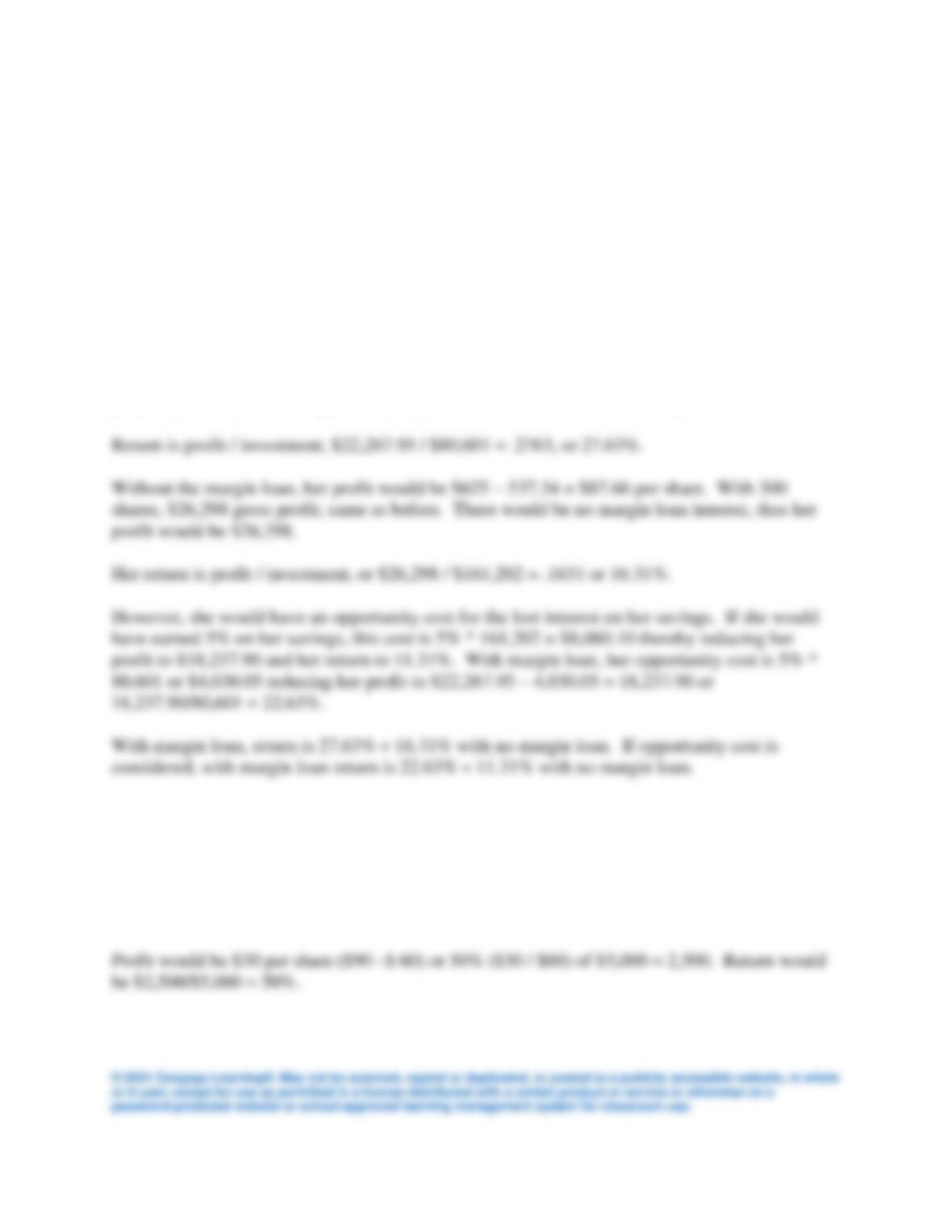
With 50 percent margin requirement, Elizabeth may borrow half of the stock, that is, stock with a
value of $80,601 (50% * 537.34 *300). With an interest rate of 5%, this loan will cost Elizabeth
$4,030.05 per year in interest (.05 * $80,601). Her profit and return with the margin loan is:
Change in value in one year, $625 – 537.34 = $87.66 per share. With 300 shares, $26,298 gross
profit. Less interest on margin account, $26,298 – $4,030.05 = $22,267.95 profit.
5. Calculating return on investment. Which of the following would offer the best return on
investment? Assume that you buy $5,000 in stock in all three cases and ignore interest and
transaction costs in all your calculations.
a. Buy a stock at $60 without margin and sell it a year later at $90.
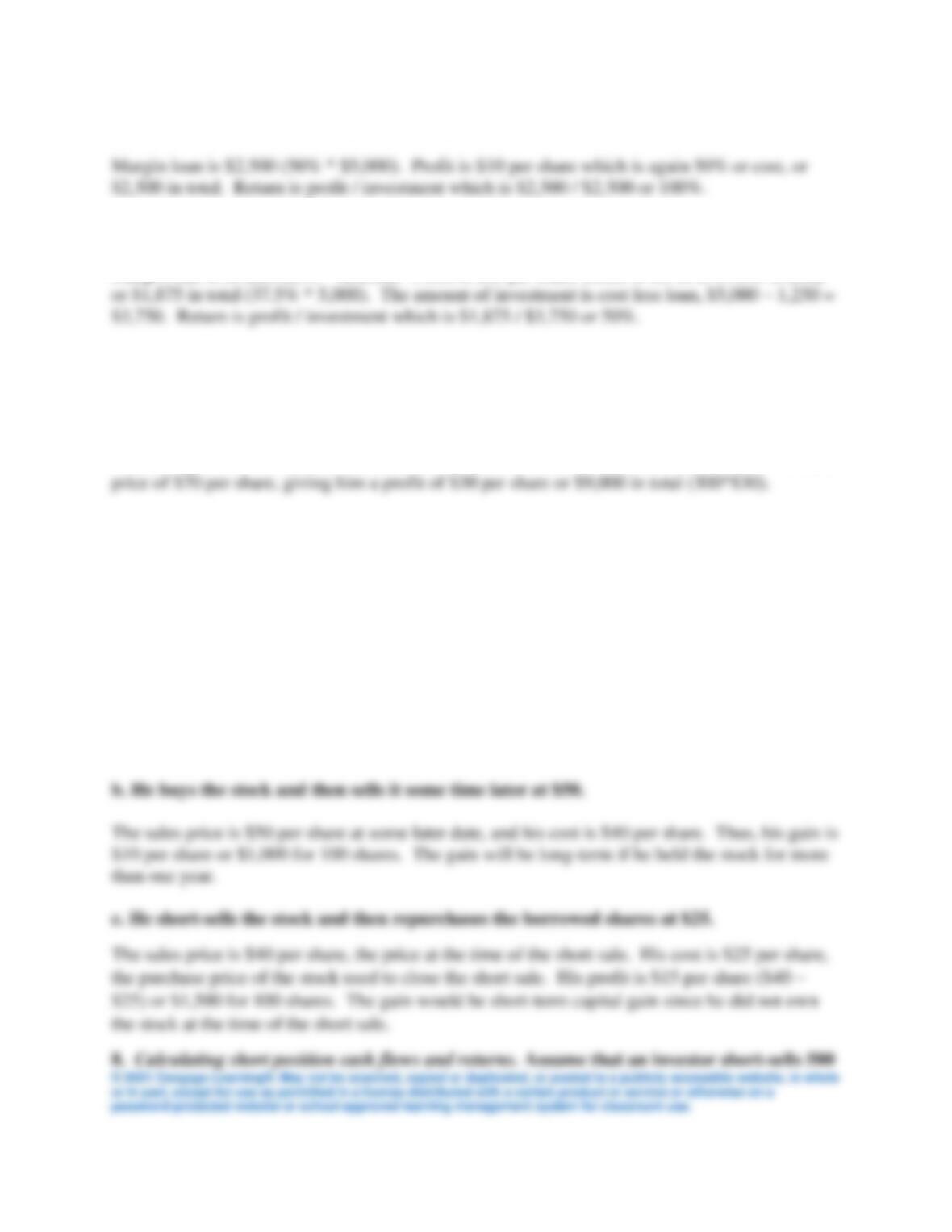
b. Buy a stock at $20 with 50 percent margin, and sell it a year later at $30.
c. Buy a stock at $40 with 75 percent margin, and sell it a year later at $55.
6. Calculating short position profit. How much profit (if any) would Roberto Chavez make if
he short sold 300 shares of a stock at $100 a share and the price of the stock suddenly
tumbled to $70?
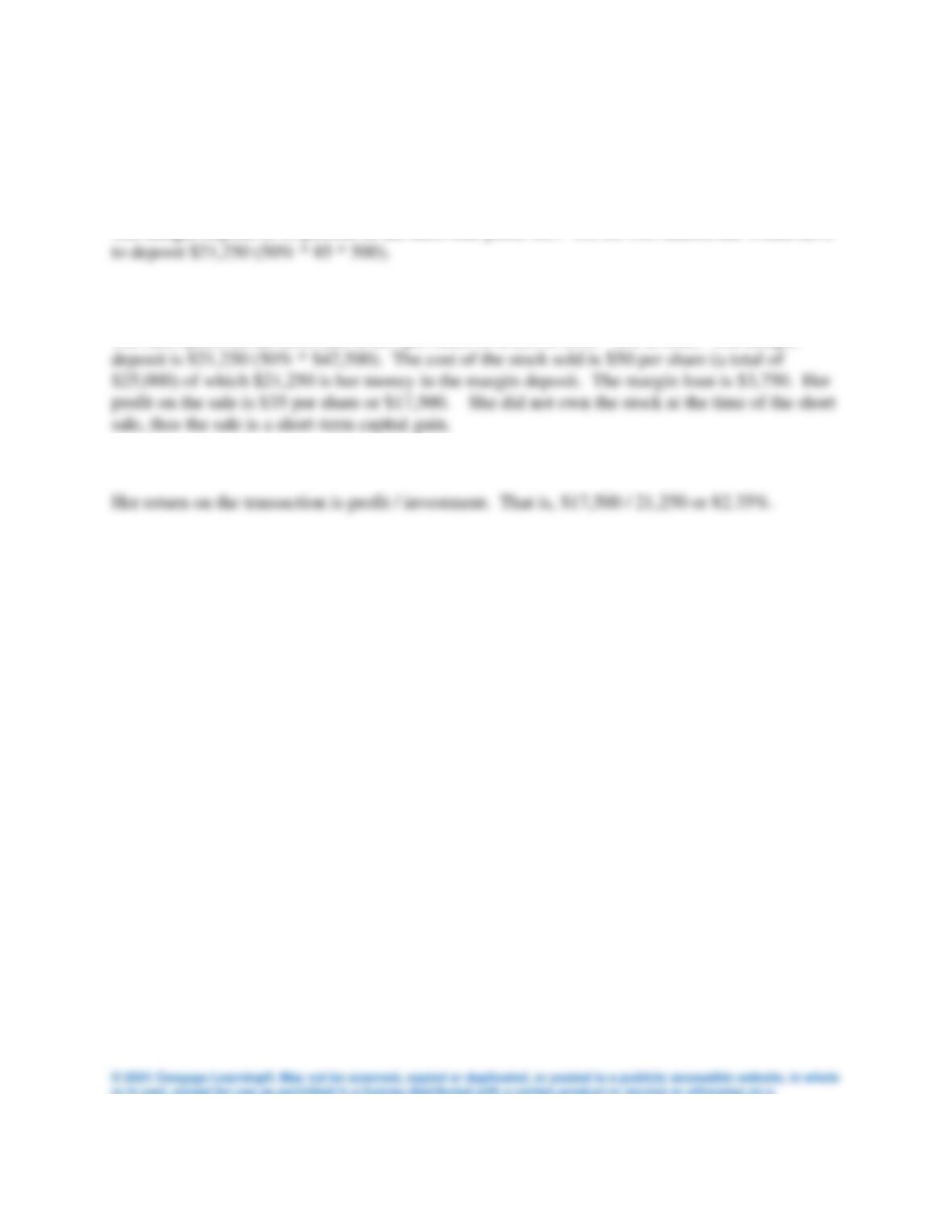
The sales price for the stock is the short sale amount of $100. His cost of the stock is the current
7. Calculating long and short position profits. Given that Local Care, Inc.’s stock is
currently selling for $40 a share, calculate the amount of money that Elijah Pearson will
make (or lose) on each of the following transactions. Assume all transactions involve 100
shares of stock, and ignore brokerage commissions.
a. He short-sells the stock and then repurchases the borrowed shares at $50.
The sales price is the short sale price of $40 per share and his cost is the repurchase price of $50
per share. So he has a loss of $10 per share or with 100 shares, a loss of $1,000. The loss would
be a short-term capital loss.
or in part, except for use as permitted in a license distributed with a certain product or service or otherwise on a
password-protected website or school-approved learning management system for classroom use.
shares of stock at a price of $85 a share, making a 50 percent margin deposit. A year later,
she repurchases the borrowed shares at $50 a share.
a. How much of her money did the short-seller have to put up to make this transaction?
b. How much money did the investor make, or lose, on this transaction?
c. What rate of return did she make on her invested capital (see part a)?
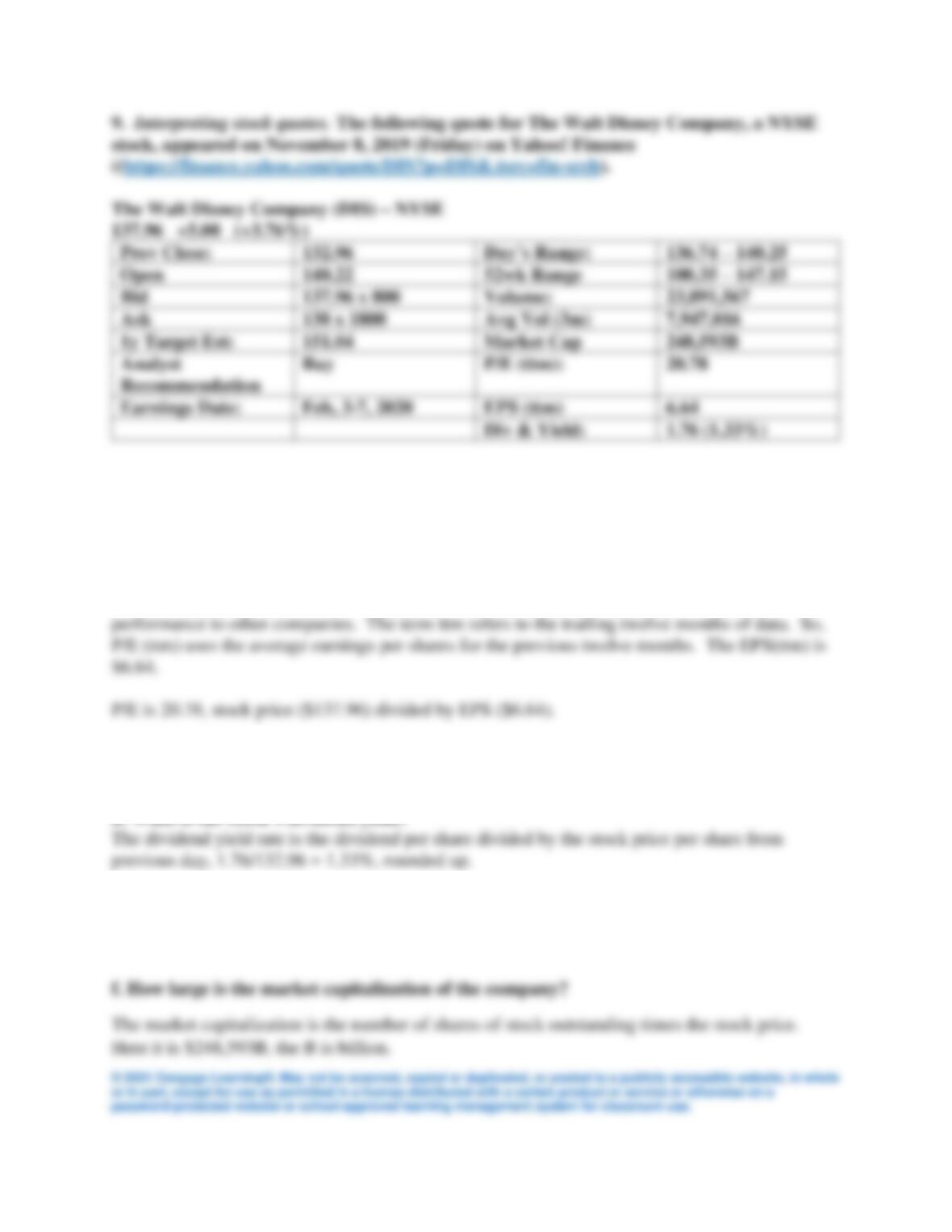
Given this information, answer the following questions.
a. At what price did the stock sell at the time of the quote?
The sale price is in the upper left-hand corner of the chart: $137.96.
b. What is the stock’s price/earnings ratio? What does that indicate?
The ratio of price per share to earnings per share may be used to compare the company’s
c. What is the last price at which the stock traded on the prior trading day?
The Prev Close is the price from the previous day, $132.96.
e. What are the highest and lowest prices at which the stock traded during the latest 52-
week period?
The 52wk range is given as a low of $100.35 to a high of $147.15.
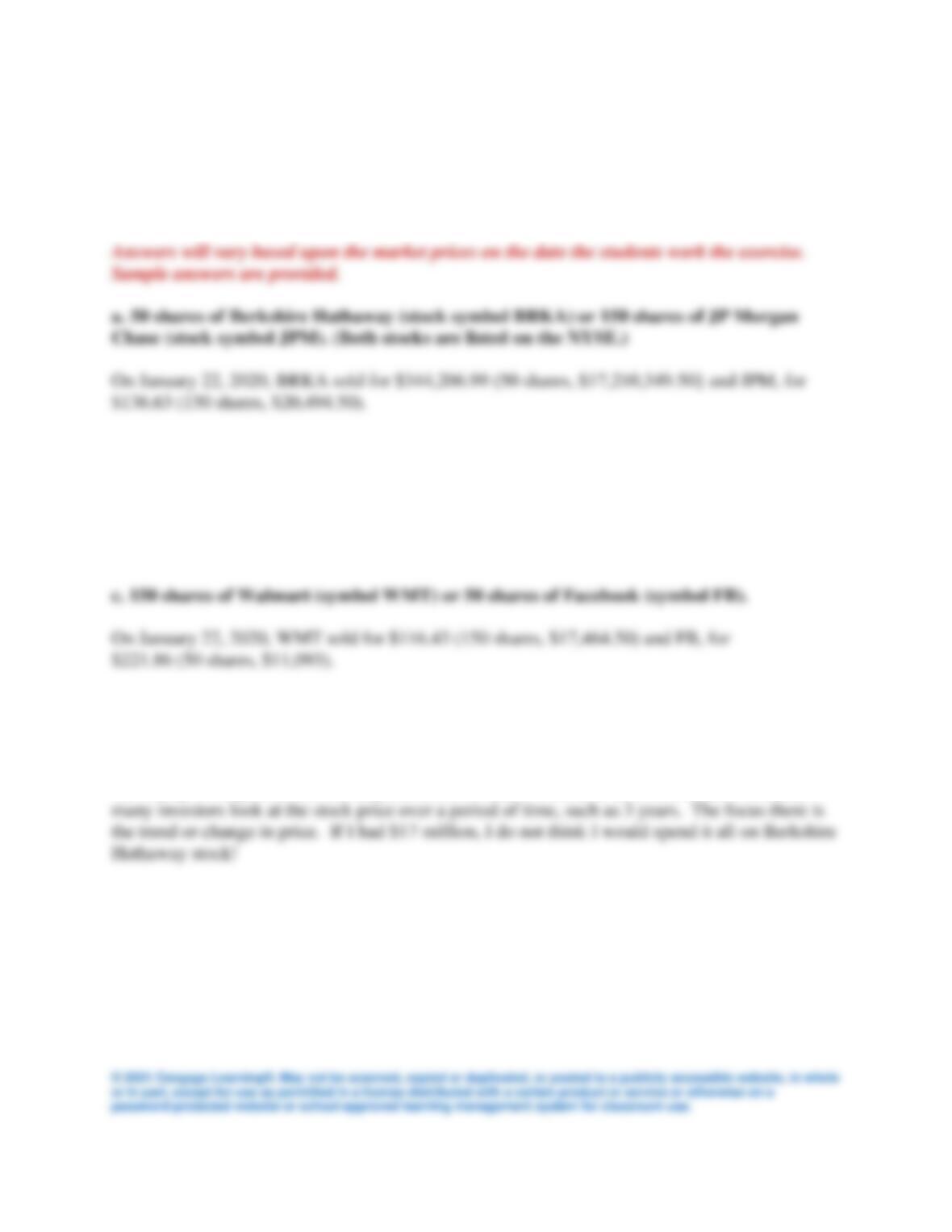
10. Finding and interpreting stock quotes. Look at each of the following three pairs of
stocks and select the security you’d like to own, given that you want to select the one with
the highest market value. Then, after making all three of your selections, use The Wall
Street Journal or some other source to find the latest market value of the two securities in
each pair.
b. 100 shares of The Home Depot (symbol HD), a NYSE stock; or 100 shares of Apple
(symbol AAPL), a NASDAQ stock and a member of the Dow Jones Industrial Average.
On January 22, 2020, HD sold for $235.87 (100 shares, $23,587) and APPL, for
$318.49 (100 shares, $31,849).
How many times did you pick the one that was worth more money? Did the price of any of
these stocks surprise you? If so, which one(s)? Does the price of a stock represent its value?
Explain.
Obviously stock price is not the only indicator of value. You have to look at more. Granted,
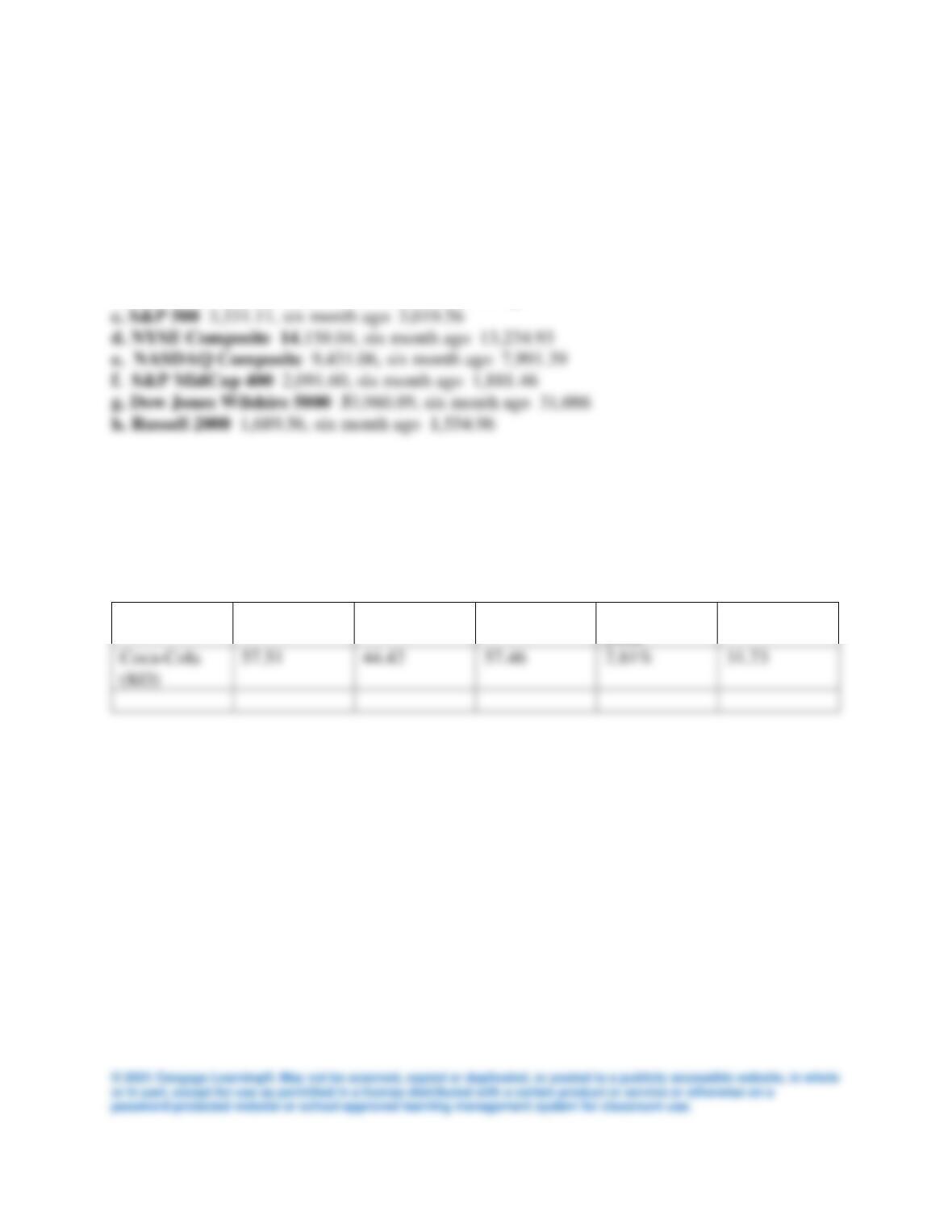
11. Finding and using market index quotes. Using a resource like The Wall Street Journal or
Barron’s (either in print or online), find the latest values for each of the following market
averages and indexes, and indicate how each has performed over the past 6 months:
Answers will vary depending upon the day the students did the exercise.
I accessed the values as January 22, 2020.
a. DJIA 29,314.07, six months ago 27,414
b. Dow Jones Global Titans 50 379.16, six month ago 339.98
12. Finding stock quote information. Using the Internet site for Yahoo! Finance
(http://finance.yahoo.com), find the 52-week high and low for Coca-Cola’s common stock
(symbol KO). What is the stock’s latest dividend yield? What was Coca–Cola’s most recent
closing price, and at what P/E ratio was the stock trading?
Accessed on January 22, 2020
Company
52-wk high
52-wk low
Recent
Dividend
Coca-Cola
57.51
44.42
57.46
2.81%
31.73
P/E ratio