
Chapter 10
Valuation
Go to the Chapter 10 folder in the Additional Instructor Resources & Solutions folder to find
the Excel spread sheets and other resources that accompany this chapter’s material.
Chapter Overview
I. Introduction
II. Fair market value
a. Arms’ length
III. Adjustments to value
a. Controlling interest
i. Estimating a non-controlling interest discount
ii. Estimating controlling interest premiums
b. Synergistic premium
c. Marketability discount
IV. Approaches to valuing an asset
a. Market approach
i. Market transactions approach
1. Adjusting for the time value of money
a. Capitalization rate
2. Adjusting for the controlling interest premium
iv. Price-to-revenue ratio
1. Choosing a multiple
2. Determining total revenue
b. Income approach
i. Steps in the income approach
c. Cost approach
V. Conclusion
Key Concepts
When reading this chapter, students should focus on the following key concepts:
1. The three approaches that can be used to analyze valuation in sport: market,
income, and cost
4. Adjustments that must be made when determining the value of an asset in the sport
industry
Quiz Questions
1. Of the following statements regarding valuation, which is NOT true?
a. Valuation is part science.
b. A valuation is always certain.
2. To be at arms’ length means that __________.
a. There is no familial relationship.
b. One party is a subsidiary of the other.
3. Of the following, which is not an adjustment made to determine the value of a specific
ownership interest?
a. Controlling interest
b. Marketability
4. Which of the following is an adjustment to the value of a share because it is not
controlling?
d. A synergistic premium
e. None of the above
5. This valuation approach relies on prices that similar assets sell for in the marketplace.
d. Synergistic approach
e. Pratt’s CPS approach
6. Using this valuation method, the cost to re-create the business or asset is calculated.
a. Market approach
e. Pratt’s CPS approach
7. Income or cash flow serves as the basis for the value of the business or asset when this
valuation approach is used.
a. Market approach
b. Income approach
c. Cost approach
8. Of the following, which is a valuation method used in the market approach to measure
the value of a business?
d. Equity shares sold
e. All of the above

9. This approach to valuation is also referred to as a discounted cash flow analysis or
discounted cash flow approach.
a. Market approach
b. Income approach
c. Cost approach
10. This valuation approach is appropriate for valuing assets for which substitutes could
reasonable be brought or built.
d. Synergistic approach
e. Pratt’s CPS approach
Answers to Quiz Questions
Numbers in parentheses represent where, in the text, you’ll find this discussed.
1. b (p. 255)
2. e (p. 255)
Responses
1. In Exhibit 10.5, why do the Expos have the highest price-to-revenue multiple?
See page 272. While having the lowest revenue in the league (as shown), the Expos
approved the team’s move to another city. That freedom gave future investors in the
team the opportunity to cause competition among cities to host the Expos. In the end,
2. Give examples of ways in which a sport team majority owner could violate fiduciary
duties and financially harm the minority shareholders.
See page 257. Any actions that either raise expenses or lower revenues from what they
would be otherwise potentially violate fiduciary duties.
Examples include:
• The majority owner could name herself as the team president and pay herself a very
high salary (higher than what the market would normally pay). This would lower the
team’s net income, which would lower any payouts to the minority shareholders.
• That person could expense the use of a private jet to fly to various events in the
name of business, while actually using it for personal reasons.
3. In a discounted cash flow analysis, what happens to the NPV, if, all else being equal, the
discount rate goes up? What happens to NPV if the growth rate for the terminal value
(perpetual growth rate) rises?
See pages 277 through 281. If the discount rate rises, the discount factor decreases
because the discount rate is in the denominator (see p. 279). This will lower the value of
future cash flows as measured in the present. In other words, a higher discount rate
means that the manager discounts future cash flows more in comparison to current
4. Give examples of how a sport franchise can use related-party transactions to reduce its
net income. For each example, how does it reduce net income?
See page 262. This is similar to Question #2 above. Using related-party transactions
(RPT) to benefit the majority owner at the expense of the minority owners is potentially
a violation of fiduciary duties. However, using RPT to lower the franchise’s net income is
not likely illegal otherwise (depending on the tax consequences). In general, lowering
the franchise’s net income causes the related party’s net income to rise.
• In baseball, the television station TBS (Turner Broadcasting Station) used to pay $0
for the Braves media rights because Ted Turner was the majority owner of the team.
If the Braves had minority owners, they would not have received the full value of the
5. When an analyst determines the value of a private company owned 100% by a single
investor by analyzing the share prices of publicly traded companies, what adjustments
must he or she make in order to arrive at a final value?
See pages 256 through 264. There exist controlling interest premiums (or the opposite
being a minority interest discount), marketability discounts or premiums, and synergistic
premiums. When using a comparable to determine value, it is important to make
adjustments to account for those types of factors.

to the marketplace is better known (based on share prices and market capitalization).
Therefore, this private company (subject company) is likely going to be less marketable
Responses
1. If the minority price for a single share of stock of a company is $20, if there are 500
thousand shares of stock, and a person offers to buy the entire company for $14.5
million, what is the controlling interest premium being offered?
See page 258. The market capitalization (price*number of shares) is $10 million.
However, in order to take control of the company, the board of directors is requiring a
controlling interest premium (CP) above the current stock price. The CP is (price paid for
2. Using the same information, what is the minority or non-controlling interest discount
for a company that has a control value of $14.5 million, 500 thousand shares, and a
share price of $20?
See page 258. This is just doing the flipped-over calculation. It is similar to saying that if
a company raises its price from $75 to $100, that is a 33% increase; if a company lowers
Response to Problems
1. Net Present Value Calculated Under the Discounted Cash Flow
Income Approach
The Greatest Deal in Sports is referenced in Sidebar 4C in Chapter 4 (see page 96). Darren
Rovell, CNBC sports business reporter, discussed payments made to Silna brothers Ozzie
your students determine what combinations of discount rates and growth rates would get
to $500MM in financial value for the Silnas’ shares (assume those shares account for 1/7 of
2. Fair Market Valuation: Market Approach, Income Approach, and
Liquidation Value
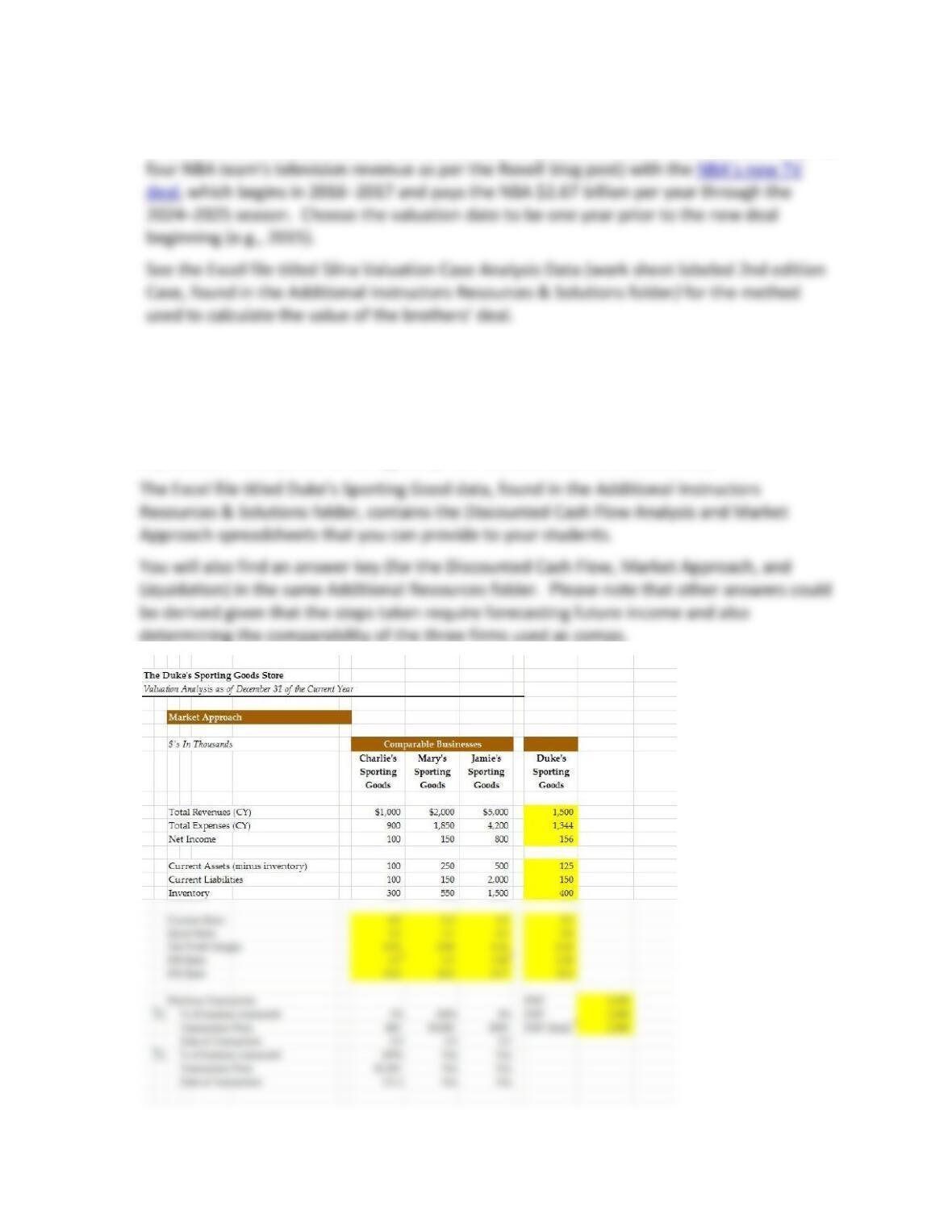
This case involves calculating the fair market valuation FMV of a sporting goods store. The
information provided allows for an Income Approach (DCF), a Market Approach, and
Liquidation Value (which is not typically FMV because there is a forced sale).