146
Chapter 10
Capital Markets and the Pricing of Risk
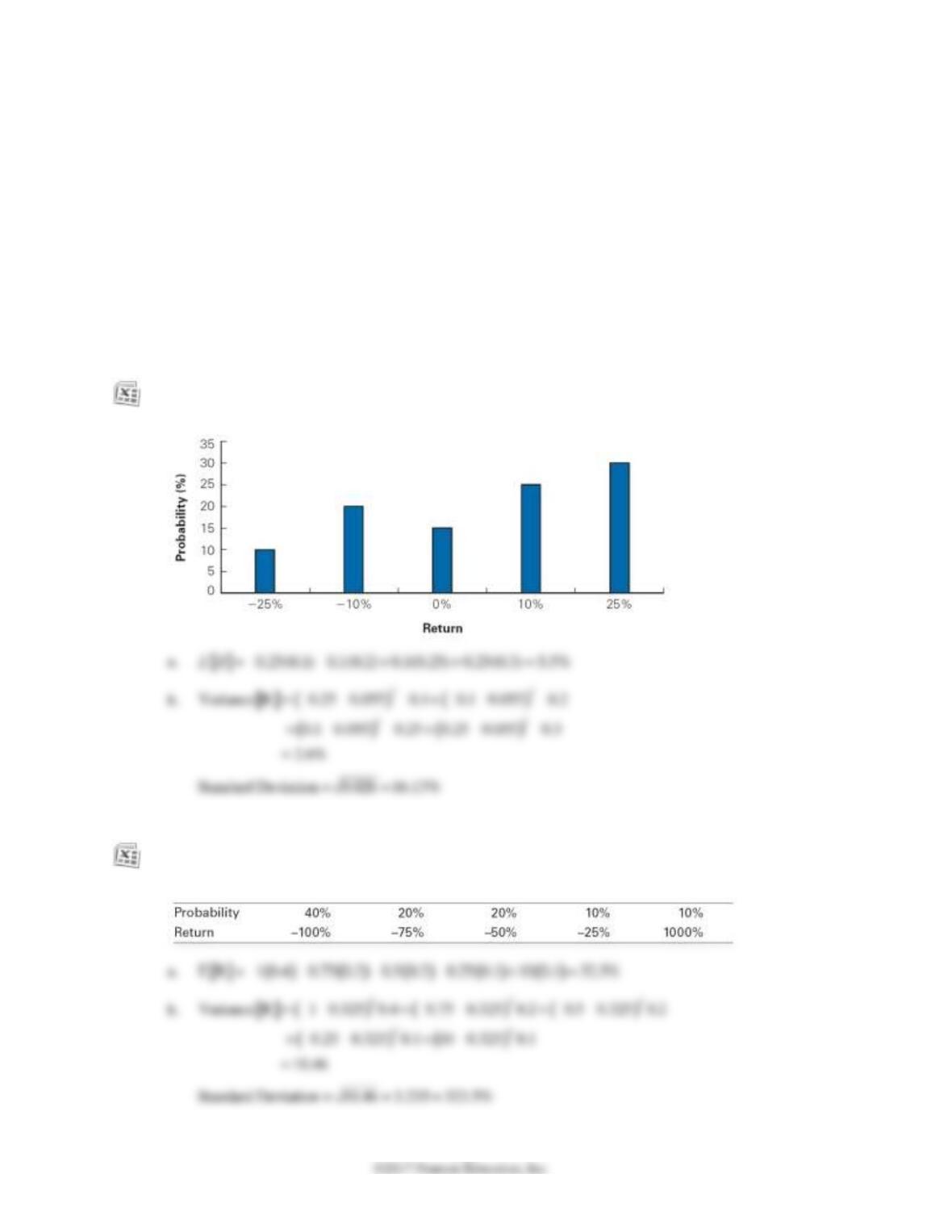
10–1. The figure below shows the one-year return distribution for RCS stock. Calculate
a. The expected return.
b. The standard deviation of the return.
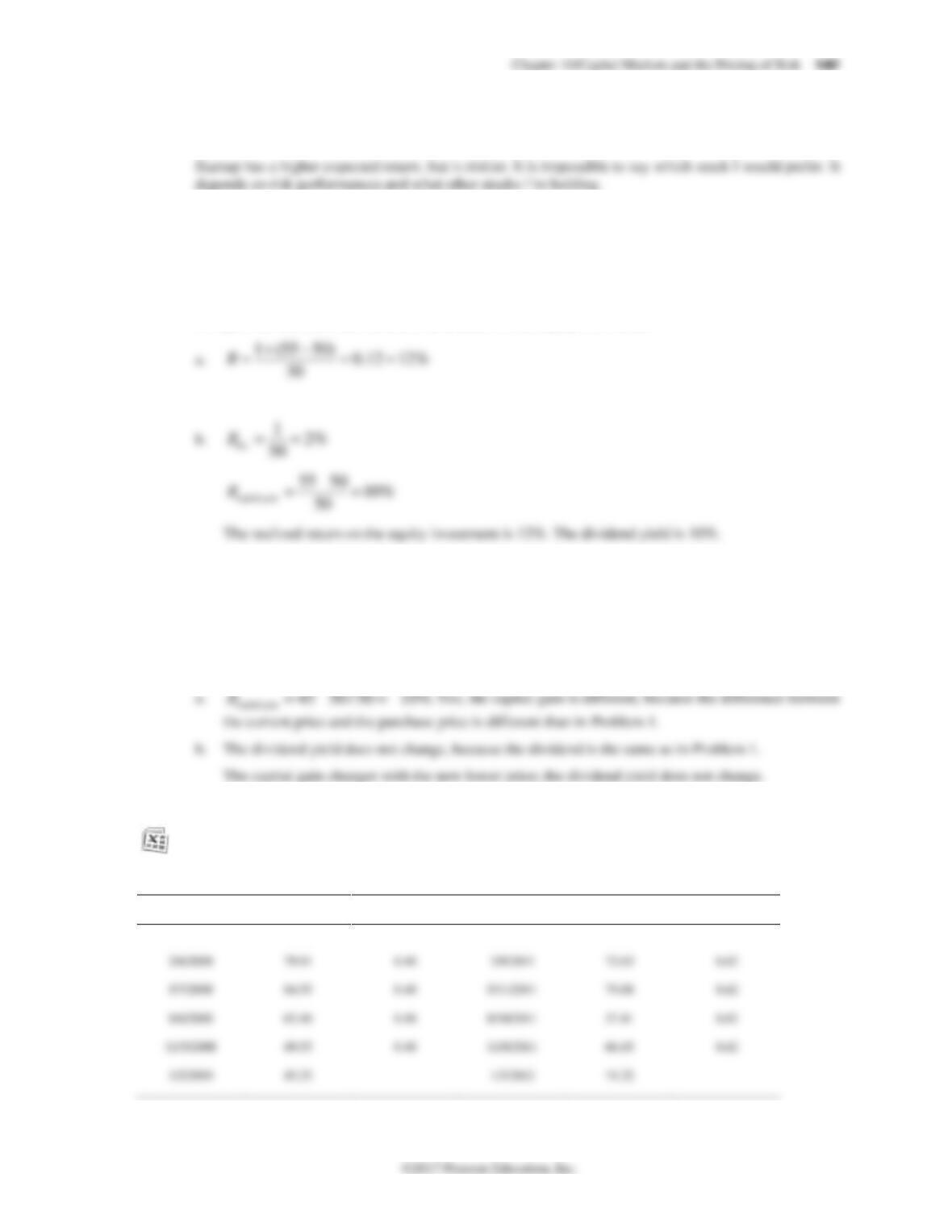
10–2. The following table shows the one-year return distribution of Startup, Inc. Calculate
a. The expected return.
b. The standard deviation of the return.
10–3. Characterize the difference between the two stocks in Problems 1 and 2. What trade-offs would
you face in choosing one to hold?
10–4. You bought a stock one year ago for $50 per share and sold it today for $55 per share. It paid a
$1 per share dividend today.
a. What was your realized return?
b. How much of the return came from dividend yield and how much came from capital gain?
Compute the realized return and dividend yield on this equity investment.
10–5. Repeat Problem 4 assuming that the stock fell $5 to $45 instead.
a. Is your capital gain different? Why or why not?
b. Is your dividend yield different? Why or why not?
Compute the capital gain and dividend yield under the assumption that the stock price has fallen to
$45.
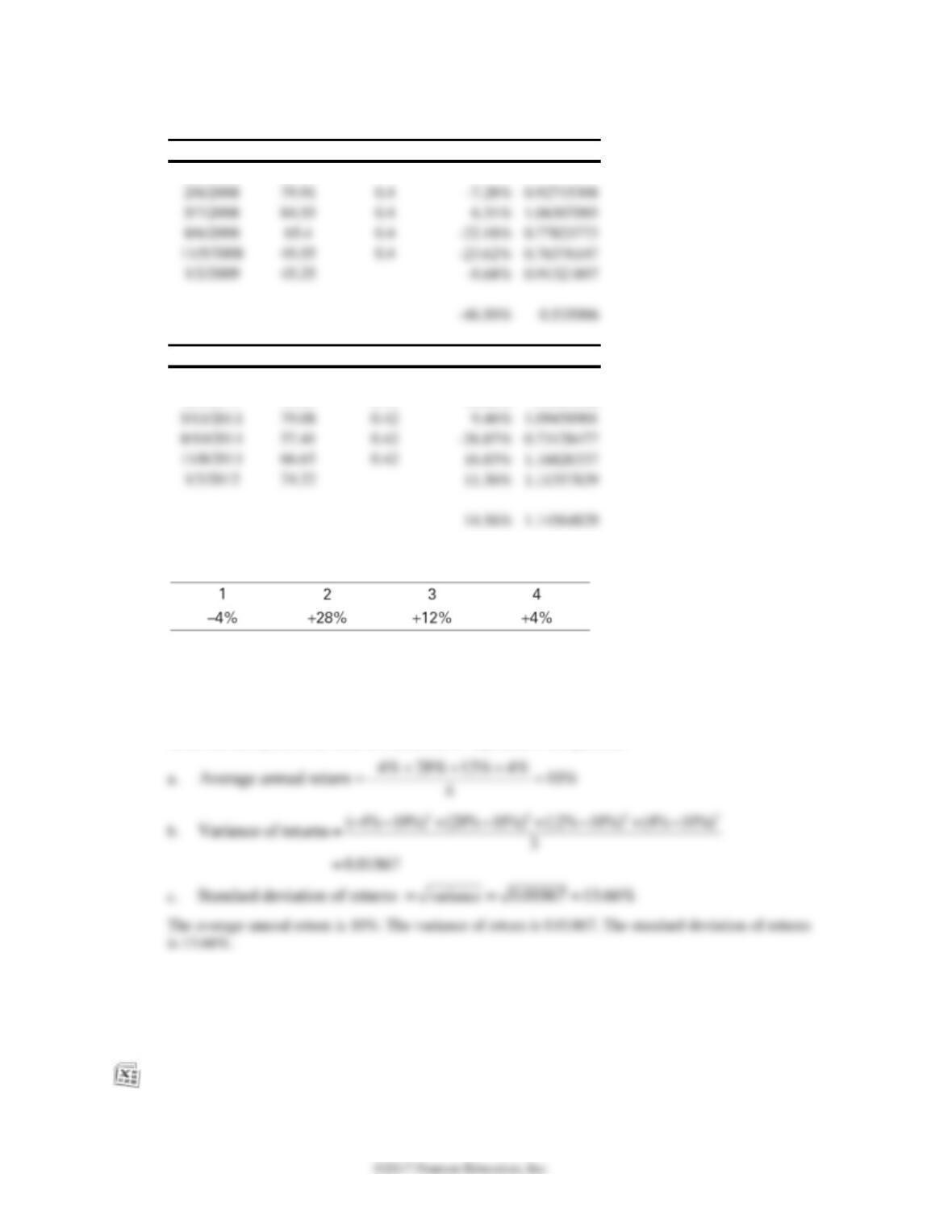
10–6. Using the data in the following table, calculate the return for investing in Boeing stock (BA) from
January 2, 2008, to January 2, 2009, and also from January 3, 2011, to January 3, 2012,
assuming all dividends are reinvested in the stock immediately.
Historical Stock and Dividend Data for Boeing
Date
Price
Dividend
Date
Price
Dividend
1/2/2008
86.62
1/3/2011
66.40
8/6/2008
65.40
57.41
148 Berk/DeMarzo, Corporate Finance, Fourth Edition
Date Price Dividend R 1+R
1/2/2008 86.62
2/6/2008 79.91 0.4 -7.28% 0.92715308
8/6/2008 65.4 0.4 -22.18% 0.77823773
1/2/2009 45.25 -8.68% 0.91321897
Date Price Dividend R 1+R
1/3/2011 66.4
2/9/2011 72.63 0.42 10.02% 1.1001506
1/3/2012 74.22 11.36% 1.11357839
10–7. The last four years of returns for a stock are as follows:
a. What is the average annual return?
b. What is the variance of the stock’s returns?
c. What is the standard deviation of the stock’s returns?
Given the data presented, make the calculations requested in the question.
10–8. Assume that historical returns and future returns are independently and identically distributed,
and drawn from the same distribution.
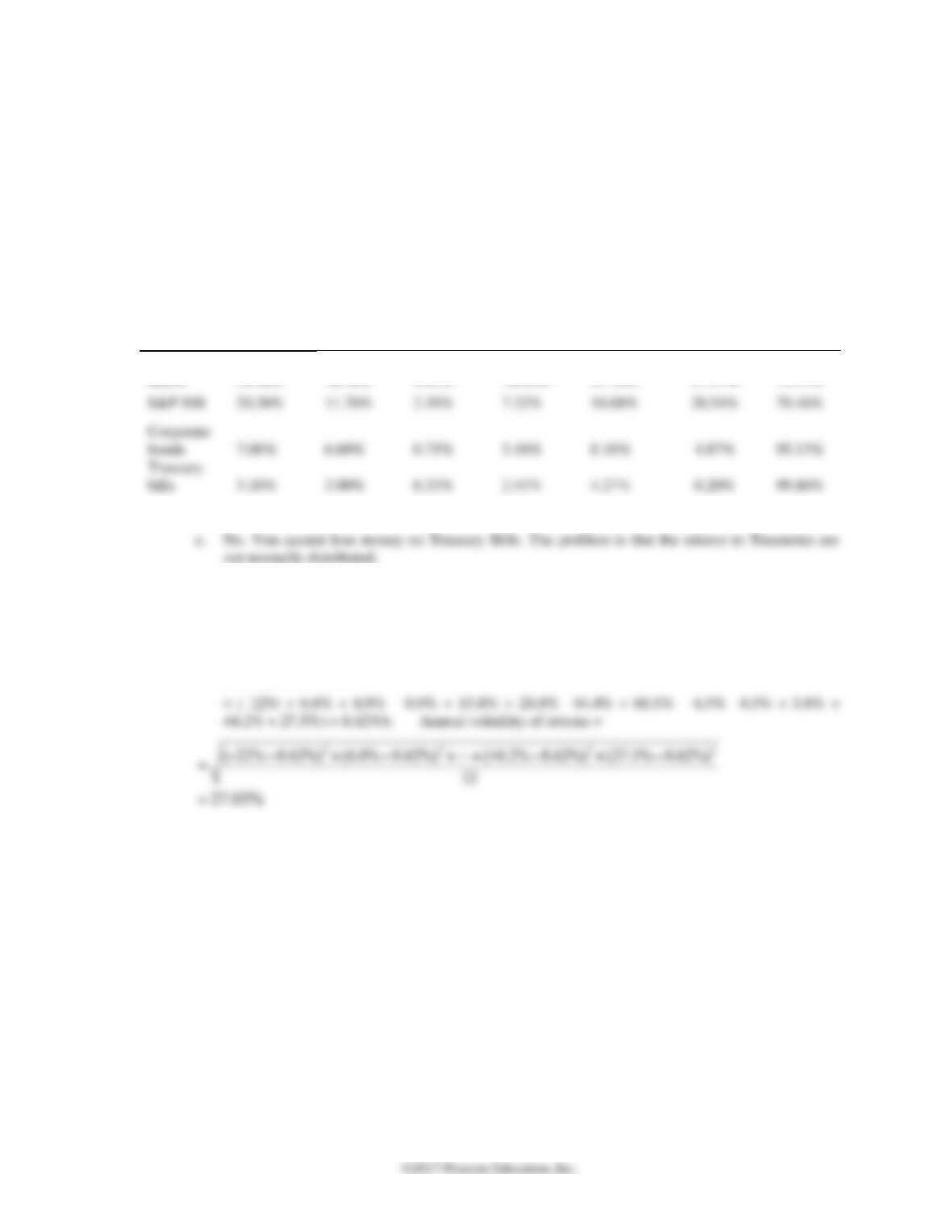
a. Calculate the 95% confidence intervals for the expected annual return of four different
investments included in Tables 10.3 and 10.4 (the dates are inclusive, so the time period
spans 86 years).
b. Assume that the values in Tables 10.3 and 10.4 are the true expected return and volatility
(i.e., estimated without error) and that these returns are normally distributed. For each
Chapter 10/Capital Markets and the Pricing of Risk 149
investment, calculate the probability that an investor will not lose more than 5% in the next
year. (Hint: you can use the function normdist (x,mean,volatility,1) in Excel to compute the
probability that a normally distributed variable with a given mean and volatility will fall
below x.)
c. Do all the probabilities you calculated in part (b) make sense? If so, explain. If not, can you
identify the reason?
Investment
Return
Volatility
(Standard
Deviation)
Average
Annual
Return
Standard
Error
Lower
Bound
Confidence
Interval
Upper
Bound
Confidence
Interval
Part b
answer
stocks
39.20%
18.70%
10.24%
27.16%
S&P 500
7.32%
16.08%
Corporate
7.00%
6.60%
0.75%
8.10%
Treasury
bills
3.10%
3.90%
0.33%
Small
10-9. Using the data in Table 10.2,
a. What was the average annual return of Microsoft stock from 2002–2014?
b. What was the annual volatility for Microsoft stock from 2002–2014?
a. Average annual return
10–10. Using the data in Table 10.2,
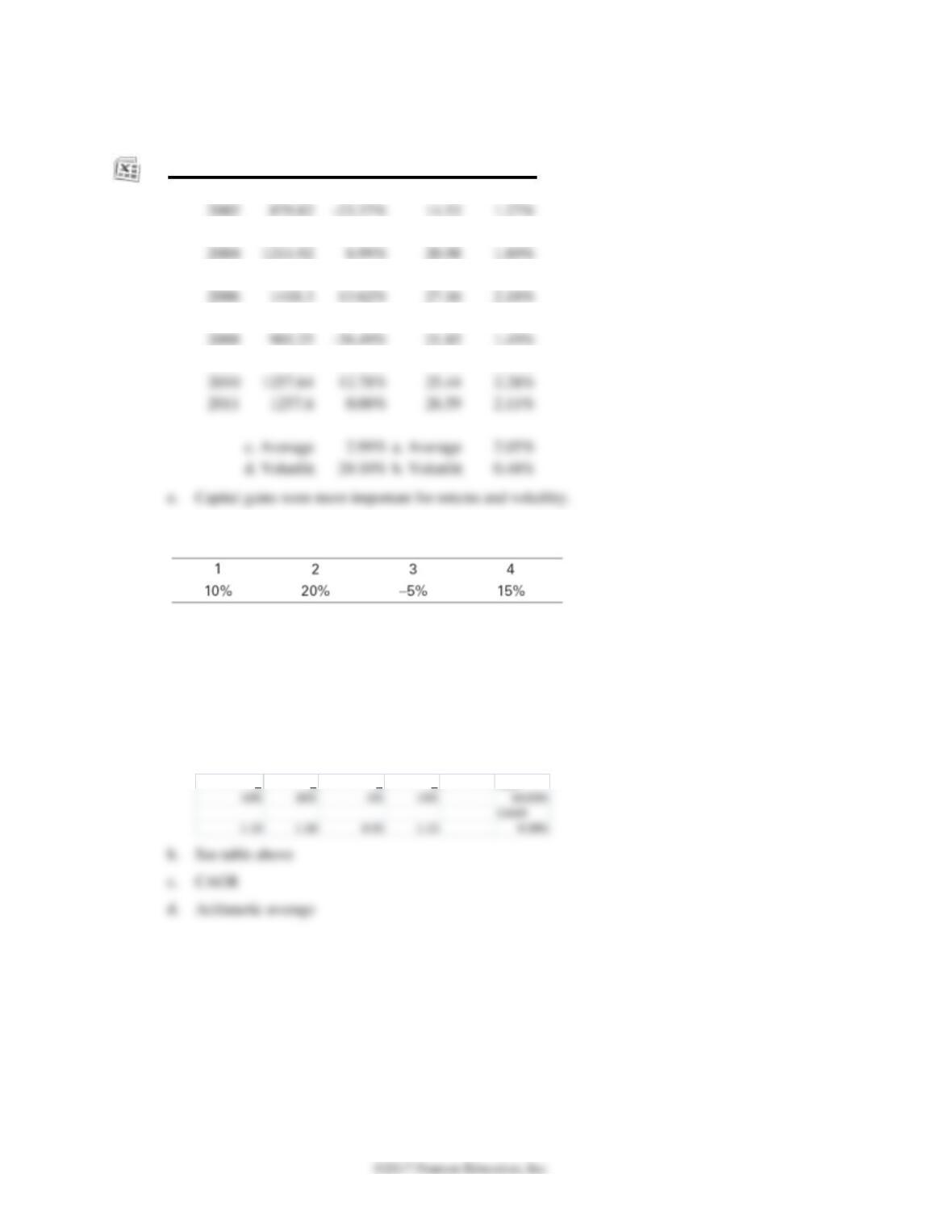
a. What was the average dividend yield for the SP500 from 2002–2011?
b. What was the volatility of the dividend yield?
c. What was the average annual return of the SP500 from 2002–2011 excluding dividends (i.e.,
from capital gains only)?
d. What was the volatility of the S&P 500 returns from capital gains?
e. Were dividends or capital gains a more important component of the S&P 500’s average
returns during this period? Which were the more important source of volatility?
150 Berk/DeMarzo, Corporate Finance, Fourth Edition
Year End
S&P 500
Index
Capital
Gains
Return
Dividends
Paid
Dividend
Yield
2001 1148.08
2003 1111.92 26.38% 20.8 2.36%
2005 1248.29 3.00% 23.15 1.91%
2007 1468.36 3.53% 27.86 1.96%
2009 1115.1 23.45% 27.19 3.01%
10–11. Consider an investment with the following returns over four years:
a. What is the compound annual growth rate (CAGR) for this investment over the four years?
b. What is the average annual return of the investment over the four years?
c. Which is a better measure of the investment’s past performance?
d. If the investment’s returns are independent and identically distributed, which is a better
measure of the investment’s expected return next year?
a.
1 2 3 4 Ave
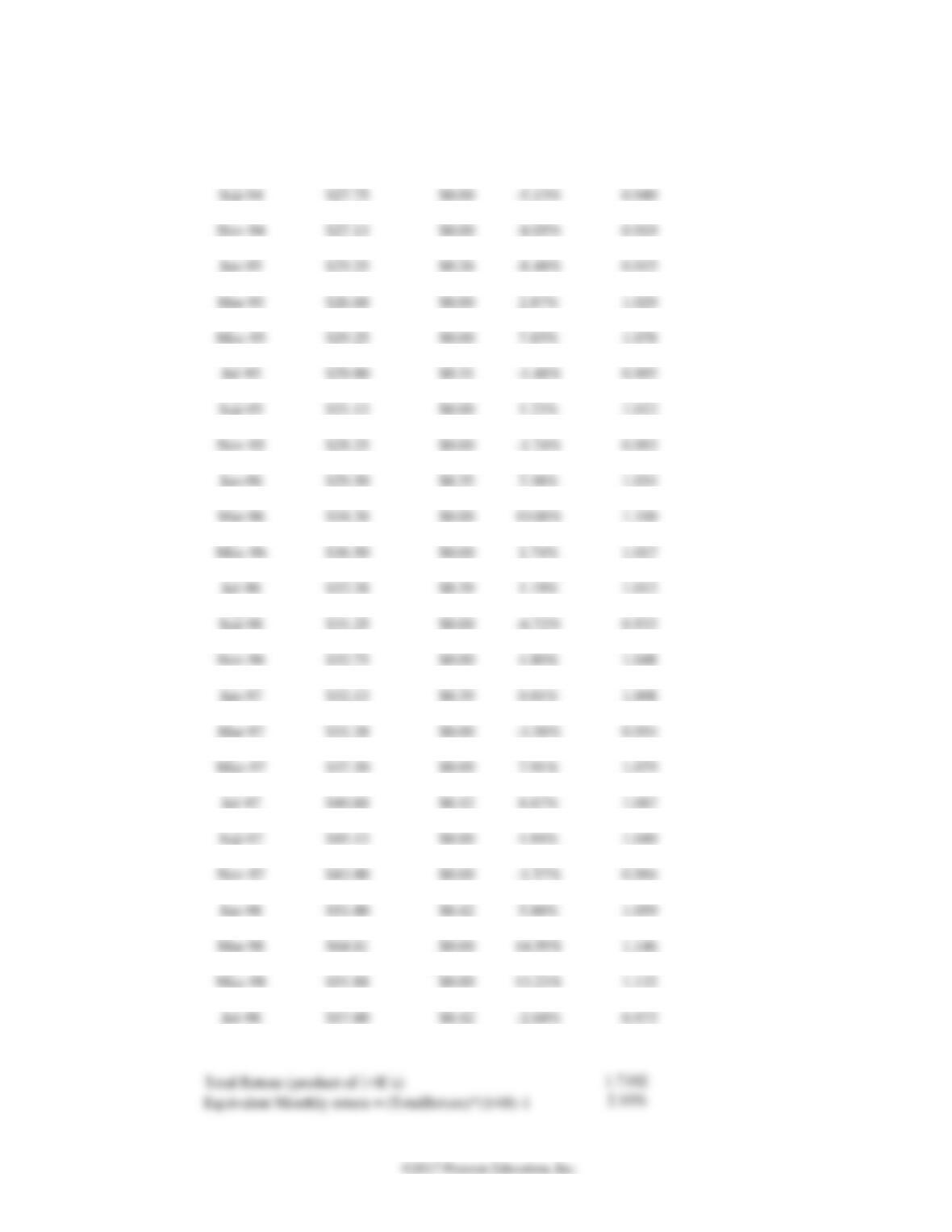
10–12. Download the spreadsheet from MyFinanceLab that contains historical monthly prices and
dividends (paid at the end of the month) for Ford Motor Company stock (Ticker: F) from
August 1994 to August 1998. Calculate the realized return over this period, expressing your
answer in percent per month (i.e., what monthly return would have led to the same cumulative
performance as an investment in Ford stock over this period).
Chapter 10/Capital Markets and the Pricing of Risk 151
Ford Motor Co (F)
Date
Stock Price
Dividend
Return
1+Rt
Aug-94
$29.25
$0.00
Sep-94
$27.75
$0.00
-5.13%
0.949
Oct–94
$29.50
$0.26
7.24%
1.072
Nov-94
$27.13
$0.00
-8.05%
0.919
Dec–94
$27.88
$0.00
2.76%
1.028
Jan-95
$25.25
$0.26
-8.48%
0.915
Feb-95
$26.13
$0.00
3.47%
1.035
$26.88
$0.00
2.87%
1.029
Apr-95
$27.13
$0.31
2.08%
1.021
$29.25
$0.00
7.83%
1.078
Jun-95
$29.75
$0.00
1.71%
1.017
$29.00
$0.31
-1.48%
0.985
Aug-95
$30.75
$0.00
6.03%
1.060
Sep-95
$31.13
$0.00
1.22%
1.012
Oct–95
$28.75
$0.35
-6.51%
0.935
Nov-95
$28.25
$0.00
-1.74%
0.983
Dec–95
$28.88
$0.00
2.21%
1.022
Jan-96
$29.50
$0.35
3.38%
1.034
Feb-96
$31.25
$0.00
5.93%
1.059
$34.38
$0.00
10.00%
1.100
Apr-96
$35.88
$0.35
5.38%
1.054
$36.50
$0.00
1.74%
1.017
Jun-96
$32.38
$0.00
-11.30%
0.887
$32.38
$0.39
1.19%
1.012
Aug-96
$33.50
$0.00
3.47%
1.035
Sep-96
$31.25
$0.00
-6.72%
0.933
Oct–96
$31.25
$0.39
1.23%
1.012
Nov-96
$32.75
$0.00
4.80%
1.048
Dec–96
$32.25
$0.00
-1.53%
0.985
Jan-97
$32.13
$0.39
0.81%
1.008
Feb-97
$32.88
$0.00
2.33%
1.023
$31.38
$0.00
-4.56%
0.954
Apr-97
$34.75
$0.42
12.10%
1.121
$37.50
$0.00
7.91%
1.079
Jun-97
$38.00
$0.00
1.33%
1.013
$40.88
$0.42
8.67%
1.087
Aug-97
$43.00
$0.00
5.20%
1.052
Sep-97
$45.13
$0.00
4.94%
1.049
Oct–97
$43.69
$0.42
-2.25%
0.977
Nov-97
$43.00
$0.00
-1.57%
0.984
Dec–97
$48.56
$0.00
12.94%
1.129
Jan-98
$51.00
$0.42
5.88%
1.059
Feb-98
$56.56
$0.00
10.91%
1.109
$64.81
$0.00
14.59%
1.146
Apr-98
$45.81
$23.68
7.22%
1.072
$51.88
$0.00
13.23%
1.132
Jun-98
$59.00
$0.00
13.73%
1.137
$57.00
$0.42
-2.68%
0.973
Aug-98
$44.63
$0.00
-21.71%
0.783
Equivalent Monthly return = (TotalReturn)^(1/48)-1
10–13. Using the same data as in Problem 12, compute the
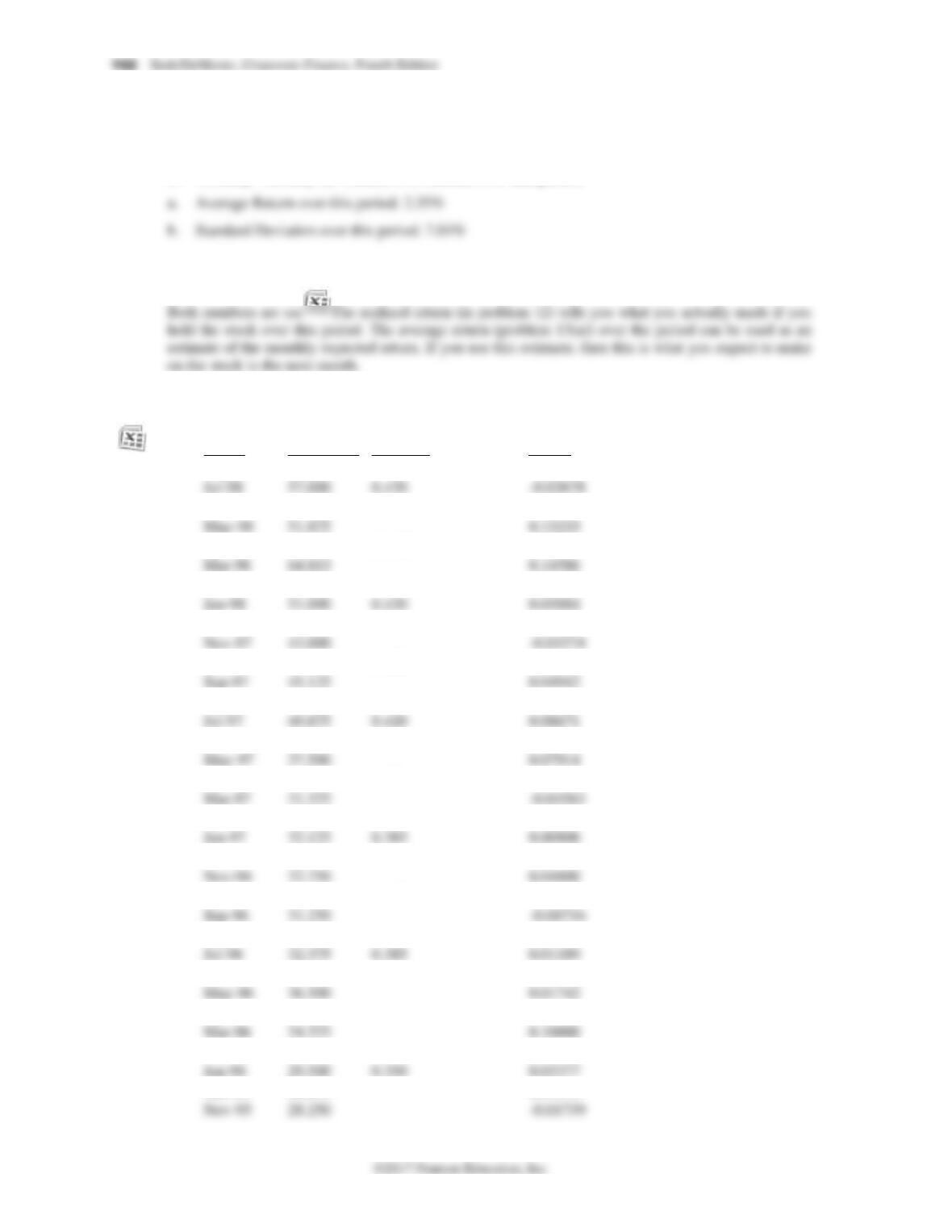
a. Average monthly return over this period.
b. Monthly volatility (or standard deviation) over this period.
10–14. Explain the difference between the average return you calculated in Problem 13(a) and the
realized return you calculated in Problem 12. Are both numbers useful? If so, explain why.
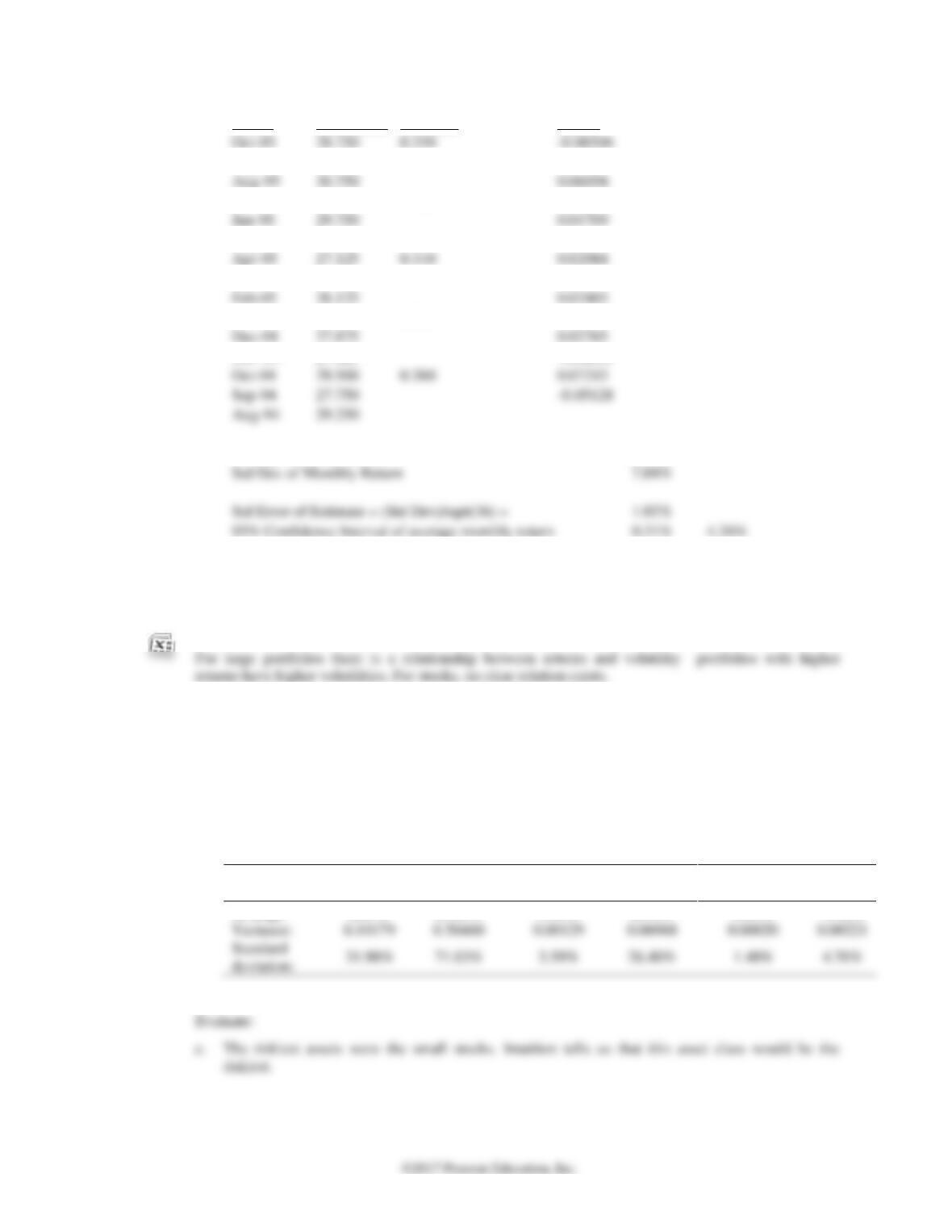
10–15. Compute the 95% confidence interval of the estimate of the average monthly return you
calculated in Problem 13(a).
Month
Stock Price
Dividend
Return
Aug-98
44.625
-0.21711
Jul-98
57.000
0.420
-0.02678
Jun-98
59.000
0.13735
51.875
0.13233
Apr-98
45.813
23.680
0.07221
64.813
0.14586
Feb-98
56.563
0.10907
Jan-98
51.000
0.420
0.05884
Dec–97
48.563
0.12936
Oct–97
43.688
0.420
-0.02255
Sep-97
45.125
0.04942
Aug-97
43.000
0.05199
Jul-97
40.875
0.420
0.08671
Jun-97
38.000
0.01333
37.500
0.07914
Apr-97
34.750
0.420
0.12096
31.375
-0.04563
Feb-97
32.875
0.02335
Jan-97
32.125
0.385
0.00806
Dec–96
32.250
-0.01527
Nov-96
32.750
0.04800
Oct–96
31.250
0.385
0.01232
Sep-96
31.250
-0.06716
Aug-96
33.500
0.03475
Jul-96
32.375
0.385
0.01189
Jun-96
32.375
-0.11301
36.500
0.01742
Apr-96
35.875
0.350
0.05382
34.375
0.10000
Feb-96
31.250
0.05932
Dec–95
28.875
0.02212
Nov-95
28.250
-0.01739
Chapter 10/Capital Markets and the Pricing of Risk 153
Month
Stock Price
Dividend
Return
28.750
0.350
-0.06506
Sep-95
31.125
0.01220
Aug-95
30.750
0.06034
Jul-95
29.000
0.310
-0.01479
Jun-95
29.750
0.01709
May–95
29.250
0.07834
Apr-95
27.125
0.310
0.02084
Mar–95
26.875
0.02871
Feb-95
26.125
0.03465
Jan-95
25.250
0.260
-0.08484
27.875
0.02765
Nov-94
27.125
-0.08051
29.500
0.260
0.07243
Sep-94
27.750
-0.05128
Aug-94
29.250
Average Monthly Return
2.35%
Std Dev of Monthly Return
7.04%
Std Error of Estimate = (Std Dev)/sqrt(36) =
1.02%
95% Confidence Interval of average monthly return
0.31%
4.38%
10–16. How does the relationship between the average return and the historical volatility of individual
stocks differ from the relationship between the average return and the historical volatility of
large, well-diversified portfolios?
10-17. Download the spreadsheet from MyFinanceLab containing the data for Figure 10.1.
a. Compute the average return for each of the assets from 1929 to 1940 (The Great
Depression).
b. Compute the variance and standard deviation for each of the assets from 1929 to 1940.
c. Which asset was riskiest during the Great Depression? How does that fit with your
intuition?
a/b.
S&P 500
Small Stocks
Corp Bonds
World
Portfolio
Treasury Bills
CPI
Average
2.55%
15.65%
5.35%
2.94%
0.83%
-1.48%
Variance:
0.50460
0.00221
deviation:
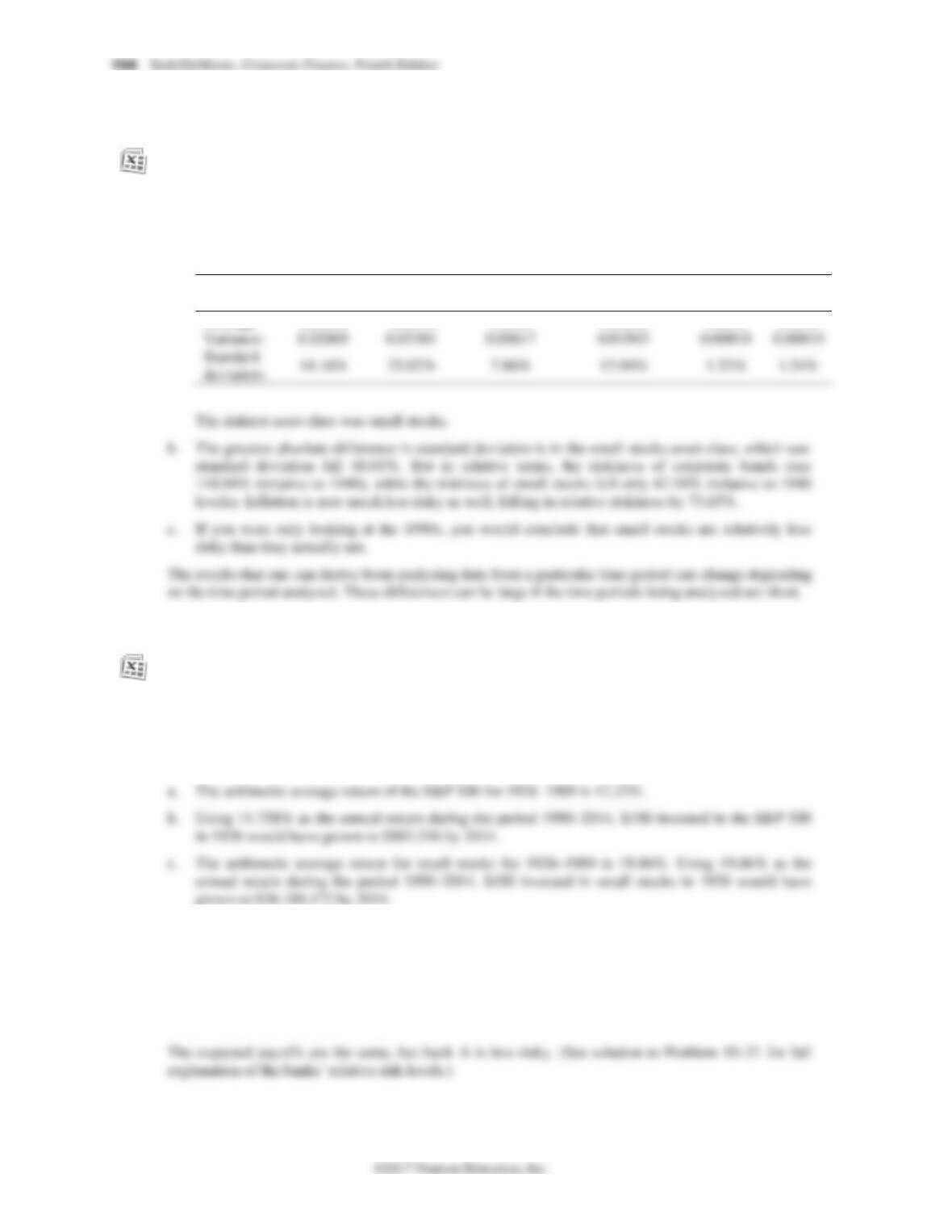
10–18. Using the data from Problem 17, repeat your analysis over the 1990s.
a. Which asset was riskiest?
b. Compare the standard deviations of the assets in the 1990s to their standard deviations in
the Great Depression. Which had the greatest difference between the two periods?
c. If you only had information about the 1990s, what would you conclude about the relative
risk of investing in small stocks?
a. Using Excel:
S&P 500
Small Stocks
Corp Bonds
World Portfolio
Treasury
Bills
CPI
Average
18.99%
10.07%
9.23%
12.82%
4.85%
2.94%
Variance:
0.05301
0.00617
0.00018
0.00015
deviation:
14.16%
1.24%
10–19. What if the last two decades had been “normal”? Download the spreadsheet from
MyFinanceLab containing the data for Figure 10.1.
a. Calculate the arithmetic average return on the S&P 500 from 1926 to 1989.
b. Assuming that the S&P 500 had simply continued to earn the average return from (a),
calculate the amount that $100 invested at the end of 1925 would have grown to by the end
of 2014.
c. Do the same for small stocks.
10–20. Consider two local banks. Bank A has 100 loans outstanding, each for $1 million, that it expects
will be repaid today. Each loan has a 5% probability of default, in which case the bank is not
repaid anything. The chance of default is independent across all the loans. Bank B has only one
loan of $100 million outstanding, which it also expects will be repaid today. It also has a 5%
probability of not being repaid. Explain the difference between the type of risk each bank faces.
Which bank faces less risk? Why?
10–21. Using the data in Problem 20, calculate
a. The expected overall payoff of each bank.
b. The standard deviation of the overall payoff of each bank.
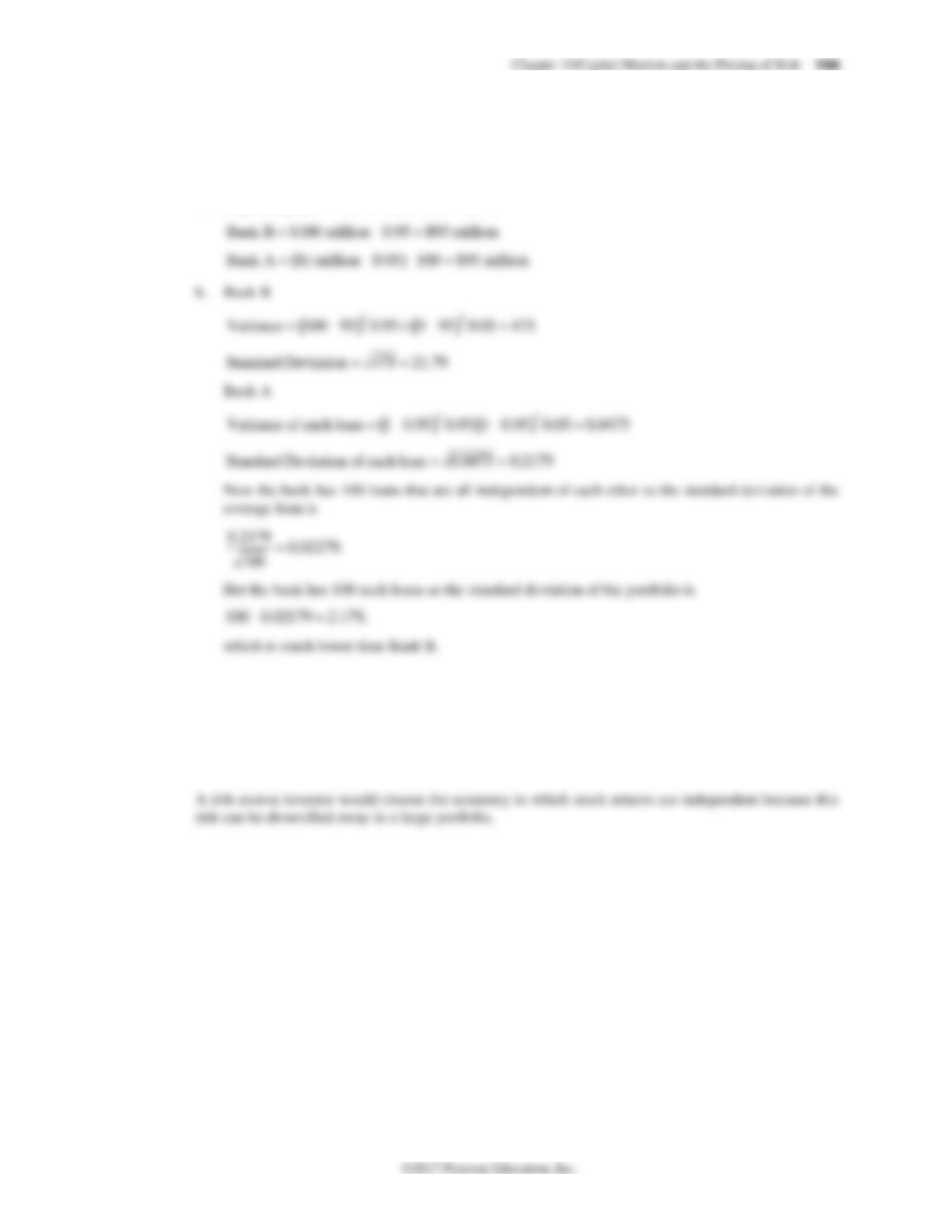
a. Expected payoff is the same for both banks
10–22. Consider the following two, completely separate, economies. The expected return and volatility
of all stocks in both economies is the same. In the first economy, all stocks move together—in
good times all prices rise together and in bad times they all fall together. In the second economy,
stock returns are independent—one stock increasing in price has no effect on the prices of other
stocks. Assuming you are risk-averse and you could choose one of the two economies in which to
invest, which one would you choose? Explain.
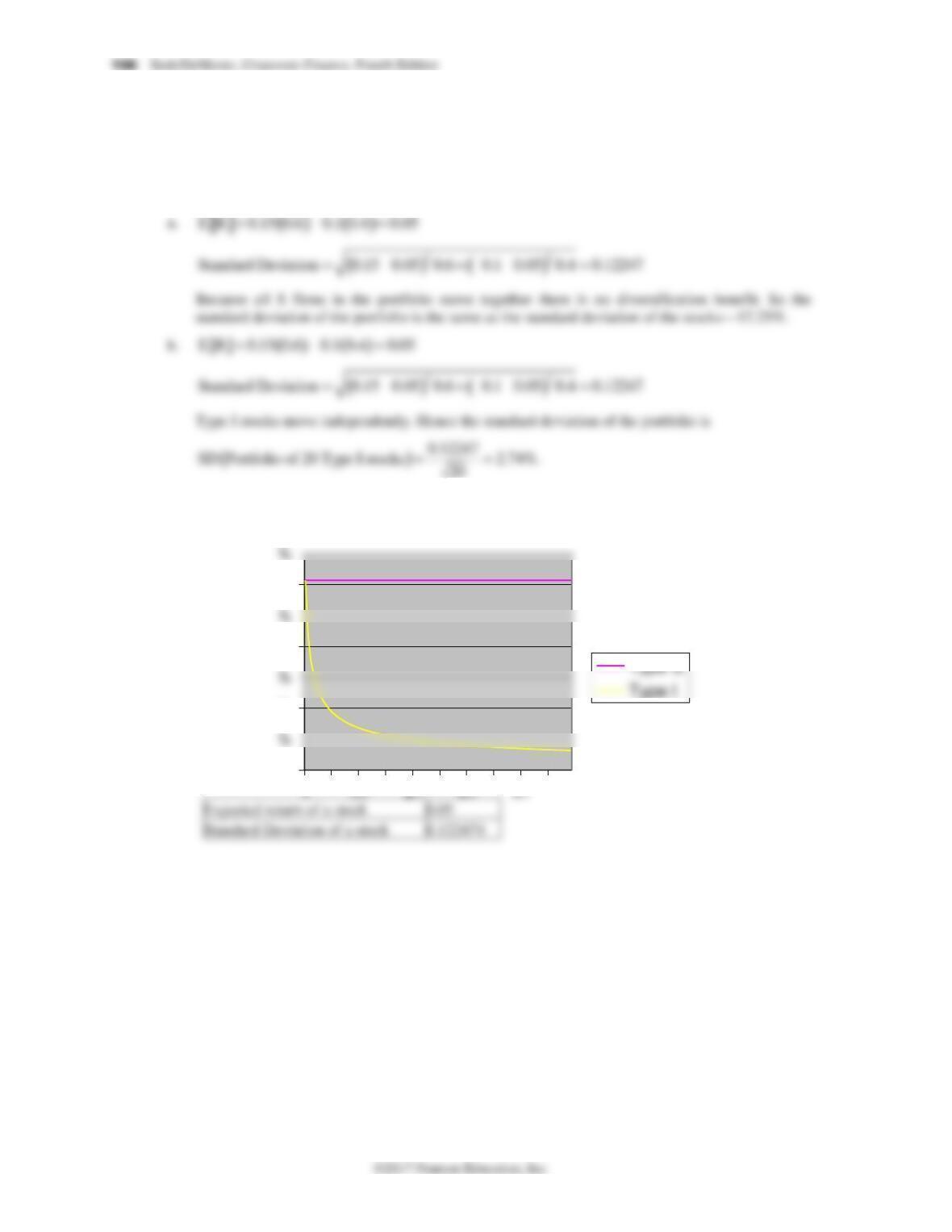
10–23. Consider an economy with two types of firms, S and I. S firms all move together. I firms move
independently. For both types of firms, there is a 60% probability that the firms will have a 15%
return and a 40% probability that the firms will have a −10% return. What is the volatility
(standard deviation) of a portfolio that consists of an equal investment in 20 firms of (a) type S,
and (b) type I?
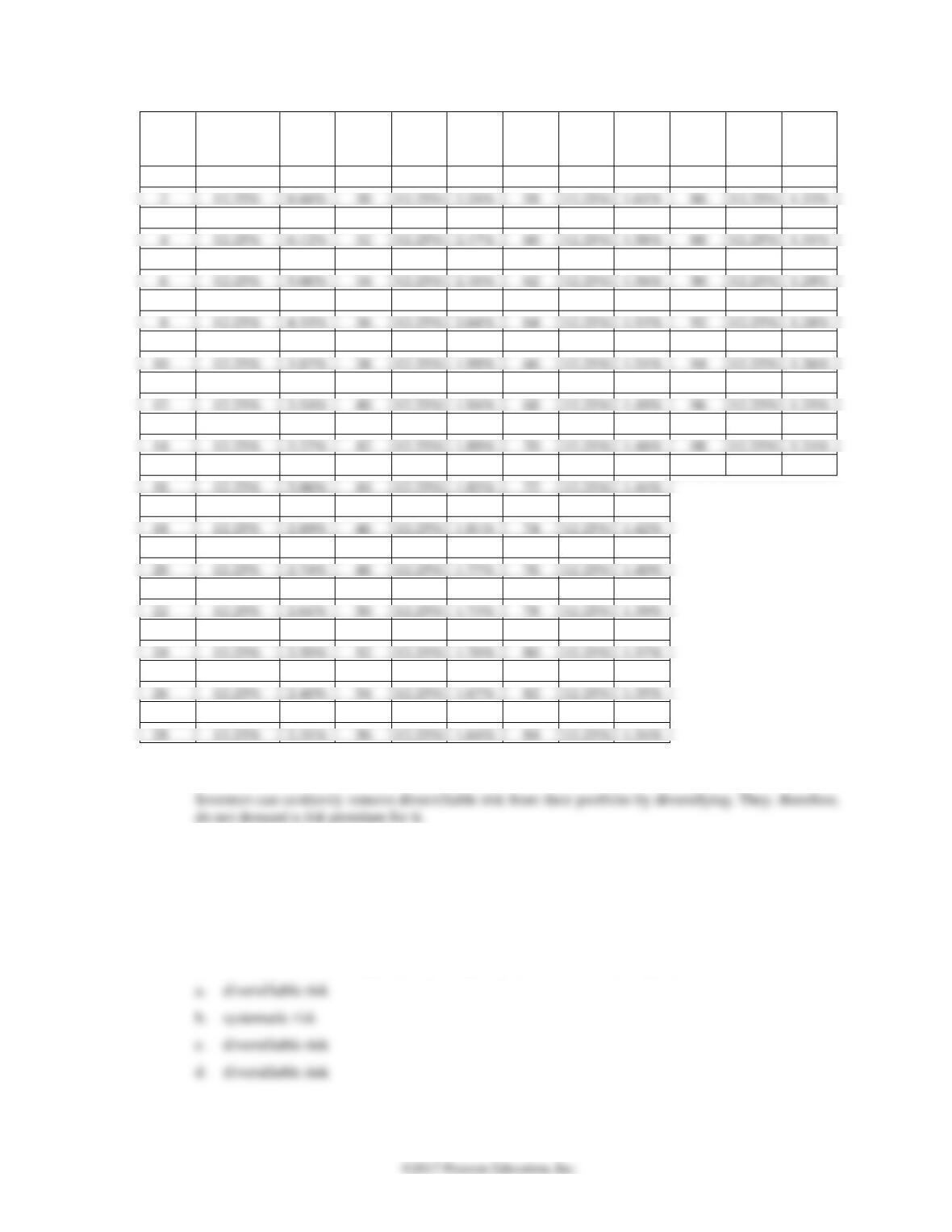
10–24. Using the data in Problem 23, plot the volatility as a function of the number of firms in the two
portfolios.
0.00%
4.00%
8.00%
12.00%
Chapter 10/Capital Markets and the Pricing of Risk 157
Number
of
Stocks
Type S
Type I
Number
of
Stocks
Type S
Type I
Number
of
Stocks
Type S
Type I
Number
of
Stocks
Type S
Type I
1
12.25%
12.25%
29
12.25%
2.27%
57
12.25%
1.62%
85
12.25%
1.33%
2
12.25%
8.66%
30
12.25%
2.24%
58
12.25%
1.61%
86
12.25%
1.32%
3
12.25%
7.07%
31
12.25%
2.20%
59
12.25%
1.59%
87
12.25%
1.31%
4
12.25%
6.12%
32
12.25%
2.17%
60
12.25%
1.58%
88
12.25%
1.31%
5
12.25%
5.48%
33
12.25%
2.13%
61
12.25%
1.57%
89
12.25%
1.30%
6
12.25%
5.00%
34
12.25%
2.10%
62
12.25%
1.56%
90
12.25%
1.29%
7
12.25%
4.63%
35
12.25%
2.07%
63
12.25%
1.54%
91
12.25%
1.28%
8
12.25%
4.33%
36
12.25%
2.04%
64
12.25%
1.53%
92
12.25%
1.28%
9
12.25%
4.08%
37
12.25%
2.01%
65
12.25%
1.52%
93
12.25%
1.27%
10
12.25%
3.87%
38
12.25%
1.99%
66
12.25%
1.51%
94
12.25%
1.26%
11
12.25%
3.69%
39
12.25%
1.96%
67
12.25%
1.50%
95
12.25%
1.26%
12
12.25%
3.54%
40
12.25%
1.94%
68
12.25%
1.49%
96
12.25%
1.25%
13
12.25%
3.40%
41
12.25%
1.91%
69
12.25%
1.47%
97
12.25%
1.24%
14
12.25%
3.27%
42
12.25%
1.89%
70
12.25%
1.46%
98
12.25%
1.24%
15
12.25%
3.16%
43
12.25%
1.87%
71
12.25%
1.45%
99
12.25%
1.23%
16
12.25%
3.06%
44
12.25%
1.85%
72
12.25%
1.44%
17
12.25%
2.97%
45
12.25%
1.83%
73
12.25%
1.43%
18
12.25%
2.89%
46
12.25%
1.81%
74
12.25%
1.42%
19
12.25%
2.81%
47
12.25%
1.79%
75
12.25%
1.41%
20
12.25%
2.74%
48
12.25%
1.77%
76
12.25%
1.40%
21
12.25%
2.67%
49
12.25%
1.75%
77
12.25%
1.40%
22
12.25%
2.61%
50
12.25%
1.73%
78
12.25%
1.39%
23
12.25%
2.55%
51
12.25%
1.71%
79
12.25%
1.38%
24
12.25%
2.50%
52
12.25%
1.70%
80
12.25%
1.37%
25
12.25%
2.45%
53
12.25%
1.68%
81
12.25%
1.36%
26
2.40%
54
12.25%
1.67%
82
12.25%
1.35%
27
12.25%
2.36%
55
12.25%
1.65%
83
12.25%
1.34%
28
12.25%
2.31%
56
12.25%
1.64%
84
12.25%
1.34%
10–25. Explain why the risk premium of a stock does not depend on its diversifiable risk.
10–26. Identify each of the following risks as most likely to be systematic risk or diversifiable risk:
a. The risk that your main production plant is shut down due to a tornado.
b. The risk that the economy slows, decreasing demand for your firm’s products.
c. The risk that your best employees will be hired away.
d. The risk that the new product you expect your R&D division to produce will not materialize.
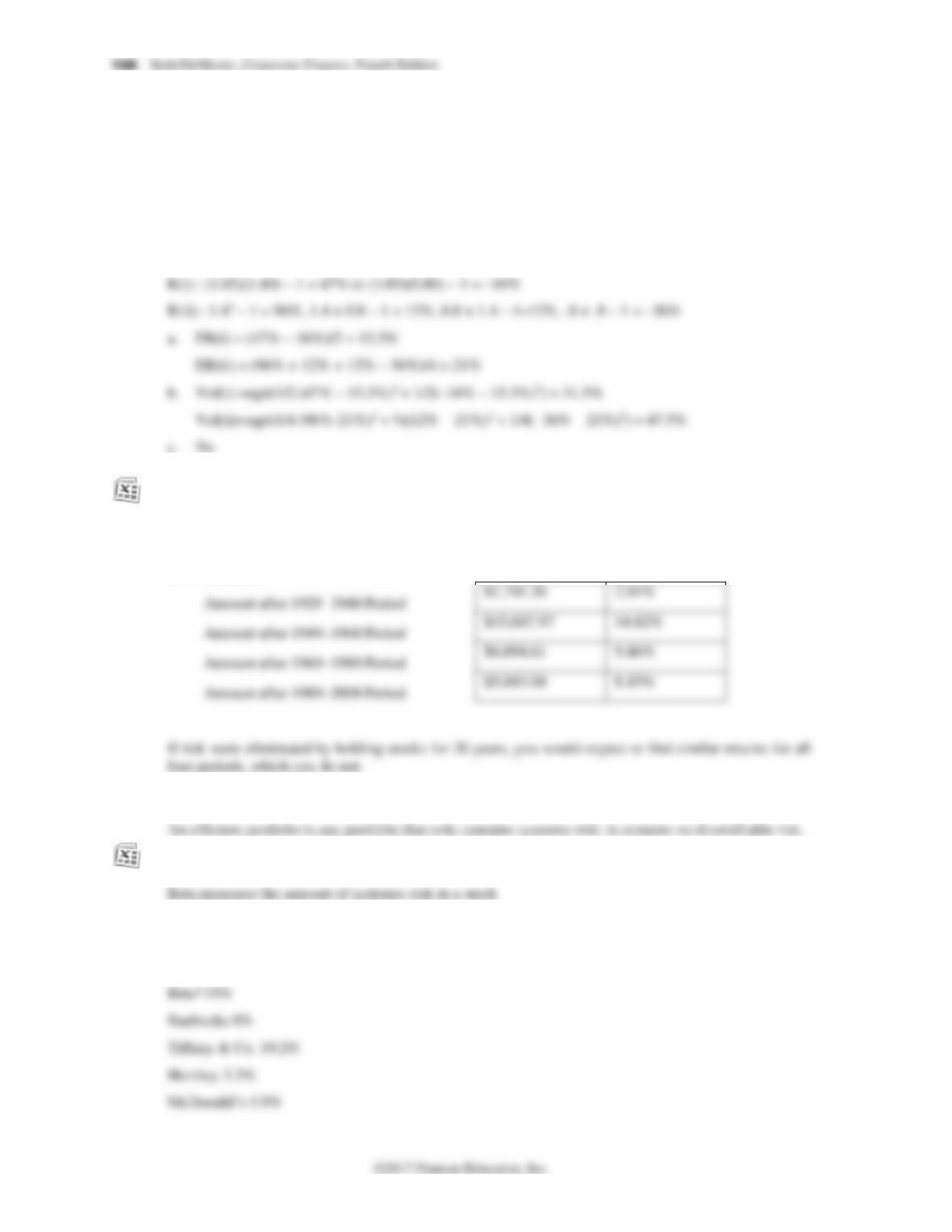
10–27. Suppose the risk-free interest rate is 5%, and the stock market will return either 40% or −20%
each year, with each outcome equally likely. Compare the following two investment strategies:
(1) invest for one year in the risk–free investment, and one year in the market, or (2) invest for
both years in the market.
a. Which strategy has the highest expected final payoff?
b. Which strategy has the highest standard deviation for the final payoff?
c. Does holding stocks for a longer period decrease your risk?
10–28. Download the spreadsheet from MyFinanceLab containing the realized return of the S&P 500
from 1929–2008. Starting in 1929, divide the sample into four periods of 20 years each. For each
20-year period, calculate the final amount an investor would have earned given a $1000 initial
investment. Also express your answer as an annualized return. If risk were eliminated by holding
stocks for 20 years, what would you expect to find? What can you conclude about long-run
diversification?
10–29. What is an efficient portfolio?
10–30. What does the beta of a stock measure?
10–31. You turn on the news and find out the stock market has gone up 10%. Based on the data in
Table 10.6, by how much do you expect each of the following stocks to have gone up or down: (1)
Starbucks, (2) Tiffany & Co., (3) Hershey, and (4) McDonald’s.
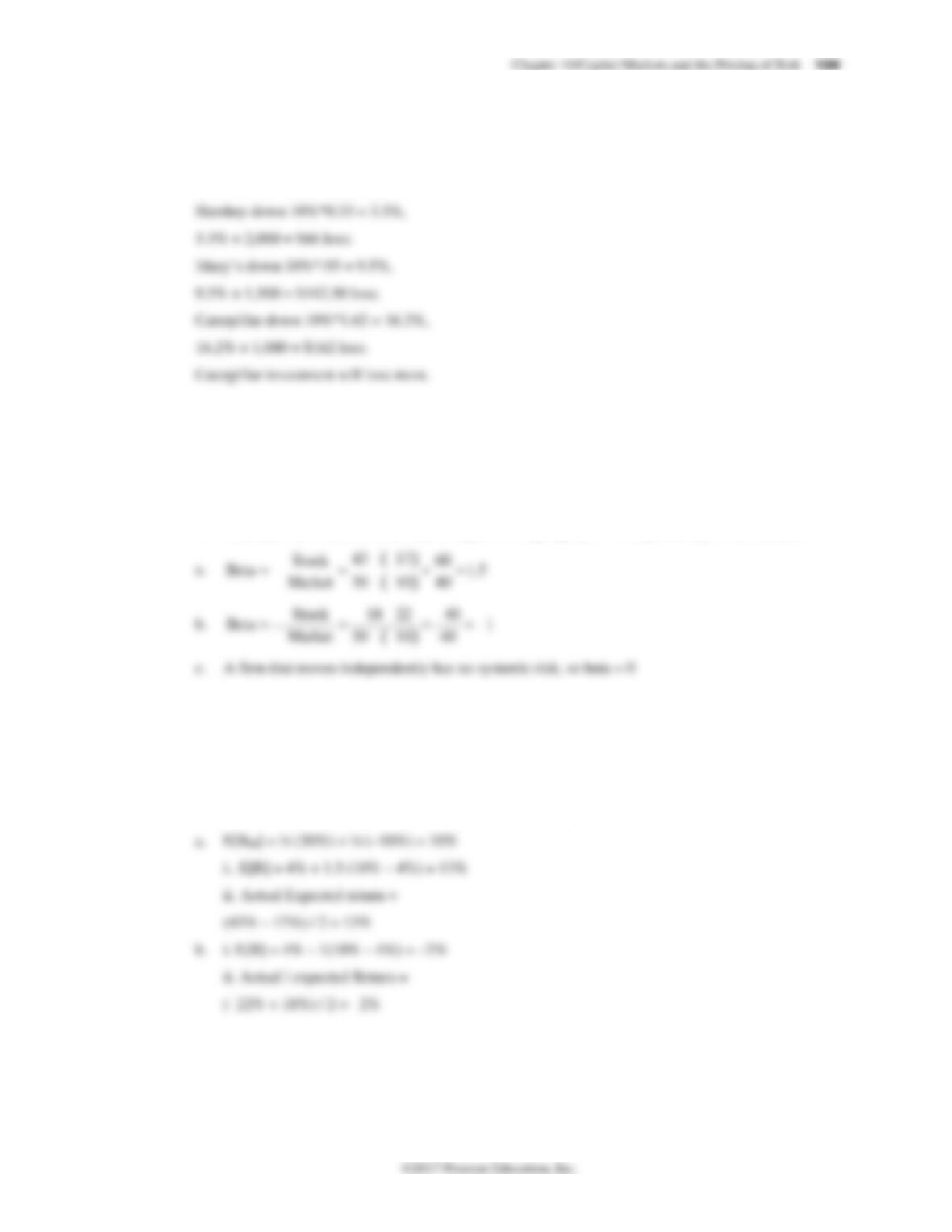
10–32. Based on the data in Table 10.6, estimate which of the following investments you expect to lose
the most in the event of a severe market downturn: (1) A $2000 investment in Hershey, (2) a
$1500 investment in Macy’s, or (3) a $1000 investment in Caterpillar.
For each 10% market decline,
10–33. Suppose the market portfolio is equally likely to increase by 30% or decrease by 10%.
a. Calculate the beta of a firm that goes up on average by 43% when the market goes up and
goes down by 17% when the market goes down.
b. Calculate the beta of a firm that goes up on average by 18% when the market goes down and
goes down by 22% when the market goes up.
c. Calculate the beta of a firm that is expected to go up by 4% independently of the market.
10–34. Suppose the risk-free interest rate is 4%.
a. i. Use the beta you calculated for the stock in Problem 33(a) to estimate its expected return.
ii. How does this compare with the stock’s actual expected return?
b. i. Use the beta you calculated for the stock in Problem 33(b) to estimate its expected return.
ii. How does this compare with the stock’s actual expected return?
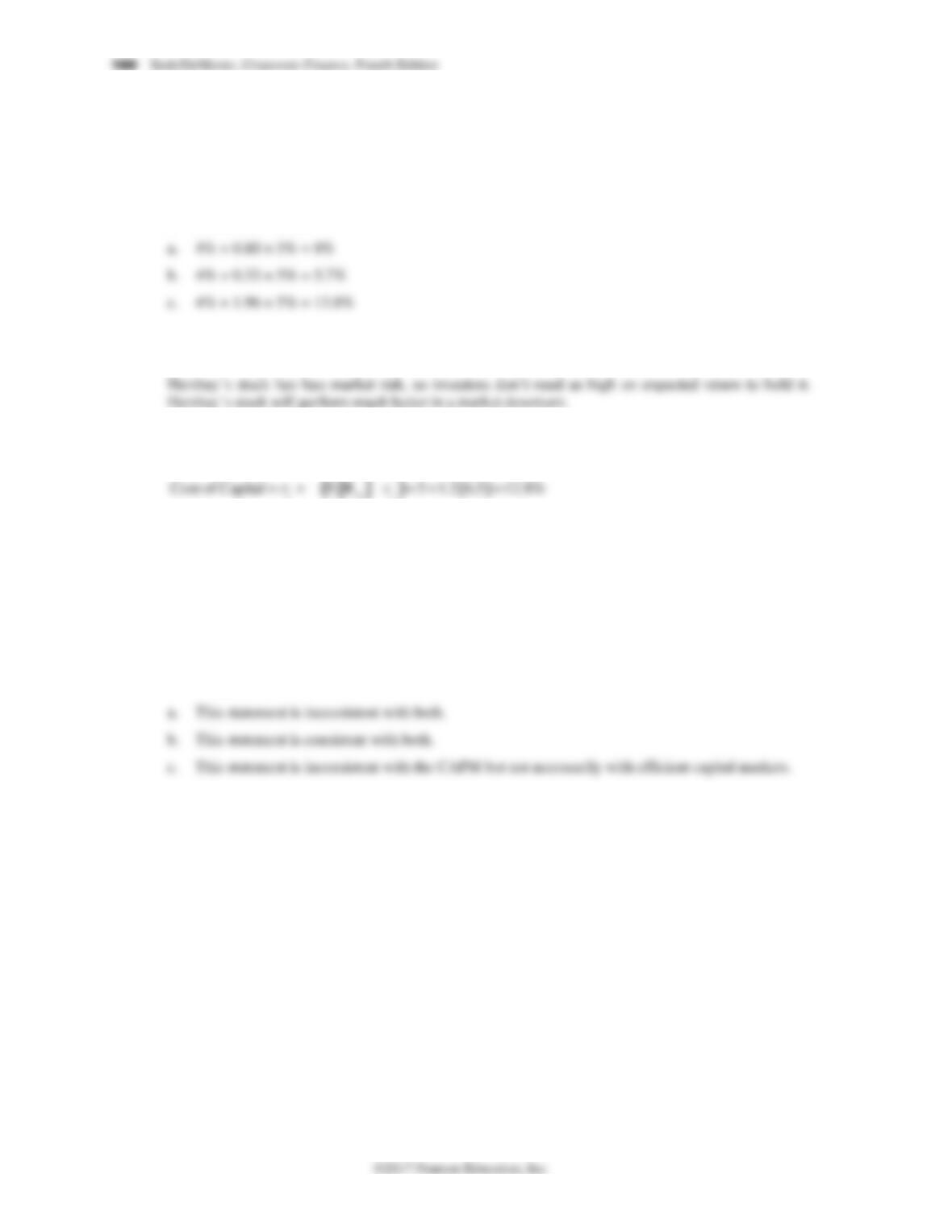
10–35. Suppose the market risk premium is 5% and the risk-free interest rate is 4%. Using the data in
Table 10.6, calculate the expected return of investing in
a. Starbucks’ stock.
b. Hershey’s stock.
c. Autodesk’s stock.
10–36. Given the results to Problem 35, why don’t all investors hold Autodesk’s stock rather than
Hershey’s stock?
10–37. Suppose the market risk premium is 6.5% and the risk-free interest rate is 5%. Calculate the
cost of capital of investing in a project with a beta of 1.2.
10–38. State whether each of the following is inconsistent with an efficient capital market, the CAPM, or
both:
a. A security with only diversifiable risk has an expected return that exceeds the risk-free
interest rate.
b. A security with a beta of 1 had a return last year of 15% when the market had a return of
9%.
c. Small stocks with a beta of 1.5 tend to have higher returns on average than large stocks with
a beta of 1.5.