ANSWERS TO END-OF-CHAPTER QUESTIONS
10-1 a. Capital budgeting is the whole process of analyzing projects and deciding whether they
should be included in the capital budget. This process is of fundamental importance to
the success or failure of the firm as the fixed asset investment decisions chart the course
of a company for many years into the future. The payback, or payback period, is the
number of years it takes a firm to recover its project investment. Payback may be
money. NPV is the present value of the project’s expected future cash flows (both
inflows and outflows), discounted at the appropriate cost of capital. NPV is a direct
measure of the value of the project to shareholders. The internal rate of return (IRR) is
the discount rate that equates the present value of the expected future cash inflows and
outflows. IRR measures the rate of return on a project, but it assumes that all cash
Chapter 10
The Basics of Capital Budgeting: Evaluating Cash
Flows
Answers and Solutions: 10 – 2
that at that point their NPVs are equal.
f. Capital projects with nonnormal cash flows have a large cash outflow either sometime
during or at the end of their lives. A common problem encountered when evaluating
projects with nonnormal cash flows is multiple IRRs. A project has normal cash flows
if one or more cash outflows (costs) are followed by a series of cash inflows.
their engineering lives and therefore it may be best to terminate a project prior to its
potential life. The economic life is the number of years a project should be operated to
maximize its NPV, and is often less than the maximum potential life. Capital rationing
occurs when a firm’s management limits its capital expenditures to an amount less than
would be required to fund the optimal capital budget. The equivalent annual annuity
10-2 Projects requiring greater investments or that have greater risk should be given detailed
analysis the capital budgeting process.
10-3 The NPV is obtained by discounting future cash flows, and the discounting process actually
10-4 This question is related to Question 10-3 and the same rationale applies. With regard to
the second part of the question, the answer is no; the IRR rankings are constant and
independent of the firm’s cost of capital.

10-5 Generally, the failure to employ common-life analysis in such situations will bias the NPV
against the shorter project because it “gets no credit” for profits beyond its initial life, even
though it could possibly be “renewed” and thus provide additional NPV.
Answers and Solutions: 10 – 4
SOLUTIONS TO END-OF-CHAPTER PROBLEMS
10-1 NPV = -$40,000 + $9,000[(1/I) – (1/(I × (1 + I)N)]
solve for NPV = $2,409.77.
10-2 Financial calculator solution: Input CF0 = -40000, CF1-7 = 9000, and then solve for IRR =
12.84%.
10-3 MIRR: PV Costs = $40000.
FV Inflows:
Answers and Solutions: 10 – 5
10-4 PV = $9,000[(1/I) – (1/(I × (1 + I)N)]
= $9,000[(1/0.11) – (1/(0.11 × (1 + 0.11)7)]
= $42,410.
10-5 Since the cash flows are a constant $9,000, calculate the payback period as:
$40,000/$9,000 = 4.44, so the payback is about 4 years.
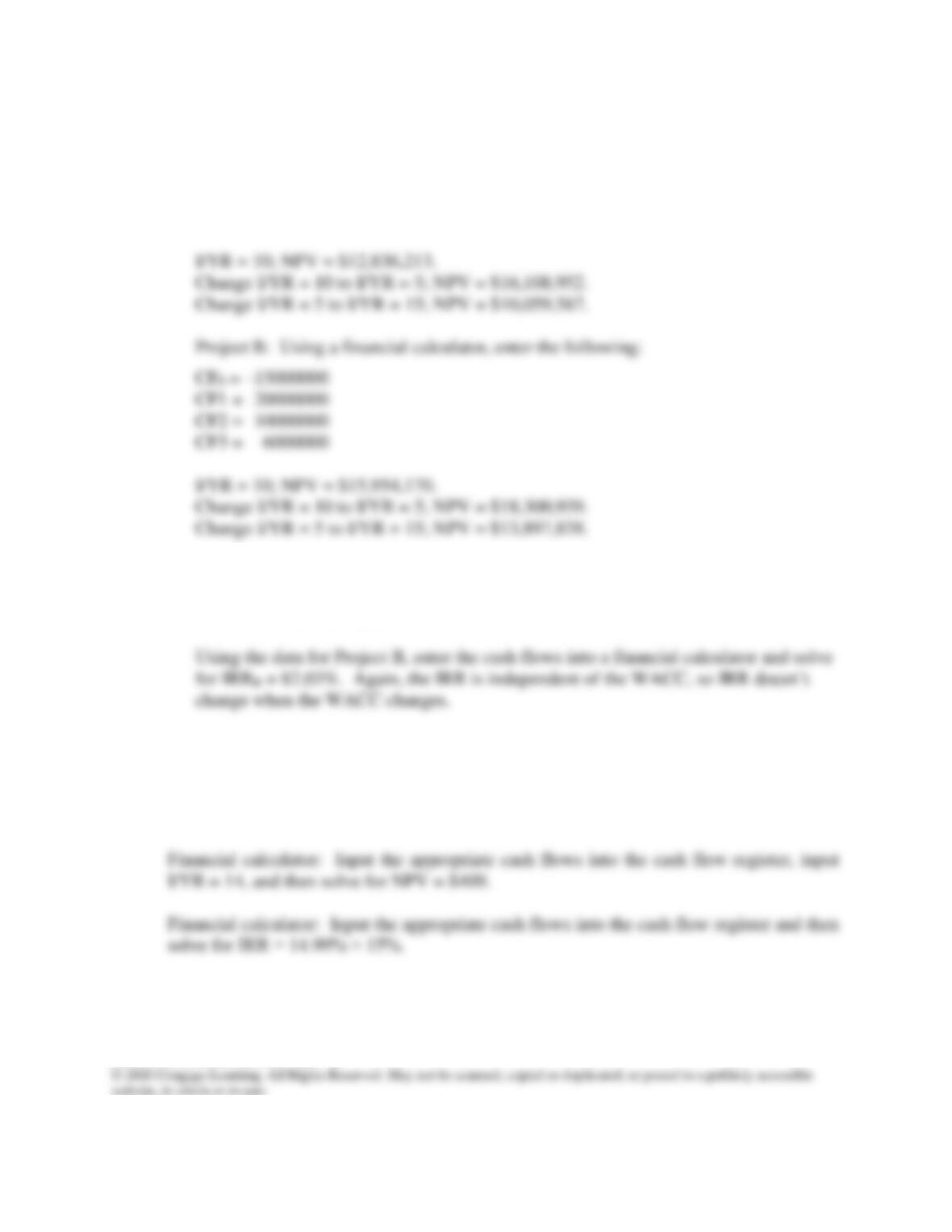
10-6 The project’s discounted payback period is calculated as follows:
Year
Annual CF
Discounted CF
(@11%)
Cumulative
Discounted CF
0
-40,000
-40,000.00
1
2
3
4
5
6
Answers and Solutions: 10 – 6
10-7 a. Project A: Using a financial calculator, enter the following:
CF0 = -15000000
CF1 = 5000000
CF2 = 10000000
CF3 = 20000000
b. Using the data for Project A, enter the cash flows into a financial calculator and solve
for IRRA = 43.97%. The IRR is independent of the WACC, so IRR doesn’t change
when the WACC changes.
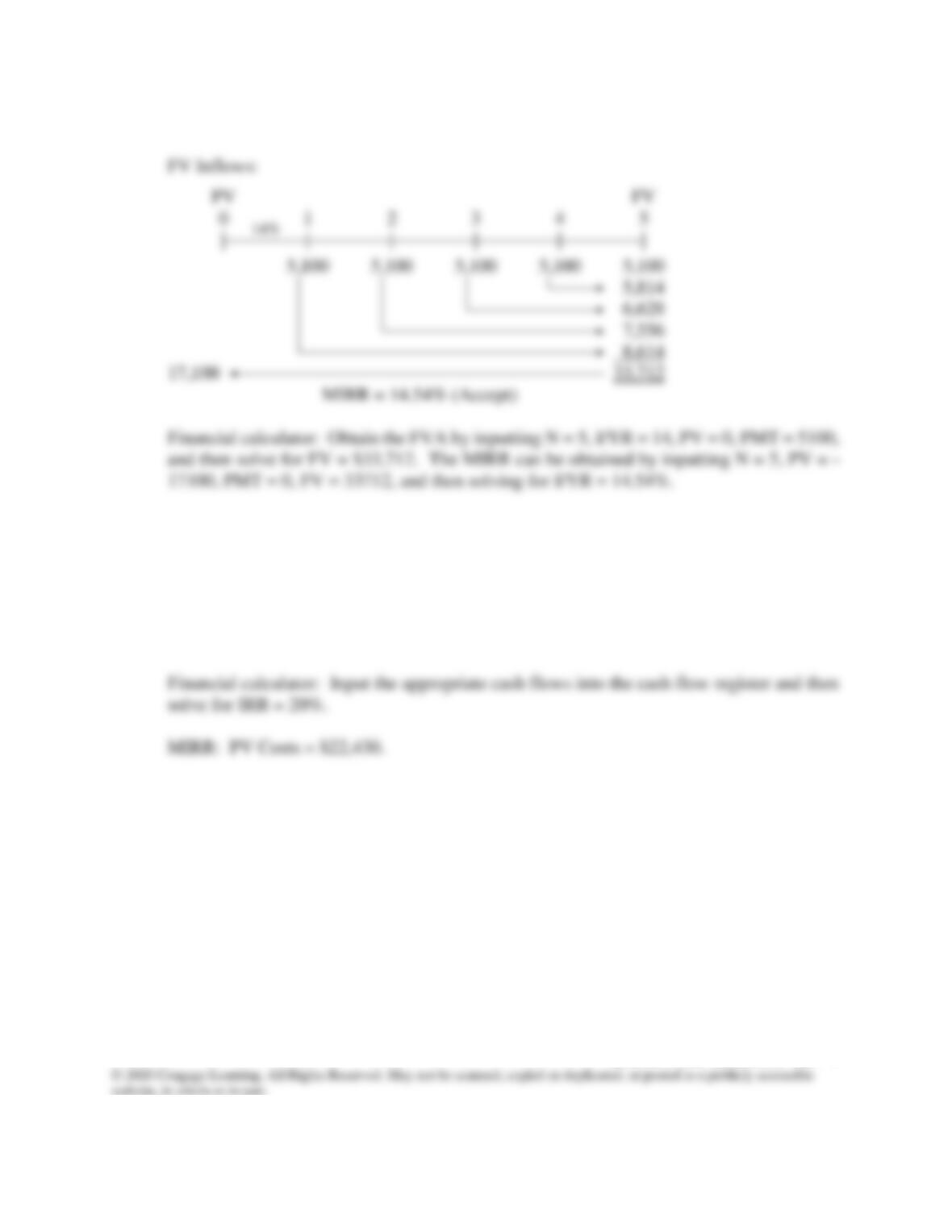
10-8 Truck:
NPV = -$17,100 + $5,100(PVIFA14%,5)
= -$17,100 + $5,100(3.4331) = -$17,100 + $17,509
= $409. (Accept)
Answers and Solutions: 10 – 7
MIRR: PV Costs = $17,100.
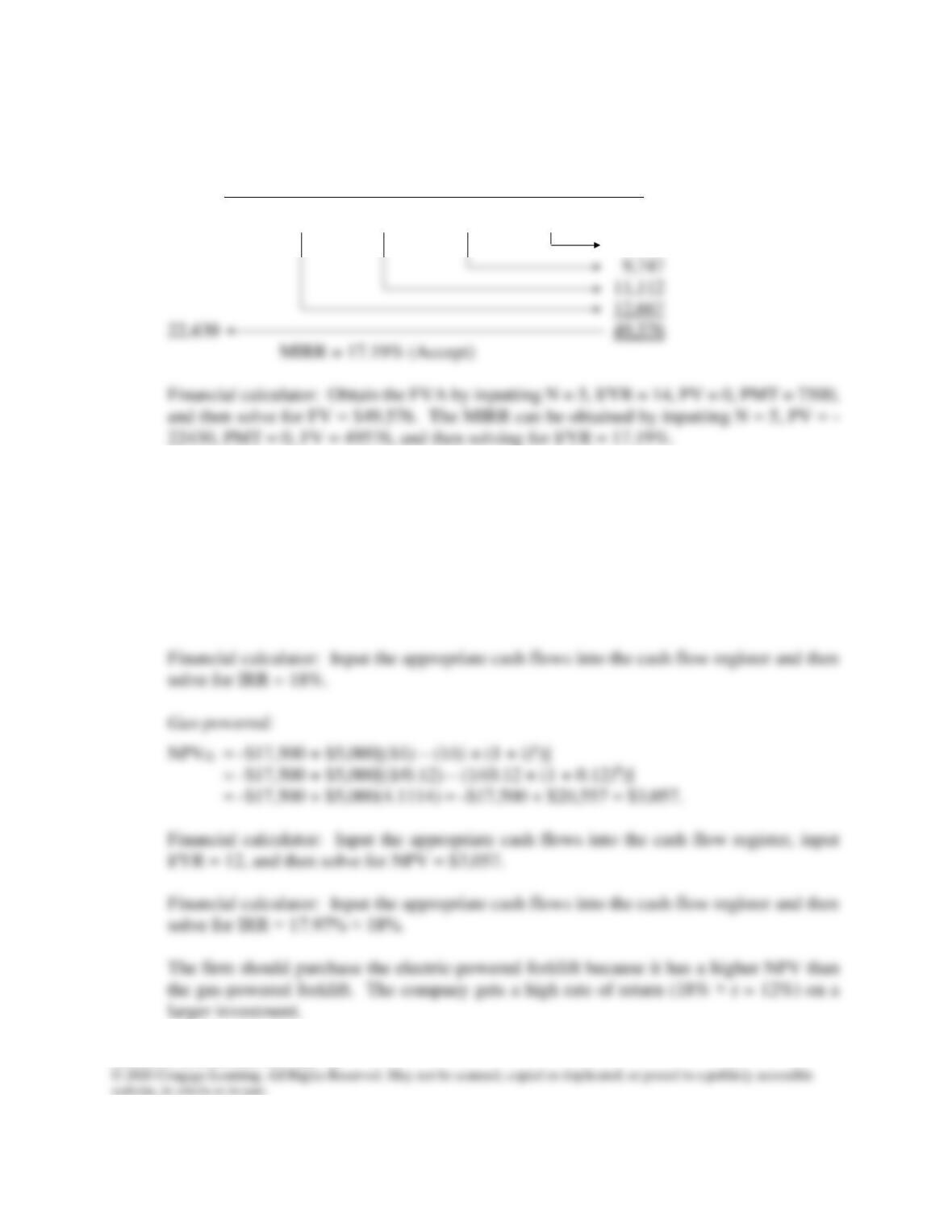
Pulley:
NPV = -$22,430 + $7,500(3.4331) = -$22,430 + $25,748
= $3,318. (Accept)
Financial calculator: Input the appropriate cash flows into the cash flow register, input
I/YR = 14, and then solve for NPV = $3,318.
Answers and Solutions: 10 – 8
FV Inflows:
PV FV
0 1 2 3 4 5
| | | | | |
7,500 7,500 7,500 7,500 7,500
8,550
10-9 Electric-powered:
NPVE = -$22,000 + $6,290[(1/i) – (1/(i × (1 + i)n)]
= -$22,000 + $6,290[(1/0.12) – (1/(0.12 × (1 + 0.12)6)]
= -$22,000 + $6,290(4.1114) = -$22,000 + $25,861 = $3,861.
Financial calculator: Input the appropriate cash flows into the cash flow register, input
I/YR = 12, and then solve for NPV = $3,861.
14%
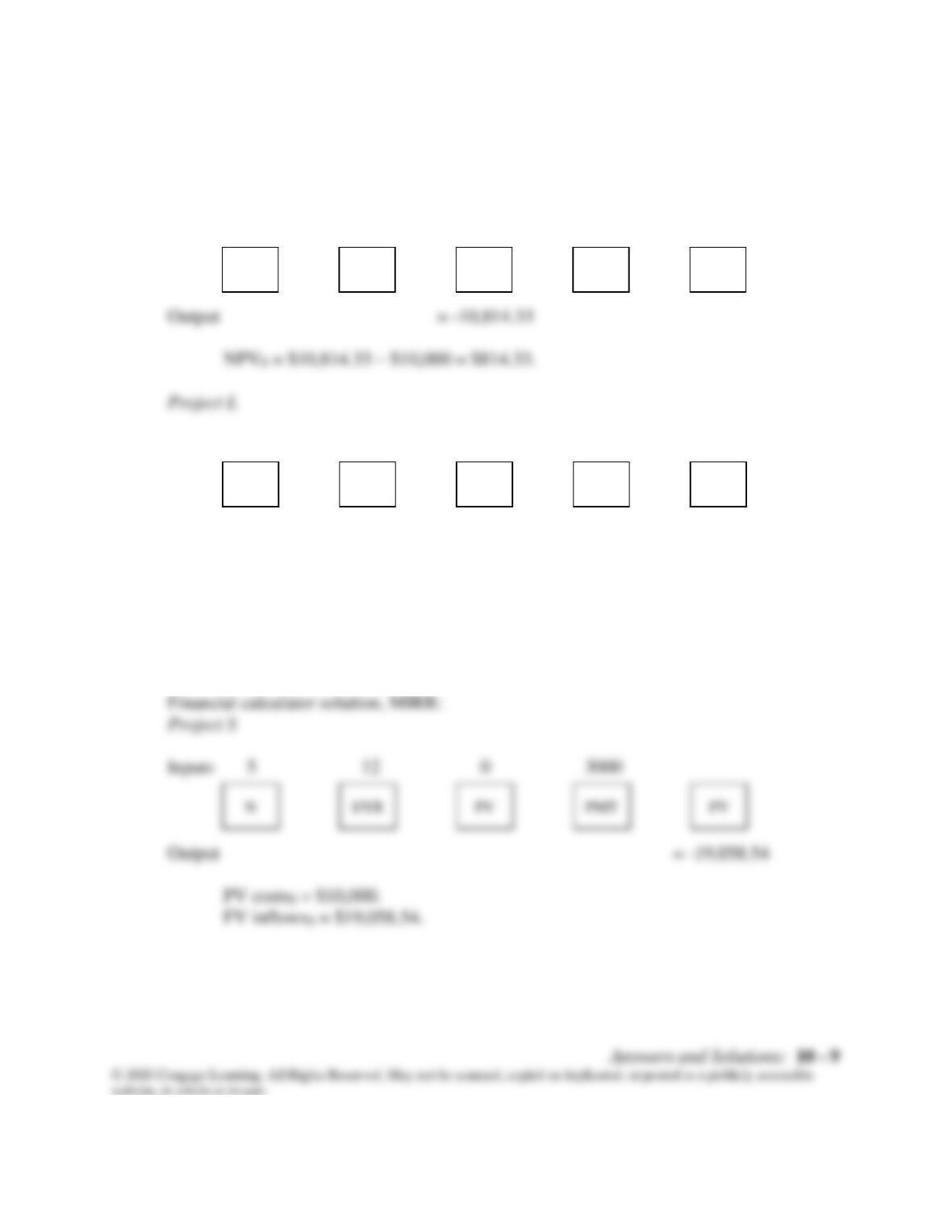
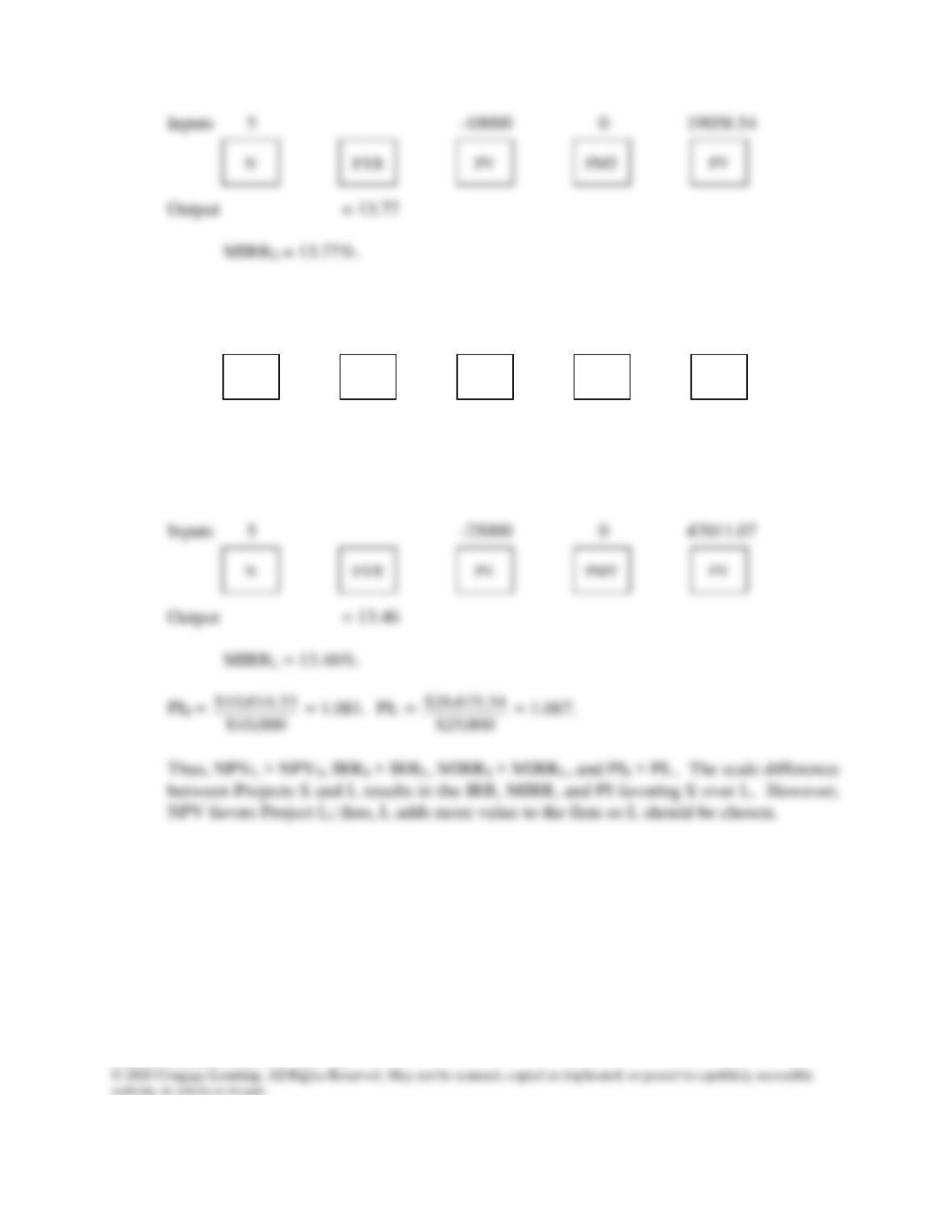
10-10 Financial calculator solution, NPV:
Project S
Inputs 5 12 3000 0
Inputs 5 12 7400 0
Output = -26,675.34
NPVL = $26,675.34 – $25,000 = $1,675.34.
Financial calculator solution, IRR:
Input CF0 = -10000, CF1 = 3000, Nj = 5, IRRS = ? IRRS = 15.24%.
Input CF0 = -25000, CF1 = 7400, Nj = 5, IRRL = ? IRRL = 14.67%.
N
I/YR
FV
PMT
PV
N
I/YR
FV
PMT
PV
Answers and Solutions: 10 – 10
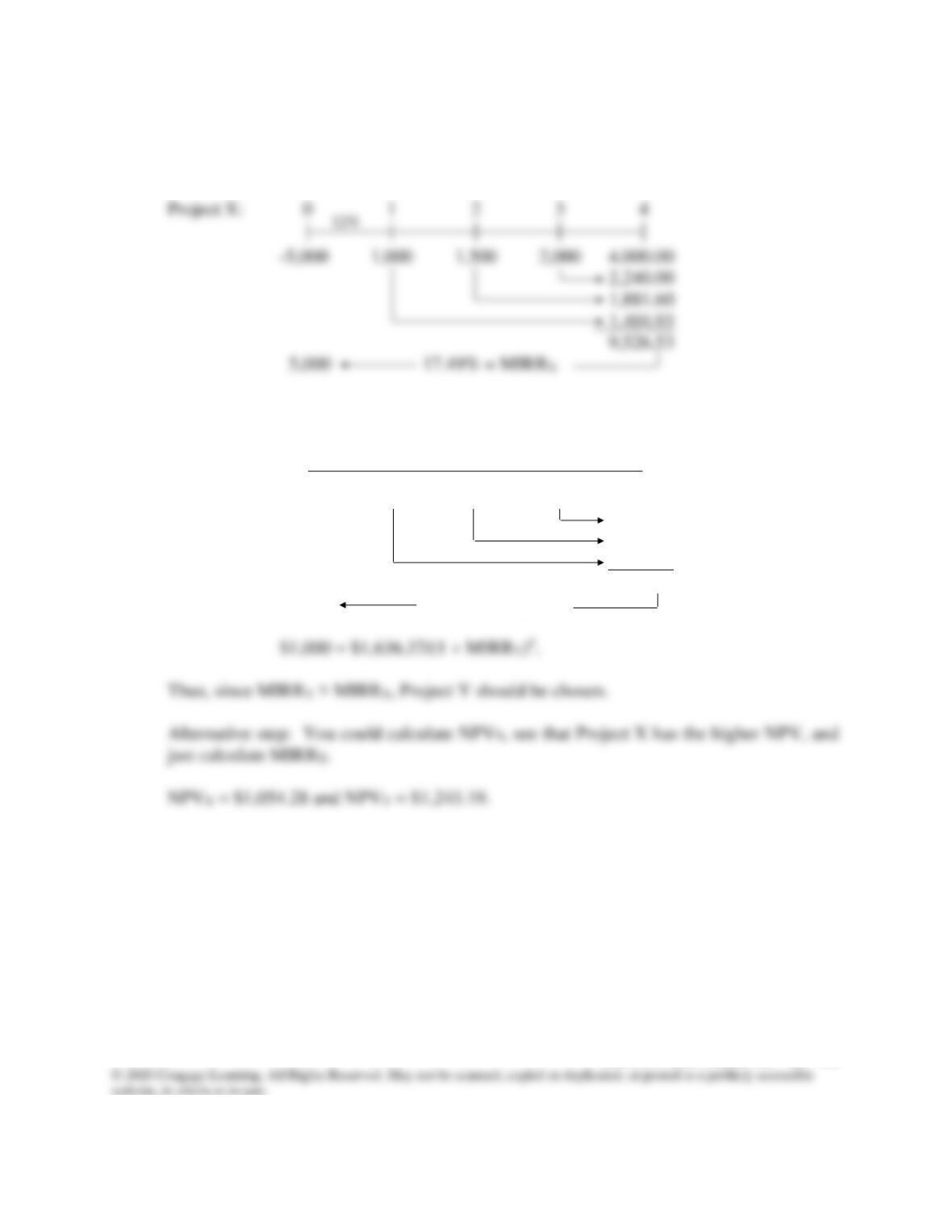
Project L
Inputs 5 12 0 7400
Output = -47,011.07
PV costsL = $25,000.
FV inflowsL = $47,011.07.
N
I/YR
FV
PMT
PV
N
I/YR
FV
PMT
PV
Answers and Solutions: 10 – 11
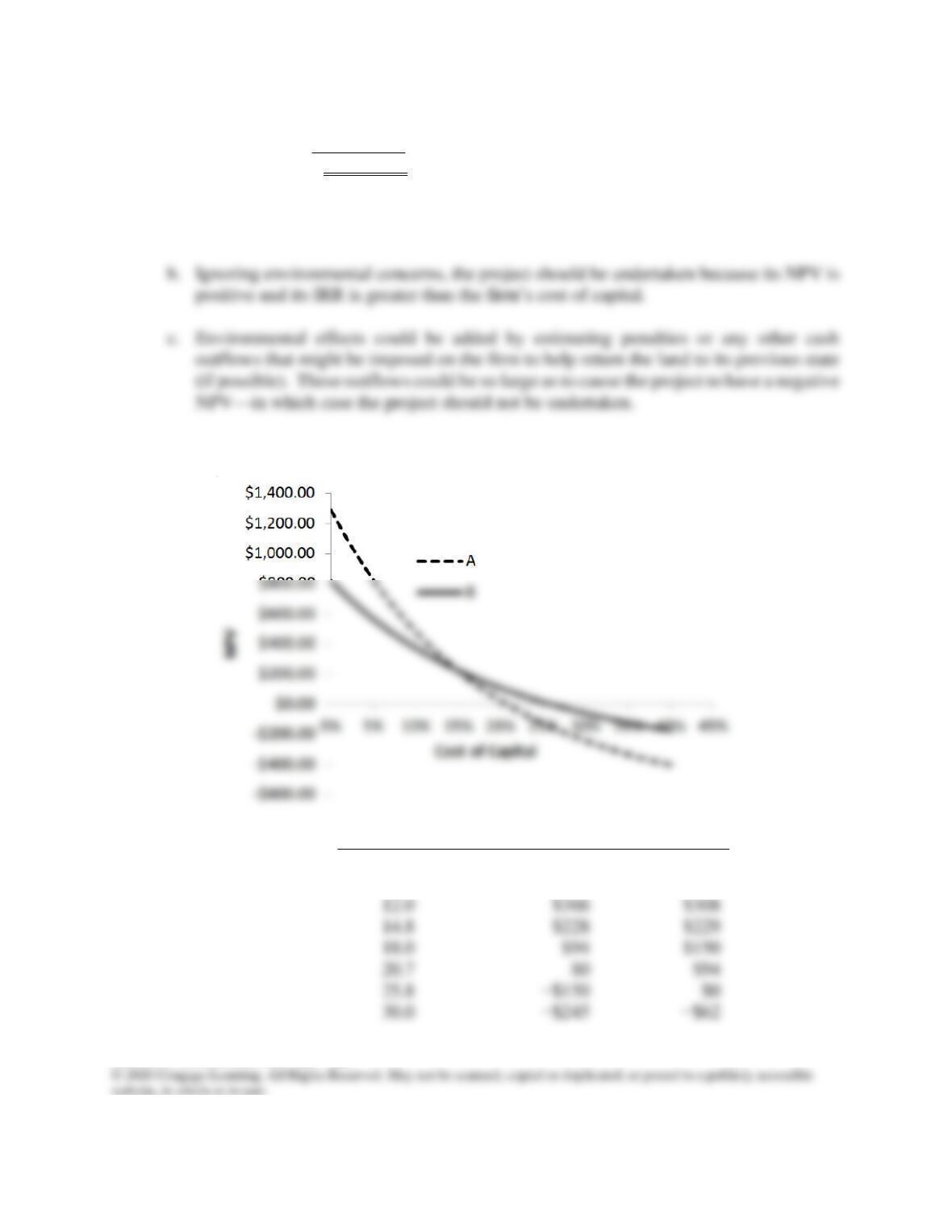
10-11 Because both projects are the same size you can just calculate each project’s MIRR and
choose the project with the higher MIRR. (Remember, MIRR gives conflicting results
from NPV when there are scale differences between the projects.)
12%
$5,000 = $9,529/(1 + MIRRX)4.
Project Y: 0 1 2 3 4
| | | | |
-5,000 4,500 1,500 1,000 500.00
1,120.00
1,881.60
6,322.18
9,823.78
5,000 18.39% = MIRRY
12%
Answers and Solutions: 10 – 12
10-12 a. Purchase price $ 900,000
Installation 165,000
Initial outlay $1,065,000
CF0 = -1065000; CF1-5 = 350000; I/YR = 14; NPV = ?
NPV = $136,578; IRR = 19.22%.
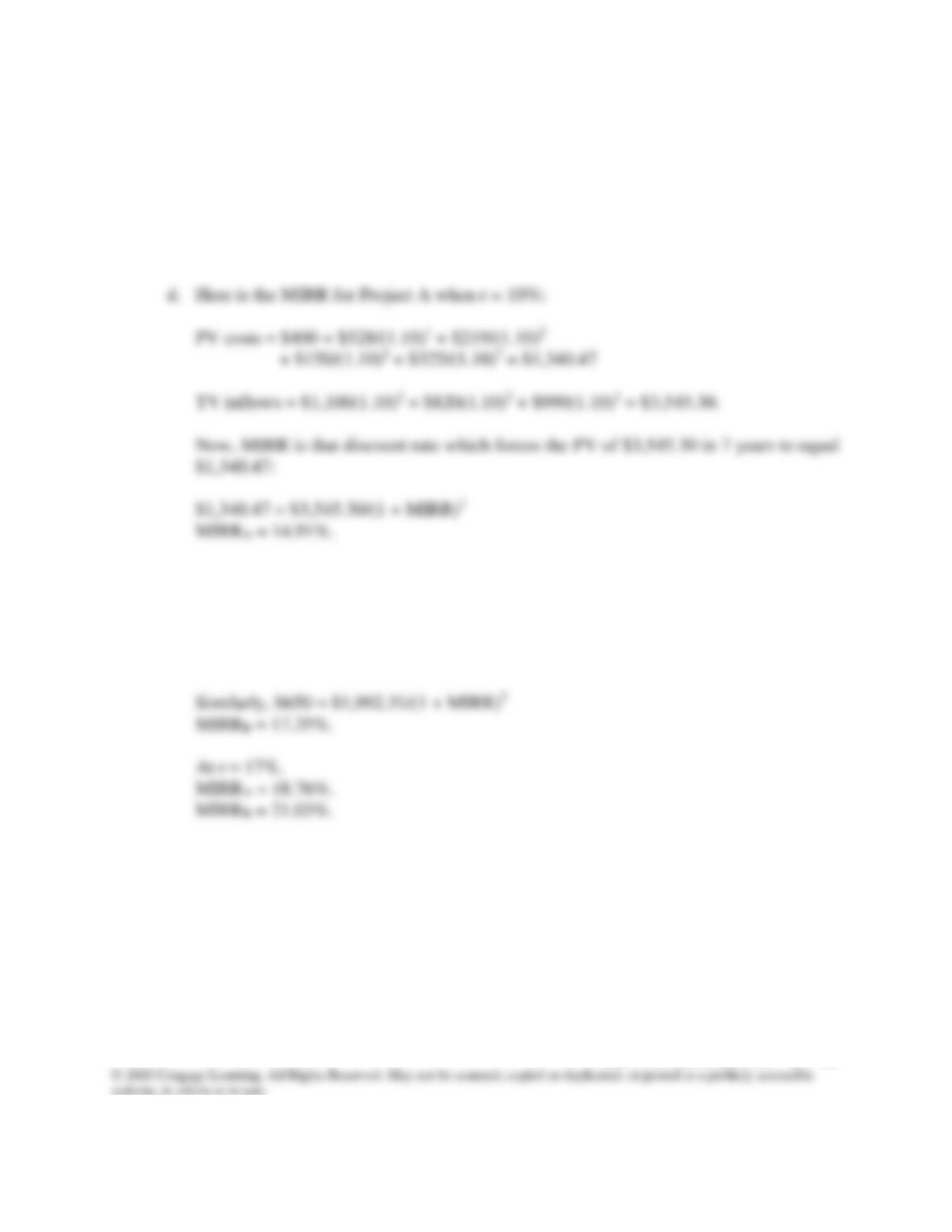
10-13 a.
r
NPVA
NPVB
0.0%
$1,288
$820
10.0
$479
$372
14.8
$228
$229
18.0
$150
20.7
25.8
30.0
Answers and Solutions: 10 – 13
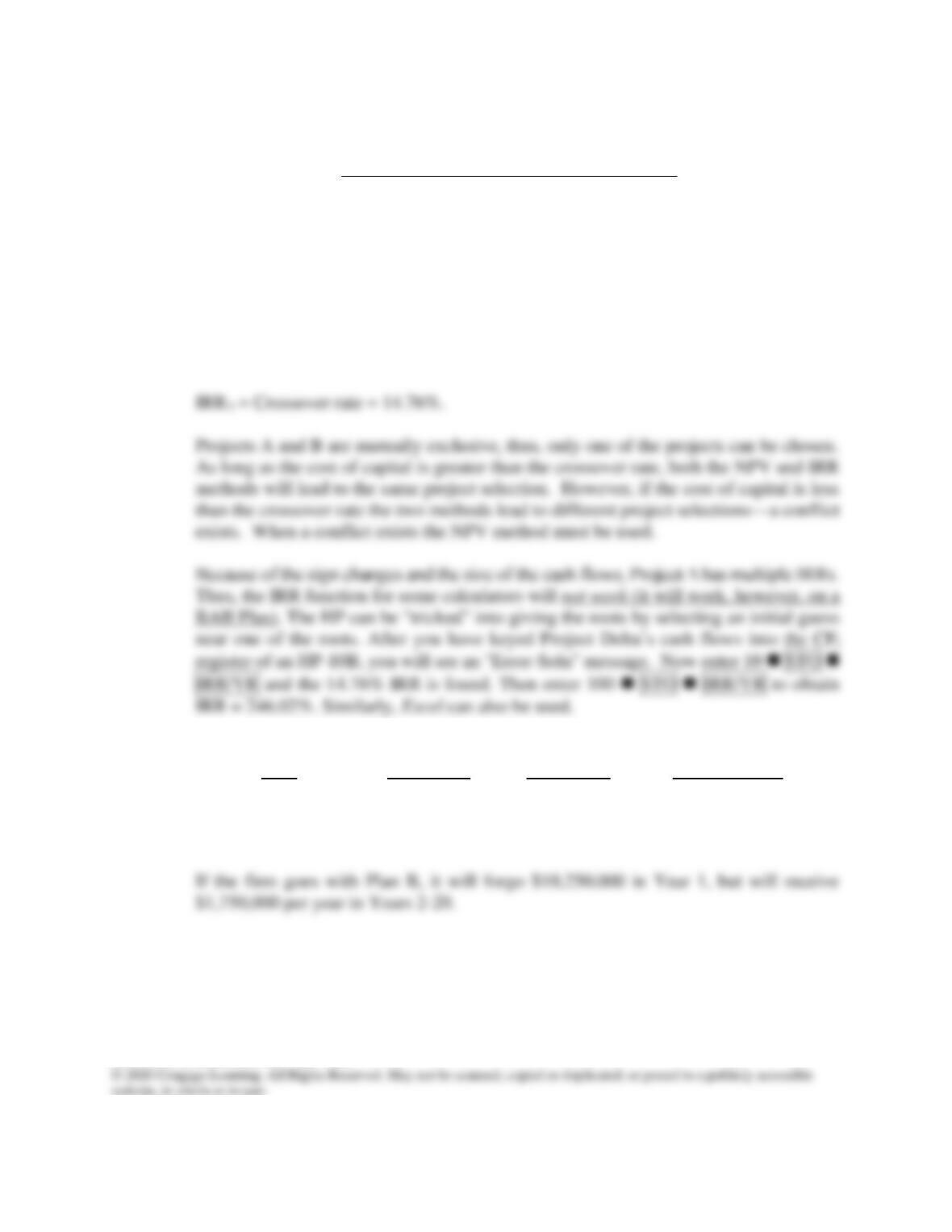
b. IRRA = 20.7%; IRRB = 25.8%.
c. At r = 10%, Project A has the greater NPV, specifically $478.83 as compared to Project
B’s NPV of $372.37. Thus, Project A would be selected. At r = 17%, Project B has
an NPV of $173.70 which is higher than Project A’s NPV of $133.76. Thus, choose
Project B if r = 17%.
Here is the MIRR for Project B when r = 10%:
PV costs = 600.
TV of inflows: Financial calculator settings are N = 7, I/YR = 10, PV = 0, PMT = 210,
and solve for FV = -1992.3059.
Answers and Solutions: 10 – 14
e. To find the crossover rate, construct a Project ∆ which is the difference in the two
projects’ cash flows:
Year
Project ∆ = CFA – CFB
0
$250
1
−738
2
−429
3
−360
4
890
5
610
6
780
7
−535
10-14 a. Incremental Cash
Year Plan B Plan A Flow (B – A)
0 ($10,000,000) ($10,000,000) $ 0
1 1,750,000 12,000,000 (10,250,000)
2-20 1,750,0000 0 1,750,000

Answers and Solutions: 10 – 15
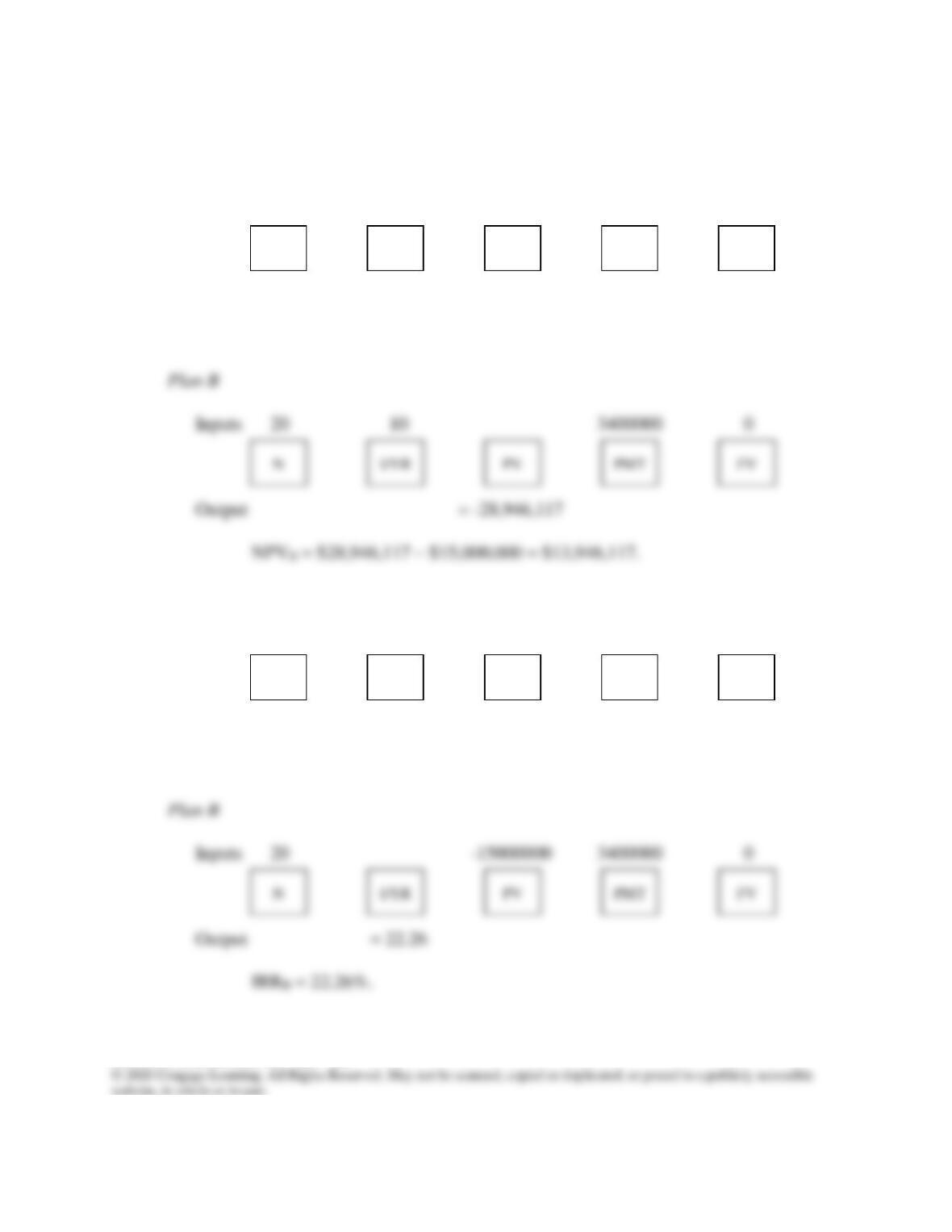
b. If the firm could invest the incremental $10,250,000 at a return of 16.07%, it would
receive cash flows of $1,750,000. If we set up an amortization schedule, we would
find that payments of $1,750,000 per year for 19 years would amortize a loan of
$10,250,000 at 16.0665%.
d. See graph. If the cost of capital is less than 16.07%, then Plan B should be accepted;
if r > 16.07%, then Plan A is preferred.
N P V ( M i l l i o n s o f D o l l a r s )
B
25
20
15
Answers and Solutions: 10 – 16
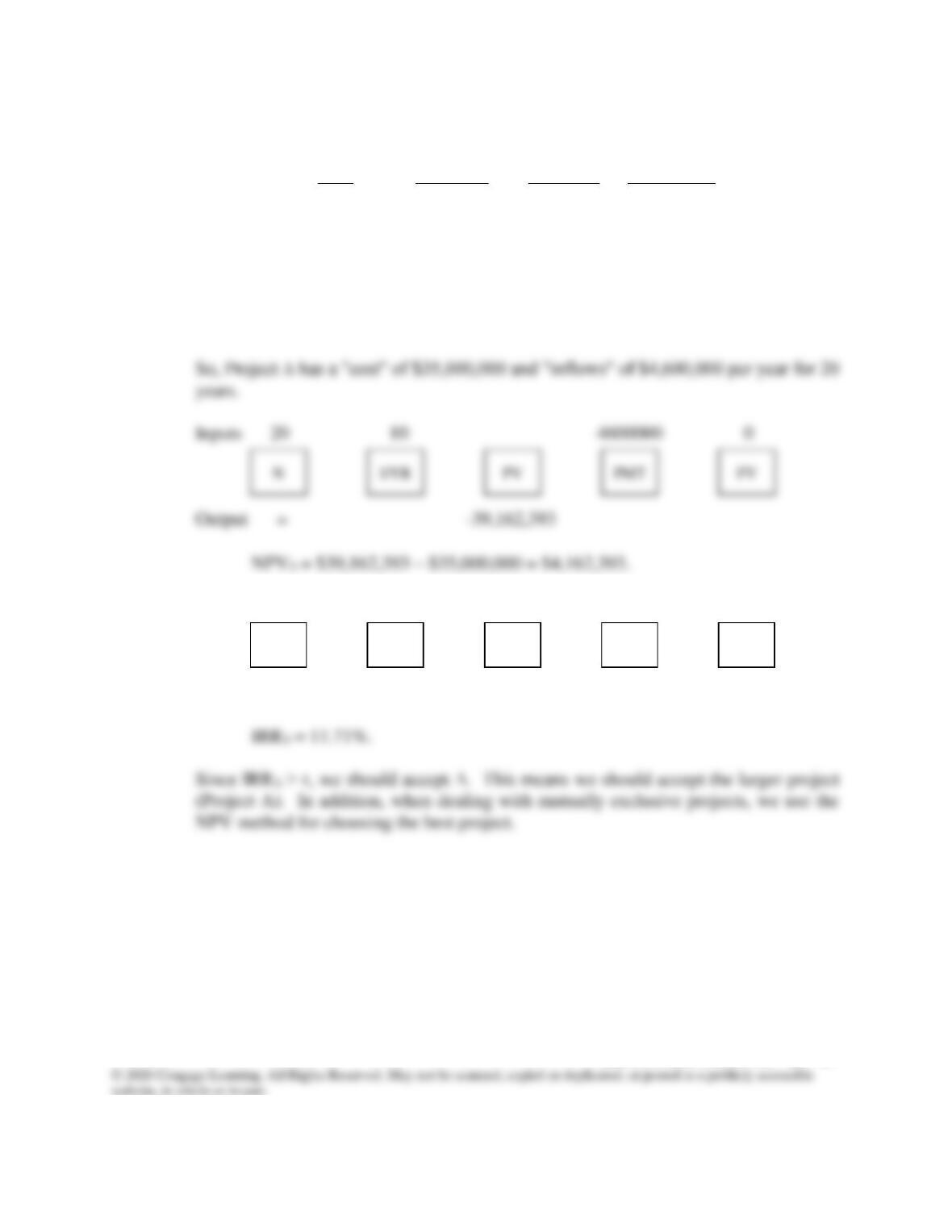
10-15 a. Financial calculator solution:
Plan A
Inputs 20 10 8000000 0
Output = -68,108,510
NPVA = $68,108,510 – $50,000,000 = $18,108,510.
Plan A
Inputs 20 -50000000 8000000 0
Output = 15.03
IRRA = 15.03%.
N
I/YR
FV
PMT
PV
N
I/YR
FV
PMT
PV
N
I/YR
FV
PMT
PV
Answers and Solutions: 10 – 17
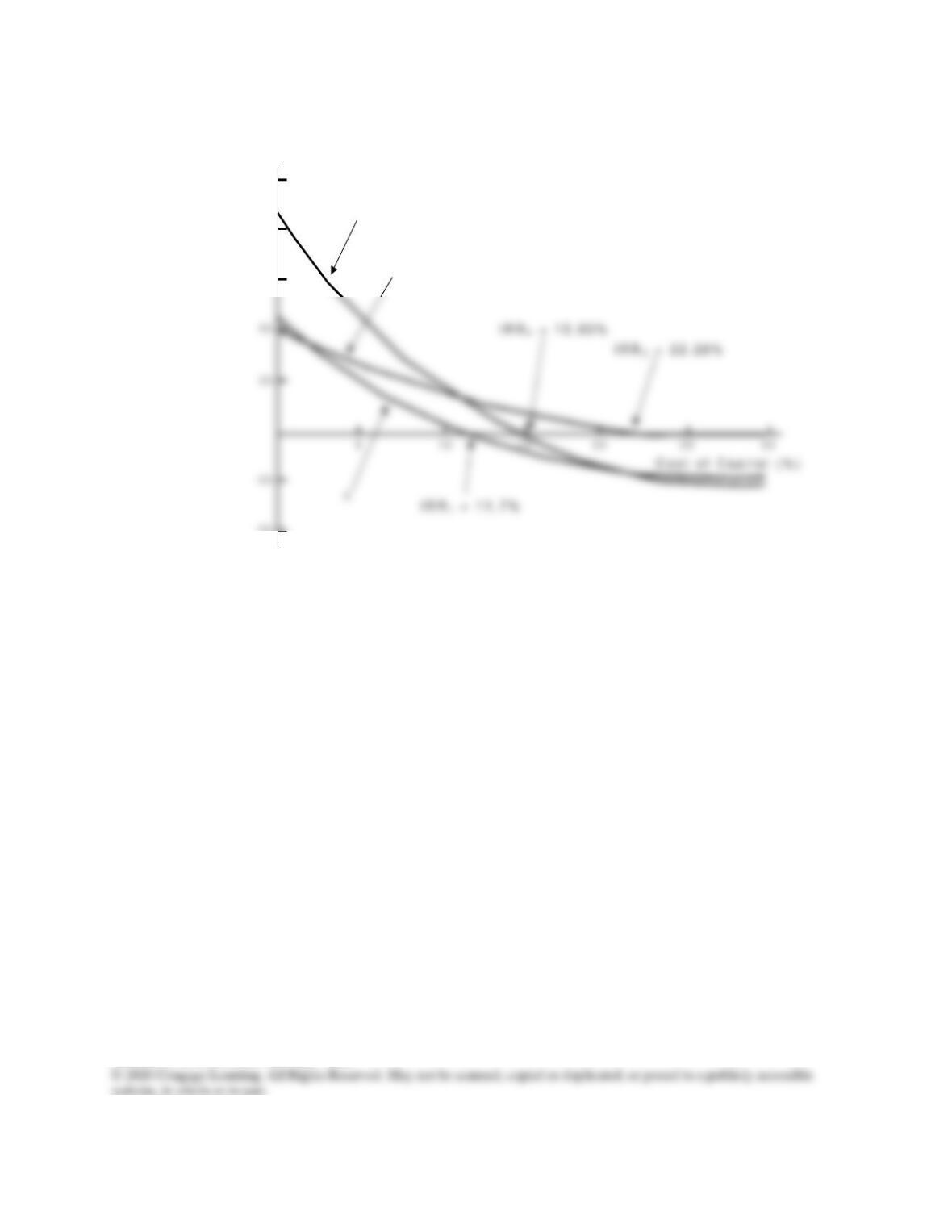
b. If the company takes Plan A rather than B, its cash flows will be (in millions of dollars):
Cash Flows Cash Flows Project ∆
Year from A from B Cash Flows
0 ($50) ($15.0) ($35.0)
1 8 3.4 4.6
2 8 3.4 4.6
– – – –
– – – –
– – – –
20 8 3.4 4.6
Inputs 20 -35000000 4600000 0
Output = 11.71
N
I/YR
FV
PMT
PV
Answers and Solutions: 10 – 18
c.
N P V ( M i l l i o n s o f D o l l a r s )
C r o s s o v e r R a t e = 1 1 . 7 %
A
B
1 2 5
1 0 0
75
– 5 0
Answers and Solutions: 10 – 19
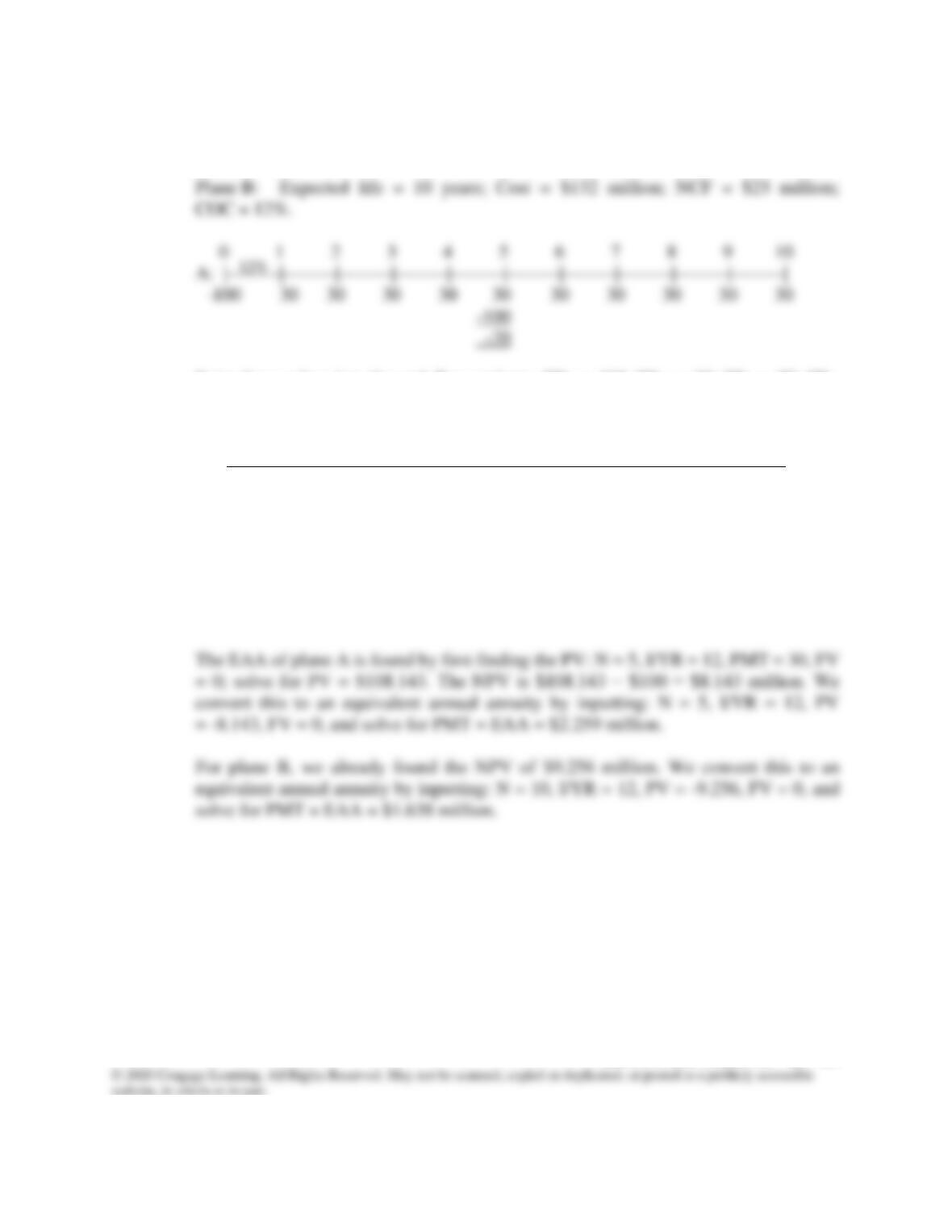
10-16 Plane A: Expected life = 5 years; Cost = $100 million; NCF = $30 million;
COC = 12%.
12%
Enter these values into the cash flow register: CF0 = -100; CF1-4 = 30; CF5 = -70; CF6-
10 = 30. Then enter I/YR = 12, and press the NPV key to get NPVA = $12.764 million.
0 1 2 3 4 5 6 7 8 9 10
B: | | | | | | | | | | |
-132 25 25 25 25 25 25 25 25 25 25
Enter these cash flows into the cash flow register, along with the interest rate, and press
the NPV key to get NPVB = $9.256 million.
Project A is the better project and will increase the company’s value by $12.764
million.
12%
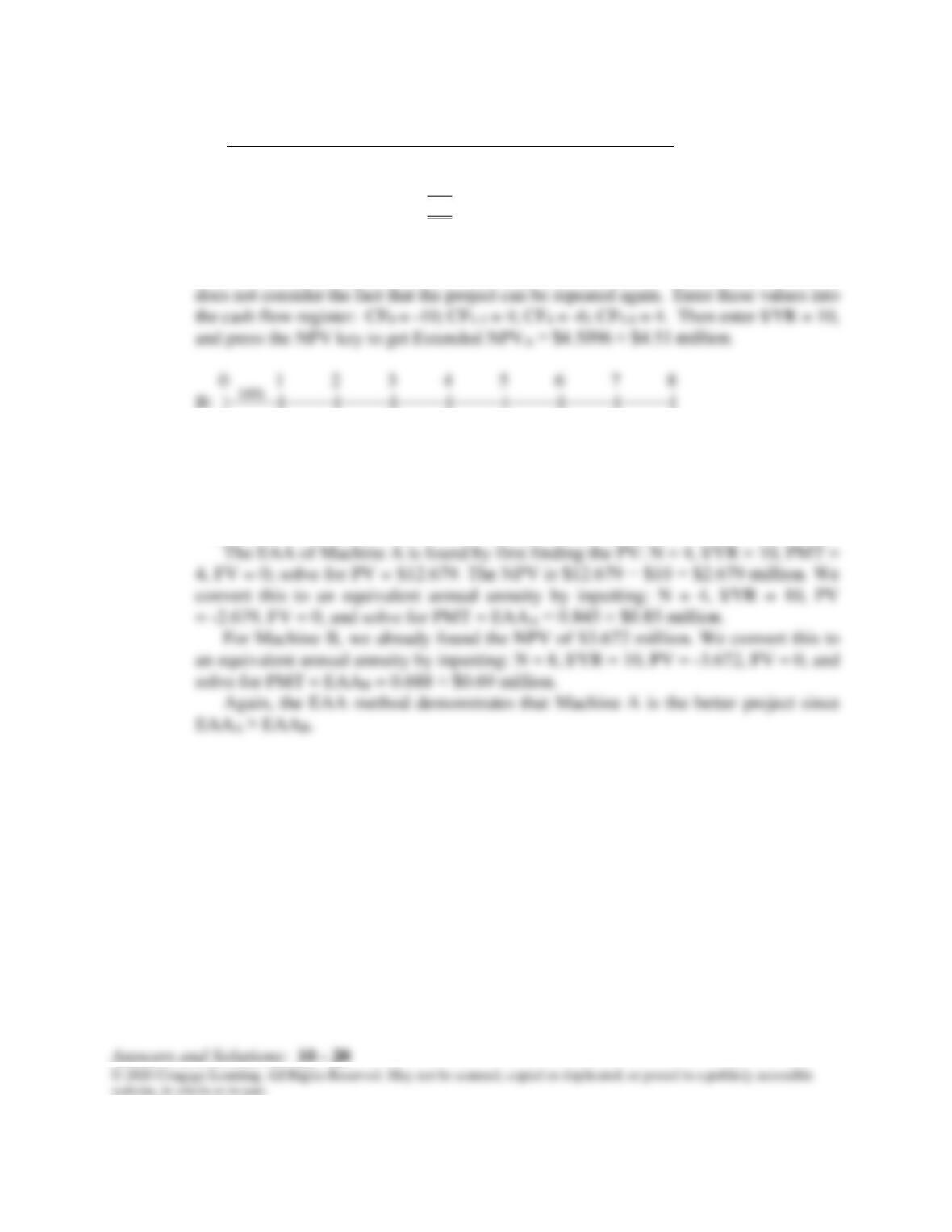
10-17 0 1 2 3 4 5 6 7 8
A: | | | | | | | | |
-10 4 4 4 4 4 4 4 4
-10
-6
Machine A’s simple NPV is calculated as follows: Enter CF0 = -10 and CF1-4 = 4. Then
enter I/YR = 10, and press the NPV key to get NPVA = $2.679 million. However, this
10%
-15 3.5 3.5 3.5 3.5 3.5 3.5 3.5 3.5
For Machine B’s NPV, enter these cash flows into the cash flow register, along with
the interest rate, and press the NPV key to get NPVB = $3.672 ≈ $3.67 million.
Machine A is the better project and will increase the company’s value by $4.51 million.
10%