4. In 1990, General Electric acquired Tungsram Ltd., a Hungarian light bulb manufacturer.
was 6.1% in 1990 and 3.1% in 1991.
4.a. What has happened to the competitiveness of GE’s Hungarian operations during 1990 and 1991?
0.95 * 0.85e0 * (1.28)(1.35)/[(1.061)(1.031)] = 1.276e0
This equation reflects the fact that if the nominal exchange rate (dollar value of the forint) at the start of 1990
4.b. In early 1992, GE announced that it would cut back its capital investment in Tungsram. What
might have been the purpose of GE’s publicly announced cutback?
5. In 1985, Japan Airlines (JAL) bought $3 billion of foreign exchange contracts at ¥180/$1 over 11
5.a. What was the economic rationale behind JAL’s hedges?
5.b. Did JAL’s forward contracts constitute an economic hedge? That is, is it likely that JAL’s losses
on its forward contracts were offset by currency gains on its operations?
6. Nissan produces a car that sells in Japan for ¥1.8 million. On September 1, the beginning of the
6.a. What scenarios are consistent with the U.S. dollar’s depreciation?
6.b. What alternatives are open to Nissan to improve its situation?
ANSWER. The alternatives open to Nissan are:
i) Raise prices in the U.S. market.
ii) Do nothing for the short run. Incur some losses and hope that the exchange rate will return to ¥200.
In addition, hold U.S. sales receipts in dollars and do not repatriate funds until the exchange rate is
more favorable. The second part of this strategy is probably useless since it requires that any
exchange rates changes not be offset by the differing interest rates between Japan and the U.S.
iii) Invest in the U.S. and build the cars there. (In 1993, 45% of the cars Toyota sold in the U.S. were
U.S. made.)
iv) Try to reduce production costs in Japan, including buying more parts overseas. (How have
production costs in Japan changed because of the exchange rate change? For example, consider the
6.c. How should Nissan respond in this situation?
ANSWER. The appropriate response by Nissan depends on its interpretation of the nature of the economic
disturbance that caused the exchange rate change. If it believes that the shock is temporary, Nissan must
calculate how long it will take for the exchange rate to return to its original level. If the shock is nominal
(PPP holds), then the real terms of trade between Japan and the U.S. are unaffected. In this case, U.S. prices
in general should have been rising and Nissan can pass along all of the exchange rate change to his U.S.
customers. (This is an important point: Is PPP a “leading” or a “lagging” relationship? How quickly can
exchange rate changes be incorporated into domestic prices?) In the present circumstance, it is virtually
6.d. Suppose that on November 1, the U.S. Federal Reserve intervenes to rescue the dollar, and the
exchange rate adjusts to ¥220:$1 by the following July. What problems and/or opportunities
does this situation present for Nissan and for General Motors?
7. Chemex, a U.S. maker of specialty chemicals, exports 40% of its $600 million in annual sales: 5%
7.a. How is Chemex affected by exchange rate changes?
7.b. Distinguish between Chemex’s transaction exposure and its operating exposure.
ANSWER. Chemex’s transaction exposure stems from the fact that most of its export sales are priced in the
7.c. How can Chemex protect itself against transaction exposure?
7.d. What financial, marketing, and production techniques can Chemex use to protect itself against
operating exposure?
7.e. Can Chemex eliminate its operating exposure by hedging its position every time it makes a
foreign sale or by pricing all foreign sales in dollars? Why or why not?
8. During 1993, the Japanese yen appreciated by 11% against the dollar. In response to the lower
cost of the main imported ingredients – beef, cheese, potatoes, and wheat for burger buns –
8.a. How much of a volume increase is necessary to justify the price cut from ¥530 to ¥410? Assume
the previous profit margin (contribution to overhead) for this meal was ¥220. What is the
implied price elasticity of demand associated with this necessary rise in demand?
8.b. Suppose sales volume of this meal rises by 60%. What will be the percentage change in
McDonald’s dollar profit from this meal?
8.c. What other reasons might McDonald’s have had for cutting price besides raising its profits?
9. In 1990, a Japanese investor paid $100 million for an office building in downtown Los Angeles. At
9.a. What exchange risk did the Japanese investor face at the time of his purchase?
9.b. How could the investor have hedged his risk?
9.c. Suppose the investor financed the building with a 10% downpayment in yen and a 90% dollar
loan accumulating interest at the rate of 8% per annum. Since this is a zero-coupon loan, the
interest on it (along with the principal) is not due and payable until the building is sold. How
much has the investor lost in yen terms? In dollar terms?
9.d. Suppose the investor financed the building with a 10% downpayment in yen and a 90% yen loan
accumulating interest at the rate of 3% per annum. Since this is a zero-coupon loan, the interest
on it (along with the principal) is not due and payable until the building is sold. How much has
the investor lost in yen terms? In dollar terms?
Y7.6/U.S.$1.
10.a. What has happened to the real value of the yuan over the past year? Has it gone up or down? A
little or a lot?
(0.1559 – 0.1235)/0.1235 = 26.2%
If PPP held, the yuan should have devalued to a new exchange rate of
e = 8.1 * 1.22/1.03= Y9.59/$
10.b. What are the likely effects of the change in the yuan’s real value on the dollar profits of a
company like Procter & Gamble that sells almost exclusively in the local market?
10.c. What are the likely effects of the change in the yuan’s real value on the dollar profits of a textile
manufacturer that exports most of its output to the U.S.? What can it do to manage these effects?
1. Scenario 4: Sales and import prices rise; domestic materials substituted for imported materials; other
variables remain the same.
1.b. Because of domestic materials substitutions, krona operating expenditures rise by only 4%
relative to the base case.
1.c. Physical sales volume stays at its predevaluation level.
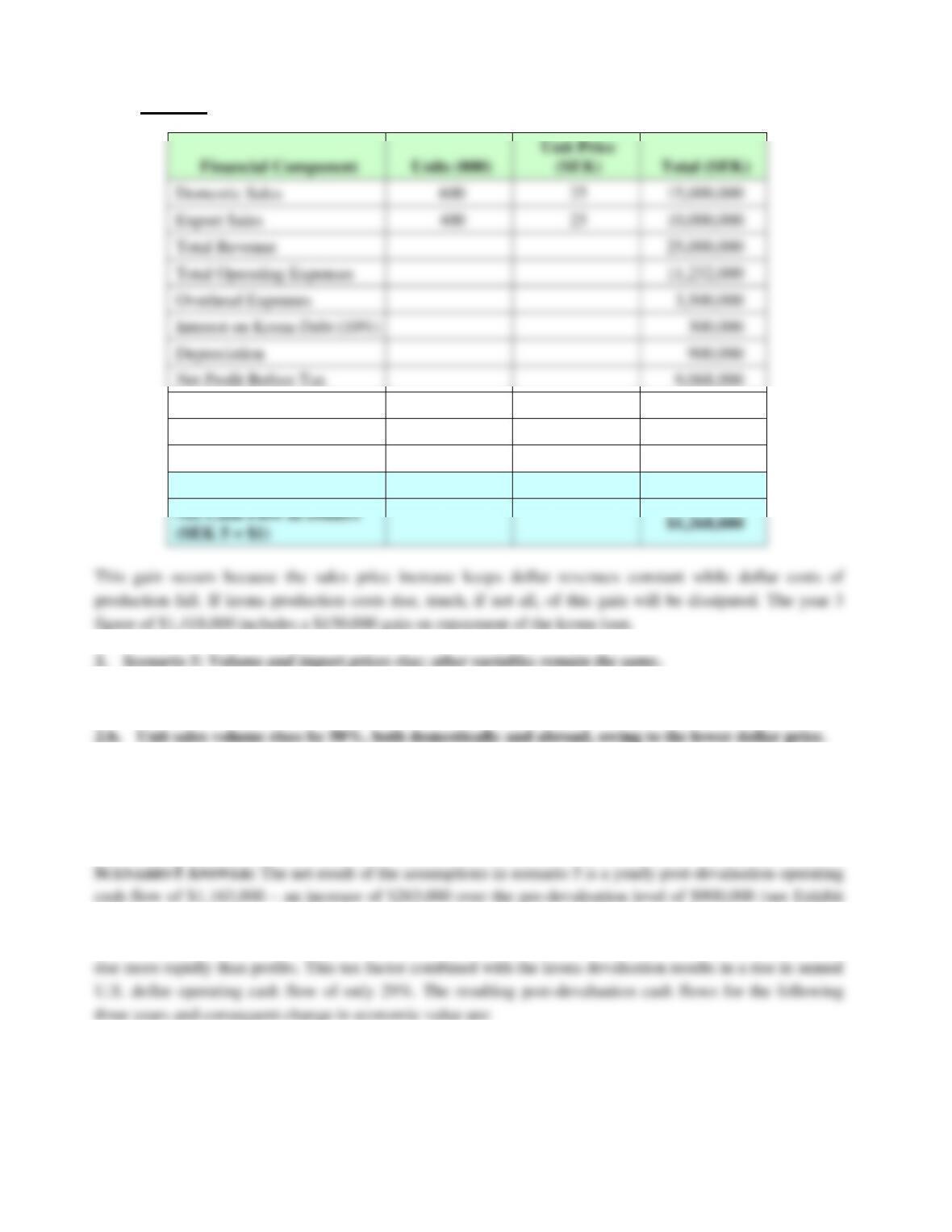
SCENARIO 4 ANSWER: Under this scenario the post-devaluation operating cash flow will be $1,268,000
annually. The calculations are shown in Exhibit 1. Spectrum’s first year gain from operations is:
First year cash flow (SEK 4 = $1) = $900,000
First year cash flow (SEK 5 = $1) = $1,268,000
This gain occurs because the sales price increase keeps dollar revenues constant while dollar costs of
production fall. If krona production costs rise, much, if not all, of this gain will be dissipated. The year 3
figure of $1,418,000 includes a $150,000 gain on repayment of the krona loan.
CHAPTER 10: MEASURING AND MANAGING ECONOMIC EXPOSURE
29
Exhibit 1. Summary of Projected Operations for Spectrum Manufacturing AB: Scenario 4
Income Tax @ 40%
3,627,000
Profit After Tax
5,441,000
Add Back Depreciation
900,000
Net Cash Flow in Krona
6,341,000
(SEK 5 = $1)
2.a. The krona sales price remains at SEK 20.
2.c. Because krona costs of local labor and materials stay the same, krona unit operating
expenditures rise by only 5.6%.
2.d. The firm’s various overhead expenses do not change.
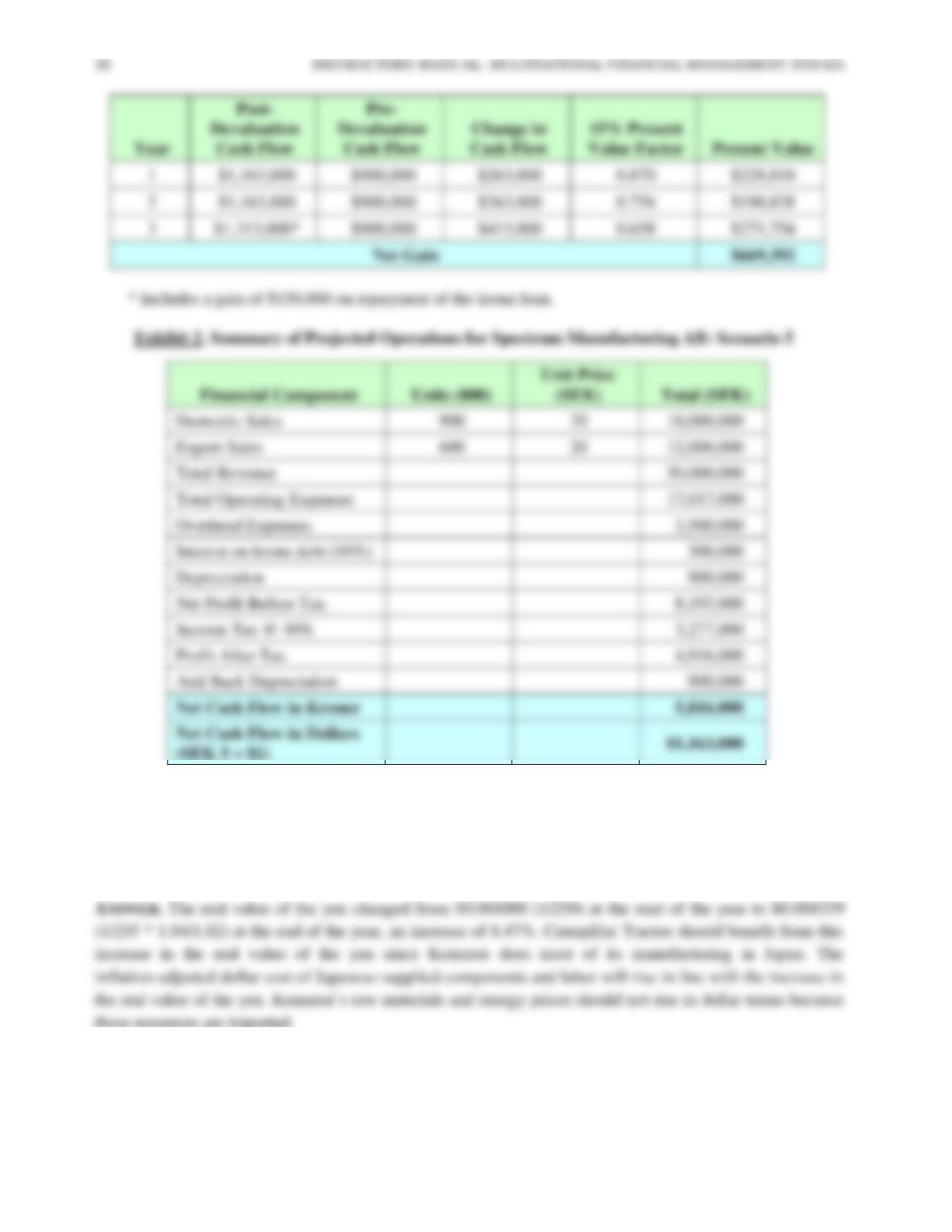
2). Note that a 50% increase in sales volume leads to an 82% increase in profit after tax but to only a 62%
increase in krona cash flow. The latter effect is due to the fixed depreciation charge which causes taxes to
Domestic Sales
Export Sales
Total Revenue
Depreciation
900,000
3. On January 1, the U.S. dollar:Japanese yen exchange rate is $1 = ¥250. During the year, U.S.
inflation is 4% and Japanese inflation is 2%. On December 31, the exchange rate is $1 = ¥235. What
are the likely competitive effects of this exchange rate change on Caterpillar Tractor, the American
earth-moving manufacturer, whose toughest competitor is Japan’s Komatsu?
4. You are asked to lend money for a major commercial real estate development in Calexico, which is
on the California side of the Mexican border. There is some talk about a further devaluation of the
Mexican peso. What information do you need to assess the creditworthiness of this project?
5. About two thirds of all California almonds are exported. The ups and downs of the U.S. dollar,
therefore, cause headaches for almond growers. To avoid these problems, a grower decides to
concentrate on domestic sales. Does that grower bear exchange risk? Why and how?
6. Aldridge Washmon Co. is one of the largest distributors of heavy farming equipment in
Brownsville, Texas, located on the border with Mexico. The time is late 1981. Sales have increased
dramatically over the past two years, and Aldridge is requesting an expansion of its credit line.
What information would you as a banker need before you accede to its request?
7. Assess the likely consequences of a declining dollar on Fluor Corporation, the international
construction-engineering contractor based in Irvine, California. Most of Fluor’s value-added
involves project design and management; most of its costs are for U.S. labor in design, engineering,
8. The European chemical industry pays for an estimated 79% of its oil-based feedstock in dollars.
Thus, its costs are declining sharply because of the drop in the price of oil combined with the sharp
decline in the value of the dollar. What is the likely impact on the European chemical industry’s
profits of the dollar decline? Will it now be more competitive relative to the American chemical
industry?