CHAPTER 10: MEASURING AND MANAGING ECONOMIC EXPOSURE
33
9. Cooper Industries is a maker of compressors, pneumatic tools, and electrical equipment. It does
not face much foreign competition in the U.S., and exports account for only 7% of its sales. Does it
face exchange risk?
10. The Edmonton Oilers (Canada) of the National Hockey League are two-time defending Stanley
Cup champions. (The Stanley Cup playoff is hockey’s equivalent of football’s Super Bowl or
baseball’s World Series.) As is true of all NHL teams, most of the Oilers’ players are Canadian.
How are the Oilers affected by changes in the Canadian dollar/U.S. dollar exchange rate?
ANSWER. The fact that the Oilers are paid in Canadian dollars does not affect the answer to this question
11. South Korean companies such as Goldstar, Samsung, and Daewoo have captured more than 10%
of the U.S. color TV market with their small, low-priced TV sets. They are also becoming more
significant exporters of videocassette recorders and small microwave ovens. What currency risk
do these firms face?
12. A common complaint leveled against the Japanese government is that it deliberately holds down
the value of the yen to boost exports of Japanese products. American steelmakers have been
particularly vocal in their complaints. As a remedy, steelmakers in 1985 asked President Reagan
to curtail Japanese steel imports further and to impose a 25% tariff to offset what they describe
as the “artificial” undervaluation of the yen. Does Nippon Steel profit from a weak yen? What
are the likely consequences of the recent appreciation of the yen? Here are some facts. Imports of
U.S. raw materials priced in dollars account for about one-third of costs, and exports to the U.S.
generate about 4% to 5% of its revenues. Nippon Steel currently is exporting as much steel as it
can to the U.S. under existing quota restrictions. What additional information do you need to
fully assess the impact of currency changes on Nippon Steel?
ANSWER. The initial response is that Nippon Steel gains more on the cost side than it loses on the revenue
13. Monsanto Co., the St. Louis chemical firm, is a major seller of herbicides. Its two brand-name
herbicides, Roundup and Lasso, have a large share of the U.S. and foreign markets. It’s major
competitors are other U.S. chemical companies. How are sales and profits of these products, as
well as Monsanto’s other chemicals, likely to be affected by changes in the value of the dollar?
14. Black & Decker Manufacturing Co. of Towson, Maryland, has roughly 45% of its assets and 40%
of its sales overseas. How does a soaring dollar affect its profitability, both at home and abroad?
ANSWER. Black & Decker has a rough balance between foreign sales and costs. Thus, as the dollar
15. The shipbuilding industry is facing a worldwide capacity surplus. Although Japan currently
controls about 50% of the world market, it is facing severe competition from the South Koreans.
Japanese shipyards are extraordinarily productive, but at current price levels were just about
breaking even with an exchange rate of ¥240 = $1. What are the likely effects on Japanese
shipbuilders of a yen appreciation to ¥180 = $1? The South Korean won has maintained its dollar
value.
ANSWER. The statement that “Japanese shipyards are extraordinarily productive” tells you that there is not
16. Nissho Iwai American Corporation is the American arm of a large Japanese trading company
that deals in everything from steel to tuna fish. Assess the credit-risk implications for Nissho Iwai
of a 30% rise in the dollar value of the yen.
17. Thomasville Plastics Corp. has contracted to buy $1.1 million worth of Japanese plastic-injection
molding machines. The contract price is set in dollars. Does Thomasville bear any currency risk
associated with this purchase? Explain.
18. Middle American Corp. (MAC) produces a line of corn silk cosmetics. All of the inputs are
purchased domestically and processed at the factory in Iowa. Sales are only in the U.S.
18.a. Is there any sense in which MAC is exposed to the risk of foreign exchange rate changes that
effect large MNCs? If yes, how could MAC protect itself from these risks?
ANSWER. MAC is exposed to the risk that the French franc/U.S. dollar exchange rate may change and alter
18.b. If MAC opens a sales office in Paris, will its exposure to exchange rate risks increase? Explain.
19. Gizmo, U.S.A. is investigating medium-term financing of $10 million in order to build an
addition to its factory in Toledo, Ohio. Gizmo’s bank has suggested the following alternatives:
19.a. What information does Gizmo require to decide among the three alternatives?
ANSWER. It is useful to divide this problem into two issues: what is the expected cost and what is the risk of
each alternative. Defining the terms “cost” and “risk” requires careful thought.
19.b. Suppose the factory will be built in Geneva, Switzerland, rather than Toledo. How does this
affect your answer in part a?
ANSWER. If the factory in Geneva sells in Switzerland, then Gizmo has an asset which is essentially
denominated in Swiss francs. This may establish a natural hedge against a Swiss franc loan and reduce the
20. In September 1992, Dow Chemical reacted to the currency chaos in Europe by switching to
DM pricing for all its products in Europe. The purpose, said a Dow executive, was to shift
currency risk from Dow to its European customers. Moreover, said the Dow executive, the
policy was fairer: By setting the same DM price throughout Europe, Dow’s new policy would
nullify any advantage that a Dow customer in one company might have over competitors in
another country based on currency swings.
20.a. What is Dow really trying to accomplish with its new pricing policy?
20.b. What is the likelihood that this new policy will reduce Dow’s currency risk?
20.c. How are Dow’s customers likely to respond to this new policy?
21. Boeing Commercial Airplane Co. manufactures all its planes in the U.S. and prices them in
dollars, even the 50% of its sales destined for overseas markets. Assess Boeing’s currency risk.
How can it cope with this risk?
22. Fire King International, an Indiana manufacturer of fire-resistant filing cabinets and disk
storage units, has sought to protect itself from currency risk by pricing its export sales in
dollars and holding firm on price. What currency risk does Fire King face from a rising dollar?
How can Fire King manage that risk?
23. Cost Plus Imports is a West Coast chain specializing in low-cost imported goods, principally
from Japan. It has to put out its semiannual catalogue with prices that are good for six months.
Advise Cost Plus Imports on how it can protect itself against currency risk.
ANSWER. A company such as Cost Plus will typically negotiate purchase contracts with the suppliers of its
24. Matsushita exports about half of its TV set production to the U.S. under its Panasonic, Quasar,
and Technics brand names. It prices its products in yen. Suppose the yen moves from ¥130 = $1
to ¥110 = $1. What currency risk is Matsushita facing? How can it cope with this currency
risk?
ANSWER. As the yen rises against the dollar, Japanese producers such as Matsushita become less
competitive in the U.S. We have good evidence on what Matsushita is doing to cope with the strong yen.
25. Lyle Shipping, a British company, has chartered out ships at fixed-U.S.-dollar freight rates.
How can Lyle use financing to hedge against its exposure? How will your recommendation
affect Lyle’s translation exposure? Lyle uses the current rate method to translate foreign
currency assets and liabilities. However, the charters are off-balance-sheet items.
ANSWER. Since Lyle has chartered out its ships in dollars, it has fixed dollar revenues. By financing its
26. Texas Instruments (TI) manufactures integrated circuits and memory chips that it sells around
the world. It has major markets in Europe. TI’s primary competitors are Japanese companies.
26.a. What factors will influence TI’s exposure to movements in the dollar value of European
currencies?
ANSWER. Since TI’s main competitors worldwide are Japanese companies, one critical factor affecting its
26.b. Does TI’s European business have yen exposure? Explain.
26.c. How can TI use financing to reduce its yen exposure, to the extent this exposure exists?
27. South Korea’s Korean Air Lines (KAL) is the world’s 12th largest passenger airline and its
second-largest cargo carrier. It has borrowed $5 billion (much of it denominated in dollars) to
finance its fleet of planes.
27.a. In what ways is KAL affected by depreciation of the won against the dollar?
ANSWER. The won’s depreciation against the dollar harms KAL in three ways. (1) Its dollar-denominated
27.b. How can KAL use financing to reduce its currency risk?
27.c. KAL argues that its jet fleet naturally hedges its currency exposure. Do you agree or disagree?
Explain.
27.d. At the end of 1997, KAL decided to sell off its older planes, use the proceeds to pay down some
of its debt, and replace the sold planes with aircraft it leases through a subsidiary in Ireland.
Will this strategy lower KAL’s high debt ratio?
ANSWER. All KAL is doing here is substituting lease payments for debt payments. The two are equivalent.
28. Over the past year, Thailand has experienced an inflation rate of about 7%, in contrast to U.S.
inflation of about 2.5%. At the same time, the exchange rate for the Thai baht (B) has gone from
B26.1/$1 to B38.9/$1.
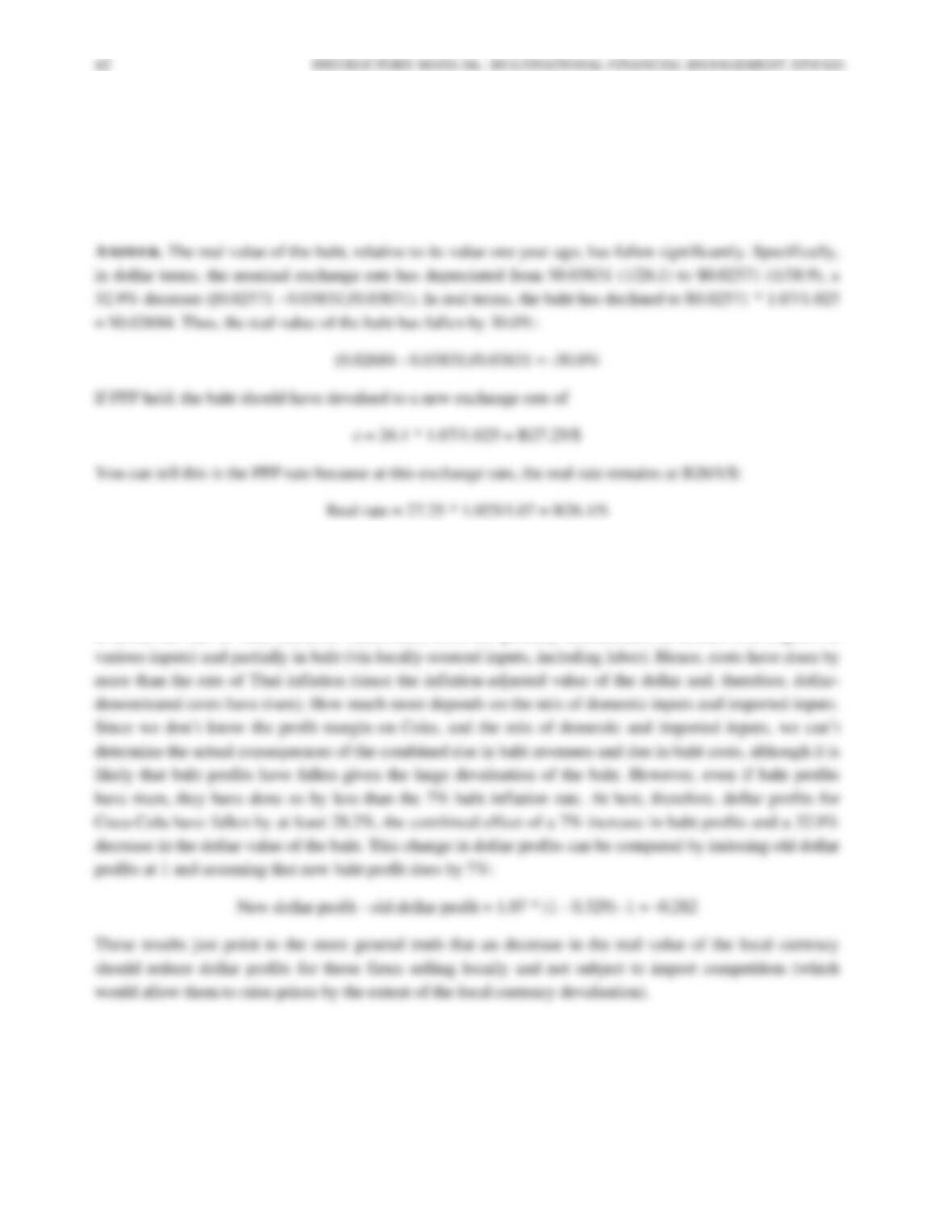
28.a. What has happened to the real value of the baht over the past year? Has it gone up or down? A
little or a lot? How does this compare to the change in its nominal value?
28.b. What are the likely effects of the change in the baht’s real value on the dollar profits of the
Thai subsidiary of a company like Coca-Cola that sells almost exclusively in the Thai market?
ANSWER. A reasonable assumption is that Coca-Cola’s sales, which are generated domestically, have risen
at about the rate of Thai inflation. Meanwhile, costs are partially denominated in dollars (via imports of
28.c. What are the likely effects of the change in the baht’s real value on the dollar profits of a textile
manufacturer that exports most of its output to the U.S.?
28.d. Suppose that Coca-Cola took out a B130 million loan at the beginning of the year. If the
interest rate on the loan was 18%, what was Coca-Cola’s real (inflation-adjusted) baht cost of
borrowing baht over the past year in percentage terms?
ANSWER. According to the Fisher effect, the relationship between the nominal interest rate, r, the inflation
rate, i, and the real interest rate, a, is as follows:
28.e. Given the parameters in part d, what was Coca-Cola’s dollar cost of borrowing baht over the
past year?