Protecting Your Property
Chapter 10
How Will This Affect Me?
The chapter explains the key property insurance concepts of indemnity, subrogation, and co-
insurance. It then describes the common sources of property and liability risk exposures and the
insurance coverage available to address them. The main characteristics of homeowner’s and auto
insurance are covered, as well as how to choose the version of each policy type that’s best for
you. Supplemental insurance to protect against floods and earthquakes and personal liability
umbrella policies are also described. Especially practical tips can be found in the discussions of
LEARNING GOALS
10 – 1 Discuss the importance and basic principles of property insurance, including types of
exposure, indemnity, and co-insurance.
This is terminology. I suggest the above “quiz” approach. Also, the importance of keeping
records of what property you own is discussed. An example worksheet is in Exhibit 10.1.
10 – 2 Identify the types of coverage provided by homeowner’s insurance.
Exhibit 10.2 covers this material, but you need to explain what the various coverages mean. You
10 – 3 Select the right homeowner’s insurance policy for your needs.

Again, a look at Exhibit 10.2 discusses this material. It would be useful to give an example of an
actual casualty that you know about, perhaps one that a “friend” suffered [that is, make up one.]
10 – 4 Analyze the coverage in a personal automobile policy (PAP) and choose the most cost-
effective policy.
10 – 5 Describe other types of property and liability insurance.
Briefly highlight the terms in this section. The power points are sufficient for this topic.
10 – 6 Choose a property and liability insurance agent and company, then settle claims.
Going through an example of a casualty, the work involved in documenting the property lost, the
Financial Facts or Fantasies?
These may be used as “teasers” to get the students on the right page with you. Also, they may be
used as quizzes [see next page] after you covered the material or as “pre–test questions” to get
their attention.
• If you rent an apartment, you don’t need to worry about property insurance since your furniture
and other personal belongings are already covered by the landlord’s insurance policy.
Fantasy: If you rent and do not have some sort of insurance coverage on your furniture and
other personal property, your possessions are uninsured and could be lost! Your landlord is liable
only if you can prove that your loss was due to his or her negligence.
• You must generally obtain an umbrella personal liability policy if you want liability coverage
of $1 million or more.
Fact: Such policies provide added liability protection for both homeowners and automobile
insurance (simultaneously). They are intended primarily for upper-income families, who are
often viewed as targets for large liability claims.

Financial Facts or Fantasies?
These may be used as a quiz or as a pre-test to get the students interested.
1. True False Homeowners insurance provides protection not only on the home
itself but also most of its contents.
2. True False If you rent an apartment, you don’t need to worry about property
insurance since your furniture and other personal belongings are
already covered by the landlord’s insurance policy.
3. True False Uninsured motorists’ coverage is available as part of most
automobile insurance policies.
4. True False The type of car you drive is a personal matter that has no bearing
on how much you will have to pay for automobile insurance.
5. True False You must generally obtain an umbrella personal liability policy if
you want liability coverage of $1 million or more.
6. True False Filing a property or liability claim is quick and easy to do. Just call
your agent, provide a few basic details, and look for your check in a
few days.
YOU CAN DO IT NOW
The “You Can Do It Now” cases may be assigned to the students as short cases or problems.
These cases will help make the topic more real or relevant to the students. In most cases, it will
only take about ten minutes to do, that is, until the student starts looking around at the web site.
But they will learn by doing so.
Check Out the Best Homeowners Insurance Companies
Evaluate the Best Auto Insurance Companies
When you’re considering buying new car insurance, it’s helpful to know which insurance
Financial Impact of Personal Choices
Read and think about the choices being made. Do you agree or not? Ask the students to discuss
the choices being made.
Jayden Saves on His Car Insurance
Jayden Dunn is a frugal and careful financial planner. One of his money-saving decisions is to
continue driving his 9-year-old car, which is now worth about $7,500. In order to save money on
Applying Personal Finance
Insure Your Property!
Adequate property insurance is a vital part of financial planning. It helps protect our hard-earned
investments in a home, car, or other property. This project will help you determine your property
insurance needs.
List the property for which you’d need insurance coverage. Your list may include such things as
Solutions to Financial Planning Exercises
1. Co-insurance clauses. Assume that Savannah Stone had a homeowner’s insurance policy
with $200,000 of coverage on the dwelling. Would a 90 percent co-insurance clause be
better than an 80 percent clause in such a policy? Give reasons to support your answer.
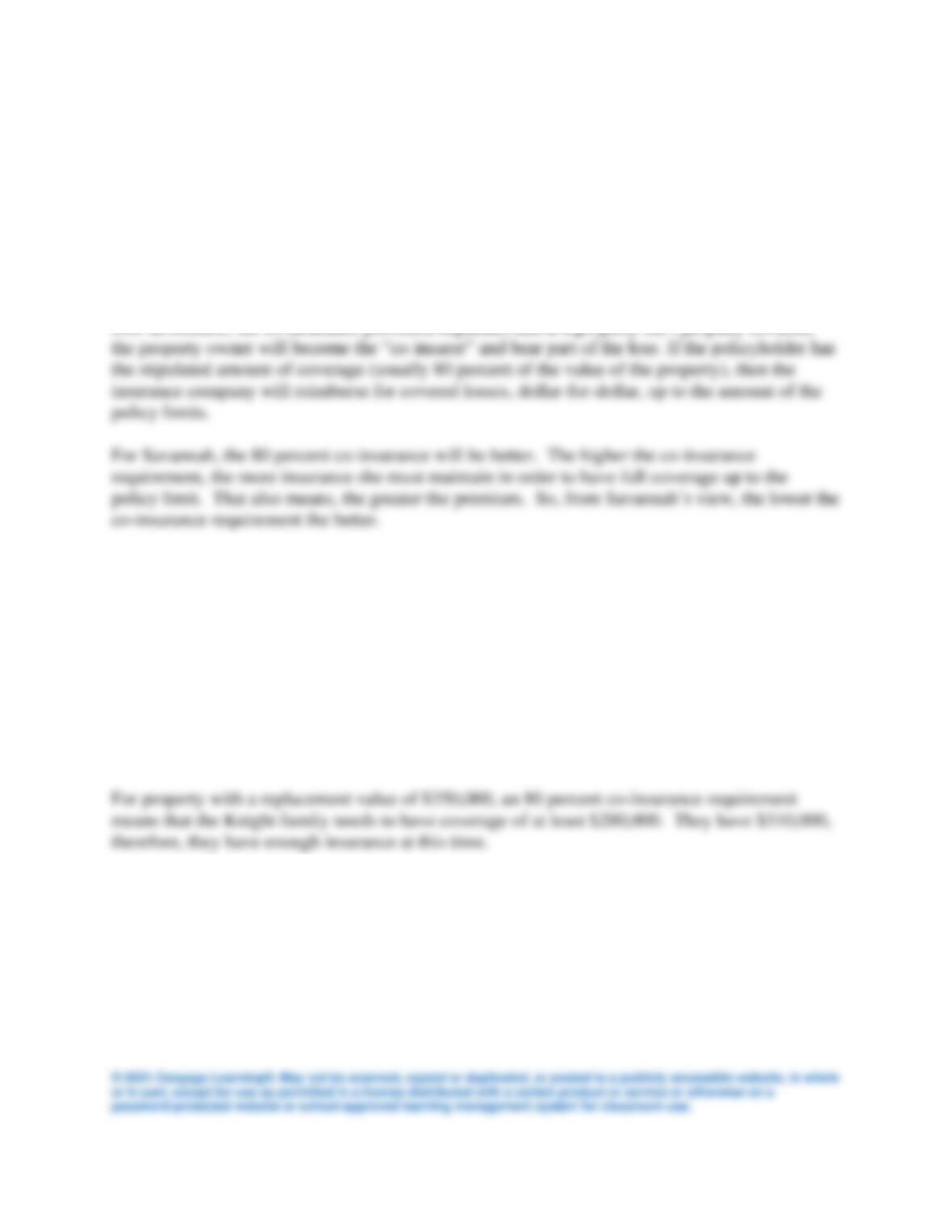
Co-insurance, a provision commonly found in property insurance contracts, requires
policyholders to buy insurance in an amount equal to a specified percentage of the replacement
value of their property, or else the policyholder is required to pay for a proportional share of the
2. Evaluating homeowner’s policy coverage. Last year, Eleanor and Felix Knight bought a
home with a dwelling replacement value of $350,000 and insured it (via an HO-5 policy) for
$310,000. The policy reimburses for actual cash value and has a $500 deductible, standard
limits for coverage C items, and no scheduled property. Recently, burglars broke into the
house and stole a 2-year-old television set with a current replacement value of $600 and an
estimated useful life of 8 years. They also took jewelry valued at $1,850 and silver flatware
valued at $3,000.
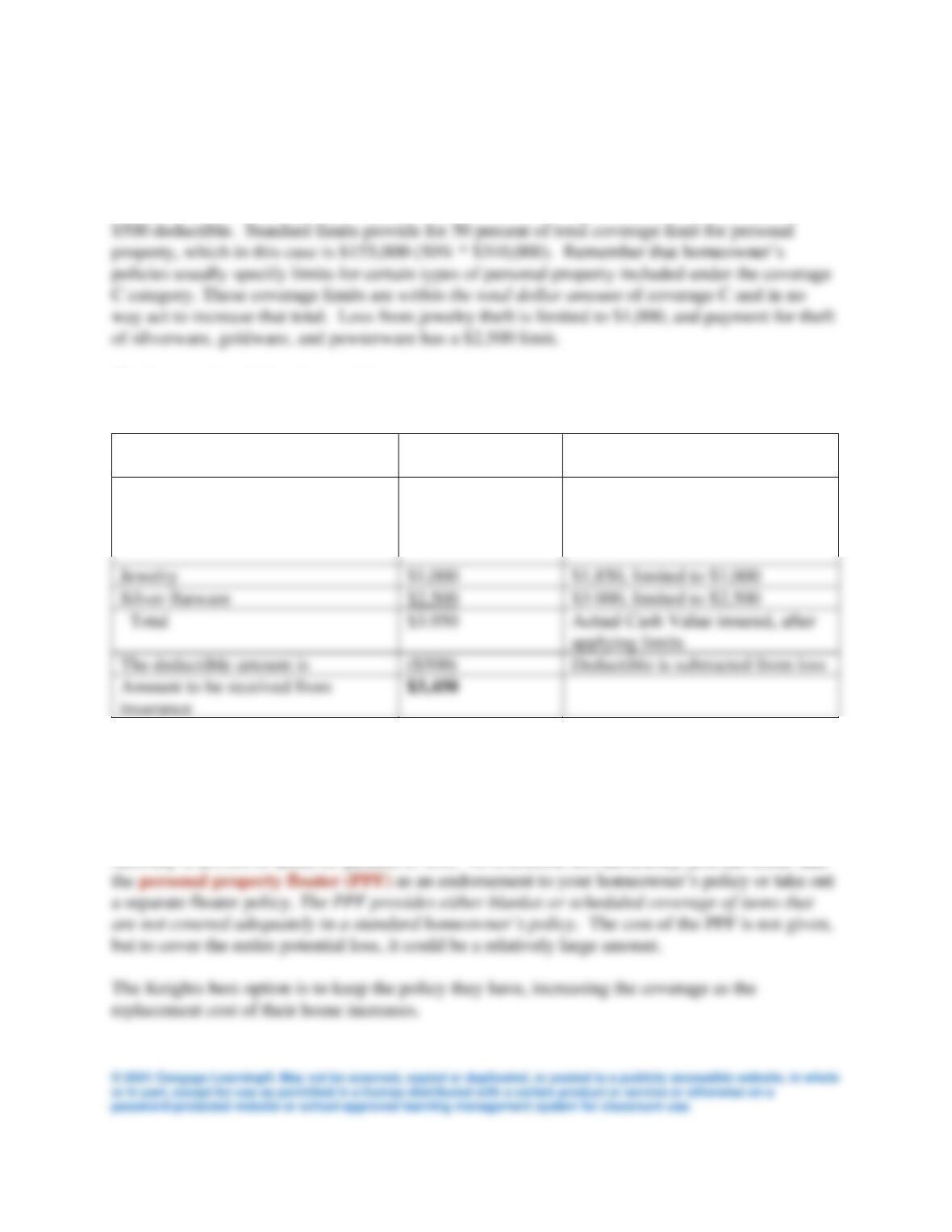
a. If the Knight’s policy has an 80 percent co-insurance clause, do they have enough
insurance?
b. Assuming a 50 percent coverage C limit, calculate how much the Knights would receive
if they filed a claim for the stolen items.
An HO-5 provides comprehensive coverage on the real and personal property. Coverage C
refers to personal property and the policy states that the coverage is actual cash value with a
The items stolen, their value, and insurance coverage are:
Item stolen
Amount received
from insurance
Computation
Two-year old television
$450
$600 replacement value less 2/8
or $150 yields actual cash value of
loss.
Jewelry
$1,000
$1,850, limited to $1,000
Silver flatware
$2,500
$3 000, limited to $2,500
The deductible amount is
($500)
Deductible is subtracted from loss
Amount to be received from
insurance
c. What advice would you give the Knight family about their homeowner’s coverage?
The probability of a second robbery is very low. With the current insurance, the Knights have a
total loss of $5,450 valued at replacement cost ($600 + $1,850 + $3,000). Their insurance
3. Payout on homeowner’s insurance policy. Ivy Gordon’s home in Charleston was recently
gutted in a fire. Her living and dining rooms were destroyed completely, and the damaged
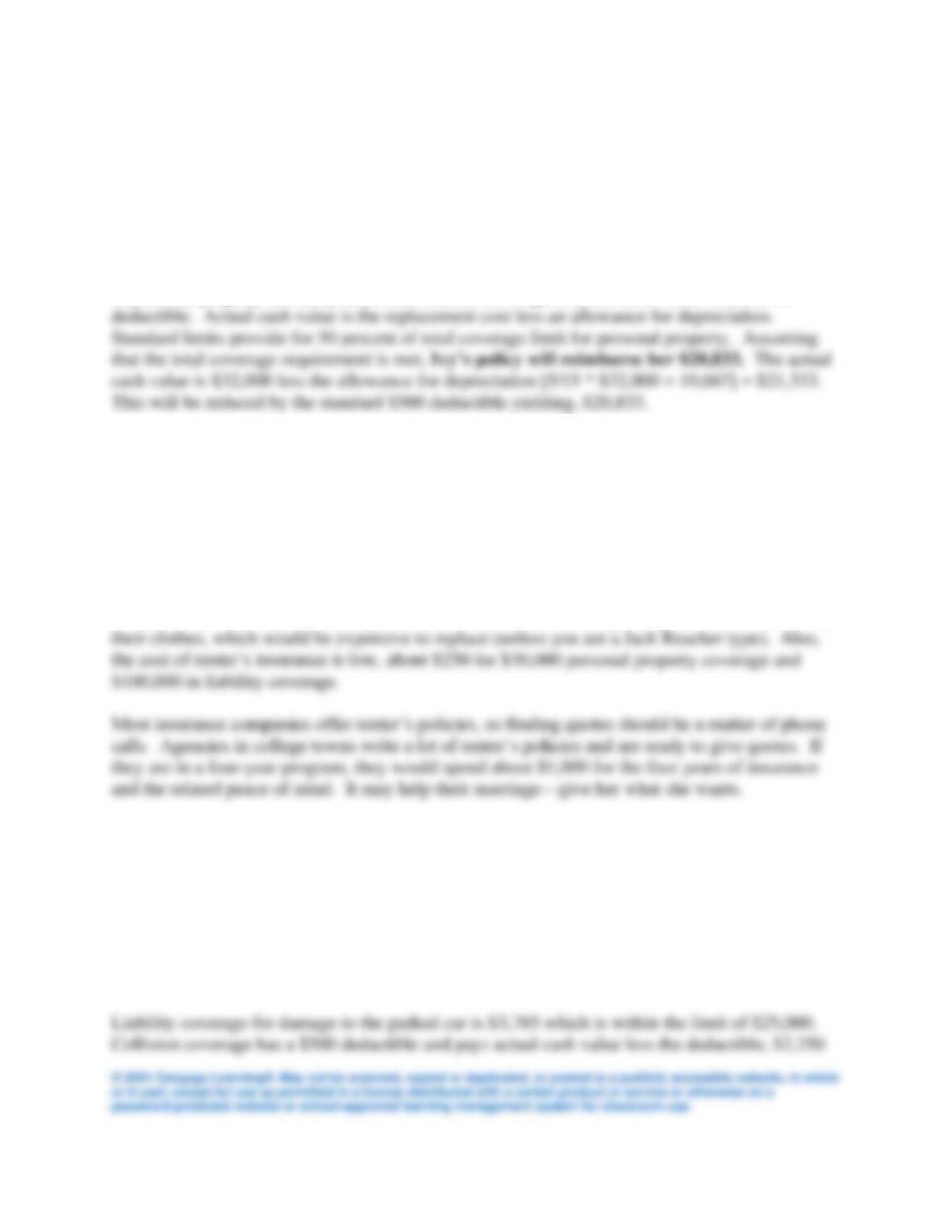
personal property had a replacement price of $32,000. The average age of the damaged
personal property was 5 years, and its useful life was estimated to be 15 years. What is the
maximum amount the insurance company would pay Ivy, assuming that it reimburses
losses on an actual cash-value basis?
A HO-5 provides comprehensive coverage on the real and personal property. Coverage C refers
to personal property and the policy states that the coverage is actual cash value with a $500
4. Need for renter’s insurance. Jane and Leo Daniels, both graduate students, moved into an
apartment near the university. Jane wants to buy renter’s insurance, but Leo thinks that
they don’t need it because their furniture isn’t worth much. Jane points out that, among
other things, they have some expensive computer and stereo equipment. To help the
Daniels resolve their dilemma, suggest a plan for deciding how much insurance to buy and
give them some ideas for finding a policy.
Without insurance, a major casualty such as a fire, would be costly to the Daniels. They have no
insurance and their expensive computers and stereo would be costly to replace. Another asset is
5. Personal automobile policy coverage. Finn Stone has a PAP with coverage of
$25,000/$50,000 for bodily injury liability, $25,000 for property damage liability, $5,000 for
medical payments, and a $500 deductible for collision insurance. How much will his
insurance cover in each of the following situations? Will he have any out-of-pocket costs?
a. Finn loses control and skids on ice, running into a parked car and causing $3,785
damage to the unoccupied vehicle and $2,350 damage to his own car.
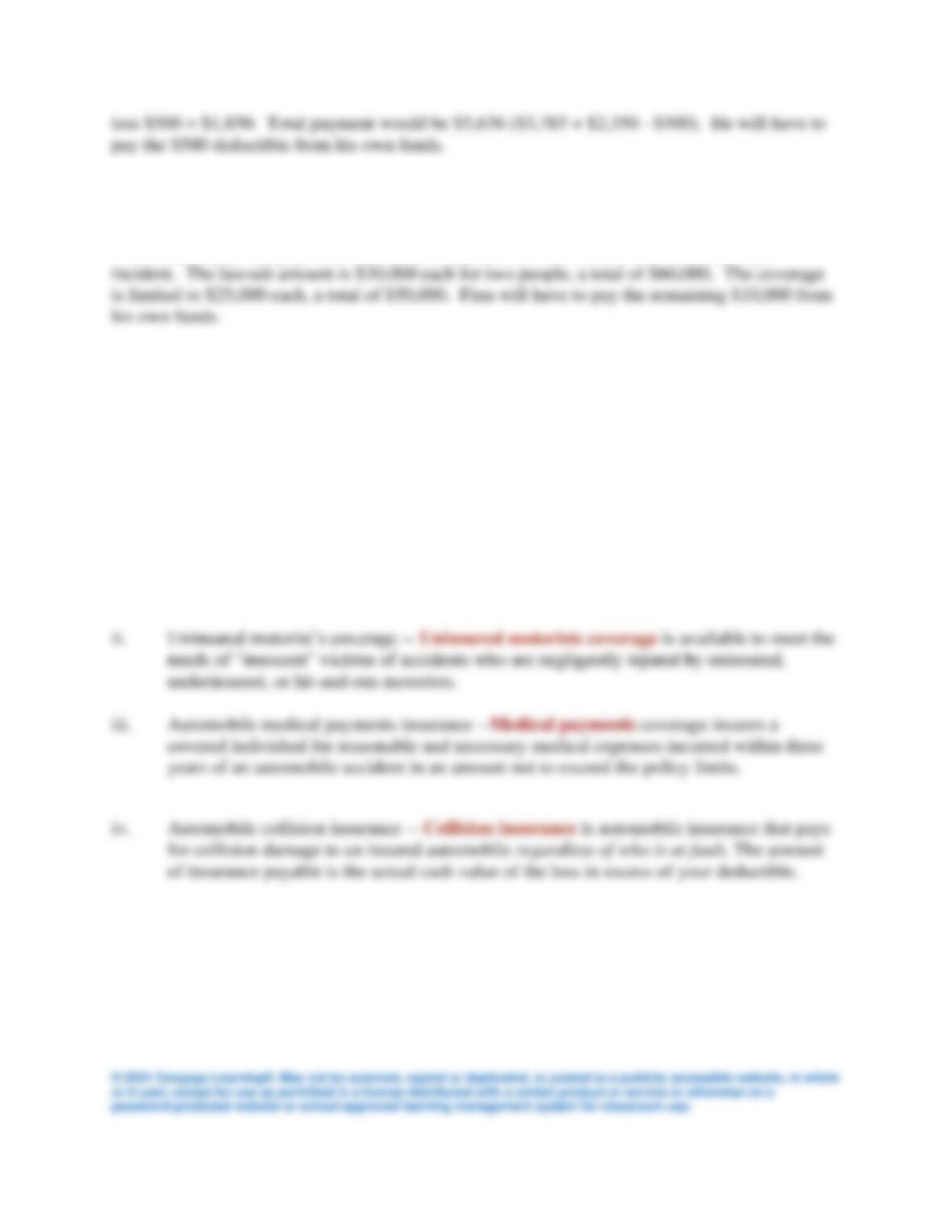
b. Finn runs a stop sign and causes a serious auto accident, badly injuring two people. The
injured parties win lawsuits against him for $30,000 each.
Finn’s liability policy pays a limit of $25,000 per person with a total limit of $50,000 per
c. Finn’s 18-year-old son borrows his car. He backs into a telephone pole and causes $1,450
damage to the car.
The collision policy covers regardless of who is at fault, thus the coverage is $950 ( damage is
$1,450, less deductible of $500).
For your information, not part of solution, the key features of these insurance policies are :
i. Basic automobile liability insurance — As part of the liability provisions of a PAP, the
insurer agrees to:
1. Pay damages for bodily injury and/or property damage for which you are legally
responsible as a result of an automobile accident,
2. Settle or defend any claim or suit asking for such damages.
v. Comprehensive automobile insurance — Comprehensive automobile insurance protects
against loss to an insured automobile caused by any peril (with a few exceptions) other
than collision.
Who is covered? Essentially, an insured person includes you (the named insured) and any
family member, any person using a covered auto, and any person or organization that may be
held responsible for your actions. The named insured is the person named in the declarations
6. Supplemental property insurance. Scarlett and Damon Mitchell are a high-net-worth
couple. They have appropriate auto and homeowner’s insurance but are concerned that
they could be sued by someone visiting or working at their home. What type of
supplemental insurance might be appropriate for the Mitchell family in light of their
expressed concern? Explain your answer.
Persons with moderate to high levels of income and net worth may want to purchase a personal
for as much as $1 million in coverage.
7. Auto insurance claims. Dexter and Hannah Roberts recently went out for dinner on a
rainy night. When the traffic unexpectedly slowed down, they were rear-ended by an
inexperienced driver. Describe what steps the Roberts family should have taken after the
accident to assure that their auto insurance claim would be settled properly.
First Steps Following an Accident After an accident, record the names, addresses, and phone
1. Notice to your insurance company. You must notify your insurance company that a loss (or
potential for loss) has occurred. Timely notice is extremely important. o Handle a Denied
Insurance Claim
2. Investigation. Insurance company personnel may talk to witnesses or law enforcement
officers and gather physical evidence to determine whether the claimed loss is covered by the
3. Proof of loss. This proof requires you to give a sworn statement. You may have to show
medical bills, submit an inventory, and certify the value of lost property (e.g., a written
inventory, photographs, and purchase receipts). You may also have to submit an employer
statement of lost wages and, if possible, physical evidence of damage (e.g., X-rays if you claim a
Critical Thinking Cases
10.1 The Scott’s Homeowners’ Insurance Decision
Levi and Riley Scott, ages 30 and 28, were recently married in Denver. Levi is an electrical
engineer with Bright Solutions, a computer component design firm. Riley has a master’s
degree in education and teaches at a local middle school. After living in an apartment for
six months, the Scotts have negotiated the purchase of a new home in a rapidly growing
Denver suburb. Denver City Savings and Loan Association has approved their loan request
Critical Thinking Questions
1. What forms of homeowner’s insurance are available? Which forms should the Scotts
consider?
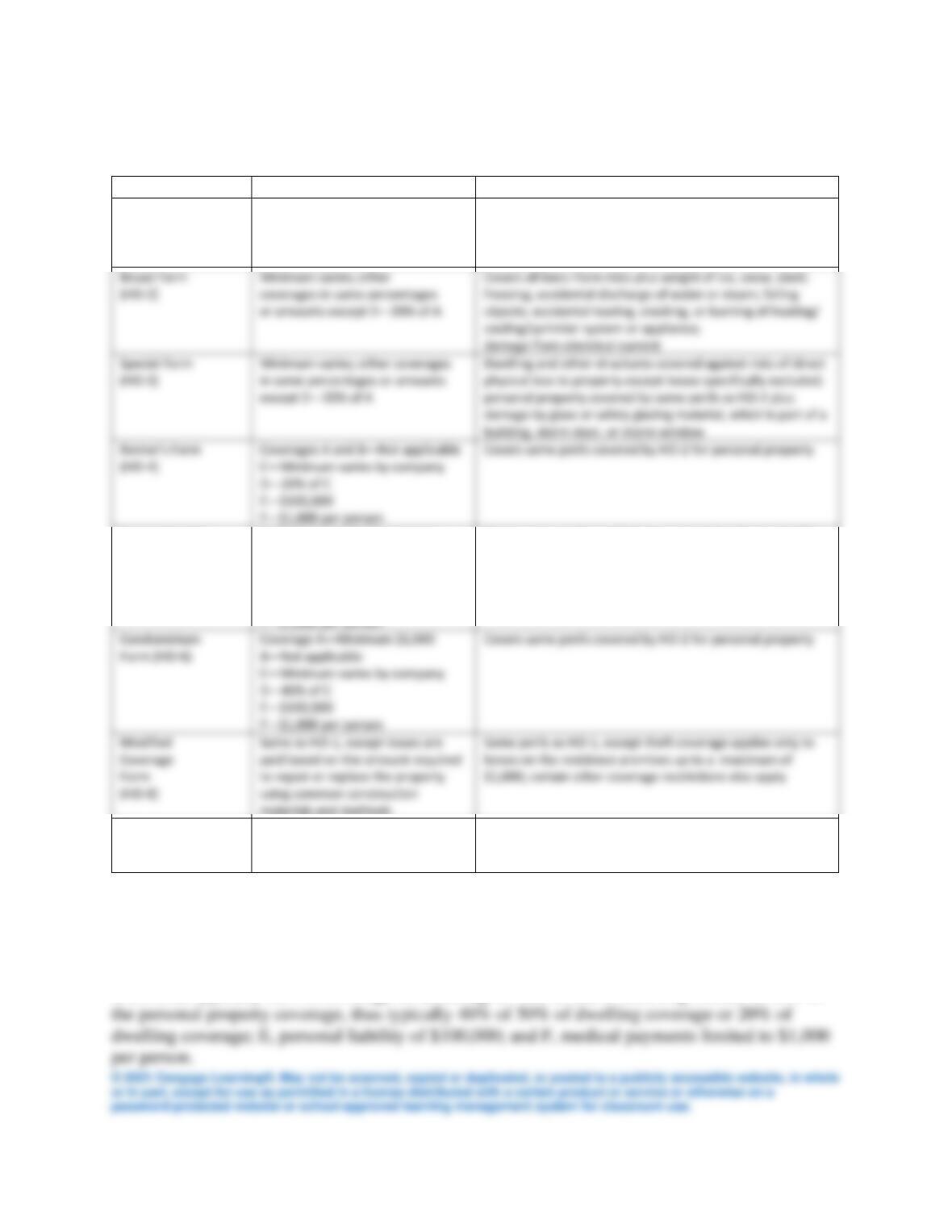
Exhibit 10.2 A Guide to Homeowner’s Policies
The amount of insurance coverage you receive depends on the type of homeowner’s (HO) policy
you buy. You can also obtain coverage if you’re a renter or a condominium
Form
Coverages
Covered Perils
Basic Form
(HO–1)
A—$15,000 minimum;
B—10% of A; C—50% of A;
D—10% of A; E—$100,000;
F—$1,000 per person
Fire, smoke, lightning, windstorm, hail, volcanic eruption,
explosion, glass breakage, aircraft, vehicles,
riot or civil commotion, theft, vandalism or malicious
mischief
damage from electrical current
Comprehensive
Form (HO–5)
A- Minimum varies by company
B- Minimum varies by company
C—Minimum varies by company
D—40% of C
E—$100,000
Form (HO–6)
D—40% of C
Covers same perils as HO-3, but covered perils are dwelling,
other structures, and personal property covered against
risks of direct physical loss except losses that are excluded
specifically
materials and methods
* Coverages:
A. Dwelling
B. Other structures
C. Personal property
D. Loss of use
E. Personal liability
F. Medical payments to others
3. Discuss the types of loss protection provided by the homeowner’s policies under
consideration.
HO-5 Comprehensive coverage provides Coverage A, the dwelling; C, the personal property
with limits typically 50% of coverage on dwelling; D. loss of use of dwelling limited to 40% of