Answers and Solutions: 1- 1
Chapter 1
An Overview of Financial Management and
The Financial Environment
ANSWERS TO BEGINNING-OF-CHAPTER QUESTIONS
1-1 The primary goal is assumed to be shareholder wealth maximization, which translates to
stock price maximization. That, in turn, means maximizing the PV of future free cash
flows.
Maximizing shareholder wealth requires that the firm produce things that customers
want, and at the lowest cost consistent with high quality. It also means holding risk
down, which will result in a relatively low cost of capital, which is necessary to
maximize the PV of a given cash flow stream.
Shareholder wealth maximization is partially consistent and partially inconsistent
with generally accepted societal goals. It is consistent because well-run firms produce
good products at low costs, sell them at competitive prices, employ people, pay taxes, and
generally improve society. However, without constraints, firms would tend to form
monopolies and end up charging prices that are too high and not producing enough
output. They might also pollute the air and water, engage in unfair labor practices, and so
1-2 See the model for quantitative answers to this question. All of these valuations involve
applications of the basic valuation model:
1-3 The advantages of a corporate form of ownership are that investor liability is limited to
the amount invested, corporations can raise capital through public offerings of stock, and
ownership can be easily transferred from person to person by simply selling shares of
stock. In a sole proprietorship or partnership, on the other hand, the owner or owners are
1-4 The cost of money is affected by (1) production opportunities, (2) the time preference for
consumption, (3) risk, and (4) inflation. When production opportunities are good, and
assets are earning high rates of return, then interest rates tend to be higher because there
is a larger demand for borrowing to finance these projects. Also, investors who are
considering lending money recognize that their alternative investments have a high
1-5 Securitization is the process by which assets, such as mortgages held by banks, accounts
receivables held by companies, or credit card obligations held by banks and finance
companies, are packaged together and sold to investors. In the case of mortgages, a bank
or savings and loan (S&L) may have a portfolio of mortgages that it has originated (or
issued). Typically, a bank will have financed these mortgages with savings and checking
1-6 Just like the Great Depression that preceded it 80 years earlier, the causes of the Global
Economic Crisis that began in 2007 and lasted through 2009 will likely be the subject of
vigorous debate for years to come. As an example of one small aspect of the crisis,
consider how securitized mortgages end up in retirement portfolios, and how a decline in
housing prices in, say Florida, can bankrupt investors half a world away: A mortgage
Now consider what happens when housing prices stop growing and begin to decline
in Florida. Many of these loans were floating rate loans with low “teaser rates” initially,
but much higher “reset” rates after 1, 2, or 3 years. The idea was when the low teaser rate
expired the homeowner would either sell the house or refinance it, in either case paying
off the loan. Importantly, the homeowner never intended, and frequently simply could not
afford, to pay the much higher “reset” rate. But with housing prices declining, the
homeowner can’t sell the house for as much as the outstanding loan. And since the
Answers and Solutions: 1- 5
ANSWERS TO END-OF-CHAPTER QUESTIONS
1-1 a. A proprietorship, or sole proprietorship, is a business owned by one individual. A
partnership exists when two or more persons associate to conduct a business. In
contrast, a corporation is a legal entity created by a state. The corporation is separate
and distinct from its owners and managers.
c. Stockholder wealth maximization is the appropriate goal for management decisions.
The risk and timing associated with expected earnings per share and cash flows are
considered in order to maximize the price of the firm’s common stock.
d. Production opportunities are the returns available within an economy from investment
in productive assets. The higher the production opportunities, the more producers
would be willing to pay for required capital. Consumption time preferences refer to
1-2 Sole proprietorship, partnership, and corporation are the three principal forms of business
organization. The advantages of the first two include the ease and low cost of formation.
The advantages of the corporation include limited liability, indefinite life, ease of
ownership transfer, and access to capital markets.
Answers and Solutions: 1- 6
1-3 A firm’s fundamental, or intrinsic, value is the present value of its free cash flows when
1-4 Earnings per share in the current year will decline due to the cost of the investment made
1-5 In a well-functioning economy, capital will flow efficiently from those who supply
capital to those who demand it. This transfer of capital can take place in three different
ways:
1. Direct transfers of money and securities occur when a business sells its stocks or
bonds directly to savers, without going through any type of financial institution. The
Mini Case: 1- 7
MINI CASE
Assume that you recently graduated and have just reported to work as an investment
advisor at the brokerage firm of Balik and Kiefer Inc. One of the firm’s clients is Michelle
Dellatorre, a professional tennis player who has just come to the United States from Chile.
Dellatorre is a highly ranked tennis player who would like to start a company to produce
and market apparel that she designs. She also expects to invest substantial amounts of
money through Balik and Kiefer. Dellatorre is also very bright, and, therefore, she would
like to understand, in general terms, what will happen to her money. Your boss has
developed the following set of questions which you must ask and answer to explain the U.S.
financial system to Dellatorre.
a. Why is corporate finance important to all managers?
Answer: Corporate finance provides the skills managers need to: (1) identify and select the
b. Describe the organizational forms a company might have as it evolves from a start-up
to a major corporation. List the advantages and disadvantages of each form.
Answer: The three main forms of business organization are (1) sole proprietorships, (2)
partnerships, and (3) corporations. In addition, several hybrid forms are gaining
popularity. These hybrid forms are the limited partnership, the limited liability
Mini Case: 1- 8
The corporate form of business has three major advantages: (1) unlimited life, (2)
easy transferability of ownership interest, and (3) limited liability. While the
corporate form offers significant advantages over proprietorships and partnerships, it
does have two primary disadvantages: (1) corporate earnings may be subject to
c. How do corporations “go public” and continue to grow? What are agency
problems? What is corporate governance?
Answer: A company goes public when it sells stock to the public in an initial public as the firm
grows, it might issue additional stock or debt. An agency problem occurs when the
d. What should be the primary objective of managers?
Answer: The corporation’s primary goal is stockholder wealth maximization, which translates
d. 1. Do firms have any responsibilities to society at large?
Answer: Firms have an ethical responsibility to provide a safe working environment, to avoid

Mini Case: 1- 9
d. 2. Is stock price maximization good or bad for society?
Answer: The same actions that maximize stock prices also benefit society. Stock price
maximization requires efficient, low-cost operations that produce high-quality goods
d. 3. Should firms behave ethically?
Answer: Yes. Results of a recent study indicate that the executives of most major firms in the
United States believe that firms do try to maintain high ethical standards in all of their
e. What three aspects of cash flows affect the value of any investment?
Answer: (1) amount of expected cash flows; (2) timing of the cash flow stream; and (3)
f. What are free cash flows?
Answer: free cash flows are the cash flows available for distribution to all investors
Mini Case: 1- 10
g. What is the weighted average cost of capital?
Answer: The weighted average cost of capital (WACC) is the average rate of return required
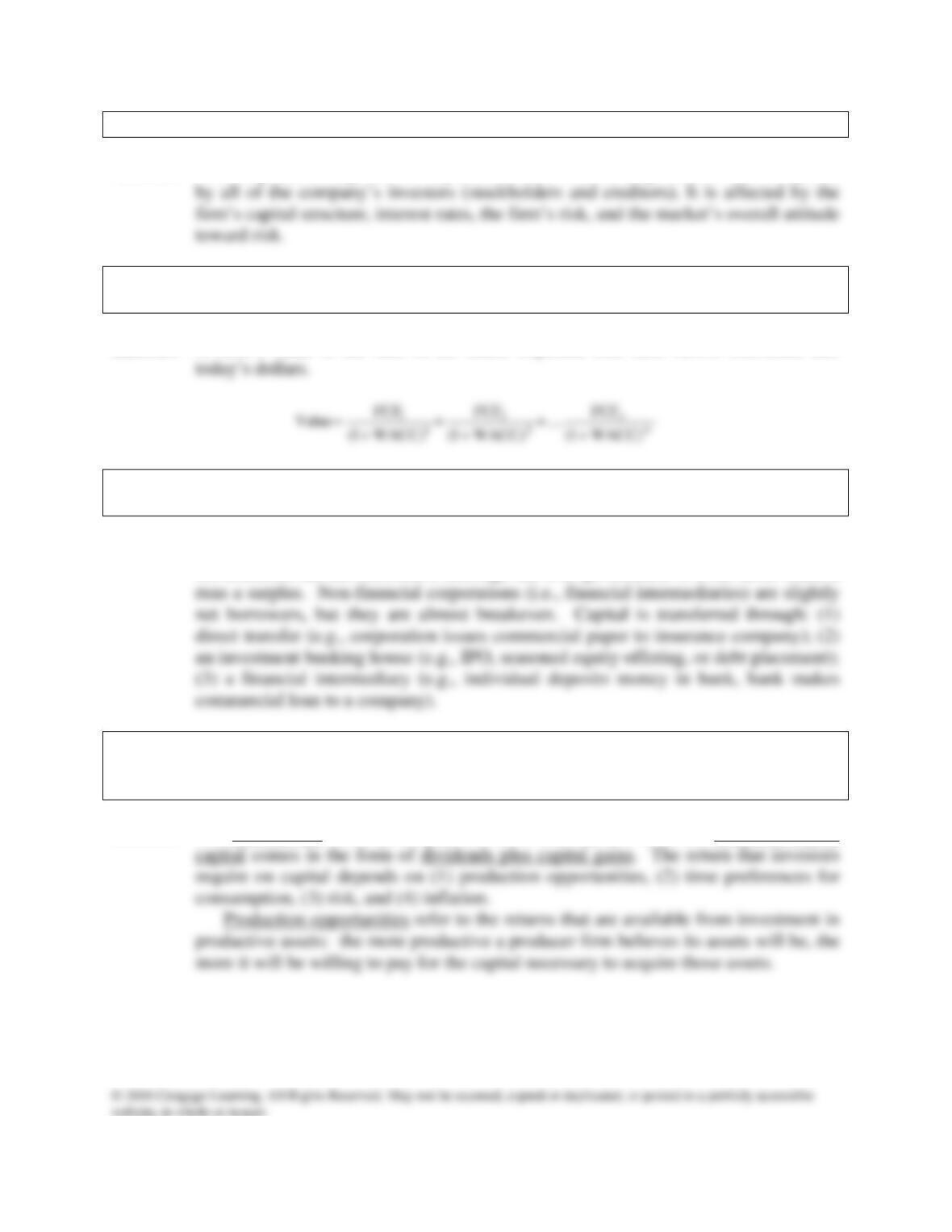
h. How do free cash flows and the weighted average cost of capital interact to
determine a firm’s value?
Answer: A firm’s value is the sum of all future expected free cash flows, converted into
i. Who are the providers (savers) and users (borrowers) of capital? How is capital
transferred between savers and borrowers?
Answer: Households are net savers. Non-financial corporations are net borrowers.
Governments are net borrowers, although the U.S. government is a net saver when it
j. What do we call the price that a borrower must pay for debt capital? What is the
price of equity capital? What are the four most fundamental factors that affect
the cost of money, or the general level of interest rates, in the economy?
Answer: The interest rate is the price paid for borrowed capital, while the return on equity
Mini Case: 1- 11
Time preference for consumption refers to consumers’ preferences for current
consumption versus savings for future consumption: consumers with low preferences
for current consumption will be willing to lend at a lower rate than consumers with a
k. What are some economic conditions that affect the cost of money?
Answer: The cost of money will be influenced by such things as fed policy, fiscal deficits,
business activity, and foreign trade deficits.
The cost of money for an international investment is also affected by country risk,
Mini Case: 1- 12
l. What are financial securities? Describe some financial instruments.
Answer: Financial assets are pieces of paper with contractual obligations. Some short-term
(i.e., they mature in less than a year) are instruments with low default risk are u.s.
treasury bills, banker’s acceptances, commercial paper, negotiable CDs, and
m. Briefly explain mortgage securitization and how it contributed to the global
economic crisis.
Answer: Homeowners wanted better homes than they could afford. Mortgage brokers
encouraged homeowners to take mortgages that would reset to payments that the
borrowers might not be able to pay because the brokers got a commission for closing