1 –
1
CHAPTER 1
THE INVESTMENT SETTING
1.1 What is an Investment
▪ Income streams and spending needs usually do not coincide
1.1.1 Investment Defined
▪ Investment is the current commitment of dollars for a period of time to obtain future
1.2 Measures of Return and Risk
1.2.1 Measures of Historical Rates of Return
than 1.0 indicates an increase in wealth, a value less than 1.0 indicates a decline in wealth,
and a value of zero indicates that all of the money invested in that asset has been lost.
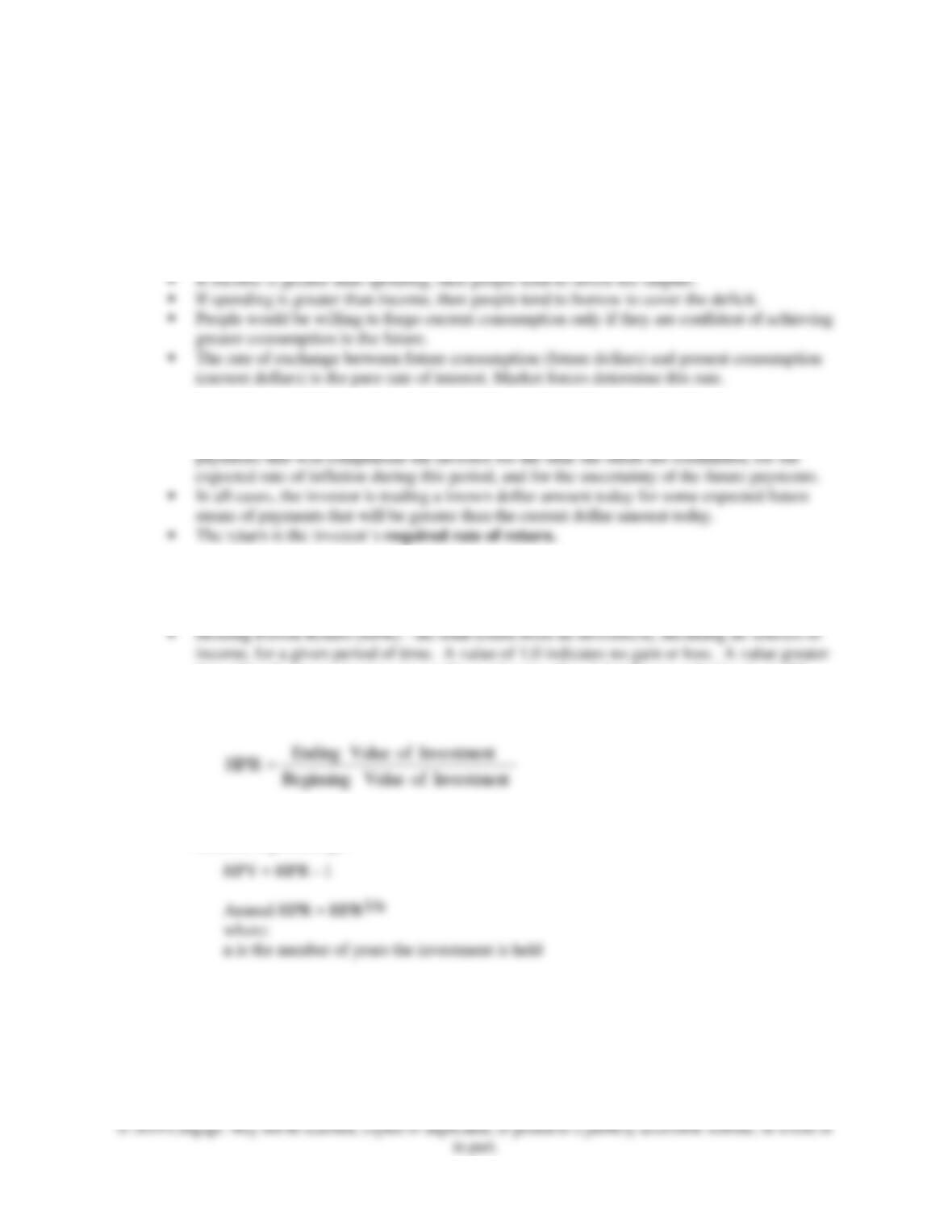
▪ Holding Period Yield (HPY) – the total return from an investment for a given period of time
stated as a percentage.
1.2.2 Computing Mean Historical Returns
▪ Mean rates of return – the average of an investment’s returns over time.
1. Single Investment
a. Arithmetic Mean (AM) – a measure of mean return equal to the sum of annual HPYs
Investment of Value Beginning
Investment of Value Ending
HPR =
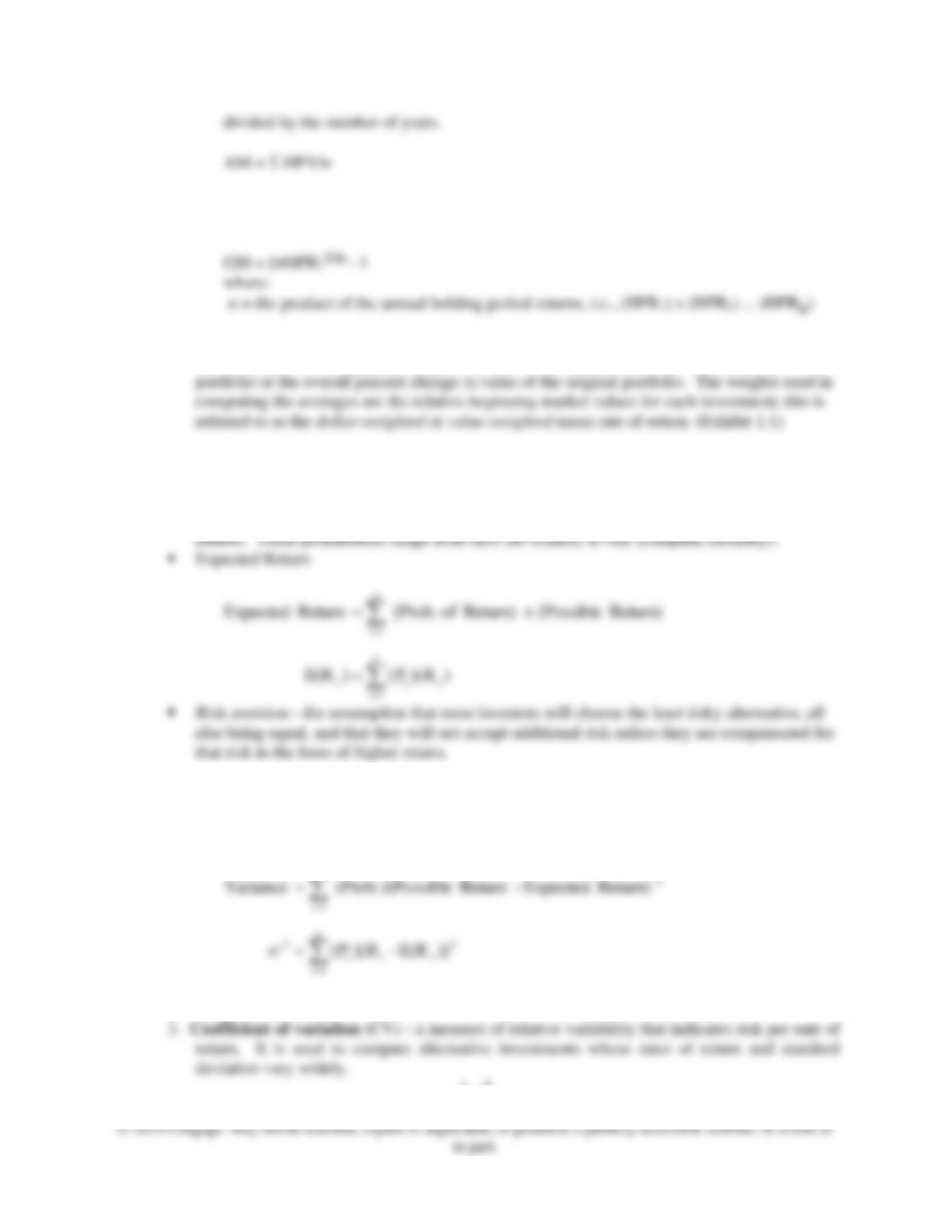
b. Geometric Mean (GM) – the nth root of the product of the annual holding period returns
for n years, minus one (1).
▪ A Portfolio of Investments – The mean historical rate of return for a portfolio of investments
is measured as the weighted average of the HPYs for the individual investments in the
1.2.3 Calculating Expected Rates of Return (Exhibit 1.2, 1.3, 1.4)
▪ Risk – the uncertainty that an investment will earn its expected rate of return.
▪ Probability – the likelihood of an outcome
▪ To compute the expected rate of return, the investor assigns probability values to all possible
1.2.4 Measuring the Risk of Expected Rates of Return
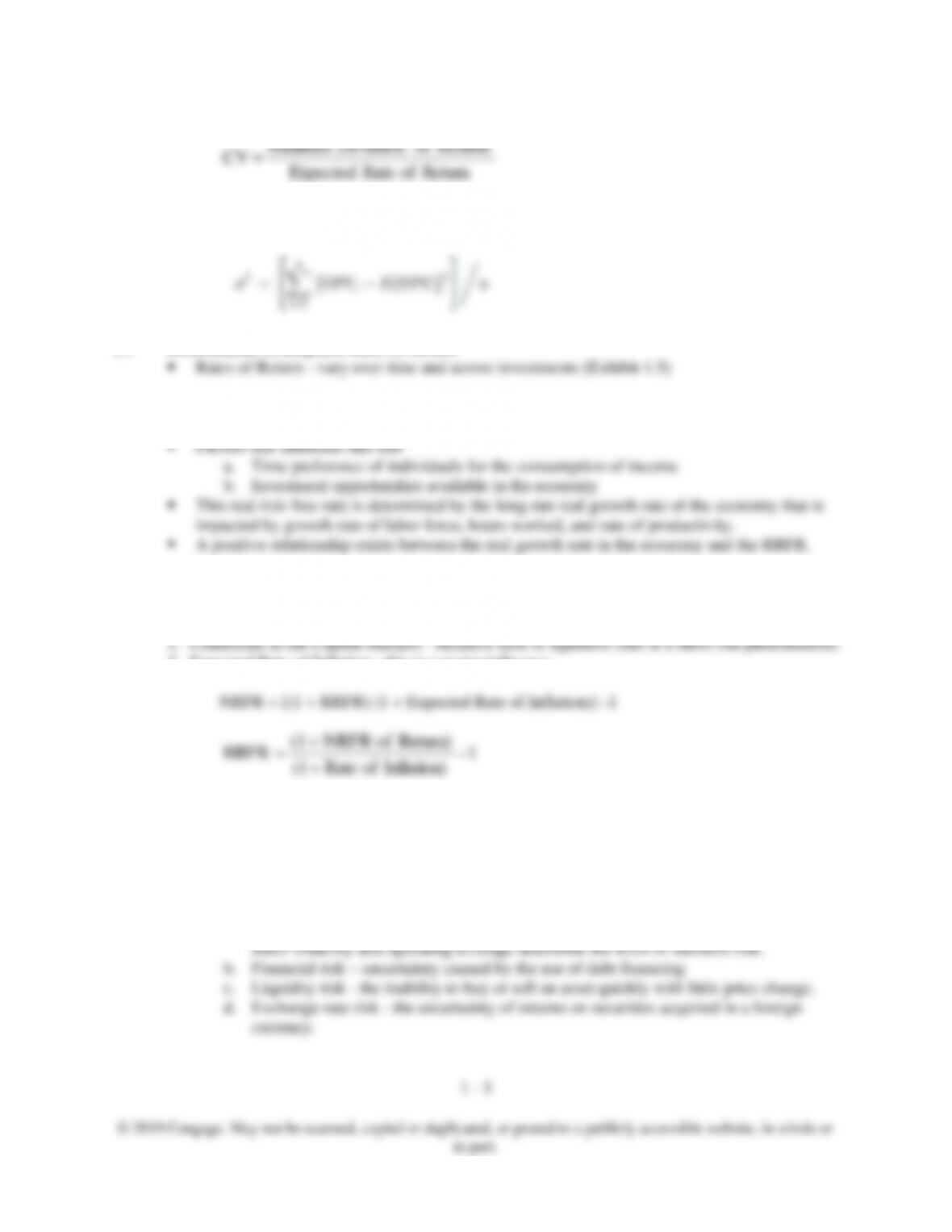
1. Variance – a measure of risk equal to the sum of the probability of return times the squares of
a return’s deviation from the mean.
2. Standard Deviation () – a measure of risk equal to the square root of variance.
=
=
=
=
n
1i
2
iii
2
n
1i
2
)]E(R – R)[P(
Return) Expected–Return ssible(Prob.)(Po Variance
1.2.5 Risk Measures for Historical Returns
▪ Use the historical holding period yields (HPYs)
1.3 Determinants of Required Rates of Return
1.3.1 The Real Risk-Free Rate (RRFR)
▪ The basic interest rate assuming no inflation and uncertainty about future flows
1.3.2 Factors Influencing the Nominal Risk-Free Rate (NRFR)
▪ Note the substantial variation in government T-bill rates over time (Exhibit 1.6)
2. Expected Rate of Inflation – this is a major influence
3. The Common Effect – all factors discussed thus far affects all investments equally,
irrespective of type or form.
1.3.3 Risk Premium
▪ Varies from asset to asset and is responsible for differences in rates of return between assets
at a certain point in time. The major determinants of the risk premium are:
a. Business risk – uncertainty of income flows caused by the nature of a firm’s business.
Return of Rate Expected
Returns ofDeviation Standard
CV =
1 –
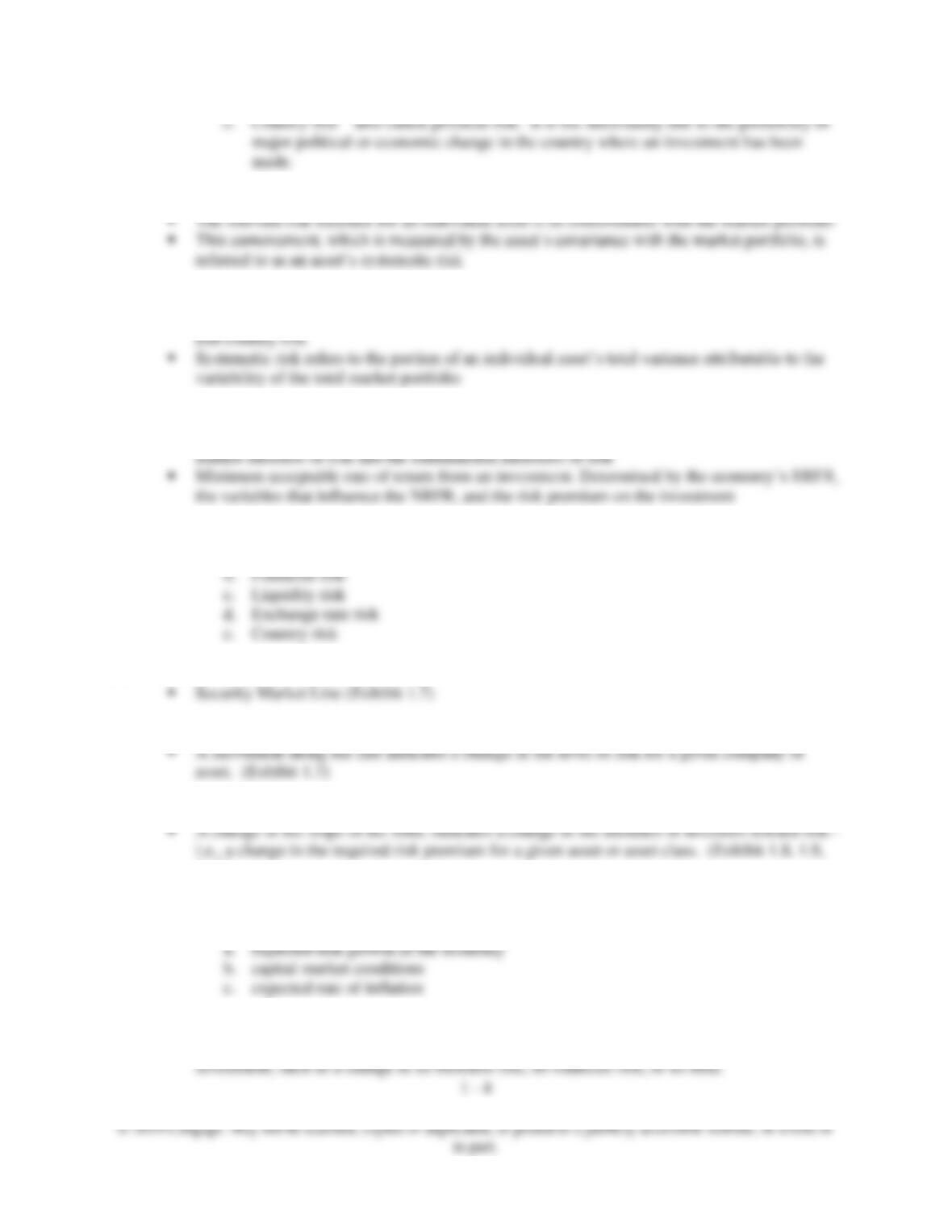
Inflation) of Rate (1
Return) of NRFR (1
RRFR +
+
=
1.3.4 Risk Premium and Portfolio Theory
1.3.5 Fundamental Risk versus Systematic Risk
▪ Fundamental risk comprises business risk, financial risk, liquidity risk, exchange rate risk,
1.3.6 Summary of Required Rate of Return
▪ Research studies have generally concluded that a significant relationship exists between the
1. Measures and Sources of Risk
a. Business risk
1.4 Relationship between Risk and Return
1.4.1 Movements along the SML
1.4.2 Changes in the Slope of the SML
1.10)
1.4.3 Changes in Capital Market Conditions or Expected Inflation (Exhibit 1.11)
▪ Can be caused by a change in any of the following:
1.4.4 Summary of Changes in the Required Rate of Return
1. A movement along the SML demonstrates a change in the risk characteristics of a specific

1 –
5
2. A change in the slope of the SML occurs in response to a change in the attitude of investors
toward risk.
3. A shift in the SML reflects a change in the expected real growth, a change in market