1
Chapter 1
The Corporation
1-1. What is the most important difference between a corporation and all other organizational
forms?
1-2. What does the phrase limited liability mean in a corporate context?
1-3. Which organizational forms give their owners limited liability?
1-4. What are the main advantages and disadvantages of organizing a firm as a corporation?
1-5. Explain the difference between an S corporation and a C corporation.
1-6. You are a shareholder in a C corporation. The corporation earns $2 per share before taxes. Once
it has paid taxes it will distribute the rest of its earnings to you as a dividend. The corporate tax
rate is 40% and the personal tax rate on (both dividend and non-dividend) income is 30%. How
much is left for you after all taxes are paid?
1-7. Repeat Problem 6 assuming the corporation is an S corporation.
An S corporation does not pay corporate income tax. So it distributes $2 to its stockholders. These
1-8. You have decided to form a new start-up company developing applications for the iPhone. Give
examples of the three distinct types of financial decisions you will need to make.
As the manager of an iPhone applications developer, you will make three types of financial decisions.
1-9. When a pharmaceutical company develops a new drug, it often receives patent protection for
that medication, allowing it to charge a higher price. Explain how this public policy of providing
patent protection might help align the corporation’s interests with society’s interests.
1-10. Corporate managers work for the owners of the corporation. Consequently, they should make
decisions that are in the interests of the owners, rather than their own. What strategies are
available to shareholders to help ensure that managers are motivated to act this way?
1-11. Suppose you are considering renting an apartment. You, the renter, can be viewed as an agent
while the company that owns the apartment can be viewed as the principal. What principal–
agent conflicts do you anticipate? Suppose instead that you work for the apartment company.
What features would you put into the lease agreement that would give the renter incentives to
take good care of the apartment?
1-12. You are the CEO of a company and you are considering entering into an agreement to have your
company buy another company. You think the price might be too high, but you will be the CEO
of the combined, much larger, company. You know that when the company gets bigger, your pay
and prestige will increase. What is the nature of the agency conflict here and how is it related to
ethical considerations?
1-13. Are hostile takeovers necessarily bad for firms or their investors? Explain.
1-14. What is the difference between a public and private corporation?
1-15. Describe the important changes that have occurred in stock markets over the last decade.
1-16. Explain why the bid-ask spread is a transaction cost.
1-17. Explain how the bid-ask spread is determined today.
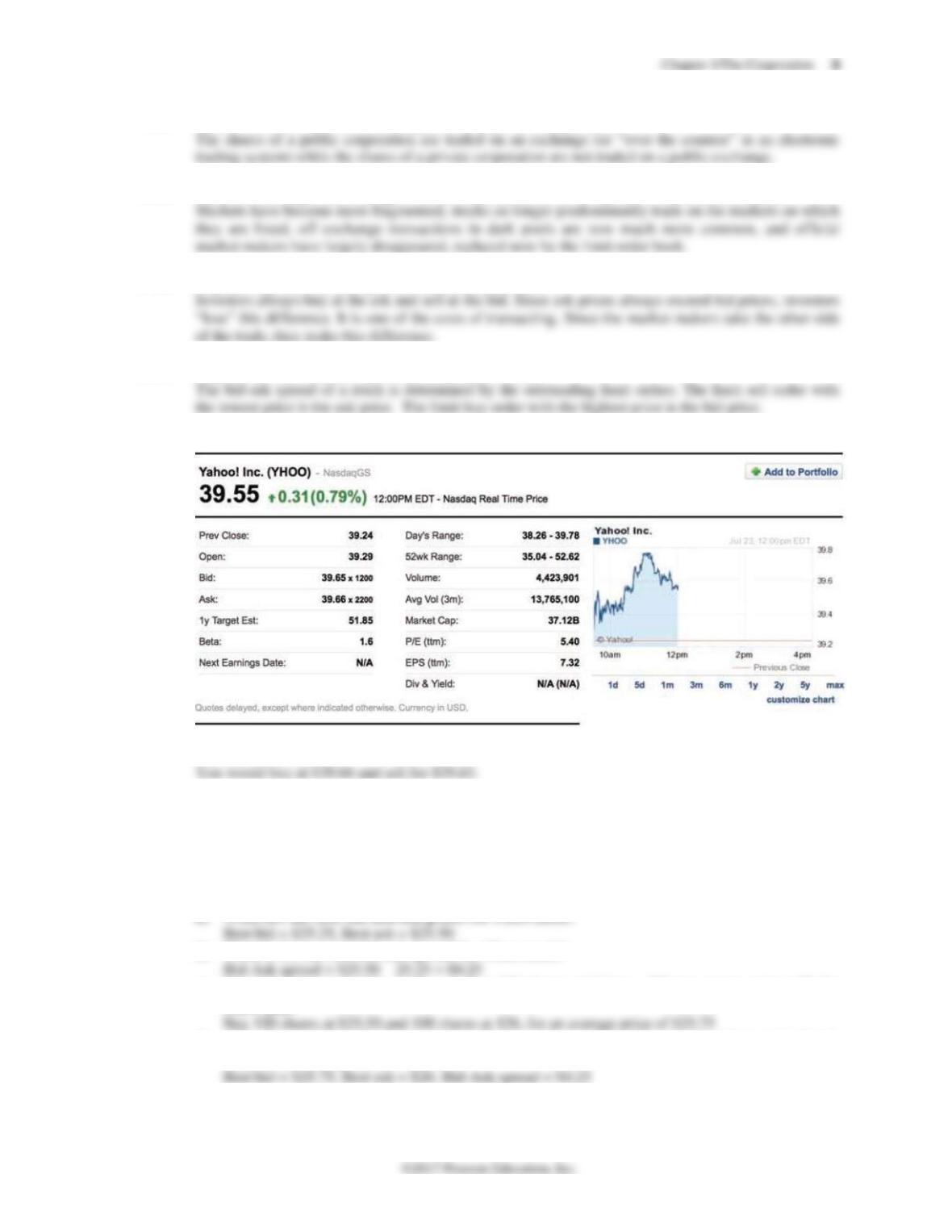
1-18. The following quote on Yahoo! Stock appeared on July 23, 2015, on Yahoo! Finance:
If you wanted to buy Yahoo!, what price would you pay? How much would you receive if you
wanted to sell Yahoo!?
1-19. Suppose the following orders are received by an exchange for Cisco stock:
• Limit Order: Buy 200 shares at $25
• Limit Order: Sell 200 shares at $26
• Limit Order: Sell 100 shares at $25.50
• Limit Order: Buy 100 shares at $25.25
a) What are the best bid and ask prices for Cisco stock?
b) What is the current bid-ask spread for Cisco stock?
c) Suppose a market order arrives to buy 200 shares of Cisco. What average price will the
buyer pay?
d) After the market order in (c) clears, what are the new best bid and ask prices, and what is
the new bid-ask spread for Cisco?