ANSWERS TO CHAPTER QUESTIONS
Web Chapter B Background Topics
1) Through the interaction of demand and supply.
2) When supply is increased prices decline. When supply is increased, producers are
3) The causes of inflation in the economy include:
a) A rise in the cost of operations
4) The impact of inflation can be good or bad depending upon the person being affected.
For example a retired person on a fixed income would be hurt by higher prices. A
5) Deflation is a decline in the price of goods and services. It can be beneficial for
consumer purchases and negative for debt holders. People may postpone purchases if
they expect prices to decline which can be detrimental to the overall economy.
6) An acceleration in demand results in a peak in production as capacity is reached.
7) There have been fewer business cycles in recent decades as the Federal Reserve has
done a better job of fine tuning the economy.
8) Four leading indicators and why they lead economic conditions are as follows:
a) Stock Prices – Perhaps the best leading indicator. It reflects beliefs by people
some of whom are better informed than the average person.
9) Government fiscal policy is most often used to deal with a recession. At that time the
government may increase its spending or cut taxes.
10) The Federal Reserve can effect a change in monetary policy through:
a) Open market operations – purchasing government bonds to increase money in
circulation and to reduce interest rates or issuing government bonds which has the
11) Fiscal policy can be used when actual shifts in spending are believed to be beneficial.
12) A financial institution acts as a middleman between an offeror and a purchaser of
funds. It is put together buyers and lenders.
13) Types of financial institutions are:
a) Commercial banks
b) Savings banks and savings and loans
14) Savings banks and savings and loans have many of the same functions as commercial
banks. They tend to do more for consumers while commercial banks operate more for
15) Brokerage transactional rates have declined sharply. As an outcome full service
16) The advantages and disadvantages of corporation, partnership and an individual
proprietorship include:
a) Individual Proprietorship
i) Strengths:
ii) Weaknesses:
(1) Limited life – dissolved on death of owner
b) Partnership
i) Strengths:
(1) Spreads risk
ii) Weaknesses:
(1) Unlimited liability vs corporation
(3) More difficult to raise money vs corporation
c) Corporation
i) Strengths:
(1) Unlimited life
ii) Weaknesses:
(1) More costly
17) Generally either a partnership or an individual proprietorship because a corporation
stockholder is generally subject to double taxation. Corporations are taxed on
18) No. There is no legal consideration such as money for painting the room.
20) A negotiable instrument must:
a) Be in writing.
b) Be signed by maker.
c) Promise to pay a staled sum with no conditions.
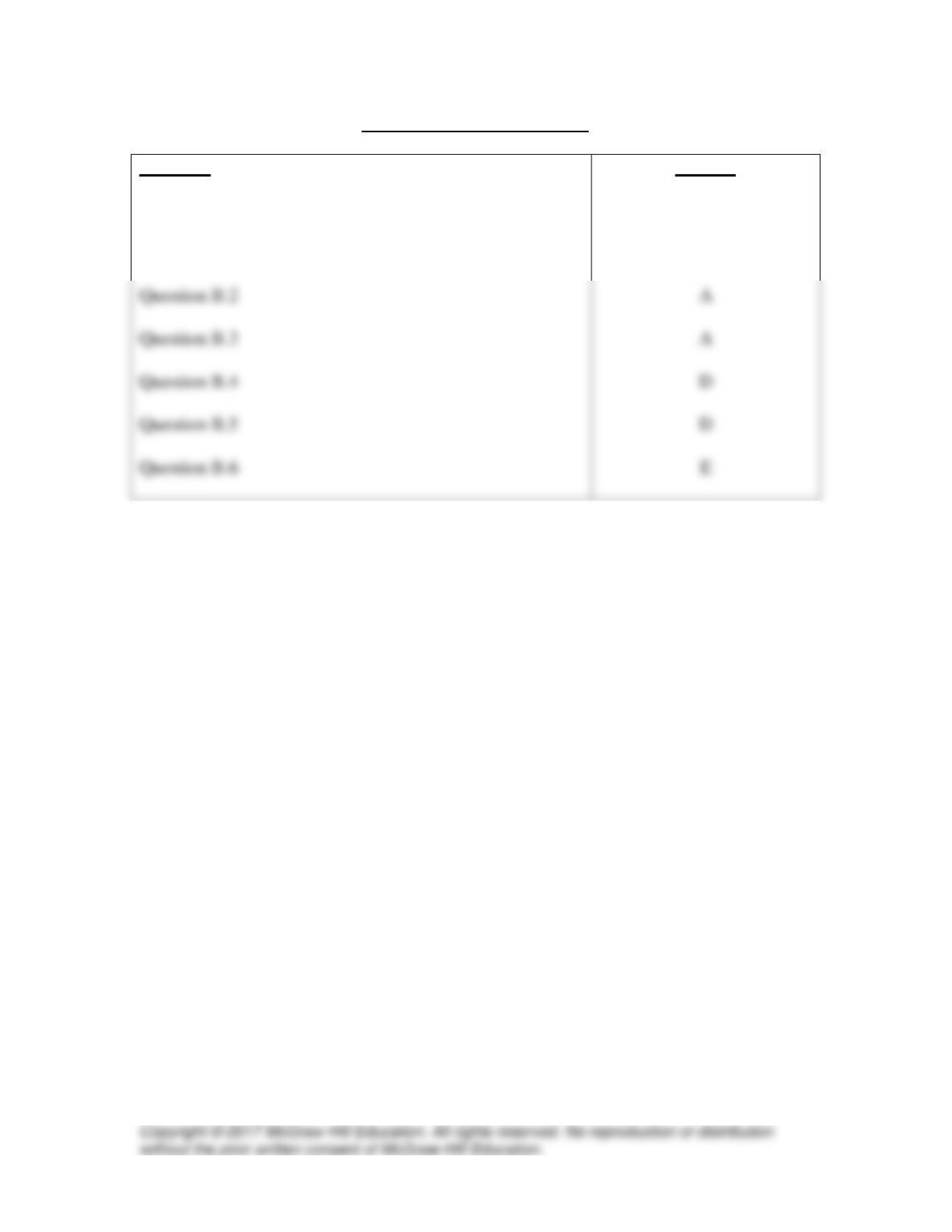
Answers to CFP® Questions
Question
Answer
Question B.1
B
Question B.2
A
Question B.3
A
Question B.4
D
Question B.5
D
Question B.6
E