ANSWERS TO CHAPTER QUESTIONS
Web Chapter A Educational Planning
1) Educational costs are one of the household’s largest outlays. Planning for these costs
2) Educational costs are heavily dependent upon high cost professionals and may not be
as amenable to productivity issues. Many funders of college costs consider it a high
3) The educational policy statement is a systematic way of planning for education. It
starts with establishing the educational goals and calculating the cost of education. It
4) Goals in planning determine the rest of the educational policy process. The focus on
goals enables the household to explore what is feasible and adjust goals accordingly.
5) Yes. High school students can benefit from knowing the realities of the cost parents
6) College tuition which will vary by school. The decision whether to live at home or
7) Financial aid is based on need and sometimes on ability and prior demonstrated
8) Children’s assets are taxed most heavily. That fact may serve those seeking financial
aid from gifting money to children.
9) The advantages and disadvantages of the three educational savings structures are:
a) Section 529 Plan Advantages
i) Tax shelter for investments
ii) Large sums can be placed in
iii) Qualified withdrawals aren’t taxed
b) Section 529 Plan Disadvantages
c) Educational IRA Advantages
i) Pretax dollar deposits for qualified people
d) Educational IRA Disadvantages
e) EE Bond Advantages
i) Tax deferred
f) EE Bond Disadvantages
i) No investment flexibility
ii) Income limitation to qualify
10) The common sources of loans to finance education are:
a) Federal Perkins loans
11) Both Coverdell and 529 plans use after-tax dollars into tax-sheltered accounts and
have no taxation on withdrawals. Coverdell is limited to $2,000 year while 529 plans
12) Section 529 plans are attractive because large amounts of money can be placed into a
13) False. Investment Policy needs to incorporate the time that transpires until
withdrawals are made. If money is being saved for retirement, for example, there is
14) Regular savings should be used when the person is unsure of the amount or even the
15) Educational monies differ in their time until use; generally it is shorter than that for
retirement. Selected educational accounts are tax sheltered. Retirement or educational
16) As the payout nears the consequences for a sharp change in asset values becomes
more important. As a result the asset allocation should become more conservative
with bonds, particularly short term ones used in greater concentration.
17) Lack of financial literacy has many causes. Among them are lack of general literacy,
18) Lack of financial literacy makes you susceptible to inappropriate selections of
19) Some key features connected with educating for financial literacy are:
a) Making presentations simple
b) Providing practical examples
ANSWERS TO CHAPTER PROBLEMS
Web Chapter A Educational Planning
1) Sam and Sue wanted to provide full funding for their son, age 4, to go to college at
age 18. The cost to them was $35,000 per year. Calculate the amount of savings they
would need per year to fund college, assuming that the education inflation rate was 3
percent and the investment return was 5 percent after tax. See Appendix I.
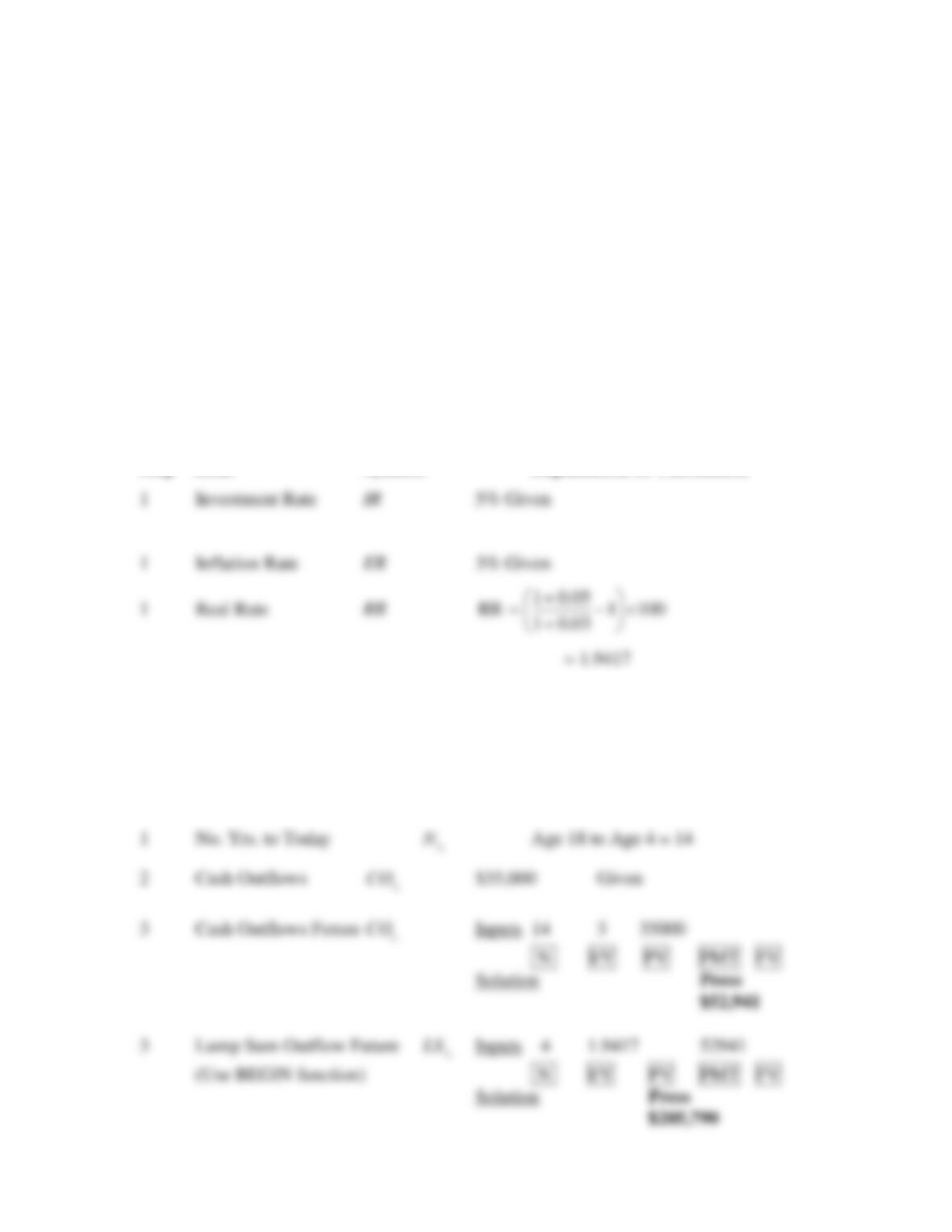
Calculator Solution
Educational Needs Calculation
Step Item Symbol Explanation or Calculation
1 No.Yrs. for Payout
p
t
N
Age 18 to Age 22 = 4
Period
1 No. Yrs. to Beginning
1
t
N
Age 4 to Age 18 = 14
of Period
4 Assets Accumulated Today
o
t
AA
0
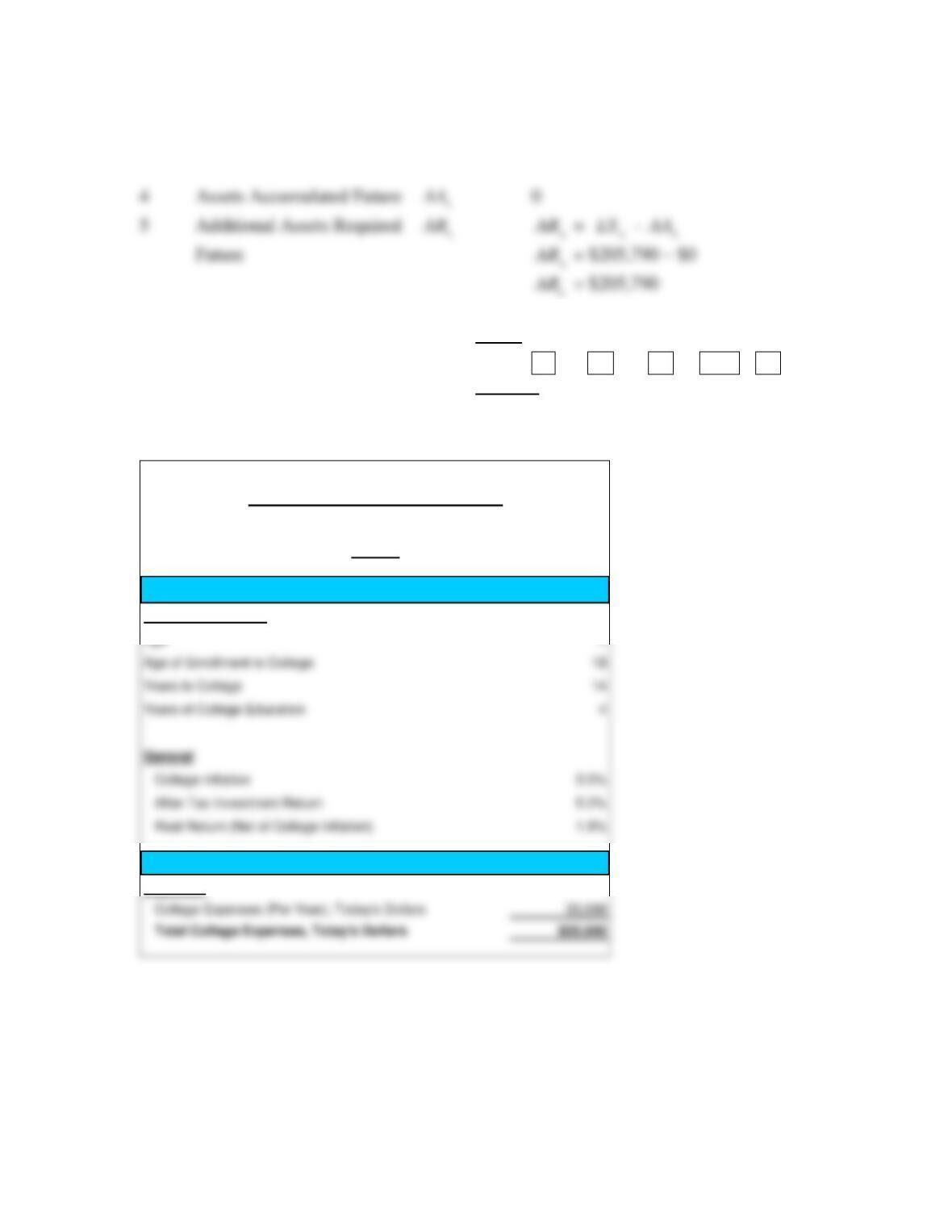
5 Required Yearly Savings
10→
t
RS
Inputs 14 5 205790
N I/Y PV PMT FV
Solution Press
$10,500
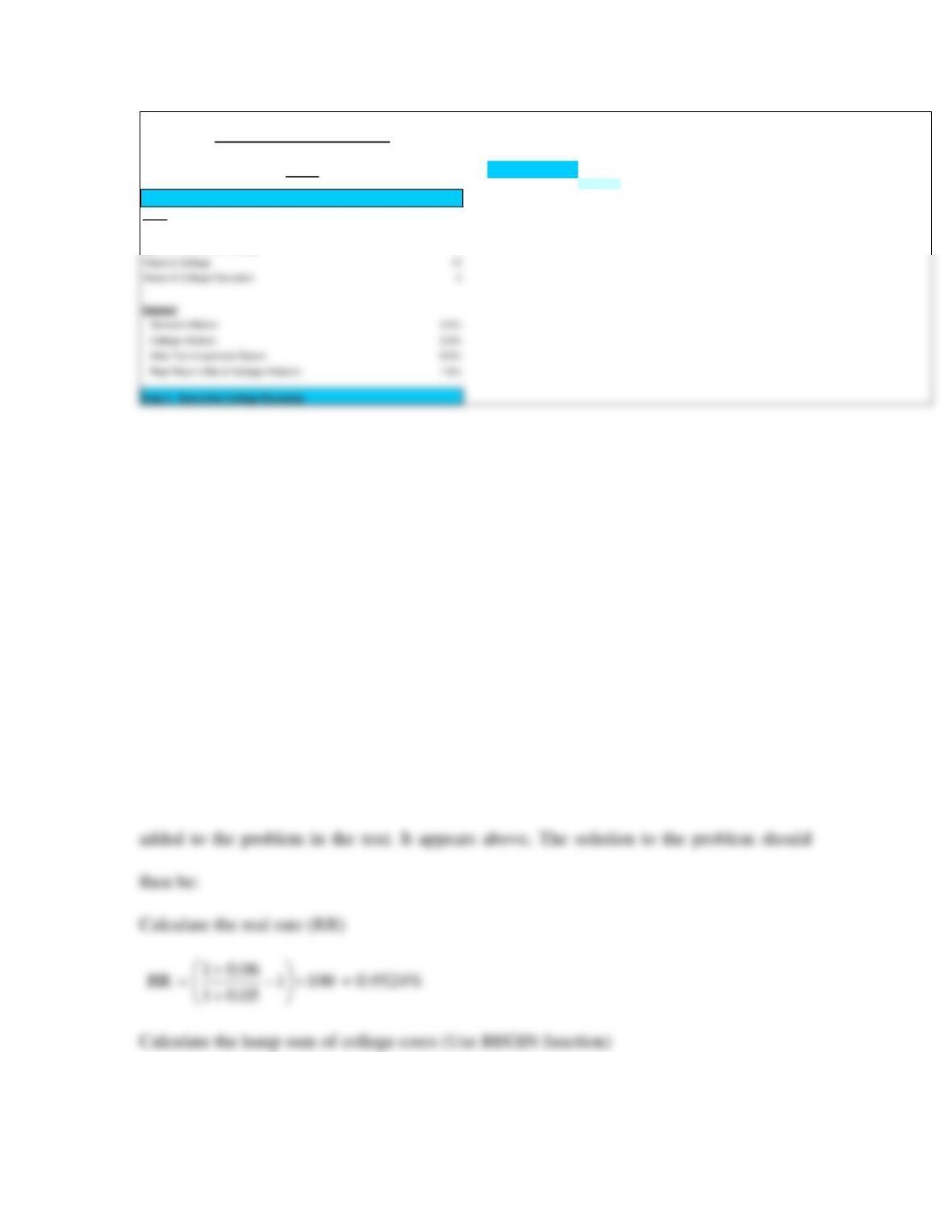
Excel Solution
Sam and Sue’s Son
Age 4
Expenses
Inputs
Step 1 – Determine Rates and Ages
Step 2 – Determine College Expenses
Educational Needs Analysis
Linda
Linda’s Age 4
Age of Enrollment to College 18
Inputs
Step 1 – Determine Rates and Ages
Educational Needs Analysis
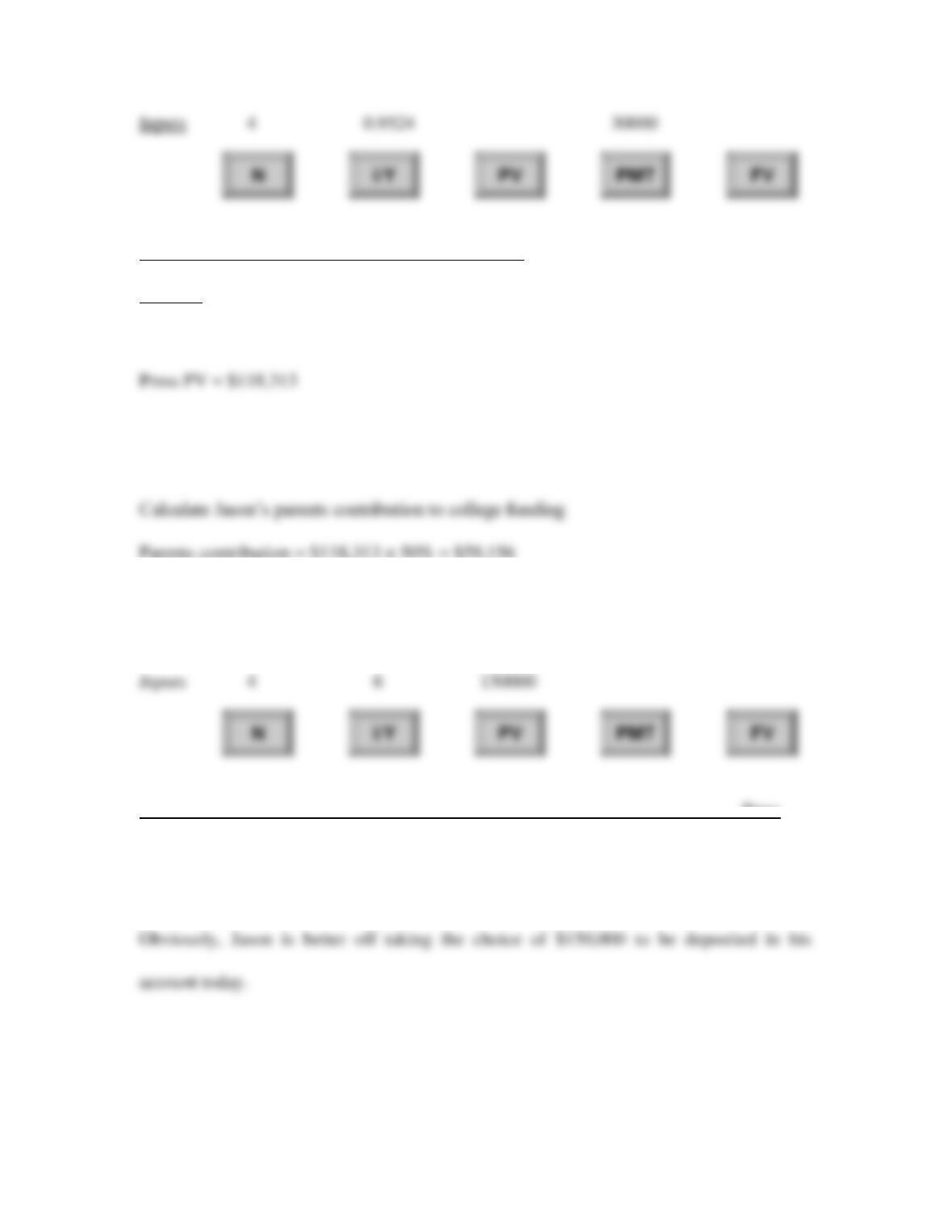
2) Jason, age 14, was given a choice of $150,000 to be deposited in his account today or
his parents would fund 50 percent of college costs, expected to amount to exactly
$30,000 a year (and for four years) in future dollars. Which should he take given a 6
percent after-tax investment return in both cases, 5 percent education inflation rate
and four years until he starts college? Show your calculations.
Note: In order to solve the problem an education inflation rate of 5 percent should be
Press
Solution $118,313
Parents contribution = $118,313 × 50% = $59,156
Calculate the future value of the deposited sum
Press
Solution $189,372
3) Warner and Aileen asked you to calculate how much money it would take to save
annually for their son’s college education. The cost of college today was $30,000 and
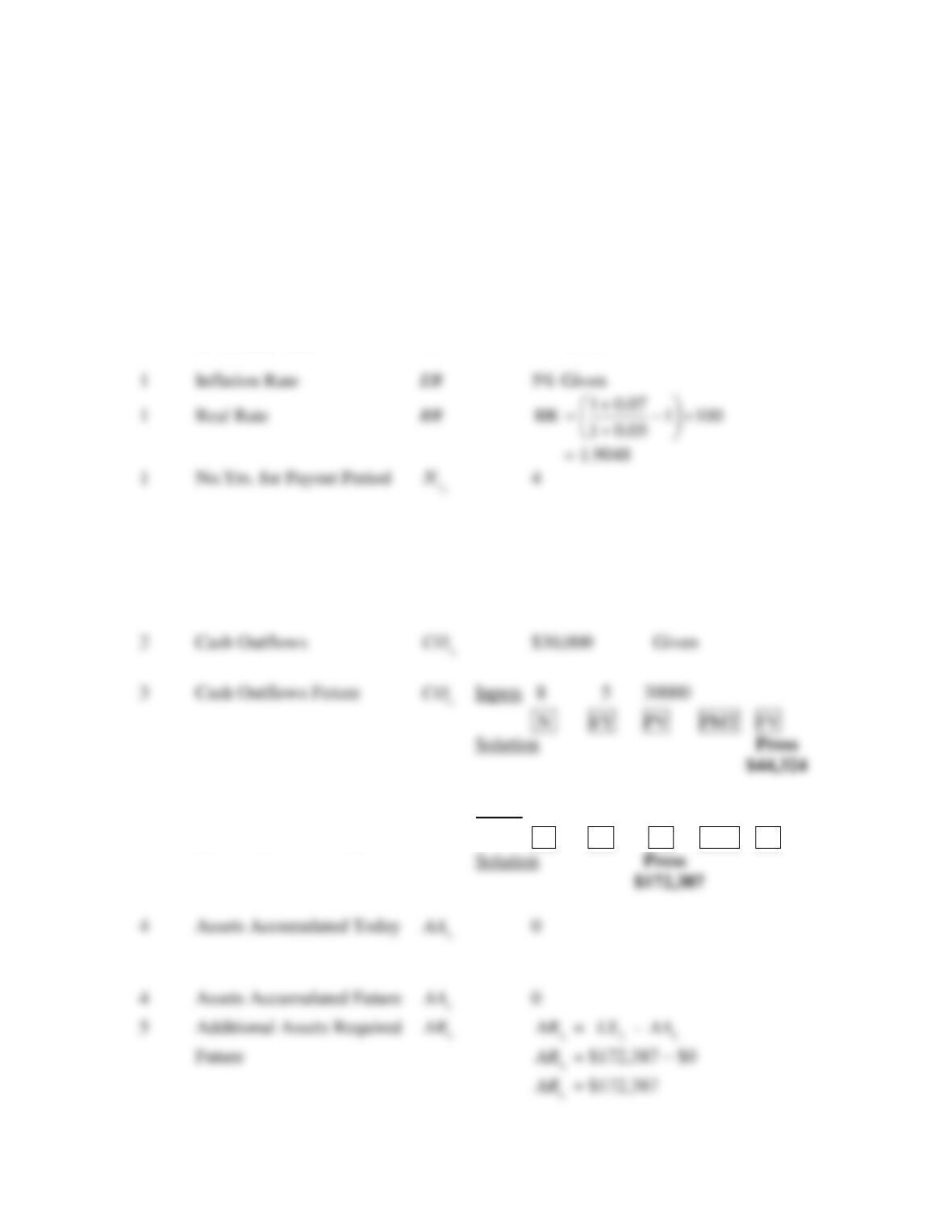
their son would enter in eight years. The inflation rate for college was 5 percent and
investment returns were 7 percent after tax. See Appendix I.
Calculator Solution
Educational Needs Calculation
Step Item Symbol Explanation or Calculation
1 Investment Rate IR 7% Given
1 No. Yrs. to Beginning of
1
t
N
8
Period
1 No. Yrs. to Today
o
t
N
8
3 Lump Sum Outflow Future
1
t
LS
Inputs 4 1.9048 44324
(Use BEGIN function) N I/Y PV PMT FV

5 Required Yearly Savings
10→
t
RS
Inputs 8 7 172387
N I/Y PV PMT FV
Solution Press
$16,802
Excel Solution
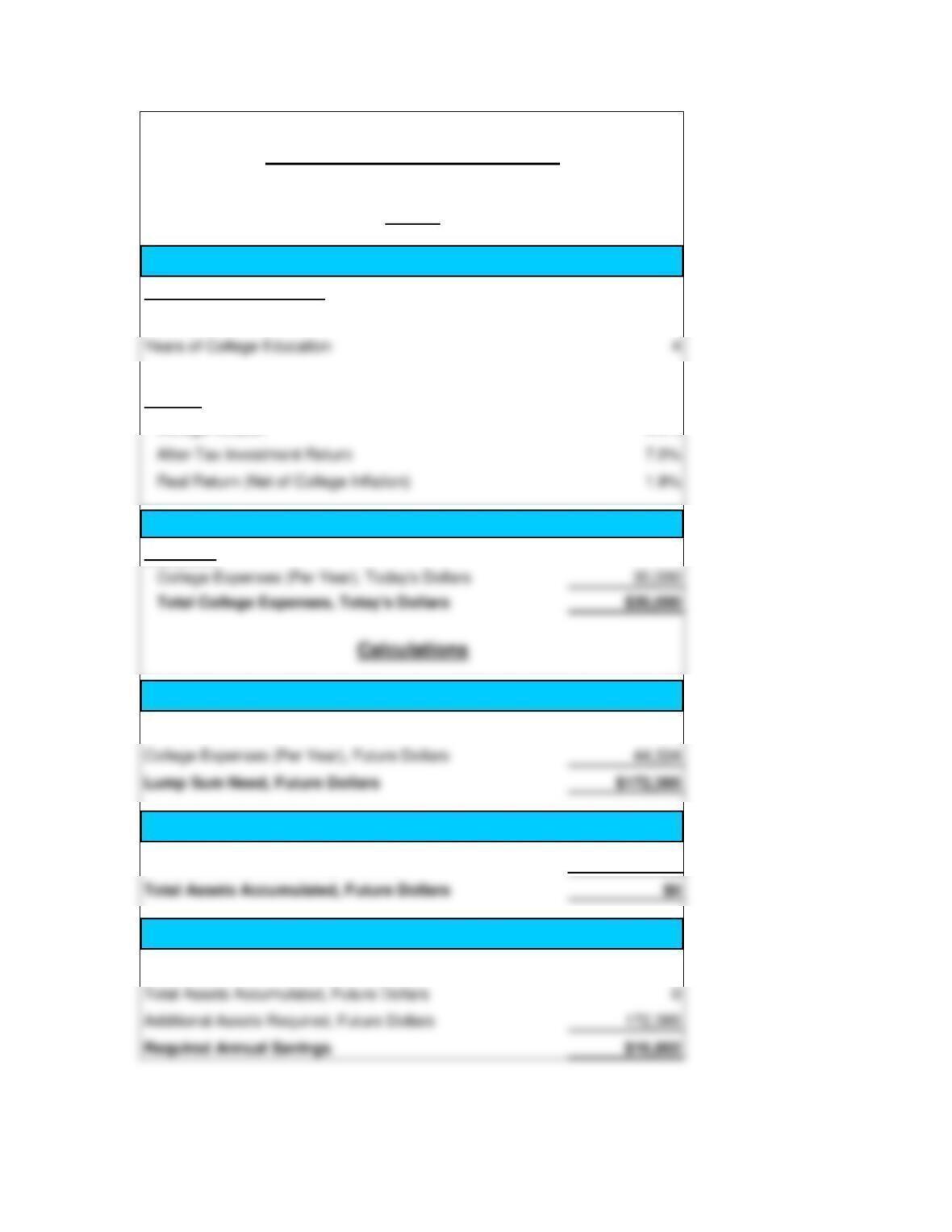
Warner and Aileen’s Son
Years to College 8
General
College Inflation 5.0%
Expenses
College Expenses (Per Year), Today‘s Dollars 30,000
Assets Accumulated, Today‘s Dollars 0
Lump Sum Need, Future Dollars 172,385
Step 5 – Compute Required Yearly Savings
Inputs
Step 1 – Determine Rates and Ages
Step 2 – Determine College Expenses
Educational Needs Analysis
Step 3 – Calculate Lump Sum Needed
Step 4 – Identify Current Assets Available
ANSWERS TO CASE APPLICATION QUESTIONS
Web Chapter A Educational Planning
1) What type school would they go to – public, private? Would they live at home?
Might they be eligible for aid? What percentage of total costs would the parents
contribute? What is their investment tolerance for risk? What is their projected
income stream?
2) Barbara’s approach is likely to be closer to the need. Neither one appears to have
the aspiration and the career pursuits to result in very large future incomes.
3) If proper funding didn’t take place they would have to borrow. The payback for
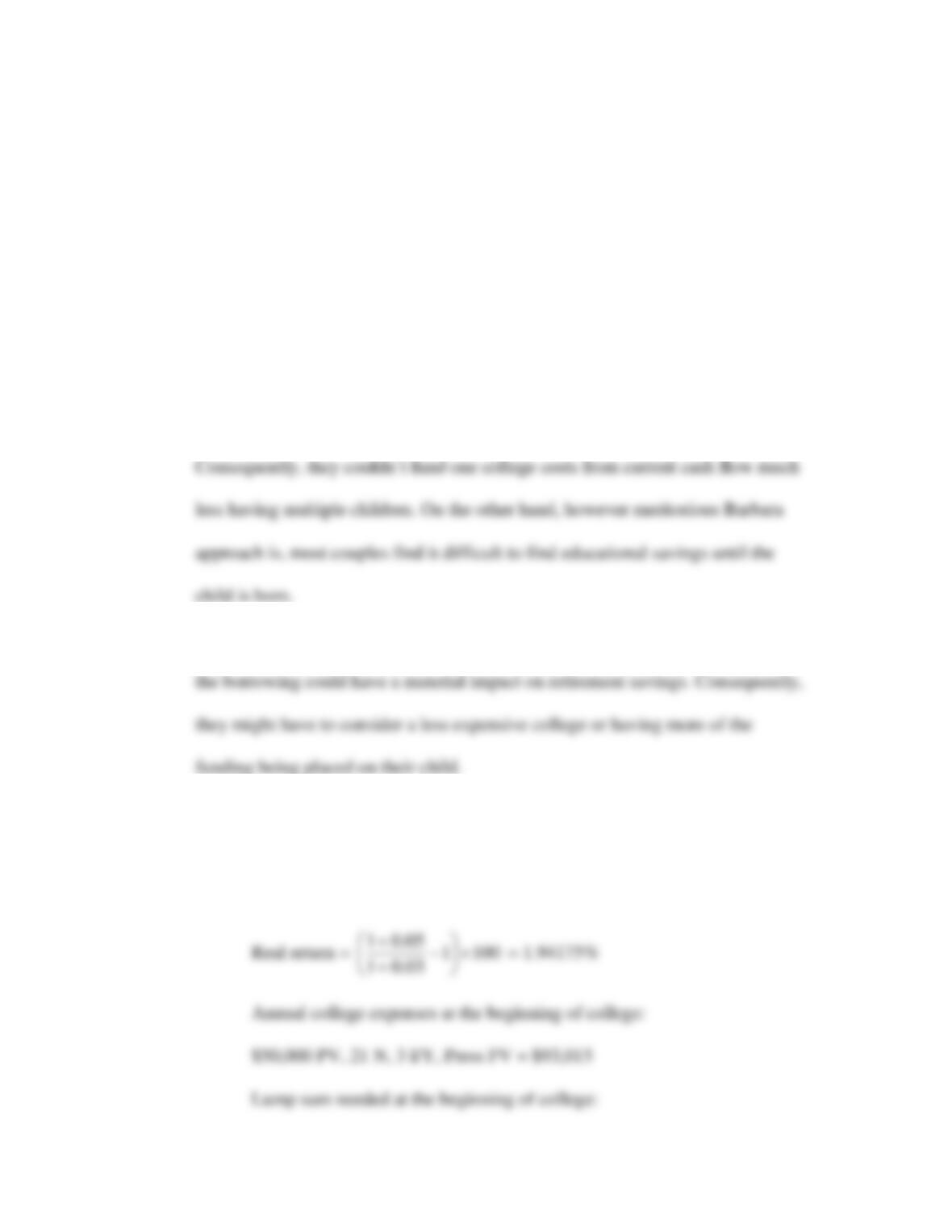
4) A full four year private school education might cost $50,000 a year in current
dollars or $200,000 for the full period for 1 child. Assuming a 21 year period
before college starts the calculation would be:

5) She should take a course at a local adult education facility if available. She should
read a good introductory financial planning text and follow financial topics in the
newspaper each week. Establishing a paper investment portfolio could make
sense.

Answers to CFP® Questions
Question
Answer
SOLUTIONS TO SELECTED CFP® CERTIFICATION EXAMINATION
PROBLEMS
1
A.2
John Hendrick wants to pay one-half of the college costs for his daughter, Ruth. She will
be attending a private college with annual costs of $20,000 today. Ruth is 10 years old
and will be starting college in eight years. If these costs are expected to increase annually
by 8 percent, how much will Mr. Hendrick need to provide for her first year of college?
a. $18,509
b $23,409
Solution:
John will provide half of the annual college costs of $20,000 or $10,000. The $10,000