
1
Focus on the Biota:
Metabolism, Ecosystems, and Biodiversity
Learning Objectives
After reading this chapter, students should be able to:
• Know two fundamental groupings of organism
• Know the characteristics of life
• Know what ecosystems are
• Recognize that ecosystems are not divorced from their environment; the
environment is part of the ecosystem (ecosystems are not static)
• Understand the concept of biomass and biodiversity
• Know the relationship between diversity and stability
Review Questions
1.) What are the characteristics of life that allow it to influence the environment at a
global scale?
Fundamental characteristics of life are as follows:
a. Life spreads exponentially
2.) What are the two fundamental groupings of organisms based on their
metabolisms?
3.) Describe the two mechanisms of autotrophy. Where on Earth might you expect to
find one or the other of these two pathways to dominate?
Autotrophs include plants, algae, and a host of microbes that can photosynthesize
CHAPTER
9
2
4.) Describe the three mechanisms of heterotrophy. Where on Earth might you expect
to find one or the other of these three pathways to dominate?
a. Aerobic Respiration
The heterotrophic pathway that releases the most energy is aerobic respiration,
which uses molecular oxygen to decompose organic matter through the
3
5.) Why is a food web often a better description than a food chain of the way in
which energy (food) is passed through an ecosystem?
We can represent which organisms feed on which by means of a food chain that
6.) How does symbiosis differ from other forms of species interactions?
Symbiosis is a relationship in which two species benefit from living together in
intimate contact. The relationship between corals and plant-like protists known as
7.) Describe a typical successional sequence following a disturbance of an
ecosystem. What are the characteristics of opportunistic species that allow them
to rapidly repopulate a disturbed area?
The first species to reinvade a disturbed environment are called opportunists or
pioneer species. They tend to be fast growing, rapidly reproducing,
4
8.) What is the advantage of the Simpson’s Diversity Index over a simple census of
the number of species in quantifying the diversity of an ecosystem?
The Simpson’s Diversity Index measures the likelihood that two individuals drawn
9.) What do we mean by “diversity of interactions”?
Critical Thinking Problems
1.) Figure 9-2 presents a systems diagram of the feedbacks involving boreal forest
cover, albedo, temperatures, sea ice, and the oceans. We used this diagram to
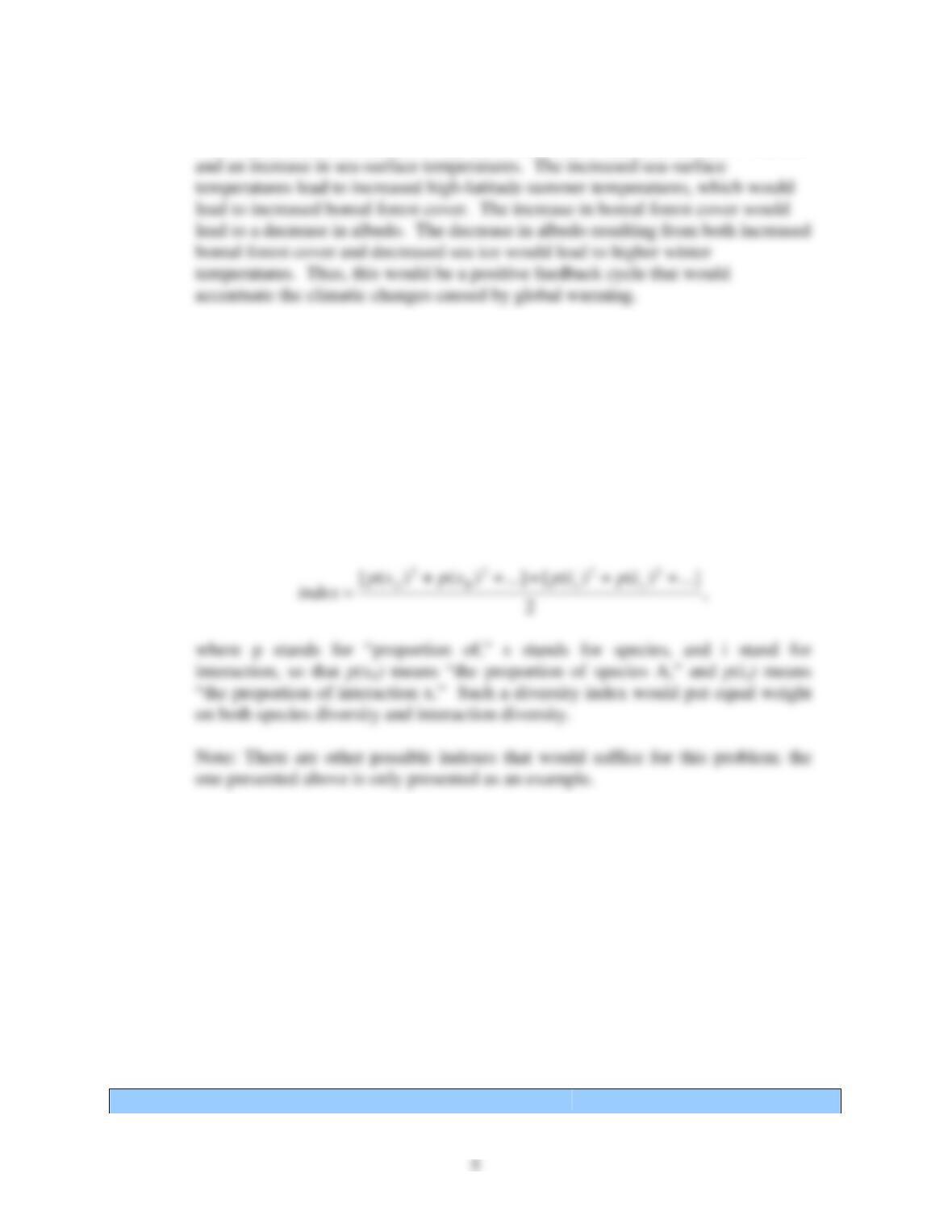
Let us assume that the greenhouse changes lead to increased winter temperatures.
This would lead to a decrease in sea ice, which would lead to a decrease in albedo
2.) In the final section of this chapter we presented some thoughts about what a
diversity index useful for Earth system scientists might include. Using these
thoughts or those of your own, develop a quantitative index, similar to the
Simpson’s Diversity Index, that reflects the diversity of interactions at the global
scale.
The index that the student submits should be influenced by the number of species
present in the community, the number of interactions within the community, and
how heterogeneous the community is, both in terms of species and in terms of
interactions. A possible index that would include these factors would be
3.) Using the information from Table 9-1, design a layered microbial ecosystem that
could be self-sustaining with the exception of the import of solar energy from
above. All of the inorganic compounds listed in the table are available for your
use in building this ecosystem.
Multiple Pathways for Life
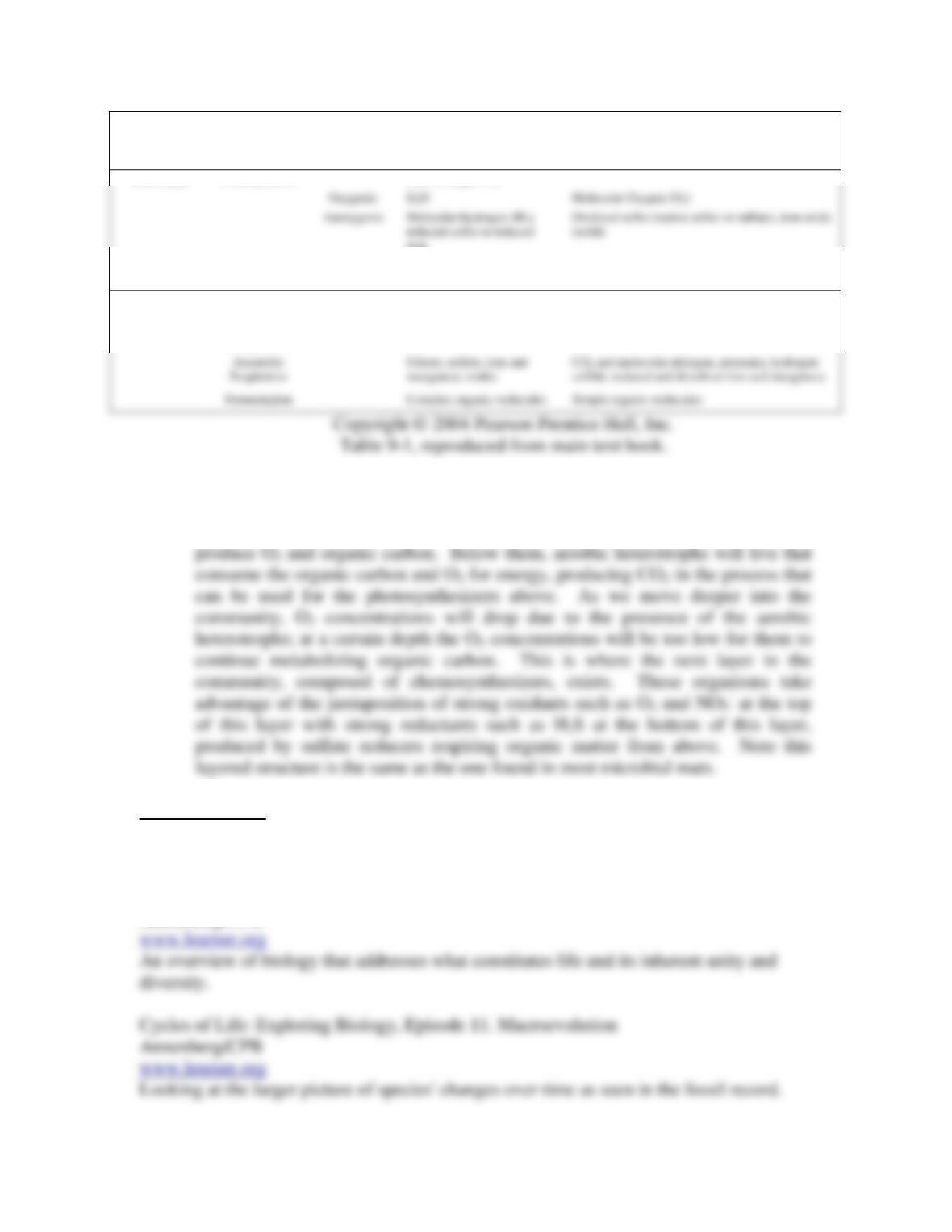
6
General
Method for
Aquiring
Energy
Specific
Pathway Subcategory Reactants Byproducts
Autotrophy Photosynthesis Solar Energy, CO2
iron
Chemosynthesis H2, reduced forms of sulfur,
nitrogen, iron or manganese Oxidized sulfur, nitrate, iron and manganese oxides
(solids)
Heterotrophy Organic
matter
Aerobic
Respiration O
2 CO2, H2O
The community should contain at least five layers: oxygenic photosynthesizers,
aerobic heterotrophs, anaerobic heterotrophs, and chemosynthesizers.
The solar energy from above will be used by oxygenic photosynthesizers that will
Resource Guide
Video/Film:
Cycles of Life: Exploring Biology, Episode 1. The Unity and Diversity of Life
Annenberg/CPB

7
Cycles of Life: Exploring Biology, Episode 24. Populations and Communities
Annenberg/CPB
Cycles of Life: Exploring Biology, Episode 25. Ecosystems and the Biosphere
Annenberg/CPB
Intimate Strangers: Unseen Life on Earth, Episode 2. Keepers of the Biosphere
Annenberg/CPB
Unseen Life on Earth: An Introduction to Microbiology, Episode 10. Microbial
Interactions
Annenberg/CPB
Rainforest: Heroes of the High Frontier Video
National Geographic Video
Note: This film is available only in the U.S. and Canada.

Websites:
• http://www.biodiv.org/