SOLUTIONS FOR CHAPTER 9
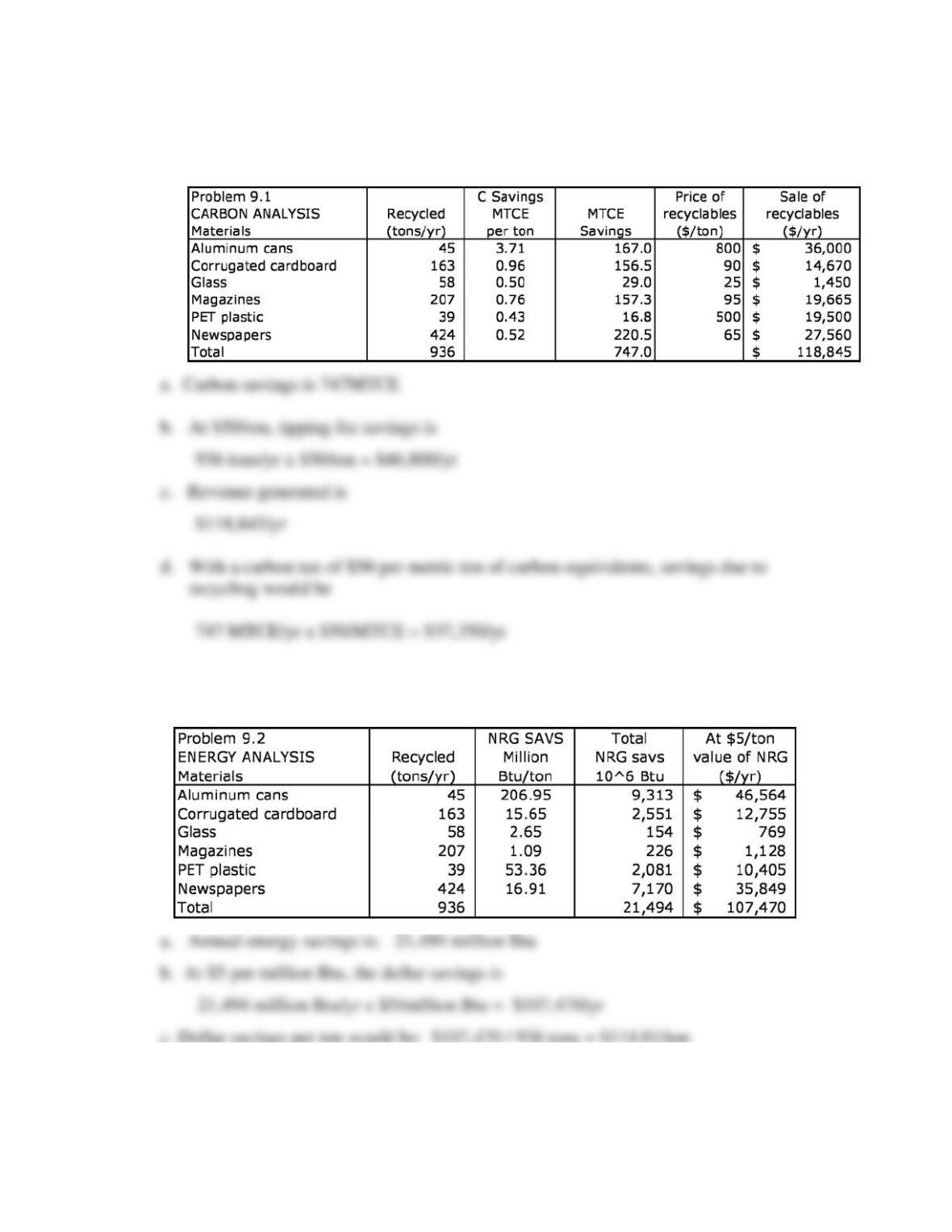
9.1 Analysis of the recycling rates using Table 9.8 data and prices from Table 9.18
9.2 Analyzing the energy side of the airport recycling program described in Problem 9.1
using Table 9.9
9.1
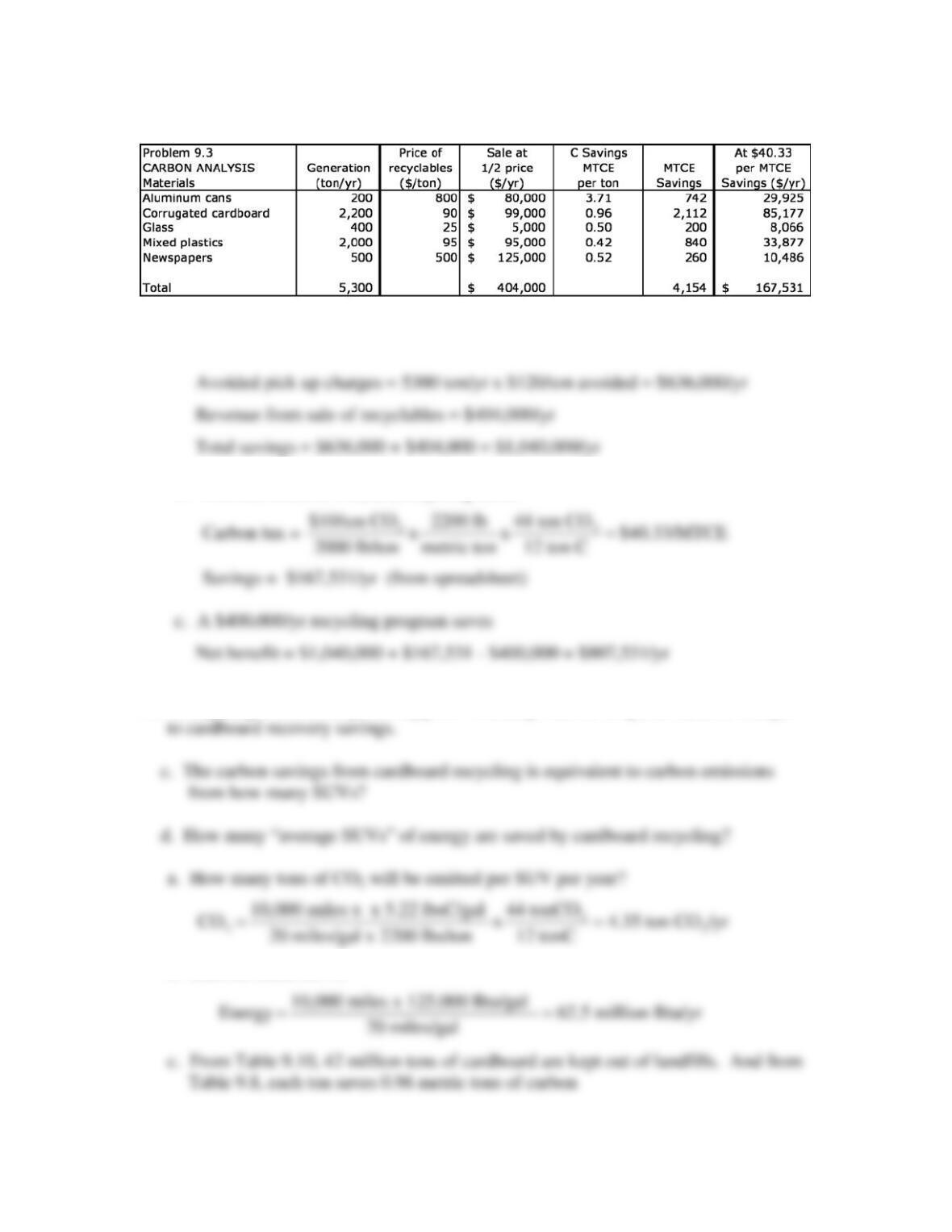
9.3 Spreadsheet analysis for the recycling program using Tables 9.8 and 9.18.
a. Avoiding $120/ton for pick up and selling these recyclables at half the Table 9.18
market price for recyclables saves
b. With a $10/ton of CO2 tax, recycling saves
9.4 Comparing a 10,000mi/yr, 20 mpg SUV burning 5.22 lbs C//gal at 125,000 Btu/gal
b. Btus for those SUVs
9.2
d. From Table 9.9, cardboard recycling saves 15.65 million Btu/ton. So,
9.5 A 0.355-L (12 oz) 16 g aluminum can with 70% recycling. Need to adjust Table
9.13 which was based on 50% recycling. Each can now has 0.7×16 = 11.2 g of
recycled aluminum and 0.3 x 16 = 4.8 g of new aluminum from bauxite.
9.6 Heavier cans from yesteryear, 0.0205 kg/can and 25% recycling rate.
New aluminum per can was 0.75 x 0.0205 kg = 0.015375 kg
Recycled aluminum per can was 0.25 x 0.0205 kg = 0.005125 kg
From Table 9.12:
9.7 Using 1.8 million tons/yr of aluminum cans, 63 percent recycled, and Table 9.12:
a. The total primary energy used to make the aluminum for those cans.
b. With no recycling:
c. Using Table 9.8 CO2 emissions that result from that recycling.
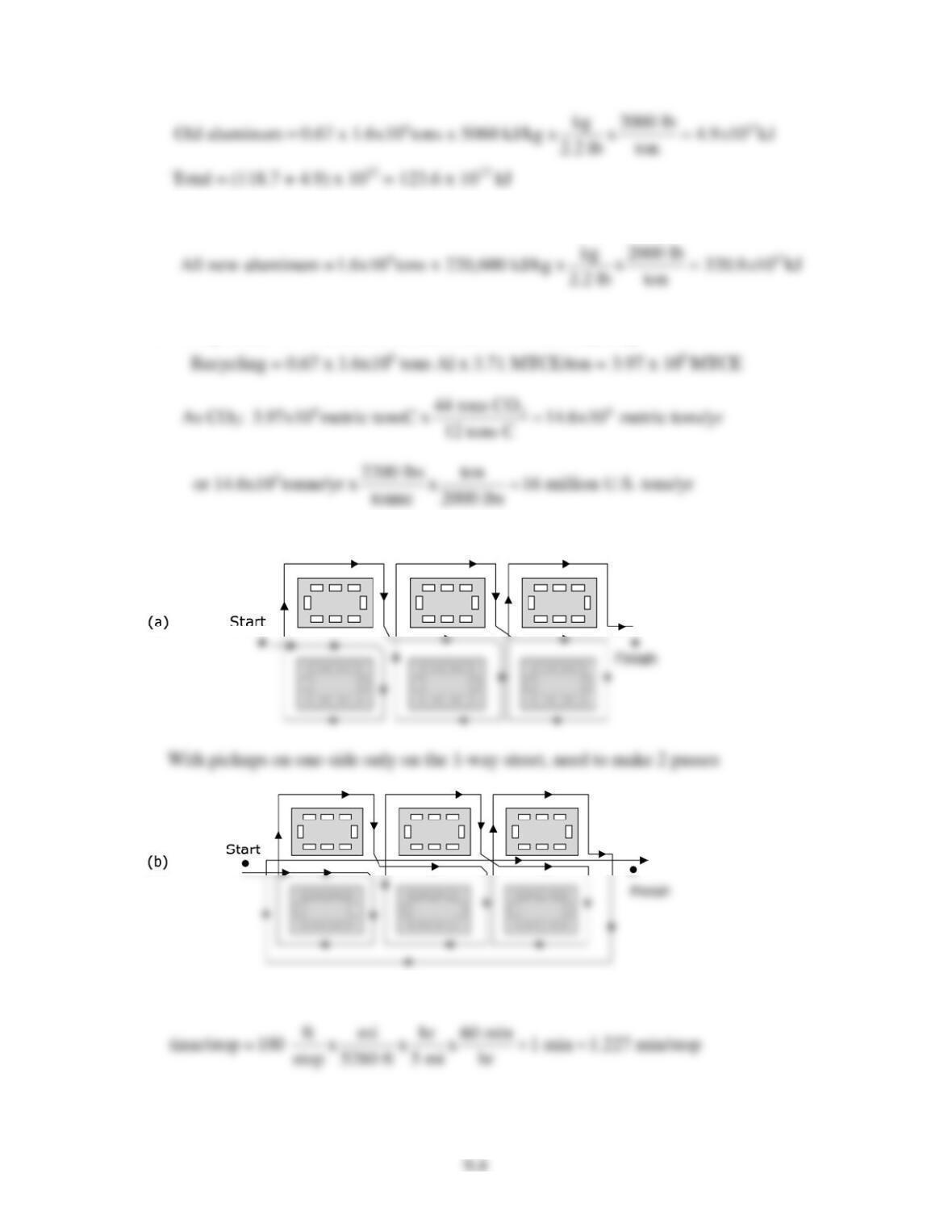
9.8 With pickups from both sides of the 1-way street:
9.9 A 30 yd3 packer truck, 750 lb/yd3, 100 ft stops, 5 mph, 1 min to load 200 lbs:
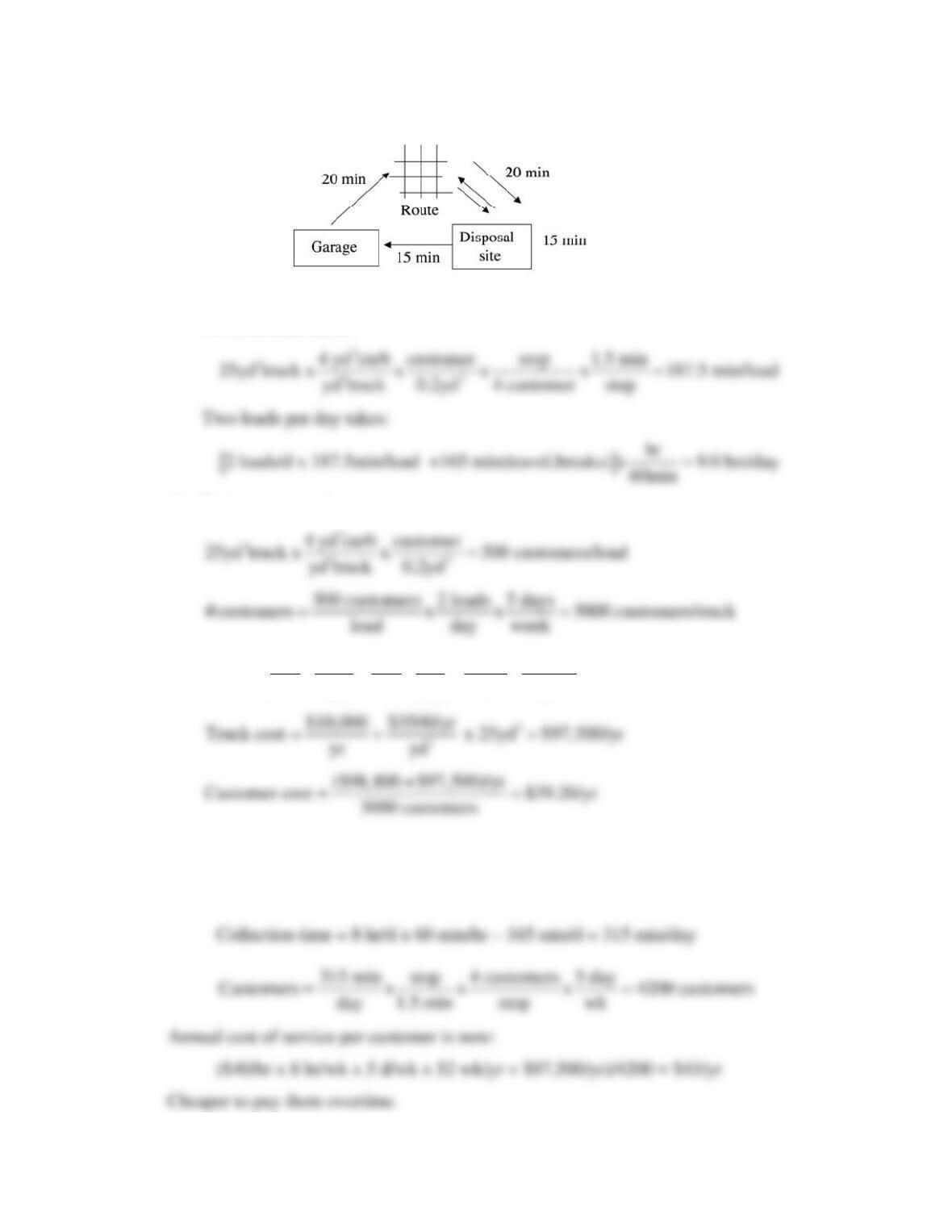
9.10 Route timing:
a. Not collecting = 20min + 3x20min + 2x15min + 15min + 40min = 165 min/day
To fill a truck takes:
b. Customers served:
c. Labor = $40
hr x8 hrs
day +$60
hr x1hr
day
⎛
⎝
⎜
⎞
⎠
⎟
x5 day
week x52 wks
yr =$98,800/yr
9.11 To avoid overtime pay, working 8 hrs/day and needing 165 min to make runs back
and forth to the disposal site, breaks, etc (Problem 9.2):
9.5
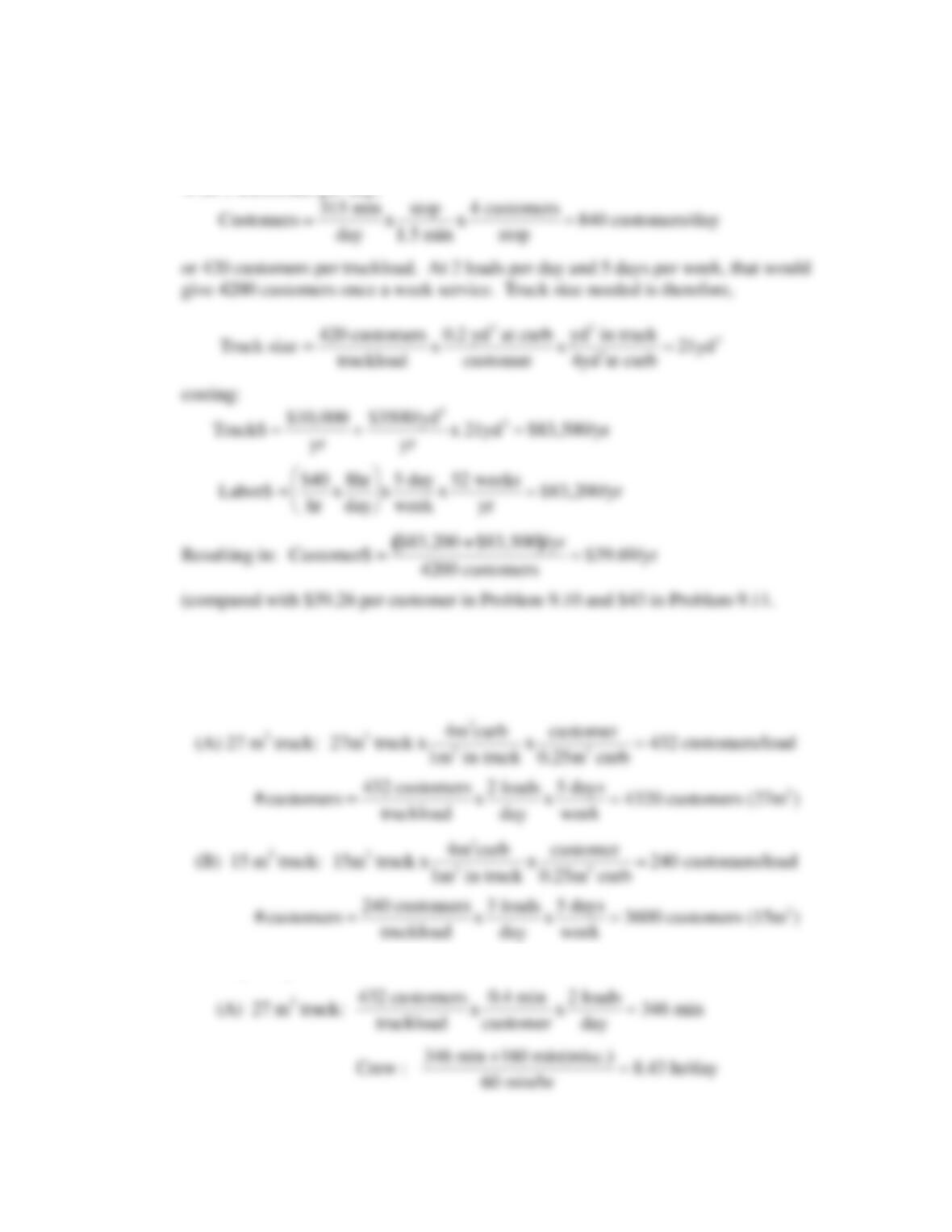
9.12 So, with 8-hr days a smaller truck can be used. As in Problem 9.11:
Collection time = 8 hr/d x 60 min/hr – 165 min/d = 315 min/day
With 2 truckloads per day,
9.13 Comparing two truck sizes:
a. Customers for each truck:
b. Hours per day for the crew:
9.6
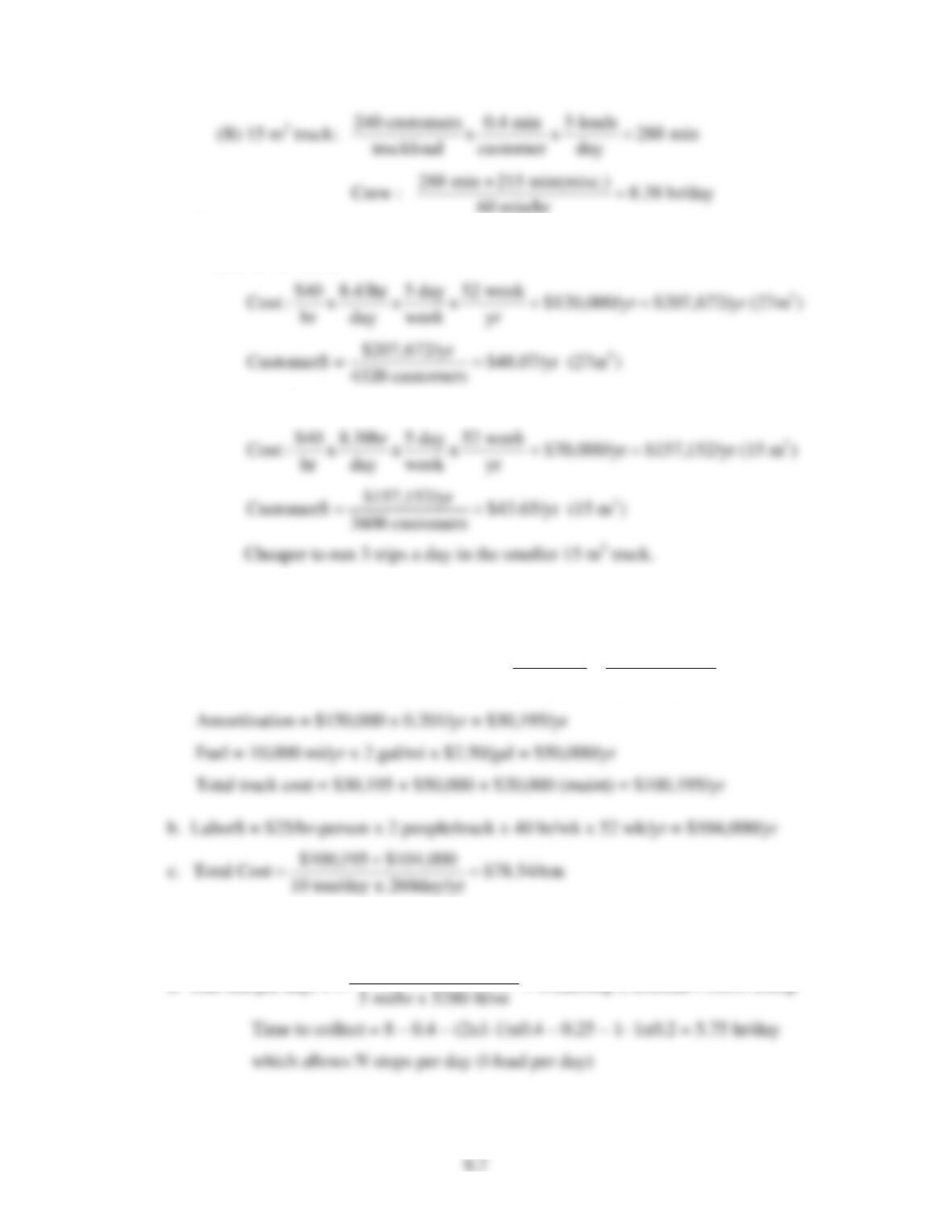
c. Cost per customer:
(A) 27 m3 truck:
(B) 15 m3 truck:
9.14 A $150,000 truck, 2 gal/mi, $2.50/gal, 10,000 mi/yr, $20k maintenance:
a. Amortized at 12%, 8-yr: CRF 8yr,12%
()
=i1+i
(
)n
1+i
()
n−1=0.12 1+0.12
(
)8
1+0.12
()
8−1=0.201/yr
9.15 Reworking Examples 9.5 – 9.7 to confirm the costs in Table 9.17:
a. One-run per day, t=150 ft/stop x 3600 s/hr
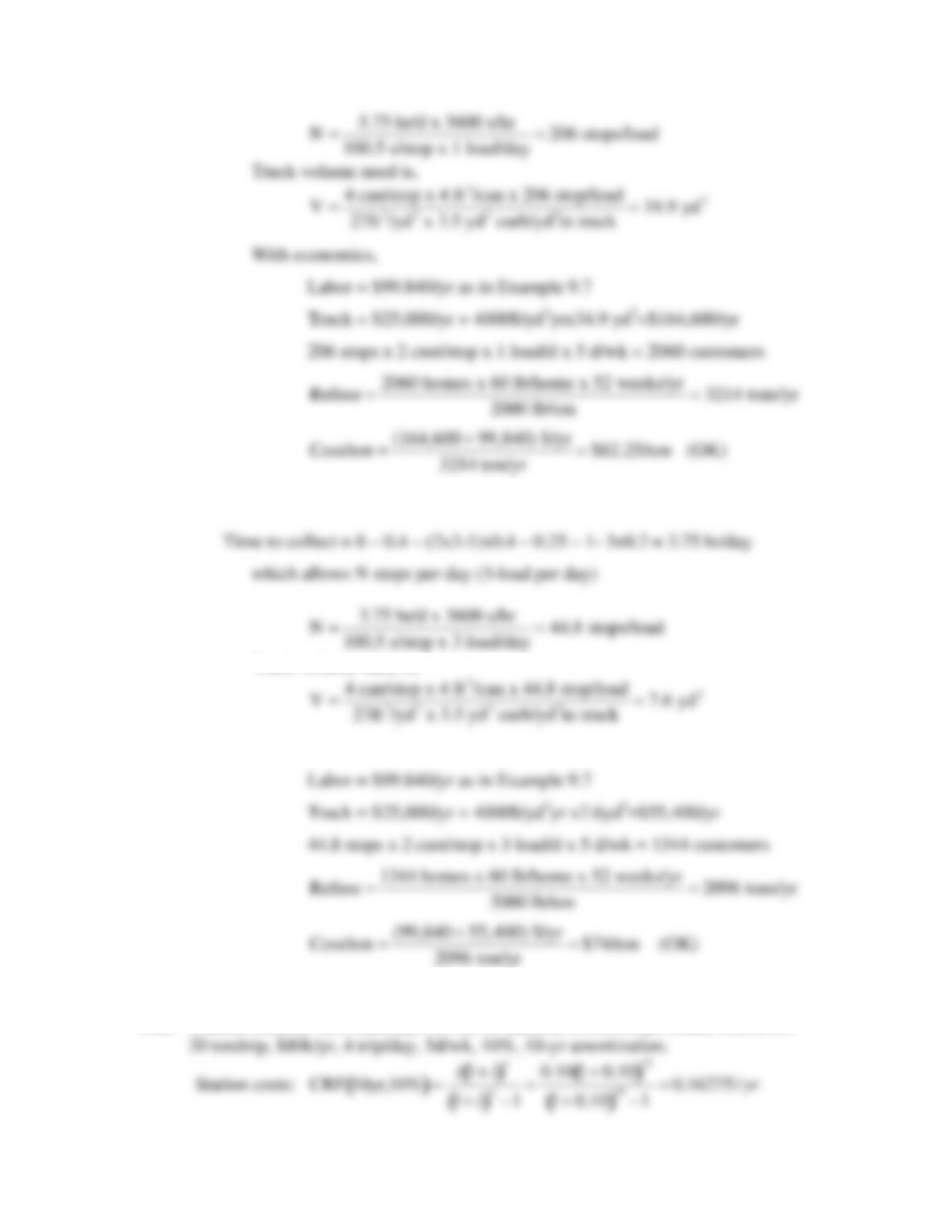
b. Three-runs per day: 100.5 s/stop
Truck volume need is,
With economics,
9.16 Transfer station: 200 tons/day, 5d/wk, $3 million, $100,000/yr, trucks $120,000,
9.8
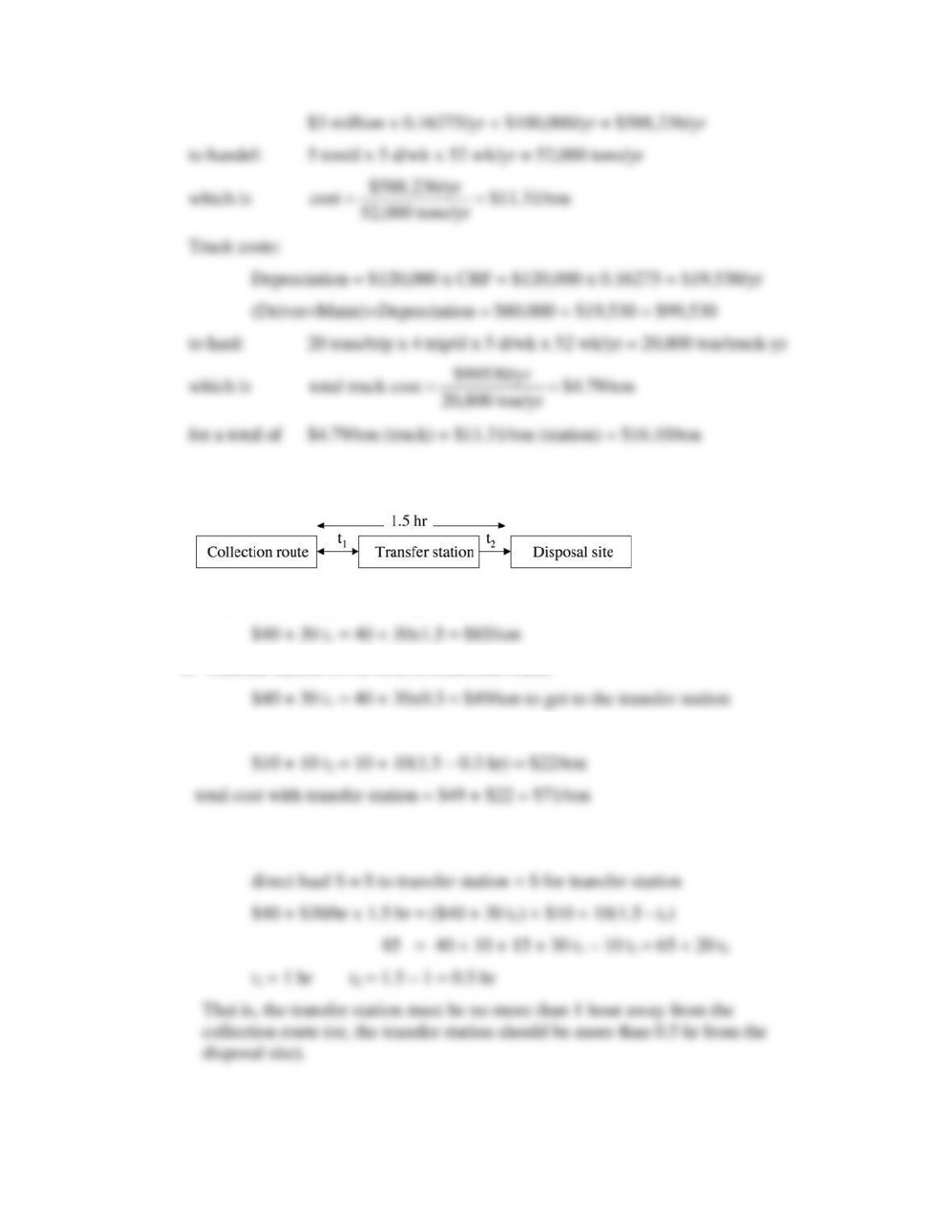
9.17 Distance for an economic transfer station:
a. Cost of direct haul to the disposal site,
b. Transfer station 0.3 hr from a collection route,
for the transfer station
c. Minimum distance from the transfer station to the disposal site,
9.9
9.18 Newsprint: 5.97% moisture, HHV = 18,540 kJ/kg, 6.1% H.
Starting with 1 kg of “as received” waste:
9.19 Corrugated boxes, 5.2% moisture, HHV = 16,380 kJ/kg, 5.7% H in dried material:
Could use the procedure shown in Prob. 9.18, or use (9.7)
9.20 2 L PET bottle, 54 g, 14% H, HHV = 43,500 kJ/kg,
9.21 Energy estimates based on HHV = 339(C ) + 1440 (H) – 139 (O) + 105 (S)
a. Corrugated boxes: based on dry weight,
b. Junk mail:
9.10
d. Lawn grass:
e. Demolition softwood:
f. Tires:
9.22 Draw the chemical structures:
a. 1,2,3,4,7,8-hexachlorodibenzo-p-dioxin
c. Octachlorodibenzo-p-dioxin
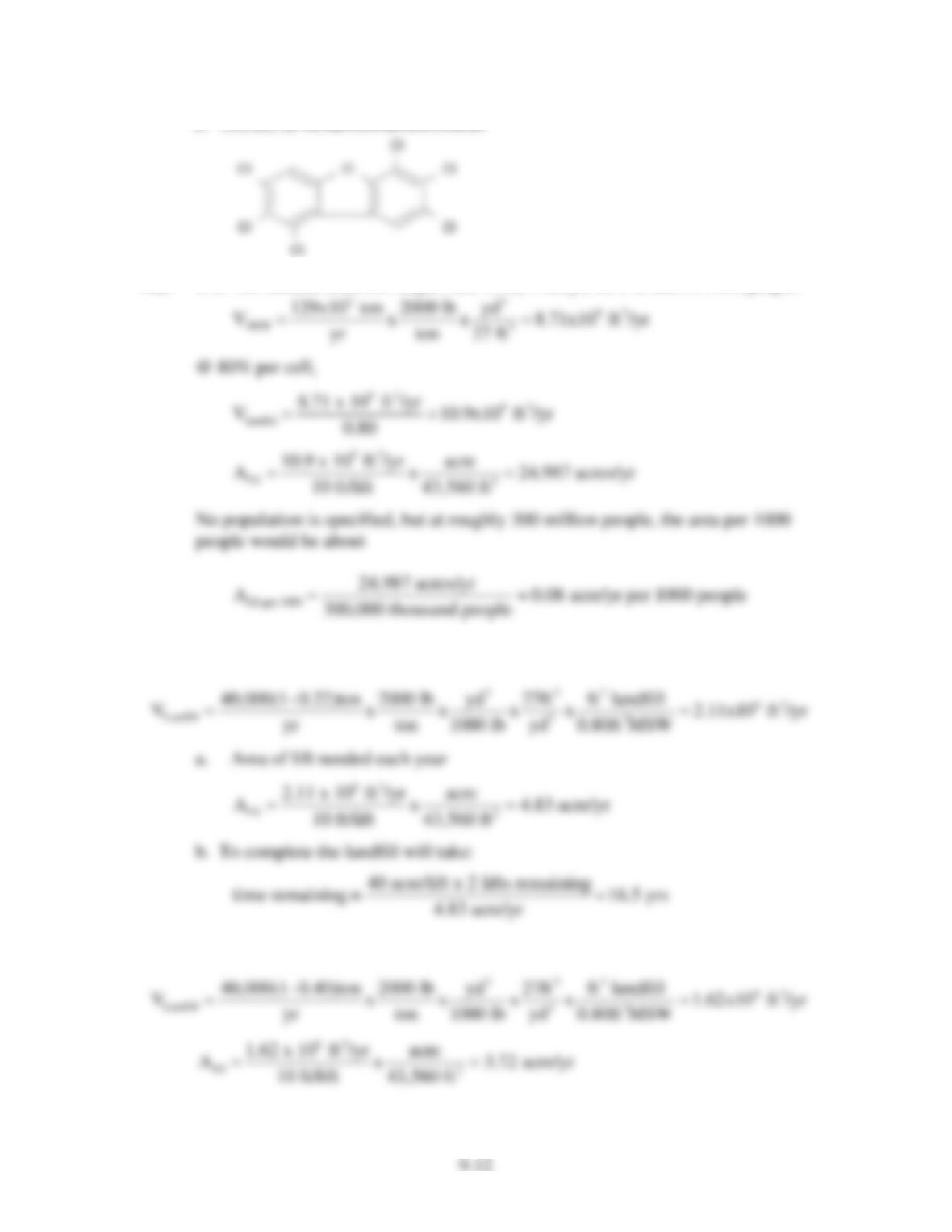
e. 1,2,3,6,7,8-hexachlorodibenzofuran
9.23 U.S. 129 million tons, 800 lb/yd3, cell 10-ft, 1 lift/yr, 80% is MSW, 1000 people:
9.24 50,000 people, 40,000 tons/yr, 22% recovery, 1000 lb/yd3, 10-ft lift, 80% MSW:
9.25 By increasing the recovery rate from 22% to 40%,
9.26 Lawn trimmings: Per kg, 620g moisture and 330g decompostables represented by
C12.76H21.28O9.26N0.54.
1 mol trimmings = 12×12.76 + 1×21.28 + 16×9.26 + 14×0.54 = 330.2 g//mol
That is, 1 kg of as received trimmings has 330g of decompostibles, which turns
out to be1 mole of decompostibles. Using (9.8) gives
C
12.76H21.28O9.26N0.54 + n H2O Æ m CH4 + s CO2 + d NH3
where m = (4×12.76 + 21.28 –2×9.26 –3×0.54)/8 = 6.5225
So, 6.5225 moles of CH4 are produced per mole (330g) of decompostibles. So, 1
kg of lawn trimmings, with 330g of decomposbiles, results in 6.5225 moles of
CH4.
a. Volume of methane:
9.27 1 kg of food wastes, with 720g water and 280g of CaHbOcNd:
a. C 45% 0.45 x 280 = 126g
b. Chemical reaction:
9.13
Methane producing reaction is therefore:
c. Fraction of the resulting gas that is methane:
d. Volume of methane per kg of food waste: