
Recycling of the Elements:
The Carbon Cycle
Learning Objectives
After reading this chapter, students should be able to:
• Understanding the global carbon cycle.
• Know why Earth is likely the only planet in our solar system that supports life.
• Know the characteristics of more productive waters (e.g., high chlorophyll
concentration).
• Understand why the composition of marine organisms determines the composition
of sea water.
• Know the concept of residence and characteristic response time.
• Know the difference between the long and short term organic carbon cycle.
• Know the characteristics of the organic and inorganic carbon cycle.
• Know the concept of the biological pump and how it has a profound effect on ocean
chemistry.
• Understand why the color of the ocean surface is strongly influenced by the density
of phytoplankton.
• Know why the cold waters of the high-latitudes are most conducive to
phytoplankton growth.
Review Questions
1.) Which of the following carbon reservoirs has the longest residence time: plants,
the oceans, or sedimentary limestone?
2.) One or more of the following processes involves organic carbon; identify it
(them): the precipitation of a calcite skeleton, the exchange of carbon between the
oceans and the atmosphere, dissolution at the sea floor or oxidation during
weathering?
CHAPTER
8
2
3.) Describe the biological pump.
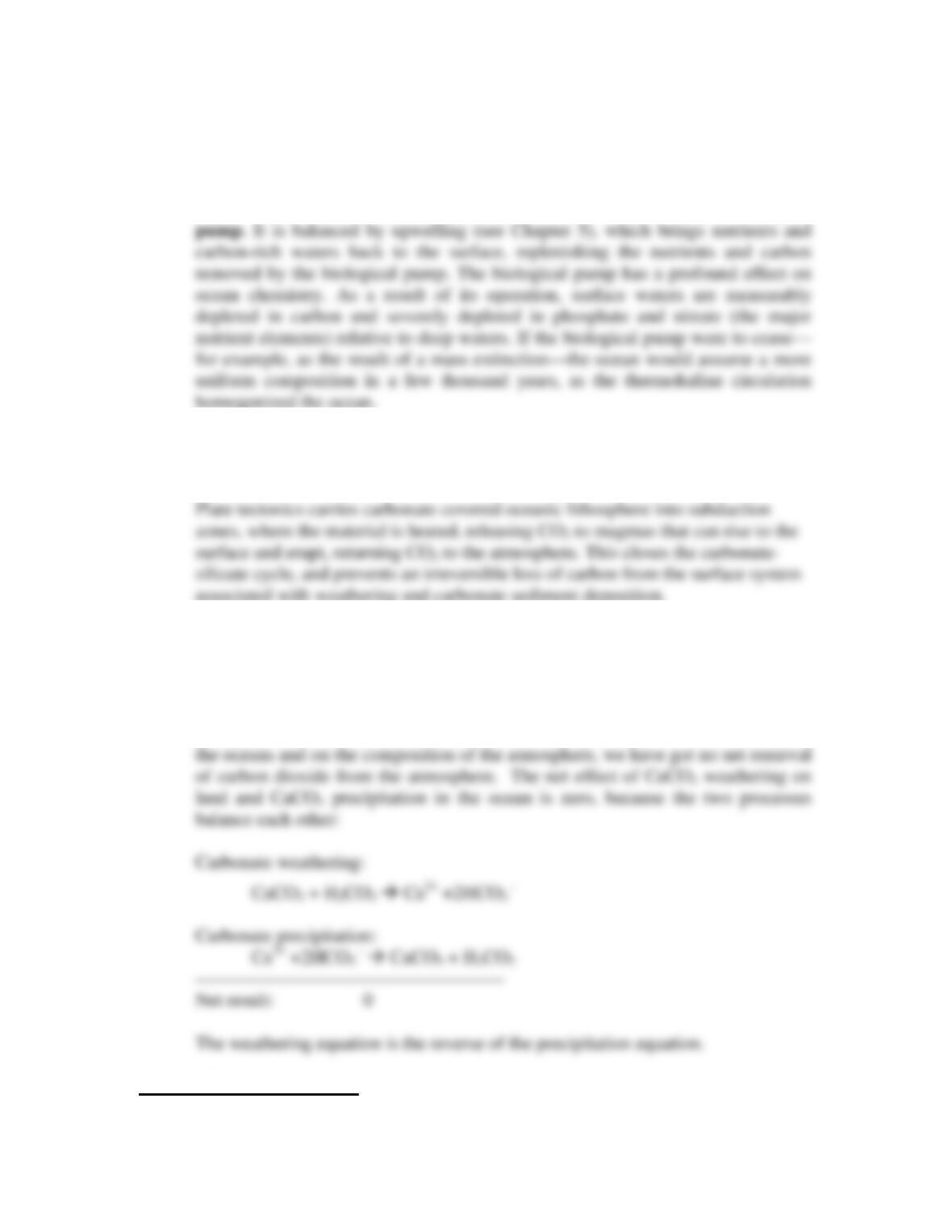
The overall effect of photosynthesis in shallow waters, of the settling of organic
matter, and of decomposition in deep waters is the transfer of CO2 and nutrients
from the surface waters to the deep ocean. This process is known as the biological
4.) Why is plate tectonics critical to the maintenance of an atmosphere-ocean
reservoir rich in carbon?
5.) Limestone (carbonate) weathering does not lead to the net removal of carbon
dioxide from the atmosphere. Why not?
Because when we combine the equations for carbonate weathering for CaCO3 and
precipitation to determine the net effects of these processes on the chemistry of
Critical Thinking Problems
3
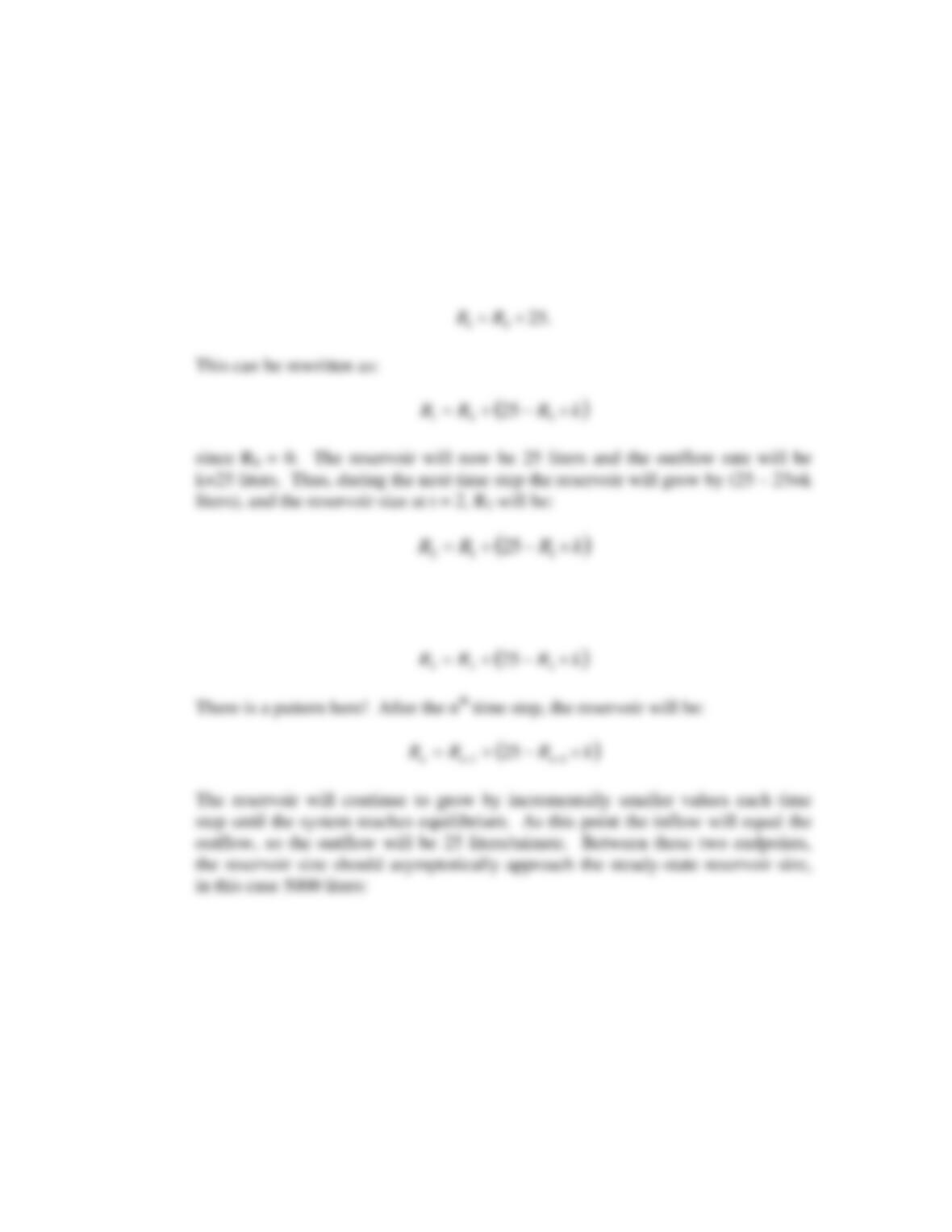
1.) The key to stability is feedback between the reservoir and the fluxes into and/or
out of the reservoir. Assume that the rate of outflow from a reservoir depends on
the size of the reservoir according to the following relationship: outflow
rate=k×(size of reservoir), where k is a constant.
a. A reservoir of water has volume of 5000 liters, and the rate of outflow at steady
state is 25 liters per minute. What is k? (Give both numerical value and its units.)
What is the residence time? What is the relationship between k and the residence
time?
Inflow Outflow 25 liter/minute
Residence time is defined as the average length of time a substance spends in a
given reservoir that is at steady state. We can calculate the residence time by
dividing the reservoir size at steady state by the inflow or outflow rate:
5000 liters
Reservoir
4
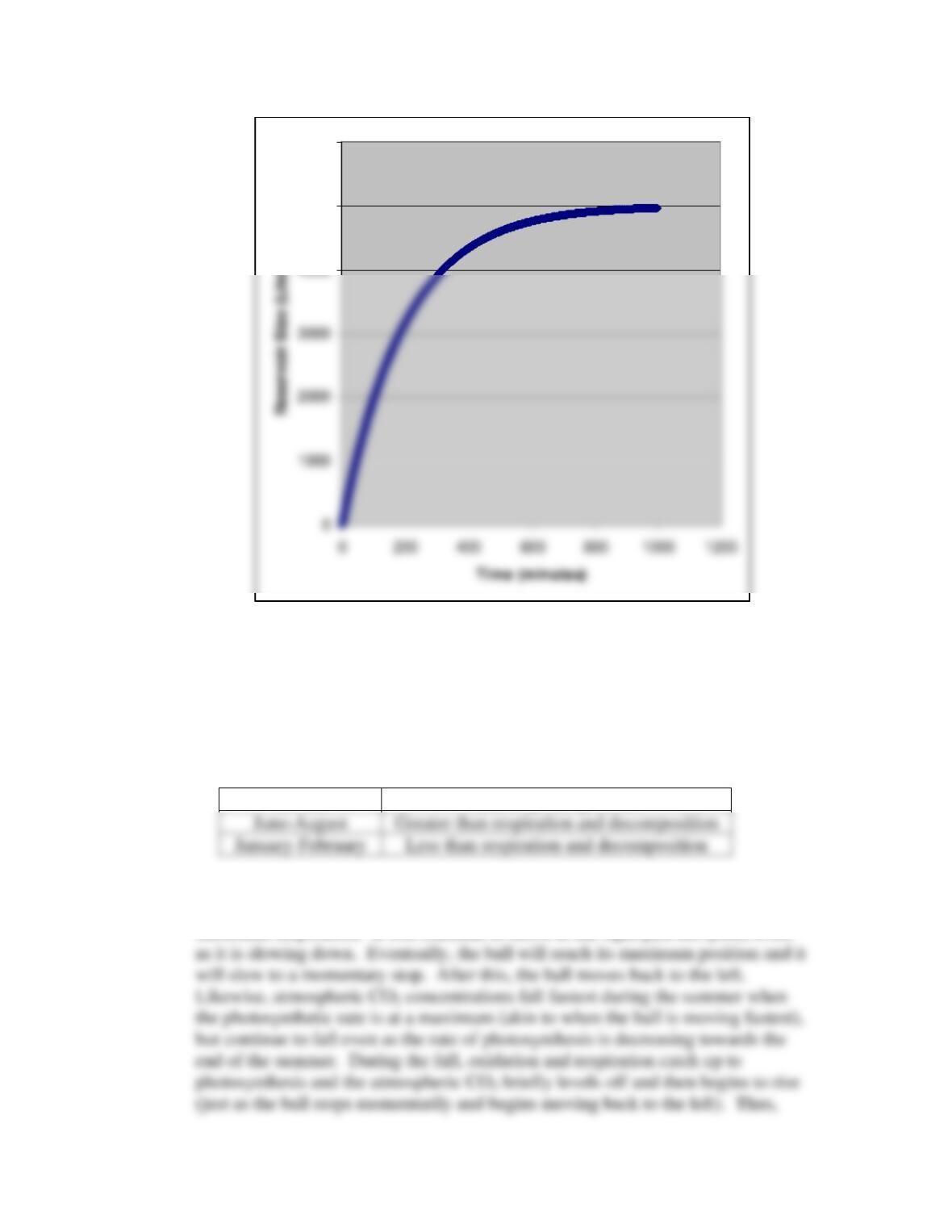
b. The inflow rate is 25 liters per minute. Describe graphically and in words how the
reservoir size would change with time, beginning with a reservoir size of zero and
continuing until the reservoir reaches steady state.
We will derive this relationship by tracking the growth of this reservoir beginning
with an initial reservoir, R0 = 0. During the first time step, the reservoir will
increase by 25 liters, as there is no outflow from the system. Thus, the reservoir
size at t=1, R1, can be written as:
The outflow rate will continue to increase with increasing reservoir size. For
example, the reservoir at time t =3 is given by:
5
4000
5000
6000
2.) Use Figure 8-4 to answer the following questions:
a. During which months is the rate of photosynthesis greatest, relative to the
combined rate of respiration and decomposition, and during which months is it
smallest? Explain your reasoning. Why aren’t these coincident with the minimum
and maximum CO2 levels for the year, respectively?
Months Rate of photosynthesis
The system is comparable to the motion of a ball on a spring. As the ball moves
in one direction, say right, it will reach its greatest velocity halfway to its
maximum disposition. It will continue to move to the right past this point, even
6
b. On the basis of your answer to part (a), estimate, for each year, the maximum net
rate of photosynthesis and the maximum net rate of respiration/decomposition for
each of the three years shown.
If we consider:
Average atmospheric CO2 = 360 ppm
For fall/winter, 2000: ppm/month. 3.25
months2
ppm 360–ppm 366.5 =
c. Are there significant differences in these rates from year to year? If so, propose an
explanation for them.
3.) A giant meteor crashes into Earth, causing devastating environmental changes
that kill off all life in the oceans.
a. Describe how the vertical distribution of dissolved oxygen, carbon, and nutrients
would respond.
7
Life is the force that drives the nutrient gradients that exist in the ocean.
b. Would the temperature and salinity of the ocean be affected by the loss of the
biological pump? Why or why not?
c. If global warming from CO2 released to the atmosphere from the meteor impact
site caused, instead of the complete loss of marine life, the sudden cessation of
thermohaline circulation in the oceans, what would be the effect on the vertical
and spatial distribution of dissolved nutrients, carbon, and oxygen in the world’s
oceans?
At first, if biological productivity continued as before, the magnitude of the
gradients would increase, as shutting off the thermohaline circulation would
4.)
a. The atmosphere consists of 78% N2, 21% O2, 1% Ar, and about 0.036%
(360ppm) CO2. What is the mean molecular weight of air? Round your answer to
three significant figures, and use the following table of atomic weights:
Element Atomic Weight
C (Carbon) 12.011
8
b. The total mass of the atmosphere is about 5×10¹⁸ kg. How many moles each of
air, O2, and CO2 are present in the atmosphere? (Note: Calculate the latter two
answers from the first one rather than by computing the masses of O2 and CO2.
The values listed in part (a) for the various gases are abundances by volume, not
by mass. This fact, and the fact that a mole of any gas takes up the same volume
at a given pressure and temperature, mean that you need to work in moles.)
c. Forests contain about 600 Gton(C) in the form of wood and leaves. Suppose that
all the world’s forests were to burn down instantaneously. By how much would
atmospheric CO2 increase? By how much would O2 decrease? Express your
answers in percentages. Assume that the equation for burning is the same as that
for respiration (give earlier in this chapter).
Forest combustion: CH2O + O2 CO2 + H2O
CO2 will increase by ~ 5 × 10¹⁶ mol, or

9
5.) Explain why lakes and rivers have slightly basic pH values, whereas rainwater
(the ultimate source of water for lakes and rivers) is slightly acidic.
Rainwater is naturally acidic because it contains dissolved carbon dioxide
Resource Guide
Video/Film:
Intimate Strangers: Unseen Life on Earth, Episode 2. Keepers of the Biosphere.
Annenberg/CPB
Sharing Carbon: The Carbon Cycle
Water, Water Everywhere: The Hydrologic Cycle
Films for the Humanities and Sciences
The Living Soil: The Value of Humus
Films for the Humanities and Sciences

10
Websites: