Circulation of the Solid Earth: Plate Tectonics
Learning Objectives
After reading this chapter, students should be able to:
• Analyze and interpret the Earth’s response to forcings on a wide range of time scales
• Know the geodynamics associated with the convective circulation in the Earth’s mantle
• Understand the concept of plate tectonics and mantle convection
• Know how plate tectonics relates to ocean history and the formation of ocean basins
(Sea-floor Spreading, Wilson Cycle)
• Know the three plate tectonic boundaries and the forces at work there
• Know the relationship of plate tectonics to sediment deposition patterns
• Know the features of the continental margins and the sea floor, especially as it relates to
tectonics
• Know the most important feature of the Earth’s interior is that it is differentiated into a
series of layers. These layers differ in both their chemical composition and in their
physical properties (solid, plastic, liquid)
• Understand how the magnetic striping pattern forms, and know why these stripes are
symmetrical about the crests of the mid-ocean ridges
• Know how the convection currents beneath the plates move the crustal plates in
different directions
• Know the source of heat driving the convection currents is radioactivity deep in the
Earth’s mantle
• Know how mountains grow
• Know about seismic waves and their characteristics
Review Questions
1.) Why was the theory of continental drift not immediately embraced by the
scientific community in the 1920s?
2.) What is the Moho?
CHAPTER
7
2
The Moho is defined by a sharp increase in seismic wave velocities that separates
3.) What are the bases for the two major divisions of Earth’s interior–one that
distinguishes crust, mantle, and core and the other that distinguishes lithosphere
and asthenosphere?
Physical properties define the lithosphere and asthenosphere. The plates consist
of an outer layer of the Earth, the lithosphere, which is cool enough to behave as
4.) Compare and contrast P and S seismic waves.
Body waves are categorized as either P waves or S waves on the basis of their
mode of propagation through Earth. P waves, or primary waves, result from the
5.) Why are earthquakes focused along plate margins?
Earthquakes are the result of plate motion: The plates move relative to each other
3
6.) What are the sources of heat in the Earth’s interior?
7.) What is magnetic polarity? What role did it play in the generation of ideas
regarding sea-floor spreading?
The magnetic polarity is the geographic orientation of the North and South Poles.
8.) What are the three types of plate boundaries, and what surface features are
characteristic of each?
9.) What is erosion?
10.) How can radioactivity be used to determine the age of a rock?
Naturally-occurring radioactive materials break down into other materials at
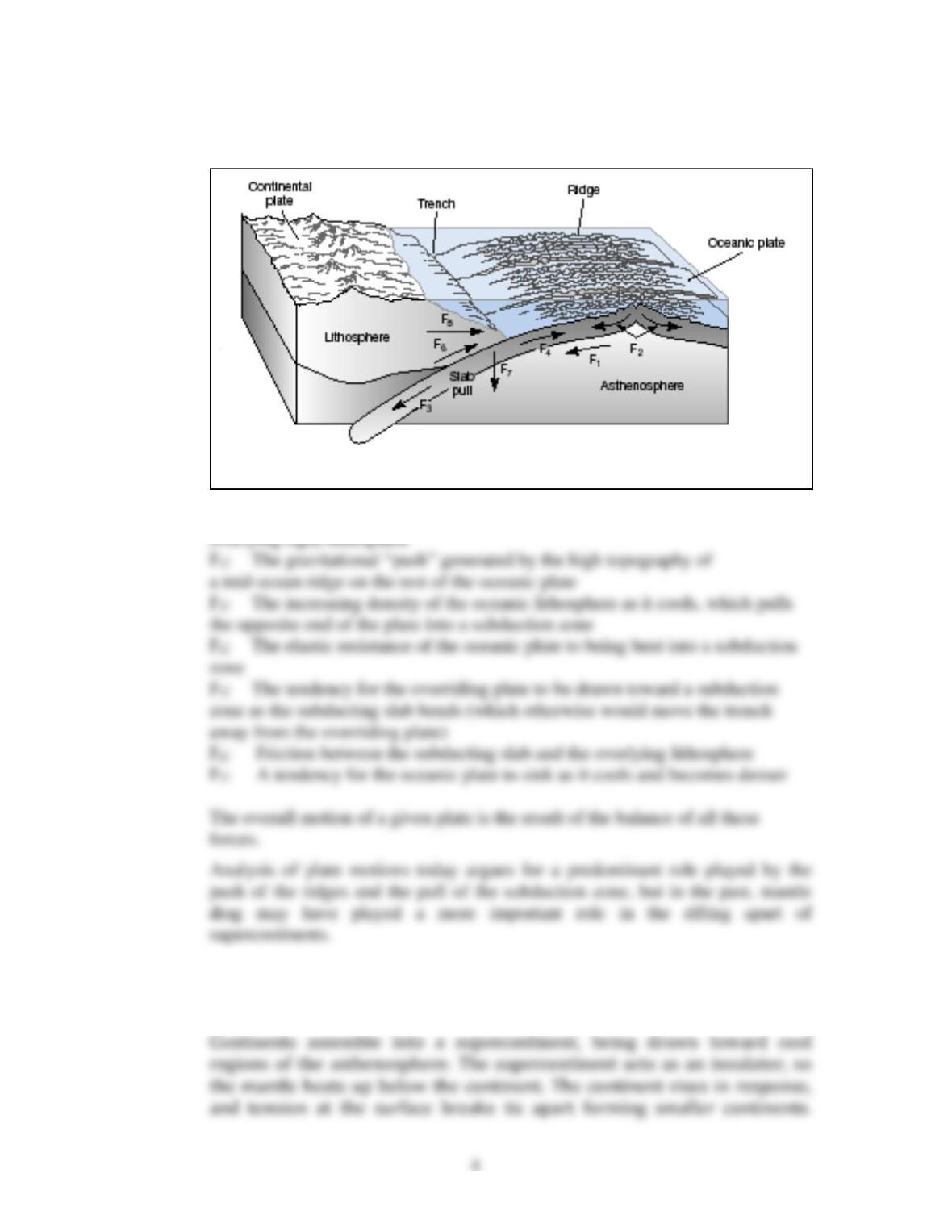
11.) What are the driving forces for plate movement?
Figure 7-23 from main textbook
F
1: Mantle drag or friction between the convecting asthenosphere and the
12.) What is hypothesized to drive the Wilson cycle of plate fragmentation and
reassembly?
5
Critical Thinking Problems
1.) We have seen that cooling of the oceanic lithosphere causes contraction, leading
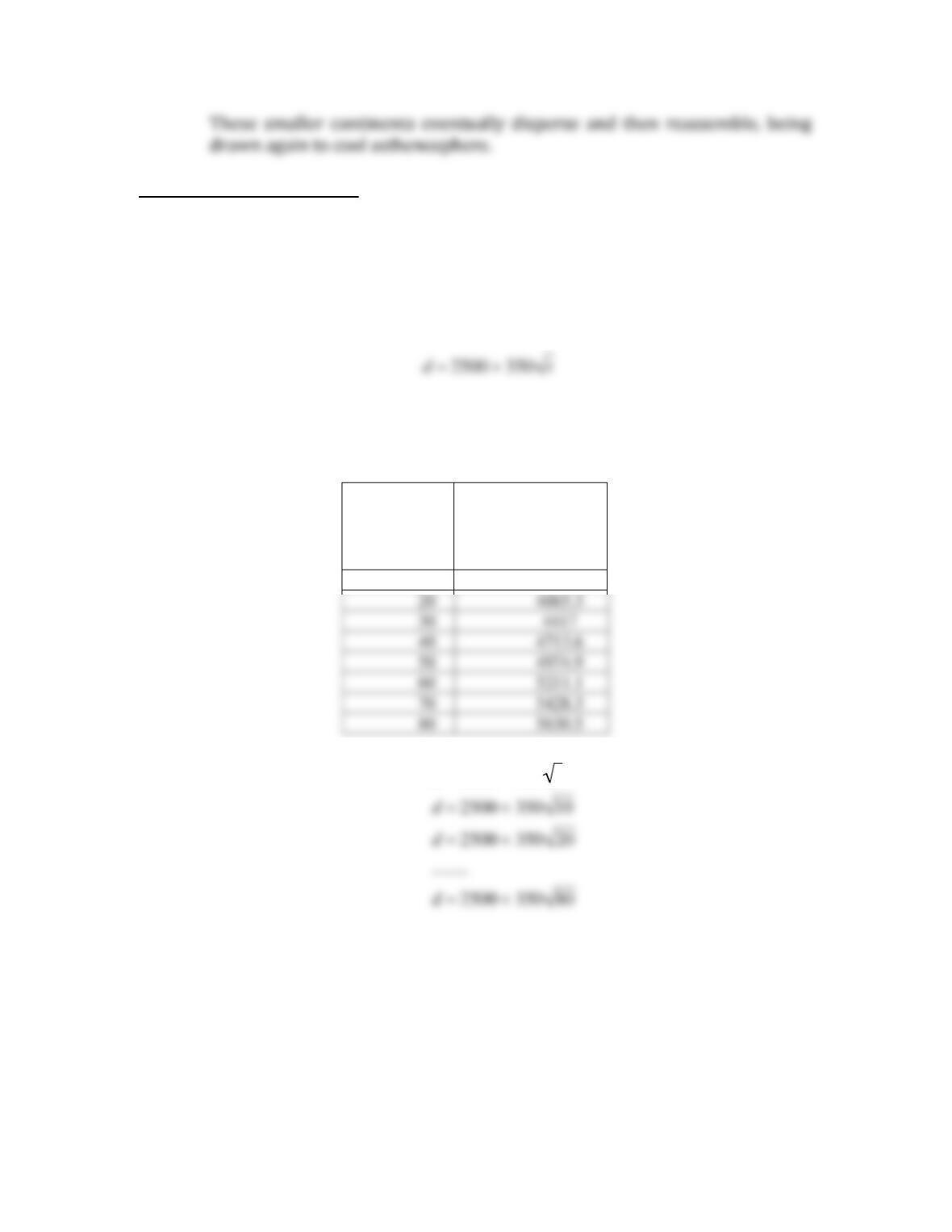
to subsidence of the sea floor away from the axis of spreading. The depth d of the
ocean floor, measured in meters, increases with age t, measured in millions of
years from the present, according to the following equation (valid for sea floor
younger than 80 million years old):
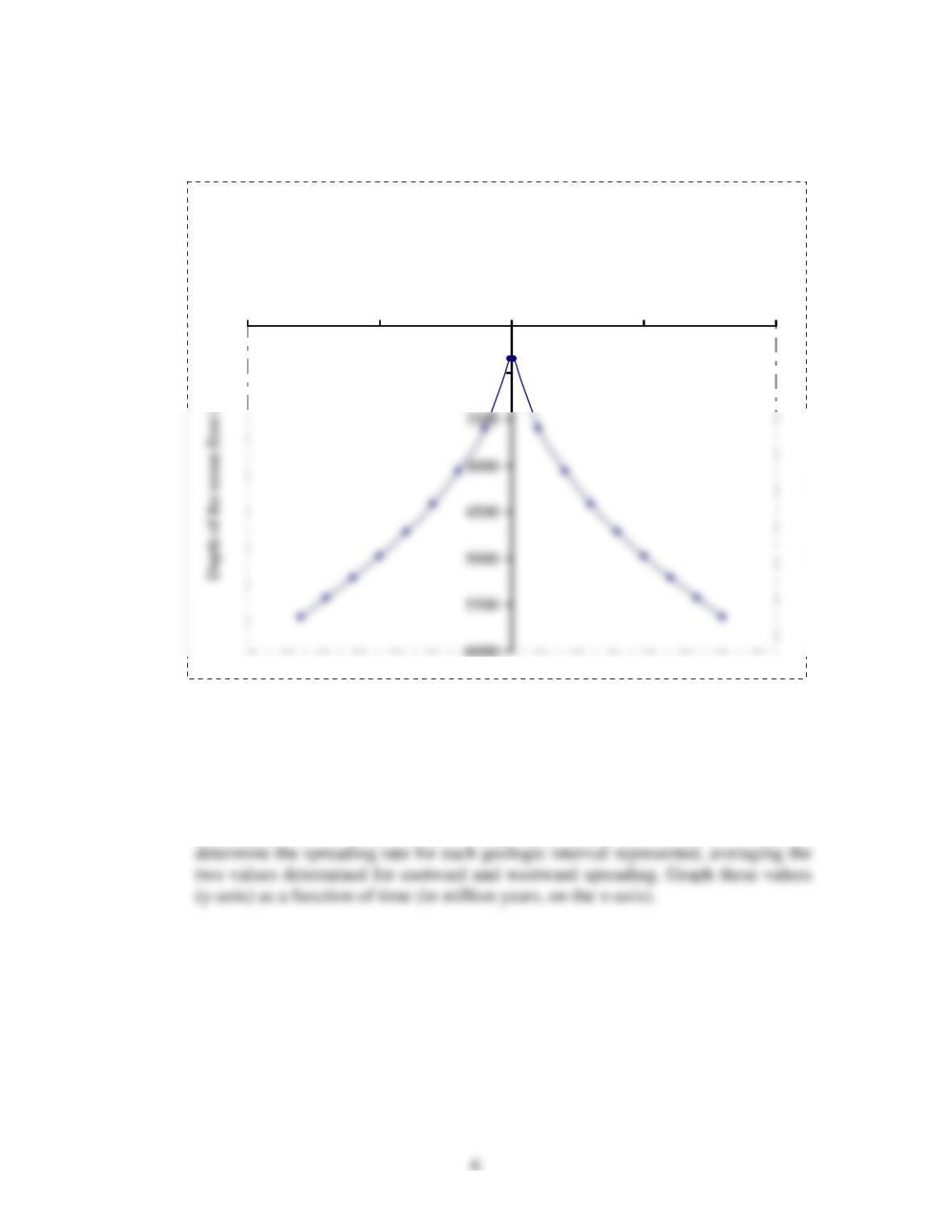
Graph a cross-section of a mid-ocean ridge that is spreading symmetrically in
both directions at a rate of 1cm/yr (10 km/million yr). The age of the oldest sea
floor shown should be 80 million years.
d=2500 +350 t
t (million
years) d(m)Depth
of the
ocean
floor
10 3606.8
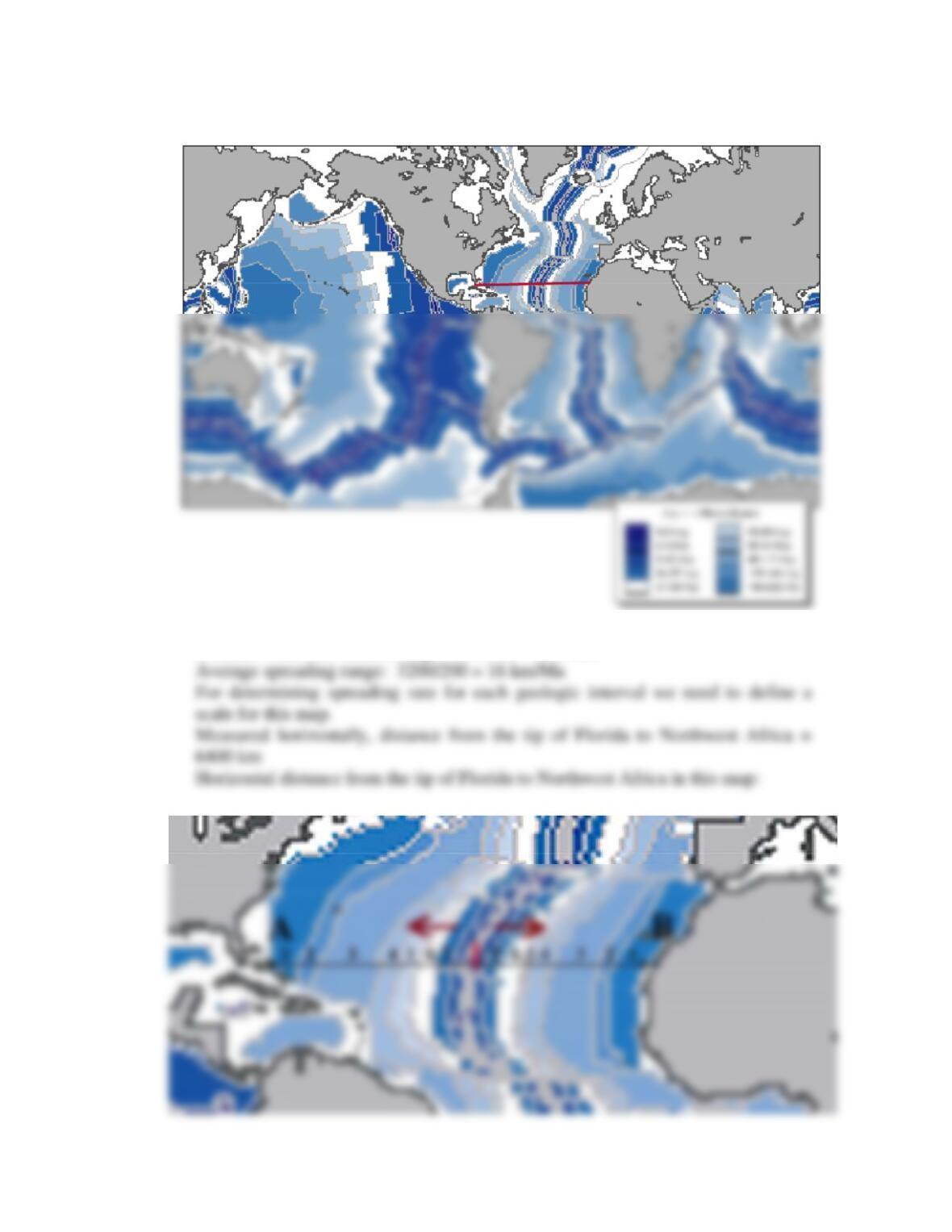
2.) Duplicate Figure 7.10 (use the color version for better clarity) and answer the
following questions.
a. Draw a line from the tip of Florida horizontally across the Atlantic to northwest
Africa, a distance of about 6400 km. Now, graph the age of the sea floor (on the
y-axis) against the distance from the ridge axis (on the x-axis). From this graph,
Mid-Ocean Ridge
2500
3000
–100 –50 0 50 100
Distance from the Mid-Atlantic Ridge (km)
m
7
Oldest sea floor = 200 Ma
Distance from mid oceanic ridge = 6400/2 = 3200 km
Florida Northwest africa
8
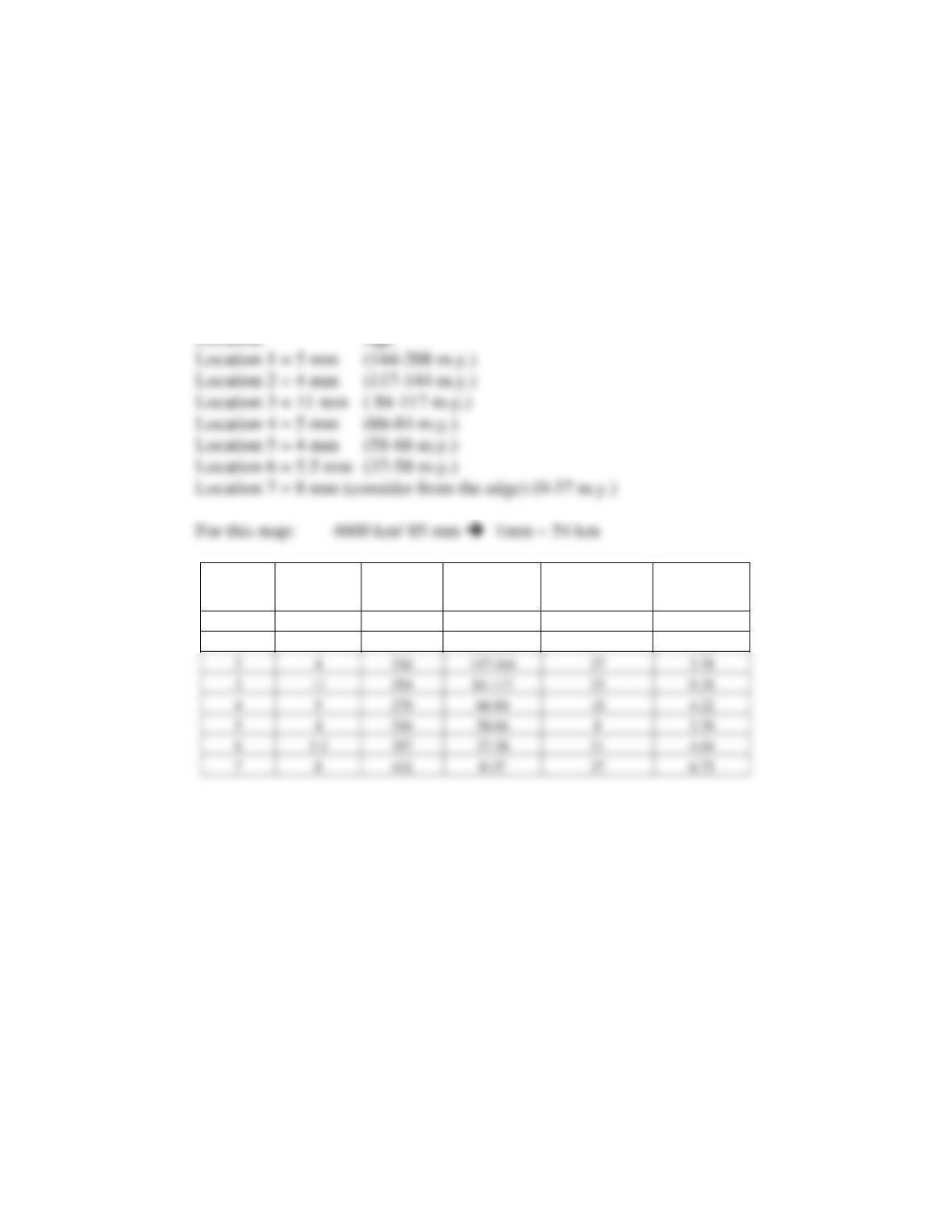
Assumption:
For simplicity we consider symmetric spreading rate from the edge. Also the
enlarged map doesn’t have good resolution, so we are going to consider only 7
stripes.
By measuring from the edge to Florida:
AB = 85 mm
Location Distance
(mm) Distance
(km) Age (m.y.) Year (m.y.) Spreading rate
(km /m.y.)
1 5 270 144-208 64 4.22
9
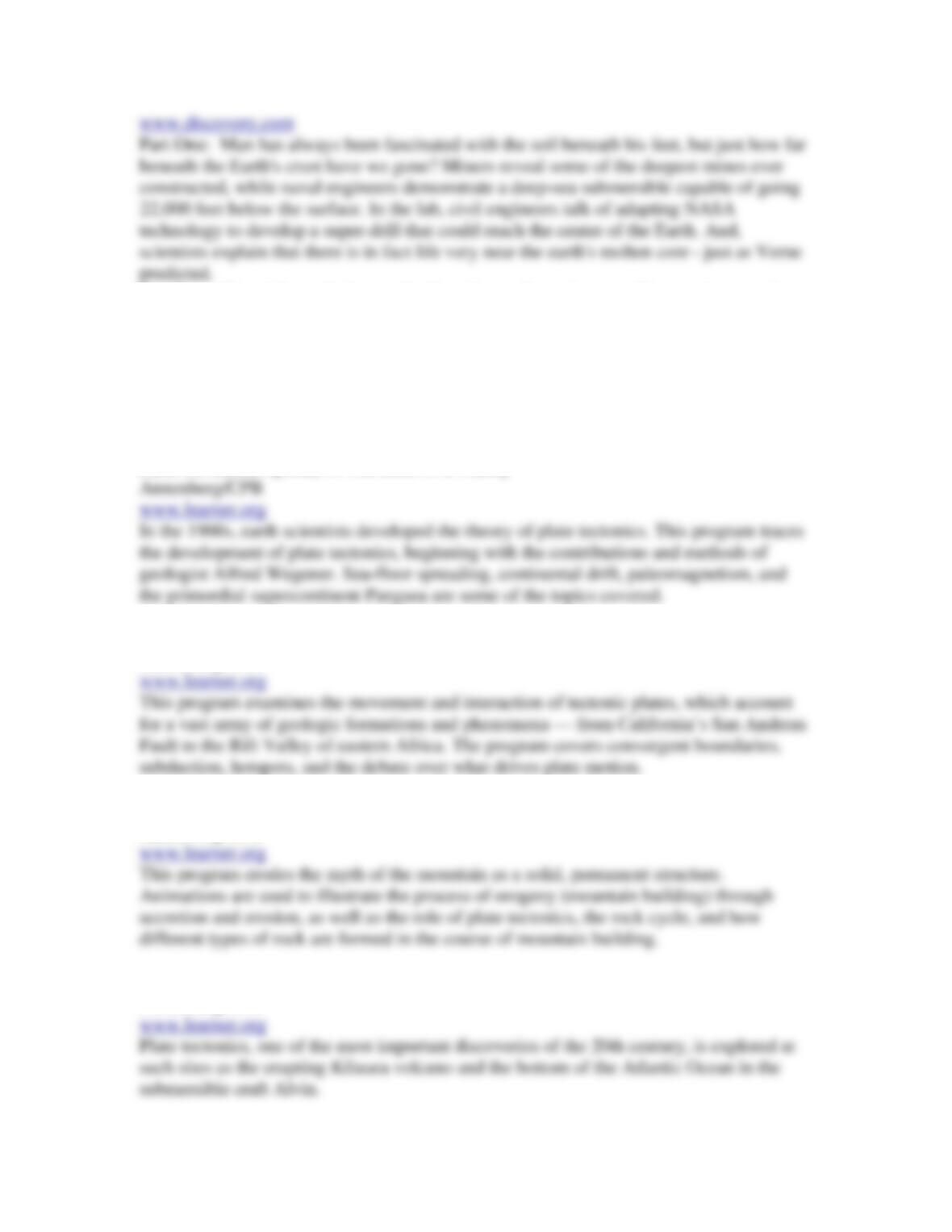
b. How has the Atlantic spreading rate varied over the last 200 million years?
The Atlantic spreading rate first decreased from 208 m.y. ago to 142 m.y. and
then it increased until 91 m.y. ago. From that time until now it has been
increasing.
Resource Guide
Video/Film:
Journey to the Center of the Earth VHS Set
Discovery Channel
Spreading Rate of The Mid –Atlantic Ridge
0
1
9
10
0 50 100 150 200 250
Age of the ocean floor (m.y.)
Spreading rate (km /m.y.)
10
Part Two: Travel through the mouth of a volcano, through a sea of lava and emerge into
a land of floating continents and upside mountains. This is the strange, violent world near
the earth’s iron core. Scientists explain how the core protects us from the sun’s deadly
cosmic rays and reveal how the molten core of iron –Verne’s shining “sea” — benefits
from our planet’s built-in recycling system. Learn how the seafloor is pushed under the
continents and down into the hot mantle where it melts — only to return to the surface
years later as molten lava and eventually the very soil on which we stand.
Earth Revealed, Episode 5. The Birth of a Theory
Earth Revealed, Episode 6. Plate Dynamics
Annenberg/CPB
Earth Revealed, Episode 7. Mountain Building
Annenberg/CPB
Planet Earth, Episode 1. The Living Machine
Annenberg/CPB
Continental Drift: Legacy of Fire
Plate Tectonics: Secrets of the Deep
Films for the Humanities and Sciences
Websites:
http://pubs.usgs.gov/publications/
http://www.seismo.unr.edu/ftp/pub/louie/class/100/plate-tectonics.html
http://rock.geosociety.org/
http://www.renaissoft.com/april/cgi-bin/wiki.pl?Plate_Tectonics
12
Literature:
The New View of the Earth by Seiya Uyeda, 1978 by W.H. Freeman and Co.
The Earth’s Dynamic Systems by W. Kenneth Hamblin, 1975 by Burgess
Publishing Co.
Global Tectonics by Philip Kearey & Frederick J. Vine, 1996 by Blackwell
Sciences Ltd.
Physical Geology by Carla W. Montgomery, 1987 by Wm. C. Brown Publishers.