Solution Manual for Introduction to Mechatronic Design Do Not Circulate
Chapter 7 Inter-Processor Communications
7.1) True or False: Asynchronous communications involves a shared clock line.
7.2) Describe the fundamental difference between bit-serial and bit-parallel communications.
In bit-serial communications, one bit of data is relayed at a time from the source of the data to the
7.3) Under what conditions will the noise flag in a typical UART be set?
7.4) What is the role of the SS* line in synchronous serial communications?
7.5) True or False: All standard synchronous serial communications protocols involve 2 data lines and 1 clock
line.
7.6) What is the purpose of the parity bit?
7.7) True or False: IR remote controls typically use FSK modulation.
7.8) True or False: RS-485 is an example of a differential signaling standard.
True.
7.9) Explain the basic difference between the RS-232 and RS-485 signaling standards.
RS-232 is a single-ended signaling standard, which relies on the voltage difference between a single
connection and ground to indicate a 1 (when the data line has a voltage between -3 V and -25 V) or a 0
RS-485 is a balanced differential signaling standard, which relies on the voltage differential between
7.10) What UART error bit (if any) would be set if the center of the 10th bit time after the falling edge of the
start bit in an 8N1 asynchronous serial bit stream was found to be at the spacing level?
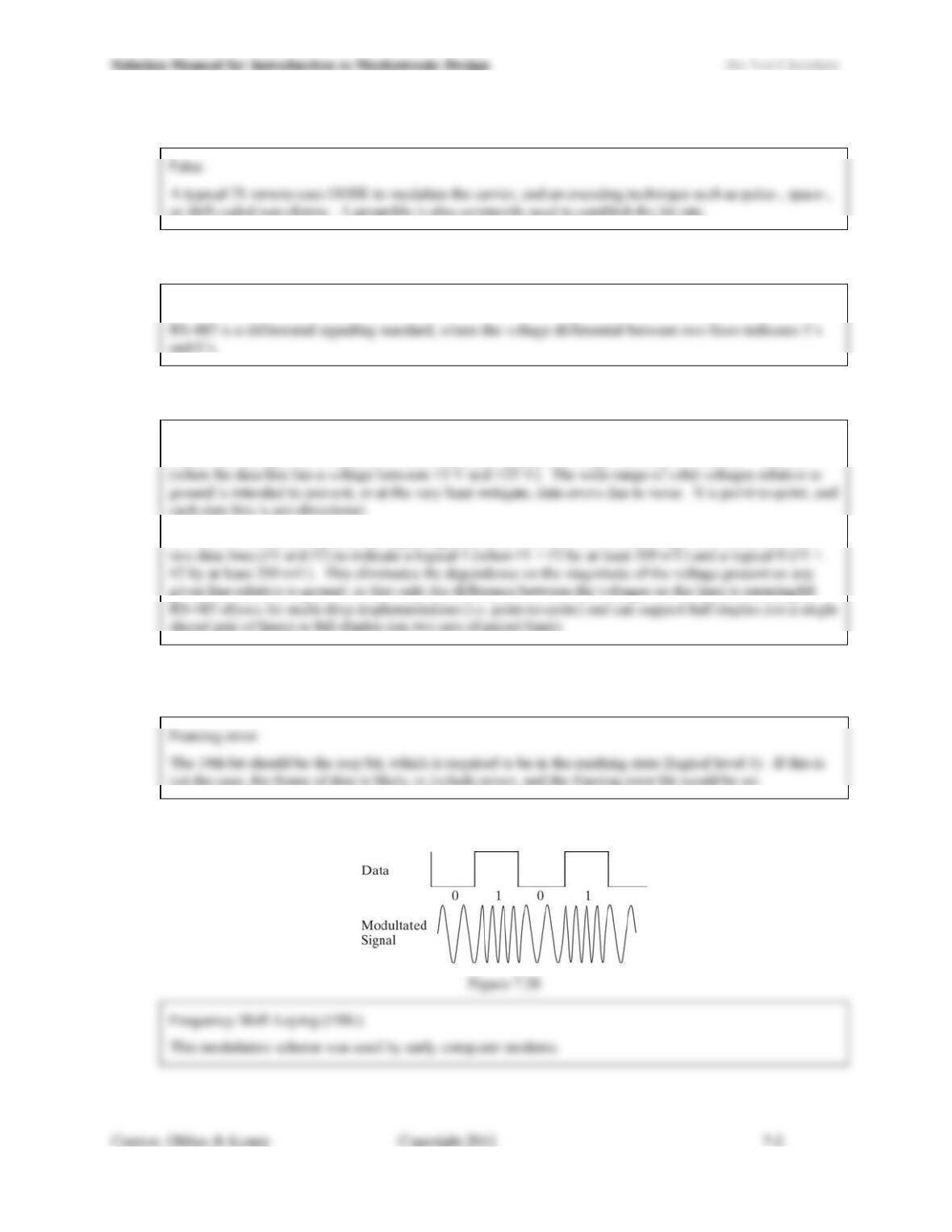
7.11) Identify the type of modulation shown in Figure 7.28. Which types of devices use this scheme?
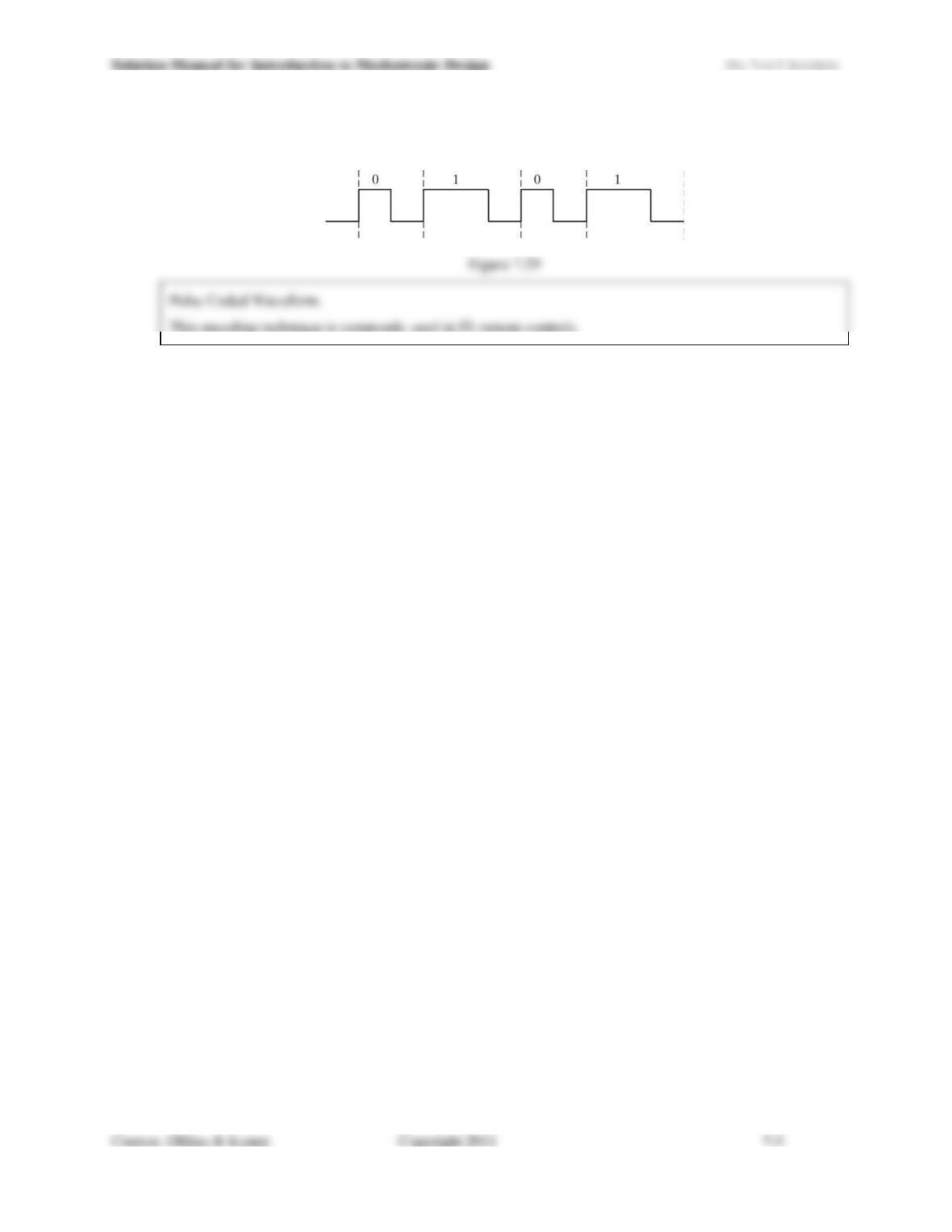
7.12) Identify the type of waveform shown in Figure 7.29, which is commonly implemented with OOSK. Which
types of devices commonly use this scheme?