55
(iii) The redox-sensitive species in these groundwaters include DOC and the sulfate/sulfide
redox pair. Note that DOC (an electron donor) decreases along the flow path, as does SO4
2, while
HS increases along the flow path. From this we can surmise that sulfate reduction is taking place:
2CH2O + SO4
2 H2S + 2HCO3
17. The following analyses (in ppm) were made for groundwater sampled from successively greater
depths in a carbonate aquifer overlain by tundra vegetation. The soil has PCO2 = 10 1.8 but are saturated
at a shallow depth. The DOC was identified as soil-derived humic material. Write out a series of
equations to describe the evolution of the carbonate system in this aquifer.
FR1
FR2
FR3
FR4
pH
8.05
7.85
7.50
7.42
T
5.1
5.1
5.1
5.1
Eh (mV)
325
175
213
207
Ca
2+
31
48
61
68
Mg
2+
1.9
1.8
2.1
1.7
Na
+
2.4
3.2
1.8
2.9
HCO3
108
163
199
223
SO4
2
<0.5
<0.5
<0.5
<0.5
Cl
3
2
4
3
DOC (mg-C/L)
44
28
12
2
CH4
0
21
43
56
13
CDIC
13.7
2.1
3.1
5.2
56
How does the state of calcite saturation and the PCO2 of this system evolve?
For these calculations, we must use the thermodynamic approach developed in problem 7 above,
including calculation of:
Ionic strength:
Activity coefficients:
57
pKCO2 = 1.19
pK1 = 6.52
pK2 = 10.55
pKCaCO3 = 8.39
The following table summarizes these calculations:
FR1 FR2 FR3 FR4
I 0.0027 0.0040 0.0050 0.0055
Ca
0.78 0.74 0.72 0.71
HCO3 0.94 0.93 0.92 0.92
CO
3
0.78 0.74 0.72 0.71
[Ca
2+
] 10
3.22
10
3.07
10
2.96
10
2.92
Account for the evolution in 13C in these groundwaters.
In fresh waters, methanogenesis generally proceeds via the CO2 reduction pathway, which imparts
a strong enrichment on the residual DIC. The 13C enrichment trend observed in this aquifer is
consistent with CH4 generation by CO2 reduction. A rough calculation of this enrichment can be
made on the basis of a 13C mass balance and a Rayleigh distillation of the DIC pool during
methanogenesis, if we presume that no carbon has been lost from the groundwater.
4.27
3.61
3.13
3.00
2.78
2.60
2.52
2.48
3
2
5.37
5.88
6.07
6.07
5
4
4
4
3
3
3
3
3
3
3
3
2+
4
4
3
3
2
58
[H+] [HCO3] = [HCO3]2 = 10 9.51
[HCO3] = 10 4.76
Under closed system conditions, the amount of carbonate dissolved by the groundwater at FR1 is
equal to mCa2+:
mCa2+ = 31/40080 = 7.73 · 10 4 moles/L
The 13C mass balance equation to calculate a final 13CDIC for FR1 is then:
This value is close the measured value of that calcite
is dissolved under closed system conditions.
The enrichment in 13C observed in FR2, FR3 and FR4 was attributed to the strong fractionation
due to methanogenesis. During bacterial CO2 reduction (see equation above) 12CO2 is
preferentially used over 13CO2. The enrichment factor 13CCO2CH4
(Whiticar et al., 1986). The 13C enrichment in the residual DIC during this reaction can be likened
to a Rayleigh distillation. It is for this reason that 13C enrichments DIC in methanogenic
-9). This can be simulated on the basis of a 13C
mass balance equation and Rayleigh equation.

59
Here we will run through this calculation for FR2, which is the first of the series to show evidence
of methanogenesis. The 13C of the total DIC pool prior to CO2 reduction is then determined from
the Rayleigh equation:
13CDIC init FR2 = 13CDIC FR1 · mDICFR1 + ( 13CDOC · (mDOCFR1 mDOCFR2)
+ 13Ccarb · (mCa2+
FR2 mCa2+
FR1)] / [mDICFR1 + (mDOCFR1 mDOCFR2) +
(mCa2+
FR2 mCa2+
FR1)]
= [ 13.7 · 1.81 · 10 3 + ( 26) · 1.33 · 10 3 + (0) · 4.24 · 10 4] / [1.81 · 10 3 +
1.33 · 10 3 + 4.24 · 10 4]
=
This value is close to the measured value for FR2 of
rayleigh enrichment during CO2 reduction must be correct.
Carrying out these calculations for FR3 and FR4 also produce values similar to those measured:
mDICinit FR3 = mDICFR2 + (mDOCFR2 mDOCFR3) + (mCa2+
FR3 mCa2+
FR2)
= 2.91 · 10 3 + (28 12)/12,000 + (61 48)/40,080
= 4.57 · 10 3 moles/L
60
mDICinit FR4 = mDICFR3 + (mDOCFR3 mDOCFR4) + (mCa2+
FR4 mCa2+
FR3)
= 3.90 · 10 3 + (12 2)/12,000 + (68 61)/40,080
= 4.90 · 10 3 moles/L
What would you predict for the 13C of the methane observed in these groundwaters?
This would be highly depleted in 13
groundwaters. Given that the average 13CDIC
methane should have a 13C value of about 70 to
18. Weathering experiment. Select 2 rock types; granite and limestone. Crush the granite to powder and
the limestone to sand-size granules and weigh out 50 g of each. Add 400 ml distilled water to a 500 ml
volumetric flask. Bubble a gas mixture of 5% CO2 in air through each of the flasks, and record the
stable pH. Now add the measured amounts of crushed rock to each flask, allowing the gas supply in
each to mix the water and sediment in the flask.
Record pH and take water samples with a syringe and plastic tubing on the following schedule: 1
minute, 5 min, 15 min, 2 hr, evening day 1, morning day 2, morning day 3, evening day 4, morning
day 7.
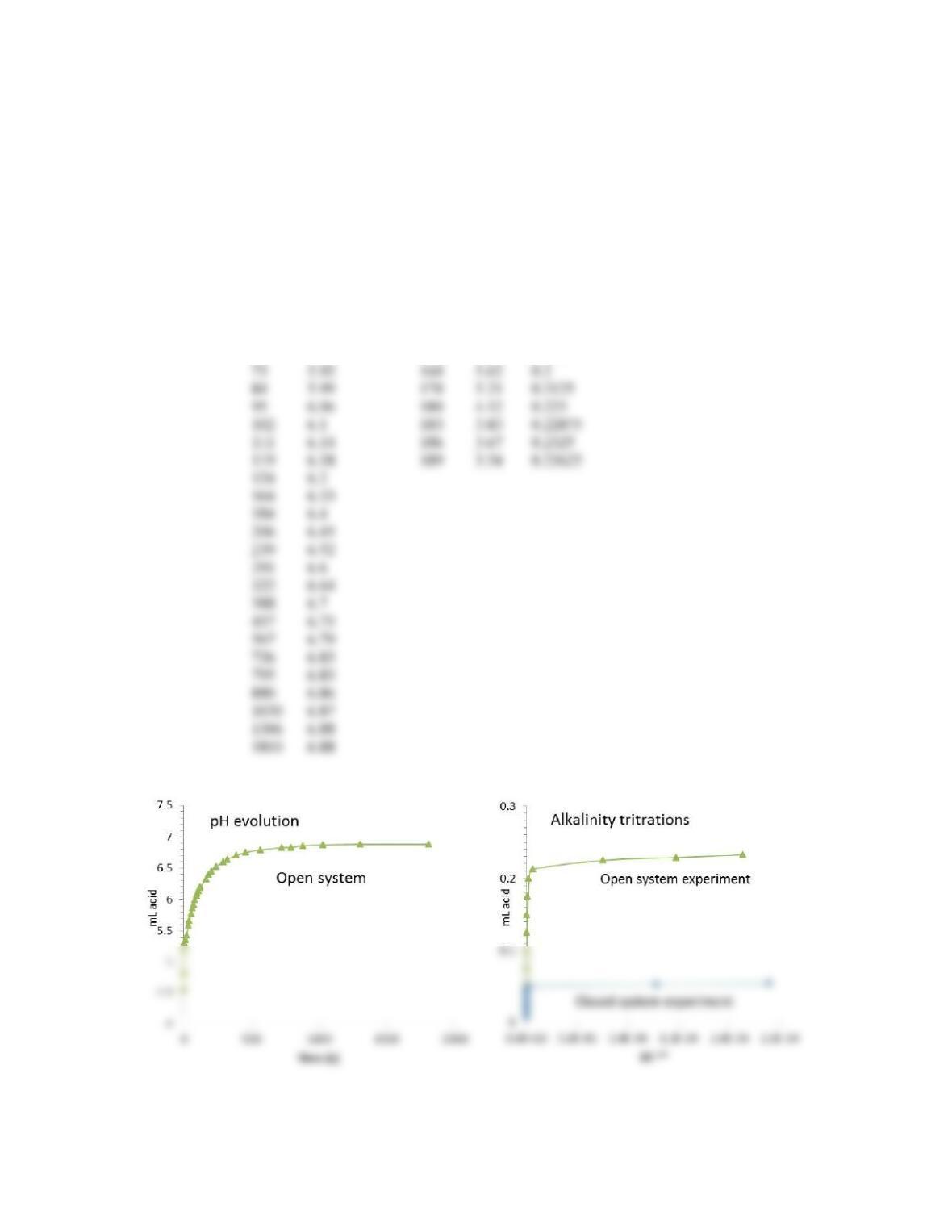
A simpler version of the experiment uses just the limestone, and with data gathered over a much
shorter period. The pH can be monitored throughout and a final sample taken for alkalinity and to
measure Ca2+.
61
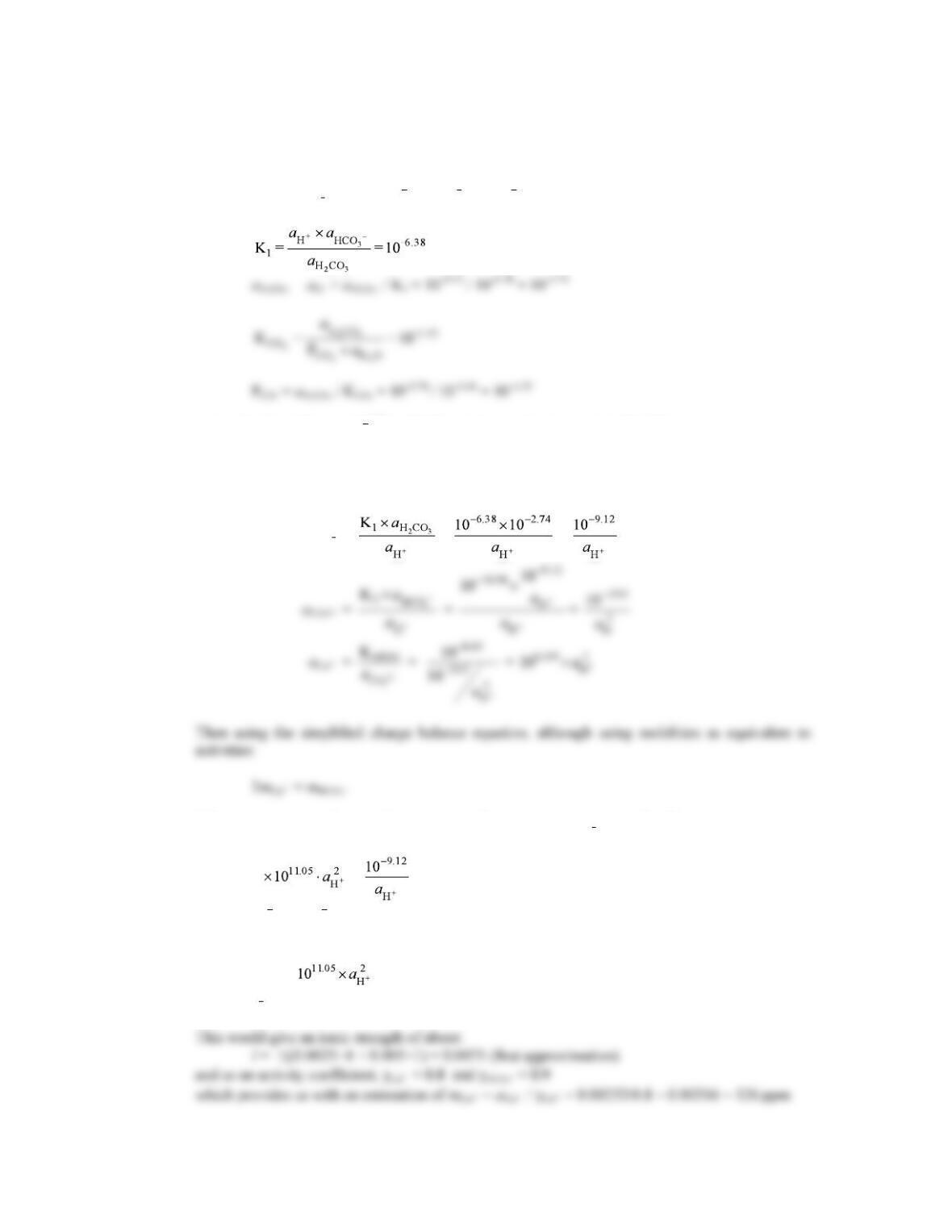
Open system
seconds pH Final
0 4.56 Alkalinity 1.6N acid 60 mL sample
1 4.82
2 5.2 Digits pH Acid (mL)
6 5.31 20 7.02 0.025
15 5.36 40 6.81 0.05
20 5.43 60 6.66 0.075
34 5.59 80 6.51 0.1
40 5.66 100 6.46 0.125
56 5.78 120 6.22 0.15
65 5.86 140 5.96 0.175
62
The initial PCO2 is calculated from the initial pH, 4.56, according to the solution in Problem 3
above, except now we solve for PCO2 rather than pH. All thermodynamic constants are taken at
20°C (Table 3.7) which is room temperature in the lab:
aH+ × aHCO3 = aH+2 = 10 4.56 × 10 4.56 = 10 9.12
and so the initial PCO2 is 10 1.33 or 0.047, and the weathering gas is 4.7% CO2.
The final amount of carbonate that can be dissolved with this PCO2 and the final pH are determined
according to Example 6.2 and as well the solution for Problem 7 above.
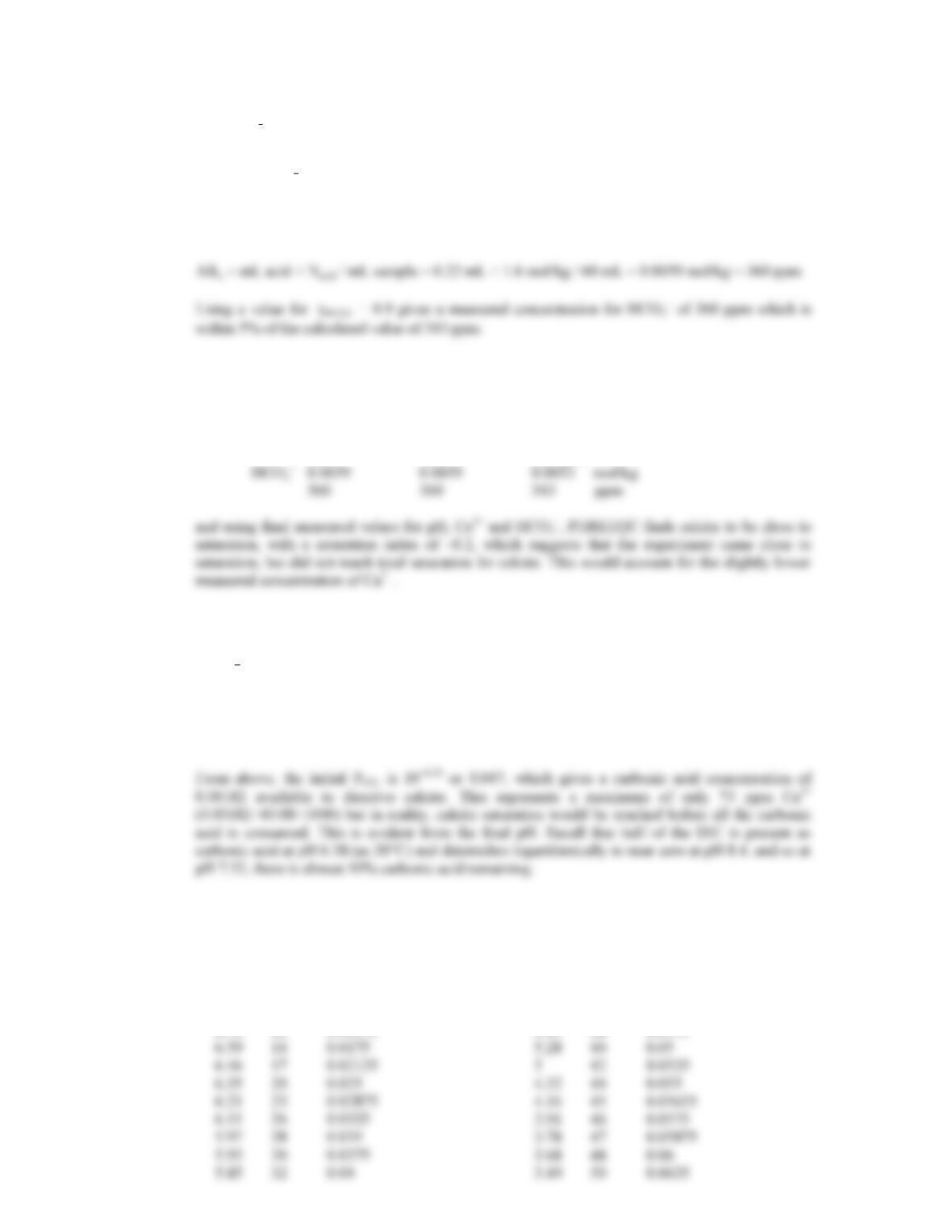
aHCO3 = = =
Substituting into the charge balance equation for aCa2+ and aHCO3 solves for H+:
2 =
10 3pH = 10 20.47
pH = 6.82
and so aCa2+ = = 0.00253
and, aHCO3= 2aCa2+ = 2×0.00253 = 0.00506
63
and mHCO3 = 0.00506 / 0.9 = 0.0053 mol/kg and so 343 ppm
This calculated value compares well with the measured value of 120 ppm for Ca2+. The measured
value for HCO3 is determined from the alkalinity titration. Plotted as a Gram plot (see above) and
regressing the last few values to the y-intercept for x = 0 to get the amount of acid added to reach
that titration endpoint (0.22 mL) allows calculation of the alkalinity, which is entirely attributed to
bicarbonate:
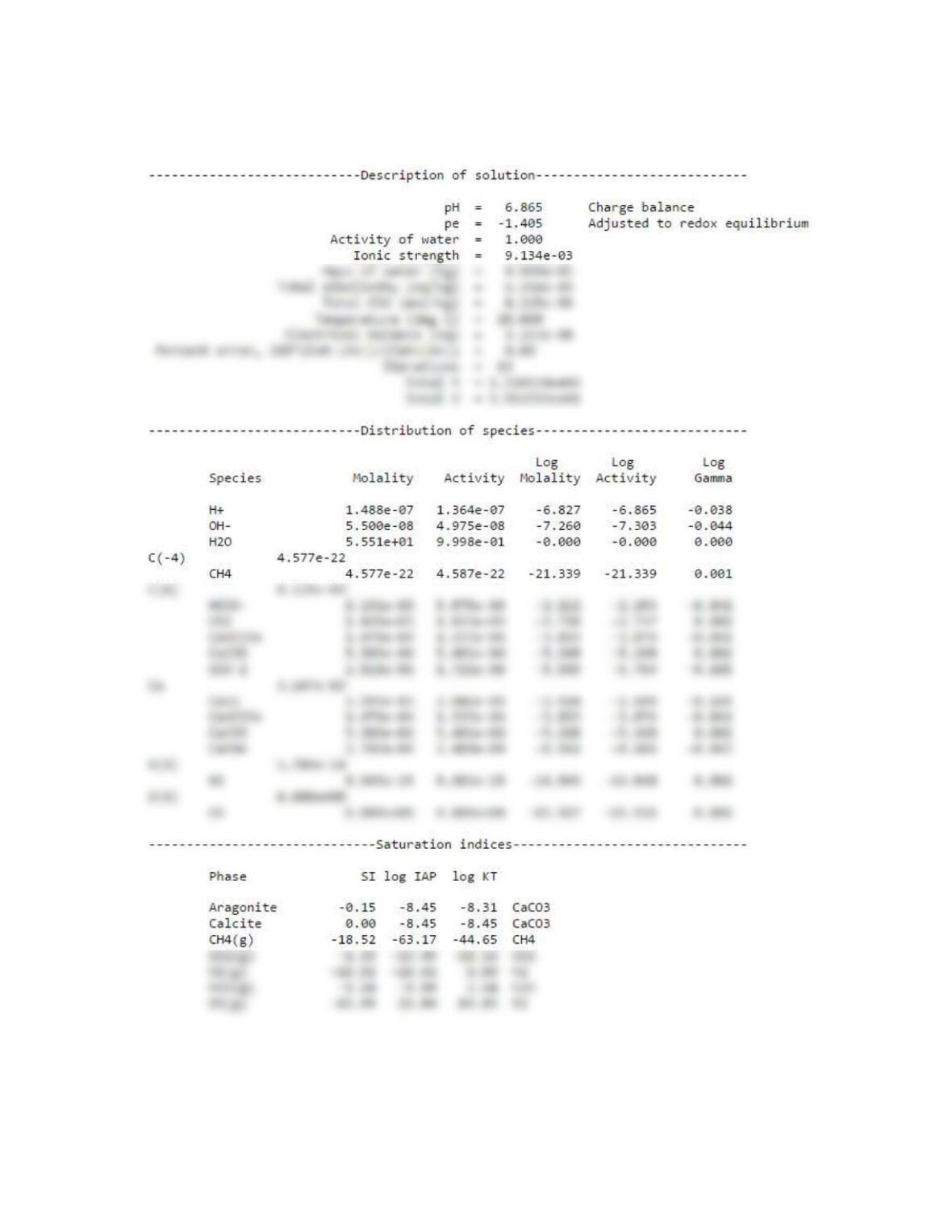
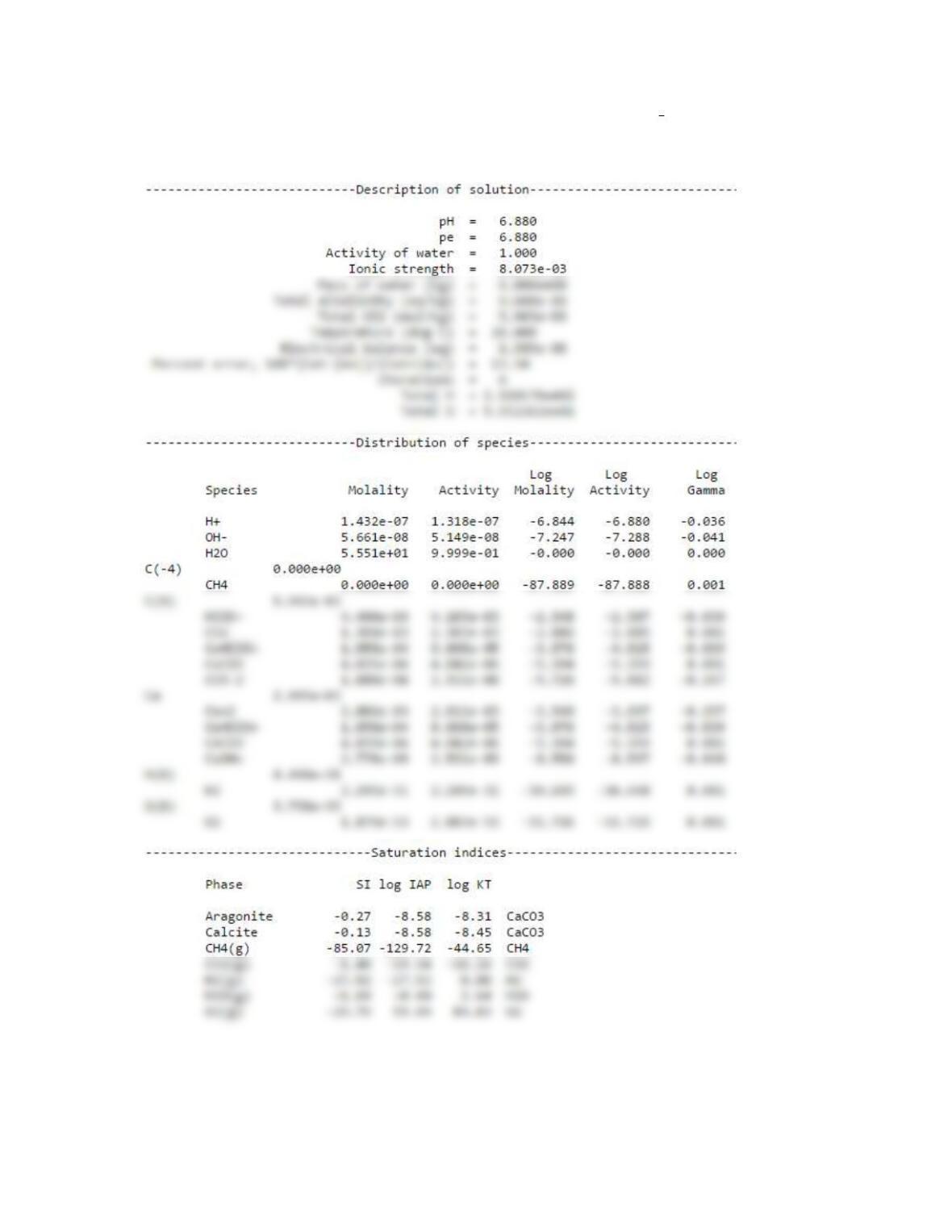
Using PHREEQC to calculate the final values, which are close to the calculated and measured
values. PHREEQC Measured Calculated
pH 6.87 6.88 6.82
Ca2+ 0.003 0.003 0.0032 mol/kg
126 120 126 ppm
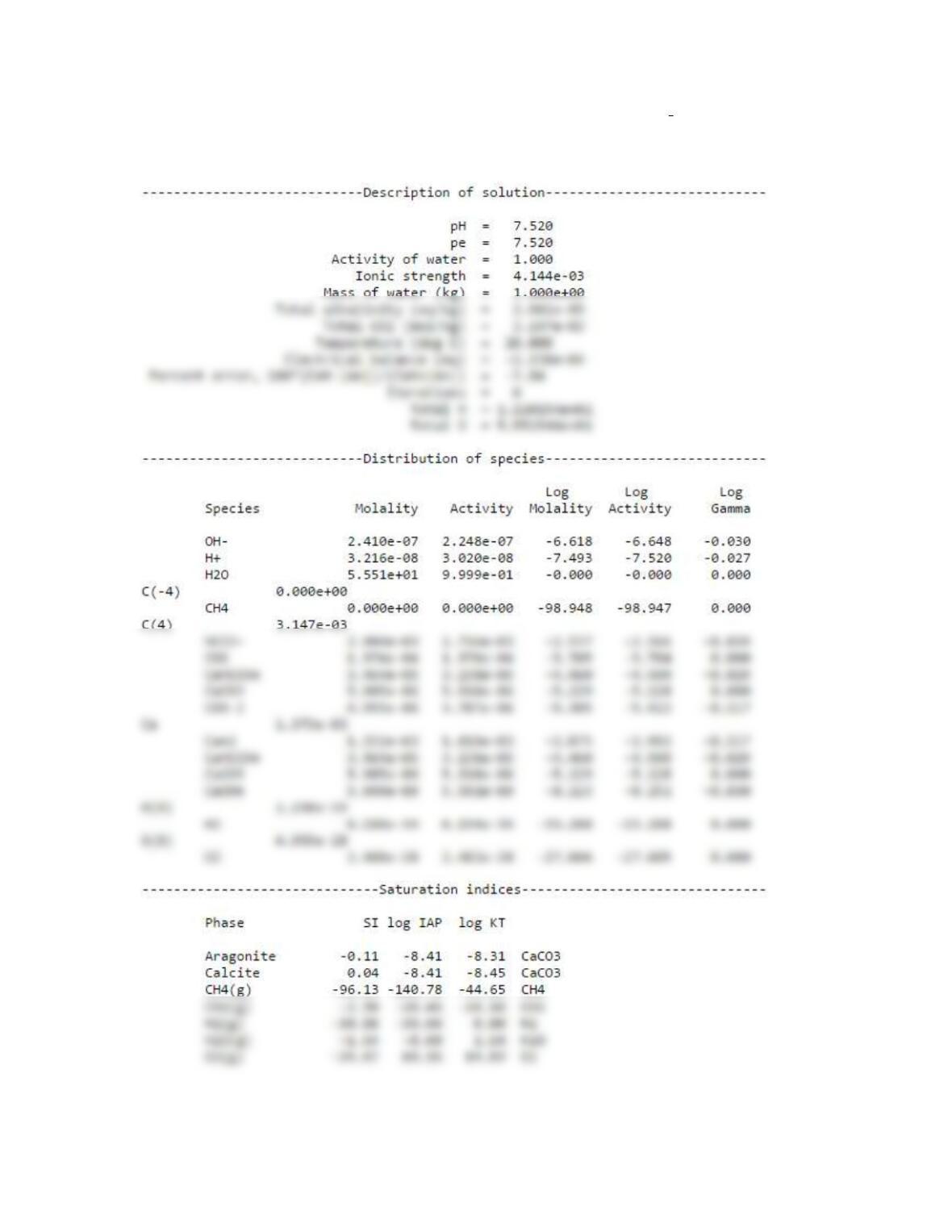
For the closed system experiment, the measured final values are
pH = 7.52
Ca2+ = 55 ppm
HCO3 = 192 ppm
This amount of calcium is less than half that of the open system experiment, which shows the
importance of the continual supply of carbonic acid, as found in unsaturated soils, for weathering
bedrock.
Closed system alkalinity titration 1.6N acid, 28 mL sample volume
pH digits mL acid
. . . cont.
5.74 34 0.0425
5.63 36 0.045
5.49 38 0.0475
pH digits mL acid
7.52 0 0
7.07 5 0.00625
6.91 8 0.01
6.74 11 0.01375
64
PHREEQC for open system initial experimental conditions, for calcite saturation:
65
PHREEQC for open system final experiment pH, Ca2+ and HCO3
66
PHREEQC for closed system final experiment pH, Ca2+ and HCO3