1
The Circulation of the Oceans
Learning Objectives
After reading this chapter, students should be able to:
• Know how ocean currents form
• Know the role of ocean circulation in the global climate system
• Understand why the movement of deep-ocean water is independent of the surface-
ocean circulation
• Know how differences in water density play an important role in deep-ocean circulation
• Understand the Coriolis Effect on ocean circulation.
• Know how the circulation of the deep ocean is affected by water salinity
• Know what drives surface circulation
• Understand the effect of Ekman spiral/Ekman transport on water motion.
• Know the major surface currents: the Sub-tropical gyres and the eastern and western
boundary currents.
• Understand the nature of wind-induced vertical circulation: coastal upwelling and
downwelling and equatorial upwelling.
• Understand the process that produces the Indian Ocean Monsoon System, and know
what the effects of a monsoon are on local climate
• Know the definition of thermocline, halocline, pycnocline
• Know what is meant by thermohaline circulation.
• Characterize water masses
Review Questions
1.) What effects does the surface-wind pattern have on the circulation of the oceans?
2.) Why do ocean currents not move in exactly the same direction as the wind?
Because of the Coriolis Effect ocean currents do not move in exactly the same
direction as the wind. The Coriolis Effect influences ocean currents just as it does
CHAPTER
5
3.) What is the Ekman spiral? Explain why Ekman transport occurs.
Due to friction between wind and the water surface, some of the kinetic energy of
the air is transferred to the top layer of the water. As that layer moves, it drags
along the water just below it, which in turn drags along the water just below that,
and so on. The water can be thought to move as many thin, coupled layers, and
4.) What is upwelling? Where does upwelling occur?
5.) What is mean by a geostrophic current?
6.) Explain the different characteristics of western and eastern boundary currents.
The flow in the western part of the gyre is confined to a narrow path with a fast–
7.) Where does the salt in the oceans originate? Are the oceans getting saltier and
saltier with time? If not, then why not?
3
The salts contained in seawater are largely the result of the weathering of crustal
rocks. The oceans are not getting saltier, because many processes also remove
salts from seawater. These processes include the following:
8.) Define the thermohaline circulation. What are the processes that drive the
circulation of the deep oceans?
Because deep-ocean circulation depends on temperature and salinity, this
9.) Explain the differences among the pycnocline, the halocline, and the thermocline.
The transition zone between the surface zone and the deep ocean is on the order
of a kilometer in thickness and is characterized by a rapid increase in density with
10.) What is bottom water? Where and how does bottom water form?
Bottom water constitutes the densest water produced in the oceans. Near the
11.) What is meant by the term thermohaline conveyor belt?
The thermohaline conveyor belt is the process by which deep water is
transported around the globe. Deep water first forms in the North Atlantic,
where downwelling of cold waters with relatively low densities occurs. After
12.) Explain what effects the ocean has on modifying the global temperature
distribution.
The ocean circulation has a strong influence on global temperatures. The
transport of warm surface water toward the poles, to replace the bottom water
5
Critical Thinking Problems
1.) Explain what is meant by Ekman transport and what role it plays in producing
oceanic gyres in the surface waters of the subtropical oceans.
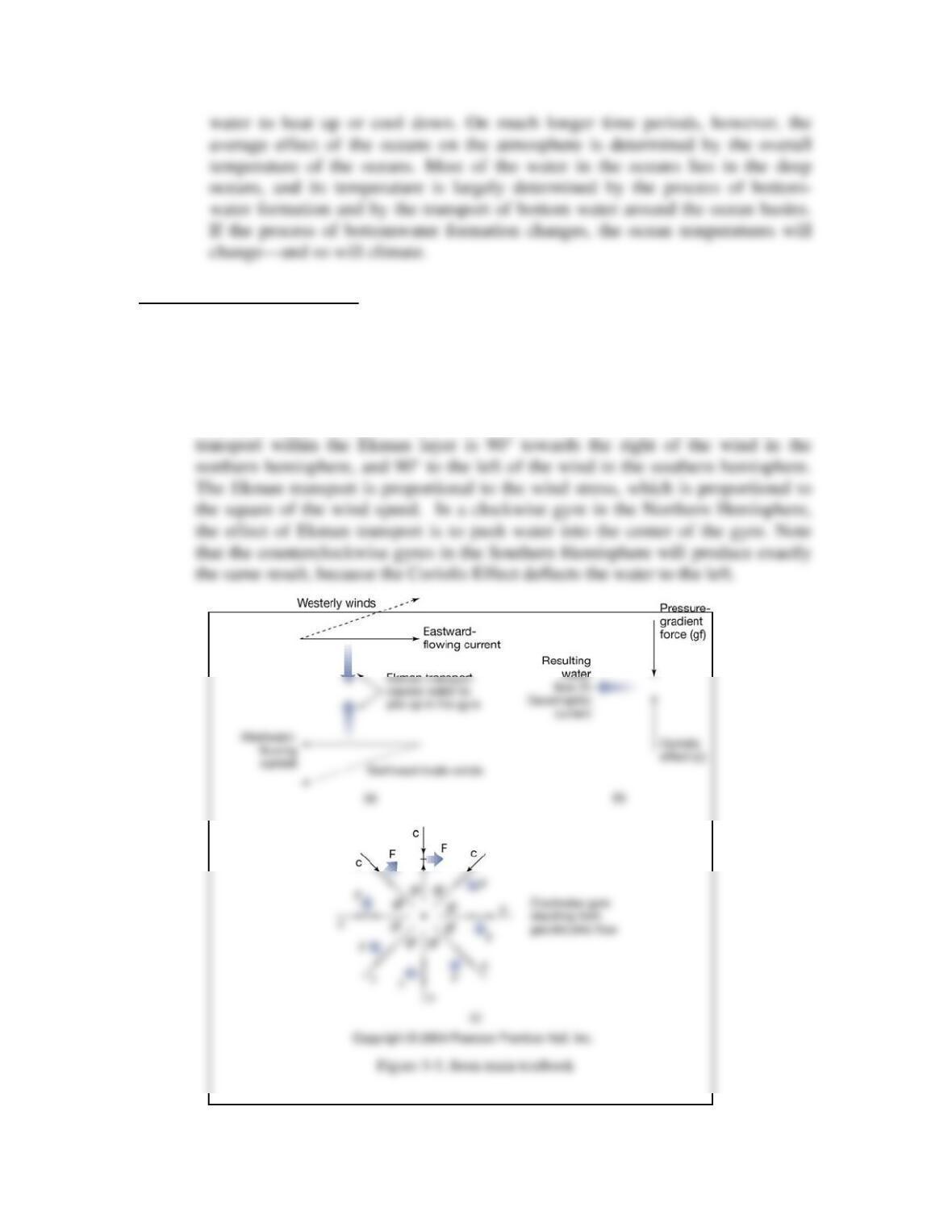
The surface Ekman layer, which extends to about 100 to 300 meters depth, is a
boundary layer feature in which the direct stresses of the wind are felt. The
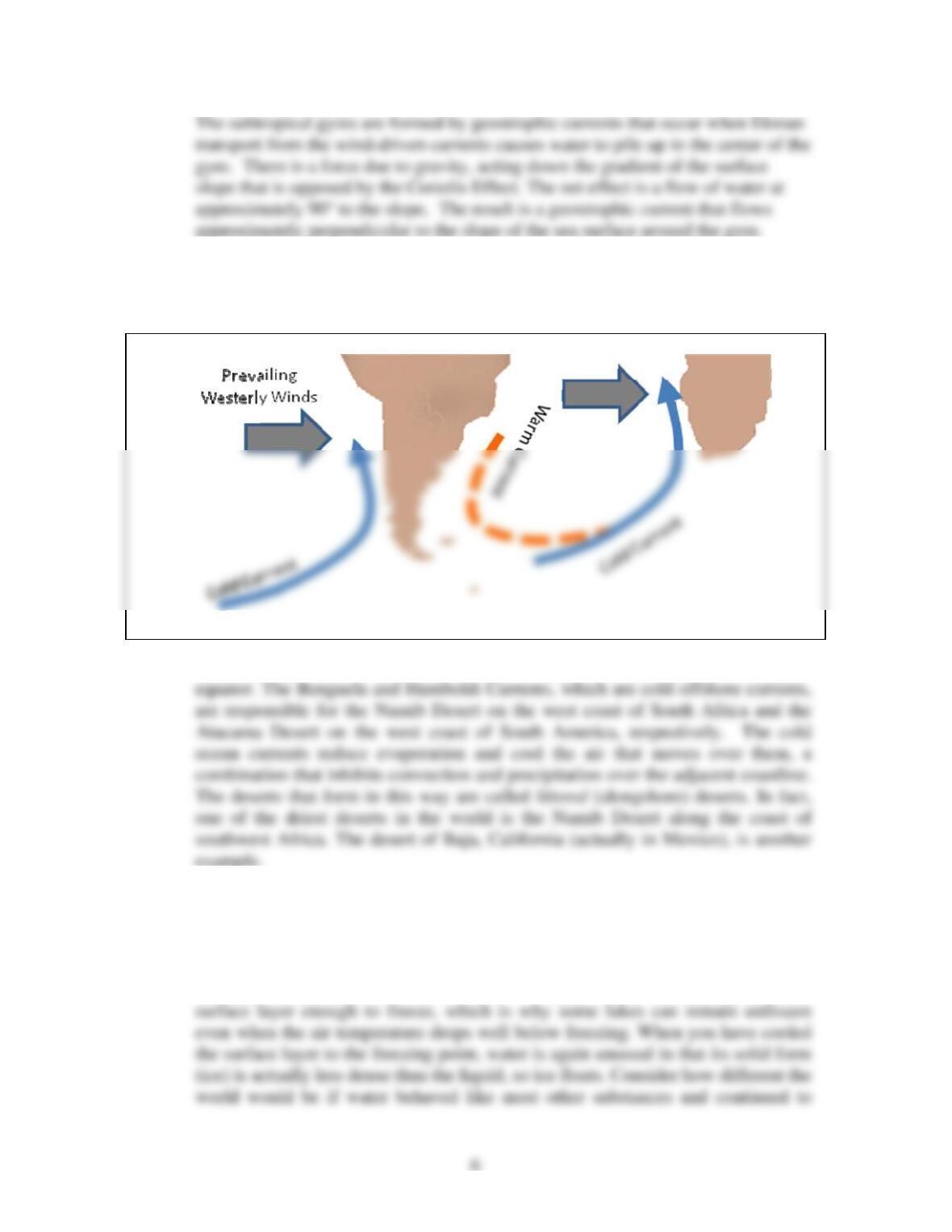
2.) Use a rough map sketch to help explain the role that the oceans play in
determining the climates of southern South America and Southern Africa,
poleward 20oS.
Ocean currents move warmer water toward the poles and cooler water towards the
3.) Water is a very unusual substance in that it reaches maximum density between the
freezing point and 4°C, depending on salinity. As you cool the water surface to
these temperatures it becomes denser and sinks (rather than immediately
freezing). This means that you have to cool the whole water body (the lake or the
surface, mixed, layer of the ocean) to this temperature before you can cool the
7
increase in density down to the freezing point, and if ice was denser than liquid
water. Speculate on what this might have meant for life on the planet.
Seawater already behaves in this way, i.e., it gets denser as its temperature drops
Resource Guide
Video/Film:
Understanding Oceans VHS
Websites:
Literature:

Aaron Sawdey, Matthew O’Keefe & Rainer Bleck, “The Design, Implementation, and
Performance of a Parallel Ocean Circulation Model,” (preprint, 1995).
Joseph Pedlosky, 1998: Ocean circulation theory, Springer-Verlag Berlin Heidelberg. 453
pp.