26
Isotope Reactions
1. What are the major and trace isotopes of H, C, N and O that can be measured by routine analytical
methods? Give the abundance of these isotopes in nature and how they can be measured.
The environmental isotopes along with their abundances and the reference material against which
2. A water sample was measured by isotope ratio mass spectrometry to have an 18O/16O ratio, R =
0.00199517 with VSMOW (R = 0.00200520). What is its –
3. A sample of water in a partially filled container has a 18O value of
What will be the 18O value of the water vapor in isotopic equilibrium with this water?
18Ovapor = 18Owater + 18Ovapor-water
4. What are the 18O fractionation factors, 18Ow-v and the 18O enrichment factors, 18Ow-v for water in
equilibrium with vapor at 0°C and at 50°C? At which temperature will there be a greater difference
between measurements of 18Owater and 18Ovapor, and what are the differences?
i. Fractionation factor, 18Owater-vapor = 1.0116 @ 0°C
5. Write an example of an equilibrium isotope exchange reaction and a biologically–mediated kinetic
reaction involving the isotopes and associated samples in Table 1-4.
An equilibrium reaction is one for which a chemical equilibrium can exist, such as evaporation, or
CO2 dissolution. Biologically-mediated reactions, for which equilibrium cannot be established,
4
27
6. Give an example of a reaction with no isotope fractionation.
13CH2Ocellulose + O2 13CO2 + H2O
7. Write the fractionation factor, 18
water-vapor in terms of the 18O/16O isotope ratio for these compounds.
Using an isotope ratio of 0.00200 for water, and for vapor of 0.00198, what is the value for 18Owater-
vapor ? What are the values for 18Owater-vapor and for 18Owater and 18Ovapor in this case (recall that
18O/16O for VSMOW is 0.0020052)?
18Owater-vapor = =
This shows the approximation that x-y x y
case) reduces to zero as approaches 1.000.
8. The isotope fractionation factor, , is the ratio of the isotope ratios in the two reacting compounds. The
-value expresses the isotope ratio of a compound as a difference from that of a reference material.
Express in terms of the -values for the two reacting compounds in a fractionation reaction.
Using VSMOW as an example of the reference material:
28
9. Atmospheric water vapor is seldom sampled and measured for isotopes, but assume that for a given
time and place it is found to have a 18O value of 18O value for rain that
fell with a condensation temperature of 15°C?
Condensation is considered to take place under equilibrium conditions and so equilibrium
fractionation factors can be used. From the equations in Table 4.2, the enrichment factor, water-
vapor for 18O
10. Surface water from a tailings pond with sulfate concentration of 2000 ppm and 34S =
to groundwater that has 50 ppm sulfate with 34 34S in the
plume are 1025 ppm and
groundwater in the plume?
This is a simple mass balance equation using the concentrations of sulfate with different 34S
values that produce a mixed value of
29
11. For the 18O values for residual water from freezing of the pond water in Table 4.3, calculate the
enrichment factor, 18Oice-water for this freezing reaction.
This is resolved using the Rayleigh distillation equation formulated in permil values:
x-f = x-o + y-x × ln f
12. The analysis of 18O by gas-source IRMS done by equilibrating the sample with CO2 and then
measuring 18OCO2. The enrichment factor, 18OCO2-H2O, for the exchange of 18O between CO2 and H2O
18OCO2
and B), what are the values for 18OH2O for A and B?
18Oreactant product = 18Oreactant 18Oproduct
18OCO2H2O = 18OCO2 18OH2O
18OH2O = 18OCO2 + 18OCO2H2O
13. The distribution of isotopes in nature is a function of two primary processes. One is fractionation, ,
the other is Rayleigh distillation. Give the generic Rayleigh equation relating isotope ratios, R, to
and the fraction, f, of the reactant reservoir. Show with this equation the effect of Rayleigh distillation
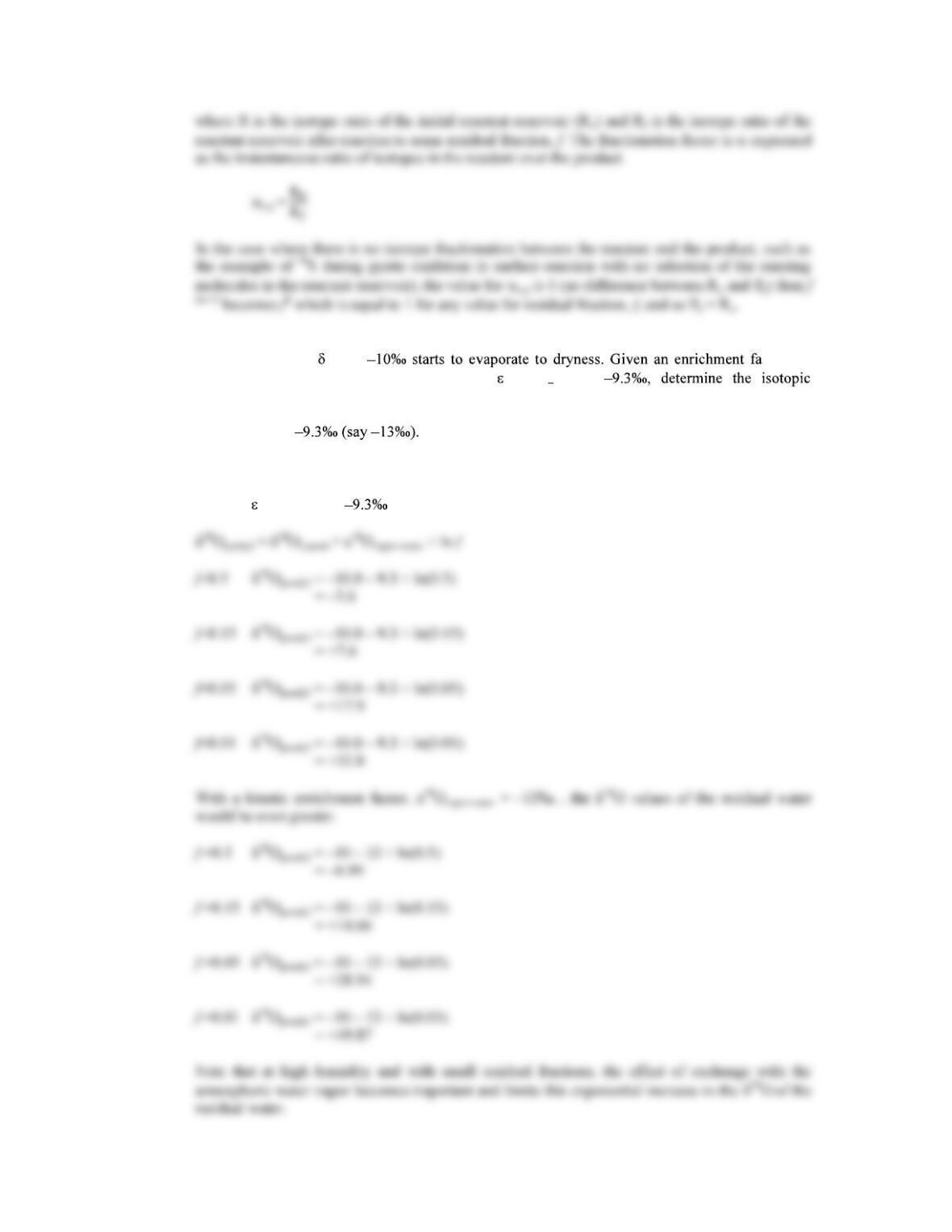
for a reaction where there is no fractionation of isotopes.
The generic form of the Rayleigh distillation equation is
30
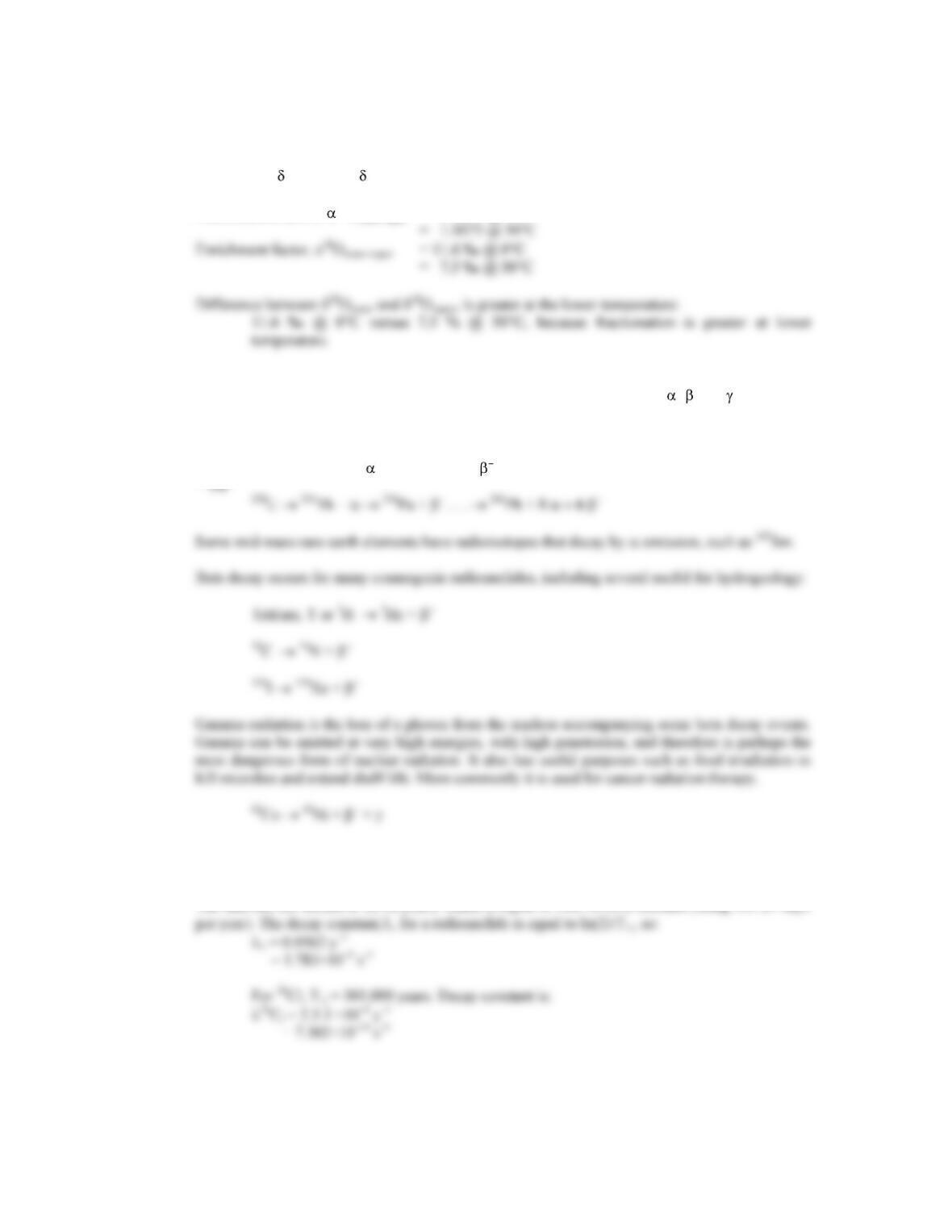
14. A pond of water, with 18O = ctor for
isotope exchange between water and vapor of 18Ovapor water =
composition of the pond water when it has evaporated to residual fractions f = 0.5, f = 0.15, f = 0.05
and f = 0.01. What would be the effect on your calculations if you used a kinetic enrichment factor
which was less than
Using the simplified Rayleigh distillation equation:
18Ovapor-water =
31
15. What are the 18O fractionation factors and the 18O enrichment factors for water in equilibrium with
vapor at 0°C and at 50°C? At which temperature will there be a greater difference between
measurements of 18Owater and 18Ovapor, and what are the differences?
Fractionation factor, 18Owater-vapor = 1.0116 @ 0°C
16. Write out examples of parent-daughter radioisotope decay reactions involving , and (alpha, beta
and gamma) decay.
Alpha decay reactions are mainly found with the actinides, and in particular with the 238U decay
chain, which undergoes 8 decays (plus 6 decays, see Figure 8.27) before producing stable
206Pb
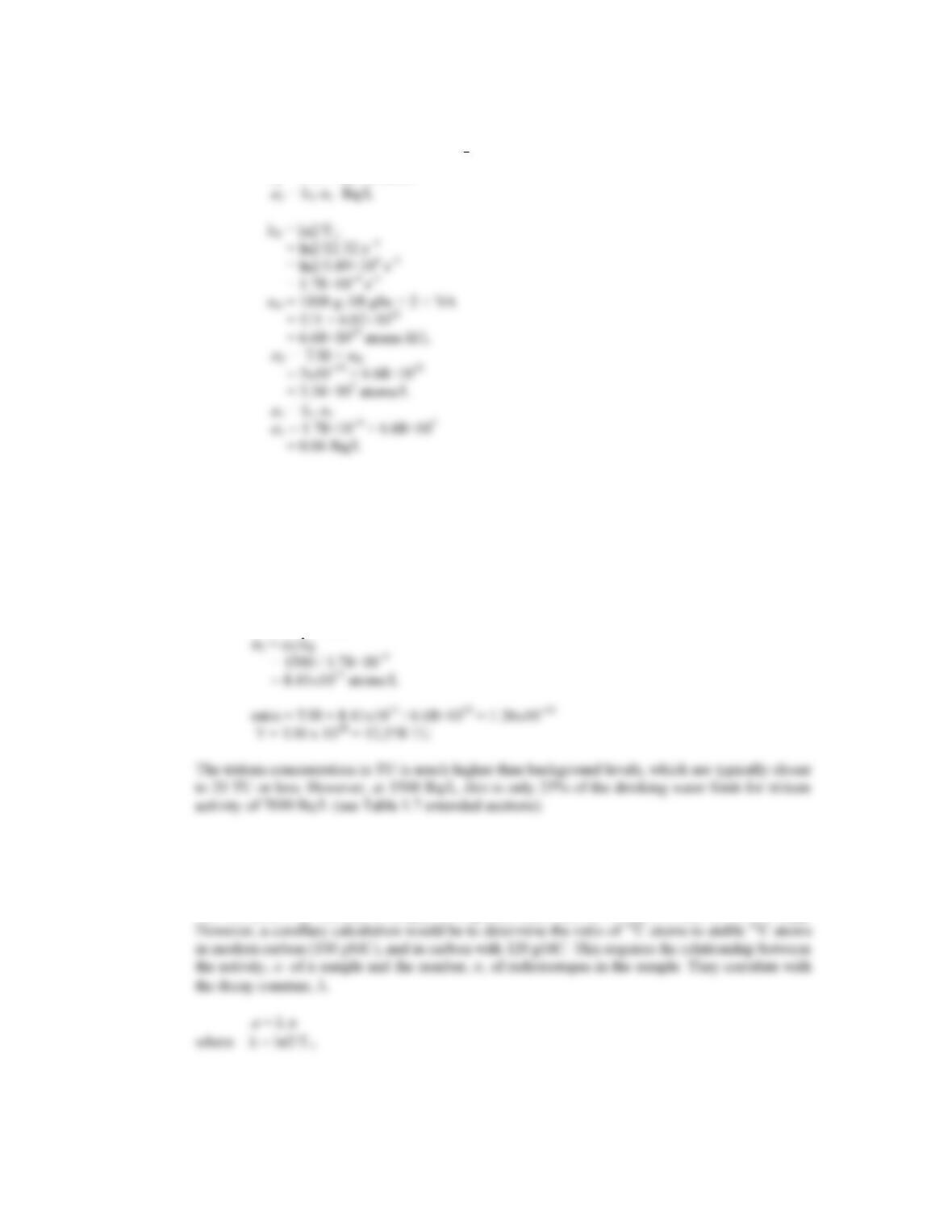
17. What are the decay constants for tritium and for 36Cl based on their half-lives in years and in seconds.
The half-life for tritium is 12.32 years, which is equal to 388,789,632 seconds (using 365.25 days
32
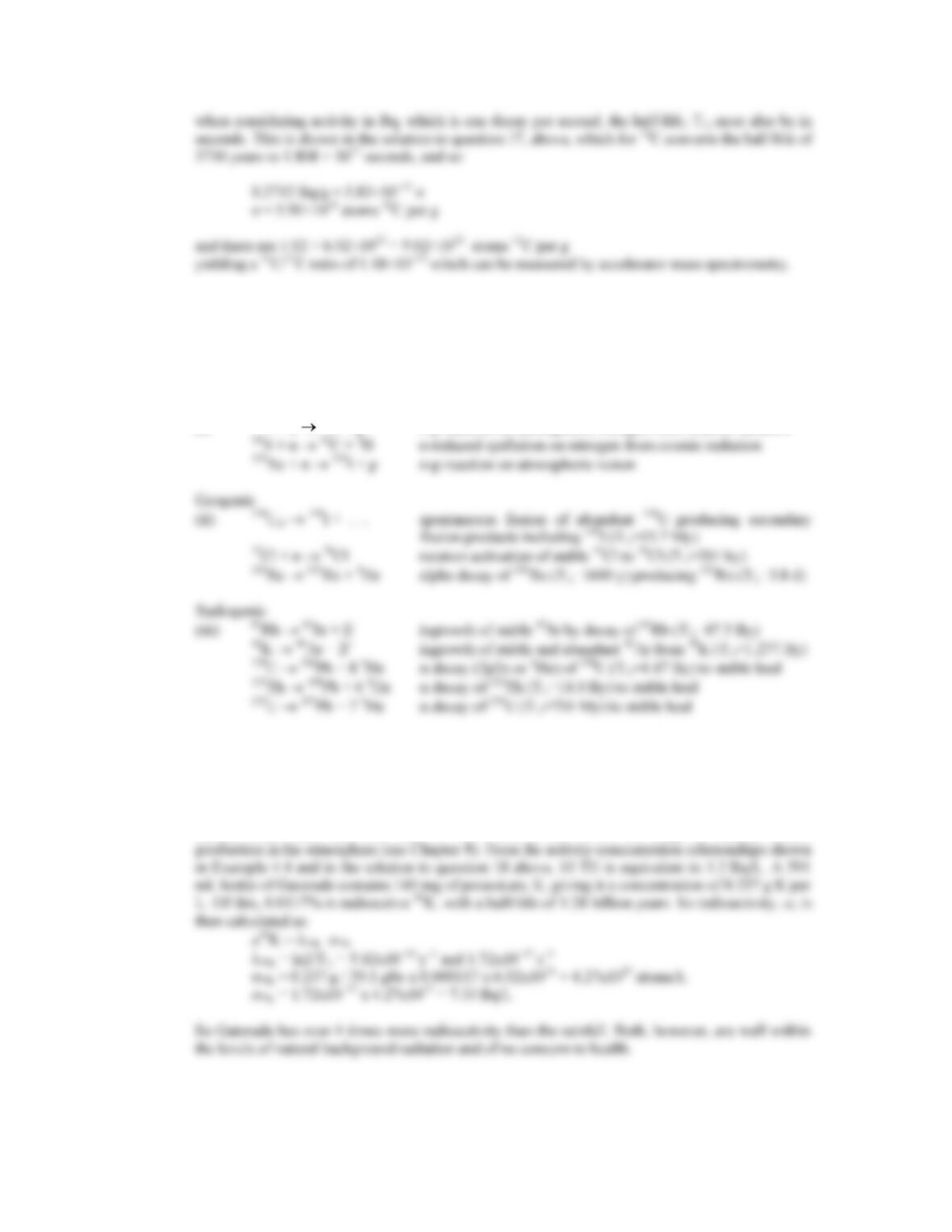
18. A water sample has a tritium concentration of 0.5 TU. What is the tritium activity per liter of this water
and how many atoms of tritium are there in 1 L? Could this be measured by AMS?
ratio = T/H = 0.5 TU/1018 = 5×10 19
nT = T/H × nH atoms/L
Measurement by AMS is not possible, as the isotope ratio is out of the range for AMS (Figure
4.7). It is, however, measureable by radiometric methods, but enrichment of the tritium
concentration by electrolysis (See Chapter 10) is required.
19. Groundwater recharged near a nuclear power generating station has a tritium activity of 1500 Bq/L.
What is the concentration of tritium in TU? Is this water hazardous for drinking?
aT = 1500 Bq/L
20. The radiocarbon standard, percent Modern Carbon or pMC is established at 100 pMC which is equal to
an activity of 0.226 Bq/g (Becquerels per gram C). What is the activity of a sample with 120 pMC?
For 120 pMC, the activity is simply 20% greater than that for 100 pMC, and so 0.2712 Bq/g.
33
21. Give two examples of (i) cosmogenic radionuclides, (ii) geogenic radionuclides, and (iii) radiogenic
stable nuclides, together with their mode of formation.
From Figure 4.9 and subsequent text,
Cosmogenic:
(i) 14N + n 14C + p n-p reaction on atmospheric nitrogen from cosmic radiation
22. Which thirst-quencher provides the lowest dose of radioactivity, precipitation from Stuttgart, Germany,
near the Neckarwestheim Nuclear Power Plants, or Gatorade?
Monitoring of isotopes in precipitation at Stuttgart (IAEA/WMO 2013) shows that in the past
decade, levels have been less than 10 TU, which is well within the range for natural tritium