
1
Global Energy Balance: The Greenhouse Effect
Learning Objectives
After reading this chapter, students should be able to:
• Know how Earth is warmed and cooled.
• Know what happens to the infrared radiation emitted by Earth’s surface.
• Know what greenhouse gases are.
• Know what the most abundant gases in Earth’s atmosphere are.
• Know how much greenhouse gases warm the Earth’s surface.
• Understand how the greenhouse effect is important to support life on the Earth.
• Know which of the atmospheric gases contribute to the greenhouse effect and how
they make this contribution.
• Know how clouds contribute to the greenhouse effect.
• Know what the characteristics of greenhouse gases are.
• Know the different layers of Earth’s atmosphere.
• Know the different mechanisms by which heat energy can be transferred.
Review Questions
1.) How are the wavelength and frequency of an electromagnetic wave related?
2.) What is a photon?
3.) What physical law describes the manner in which the intensity of sunlight
changes as the observer moves away from the Sun?
The flux of solar energy decreases as distance from the Sun increases. This
CHAPTER
3
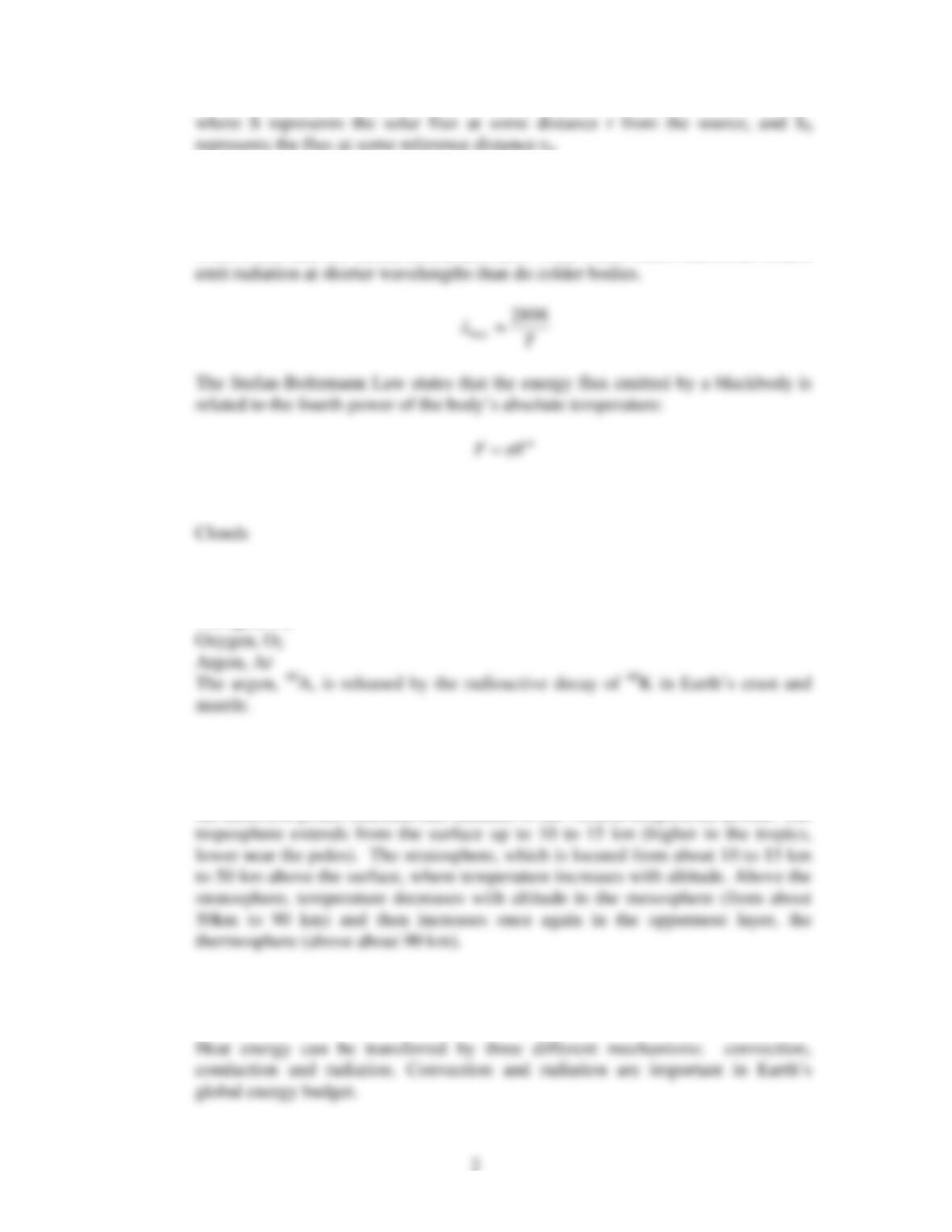
4.) Name two physical laws that apply to blackbody radiation. What do these laws
tell us about the nature of the emitted radiation?
Wien’s Law and the Stefan-Boltzmann Law. Wien’s Law states that hotter bodies
5.) What is the major contributor to Earth’s albedo?
Clouds
6.) What are the three most abundant gases in Earth’s atmosphere?
Nitrogen, N2
7.) List the four layers of Earth’s atmosphere. How are they defined?
Troposphere, stratosphere, mesosphere, and thermosphere. They are defined by
the inflection points (maxima and minima) of the vertical temperature profile. The
8.) Name three mechanisms by which heat energy can be transferred. Which two are
important in Earth’s global energy budget?
3
9.) Identify two physical processes by which gases can absorb infrared radiation.
Give examples of each process.
1- One way is by changing the rate at which the molecules rotate. If molecules
10.) Why are O2 and N2 not greenhouse gases?
11.) Describe the different ways in which climate is affected by high and low clouds.
Low, thick clouds, such as stratus clouds, generally cool the surface because
12.) Identify two positive feedback loops in Earth’s climates system. Why is Earth’s
climate stable despite these destabilizing, positive feedbacks?
The water vapor feedback is a positive feedback that tends to amplify small
Critical Thinking Problems
1.)
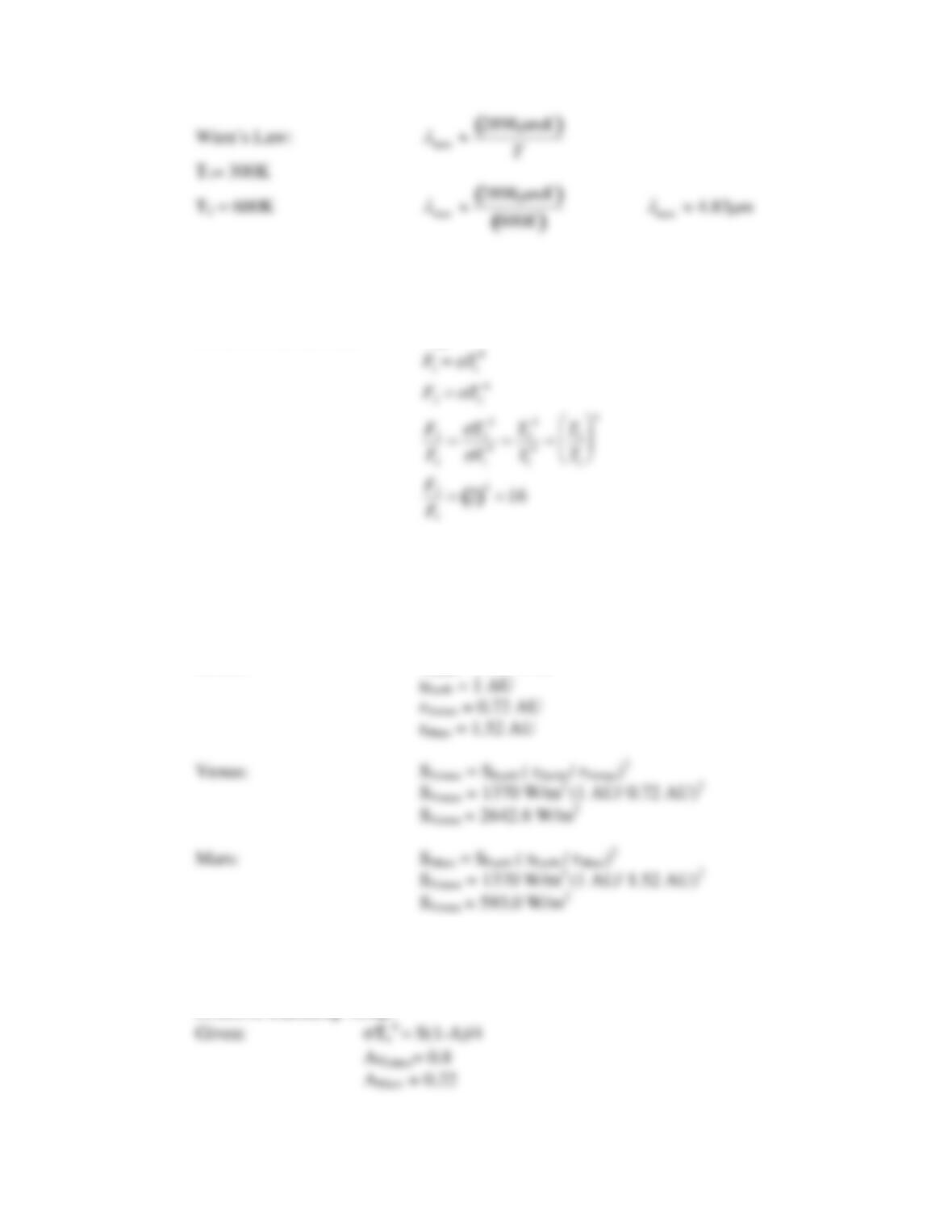
a. Given that a 300-K blackbody radiates its peak energy at the wavelength of about
10 mm, at what wavelength would a 600-K blackbody radiate its peak energy?
4
b. If the two bodies in part (a) were the same size, what would be the ratio of the
heat emitted by the hotter object to the heat emitted by the colder one?
Stefan-Boltzmann Law: F
s
tar
=
σ
T4
2.)
a. Venus and Mars orbit the Sun at average distances of 0.72 AU and 1.52 AU,
respectively. What is the solar flux at each planet?
Inverse Square Law: S = S0(r0/r)
Given: SEarth= 1370 W/m2
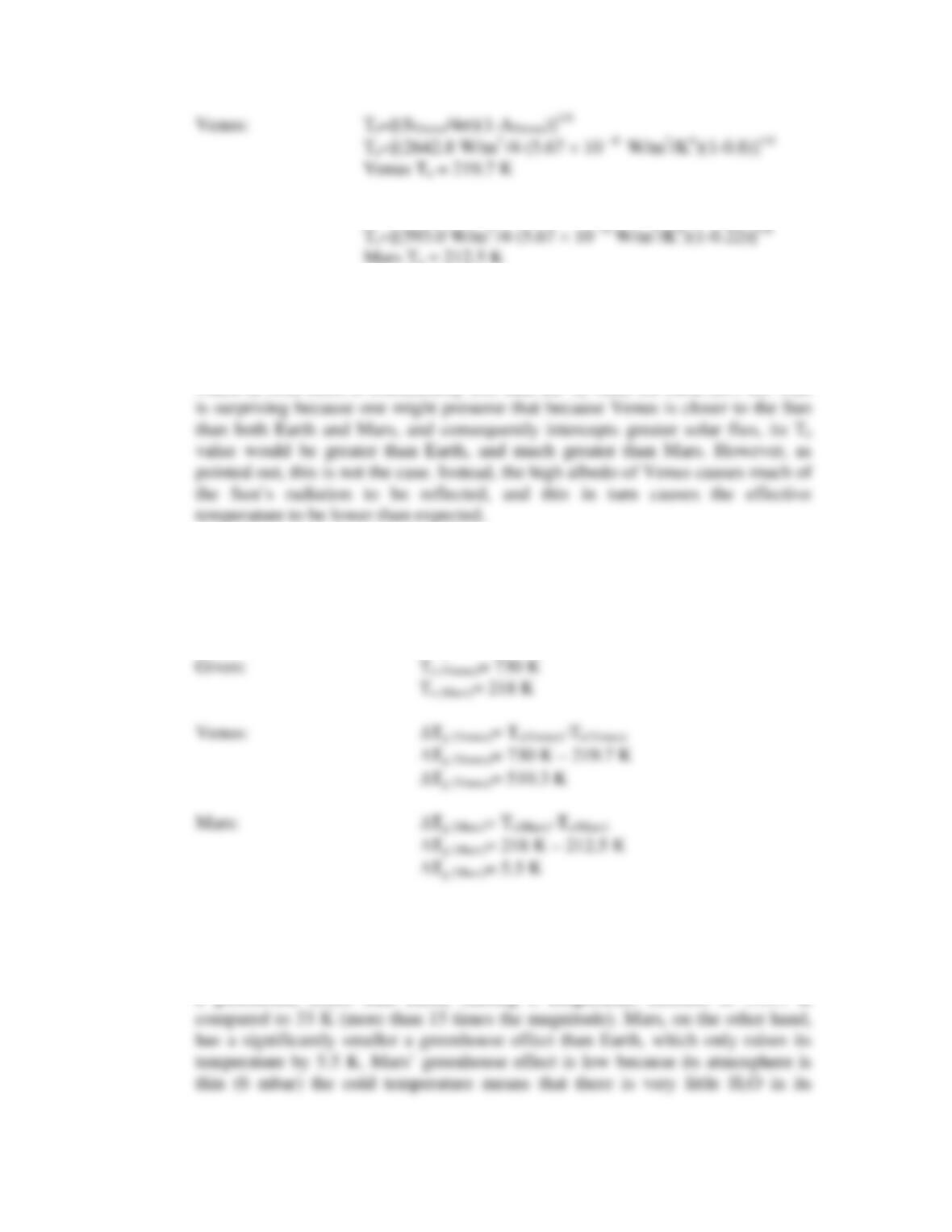
b. Venus has a planetary albedo of 0.8, and Mars has an albedo of 0.22. Using the
answer to part (a), determine the effective radiating temperatures of these planets.
Effective Radiating Temp:
5
Mars: Te=[(SMars/4σ)(1-AMars)]1/4
e = 212.5 K
c. How do the effective radiating temperatures determined in part (b) compare with
the value for Earth, and why is this result surprising?
The values of Te for both Venus and Mars are 219.7 K and 212.5 K respectively,
which in both cases is considerably less than the Te value for earth (255 K). This
d. The mean surface temperatures of Venus and Mars are 730 K and 218 K,
respectively. Using the answer to part (b), determine the magnitude of the
greenhouse effect on each planet.
Greenhouse Effect: ΔTg= Ts-Te
e. How do the results of (d) compare with the magnitude of the greenhouse effect on
Earth?
Venus’ atmosphere contains 90 bar of CO2, and it consequently has much more of
a greenhouse effect than Earth, causing a temperature increase of 510.3 K

3.) The Sun radiates at an effective temperature of 5780 K and has a radius of about
696,000 km. Remembering that 1 AU = 149,600,000 km, derive the approximate
value of the solar flux at Earth’s orbit. Compare your answer with the value given
in the text.
Given:
Effective temperature of Sun: Te= 5780 K; Te= ((S/4σ)(1-A))1/4
Radius of Sun: r
4.) The tropospheric lapse rate (the rate at which temperature decreases with altitude)
is approximately 6 oC (11 oF) per kilometer. Given that the mean surface
temperature of Earth is 288K and the effective radiating temperature is 225K,
from what altitude does most of the emitted radiation derive? How and when did
the atmosphere and ocean form? Which gases are thought to have been present in
the early atmosphere?
Given:
5.) Solar luminosity is estimated to have been 30% lower than today at the time when
the Solar System formed, 4.6 billion years ago.
a. If Earth’s albedo was the same as it is now (A=0.3), what would have been its
effective radiating temperature at that time?
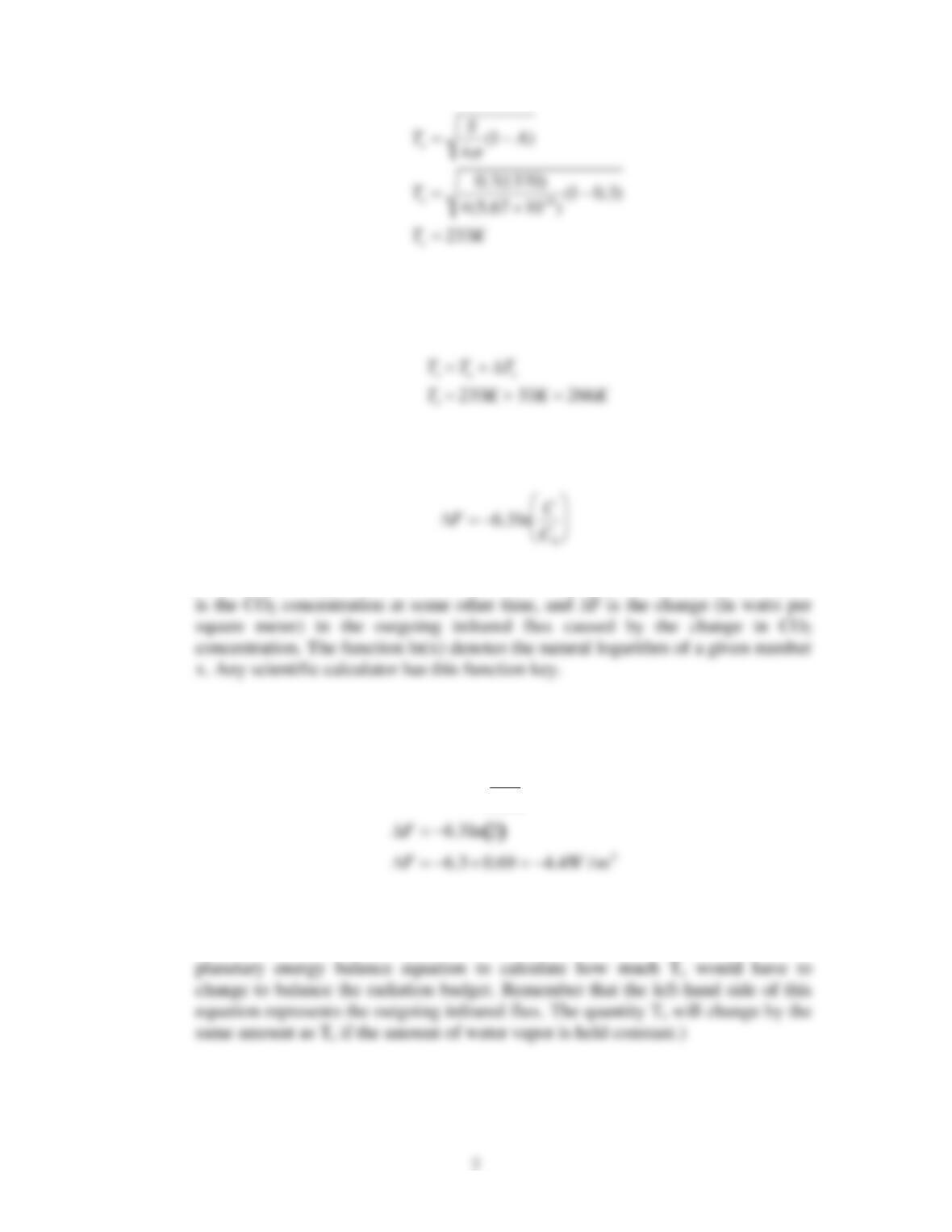
b. If the magnitude of the greenhouse effect had also remained unchanged (ΔTg
= 33 K), what would Earth’s average surface temperature have been? How
does this compare with today’s value?
6.) For atmospheric CO2 concentrations not too different from the present value, the
radiative forcing of CO2 can be expressed by the formula:
Where C0 = 300ppm is the CO2 concentration near the turn of the 20th century, C
a. By how much would the outgoing infrared flux decrease if the atmospheric CO2
concentration were increased from 300 ppm to 600 ppm (i.e., if C=600 ppm)?
ΔF=−6.3ln 600
300
⎛
⎝
⎜
⎞
⎠
⎟
b. By how much would surface temperature have to increase in order to bring the
radiation budget back into balance in part (a), assuming that the planetary albedo
and the amount of water vapor in the atmosphere do not change? (Hint: Use the
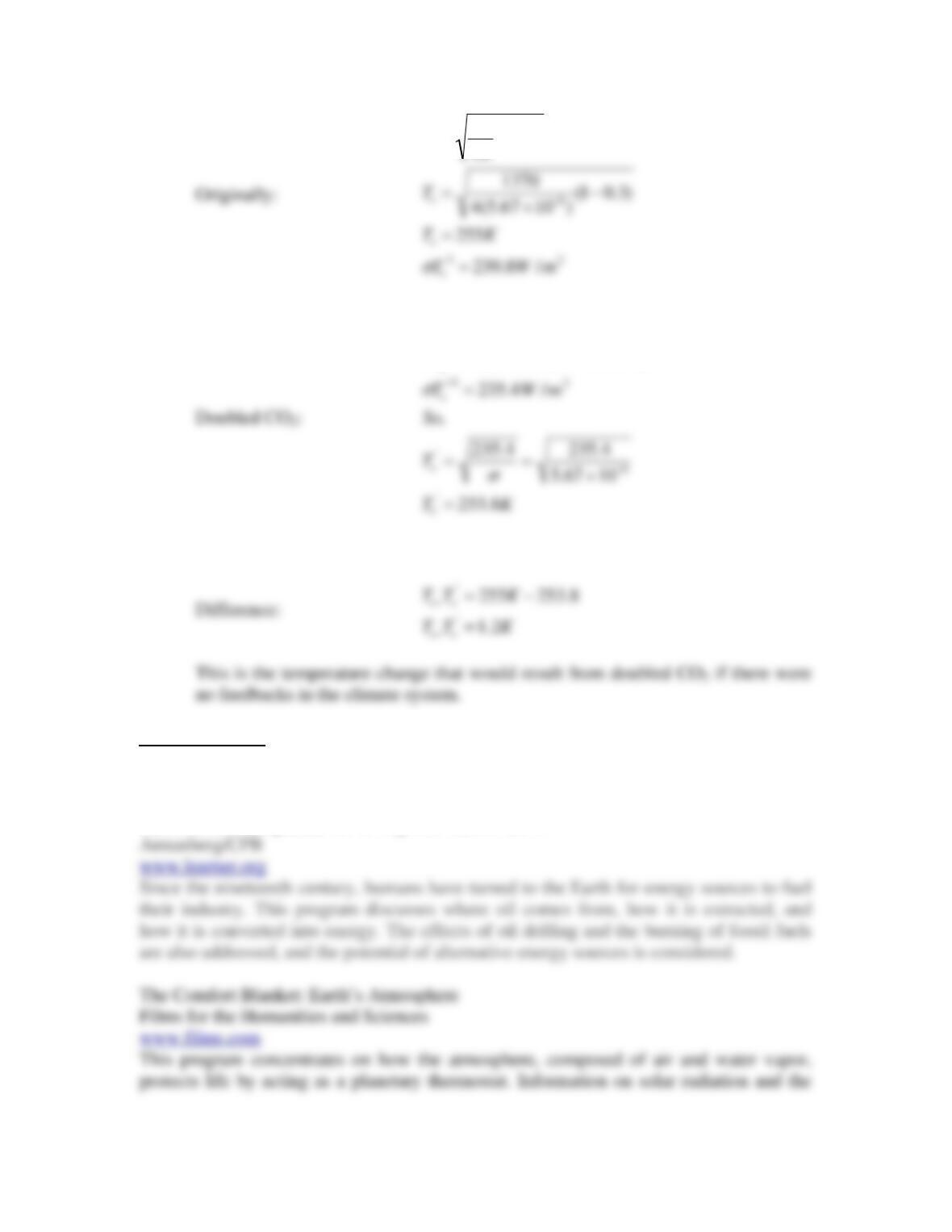
8
Te=S
4
σ
(1 −A)
σ
Te
/4 =239.8W/m2−4.4W/m2
Resource Guide
Video/Film:
Earth Revealed, Episode 26. Living with Earth, Part II

9
role of carbon dioxide and other gases in trapping heat is included in this discussion of
Earth’s global “comfort blanket.” (20 minutes, color)
Websites:
Literature: