20
Geochemical Reactions
1. Write out the reactions for the dissolution of fluorite and for the hydrolysis of Fe3+, and the equation
for the law of mass action for each.
CaF2 Ca2+ + 2F Fe3+ + H2O Fe(OH)2+ + H+
2. Write balanced equations for the following aqueous reactions:
(i) hydration of CO2 and dissociation of carbonic acid
CO2 + H2O H2CO3 HCO3 + H+
3. From the data given in Table 3.3, what would be the concentration of CaSO4° in a gypsum-saturated
solution at 25°C?
Following the solution in Example 2.2, the solubility constant for gypsum, Kgyp was found to be
10 4.60. Therefore, the activities of Ca2+ and SO4
2 are each 10 2.30.
3
21
4. Is nitrate a functional electron acceptor for the oxidation of dissolved hydrogen sulfide? Calculate the
G°r for this reaction and determine whether it is exothermic or endothermic. How does this reaction
compare with the oxidation of hydrogen sulfide with O2?
8NO3 + 5H2S 4N2 + 5SO4
2 + 4H2O + 2H+
5. Provide an example of electron donor and electron acceptor species (redox couple) for S, N, Fe and As,
and write balanced redox half-reactions for the electron transfer.
SO4
2 + 8e + 10H+ H2S + 4H2O
6. Calculate the Gibbs free energy for the oxidation of organic matter (CH2O) with nitrate
(denitrification). How does this compare with that for oxidation by O2 (Example 3.2) on a per mole
basis for CH2O?
22
5CH2O + 4NO3+ 2N2 + 5HCO3 +2H2O + H+ = 2324.82 kJ
7. Write the two complementary redox half-reactions for (i) the oxidation of hydrogen H2 by O2 and
(ii) oxidation of methane CH4, with O2. Determine the Gibb’s free energy for each overall reaction.
Which would provide more energy to bacteria, per mole of O2 consumed? (Same question, by
oversight, as question 3 in Chapter 7)?
(i) H2 2H+ + 2e
8. Name the gases that are commonly found in groundwater that are: (i) essentially of an atmospheric
origin, (ii) produced in the soil or groundwater by geochemical processes, and (iii) geogenic gases
produced by reactions in bedrock. Note that some gases can originate from more than one of these
sources.
(i) Atmospheric N2, O2, Ar, Ne, Kr, Xe, CO2 (minor)
9. How much biogenic methane can be produced (and mol/L) at 10 m below the water table before you
produce a separate gas phase (@25°C)?
KH for CH4 from Table 3-5 is 0.0014 mol/L/atm. At 10 m depth, the pressure is 2 atm, and
therefore the partial pressure of CH4 would have to exceed 2 atm to form a separate gas phase.
23
10. Fig. 3-7 shows that helium has a higher atmospheric concentration than krypton, but lower
concentration in air-equilibrated water. Explain this change using their Bunsen coefficients.
The atmospheric partial pressure for He is 6.24·10 6 atm and 1.14·10 6 atm for Kr. The Bunsen
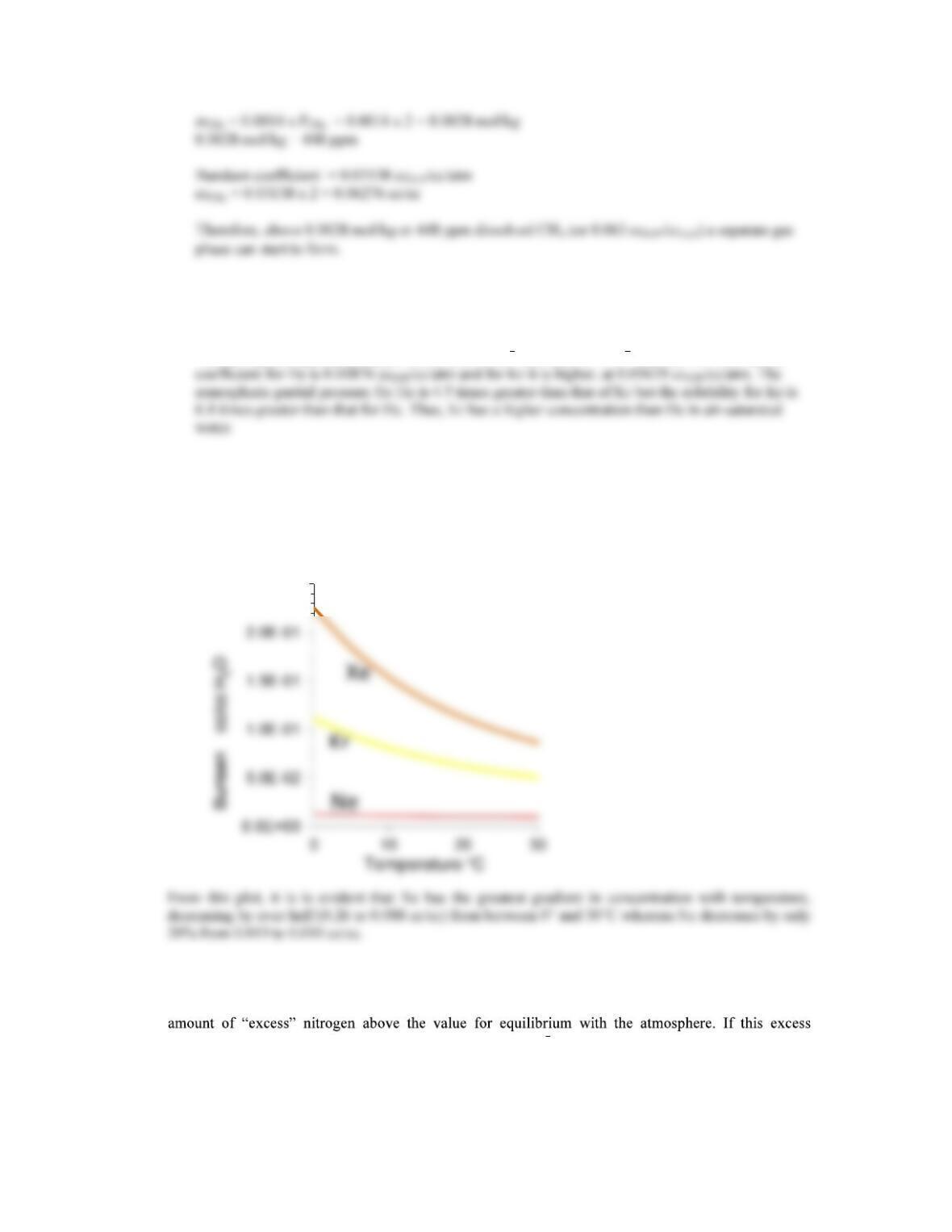
11. Neon, Krypton and Xenon are essentially atmospherically-derived gases, with only trace
concentrations of some rare isotopes produced in the geosphere. Plot the concentration of these three
gases in groundwater recharge between the temperatures of 0°C and at 30°C. Which shows the
strongest variation with temperature as a record for paleorecharge temperature?
12. A groundwater has a measured concentration of nitrogen, N2, of 0.025 ccSTP/ ccH2O. Its temperature is
25°C and is the same as the recharge area. Convert this concentration to ppm and determine the
nitrogen is derived from denitrification, then how much NO3 would have reacted?
Recall that the Bundsen value is related to KH by the gas constant, R and T, so
2.5E-01
24
Bunsen/RT = mol/L/atm
0.025 ccSTP/cc /RT = 0.025/22.4 = 0.00112 mol/kg = 31.3 ppm.
13. What are the concentrations and activities of carbonate, aCO32, and carbonic acid, aH2CO3 for low ionic-
strength groundwater (I = 0.01) at 25°C, with pH 7.8 and bicarbonate concentration of 86 ppm as
HCO3. How much do they contribute to DIC?
mHCO3 = 86/61000 = 0.0014 mol/kg
aHCO3 = mHCO3 · HCO3 = 0.0014 × 0.89 = 0.00126
14. Calculate the PCO2 of the groundwater in Question 13 from your calculated activity of H2CO3. Will this
groundwater degas CO2 upon discharge? What would be the effect on pH?
For PCO2: KCO2 = = 10 1.47
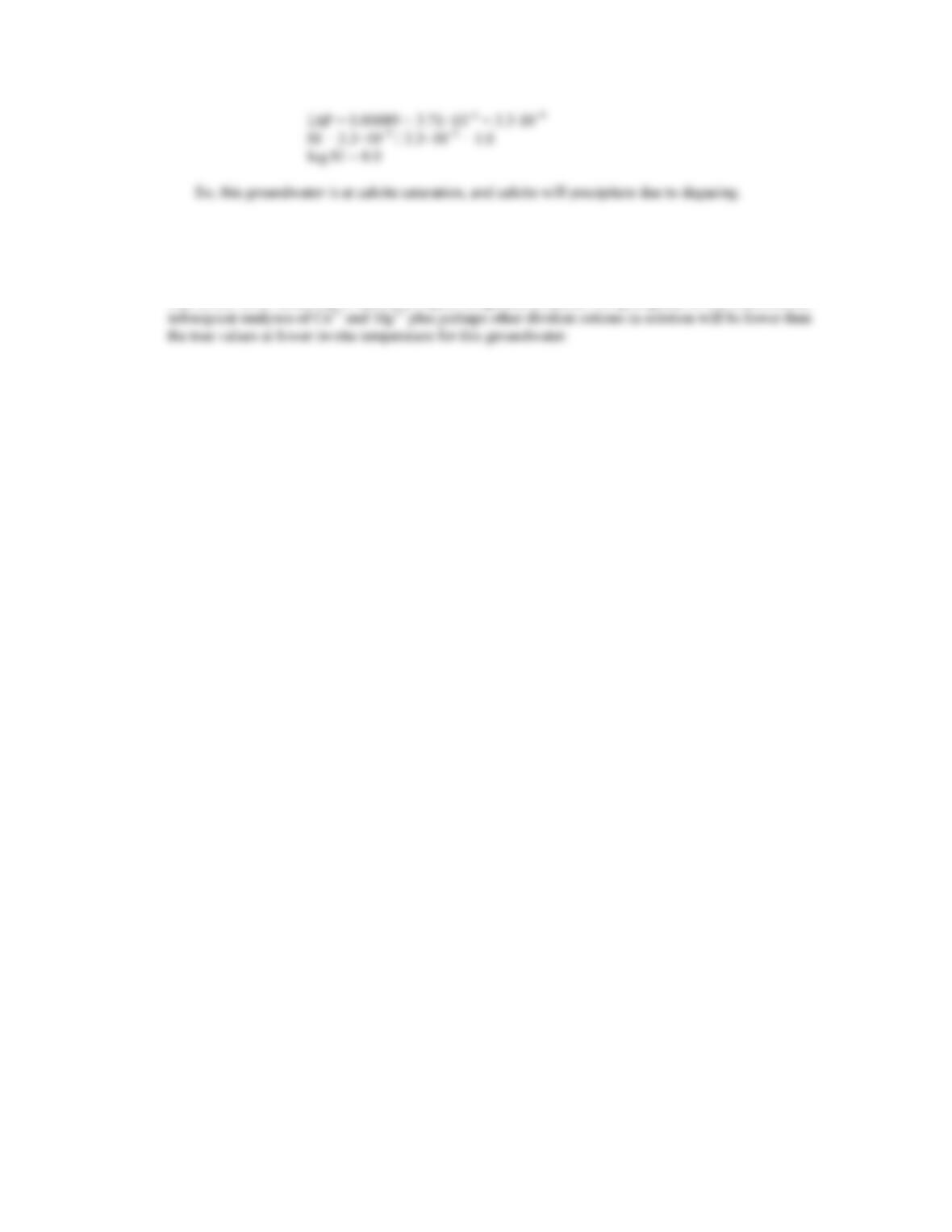
15. The calcium concentration in the groundwater in Question 13 was measured to be 56.8 ppm. What is
its state of calcite saturation? What will happen when this groundwater discharges?
For SIcalcite: Kcalcite = 10 8.48 = 3.31×10 9
25
16. What is the consequence to sampling a calcite-saturated groundwater at a low temperature of say 10°C,
and then storing it at room temperature, 25°C?
Due to the lower solubility of calcite at higher temperature, calcite will precipitate in the bottle and so