Solution Manual for Introduction to Mechatronic Design Do Not Circulate
Chapter 28 Basic Closed-Loop Control
28.1) Which PID term(s) contribute(s) instability to the system when the gain is too large? Which one(s)
contribute(s) stability?
28.2) Write pseudo-code for a function to implement a bang-bang control law as described in Section 28.4.
28.3) Explain, in your own words, why proportional-only control can never reach the set-point.
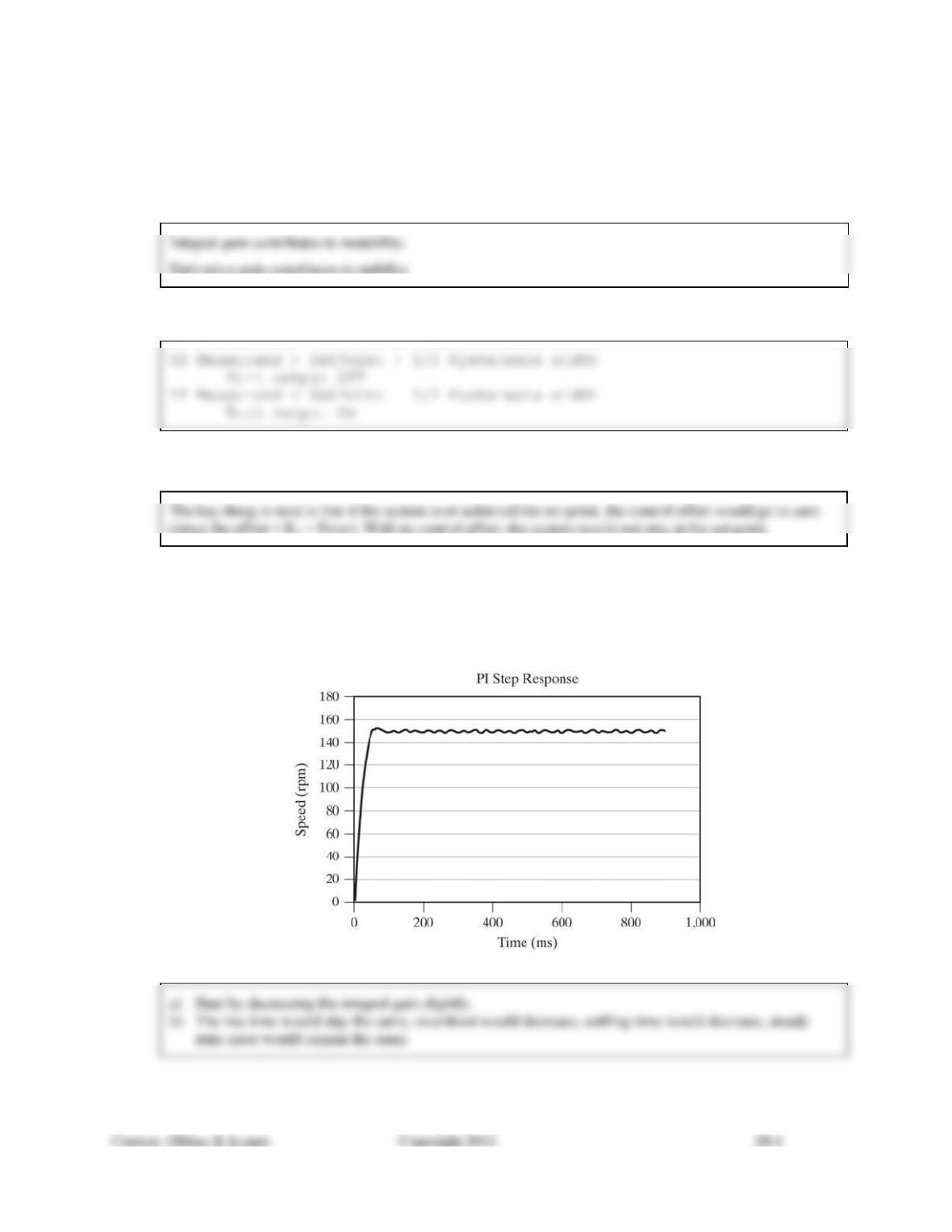
28.4) A system that implements PI control exhibits a step response like that shown in Figure 28.19.
a) How would you modify the gains to eliminate the oscillatory behavior while preserving as much of the
rise time as possible?
b) If you were simply to add a derivative term (with some nonzero gain) to this system (keeping the other
gains the same) how would you expect the response to change?
Figure 28.19: System response for Problem 28.4.
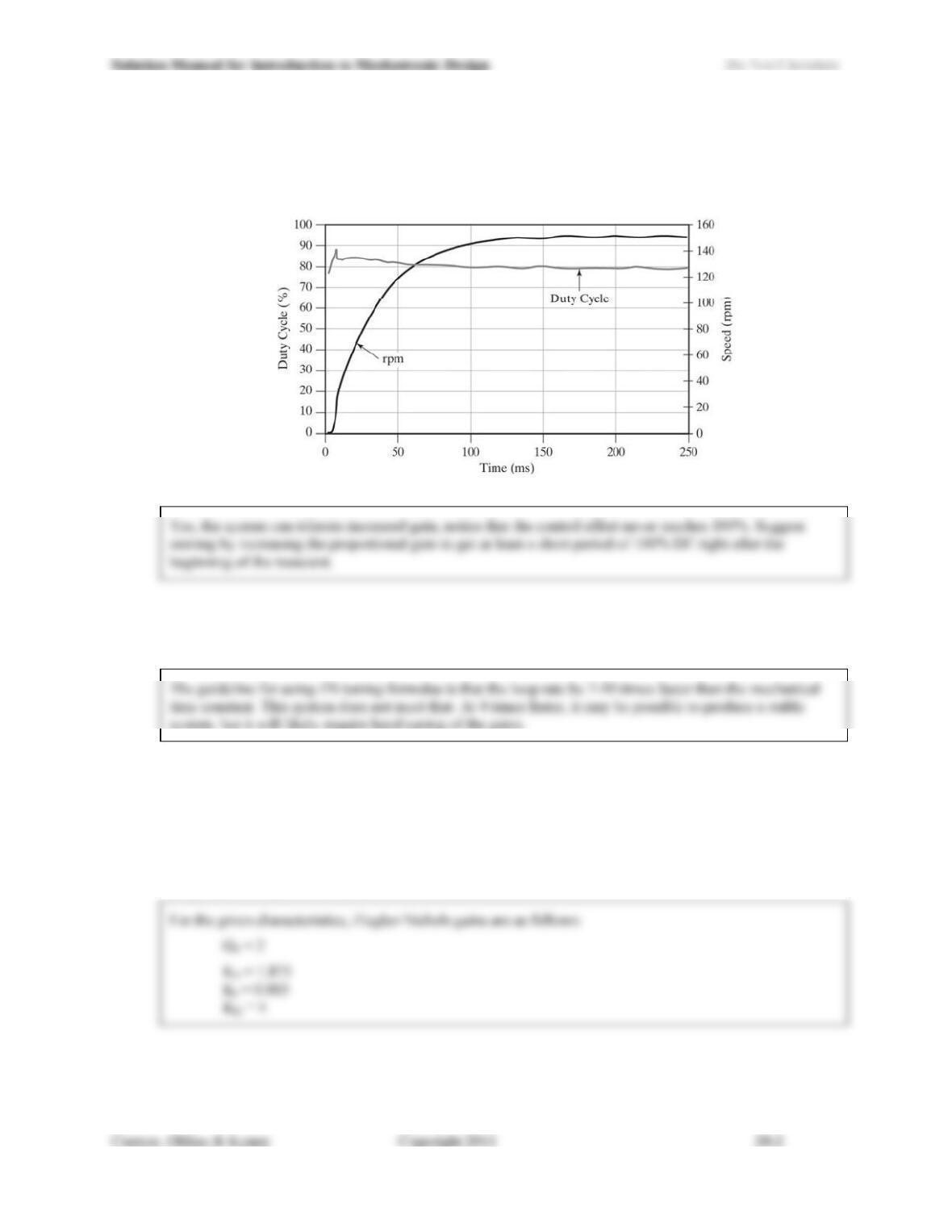
28.5) Lab-mates have collected some step response data from a system that they are trying to control using a PI
controller. The plots of rpm and duty cycle are shown in Figure 28.20. They have asked you whether or
not you think that they can increase the gains to improve the response of this system, and if so, which gain
should they try increasing first?
Figure 28.20: System response for Problem 28.5.
28.6) A particular mechanical system with a time constant of 100 ms is to be controlled using a PID controller
running at a 25 ms loop rate. Would you expect to be able to use the Ziegler-Nichols formulas to calculate
stable gains for this system? Explain your answer based on the guidelines from this chapter.
28.7) The results of an open-loop step response for a particular system yield the following data:
Pseudo-delay = 8 ms
T = 25 ms
Change in output = 20 rpm for a 10% change in commanded duty cycle.
If the system is to be controlled using a PID controller running at a loop rate of 1 ms, what should the
Ziegler-Nichols gains be for KP, KI and KD?
28.8) The results of an open loop-step response for a particular system yields the following data:
Pseudo-delay = 2 ms
T = 12 ms
Change in output = 30 rpm for a 10% change in commanded duty cycle.
If the system is to be controlled using a PID controller running at a loop rate of 1 ms, what should the
Ziegler-Nichols gains be for KP, KI and KD?
28.9) The results of an open loop step response for a particular system yields the following data:
Pseudo-delay = 30 ms
T = 120 ms
Change in output = 30 rpm for a 15% change in commanded duty cycle.
If the system is to be controlled using a PID controller running at a loop rate of 5 ms, what should the
Ziegler-Nichols gains be for KP, KI and KD?
28.10) A particular actuator driven mechanical system is found to have a time constant of 30 ms from actuation to
stable response. Suggest a reasonable control loop rate to use in controlling this system. Explain your
reasoning.
28.11) Only certain systems are good candidates for bang-bang control. What is the prime characteristic to
consider when evaluating whether or not a system is suitable for use with bang-bang control?