Solution Manual for Introduction to Mechatronic Design Do Not Circulate
Chapter 27 Other Actuator Technologies
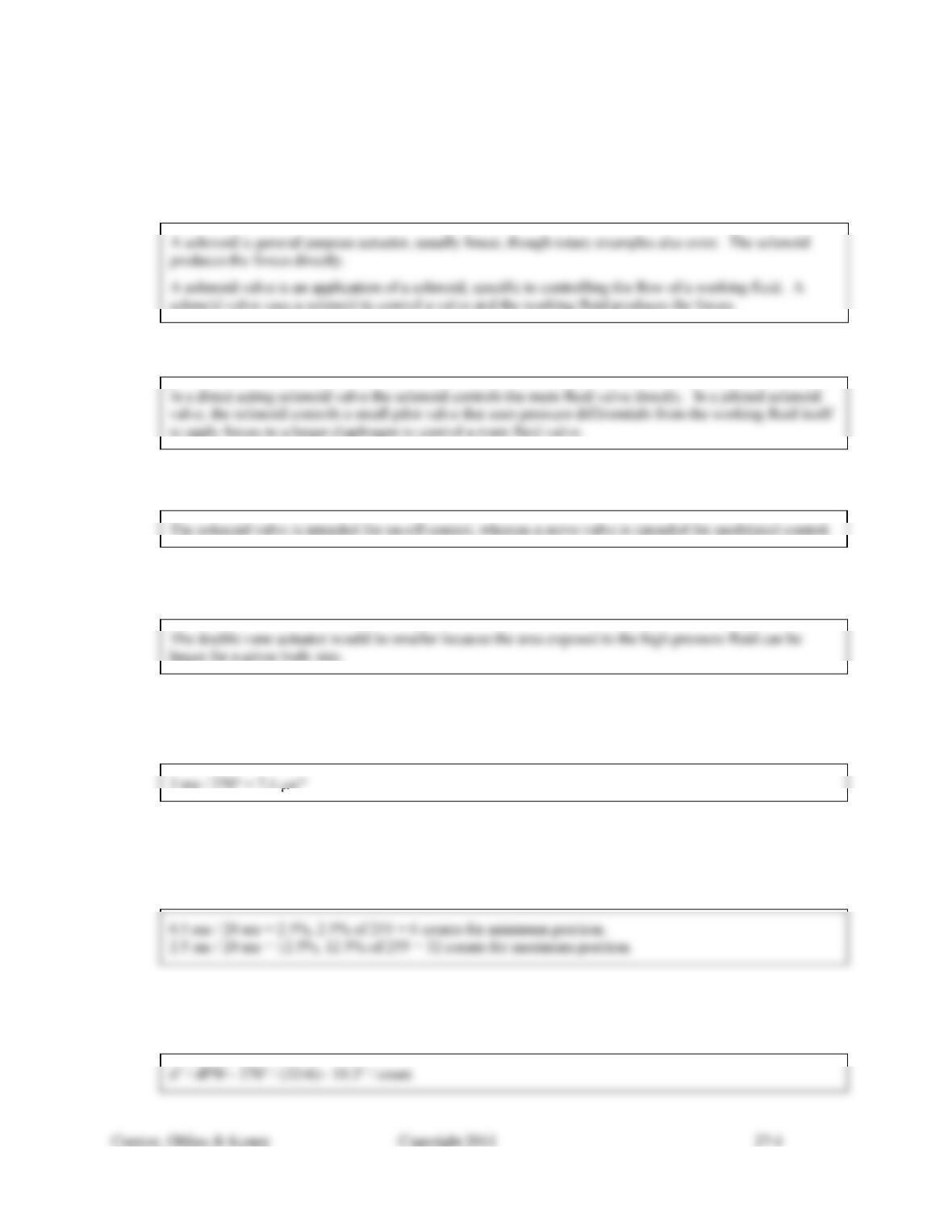
27.1) Describe the basic difference between a solenoid, as introduced in Chapter 24 and the solenoid valve
introduced in this chapter.
27.2) How does a direct acting solenoid valve differ from a piloted solenoid valve?
27.3) How does a solenoid valve differ from a servo valve?
27.4) Would you expect a single vane or double vane rotary actuator to be smaller for a given amount of torque
produced? Explain why?
27.5) A servo motor capable of a 270° rotation responds to a range of pulses between 0.5 ms and 2.5 ms to move
between the two extremes of its rotation. What timing resolution is necessary in the pulse generation in
order to provide position control in 1° increments?
27.6) An engineer wants to use a microcontrollers 8-bit hardware PWM subsystem to generate the pulses to
position the motor from Problem 27.5. If the clock for the PWM subsystem is chosen so that the maximum
PWM period is 20 ms, what duty cycles (0-255 for the full 8-bit PWM) should be requested to place the
servo at its minimum and maximum positions?
27.7) For the combination of motor and PWM drive system from Problem 27.6, what is the best expected
angular resolution for the system (i.e. how much will the motor move when the PWM count changes by
1)?
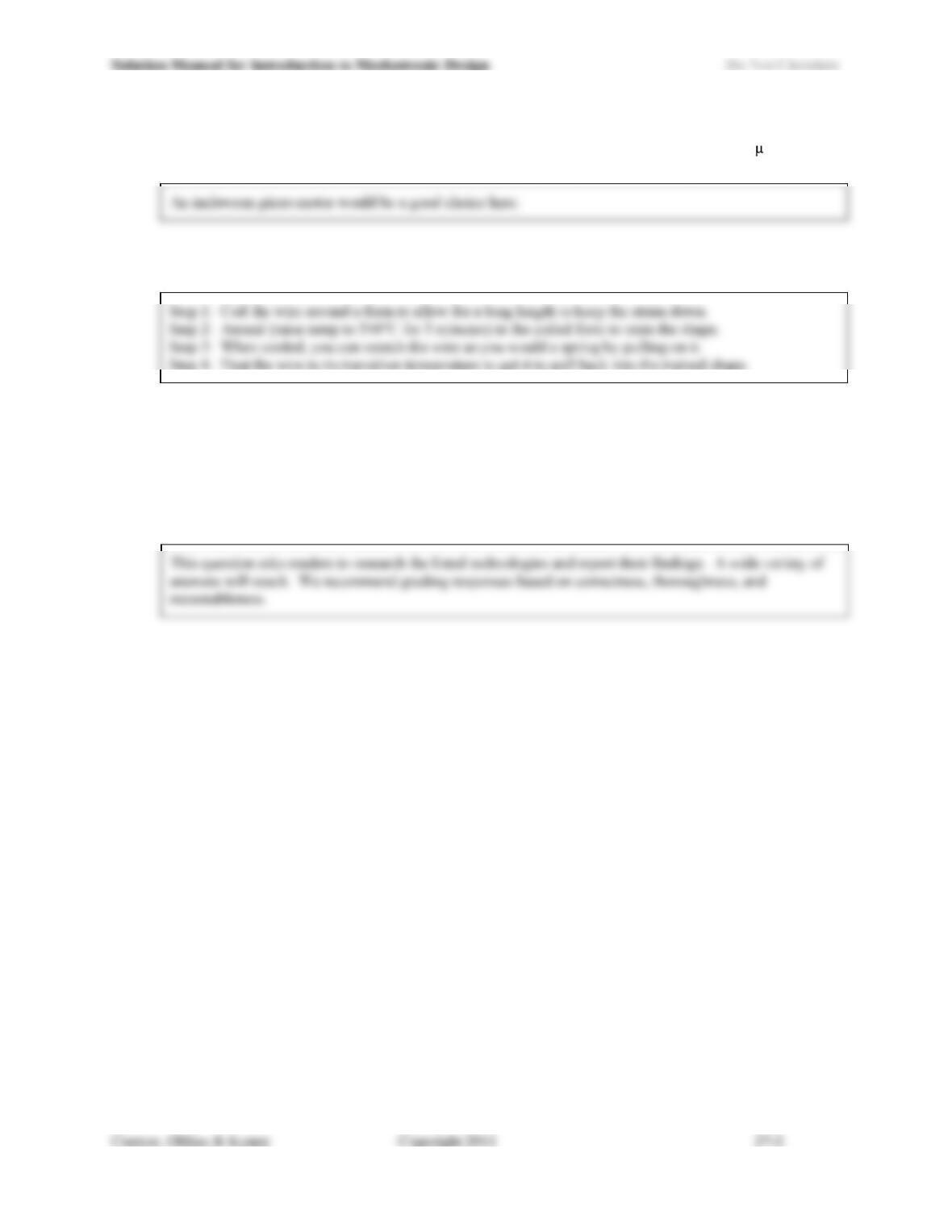
27.8) A particular positioning application requires motion on the order of 1 cm to be produced with m
resolution while producing 10 N of force. Suggest an appropriate actuator technology to fit this application.
27.9) Explain the process that you would go through to produce an actuator that produced a pull-force using a
length of Nitinol wire. Start with the raw, untrained wire and describe the processes through to actuation.
27.10) From the list of actuator technologies below (none of which were discussed in this chapter), select one and
1) briefly describe its theory of operation, 2) cite at least one application, and 3) complete a new row for
Table 27.1 corresponding to the actuator technology you selected (include justifications for your answer to
part 3).
a) Magnetorestrictive actuators
b) Magnetorheological actuators
c) Dielectric electroactive polymer actuators