Chapter 26
CONSUMER LAW
1
Suggested Additional Assignments
Research: Unfair or Deceptive Advertising
Ask students to bring to class an ad that they think is deceptive or unfair. They could either clip an ad
from a newspaper or magazine, or record one from television.
Research: Credit Reports
Ask students to order a credit report from one of the three national credit reporting agencies. They can
obtain ordering information from the following websites:
Chapter Overview
Chapter Theme
This chapter covers statutes that are designed to protect consumers. It also discusses the important role
that the FTC plays in enforcing consumer rights.
Quote of the Day
“Everyone lives by selling something.” –Robert Louis Stevenson (1850-1894), Scottish author of
Treasure Island and Kidnapped.
Federal Trade Commission
Congress created the FTC in 1915 to regulate business. Although its original focus was on antitrust law, it
Consumer Financial Protection Bureau
Sales
Deceptive Acts or Practices
An advertisement is deceptive if it contains an important misrepresentation or omission that is likely to
mislead a reasonable consumer.
2 Unit 5 Government Regulation and Property
Case: Federal Trade Commission v. Direct Marketing Concepts, Inc.
1
Facts: Direct Marketing Concepts, Inc. broadcast an infomercial for Coral Calcium that featured a
spokesperson named Robert Barefoot. In the ad, his claims were as bare as his feet. He asserted that
virtually all diseases — heart disease, cancer, lupus, multiple sclerosis, Parkinson’s — are caused by a
condition called acidosis. And that calcium derived from Okinawan coral cures these diseases by
rendering the body more alkaline: “I’ve had 1,000 people tell me how they’ve cured their cancer. I‘ve
witnessed people get out of wheelchairs with multiple sclerosis just by getting on the coral.”
Issue: Were these infomercials misleading as a matter of law?
Excerpts from Judge Thompson’s Decision: When the FTC brings an action based on the theory that
advertising is deceptive because the advertisers lacked a reasonable basis for their claims, the FTC must:
(1) demonstrate what evidence would in fact establish such a claim in the relevant scientific community;
and (2) compare the advertisers’ evidence to that required by the scientific community to see if the claims
have been established.
On the first prong, the FTC produced four expert declarations which demonstrated that the claims
the first prong.
On the second prong, the FTC relied on the same four expert declarations, in which the experts compared
the Defendants’ evidence to the available literature and concluded in each case that the Defendants’
evidence was woefully inadequate. The experts specifically opined that: (1) there was no evidence that
reductions of these studies. However, none of these scientists or studies supports the panacean claims
made in the Coral Calcium infomercial. The Defendants therefore engaged in deceptive advertising as a
matter of law.
The Defendants attempt to head off the above analysis by asserting that their infomercials advanced no
actual health claims but, instead, presented only puffery which was further attenuated by the presence of
general disclaimers. However, specific and measurable claims are not puffery, and may be the subject of
deceptive advertising claims. [T]he Defendants’ infomercials presented specific and measurable health
claims.
Disclaimers or qualifications in any particular ad are not adequate to avoid liability unless they are
sufficiently prominent and unambiguous to change the apparent meaning of the claims and to leave an
Chapter 26 Consumer Law 3
accurate impression. The disclaimers at issue here did nothing to affect the meaning of the infomercials’
health claims. The infomercial transcripts reveal only disclaimers that the infomercials are paid
advertising. In contrast, the health claims were bold and straightforward, presented by supposed experts
as testable observations backed up by clinical trials and studies.
[W]e affirm the district court’s grant of summary judgment.
Decision: Yes, the infomercials were misleading and no trial was needed.
Reasoning: To make claims such as these, the defendants must have some scientific evidence. But
medical experts for the FTC testified that there is no evidence that calcium cures any of the diseases listed
Question: Did the court find that the FTC met the two requirements that the defendant lacked a
reasonable basis for its claims?
Question: What was an argument that the defendants asserted?
Additional Case: You Be The Judge: Federal Trade Commission v. Business Card
Experts, Inc.
2
Facts: Business Card Experts, Inc. (BCE) grossed over $16 million selling business-card dealerships.
The prices of the dealerships ranged from $10,000 to $25,000.
BCE recruited dealers through advertisements on the Internet and in newspapers and magazines. The
2
2007 U.S. Dist. LEXIS 31366, United States District Court for the District of Minnesota, 2007.
4 Unit 5 Government Regulation and Property
business.” When in reality he had ordered only 5 boxed of cards in the prior three years. Another sales
rep told and FTC investigator that he had fifteen people working for him and earned his investment back
in three to four months, when in reality he sold less than $19,000 worth of cards in three years.
Dealers did testify that the BCE website was helpful for ordering cards, the cards were good quality,
and they were competitively priced.
Section 5 of the FTC Act prohibits “unfair or deceptive acts or practices in or affecting
commerce.” According to the court, to establish liability under section 5, the FTC must prove that
defendants made a material misrepresentation that was likely to mislead customers acting reasonably
under the circumstances. Misrepresentations about expected profits from a business or returns from an
investment violate section 5.
BCE does not dispute that it lacks sufficient assets to compensate the pool of potential victims. It is
also clear that, in its current form as a receivership, BCE has or will soon become a money-losing
operation. The status quo is therefore not sustainable. The Court has carefully balanced, on the one hand,
BCE’s interest in maintaining BCE in its current form in case they ultimately prevail, against, on the other
hand, the interests of potential victims and active BCE dealers. In light of the FTC’s very strong
likelihood of success, the most important interest at stake is that of the potential victims. Thus, the FTC’s
request for an injunction is allowed.
Question: Is it reasonable for someone to believe that they could make $150,000 per year by selling
business cards?
Question: Is it the role of the law to protect the silly and gullible?
Answer: The law does not protect people from making bad investment decisions. However, it does
Question: Did BCE tell the truth?
Question: Were these business card dealerships a good investment?
Question: Was it legal to sell them anyway?
Answer: It was perfectly legal to sell them, just not perfectly legal to lie about them.
Unfair Practices
The FTC Act prohibits unfair acts or practices. A practice is unfair if:
• It causes a substantial consumer injury
Chapter 26 Consumer Law 5
Research: Unfair or Deceptive Advertising
If students located ads that they think are deceptive or unfair, ask them to show these ads to the class.
General Questions:
• What is deceptive or unfair about the ad?
Key Issue: Additional Sales Rules
FTC rules prohibit bait and switch advertisements. They also regulate mail or telephone order merchan-
dise, unordered merchandise, and door-to–door sales.
Question: Have students ever been the victims of bait and switch sales practices? Have they noticed
what some stores do to prevent charges of baiting and switching?
Question: Is this a satisfactory solution?
Question: Many charities send out return address labels printed with the recipient’s name, hoping for
a contribution In return. Does the recipient have a (legal) obligation to make a contribution if she
keeps the labels? What if she uses them?
General Questions:
• Would you feel a moral obligation to make a donation if you used the address labels?
• Have students received other free gifts?
Consumer Credit
Example
The newest controversy in consumer loans involves so-called “payday lending companies.” Ima Poor
is living from paycheck to paycheck. She can pay all her regular expenses, barely, but has no
savings. One broken arm later and she finds herself $500 in debt. How can she pay? She goes to a
6 Unit 5 Government Regulation and Property
Question: What interest rate is Poor paying?
Answer: A $30 fee on a two-week loan of $100 works out to an annual interest rate of 780 percent.
Question: What other alternatives does she have?
Answer: Not many. Most banks will not make loans for less than $1,000, and her credit rating may
inconvenient and may be embarrassing.
Question: Isn’t this incredibly sleazy on the part of the payday lenders?
Answer: They say that they are performing a vital service, helping out a segment of society that
pay off most loans within a couple of weeks.
Question: Forget sleazy, isn’t this illegal, at least in states that have usury statutes?
General Question: Can you see now the point of usury laws and the Truth in Lending statute?
Truth in Lending Act (TILA) General Provisions
Congress passed TILA to ensure that consumers receive adequate information about credit terms before
entering into a loan.
In all loans regulated by the Truth in Lending Act, the disclosure must be clear and in meaningful
sequence. The lender must disclose the finance charge and the annual percentage rate.
Additional Cases: Three TILA Cases
1. IN RE Pittman v. Allright.
3
Allright Mortgage Company extended a loan to James Pittman. The loan
2. Mars v. Spartanburg Chrysler Plymouth, Inc and First National Bank of South Carolina.
4
When Mars
purchased a car from Spartanburg Chrysler Plymouth, the defendant used the term “amount financed”
instead of the required term “unpaid balance.”
5
Question: Have these firms violated TILA?
Answer:
• In the first two cases, the courts held that the lenders had violated TILA, even though the
Chapter 26 Consumer Law 7
Question: Note that if Bonfiglio had borrowed money from a bank to pay the law firm, the bank
would have had to comply with TILA. Why should the bank have to comply and not the law firm?
Answer: TILA is complex, with a great number of technical rules. Those not in the business of
Home Loans
Mortgage Loans
TILA prohibits unfair, abusive, or deceptive home mortgage lending practices.
TILA also regulates so-called subprime loans (also known as higher-priced mortgage loans). These are
loans that have an above-market interest rate because they involve high-risk borrowers.
Home Equity Loans
Credit Cards
Credit and debit cards are extremely important to most consumers so lately they have come under
increased scrutiny from Congress and the regulatory agencies.
Disclosure
TILA establishes disclosure rules for credit cards, which it calls open-end credit. This is a credit
transaction in which the lender makes a series of loans that the consumer can repay at once or in
installments. These rules apply to all consumer credit cards.
Regulation of Credit Card Debt
Credit Card Act of 2009. During the economic crisis that began in 2008, many consumers struggled to
Liability
Stolen Cards. Under TILA, you are liable only for the first $50 in charges the thief makes before you
notify the credit card company.
Disputes with Merchants.In the event of a dispute between a customer and a merchant,
the credit card company cannot bill the customer if (1) she makes a good faith effort to
8 Unit 5 Government Regulation and Property
Case: Gray v. American Express Co.
6
Facts: In December, Oscar Gray used his American Express credit card to buy airline tickets costing
$9,312. American Express agreed that Gray could pay for the tickets in 12 monthly installments. In
January, Gray paid $3,500 and then in February an additional $1,156. In March, American Express billed
Gray sued American Express for violating the FCBA. The trial court dismissed the complaint on the
grounds that Gray had waived his rights under the FCBA.
Issue: Is American Express liable to Gray for violating the FCBA?
Holding: Yes. The contract between Gray and American Express provided: “We can revoke your right
to use [the card] at any time. We can do this with or without cause and without giving you notice.”
However, the FCBA provides that, “during the pendency of a disputed billing, the card issuer shall not
cause the cardholder’s account to be restricted or closed because of the failure of the obligor to pay the
amount in dispute.” These two provisions are in conflict, and, in such a case, the FCBA prevails.
Question: Doesn’t American Express have the right to cancel an account whenever it wants?
Question: Why shouldn’t American Express have the right to cancel an account anytime? Gray
could always get another card from Visa or MasterCard.
Answer: If every company acted as American Express did in this case, Gray might soon run out of
Question: Gray had signed a contract with American Express that allowed the company to cancel a
card whenever it wanted. He’s a law professor, for heaven’s sake. If he did not want to abide by
American Express’s rules, why did he sign the agreement?
Debit Cards
Liability
Your liability for a stolen debit card is much greater than on a credit card. If you report the loss before
anyone uses your card, you are not liable for any unauthorized withdrawals. If you report the theft
within two days of discovering it, the bank will make good on all losses above $50. If you wait until
after two days, your bank will only replace stolen funds above $500. After 60 days of receipt of your
bank statement, all losses are yours: the bank will not repay any stolen funds.
Fees
Traditionally banks would charge a flat fee of $20-$30 each time cardholders overdrew their bank
account, no matter how small the overdraft. Under new rules, though, banks are not allowed to
overdraw an account and charge the fee unless the consumer signs up for an overdraft plan.
Chapter 26 Consumer Law 9
Credit Reports
Accuracy of Credit Reports
A number of statutes, including the Fair Credit Reporting Act (FCRA), the Fair and Accurate Credit
Research: Credit Reports
If you asked students to obtain a credit report, you could now find out what they discovered.
General Questions:
• Did anyone have any difficulty in obtaining a credit report?
• Did anyone find inaccurate information in his or her report?
Question: What can you do if your credit report contains inaccurate information?
Answer: If a consumer tells an agency that some of the information in his file is incorrect, the
Identity Theft
In identity theft, a fraudster steals his victim’s personal information, such as social security number, credit
Debt Collection
You Be the Judge: Brown v. Card Service Center
7
Facts: Card Service Center (CSC) sent Elizabeth Brown a collection letter demanding payment for a
delinquent credit card balance of $1,874. The letter said:
“You are requested to contact the Recovery Unit of the Card Service Center…to discuss your
account. Refusal to cooperate could result in a legal suit being filed for collection of the account.
You now have five (5) days to make arrangements for payment of this account. Failure on your part
You be the Judge: Did CSC’s letter violate the FDCPA?
Holding: Yes, the district court’s ruling is reversed. According to the FDCPA, a debt collector may not
use any false, deceptive, or misleading representation or means in connection with the collection of any
10 Unit 5 Government Regulation and Property
deceptive, or misleading” or constitutes a threat to take any action not intended to be taken, it violates the
Act.
Because the FDCPA is designed to protect consumers, in considering claims under the FDCPA,
communications from lenders to debtors should be analyzed from the perspective of the “least
sophisticated debtor. According to the court, the basic purpose of the least-sophisticated consumer
standard is to ensure that the FDCPA protects all consumers, the gullible as well as the shrewd. Using this
standard, the court concluded that such debtor might be given the impression that litigation or referral to a
lawyer would be imminent if he or she did not respond within five days even though CSC had no
intention of taking that action, or has never or very rarely taken that action before. A debt collection letter
is deceptive where it can be reasonably read to have two or more different meanings, one of which is
inaccurate.
Question: Did Elizabeth Brown do anything wrong?
Question: Then why did she win this case?
Question: What did CEU do wrong?
Answer: The notice it sent Brown threatened legal action if she did not respond to the notice within
ever, initiated legal action under these circumstances.
Question: The letter sent to Brown from CSC stated that Brown’s failure to respond “could” result
in legal action. Doesn’t that mean that it may not result in legal action?
Question: It could mean that, but that ambiguity is what makes the notice illegal. According to the
court, if the language could have two possible interpretations, one of which is inaccurate, then the
statement is deceptive and a violation of the FDCPA.
General Question: In the scheme of things, who behaved worse – Brown or CSC?
Three FDCPA Examples
1. Loretta Broadway of Meriden, Connecticut, owed $373 to a catalog company. She received a letter
that threatened to have her car and bank account seized if she did not pay what she owed. The letterhead
looked like this:
Goldman & Levine
Question: What conclusion would you draw from this letterhead?
Question: In fact, the letter was from G&L Financial Services, d/b/a as Goldman & Levine. What
conclusion would you draw from that information?
Answer: That G&L was violating the FDCPA, which prohibits a collection agency from using a fake
& Levine.
2. As a standard part of its debt collection process, Allied Bond and Collection Agency in Trevose,
Pennsylvania told consumers it “might recommend” that the creditor file a complaint against them.
Question: Did Allied Bond’s statement violate the FDCPA?
Chapter 26 Consumer Law 11
3. A collection agency was trying to collect $200 that Patty Herndon of Temperance, Michigan, owed to
a medical clinic. When the collection agency could not reach her, it called her mother, a 66-year-old
widow, and said, “If you see her, give her the message that we’re after her.”
Question: Is this agency in violation of the FDCPA?
Answer: Yes, the FDCPA prohibits an agency from contacting acquaintances of the debtor for any
Equal Credit Opportunity Act (ECOA)
The Equal Credit Opportunity Act (ECOA) prohibits any creditor from discriminating against a borrower
because of race, color, religion, national origin, sex, marital status, age (as long as the borrower is old
enough to enter into a legal contract), or because the borrower is receiving welfare.
Case: Treadway v. Gateway Chevrolet Oldsmobile Inc.
9
Facts: Gateway Chevrolet Oldsmobile (GCO), a car dealership, sent an unsolicited letter to Tonja
Treadway notifying her that she was “pre-approved” for the financing to purchase a car. In fact,
Treadway had recently filed for bankruptcy and was not eligible for credit, a fact GCO knew. GCO
promised to apply for a loan on Treadway’s behalf, but never did. Instead it told her she had to have a
Treadway sued GCO, alleging that it had violated the ECOA by not notifying her that it had taken an
adverse action against her. The district court granted GCO’s motion for summary judgment on the
grounds that GCO had not committed an adverse action under the ECOA. This appeal followed.
Issue: Did Gateway violate the ECOA?
Holding: Judgment for GCO reversed. The term, “adverse action” includes “a denial or revocation of
credit.” By deciding not to send Treadway’s application to any lender, GCO effectively denied her credit.
Since GCO did not tell Treadway of its decision not even to apply for a loan on her behalf, it would be
difficult for her ever to determine that she was the victim of discrimination. Car dealers could throw the
credit report of every minority applicant in the “circular file” and none would be the wiser.
Question: Did Treadway ever file a loan application?
Question: Then how could she claim that she had been denied credit?
that that was the same thing as denying credit.
Question: Did the court rule that GCO had discriminated?
Answer: No, but it ruled that failing to tell her the truth was an “adverse action”. The statute requires
scam.
8
These three examples were reported in Sana Siwolop, “Nasty Calls at 6 A.M.: Dunners Who Go Too Far,” New
York Times, July 14, 1996, p. F8
9
362 F.3d 971; 2004 U.S. App. LEXIS 6325 Court of Appeals for the Seventh Circuit, 2004
12 Unit 5 Government Regulation and Property
Magnuson-Moss Warranty Act
When Senator Frank E. Moss sponsored the Magnuson-Moss Warranty Act, this is how he explained the
need for such a statute:
[W]arranties have for many years confused, misled, and frequently angered American consumers….
Consumer anger is expected when purchasers of consumer products discover that their warranty may
Additional Case: Muchisky v. Frederic Roofing
10
Thomas Muchisky hired Frederic Roofing Company to re-roof his home. Their contract included a
12-year warranty guaranteeing the roof would be free from defects in workmanship and materials. The
roofing job was unsatisfactory, and Muchisky sued for damages. If the Magnuson-Moss Warranty Act
applied, then Muchisky was entitled to legal fees as well as damages.
Issues: Does the Magnuson-Moss Warranty Act apply in this case? Is the re-roofing of a home a
“consumer product” under the Act?
Holding: The Act does not apply to purchases and sales of real estate, but it does apply to consumer
products that become affixed to property, such as air conditioners and hot water heaters. The court
concluded that the roofing was a consumer product and awarded attorney’s fees to Muchisky.
Question: Does the Magnuson-Moss Warranty Act apply to all warranties?
Question: Is a house a consumer product?
Question: What about a product attached to a house, such as an air conditioner or hot water heater?
Question: Is a new roof real estate or a consumer product?
Question: So where do you draw the line? What about new windows? Or a new carpet?
Ethics
The quote of the day is: “Everyone lives by selling something.”
Question: What obligations does a salesperson have to consumers? Why not simply adopt the rule,
“Buyer Beware?”
Answers:
• In many of the cases discussed in this chapter, there is inequality of bargaining power, strength,
and determination. Certainly, the victims of the Arthur Murray studio (text p. 966) could have
10
838 S.W.2d 74, 1992 Mo. App. LEXIS 1287 Missouri Court of Appeals, 1992
Chapter 26 Consumer Law 13
• These laws are designed to protect those who cannot protect themselves–which means all of us.
General Question: Are other federal statutes needed to protect consumers?
Consumer Product Safety
The goal of the Consumer Product Safety Act of 1972 (CPSA) is to prevent injuries from consumer
products such as toys. This act created the Consumer Product Safety Commission (CPSC) to evaluate
consumer products and develop safety standards. Manufacturers must report all potentially hazardous
product defects within 24 hours of discovery.
Multiple Choice Questions
1. Dell advertised that a computer came with particular software. In fact, the software was not
available for several months. Instead, Dell sent customers a coupon for the software “when
available.” What did Dell do wrong?
I. Failed to offer buyers the opportunity to cancel their orders
II. Did not automatically cancel the orders
III. Did not ship the software within 30 days
(a) I and II
(b) I, II and III
(c) I and III
(d) II and III
2.
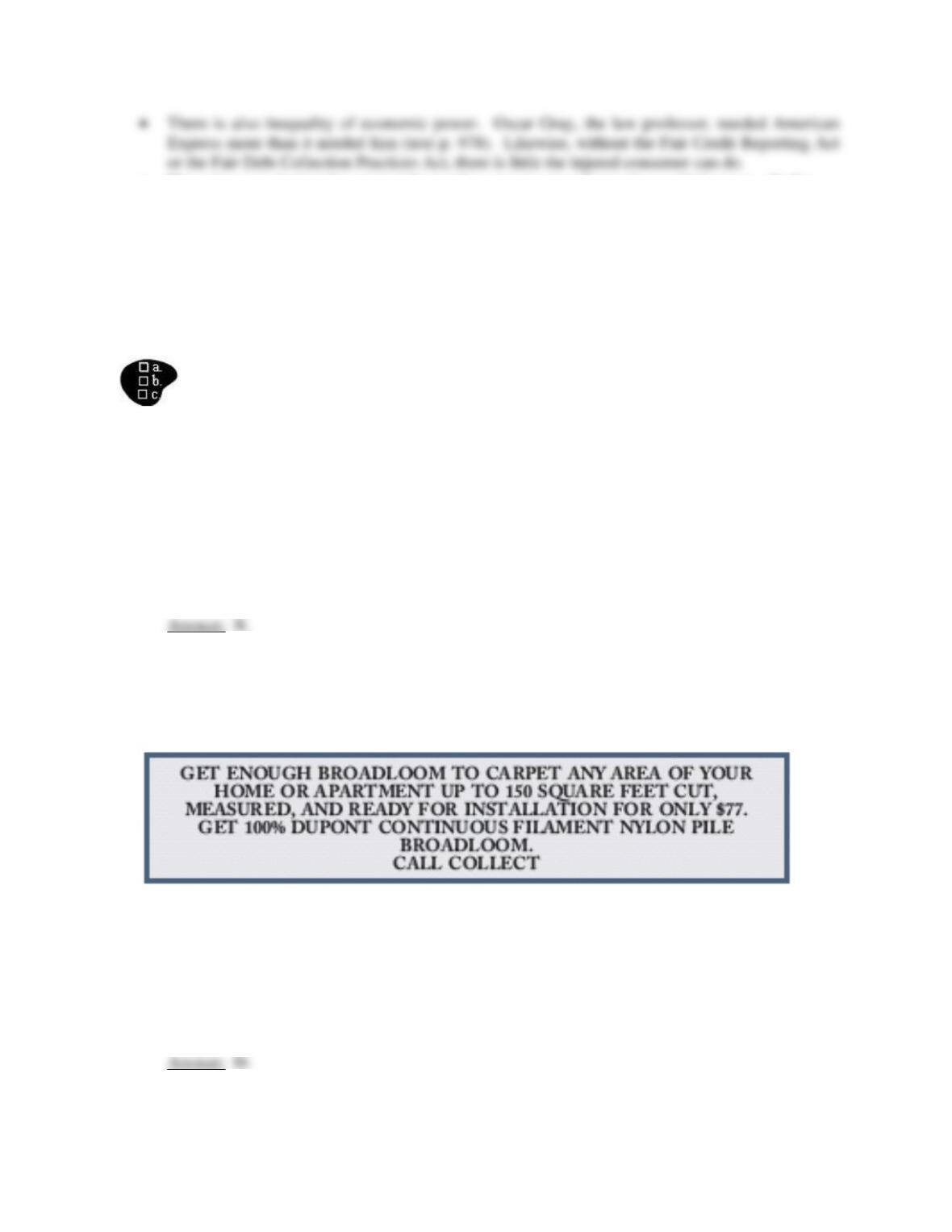
When customers called the number provided, New Rapids Carpet Center, Inc., sent salespeople to
visit them at home to sell them carpet that was not as advertised—it was not continuous filament
nylon pile broadloom, and the price was not $77. What set of rules has New Rapids violated?
(a) Unordered Merchandise
(b) Consumer Product Safety
(c) Truth in Lending
(d) Bait-and-Switch
(e) Fair Credit Reporting Act
3. Which of the following laws set limits on interest rates?
14 Unit 5 Government Regulation and Property
(a) State usury laws
(b) TILA and state usury laws
(c) TILA
(d) None,there are no limits on interest rates.
4. Companies must obtain permission from a consumer before charging for overdrafts on:
(a) debit cards.
(b) credit cards
(c) neither
(d) both
5. You notice a charge on your credit card bill of $149.99 for a kayak. This seems very strange to
you because you have not purchased a kayak. What do you need to do to avoid having to pay this
charge?
(a) Call the store.
(b) Call the credit card company.
(c) Write the store.
(d) Write the credit card company.
Essay Questions
1. You Be the Judge: WRITING PROBLEM Process cheese food slices must contain at
least 51 percent natural cheese. Imitation cheese slices, by contrast, contain little or no natural
cheese and consist primarily of water, vegetable oil, flavoring, and fortifying agents. Kraft, Inc.,
makes Kraft Singles, which are individually wrapped process cheese food slices. When Kraft
began losing market share to imitation slices that were advertised as both less expensive and
equally nutritious as Singles, Kraft responded with a series of advertisements informing
consumers that Kraft Singles cost more than imitation slices because they are made from five
ounces of milk. Kraft does use five ounces of milk in making each Kraft Single, but 30 percent of
the calcium contained in the milk is lost during processing. Imitation slices contain the same
amount of calcium as Kraft Singles. Are the Kraft advertisements deceptive? Argument for
Kraft: This statement is completely true—Kraft does use five ounces of milk in each Kraft
Single. The FTC is assuming that the only value of milk is the calcium. In fact, people might
prefer having milk rather than vegetable oil, regardless of the calcium. Argument for the FTC:
It is deceptive to advertise more milk if the calcium is the same after all the processing.
2. Josephine was a 60-year-old widow who suffered from high blood pressure and epilepsy. A bill
collector from Collections Accounts Terminal, Inc., called her and demanded that she pay $56
she owed to Cabrini Hospital . She told him that Medicare was supposed to pay the bill. Shortly
thereafter, Josephine received a letter from Collections that stated:
You have shown that you are unwilling to work out a friendly settlement with us to clear
the above debt. Our field investigator has now been instructed to make an investigation in
Chapter 26 Consumer Law 15
your neighborhood and to personally call on your employer. The immediate payment of
the full amount, or a personal visit to this office, will spare you this embarrassment.
Has Collections violated the law?
Answer: The court held that Collections’ letter violated the Fair Debt Collection Practices Act.
3. Thomas worked at a Sherwin-Williams paint store that James managed. Thomas and James had a
falling out when, according to Thomas, “a relationship began to bloom between Thomas and one
of the young female employees, the one James was obsessed with.” After Thomas quit, James
claimed that Thomas owed the store $121. Sherwin-Williams reported this information to the
Chilton credit reporting agency. Thomas sent a letter to Chilton disputing the accuracy of the
Sherwin-Williams charges. Chilton contacted James who confirmed that Thomas still owed the
money. Chilton failed to note in Thomas’s file that a dispute was pending. Thereafter, two of
Thomas’s requests for credit cards were denied. Have James and Chilton violated the Fair Credit
Reporting Act?
Answer: Once Chilton received notice of the dispute, it was obligated to re-verify the accuracy of
4. In October, Renie Guimond discovered that her credit report at TransUnion incorrectly stated that
she was married, used the name “Ruth Guimond,” and had a credit card from Saks Fifth Avenue.
After she reported the errors, TransUnion wrote her in November to say that it had removed this
information. However, in March, TransUnion again published the erroneous information. The
following October, TransUnion finally removed the incorrect information from her file. Guimond
was never denied credit because of these mistakes. Is TransUnion liable for violating the Fair
Credit Reporting Act?
Answer: Although Guimond was never denied credit, she had been deterred from even applying
5. Thomas Waldock purchased a used BMW 320i from Universal Motors, Inc. It was warranted “to
be free of defects in materials or workmanship for a period of three years or 36,000 miles,
whichever occurs first.” Within the warranty period, the car’s engine failed and upon examination
was found to be extensively damaged. Universal denied warranty coverage because it concluded
that Waldock damaged the engine by over-revving it. Waldock vehemently disputed BMW’s
contention. He claimed that, while being driven at a low speed, the engine emitted a gear–
crunching noise, ceased operation, and would not restart. Is Universal in violation of the law?
Answer: It depends on whom you believe. If, as Universal alleged, the damage was caused by
6. ETHICS After TNT Motor Express hired Joseph Bruce Drury as a truck driver, it ordered a
background check from Robert Arden & Associates. TNT provided Drury’s Social Security
number and date of birth, but not his middle name. Arden discovered that a Joseph Thomas
Drury, who coincidentally had the same birth date as Joseph Bruce Drury, had served a prison
16 Unit 5 Government Regulation and Property
sentence for drunk driving. Not knowing that it had the wrong Drury, Arden reported this
information to TNT, which promptly fired Drury. When he asked why, the TNT executive
refused to tell him. Did TNT violate the law? Whether or not TNT was in violation, did its
executives behave ethically? Who would have been harmed or helped if TNT managers had
informed Drury of the Arden report?
Discussion Questions
1. Should employers use credit checks as part of the hiring process? On the one hand, each year
employers suffer losses of $55 million because of workplace violence while retailers lose $30
billion a year from employee theft. Those who commit fraud are often living above their means.
On the other hand, there is no evidence that workers with poor credit reports are more likely to be
violent, steal from their employers or quit their jobs. And refusing to hire someone with a low
credit score may simply be kicking him when he is down. What would you do if you were an
employer?
2. The fee on a debit card overdraft can be as high or higher than the amount drawn out. Instead of
overdrawing their accounts, consumers would be much better off either not spending the money,
using a credit card or paying cash. Typically, the people most likely to sign up for overdraft
“protection” are those who can least afford it – they have maxed out their credit cards and used up
any home equity. Is it ethical for a bank to offer an overdraft plan?
3. Look at the section entitled “Credit Card Act of 2009” All of these activities used to be legal.
Which ones were unethical?
4. Go to youtube.com and search for “free credit reports”. Watch advertisements for
freecreditreport.com. Although the characters repeat the word, “free” over and over, in fact the
reports are not free unless the consumer signs up for the paid credit monitoring service. At the
end of the ad, a voice quickly says, “Offer applies with enrollment in Triple Advantage.” Are
these ads deceptive under FTC rules? Are they ethical under your Life Principles?
5. Advertisements for Listerine mouthwash claimed that it was as effective as flossing in preventing
tooth plaque and gum disease. This statement was true, but only if the flossing was done
incorrectly. In fact, many consumers do floss incorrectly. However, if flossing is done right, it is
more effective against plaque and gum disease than Listerine. Is this advertisement deceptive?