Solution Manual for Introduction to Mechatronic Design Do Not Circulate
Chapter 22 Permanent Magnet Brushed DC Motor Characteristics
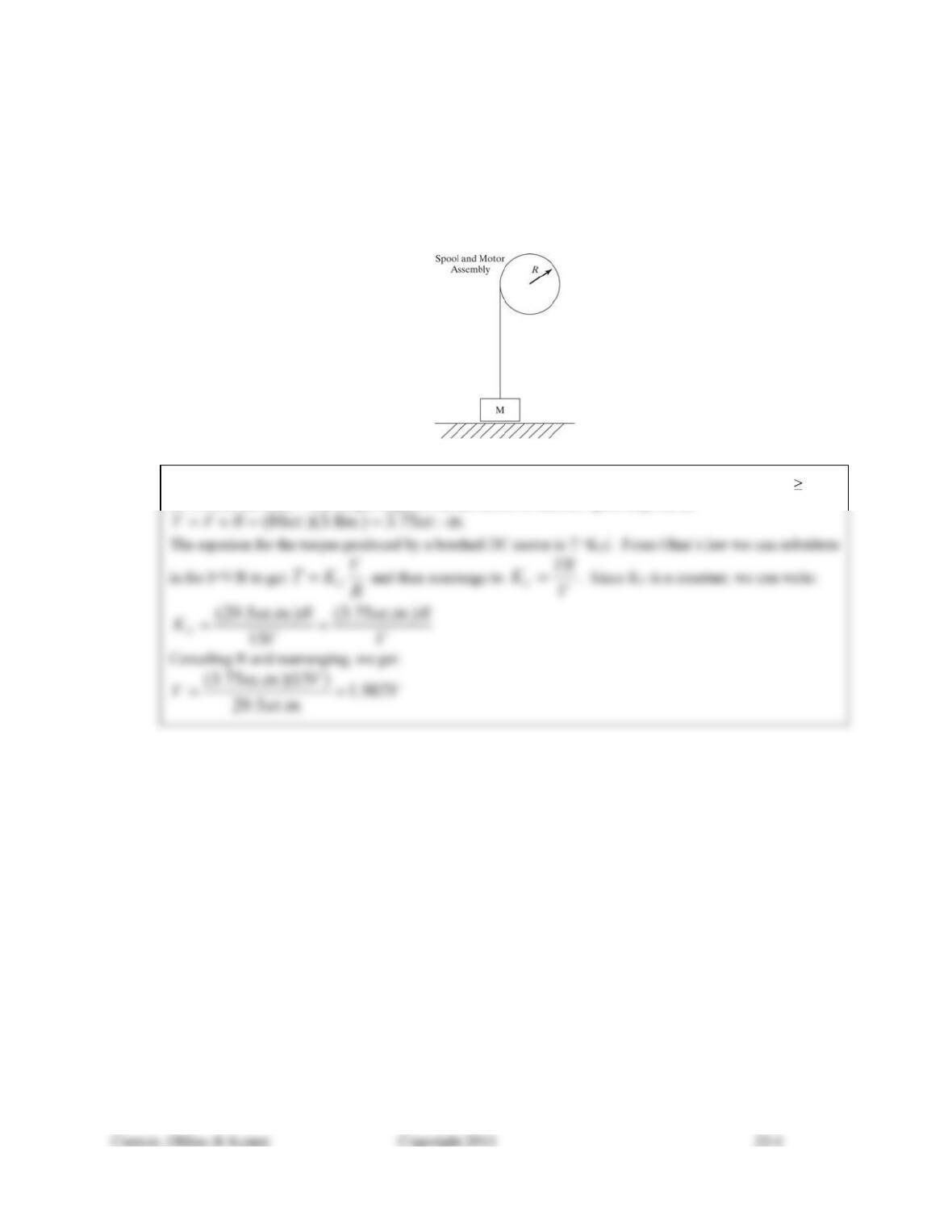
22.1) The mechatronic system shown in Figure 22.12 is designed to periodically hoist a 10 oz. mass above a
platform where it is normally resting. The spool has radius 3/8 in., and is directly connected to the output
shaft of the motor. If the motor has a stall torque of 29.5 in.·oz. at 15 V, what is the minimum voltage
required to hoist the mass?
Figure 22.12 Mechanism for Problem 22.1.
Since the weight of the mass is given in ounces, gravity is already included: the force F needs to be 10
oz. to hoist the mass. The torque required for the motor to turn the spool is given by:
22.2) As you stroll the isles of the local flea market, you come across a booth stocked with surplus permanent magnet
brushed DC motors. Your eyes widen with excitement as you notice a particularly shiny gear motor priced at
just $1.50. Whipping your trusty multimeter out of its belt holster, you measure the winding resistance to be 18.9
. Next, you pull a small torque wrench out of your fanny pack and measure the stall torque, which is 2.8 Nm
when powered by the 12 V battery you keep handy for just such occasions. The gearhead is marked 100:1.
The application you have in mind for this motor requires that the gearhead output shaft deliver 400 mNm at 35
rpm when driven at 15 V. You assume that the frictional losses in the motor and gearbox are negligible.
Determine the appropriateness of the motor by answering the following:
a) Will the motor and gearhead meet the requirements for torque and speed at 15 V? If not, what drive voltage
would enable you to meet the design requirements?
b) What is the current required to operate at the design point?
a) We have adequate information about the motor to calculate KT and KE:
In order to meet the requirements, we solve the Eq. 22.9, since V is the only unknown:
22.3) A motor with KT = 105 mNm/A, RCOIL = 10 and NL (at 48 V) = 4,320 rpm will be operated with a 48 V
supply. If this motor is connected to a mechanism that has frictional torque losses of Tf, = 55 mNm, what
will its output shaft rotational speed be?
From the given quantities, we can determine KE from Eq. 22.11:
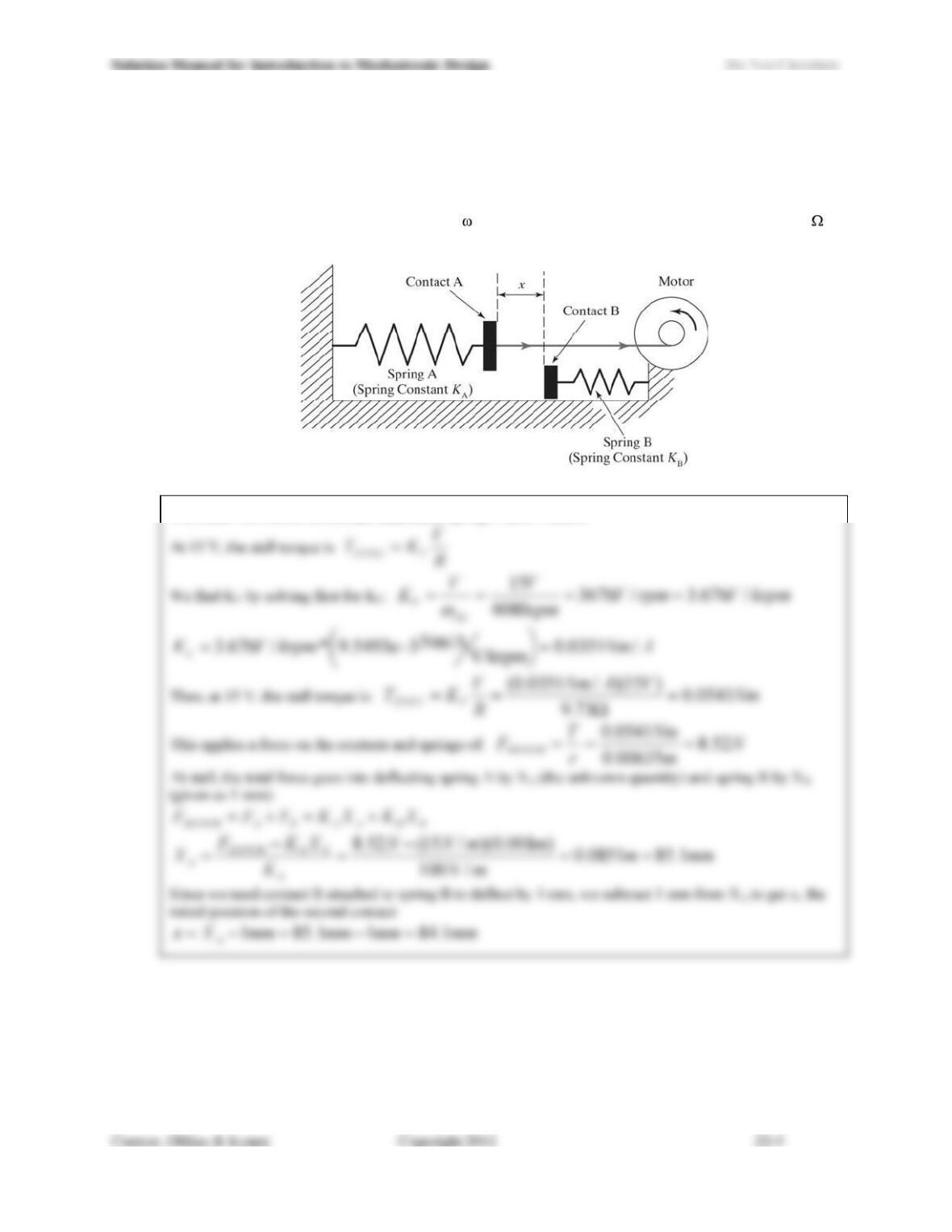
22.4) For the system shown in Figure 22.13, electrical contact A is attached to a fixed reference point via spring
A with spring constant KA. The spring is spooled onto the shaft of a DC motor in order to move the
electrical contact from its initial location, until it makes contact with electrical contact B that is also
attached to a fixed reference point via spring B that has a spring constant KB. The first spring constant is
KA = 100 N/m, the second spring constant is KB = 15 N/m and the motors shaft diameter is 0.5 in. The
motor is powered at 15 V, has a no-load speed NL = 4,080 rpm (at 15 V), and coil resistance R = 9.73 .
What is the value of the initial distance, x, between the contacts to ensure that contact B is displaced 1 mm
when the motor is switched on and pulls contact A into contact B and compresses spring B?
Figure 22.13 Mechanism for Problem 22.4
The motor will move the contact attached to spring A until it stalls.
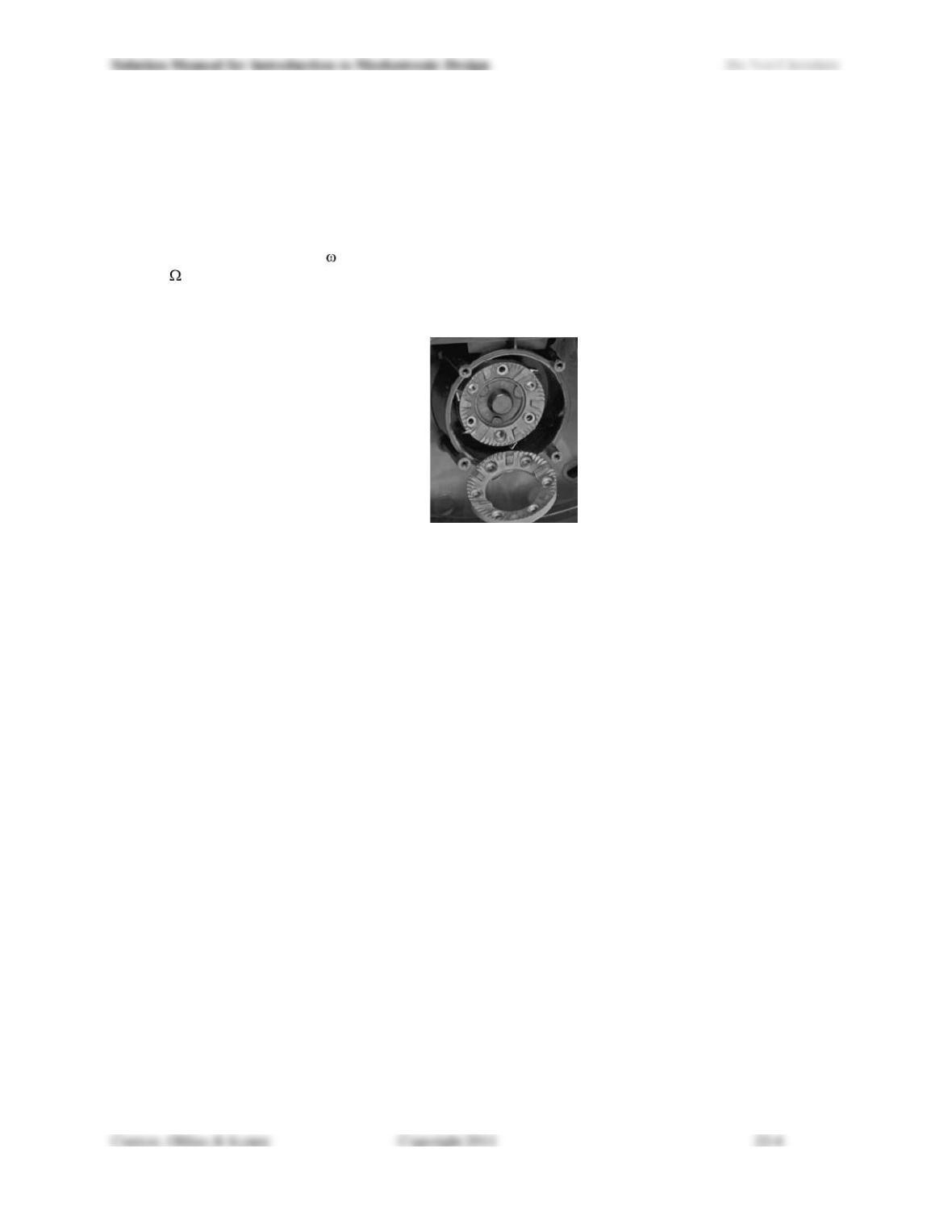
22.5) You wish to design a new ultrahigh quality, portable, battery-powered coffee burr grinder for backpacking
espresso fanatics. The grinding elements you have selected (Figure 22.14) are adjustable so that a course
grind results when the burr cones are moved far apart from each other, a fine grind results when the cones
are moved close together, and any intermediate point may be selected by the user. The manufacturer of the
burr cones claims that the torque required to grind coffee ranges from 0.1 Nm (course grind) to 0.5 Nm
(fine grind), and that the burr cones only function when rotating between 6 to 10 rpm. You will use a 12 V
battery and a motor with NL = 13,900 rpm, TSTALL = 28.8 mNm, ISTALL = 3.55 A, coil resistance R = 3.38
, maximum continuous current I = 0.614 A, KT = 8.11 mNm/A, and KE = 0.847 V/krpm. There are three
gearheads available to you for this design: the first has a 850:1 ratio with 65% efficiency, the second has a
ratio of 1,621:1 with 59% efficiency, and the third has a ratio of 3,027:1 with 59% efficiency. Which
gearhead satisfies all the constraints (including continuous operation of the motor)?
Figure 22.14 Burr coffee grinder elements for Problem 22.5.
Solution Manual for Introduction to Mechatronic Design Do Not Circulate
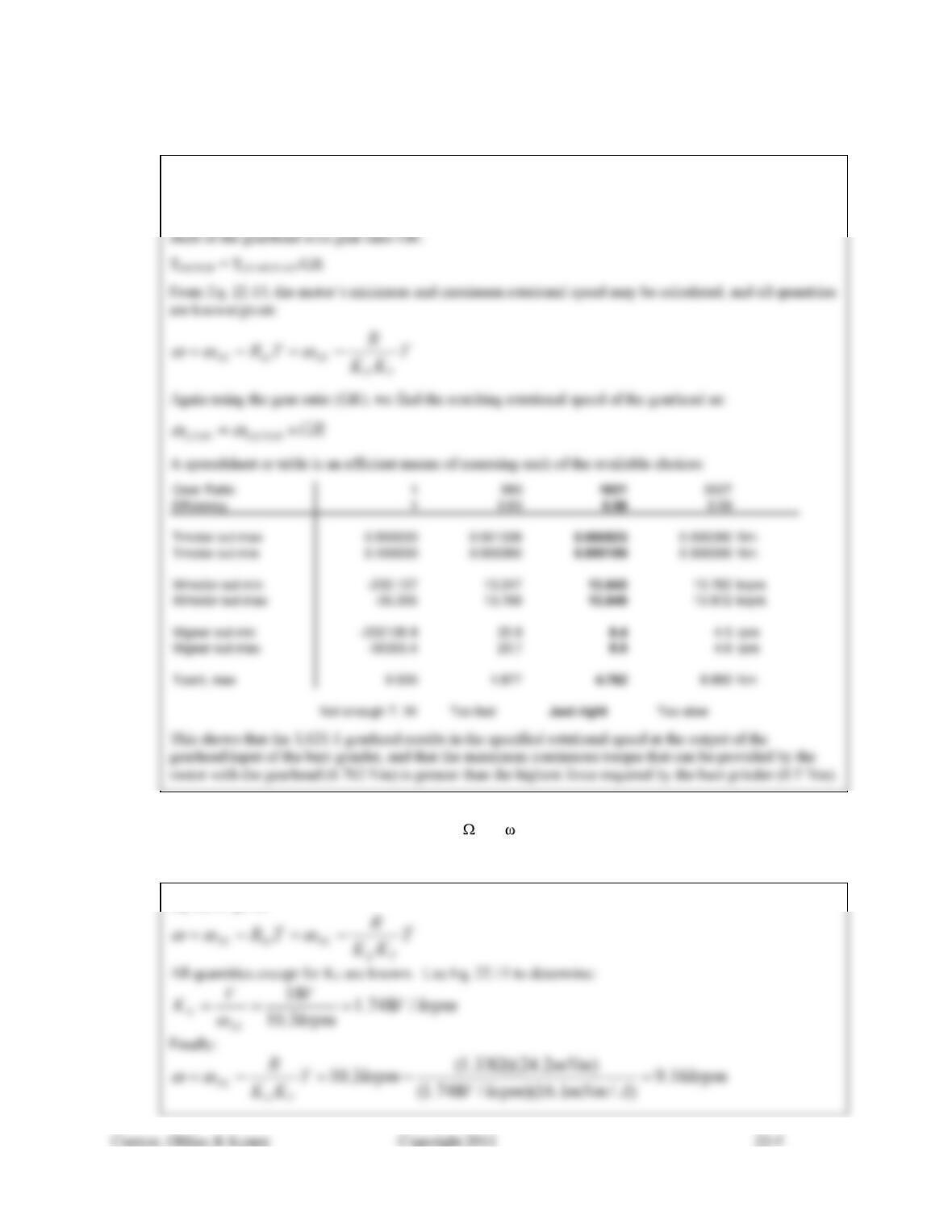
This problem is a straightforward application of Eq. 22.13 for each of the gearhead choices, then checking
to see which of them satisfies the constraints.
The first quantity to determine is the minimum and maximum torque required from the motor, at the input
22.6) A motor with KT = 16.1 mNm/A, RCOIL = 1.33 and NL (at 18 V) = 10,300 rpm will be operated with an
18 V supply. The maximum permissible continuous torque specification is 24.2 mNm. What rotational
speed does this correspond to?
Eq. 22.13 gives:
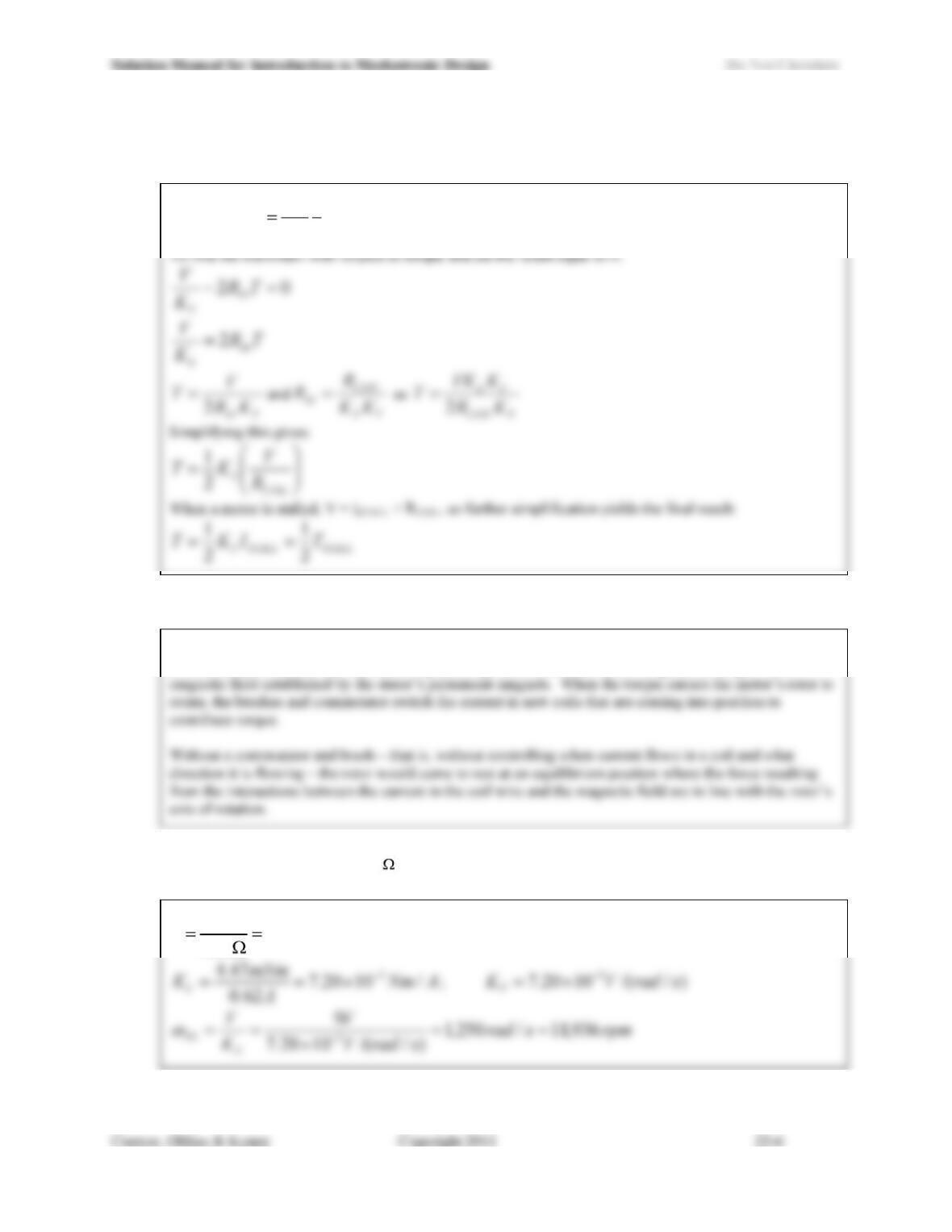
22.7) Starting with the expression for motor power output given in Eq. 22.18, show that maximum power is
developed at ½ TSTALL.
Eq. 22.18 is 2
TR
K
VT
PM
E
22.8) What are the roles of the commutator and brushes in a brushed DC motor?
The commutator and brushes control the current that flows in the coils on the rotor of a brushed DC motor
so that current flows in coils that are in a physical position that allows them to generate torque in the
22.9) A motor has a measured R = 14.5 , and a measured stall torque of 4.47 mNm when operated on 9 V.
What is the expected no-load speed of this motor? You should ignore motor friction for this problem.
mA
V
I620
5.14
9
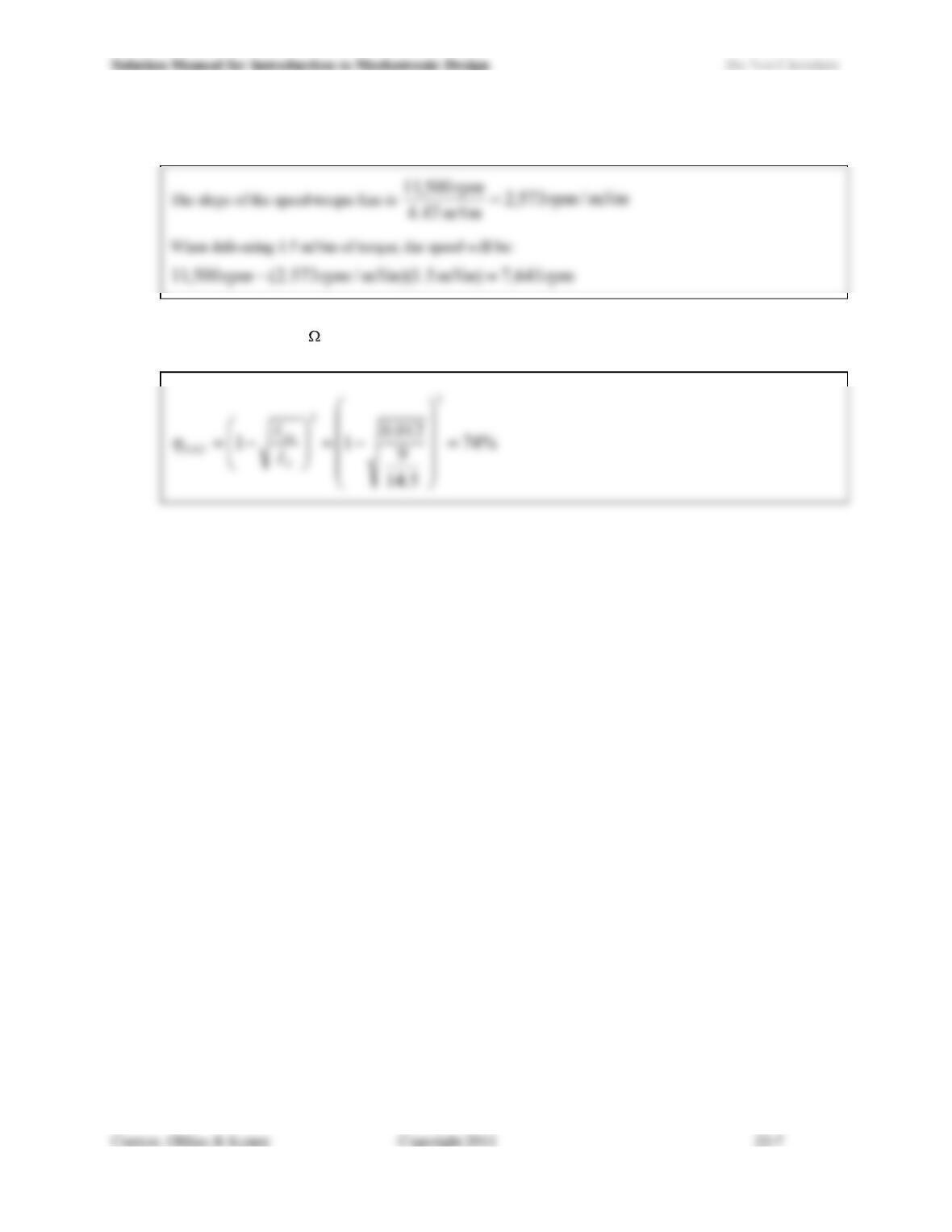
22.10) A motor has a measured no-load speed of 11,500 rpm, measured stall torque of 4.47 mNm. What is the
expected speed of this motor when delivering 1.5 mNm of torque into an external load?
22.11) A motor has R = 14.5 , a no-load speed of 11,500 rpm and no-load current of 12 mA when operated at 9
V. What is the maximum efficiency when operated on 9 V?