14 Unit 4 Business Organizations
• The interests of managers and shareholders often conflict; binding proposals can keep managers
honest.
• Presumably, a majority of shareholders will not vote in favor of some crackpot resolution.
Arguments against:
Election and Removal of Directors
Congress began its reform effort by passing the Sarbanes-Oxley Act (SOX), which applies to all publicly
traded corporations in the United States as well as to all foreign companies listed on a U.S. stock
exchange. Among other provisions, SOX stipulates that all members of a board’s audit committee must
be independent and at least one of these members must be a financial expert.
Compensation for Officers and Directors – The Problem. Between 2001 and 2003, public companies
spent 9.8 percent of their net income on compensation for top executives. Executives also get many non–
cash perks such as stock options, termination benefits, retirement benefits, luxury perks, and sometimes
Compensation for Officers and Directors – A Solution?
The federal government has begun to respond to these perceived abuses by amending proxy rules, and by
Chapter 20 Corporations 15
Case: Brehm v. Eisner9
Facts: Michael Ovitz founded Creative Artists Agency (CAA), the premier talent agency in Hollywood.
As a partner of this agency, he earned between $20 and $25 million per year. He was also a longtime
friend of Michael Eisner, Chairman and CEO of the Walt Disney Company. Disney hired Ovitz to be its
President. Upon the advice of Graef Crystal, a compensation consultant, the Board approved Ovitz’s
contract.
After 14 months, all parties agreed that the experiment failed, so Ovitz left Disney with a $130
million severance package. Shareholders of Disney sued the Board, alleging that it had violated the
business judgment rule and that such a large payout was a waste of corporate assets. The trial court found
for Disney and the shareholders appealed.
Issue: Did the Disney directors have the right to pay $130 million to an employee who had worked at the
company unsuccessfully and for only 14 months?
Holding: Yes, the Disney Board of Directors had the right to pay Michael Ovitz $130 million. The
compensation committee of the Board was informed of the material facts relating to the payout. While
they did not use “best practices”, the committee reasonably believed that the analysis of the terms of the
contract was within Crystal’s professional competence, and the committee relied on the information and
opinions of Crystal. Crystal was selected with reasonable care in light of his previous engagements with
the company.
The purpose of the business judgment rule is to protect directors who rely in good faith upon
information presented to them from various sources, including any other person as to matters the member
reasonably believes are within such person’s expert competence. For these reasons, we uphold the
Chancellor’s determination that the compensation committee members did not breach their fiduciary duty
of care.
The shareholder’s claim of waste is unsupported by the evidence. To recover for waste, the plaintiffs
must prove that the exchange was so one sided that no businessperson of ordinary, sound judgment could
conclude that the corporation has received adequate consideration. The shareholders claim that the
contract was wasteful because it incentivized Ovitz to perform poorly in order to obtain payment. The
approval of the contract had a rational business purpose: to induce Ovitz to leave CAA, at what would be
otherwise considerable cost to him, in order to join Disney. The Chancellor found that the evidence does
not support any notion that the contract irrationally incentivized Ovitz to get himself fired.
Question: What was Michael Ovitz’s career path at Disney?
Question: Why?
Answer: Ovitz was considered by some to be the “Most Powerful Man in Hollywood.” When it hired
Question: When they approved his severance package, Disney’s board did not know how much his
severance package would cost. How could this be considered an informed decision under the
business judgment rule?
Question: Wasn’t the payment ridiculously excessive?
9 2006 Del. LEXIS 307, Supreme Court of Delaware, 2006.
16 Unit 4 Business Organizations
General Question: What do you think?
Executive Compensation
Question: How much of corporate earnings should go to the top five earners in a company (given that
there are millions of shareholders)?
General Questions: In 2006, Exxon had a profit of $36 billion, which was the largest any American
company had ever earned. Every time the price of oil increased by $1, Exxon’s earnings increased by
1.5%. Why were oil prices up? Because of the war in Iraq and increased demand from China.
Bonuses for the top five executives at Exxon increased by $14.3 million. Had the executives earned
such large increases?
In September 2002 Fortune magazine reported on a survey it conducted to answer the following
$3. Yahoo executives reaped $901 million in stock sales while the company’s shares fell from $250
to about $11. InfoSpace, once touted by its founder, Naveen Jain, as on its way to becoming the first
“trillion-dollar” company, makes the list. In early 2000, by which time Jain had already taken out
more than $200 million, he protested to FORTUNE that “investors … know I am committed to our
long-term success.” Now Jain’s “trillion-dollar” company has a stock price of around 50 cents and a
market cap of around $145 million—and meanwhile, its founder has sold an additional $200 million or
General Questions:
• Do these sales satisfy the officers and directors’ duties as corporate fiduciaries?
• Do these sales satisfy the officers and directors’ moral obligations to their corporations? To
shareholders?
Current Focus
Why has executive compensation increased so dramatically? In the 1950s, executives earned 40 times as
much as the average worker. Now they earn 458 times as much. Some commentators suggest that
10 Mark Gimein, “You Bought. They Sold.” Fortune, September 2, 2002
Chapter 20 Corporations 17
Question: What can companies do about executive compensation?
Answer: Some commentators suggest the following:
meetings.
General Questions:
• What ethical obligations do directors have in setting officers’ pay?
If students completed the Executive Compensation Research, have them report what they found. Chart
the raw data on the board–what is the range of salaries for CEOs? Then see if the students are able to
discern any correlation among income, performance, and size.
Right to Protection from Other Shareholders
Anyone who owns enough stock to control a corporation has a fiduciary duty to minority shareholders.
You Be the Judge: eBay Domestic Holdings, Inc. v. Newmark11
Facts: Defendant, craigslist, Inc. owned the most popular website in the country for classified ads. It had
just two shareholders – Craig Newmark and Jim Buckmaster — and only 34 employees. eBay, Inc. was a
publicly traded company that operated online auction sites worldwide. It employed over 16,000 people.
eBay bought a minority interest in craiglist with the goal of ultimately acquiring the company or, failing
that, learning the “secret sauce” of craigslist’s success. It turned out, though, that craigslist and eBay
were not a good match because they had entirely different cultures and approaches to business. craigslist
11 2010 Del. Ch. LEXIS 187 Court of Chancery of Delaware, 2010
18 Unit 4 Business Organizations
Issue: Did Craig, Jim and craiglist violate their fiduciary duty to the minority shareholder?
Excerpts from Chancellor Chandler’s Decision: All directors of Delaware corporations are fiduciaries
of the corporations’ stockholders. Similarly, controlling stockholders are fiduciaries of their corporations’
minority stockholders.
[In a situation such as this] directors must (1) identify the proper corporate objectives served by their
actions; and (2) justify their actions as reasonable in relationship to those objectives. Thus, the two main
culture that sufficiently promotes stockholder value to support the indefinite implementation of a poison
pill. Jim and Craig did not make any serious attempt to prove that the craigslist culture, which rejects any
attempt to further monetize its services, translates into increased profitability for stockholders.
I am sure that part of the reason craigslist is so popular is because it offers a free service that is also
extremely useful. It may be that offering free classifieds is an essential component of a successful online
classifieds venture. After all, by offering free classifieds, craigslist is able to attract such a large
community of users that real estate brokers in New York City gladly pay fees to list apartment rentals in
order to access the vast community of craigslist users. Giving away services to attract business is a sales
tactic, however, not a corporate culture. To the extent business measures like loss-leading products,
money-back coupons, or putting products on sale are cultural artifacts, they reflect the American capitalist
culture, not something unique to craigslist.
The defendants also failed to prove at trial that when adopting the Rights Plan, they concluded in good
As long as Jim and Craig have control they can maintain the craigslist “culture” regardless of whether
eBay sells some or all of its shares. The Rights Plan therefore does not have a reasonable connection to
Jim and Craig’s professed goal. It therefore falls outside the range of reasonableness.
I rescind the Rights Plan in its entirety.
Question: Chancellor Chandler gives two main reasons why Craig and Jim failed to make their case.
What are they?
Answer: First, they failed to prove that their corporate “culture” promotes stockholder value in any
Chapter 20 Corporations 19
Additional Case: Michael L. Retzer v. Nancy B. Retzer12
Facts: Mr. Retzer worked long hours to acquire five McDonald’s franchises. He owned 1,610 shares of
stock in the close corporation that owned the franchises; his wife had 1,600 shares. Mrs. Retzer was
unfaithful and a profligate spender. The couple divorced.
Issue: What are Mr. Retzer’s obligations to Mrs. Retzer as a minority shareholder?
Holding: Because of her adultery, Mrs. Retzer would not be entitled to any alimony. However, she was
entitled to a fair return as a shareholder and Mr. Retzer owed her a fiduciary duty. The court promised
that it would closely scrutinize Mr. Retzer’s conduct.
Question: What did Mr. Retzer owe Mrs. Retzer for alimony?
Question: What is Mr. Retzer’s duty to Mrs. Retzer as a shareholder of the company?
Answer: He must pay her a reasonable share of the profits and keep her fully informed about the
Question: Is the result in this case fair?
Answer: Although students often begin by saying that the case is not fair, they ultimately
Example: The Sinven Case13
Sinclair Oil owned 97 percent of Sinven. Sinven’s minority shareholders complained that Sinclair:
• Forced Sinven to pay dividends so large that the subsidiary faced bankruptcy,
• Hired other, wholly owned subsidiaries but not Sinven, and
• Refused to force its other subsidiaries to abide by their contracts with Sinven. For instance, a Sinclair
subsidiary signed a contract with Sinven to buy crude oil but failed to purchase the required amount.
Question: Was it fair for Sinclair to force Sinven to pay dividends so large that it faced bankruptcy?
received the dividends.
Question: Was it fair for Sinclair to hire other, wholly owned subsidiaries rather than Sinven?
Question: Was it fair for Sinclair not to force its other subsidiaries to abide by their contracts with
Sinven?
Enforcing Shareholder Rights
Derivative Lawsuits
Shareholders bring a derivative lawsuit to remedy a wrong to the corporation. The suit is brought in the
name of the corporation and all proceeds of the litigation go to the corporation.
20 Unit 4 Business Organizations
Additional Case: In re eBay, Inc. Shareholder Litigation14
Facts: Pierre M. Omidyar and Jeffrey Skoll founded eBay, Inc. a company that hosts an online auction
site. Later, Robert C. Kagle and Margaret C. Whitman joined the eBay board. Whitman also became
president and CEO. Goldman Sachs Group Inc. twice served as lead underwriter when eBay sold shares
to the public. Then Whitman became a director of Goldman. Afterwards, Goldman served as eBay’s
financial advisor when it acquired PayPal, Inc.
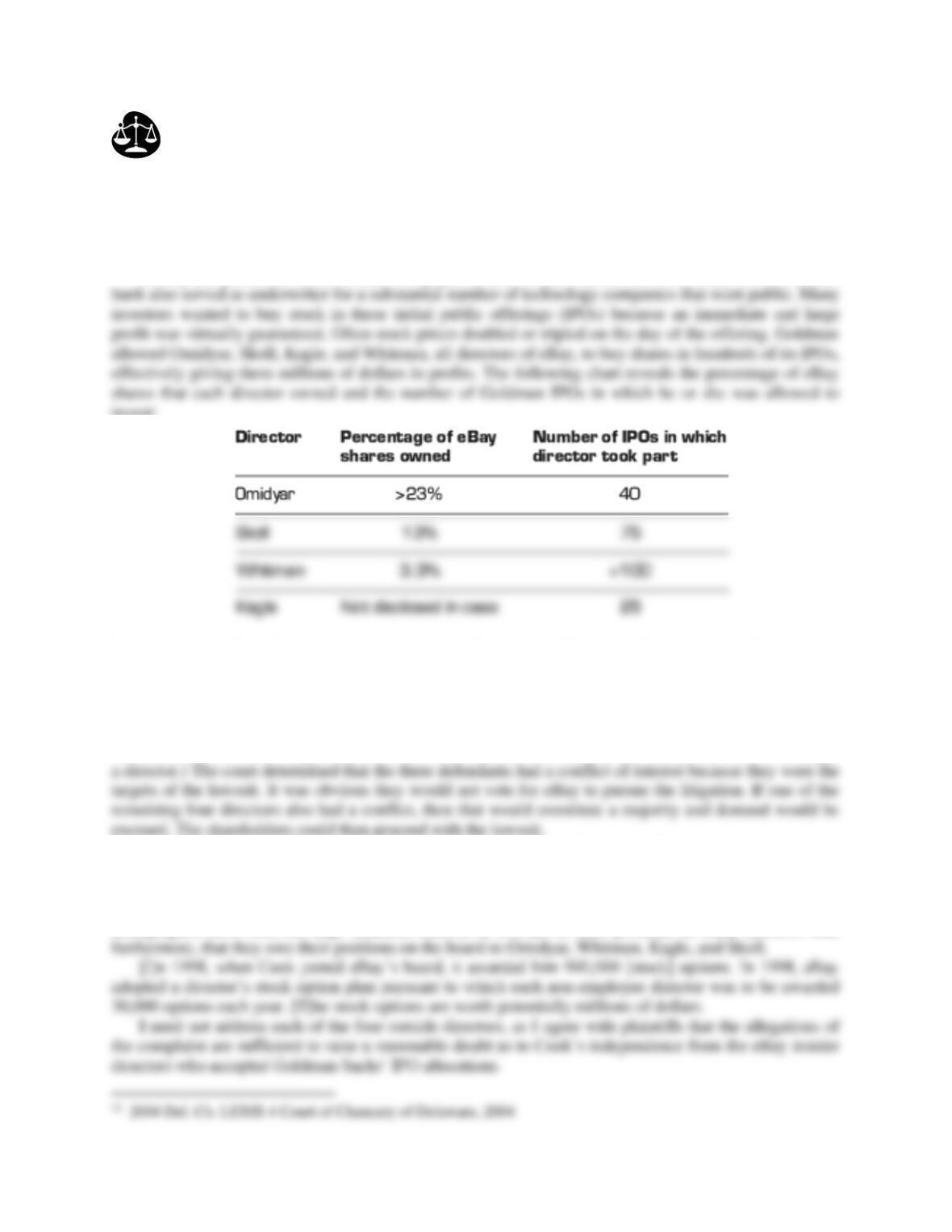
During this period in which Goldman engaged in three major transactions with eBay, the investment
invest:
In each case, the eBay directors sold the stock immediately for millions of dollars in total profit.
eBay shareholders sued, alleging that Goldman had effectively bribed the defendants to continue
giving business to the bank. The lawsuit was brought as a derivative action in the name of eBay. The
plaintiffs alleged that demand was futile because the directors had a conflict of interest.
eBay’s board of directors had seven members: Omidyar, Kagle, Whitman, Philippe Bourguignon,
Scott D. Cook, Dawn G. Lepore, and Howard D. Schultz. (At the time of the lawsuit, Skoll was no longer
Issue: Did a majority of the board of directors have a conflict of interest? Was demand on the board
futile?
Holding: Judgment for the shareholders.
Excerpts from Chancellor Chandler’s Decision: Plaintiffs allege that Cook, Lepore, Schultz, and
Bourguignon have received huge financial benefits as a result of their positions as eBay directors and,
Chapter 20 Corporations 21
First, Whitman, Omidyar, Kagle, and Skoll (and their affiliates) own about one-half of eBay’s
outstanding common stock. As a result, these eBay officers and directors effectively have the ability to
control eBay and to direct its affairs and business, including the election of directors and the approval of
significant corporate transactions.
Second, a significant number of options have not yet vested and will never vest unless the outside
should be excused as futile.
Update: Meg Whitman and the two other company officials agreed to pay $3 million to settle this suit.
Question: What is a derivative suit?
Question: Why would anyone want to do that?
Answer: If the corporation has been injured, that is the shareholders’ only option. They cannot file a
direct lawsuit against the corporation (or the directors).
Question: Why can’t they simply file a direct lawsuit?
Answer: The theory is that, if the corporation is injured, all shareholders suffer the same injury
Question: Why would any shareholder file suit if recovery goes to the corporation?
Question: Are there any circumstances under which a shareholder can bring a direct action against
the company?
Answer: Only if the shareholder has some “special injury.” This means that either:
Question: Can you give an example?
Answer:
• If the corporation refuses to repay a loan to one shareholder, she can file a direct action against
Question: Could the shareholders have filed a direct lawsuit in this case?
Answer: No, because the corporation had been injured by the directors’ actions. There was no
special injury to shareholder.
Question: What was the injury to the corporation?
Answer: Whitman and some of the directors bought shares in IPOs from Goldman, knowing that
Question: Did they make money?
Question: How did this harm eBay?
Answer: These same people then hired Goldman to do work for eBay – a classic conflict of interest.

22 Unit 4 Business Organizations
demand would be futile.
Question: What happened next?
Answer: The defendants settled the case. This is typically what happens if a court rules that demand
is futile.
Question: Some of the defendants in this case were billionaires. Why would they take stock from
Goldman?
Answer: This behavior was standard operating procedure at the time. “Everyone” was doing it.
Multiple Choice Questions
1. CPA QUESTION Generally, a corporation’s articles of incorporation must include all of the following
except the:
(a) Name of the corporation’s registered agent
(b) Name of each incorporator
(c) Number of authorized shares
(d) Quorum requirements
2. CPA QUESTION A corporate stockholder is entitled to which of the following rights?
(a) Elect officers
(b) Receive annual dividends
(c) Approve dissolution
(d) Prevent corporate borrowing
3. Participating preferred stockholders:
(a) only receive payment after other preferred shareholders have been paid
(b) only receive payment after common shareholders have been paid
(c) are treated like both a preferred shareholder and a common shareholder
(a) receive all their payments before all other shareholders
4. If a manager engages in self-dealing, which of the following answers will NOT protect him from a
finding that he violated the business judgment rule:
(a) The disinterested members of the board approved the transaction
(b) The transaction was of minor importance to the company
(c) The disinterested shareholders approved the transaction
(d) The transaction was entirely fair to the corporation

Chapter 20 Corporations 23
5. The duty of care:
(a) Is not a requirement of the business judgment rule
(b) Protects directors who make an uninformed decision if it was entirely fair to the company
(c) Protects a decision that has a rational business purpose, even if the activity was illegal
(d) Will not protect directors who make a decision that harms the company
6. The president of R. Hoe & Co., Inc., refused to call a special meeting of the shareholders although 55
percent of them requested it. One purpose of the meeting was to demand that the former president be
reinstated. Do shareholders have the right to make these two requests?
(a) Yes to both.
(b) No to both.
(c) The shareholders have the right to call a meeting but not to reinstate the president.
(d) The shareholders have the right to reinstate the president but not to call a meeting.
7. Under SOX and Dodd-Frank:
(a) Companies are prohibited from making personal loans to directors and officers.
(b) If a company restates its earnings, the five top executives must reimburse the company for any
income they have received during that period.
(c) All directors must be independent.
(d) Shareholders have the right to strike down golden parachutes.
Essay Questions
1. Michael incorporated Erin Homes, Inc., to manufacture mobile homes. He issued himself a stock
certificate for 100 shares for which he made no payment. He and his wife served as officers and
directors of the organization, but, during the eight years of its existence, the corporation held only one
meeting. Erin always had its own checking account, and all proceeds from the sales of mobile homes
were deposited there. It filed federal income tax returns each year, using its own federal identification
number. John and Thelma paid $17,500 to purchase a mobile home from Erin, but the company never
delivered it to them. John and Thelma sued Erin Homes and Michael, individually. Should the court
“pierce the corporate veil” and hold Michael personally liable?
2. You Be the Judge: WRITING PROBLEM Asher and Stephen formed a corporation named
“Ampersand” to produce plays. Both men were employed by the corporation. Stephen decided to
24 Unit 4 Business Organizations
write Philly’s Beat, focusing on the history of rock and roll in Philadelphia. As the play went into
production, however, the two men quarreled over Asher’s repeated absences from work and the
company’s serious financial difficulties. Stephen resigned from Ampersand and formed another
corporation to produce the play. Did the opportunity to produce Philly’s Beat belong to Ampersand?
Argument for Stephen: Ampersand was formed for the purpose of producing plays, not writing
them. When Stephen wrote Philly’s Beat, he was not competing against Ampersand. Furthermore,
Ampersand could not afford to produce the play even if it had had the opportunity. Argument for
Asher: Ampersand was in the business of producing plays, and it wanted Philly’s Beat. Ampersand
was perfectly able to afford the cost of production—until Stephen resigned.
Answer: Producing “Philly’s Beat” was clearly within the scope of Ampersand’s business. Although
3. Angelica is planning to start a home security business in McGehee, Arkansas. She plans to start
modestly but hopes to expand her business within 5 years to neighboring towns and, perhaps, within
10 years to neighboring states. Her inclination is to incorporate her business in Delaware. Is her
inclination correct?
4. Eve bought defective ball bearings from Saginaw Corp. Alfred was the sole shareholder of the
company and also its landlord. After Alfred sold all of Saginaw’s assets, he withheld enough money
to cover the rent that Saginaw owed him. As a result, Saginaw had no money to pay Eve. Does Eve
have a claim against Alfred?
Answer: The court ruled that Alfred had engaged in self-dealing, which violated his fiduciary duty to
5. Congressional Airlines was highly profitable operating flights between Washington D.C. and New
York City. The directors approved a plan to offer flights from Washington to Boston. This decision
turned out to be a major mistake and the airline ultimately went bankrupt. Under what circumstances
would shareholders be successful in bringing suit against the directors?
Answer: Even if the plan was bad, it met the standard of having a “rational business purpose.” Only
Discussion Questions
1. States compete for lucrative filing fees by passing corporate statutes that favor management. One
proposed solution to this problem would be a federal system of corporate registration. Is this a good
idea? What are the impediments to such as system?
Chapter 20 Corporations 25
2. Ford Motor Co. and TheFacebook, Inc. have both created dual classes of stock so that the founders
can continue to control their company even after it goes public. Should corporate laws permit this?
Should some shareholders be more equal than others? If the founders want to control a company, why
shouldn’t they buy enough regular stock to do so?
1. ETHICS Edgar Bronfman, Jr., dropped out of high school to go to Hollywood and write songs and
produce movies. Eventually, he left Hollywood to work in the family business—the Bronfmans
owned 36 percent of Seagram Co., a liquor and beverage conglomerate. Promoted to president of the
company at the age of 32, Bronfman seized a second chance to live his dream. Seagram received 70
percent of its earnings from its 24 percent ownership of DuPont Co. Bronfman sold this stock at less
than market value to purchase (at an inflated price) 80 percent of MCA, a movie and music company
that had been a financial disaster for its prior owners. Some observers thought Bronfman had gone
Hollywood; others that he had gone crazy. After the deal was announced, the price of Seagram shares
fell 18 percent. Was there anything Seagram shareholders could have done to prevent what to them
was not a dream but a nightmare? Apart from legal issues, was Bronfman’s decision ethical? What
ethical obligations did he owe Seagram’s shareholders?
4. Pfizer Inc. paid $2.3 billion to settle civil and criminal charges alleging that it had illegally marketed
13 of its most important drugs. This settlement made history, but not in a good way. It was both the
largest criminal fine and the largest settlement of civil health care fraud charges ever paid.
Shareholders filed a derivative suit against the Pfizer board and top executives. Defendants responded
with a motion to dismiss on the grounds that shareholders had not made demand on the board. Is
demand necessary?
Answer: The court excused demand because the Complaint alleged “misconduct of such
5. ETHICS After a recent annual meeting, Cisco Systems reported the results of the votes on both
management and shareholder proposals. The company reported the results of its own proposals as a
simple ratio of those in favor divided by the total number of votes cast. But for shareholder proposals,
it reported the percentage as a ratio of those in favor divided by all outstanding shares. As a result, it
reported the favorable vote for one shareholder proposal as 19% when, in fact, 34% of the votes cast
supported this proposal. Is Cisco behaving ethically?