11
Thermodynamics of
Aqueous Systems
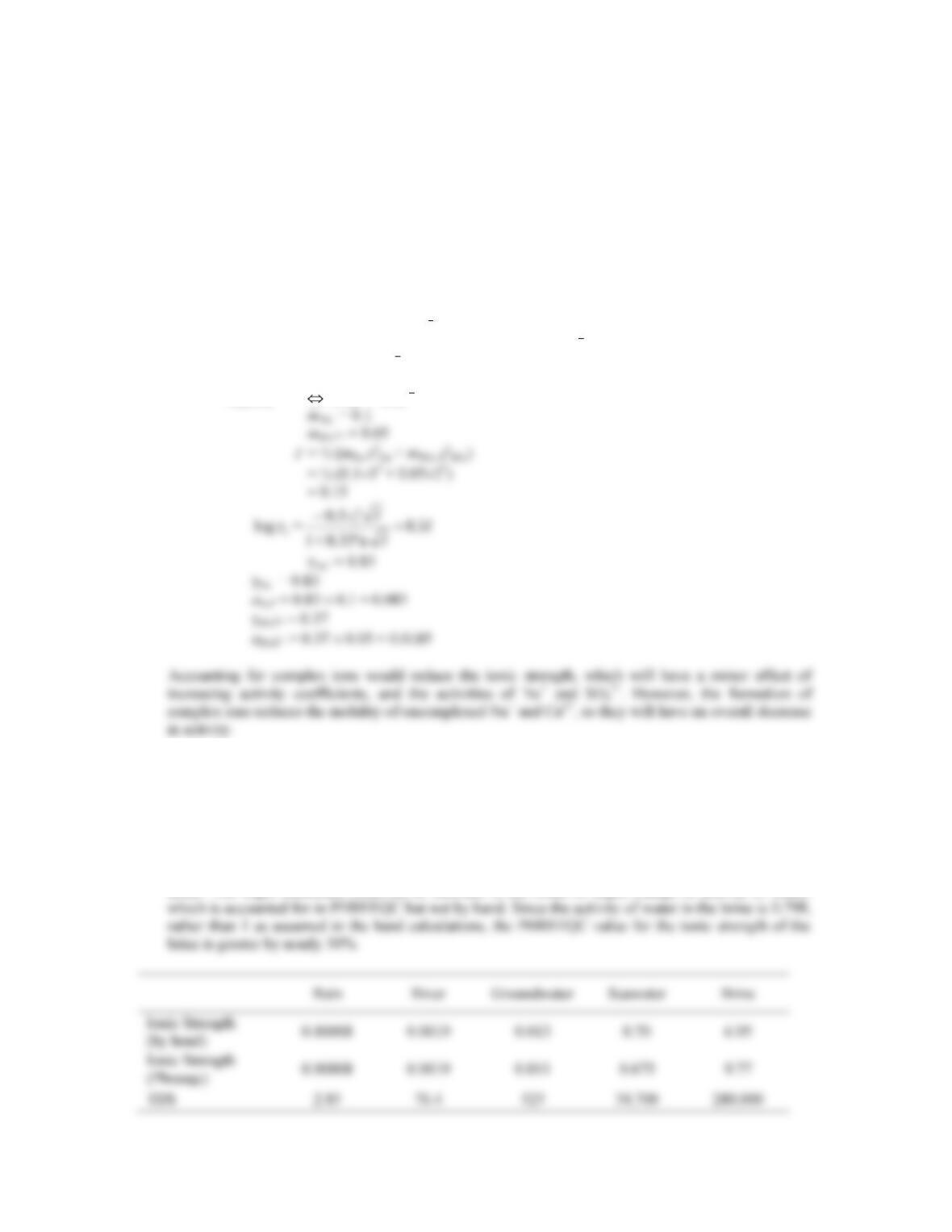
1. Calculate the ionic strength of a 0.05 molal Na2SO4 solution, ignoring the effects of complex ions.
What are the activities of Na+ and of SO4
2?
What would be the effect of any complex ions such as NaSO4 on the ionic strength and on your
calculated activities of Na+ and SO4
2?
Na2SO4 2Na+ + SO4
2
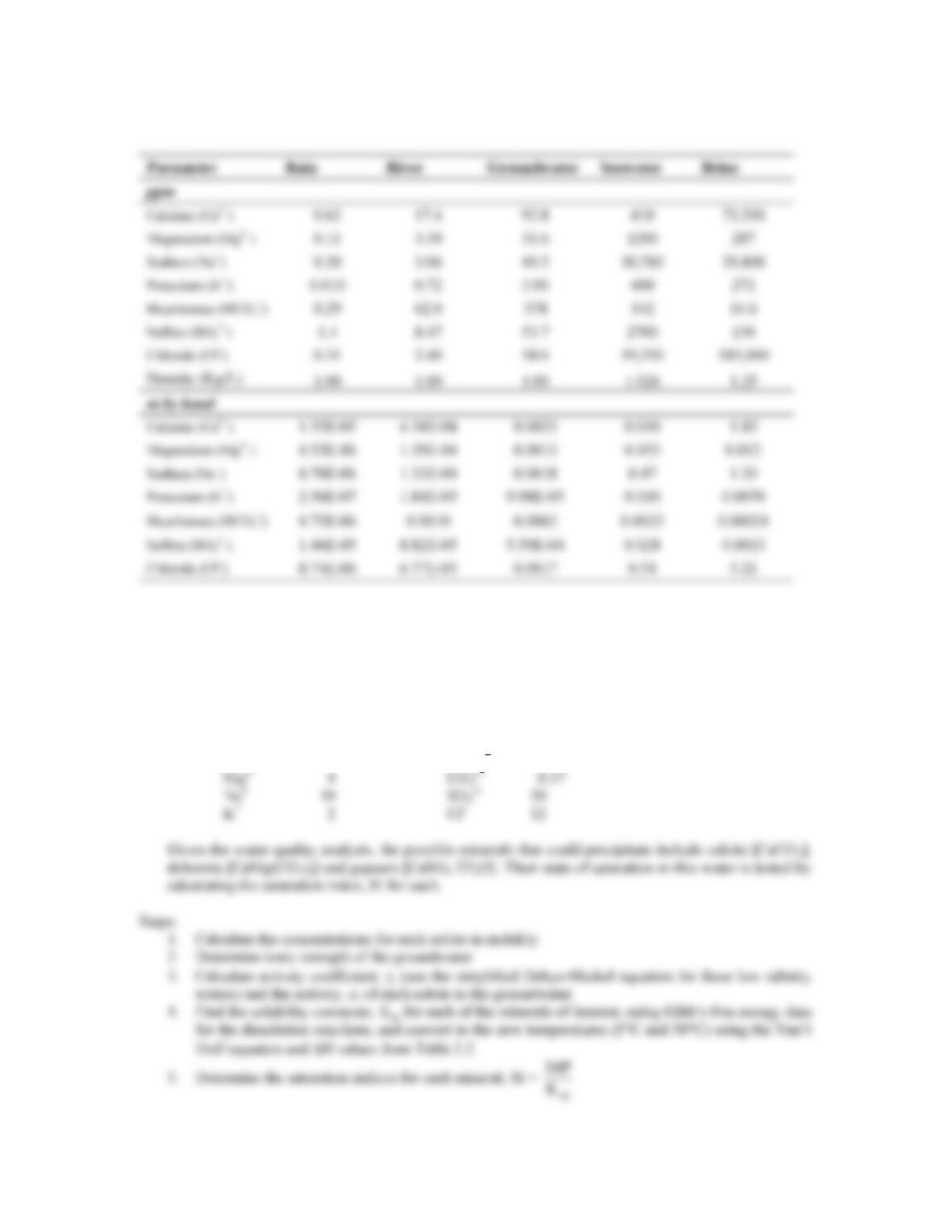
2. Calculate the ionic strength using the major ions for the waters given in Table 1-7 and compare with the
measured TDS. Now use PHREEQC to determine ionic strength of these waters taking into account
complex ions (CaSO4°, etc). How do the values for I, corrected for complex-species, compare with the
hand calculations and with measured TDS? What is the activity of water in the brine sample and what is its
effect on ionic strength?
For the rain, river, and groundwater the ionic strength calculated by hand and in PHREEQC do not
differ. The slight difference observed in seawater is the result of slight change in activity of water,
2
12
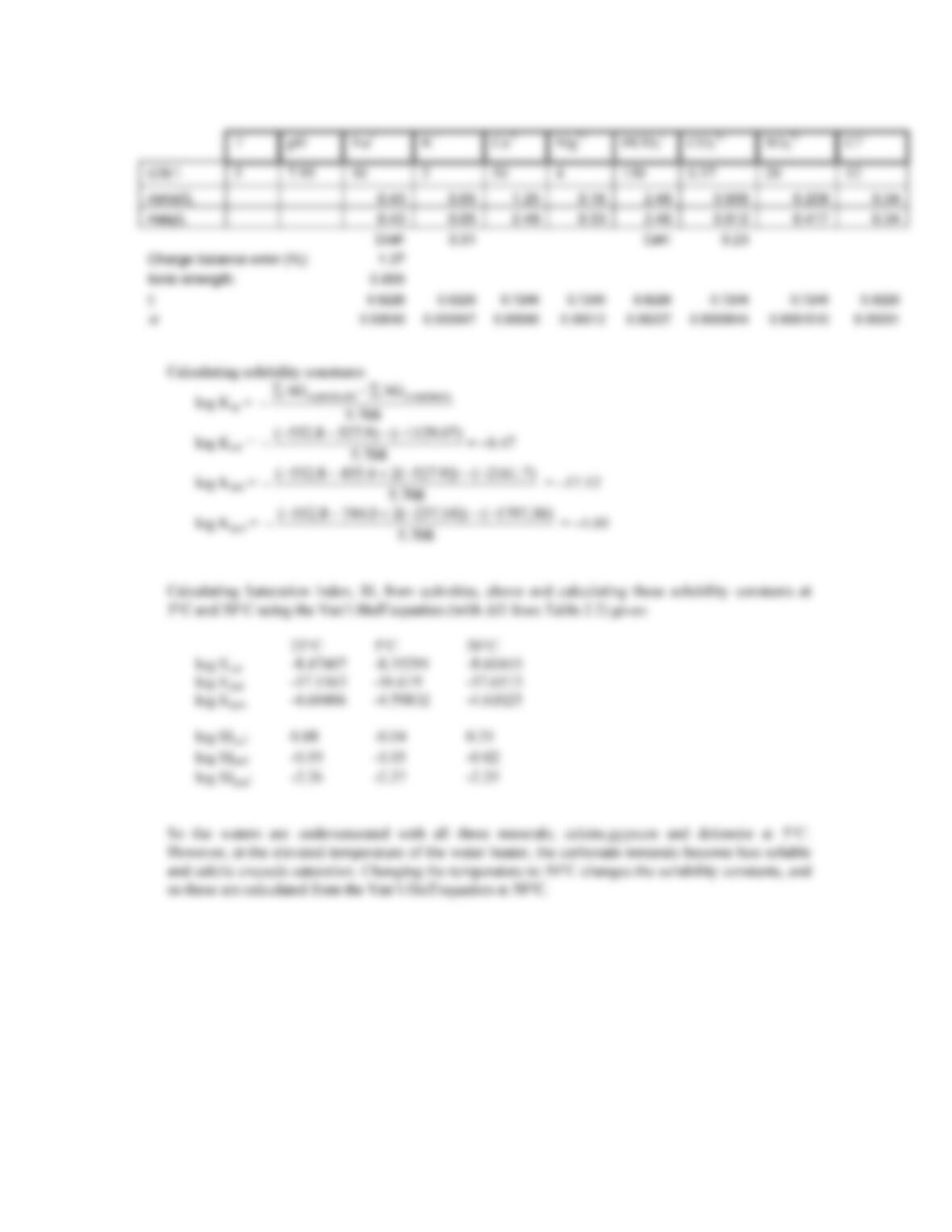
3. The following analysis (concentrations in ppm) comes from groundwater collected during a pump test for a
water well drilled for a new house. Using hand calculations (and the simplified Debye-Hückel limiting law
equation for this low salinity water), determine the saturation indices for calcite and gypsum in this
groundwater? What are their saturation indices at 50°? Will there be a problem of mineral precipitation in
the hot water heater?
Temperature 5°C pH 7.95
Ca2+ 50 HCO3 150
13
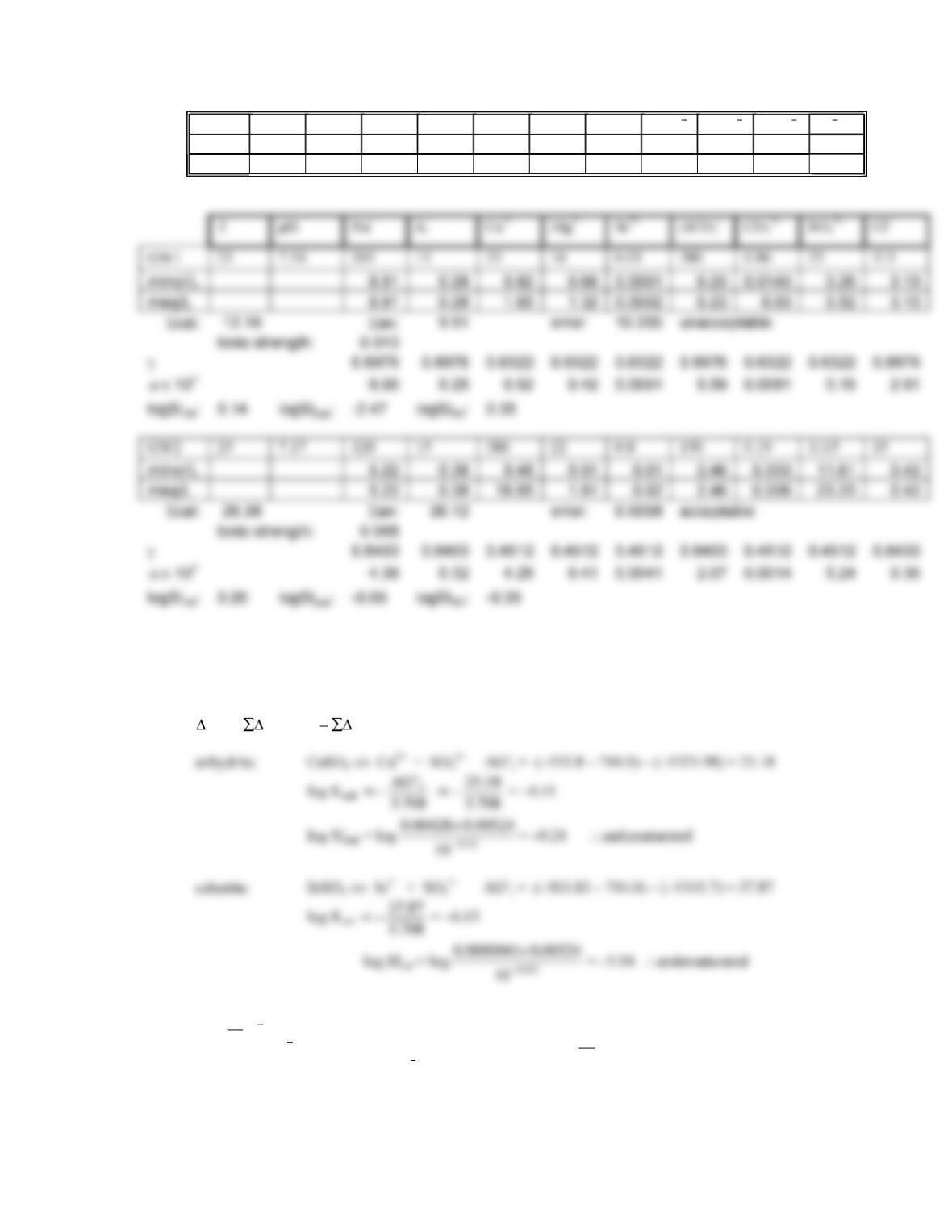
4. For the following groundwater analyses (concentrations in mg/L), determine:
i. meq/L for all cations and anions
ii. the charge balances. Are these acceptable analyses?
iii. the ionic strength, I
iv. the activity coefficients and activities for all ions using the extended Debye-Hückel
v. the saturation state of calcite (Kcalcite = 10-8.47), gypsum (Kgypsum = 10-4.6) and dolomite (Kdolomite
= 10-17.1). Assume that the effects of complex ions are negligible.
14
T pH Na
+
K
+
Ca
2+
Mg
2+
Sr
2+
HCO
3
CO
3
2
SO
4
2
Cl
GW1 25 7.54 205 11 33 16 0.01 380 0.61 25 111
GW2 25 7.40 120 15 380 22 0.8 150 0.10 1115 15
5. Using the data for GW2 in question 4, calculate the solubility products, Ksp, for anhydrite and
celestite. What are the states of saturation of these minerals?
G°r = G°products G°reactants
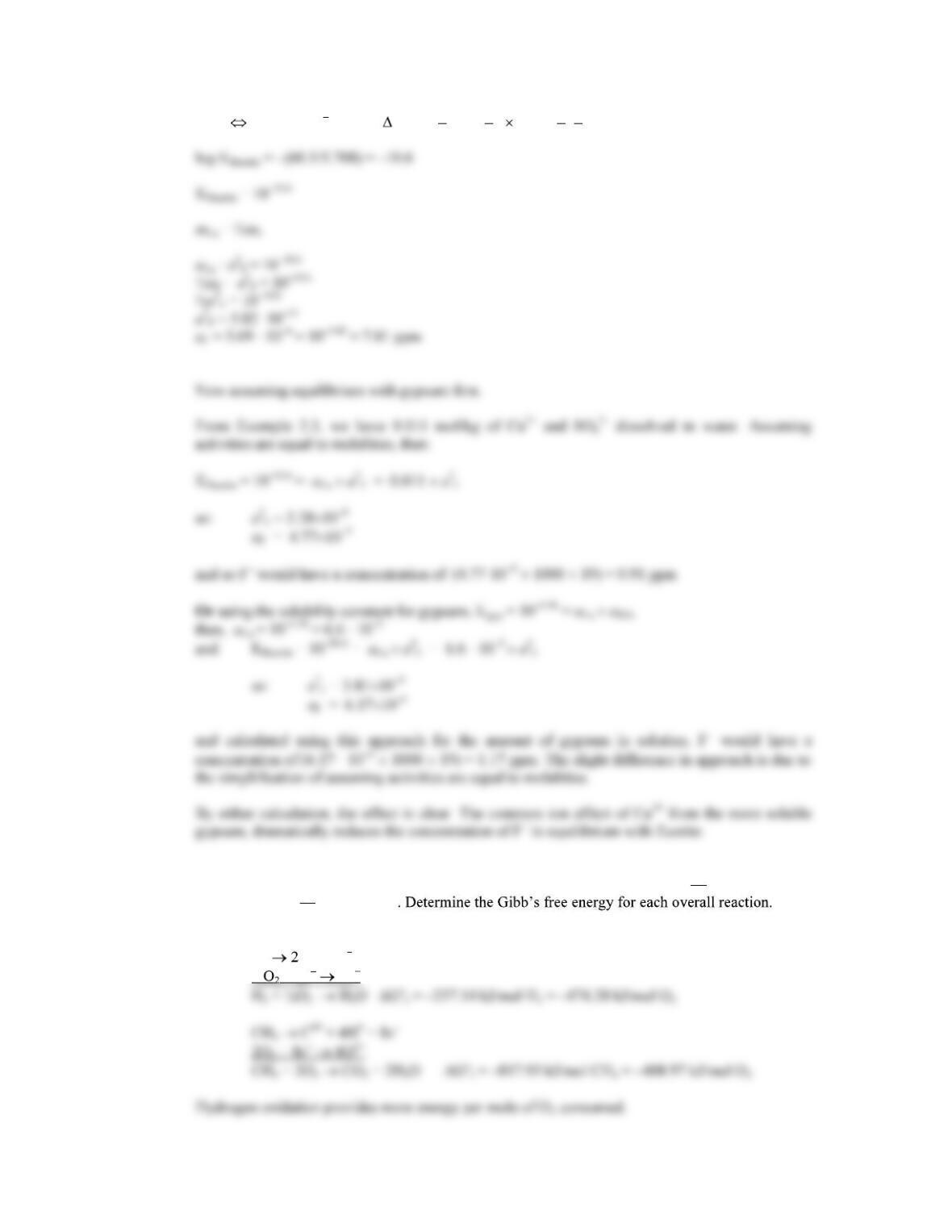
6. Fluoride F is a contaminant in groundwater at concentrations greater than 1 ppm. What is the
concentration of F in a groundwater, which dissolves fluorite CaF2, to the point of saturation?
Now determine the concentration of F when the groundwater first reaches equilibrium with gypsum,
then begins to dissolve fluorite? Assume activities equal molalities.
15
CaF2 Ca2+ + 2F G°r = ( 552.8 2 281.5) ( 1176.3) = 60.5 kJ/mol
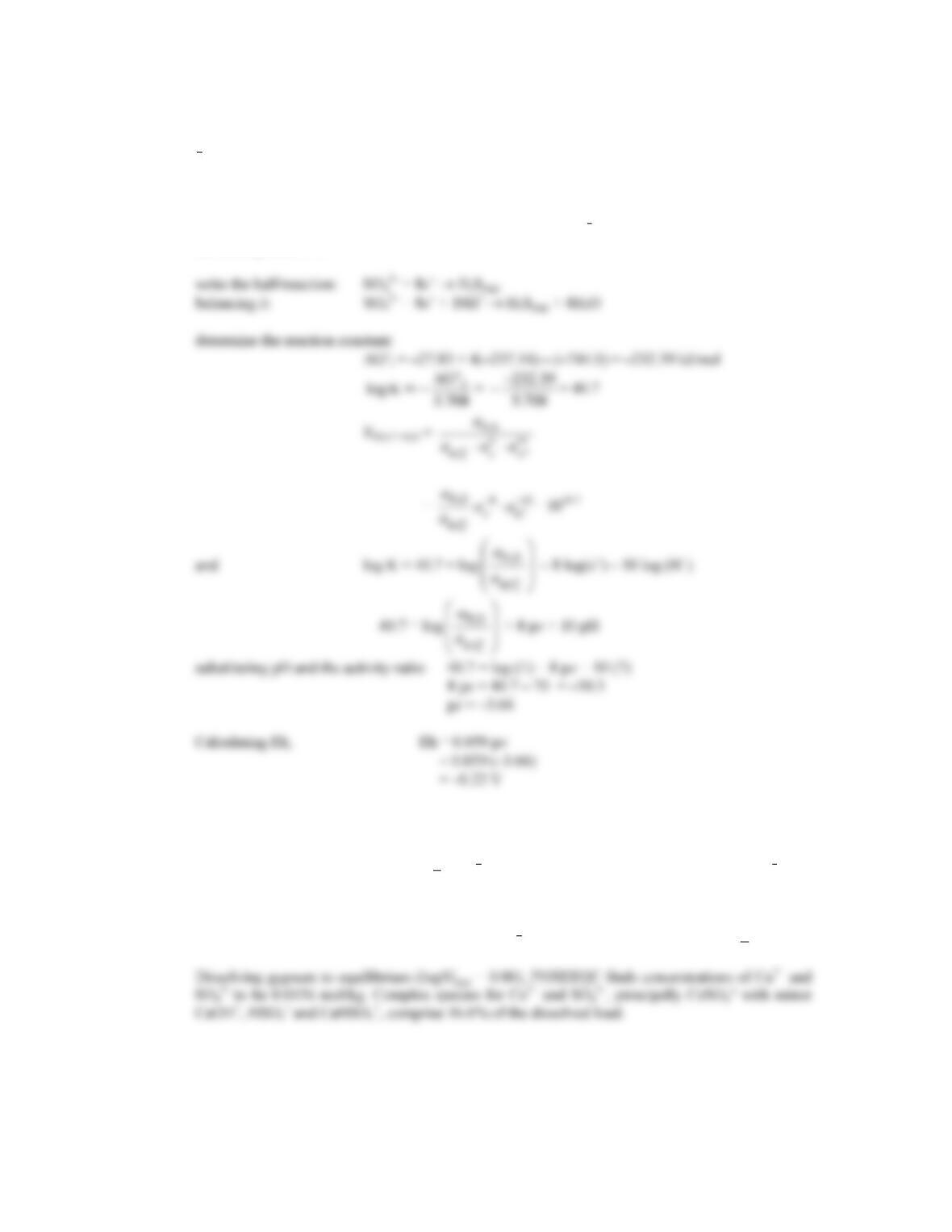
7. Write the two complementary redox half-reactions for (1) the oxidation of hydrogen H2 by O2 and (2)
oxidation of methane CH4, with O2
Which would provide more energy to bacteria, per mole of O2 consumed?
H2 H+ + 2e
½ + 2e O2
16
8. What would be the measured Eh of a solution with pH = 7 that contained equal activities of H 2S and
SO4
2? (hint: begin by finding the pe of the redox half reaction for sulphate reduction)
This solution is the same as in Example 2.6, with the additional calculation of Eh from pe. The
activities of the reduced and oxidized species of the H2S/SO4
2 redox pair are not given, only that
the activity ratio is 1.
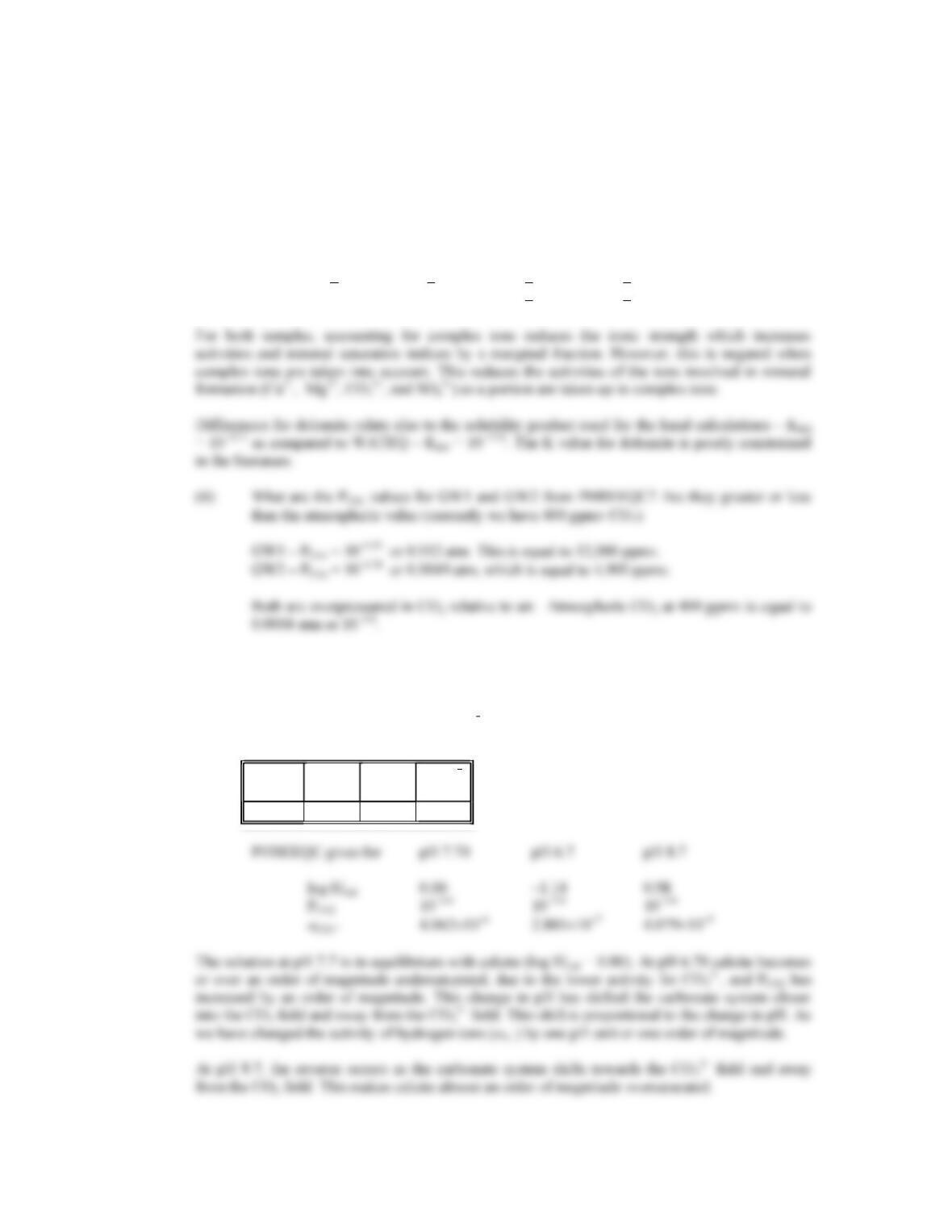
9. In Example 2.3, we calculated that 0.011 moles of gypsum can be dissolved in 1 kg of water. The
effects of complex species were not taken into account. Using PHREEQC, determine (i) the state of
saturation for gypsum in a 0.011 m Ca2+ SO4
2 solution and (ii) the moles of Ca2+ and SO4
2
in a
gypsum saturated solution. Compare the hand calculations with the PHREEQC output and account for
the difference. List the complex species in solution and determine their contribution.
Using a concentration of 0.011 m for Ca2+ and SO4
2, PHREEQC gives a log SIgypsum = 0. 20.
17
10. Use PHREEQC to determine the speciation for the geochemical analysis of GW1 and GW2 in question
4 above.
(i) How do the computed saturation indices for calcite, gypsum and dolomite differ from the
hand calculations in Question 4. Suggest reasons why they may differ?
GW1
Hand
calculation
GW1
PHREEQC
GW2
Hand
calculation
GW2
PHREEQC
Calcite 0.14 0.01 0.26 0.35
Gypsum 2.47 2.56 0.05 0.26
Dolomite 0.35 0.05 0.35 0.21
11. Geochemical speciation and mineral solubility codes are useful for demonstrating the effects of pH on
carbonate solubility. For the carbonate spring water here, determine first the saturation of calcite,
noting the PCO2 and the carbonate activity, aCO32 Now rerun the analysis with a pH that is one unit
higher and again at pH one unit lower, but first predict the effect on calcite solubility and on PCO2.
T°C pH Ca
2+
mg/L
HCO3
mg/L
15 7.70 48 150
18
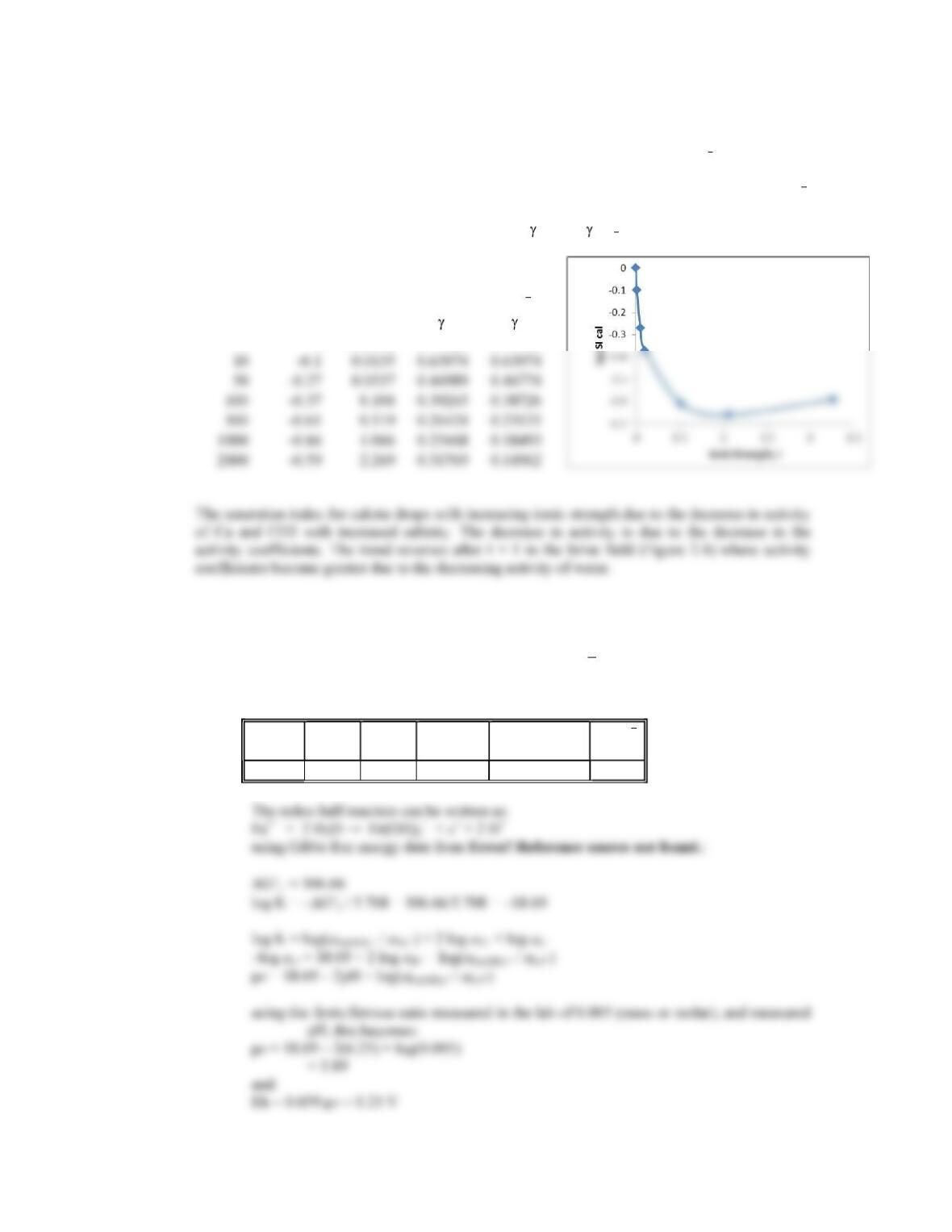
12. Test the effects of ionic strength on mineral solubility with PHREEQC, by running the calcium–
bicarbonate groundwater in Question 10 ( Ca2+ = 48 mg/L or 1.2 mmol/L and HCO3 = 150 mg/L or
2.46 mmol/L) with increasing concentrations of dissolved halite. Run the program with successive
additions of Na and Cl, by specifying 10, 50, 100, 500, 1000 and 2000 mmol/L for Na+ and for Cl .
From the results, plot the logSIcalcite values with increasing ionic strength, I. What happens to the
saturation of calcite and why? Note as well the change in Ca2+ and CO32.
mmo
l
NaCl
log SI
cal I
Ca2+
CO3
2
0
0
0.00351
0.77983
0.77983
13. An iron titration was performed on deep groundwater and found to contain the following
concentrations of ferrous and ferric iron. Calculate the pe and Eh of this groundwater by hand
calculations, using the dominant species for ferric iron at that pH i.e. Fe(OH)2
+, then compare with
the calculations made by PHREEQC using the Fe3+/Fe2+ redox option. Note the distribution of ferric
and ferrous iron and confirm that Fe(OH)2
+ and Fe2+ are the dominant species.
T°C pH Ca
2+
ppm
Fe
2+
total
ppm
Fe
3+
total
ppm
HCO3
ppm
25 6.25 48 1.0 0.005 150
19