1
Daisyworld: An Introduction to Systems
Learning Objectives
After reading this chapter, students should be able to:
• Understand what the essentials of systems are
• Know how the components of systems interact with each other
• Describe the concept of a “feedback” both positive and negative
• Know how positive and negative feedback loops affect the equilibrium states of the
system
• Know how we can learn about climate systems in general by studying the
hypothetical planet Daisyworld
• Know how forcings in the daisyworld system affect albedo
• Know how albedo affects climate
Review Questions
1.) A perturbation that causes a decrease in component A leads to a decrease in
component B. Is the coupling between these two components positive or
negative?
2.) What is a feedback loop?
3.) Why do negative feedback loops tend to diminish the effect of disturbances?
For simplicity, consider a two component system linked by a positive and a
CHAPTER
2
2
4.) What distinguishes a forcing from a perturbation?
5.) Are all equilibrium states stable? Why or why not?
6.) What is albedo? How does it influence climate?
7.) How are daisies on Daisyworld able to regulate the hypothetical planet’s
temperature?
Critical Thinking Problems
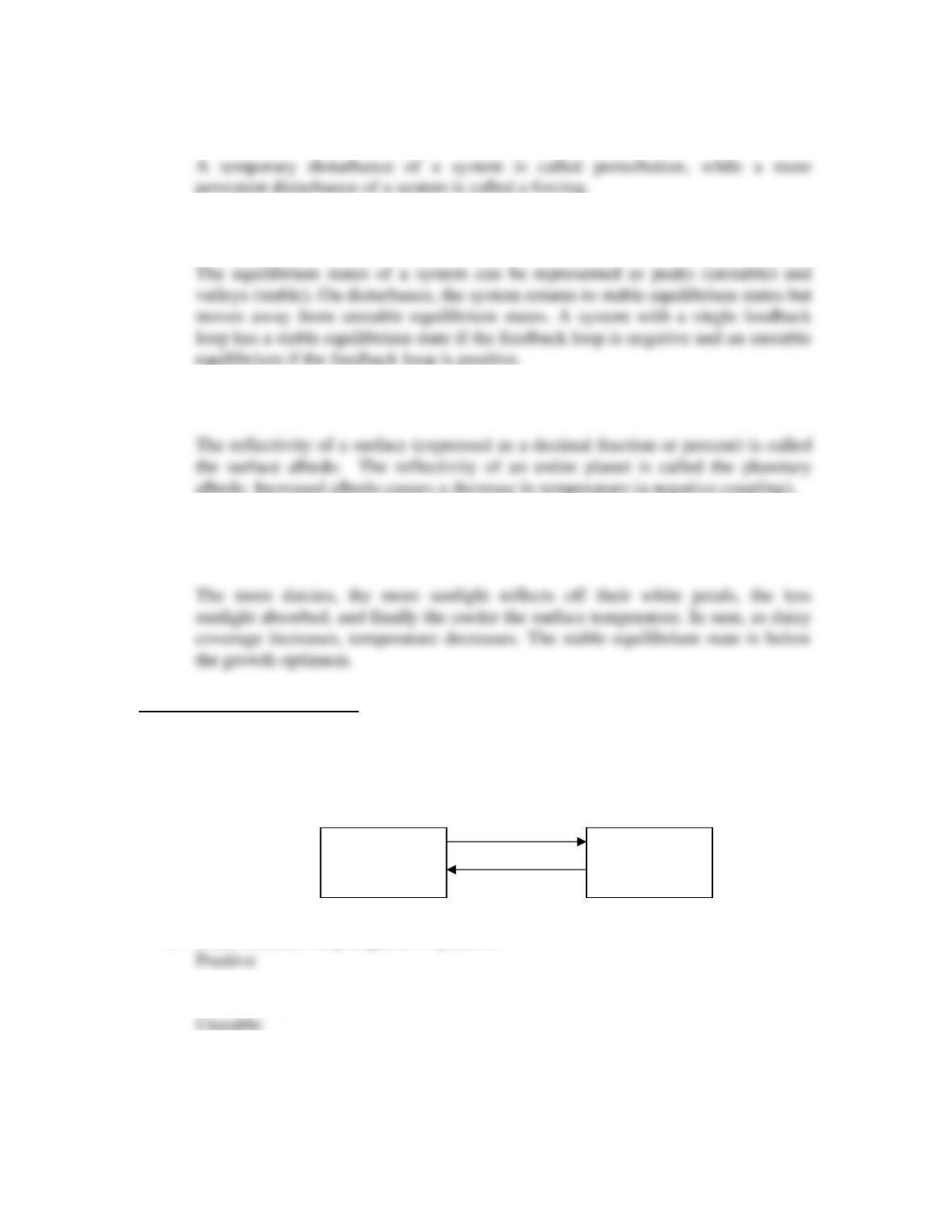
1.) In the Dysfunctia family, when the children get noisy, the parents get mad. When
the parents get mad, the children get noisy. Draw a systems diagram for the
Dysfunctia family.
a. Is the feedback loop negative or positive?
b. Is the family stable or unstable?
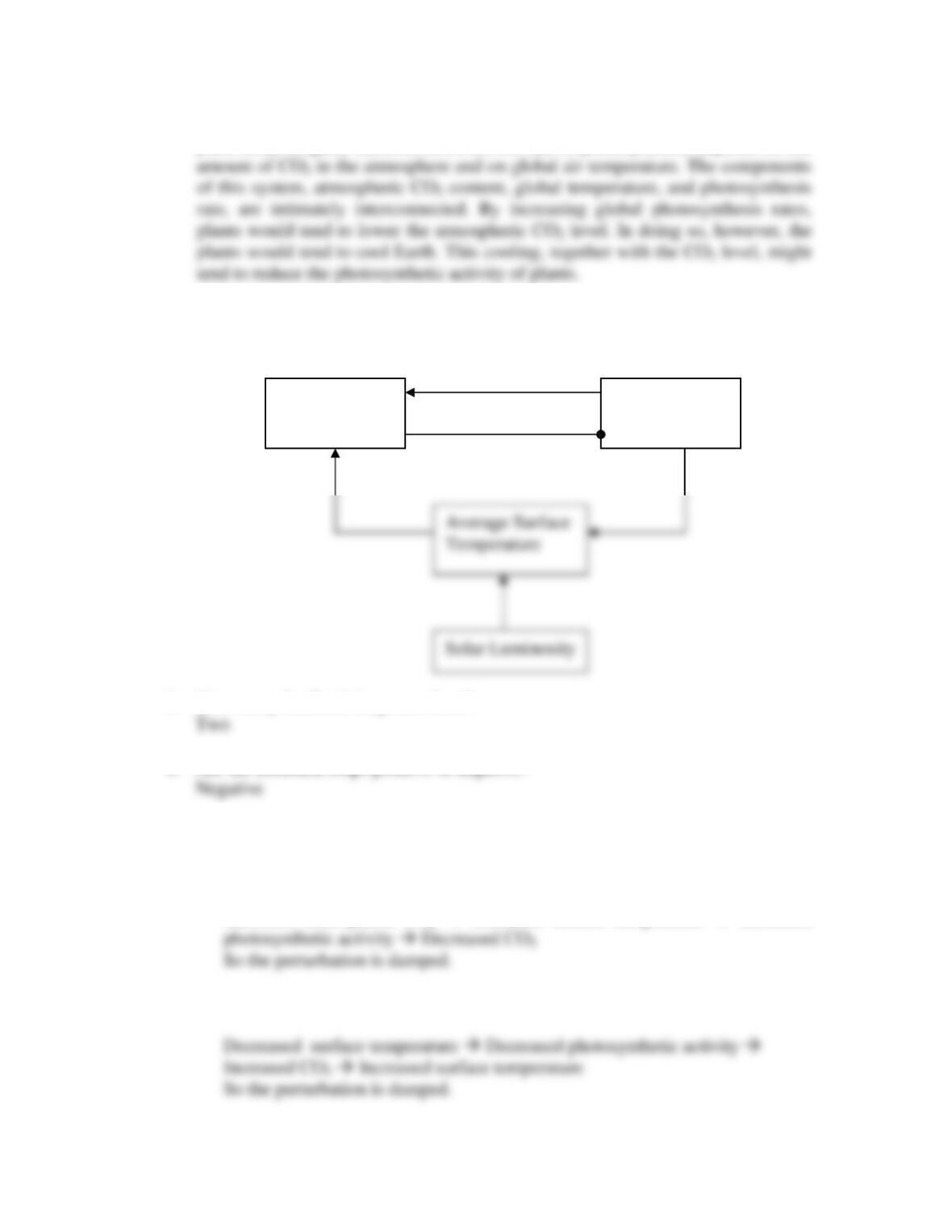
2.) Earth’s average temperature is determined in part by the amount of CO2 in the
atmosphere, by way of the greenhouse effect. The atmospheric CO2 content may
Children Get
Noisy Parents Get
Mad
(+)
3
in turn be affected by photosynthetic activity of plants, which convert CO2 into
plant tissue (organic carbon); however, the rate of photosynthesis depends on the
a. On the basis of this discussion, draw a system diagram of the photosynthetic rate-
CO2 –temperature system.
b. How many feedback loops are there?
c. Are the feedback loops positive or negative?
d. Describe the response of the system to the following perturbations:
(i) An increase in atmospheric CO2
Increased atmospheric CO2 Æ Increased surface temperature Æ Increased
(ii) A decrease in temperature
photosynthetic
rate
CO2
(-)
(-)
4
e. Extra credit: How might the system respond to a continued forcing–an increase in
solar luminosity through time?
3.) Daisyworld has a companion planet that is similar in all ways except that the
daisies are black.
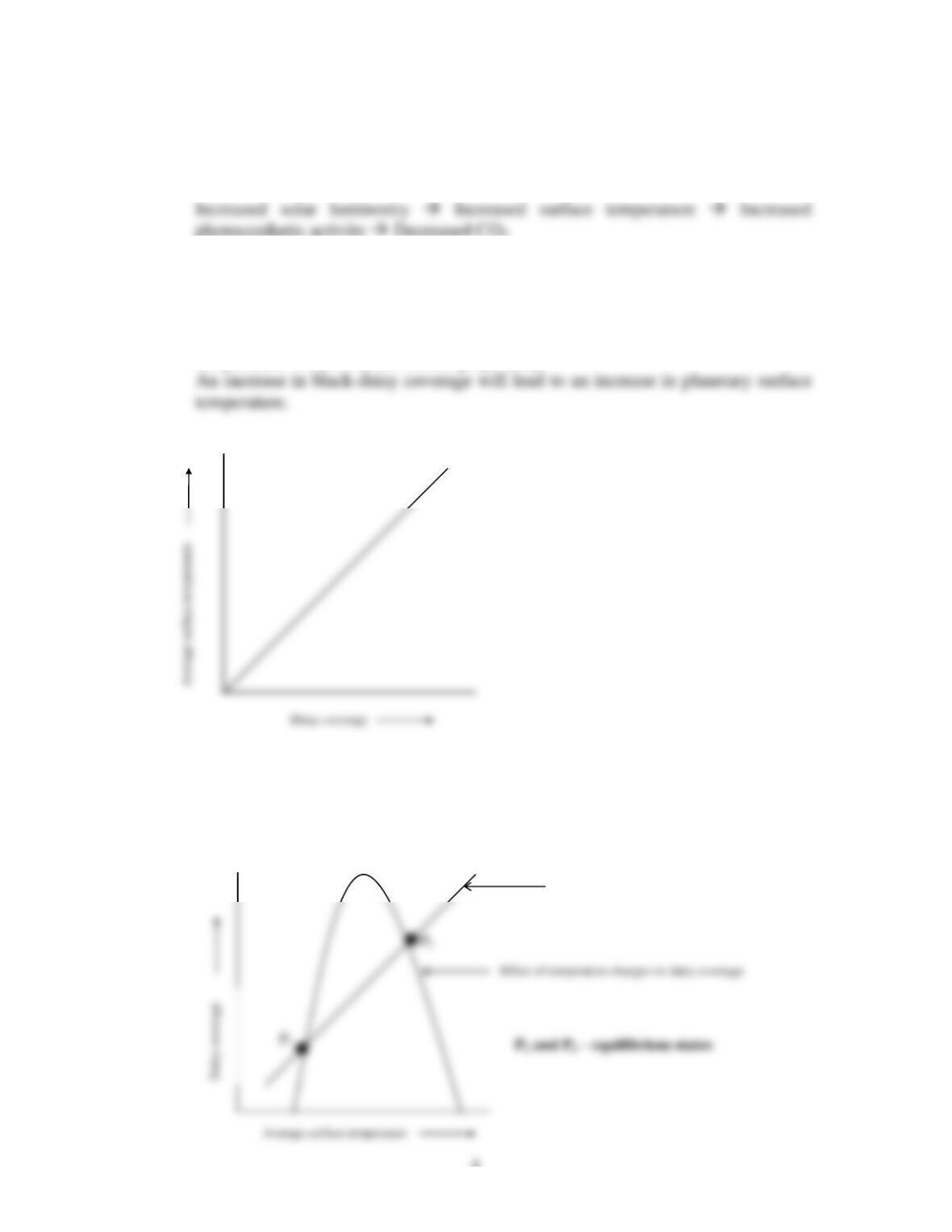
a. What is the effect of an increase in black-daisy coverage on planetary
temperature? Express your answer graphically.
b. Assuming that the effect of temperature on daisy coverage is the same on black-
daisy Daisyworld as on white-daisy Daisyworld, draw a stability diagram–a
diagram analogous to Figure 2-10 – for black daisy Daisyworld. Include two
equilibrium states.
Effect of changes in daisy coverage on temperature
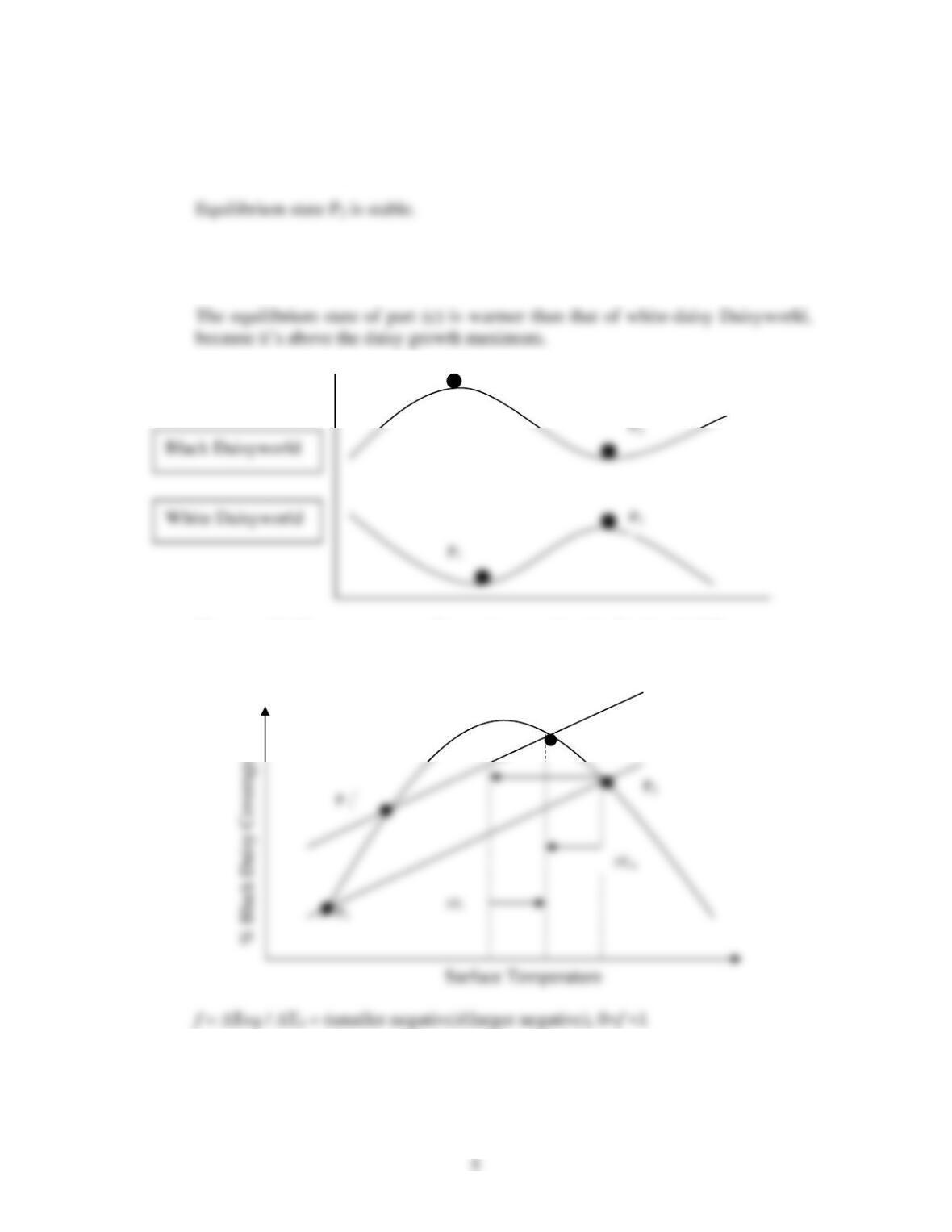
c. Which of the two equilibrium states in part (b) is stable?
d. Is the stable equilibrium state of part (c) cooler or warmer than that of white-daisy
Daisyworld?
The equilibrium state of part (c) is warmer than that of white-daisy Daisyworld,
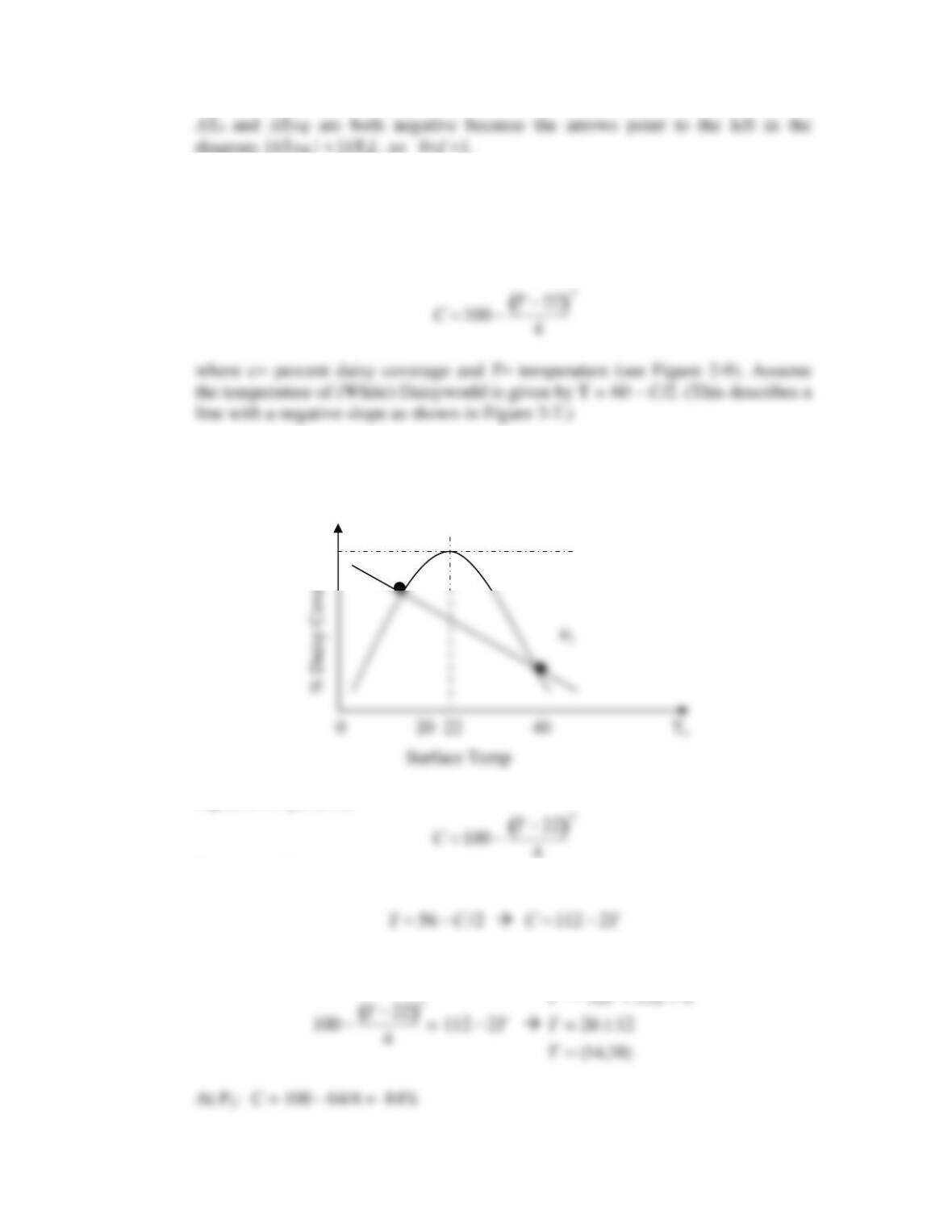
answer graphically and in terms of the feedback factor.
f. Is f of part (e) greater than or less than 1?
P1
P 2
/
Δ
T0
6
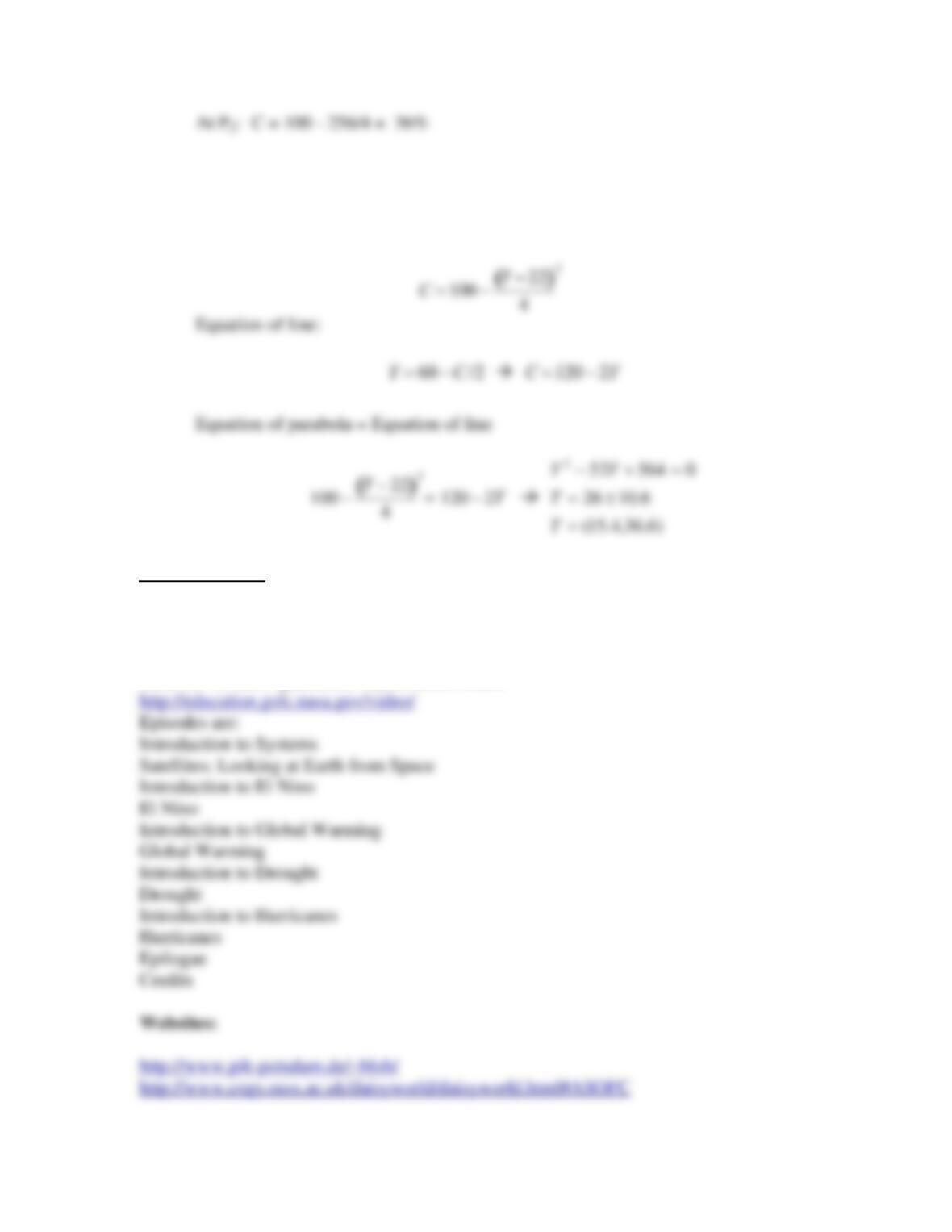
4.) Real daises have an optimum growth temperature of 22 oC and they go extinct at
temperatures 20 oC warmer or colder than this value. Let’s assume that they cover
100% of Daisyworld at their optimum growth temperature. A parabola that
describes this mathematically is:
a. Combine these equations and solve for the equilibrium solution, i.e., the values of
c and T that satisfy both equations. How many solutions are there? Which solution
is stable?
Equation of parabola:
Equation of line:
Equation of parabola = Equation of line
2
P
1
7
b. Suppose that the Daisyworld Sun brightens so that temperatures increase by 4
degrees for daisy coverage of 0%, i.e., T = 60 – C/2. What are the solutions in this
case?
Equation of parabola:
Resource Guide
Video/Films:
Earth Systems Science Video
Series of 12 short Quicktime videos from NASA

8
Literature:
Watson, Andrew J. and J. E. Lovelock. “Biological homeostasis of Daisyworld,” Tellus
35B, 1983, pp. 284-289.
Lovelock, James E. The Ages of Gaia: A Biography of Our Living Earth. Norton, 1988.