Climate Stability on Earth and Earthlike Planets
Learning Objectives
After reading this chapter, students should be able to:
• Realize how the Sun and the Earth’s atmospheric composition have evolved over
timescales of billions of years.
• Know what the habitable zone of a star system is.
• Explain why Venus and Mars do not have liquid water at their surface.
• Know what the significance of the CO2 compensation point is.
• Describe how Venus developed a runaway greenhouse.
• Describe how Mars lost most of its atmosphere and surface water.
• Realize that astronomers have discovered over 100 extrasolar planets.
• Know how the continuously habitable zone is defined.
• Know what the Drake equation is, and be able to discuss the variables in the Drake
equation.
• Recognize how dependent the Drake equation is on the lifetime of advanced
civilizations.
• Understand the long-term threats to life and advanced civilization on Earth.
Review Questions
1.) How should future solar evolution affect climate and life here on Earth?
As the sun ages, it becomes brighter. This results in a higher incoming solar flux
at Earth orbit. The carbonate-silicate cycle dictates that this higher solar flux will
2.) What is the evidence that Venus once possessed more water than it does today?
How did it lose its water, and how did its atmosphere evolve afterward?
CHAPTER
19
2
3.) What is the evidence that Mars was warmer and wetter in the past? Why did
Mars cool off over time, even though the Sun has become brighter?
4.) How is the habitable zone around a star defined?
5.) What is the relationship between the instantaneous habitable zone and the
continuously habitable zone around the Sun? How wide are these zones thought
to be?
6.) Why are bright, blue stars and dim, red stars not good candidates for supporting
habitable planets?
For dim, red stars, the habitable zone typically exists within the tidal locking
radius of the star, which forces the same side of a planet in the habitable zone to
3
7.) What factors in the Drake equation are we capable of estimating today?
We can estimate Ng, the number of stars in a galaxy; fp, the fraction of stars that
8.) How do we know that planets exist around other stars? How many such planets
have been detected to date?
We have witnessed the effects of extrasolar planets on their parent stars, both in
9.) How might the presence of life on another planet be inferred from the
composition of that planet’s atmosphere?
Detection of a gas or series of gases at a level which cannot exist outside the
10.) What factors might limit the lifetime of a technological civilization? Could any
of today’s global environmental problems (global warming, ozone depletion,
and loss of biodiversity) destroy our technological society?
Although all these issues pose serious problems for society, none of them seem
Critical-Thinking Problems
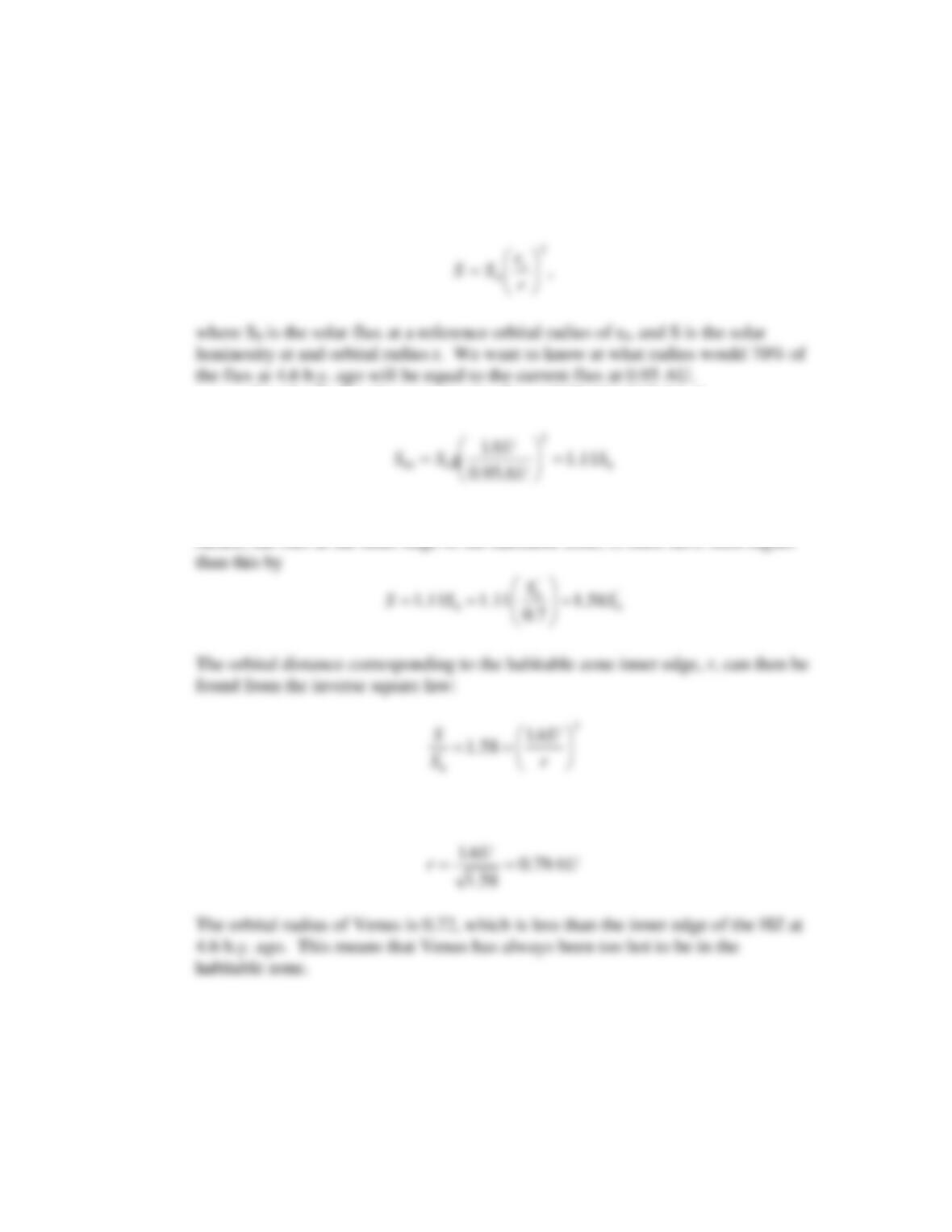
1.) The inner edge of the HZ is currently estimated to be at a distance of 0.95 AU
from the Sun. Where would it have been 4.6 b.y. ago when solar luminosity was
4
about 70% of its present value? Would Venus, which orbits the Sun at a distance
of 0.72 AU, have been made inside or outside this critical distance? (Hint:
Remember the inverse-square law from Chapter 3.)
The inverse square law from chapter 3 tells us that:
Start by finding the present solar flux at 0.95 AU. Call this S95:
At 4.6.b.y. ago, the solar flux at 1 AU, S0’, was lower than S0 by a factor of 0.7.
Hence, the flux at the inner edge of the habitable zone, S, must have been higher
Or, solving for r:
2.) How long do you think our present, technological civilization will last, and what
factor (or combination of factors) do you think will bring it to an end? Write a 1-
to 2-page essay defending your opinion.
This, of course, is an opinion piece.

5
Resource Guide
Videos/Films:
Exodus Earth VHS
Discovery Channel
This video discusses the ways in which civilized life on Earth could end, and the
things humanity can and must do to avoid extinction (50 minutes)
Cosmic Safari VHS
Discovery Channel
This video considers alien life forms and how they might be affected by the
conditions of their home planet. This program is good for showing how changes to a
planet’s conditions might affect the biota that inhabit the planet (50 minutes).
Life Beyond Earth
Discovery Channel Store
Overview of astrobiology – covers evolution of life, life in extreme environments,
and the possibility of life existing on planets other than Earth (50 minutes).
Earth: A Special Case
Films for the Humanities and Sciences
Websites:
Internet Resource Guide for astrobiology

6
The European Space Agency’s Website for Project Darwin, a mission to send a