Human Threats to Biodiversity
Learning Objectives
After reading this chapter, students should be able to:
• Realize where species loss is occurring, how it is occurring, and why it is important
to society
• Understand the uncertainties in measuring and estimating rates of extinction.
• Realize that despite these uncertainties, species loss is currently occurring at a high
rate
• Realize that ecosystem loss is also occurring, perhaps due to the loss of keystone
species
• Know some of the evidence for human-induced extinctions and the human activities
that are thought to cause extinction
• Realize that some ecosystems are more resilient than others to extinctions
• Understand some of the secondary consequences of tropical deforestation
• Understand why some developing nations benefit from forest exploitation
• Comprehend the concept of extinction hotspots, and recognize some of the trends in
hotspot location
• Realize that species loss is occurring in the oceans as well, and that the coral reef
ecosystem is in danger of going extinct
• Realize the intrinsic and extrinsic values to biodiversity
• Realize what some of the consequences of a loss of diversity could be for society
Review Questions
1.) Explain why it is difficult to give an accurate count of the number of species that
go extinct each year.
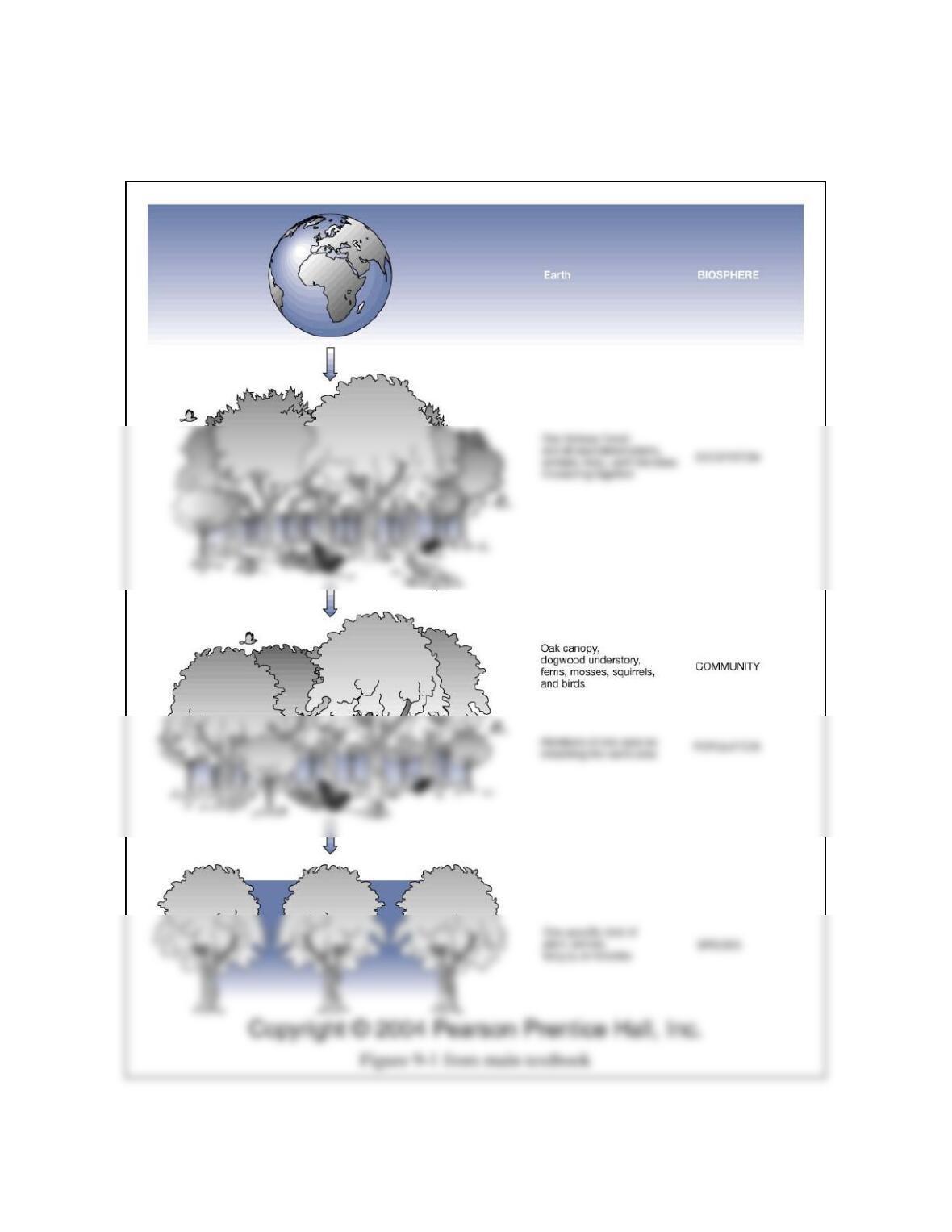
2.) Use a diagram to help explain the relationships among ecosystems, communities,
and species.
CHAPTER
18
2
Figure 9-1 is a good figure to help explain this. Species interact in one particular
area to form communities, and interact on a larger scale with a greater variety of
organisms to form ecosystems.
3.) What is meant by the term habitat? Explain its importance to issues of
biodiversity and extinction.
The habitat of an organism is the physical, chemical, and biological conditions
4.) What is meant by the term keynote species? Explain why it is important to issues
of biodiversity and extinction.
A keynote species is a species whose survival is essential to the success of the
6.) If a large area of temperate forest is cleared, it can commonly grow back fairly
rapidly to something that closely resembles the original forest. If a large area of
tropical forest is cleared, regrowth is slow and the original forest cover may never
return. Explain why these forests respond differently to clearing.
The fast nutrient recycling that occurs in the tropical forests and the heavy rainfall
7.) Describe three consequences of tropical deforestation other than loss of
biodiversity.
Deforestation leads to an increase in albedo, increased runoff, and decreased
8.) List four social and economic factors that contribute to tropical deforestation.
Growing populations, unequal distribution of land amongst people, resettlement
4
10.) What is meant by the instrumental and intrinsic values of species?
11.) Explain why lack of diversity in food crops might present problems for the
world food supply.
Due to genetic engineering of crops, there is little biodiversity in cash crops
12.) Why is there a relationship between biodiversity and the long-term health of an
ecosystem?
In a diverse ecosystem, the extinction of one species will leave a role in the
13.) Explain the difference between Ehrlich’s rivet theory and Walker’s theory of the
importance of biodiversity.
Ehrlich’s theory states that all species are fairly equal in their importance to the
ecosystem and the ecosystem will fail after the removal of species places a
Critical-Thinking Problems
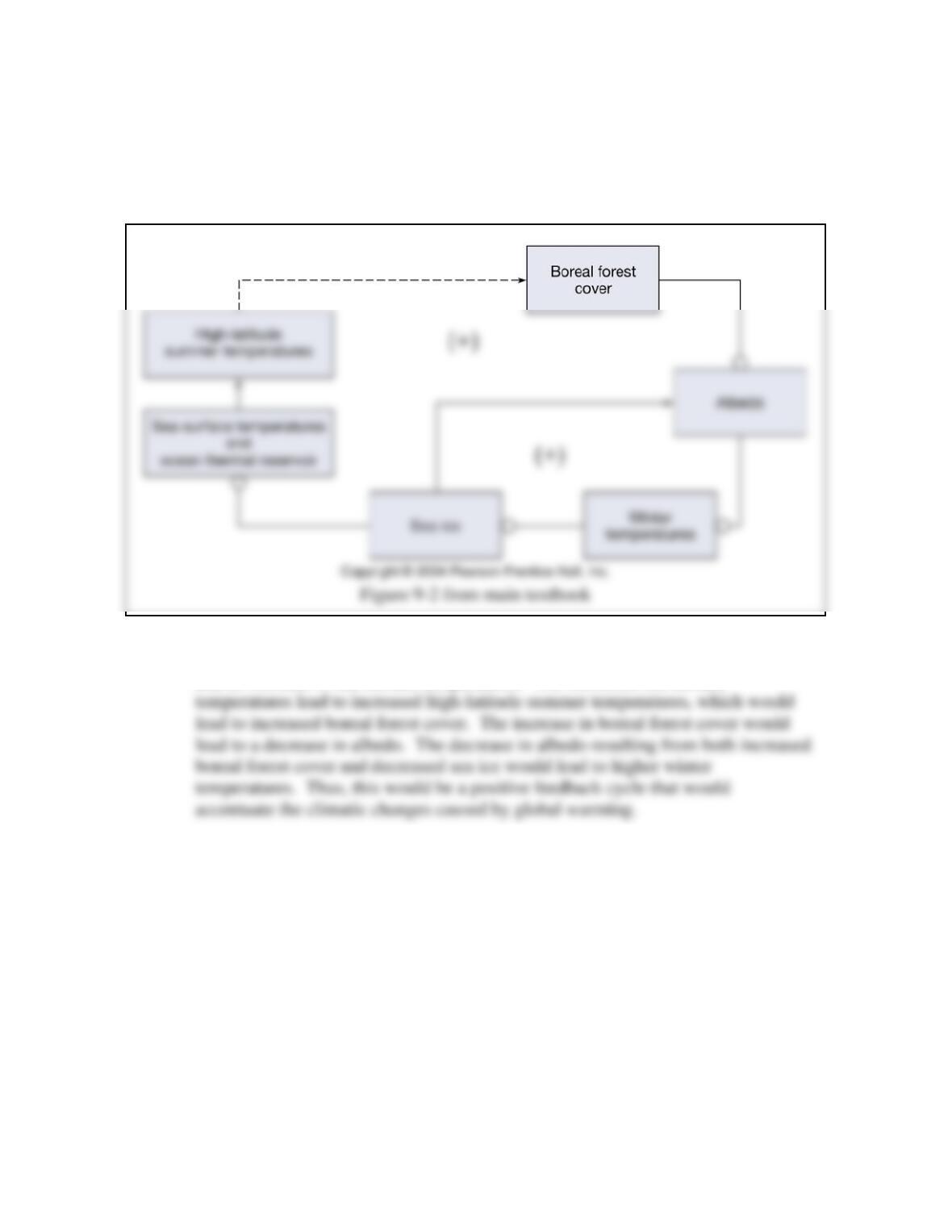
1.) Figure 9-2 presents a systems diagram of the feedbacks involving boreal forest
cover, albedo, temperatures, sea ice, and the oceans. We used this diagram to
5
show that it is possible for the northern boreal forest to have a significant impact
on the larger-scale climate. Using the information you now have about the
possible impacts of anthropogenically induced greenhouse climate change,
expand on this diagram and discuss the implications in terms of climate and forest
cover.
Let us assume that the greenhouse changes lead to increased winter temperatures.
This would lead to a decrease in sea ice, which would lead to a decrease in albedo
and an increase in sea-surface temperatures. The increased sea surface
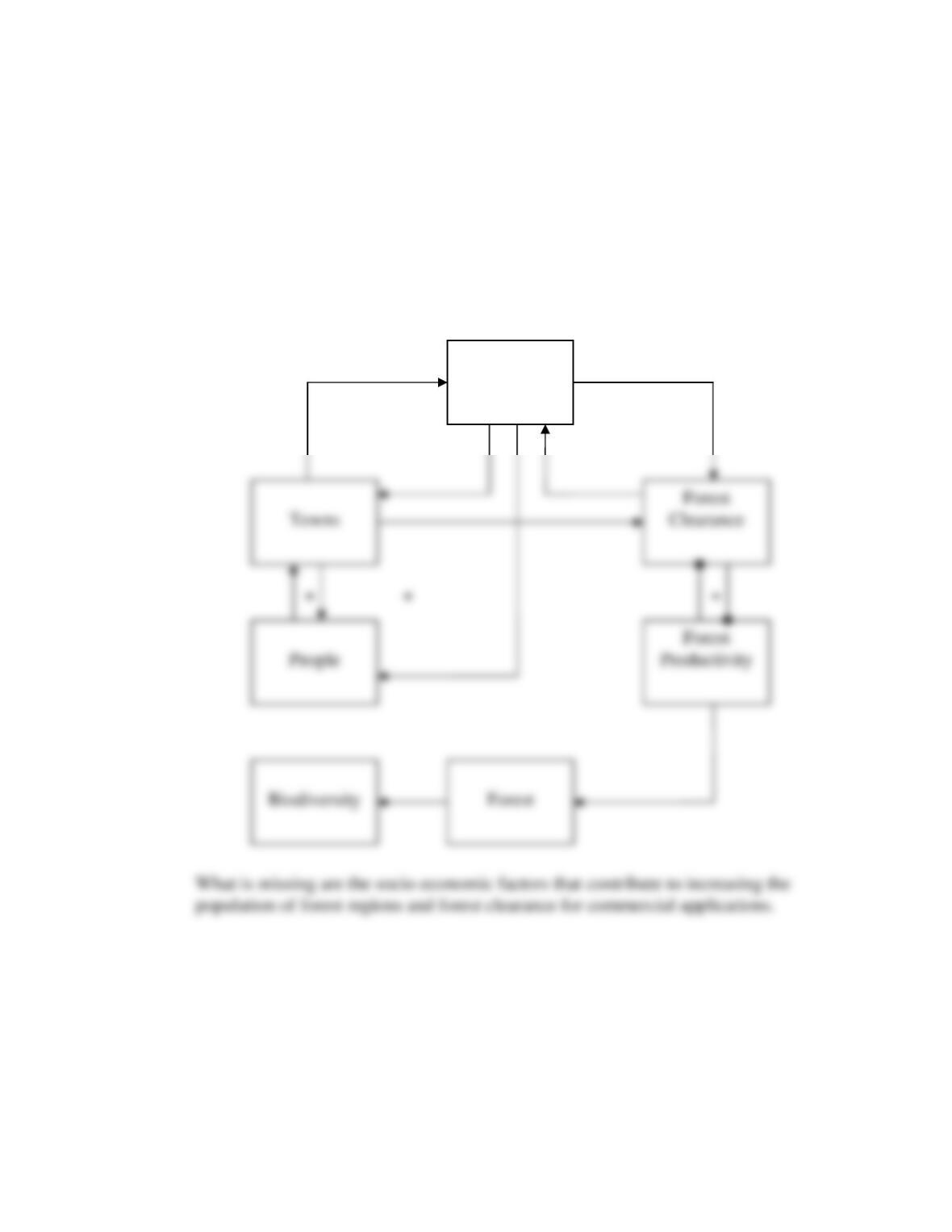
2.) Consider the following set of statements for a situation in the tropical forest where
forest is cleared for crops:
• Forest clearance requires access to the forest (roads).
• An increasing population requires access to services and commodities (a town
or city).
• Settlements require roads.
• Construction and forest clearance are easier (may increase) if roads are present.
• The presence of roads and settlements attracts more people into the region.
• Forest clearings rapidly lose productivity, requiring more clearing.
• Clearing results in loss of biodiversity
6
Take these statements as a minimum; you might think of some other conditions or
relationships that could also be included. Construct a systems diagram showing
how the statements all intersect. Describe what the diagram shows. Are any
feedback loops present? If so, are they positive or negative? Is this a useful way
of looking at some of the forces that promote deforestation? Is anything missing
that you think should also be taken into account?
There are a number of components to this system: roads, forest, towns, people,
forest productivity, and biodiversity. Let’s see how they connect:
3.) What would happen to atmospheric oxygen if photosynthesis were to shut off
suddenly? Photosynthesis is the source of most of the O2 in the atmosphere, so it
is reasonable to guess that O2 would decline. Analyze how it would do so by
performing the following calculations:
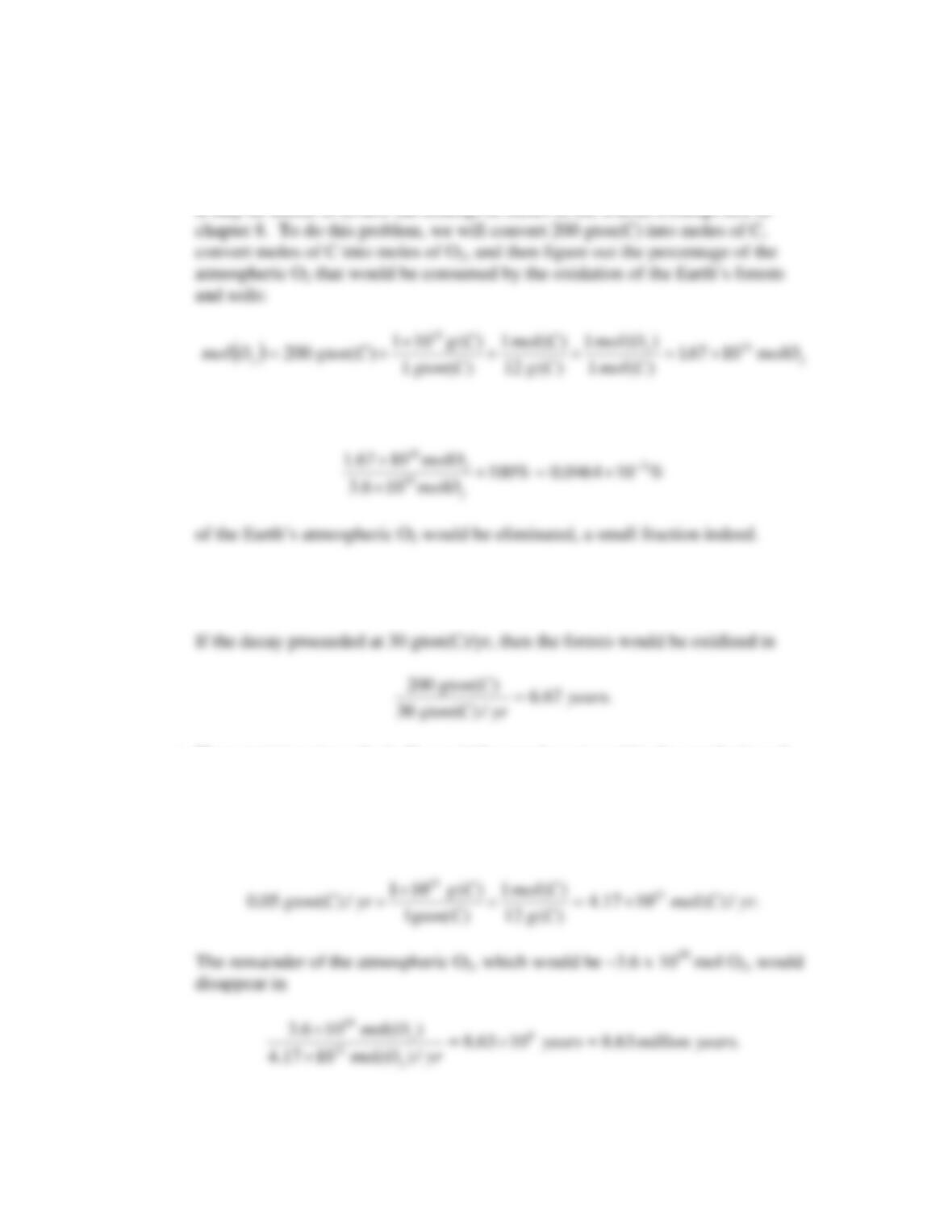
a. Forests and soils together contain about 200 Gton of carbon. The amount of
carbon stored in the living marine biomass is negligible in comparison. The
atmosphere contains 3.6 x 10¹⁹ moles of O2. By what percentage would
Roads
+
+
7
atmospheric O2 decrease if Earth’s biota were to die suddenly and if the forest and
soil organic carbon were to be oxidized? (Hint: Remember that in the decay of
organic mater, 1 mol of carbon reacts with 1 mol of O2.)
It may be useful to review the concept of moles in the Useful Concept box in
Thus,
b. Approximately how long would this process take? Assume the decay proceeded
at the modern rate of 30 Gton/yr.
c. The remaining atmospheric O2 would have to be removed by the weathering of
kerogen and other reduced minerals (iron and sulfides) in rocks. Kerogen is
weathered at a rate of 0.05 Gton(C)/yr. Express this rate in terms of moles of
carbon per year. If the oxidation of iron and sulfides were to use up oxygen at
this same rate, how long would it take for atmospheric O2 to disappear?

8
Resource Guide
Video/Film:
Cycles of Life: Exploring Biology, Episode 1. The Unity and Diversity of Life
Cycles of Life: Exploring Biology, Episode 25. Ecosystems and the Biosphere
Cycles of Life: Exploring Biology, Episode 26. The Human Factor
Annenberg/CPB
Intimate Strangers: Unseen Life on Earth, Episode 4. Creators of the Future
Annenberg/CPB
Unseen Life on Earth: An Introduction to Microbiology, Episode 12. Microbes and
Human Diseases
Annenberg/CPB
The Living Soil: The Value of Humus
Films for the Humanities and Sciences

9