Ozone Depletion
Learning Objectives
After reading this chapter, students should be able to:
• Know what the effects of UVA, UVB, and UVC radiation are on life.
• Know that UVC radiation is mostly absorbed by ozone.
• Know the general shape of the ozone profile.
• Realize how the solar zenith angle affects the effectiveness of the ozone shield.
• Understand the chemistry behind ozone production.
• Understand the importance of the production and destruction of odd oxygen to
ozone levels.
• Know how the Chapman mechanism works.
• Understand how catalytic cycles involving nitrogen and chlorine decrease ozone
concentrations.
• Realize that anthropogenic fluxes of chlorofluorocarbons into the atmosphere are
increasing Cl concentrations and that this increase is leading to decreased ozone
concentrations.
• Understand the importance of polar stratospheric clouds in the formation of the
ozone hole.
• Explain the seasonal cycles in Antarctic ozone concentrations.
• Realize what implications ozone depletion has for the mid-latitude areas of the
planet.
• Discuss the success of the Montreal Protocol and subsequent treaties.
• Realize some of the problems with the freon substitutes currently being used.
Review Questions
1.) What are the three categories of UV radiation? Which of these are considered to
be biologically harmful?
2.) What is ozone column depth? In what units is it measured?
CHAPTER
17
2
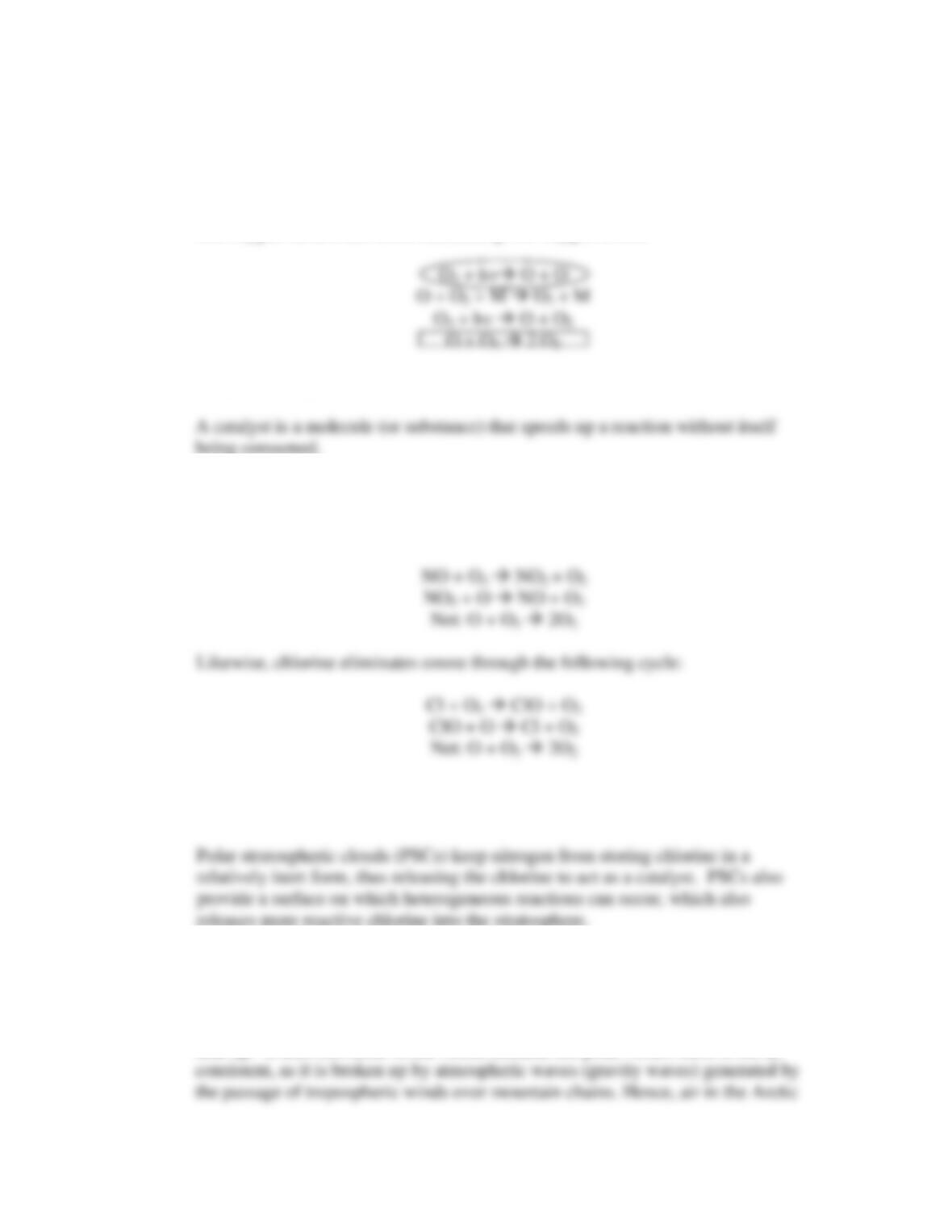
3.) What are the four chemical reactions that comprise the Chapman mechanism?
Which ones affect odd oxygen?
These are the four reactions in the Chapman mechanism, with those producing
odd oxygen circled and those eliminating odd oxygen boxed:
4.) What is a catalyst?
5.) How do nitrogen and chlorine catalyze the destruction of ozone?
Nitrogen eliminates ozone through the following cycle:
6.) What role do polar stratospheric clouds play in the formation of the Antarctic
ozone hole?
7.) Why is a springtime hole observed over the Antarctic but not usually over the
Arctic?
The springtime hole results from a release of Cl from cloud surfaces as the clouds
heat up. It does not occur in the Arctic because the polar vortex there is not as
3
8.) What is the long-term trend in mid-latitude ozone column depths? Can it be
explained by the observed increase in stratospheric chlorine and bromine?
,
9.) What strategies have been adopted for reducing or eliminating the use of freons?
The Montreal Protocol and its amendments have limited the production of freons.
Critical-Thinking Problems
1.)
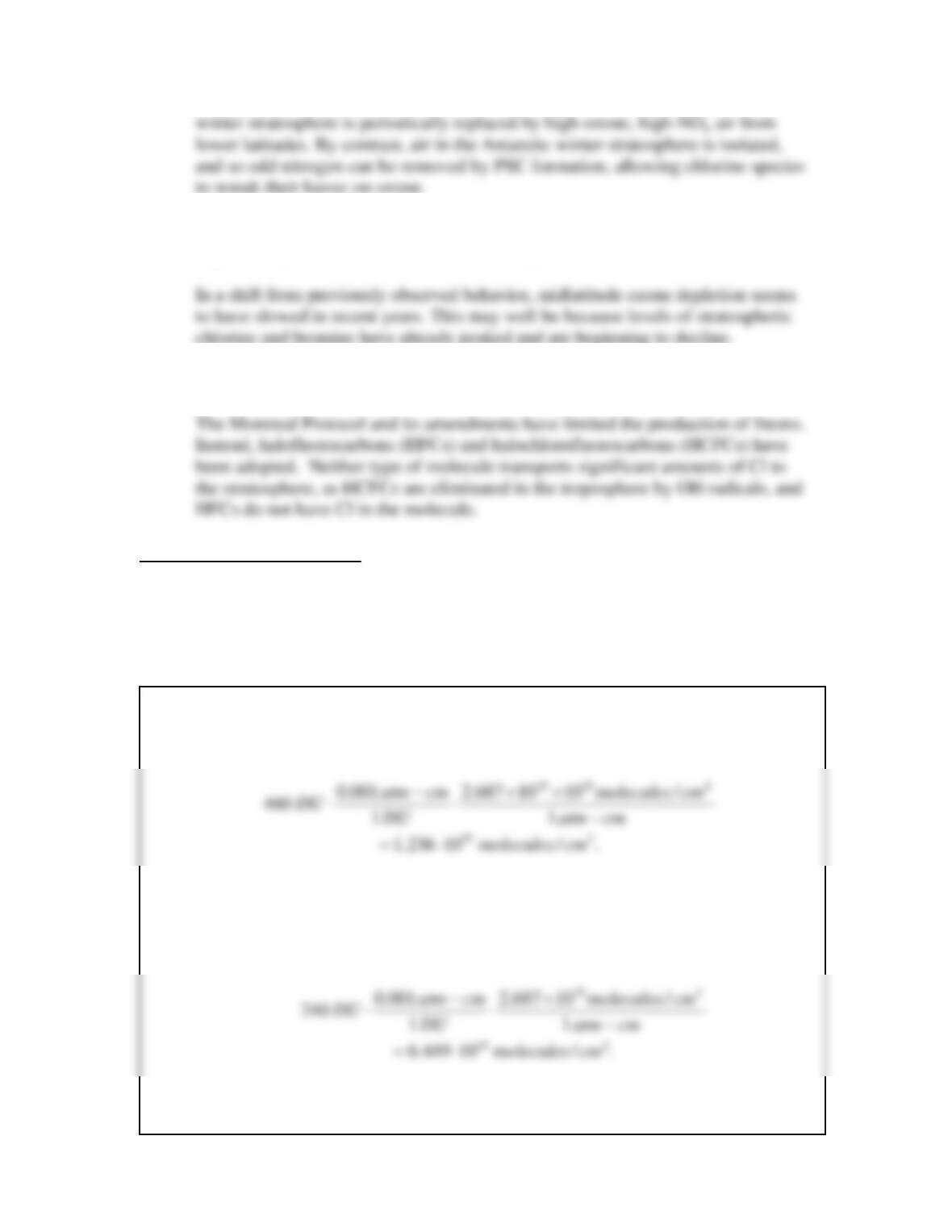
a. According to Figure 17-5, the maximum ozone column depth occurs at high
northern latitudes during late winter. The column depth there is 460 DU. How
many molecules of ozone per square centimeter does this correspond to?
1 DU is equivalent to 0.001 atm-cm. The book tells us that 1 atm-cm is equal to
2.687 x 10¹⁹ molecules/cm2. Thus,
b. The minimum ozone column depth, which occurs in the tropics, is 240 DU. How
many ozone molecules are in a 1-cm2 vertical column there?
This calculation is done in the same way:
4
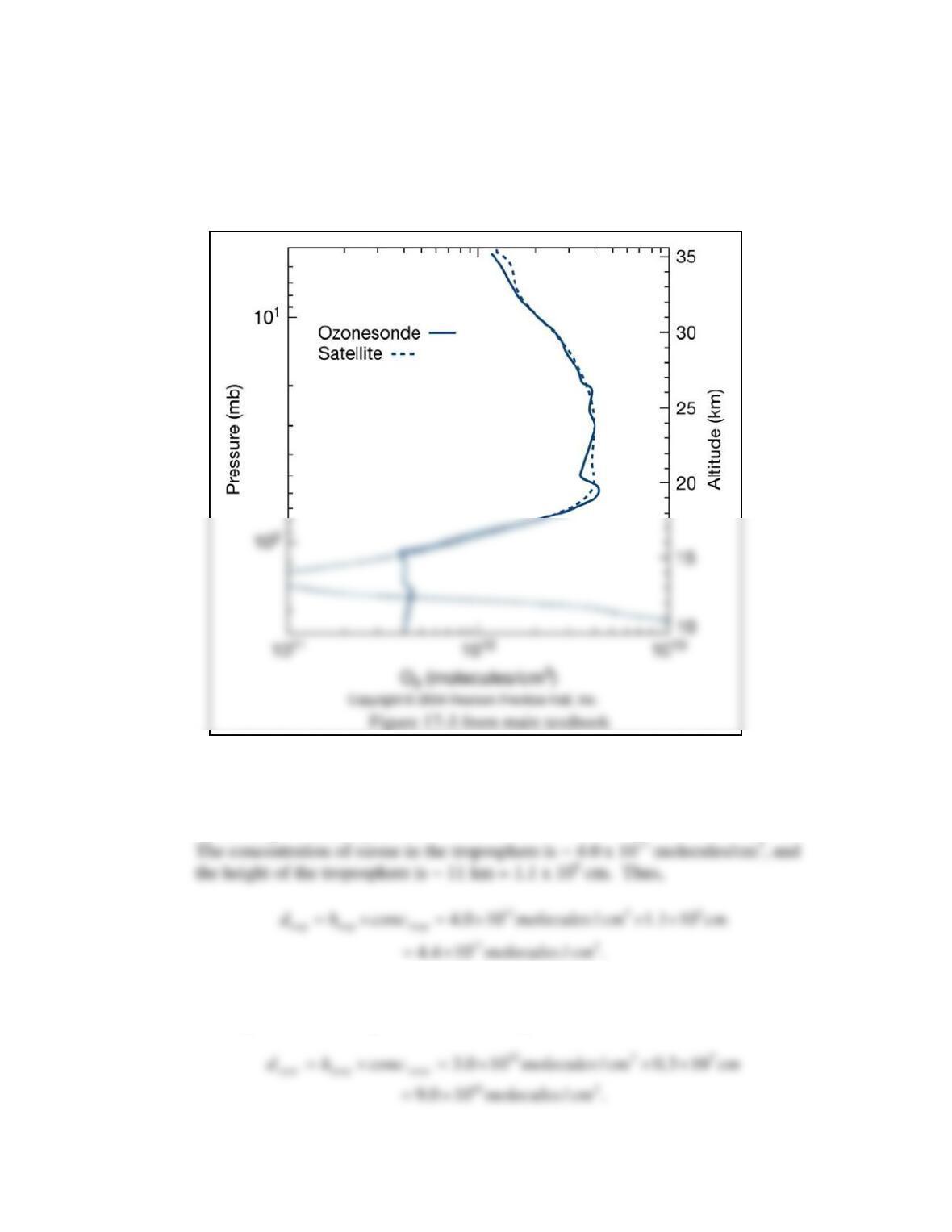
c. What was the approximate ozone column depth (in Dobson units) over Wallops
Island, Virginia, at the time of the measurements shown in Figure 17-3? (Hint:
Ozone column depth is ozone concentration [in molecules/cubic centimeter]
multiplied by the height of the column. You may want to use a different average
ozone concentration for the troposphere and the stratosphere.)
We will follow this suggestion, and calculate the ozone column depth separately
for the troposphere and stratosphere, and then add these two column depths
together to get a column depth for the atmosphere. To calculate the column
depth, we will multiply the concentration of ozone in one part of the atmosphere
by the height of that layer.
The concentration of ozone in the stratosphere is ~ 3.0 x 10¹² molecules/cm3, and
the height of the stratosphere where O3 is high is ~ 30 km = 0.3 x 107 cm. Thus,
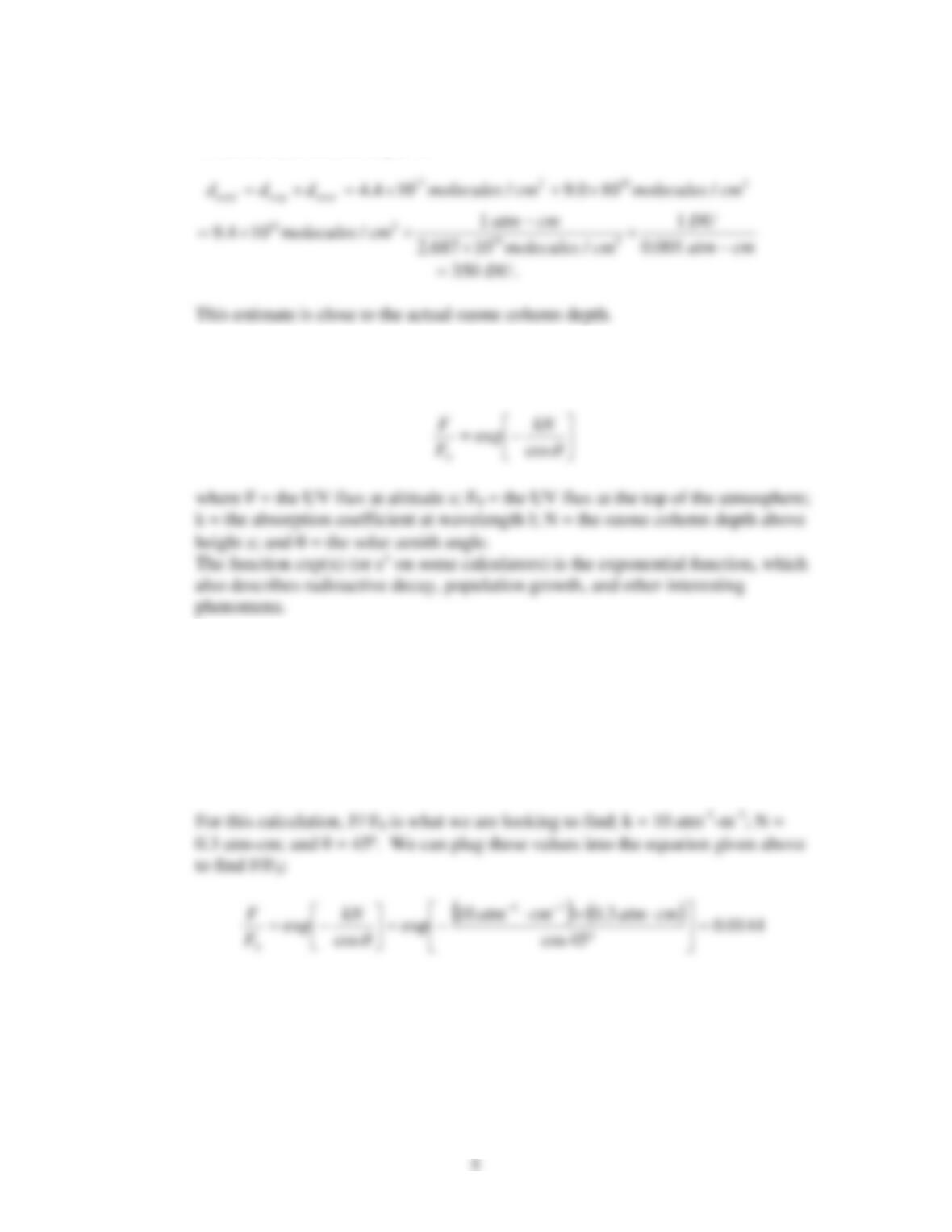
Thus, the total column depth is:
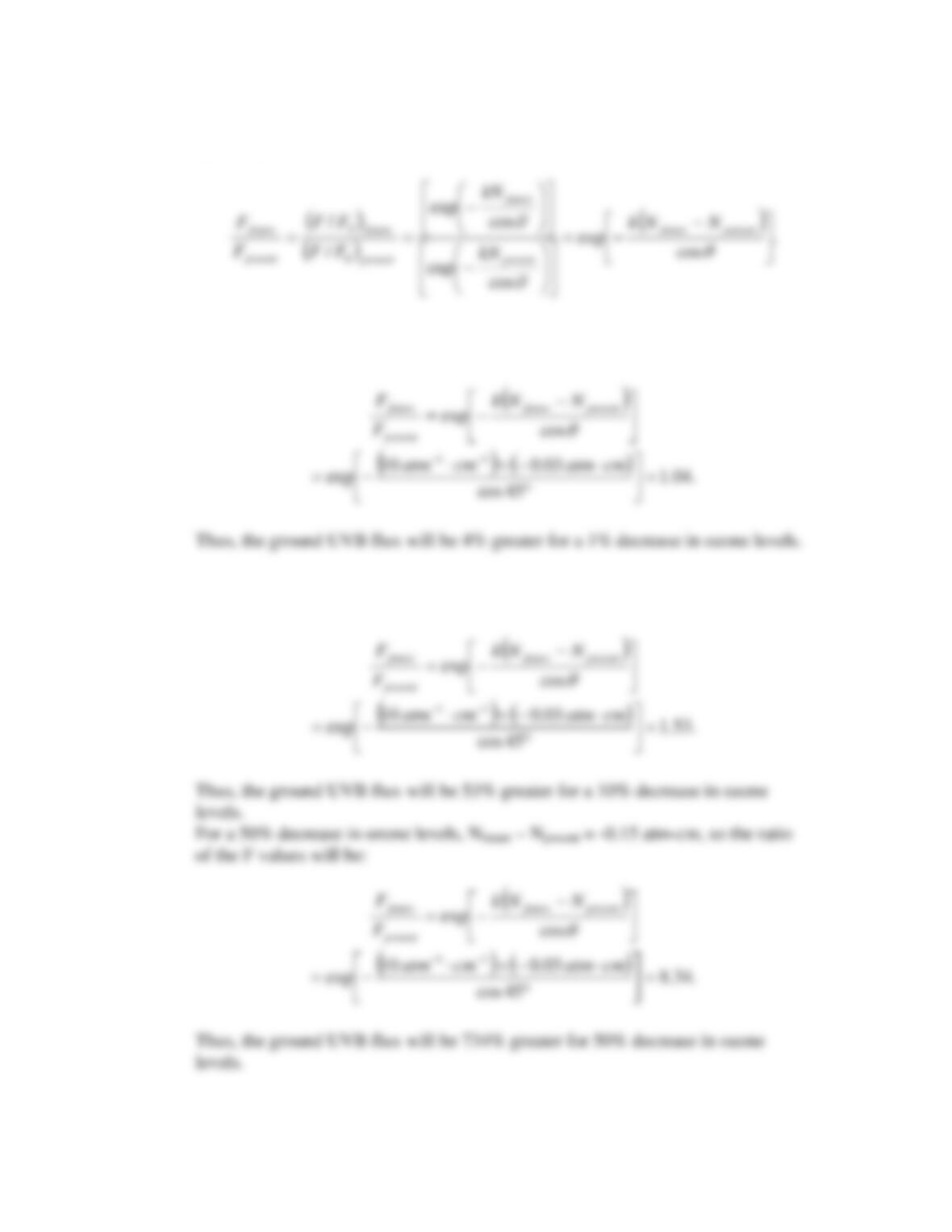
2.) The absorption of solar ultraviolet radiation of a given wavelength l by
atmospheric ozone follows Beer’s Law:
a. The wavelength region where changes in the solar UV flux have the most
potential to do harm is around 290 nm, in the UVB range. The absorption
coefficient of ozone at this wavelength is about 10 atm-1-cm-1. The average
column depth of ozone from the ground up to the top of the atmosphere is about
0.3 atm-cm. By what factor is the incident solar UV flux at 290 nm attenuated
today – that is, what is the current value of F/F0 at ground level? Evaluate your
answer for a solar zenith angle of 45°.
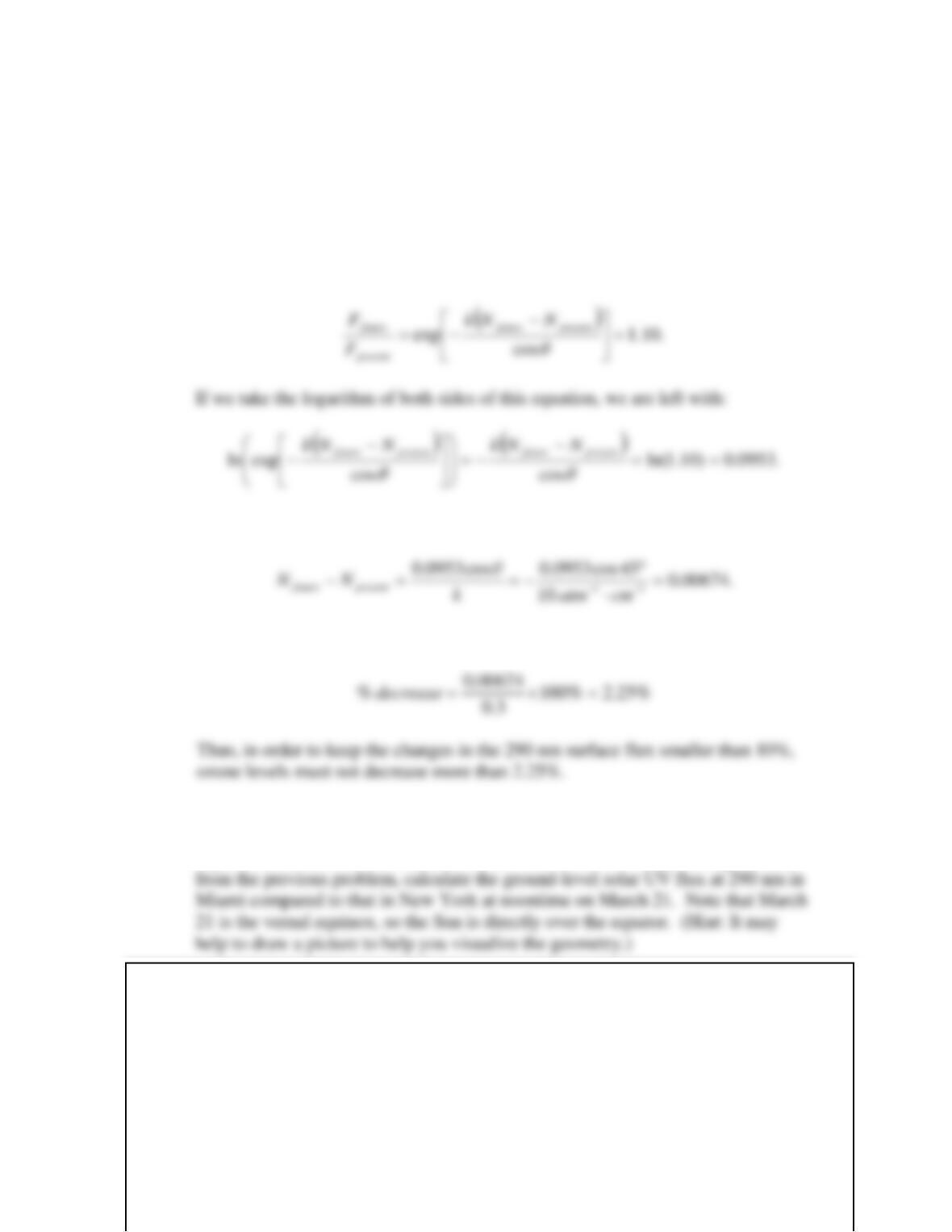
b. If the ozone column depth were to be reduced by 1% as a consequence of
increasing concentrations of chlorofluorocarbons, what would be the resulting
percent increase in the ground-level UV flux at 290 nm? What about for an ozone
decrease of 10%? 50%? Assume a solar zenith angle of 45° in each case.
6
We can find this by dividing the equation for F/F0 for the decreased ozone levels
by the equation for F/F0 for the current ozone levels:
For a 1% decrease in ozone levels, Nfuture – Npresent = -0.003 atm-cm, so the ratio
of the F values will be:
For a 10% decrease in ozone levels, Nfuture – Npresent = -0.03 atm-cm, so the ratio
of the F values will be:
7
c. Suppose that we decided that we could tolerate a 10% increase in the UV flux at
290 nm for θ = 45°, but no more. What would be the maximum percentage
decrease in ozone that we could allow? (Hint: The increase of the exponential
function is called the natural logarithm, abbreviated as ln. If y = exp(x), then x =
ln(y).)
This time, we will be solving for the change in N. A 10% increase in the UV flux
implies that:
We can now solve for the change in N:
The % change in N is:
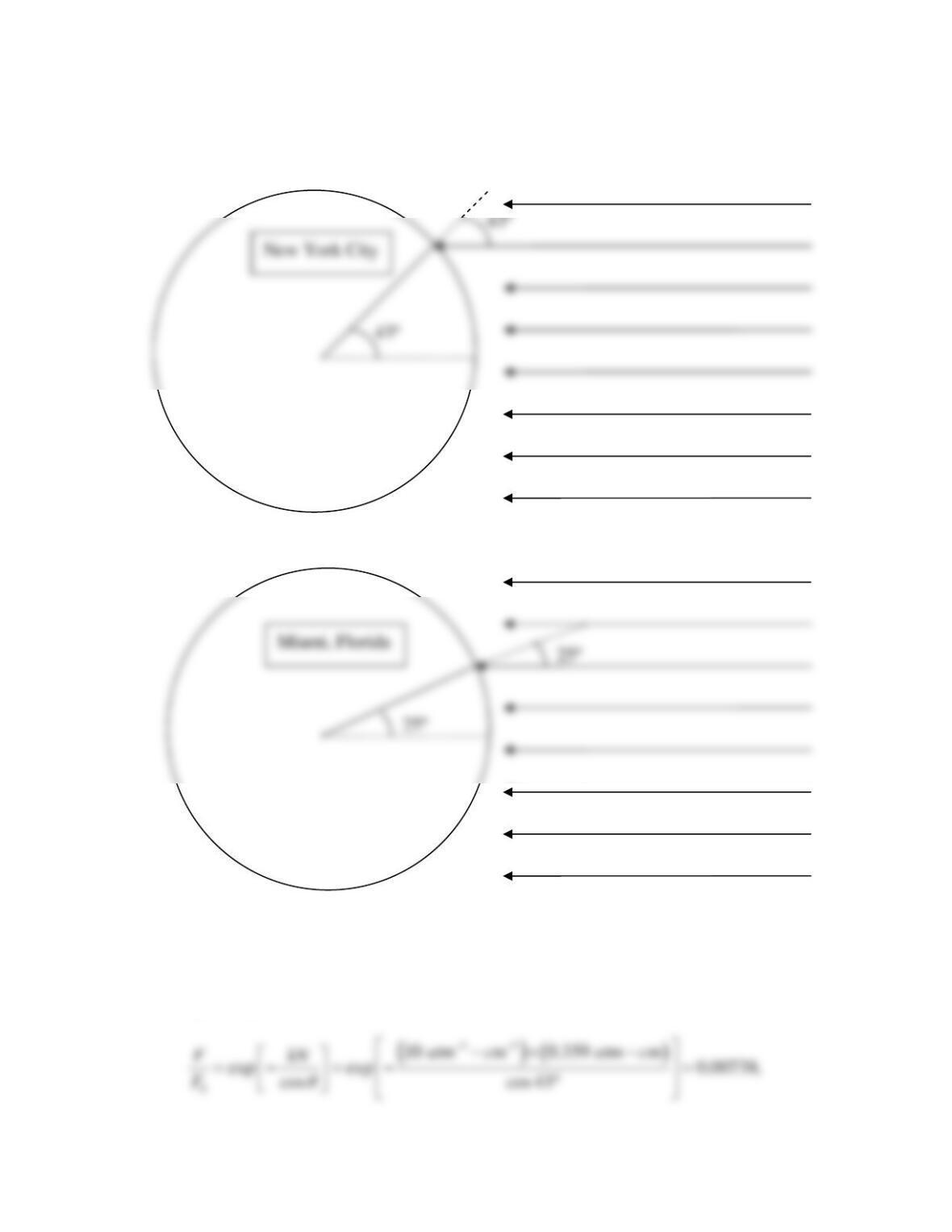
3.) New York City is at 43° N. Miami, FL, is at 25° N. In March, when most
colleges have their spring break and students go to Florida, the ozone column
depth is about 280 DU over Miami and 359 DU over New York. Using the data
8
First, examine the figure below (which is not to scale):
This figure shows that the solar zenith angle for each city (at local noon at equinox)
should have the same value as its latitude does. Therefore, we can use the latitude values
for θ in the F/F0 equation. For New York City, which has 359 DU of ozone, this means
F/F0 is given by:
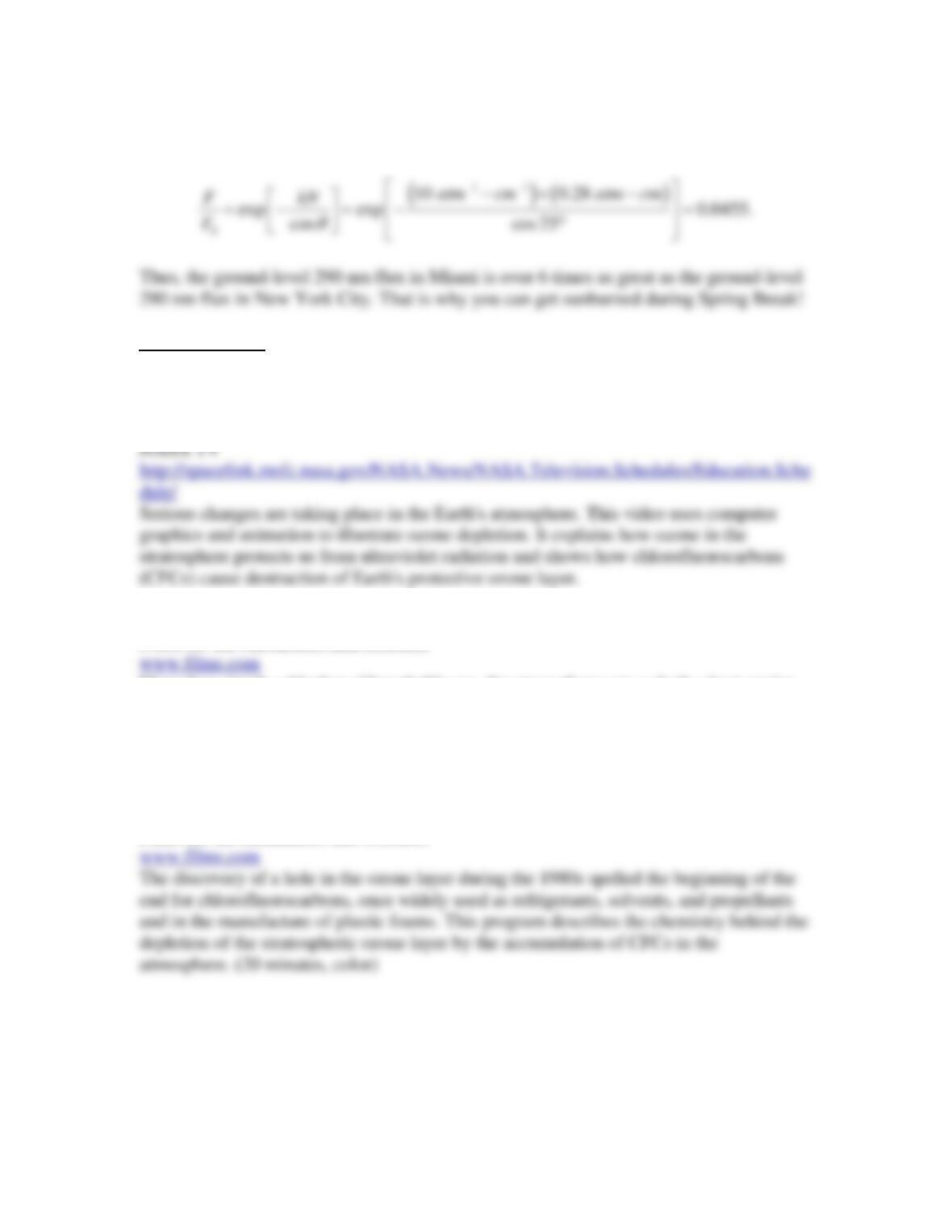
9
and for Miami, FL, which has 280 DU of ozone, this means that F/F0 is given by:
Resource Guide
Video/Film:
Ozone 9-12
The Oxygen Partnership: Air and Evolution
Films for the Humanities and Sciences
More than simply a blanket of breathable gas, the atmosphere acts as both a heat engine
and a solar shield. This program investigates the relationship between the evolution of
life on Earth and the appearance of oxygen in the atmosphere, the development of the
ozone layer, and the implications of shifts in the balance of atmospheric components. (20
minutes, color)
Ozone: Chlorofluorocarbons and Ozone Depletion
Films for the Humanities and Sciences