Chapter 16
AGENCY LAW
Suggested Additional Assignments
Personal Experiences: Agency
Ask students to prepare a list of five instances in which they have acted as an agent for someone else, or
someone else has acted as an agent for them.
Sports Agents
For many students, agency law will immediately conjure images of the Tom Cruise film Jerry Maguire
Writing Exercise: Apparent Authority
Apparent authority is often a difficult concept for students to understand. Ask students to prepare and
Research: Straw Buyers
Have students research ways in which “straw buyers” are used in real estate transactions. They will find
Chapter Overview
Chapter Theme
Once again, the subject is trade-offs. You can accomplish more if other people do things for you. On the
other hand, you also face liability for their actions. Being a manager means getting things done through
Quotes of the Day
“If you want something done right, do it yourself.” “Many hands make light work.” –Anonymous folk
sayings.
“Let every eye negotiate for itself and trust no agent.” William Shakespeare (1564 – 1616), playwright, in
“Much Ado about Nothing,” Act 2 scene 1.
1 “Playing Secret Agent for Mickey Mouse; Lawyers Ran Dummy Companies, Bought Real Estate for Disney,” by
2 Unit 3 Agency and Employment Law
Creating an Agency Relationship
Let us begin with two important definitions:
• Principal: A person who has someone else acting for him.
• Agent: A person who acts for someone else.
To create an agency relationship, there must be:
• A principal and
• Thereby creating a fiduciary relationship.
Consent and Control
To create an agency relationship, the principal and agent must agree that the agent will act for the princi–
pal and under his control.
Example: Consider the following examples from the Restatement of Agency (2nd). Is there an agency
relationship?
Question: Antonia wants to buy a car. The dealer permits her to take an automobile home to
show her mother. On the way home, she gets into an accident. Is Antonia an agent for the dealer?
Question: Suppose that Martin asks Beverly to return a shirt to the store where he recently
purchased it. Is she an agent for Martin? Does it matter that he is not paying her?
Question: Are the directors of a corporation agents of the shareholders?
Answer: No, because they are not under any obligation to do what the shareholders tell them —
Question: What about a truck driver who agrees to make a detour to take a hitchhiker to her
Additional Case: Taylor v. Gill2
Kenny Willis and his neighbors, Rick and Joyce Taylor, were good friends. Rick helped Kenny repair his
truck and Kenny cut the Taylors’s yard because they did not own a lawnmower. One day, while the
Taylors were out, Kenny began to cut their grass. Joyce returned home and saw what he was doing but
made no effort to stop him. Kenny negligently ran the mower over a stretch of gravel. A piece of the
gravel shot through the air and struck Jackie Gill in the eye. She filed suit against both Kenny and the
Taylors. A jury found the three defendants jointly and severally liable. The Taylors appealed.
Question: Why would the Taylors be liable for Kenny’s negligence?
Answer: The jury found that Kenny was an agent acting for the Taylors.
Question: Why?
2 934 S.W.2d 919; 1996 Ark. LEXIS 714
Chapter 16 Agency Law 3
Question: No, but an agency relationship may be implied from the conduct of the parties even
without an explicit agreement.
Question: Did the Taylors have control over their yard? Could Joyce have asked Kenny to stop
mowing her yard?
Question: Was Kenny acting as an agent for the Taylors?
Example: DEA Agent?
A Federal Express employee in West Palm Beach noticed that a package smelled like laundry soap.
Cocaine is often packed in laundry products to mask its smell. The employee checked the telephone
Therefore, the search was illegal because the employee did not first obtain a search warrant, as the
government would have been required to do. (The exclusionary rule applies only to searches by the
government.)3
Question: Was the Federal Express employee an agent of the DEA?
Answer: The court ruled against Koenig on the grounds that the government had not influenced the
Fiduciary Relationship
In a fiduciary relationship, a trustee acts for the benefit of the beneficiary, always putting the interests of
the beneficiary before his own. A fiduciary relationship is a special relationship, with high standards.
Additional Case: Elson v. Koehr4
Facts: During a layover at the St. Louis Airport, Rose Elson was injured in a fall at the Southwest
Airlines ticket counter. She filed suit against Southwest for negligence. Elson was a resident of Texas
and Southwest is a Texas corporation, but she filed the case in St. Louis. Southwest’s only connection
with St. Louis was that passenger reservations and ticket sales for Southwest flights were made through
independent travel agents located in the city.
4 Unit 3 Agency and Employment Law
Holding: The ticket sellers were agents of Southwest and, therefore, Elson could file suit in St. Louis.
Southwest and the independent travel agencies agreed in writing to establish an agency relationship in
which the agents were given the express authority to sell and promote air travel on the airline. All three
essential agency characteristics were present: consent, control and a fiduciary relationship.
Question: What three elements must be present to establish an agency relationship?
Question: In this case, was there consent?
authorized to sell tickets for Southwest.
Question: Was there control?
Answer: The agreement between Southwest and the agencies was full of conditions and restrictions
on their activities.
Question: Was there a fiduciary relationship?
Question: But is that enough to establish a fiduciary relationship?
Question: Is there one activity in particular that often indicates a fiduciary relationship?
Duties of Agents to Principals
There are four elements to the fiduciary duty that agents owe to their principals: duty of loyalty, duty to
obey instructions, duty of care, and duty to provide information.
Case: Otsuka v. Polo Ralph Lauren Corporation5
Facts: Justin Kaiser and Germania became friends while working together at a Ralph Lauren Polo store.
When Germania left the store, Kaiser allowed Germania to buy clothing using merchandise credits made
out to fake people, and he also allowed her to use his employee discount. Both of these activities were
against store policy.
employees owe to their employer. While the cases cited by Polo address fiduciary duty with respect to
higher-ranking employees, according to the Third Restatement, all employees are agents, and that “[a]s
agents, all employees owe a duty of loyalty to their employers.” This is true regardless of how ministerial
or routinized a work assignment may be.
Question: Does it make sense to hold low-level employees to the same standard as high-ranking
employees?
Answer: The court thinks so. Applying different standards regarding a fiduciary duty of to different
5 2007 U.S. Dist. LEXIS 86523, United States District Court for the Northern District of California, 2007.
Chapter 16 Agency Law 5
Duty of Loyalty
During their careers, students will inevitably face issues involving the duty of loyalty to an employer. In
determining whether an action would violate this duty, they may find the Ethics Checklist in Chapter 2
helpful. For instance, under the Light of Day test, they should consider whether they would want their
Confidential Information
Case: ABKCO Music, Inc. v. Harrisongs Music, Ltd.6
Facts: Bright Tunes Music Corp. (Bright Tunes) owned the copyright to the song “He’s So Fine.” The
company sued George Harrison, a Beatle, alleging that the Harrison composition “My Sweet Lord”
copied “He’s So Fine.” At the time the suit was filed, Allen B. Klein handled the business affairs of the
Beatles.
Klein (representing Harrison) met with the president of Bright Tunes to discuss possible settlement of the
copyright lawsuit. Klein suggested that Harrison might be interested in purchasing the copyright to “He’s
Issue: Did Klein violate his fiduciary duty to Harrison by using confidential information after the agency
relationship terminated?
Holding: Yes, Klein was in violation because an agent has a duty not to use confidential knowledge
acquired in his employment to compete with his principal. This duty continues after the agency
terminates.
Excerpts from Judge Pierce’s Decision: There is no doubt that the relationship between Harrison and
[Klein] prior to the termination of the management agreement was that of principal and agent, and that the
relationship was fiduciary in nature. [A]n agent has a duty not to use confidential knowledge acquired in
Question: What did Klein do wrong?
6 722 F.2d 988, 1983 U.S. App. LEXIS 15562 United States Court of Appeals for the Second Circuit, 1983

6 Unit 3 Agency and Employment Law
Answer:
Question: Klein felt he had been unfairly fired by the Beatles. What if he had simply told Bright
Tunes information about “My Sweet Lord” out of spite, not to benefit himself?
Question: Suppose that, during his employment by the Beatles, Klein develops relationships with all
the top music industry executives. After he leaves the Beatles, he represents other music groups,
negotiating contracts, etc. If it weren’t for his relationship with the Beatles, no one would return his
phone calls, but now he has a thriving business. Has he violated his fiduciary duty to the Beatles by
using information he learned while working for them to represent other groups?
Answer: The court in ABKCO says that an agent can “use information based on general business
Competition with the Principal
Agents are not allowed to compete with their principal in any matter within the scope of the agency
business.
Example
While serving as outside auditors for the consulting firm of Stern, Stewart & Co., KPMG discovered how
much money Stern, Stewart was earning from its financial management and incentive compensation
consulting practice. KPMG sent six of its employees to a Stern, Stewart seminar to learn about this
consulting practice. It then hired two of Stern, Stewart’s consultants and started its own competing
business.7
Question: Did KPMG do anything wrong?
Question: What is a fiduciary duty?
Question: If KPMG wanted to start a consulting business, what should it have done?
Answer: KPMG should have resigned from its position as Stern, Stewart’s outside auditors and then
Additional Case: Reading Radio, Inc. v. Fink8
Facts: David Kline was the station manager and sales manager for Reading Radio, Inc., a/k/a WAGO
Radio. As manager, Kline was in charge of supervising the station’s sales representatives. Molly Fink and
Isaac Ulrich, two of WAGO’s top sales representatives, had both signed non-compete agreements with
WAGO that prohibited them from taking a radio or television broadcasting job, within fifty miles of
Reading, Pennsylvania, for six months after leaving WAGO. Kline did not have a covenant not to
compete.
Chapter 16 Agency Law 7
despite their non-competition agreements with WAGO. After Fink and Ulrich left, sales revenue at
WAGO fell by $1.6 million dollars.
WAGO sued both Kline and Eagle. The jury returned a verdict for WAGO in the amount of
$1,105,000. The defendants appealed.
Issue: Did Kline violate his duty of loyalty to his employer, WAGO?
Holding: Judgment for WAGO affirmed. While still employed by WAGO, Kline actively encouraged
Fink and Ulrich to leave WAGO and go to work at WEEU. He also refused to enforce their covenants-
not-to-compete. These acts were clear violations of his duty of loyalty.
Question: Kline showed how not to move from one job to another. What did he do wrong?
Answer:
• He hired away two of the WAGO’s top salespeople.
them.
Example: Taking Client Lists
Stockbroker Ronald Waitemeyer left Merrill Lynch to go to work for Dean Witter. Merrill Lynch sued
to prevent him from taking his client list with him. Fortunately, for him, a heavy snowstorm on the day
he left Merrill Lynch shut the Baltimore federal court for three days. This interlude gave him the
opportunity to sign up his old clients before Merrill Lynch could obtain a restraining order against him.9
Question: Was Waitemeyer violating his duty of loyalty when he solicited clients after leaving Merrill
Lynch.
Question: Some brokerage houses offer clients a reduced commission rate if they will stay with their
old firm instead of following their broker when she leaves. Are there any limits to what the firm can do
to keep clients?
Answer: Offering a reduced commission rate is fine, but some brokerage houses have (untruthfully)
Principal’s Remedies when the Agent Breaches a Duty
A principal has three potential remedies when an agent breaches her duty:
• The principal can recover from the agent any damages the breach has caused.
9Michael Siconolfi, “Brokers and the Firms They Leave Battle To Keep Clients,” Wall Street Journal, March 18, 1996, p. 1.
8 Unit 3 Agency and Employment Law
• If an agent breaches the duty of loyalty, he must turn over to the principal any profits he has
earned as a result of his wrongdoing.
• If the agent has violated her duty of loyalty, the principal may rescind the transaction.
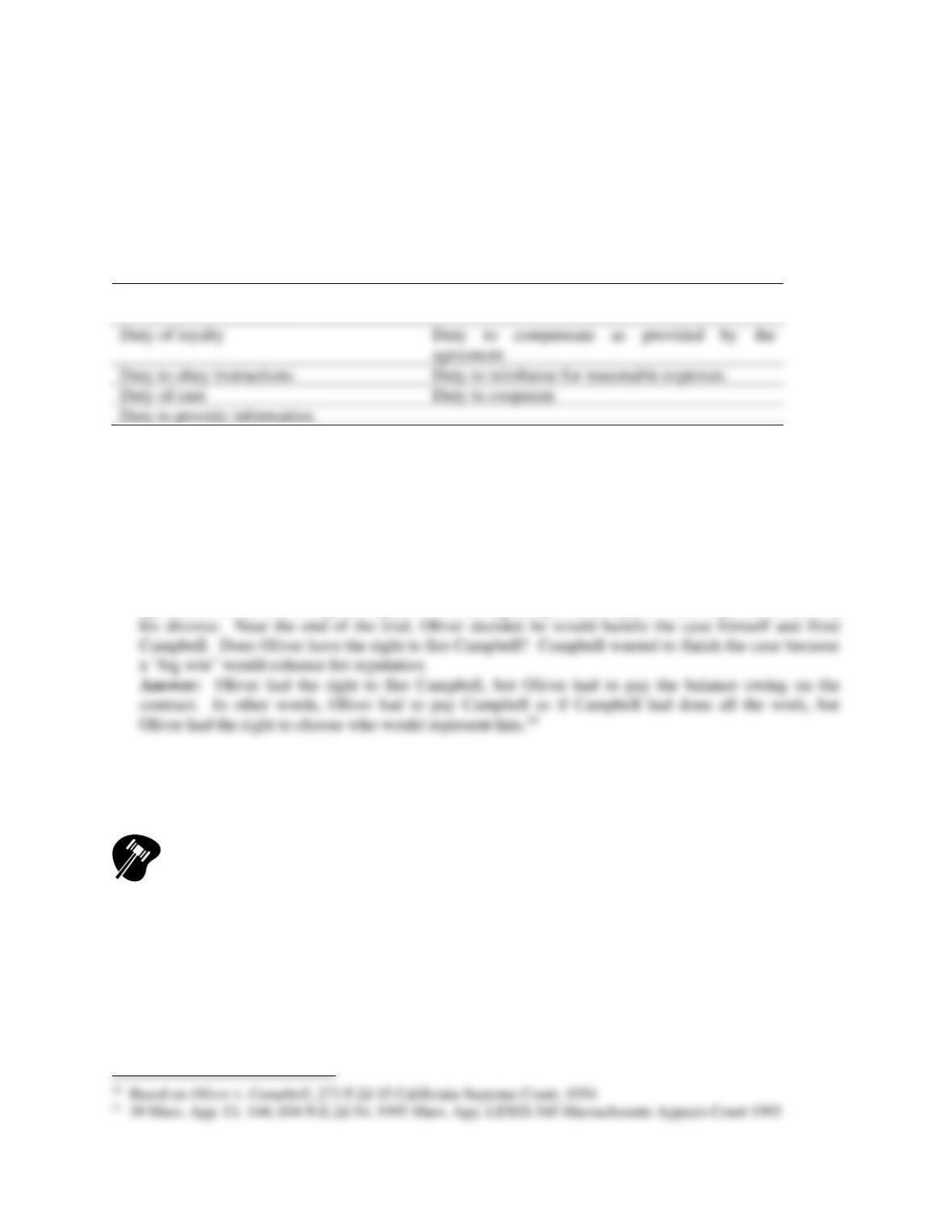
Duties of Principals to Agents
In a typical agency relationship, the agent agrees to perform tasks for the principal, and the principal
agrees to pay the agent. The respective duties of agents and principals can be summarized as follows:
Duties of Agents to Principals
Duty of Principals to Agents
Terminating an Agency Relationship
Termination by Agent or Principal
Either party has the power to terminate an agency relationship; they may not, however, have the right.
The relationship may be terminated at the completion of a term agreement, whenever desired in an agency
at will, or wrongfully terminated at another time.
Question: Oliver and Campbell signed a contract agreeing that Campbell would represent Oliver in
Change in Circumstances—Loss or Destruction of Subject
Matter
Additional Case: You Be The Judge: Gagnon v. Coombs11
Facts: Eighty-five year old Francis Gagnon and his wife lived on a farm in Shelburne, Massachusetts.
They also owned land in Hillsborough, New Hampshire. They had two children: Joan Coombs, who lived
20 miles from Shelburne, and Frank Gagnon who lived in a trailer on a far corner of the farm. Joan
suggested that her parents sign powers of attorney appointing her as their agent so that she could take care
of them and their property.
Frank found out about the power of attorney when he checked his mother into a nursing home. Frank
then moved his trailer in to the main house and convinced his father to revoke the power. Francis did so,
but never told Joan explicitly. Two months later, Mrs. Gagnon died and Mr. Gagnon signed a purchase
Chapter 16 Agency Law 9
and sale agreement for the Shelburne farm. He gave the property in Hillsborough to Frank.
When Mr. Gagnon told Joan about the sale of the land and his intention to move to Hillsborough to
live with Frank, she crafted her own plan. Not realizing that her power of attorney had been revoked, she
used it to transfer the Shelburne property to a trust that she had created and that she controlled. Francis’s
lawyer wrote to Joan demanding that she return the Shelburne property to him. She refused.
The trial court found that Joan had the authority under the power of attorney to convey the Shelburne
Question: What is a power of attorney?
Answer: It is a document authorizing someone to be an agent.
Question: When does it expire?
Answer: It expires when the principal revokes it, when the principal dies or if the principal becomes
Question: Francis never told Joan that he revoked her power of attorney. If Joan did not know, how
could her authority be revoked?
Answer: Francis told Joan indirectly. When she found out that he had signed a purchase and sale
Question: But even after Francis signed the P&S, he still owned the property. Couldn’t Joan transfer
it to the trust?
Answer: It didn’t matter if he still owned the property. Joan knew that he had taken control of it and
Question: Was Joan really doing what was best for Francis?
Answer: Joan didn’t tell him that she had transferred the property. Also, she tried to transfer the
Question: What is the moral of this story?
Effect of Termination
Once an agency relationship ends, the agent no longer has the authority to act for the principal.
Principal’s Liability for Contracts
The principal is liable for the acts of an agent if (1) the agent had authority, or (2) the principal ratifies the
acts of the agent.
Authority
A principal is bound by the acts of an agent if the agent has authority. There are three types of authority:
express, implied, and apparent.
10 Unit 3 Agency and Employment Law
Express Authority
The principal grants express authority by words or conduct that, reasonably interpreted, cause the agent to
believe the principal desires her to act on the principal’s account.
Implied Authority
Apparent Authority
A principal can be liable for the acts of an agent who is not, in fact, acting with authority, if the principal
Role Play: Apparent Authority
This skit requires no rehearsal; any three students can play the roles. Provide a copy to each of the
students a few minutes before class so that they have an opportunity to read it in advance. (Use
highlighter to indicate their lines.)
Anne Dawson, to class: Hello, my name is Anne Dawson. I am a salesperson for the Pure Brush
Company.
James Fraser to Anne Dawson:
I’m terribly afraid, Anne, that we will have to let you go. You have missed your sales quota three out
of the last four months. Frankly, I just don’t think you are working hard enough. I’m terribly sorry,
but my boss, Franklin, is breathing down my neck to get sales up, and you are simply not pulling your
weight.
Anne Dawson (looking sneaky):
I’ve used up all my forms and my sample case was stolen out of my car last week. I’m out of here
now. You guys are going to regret this. [She stomps off.]
James Fraser: You’re probably right. I’m sorry and good luck.
Chapter 16 Agency Law 11
Anne Dawson: We’ve got this fabulous new product you’ll just love–it’s a brush for
cleaning blinds. I remember last time you told me that your husband has asthma. Did you know that
Connie Lynch (hesitating):
Well, it seems like a good idea. How much is it?
Anne Dawson: Normally, it’s $99, but right now we’re having a super special. It’s
Anne Dawson: Just sign this form right here.
Question: Does Anne Dawson have express authority to act for the Pure Brush Company?
Question: Does she have implied authority?
Question: Does Dawson have any authority?
Answer: Apparent authority. This means that the principal has not authorized her to act but the
principal has done something to make an innocent third party believe she was authorized.
Question: What has Pure Brush Company done to make Connie Lynch believe that Dawson was
authorized to act?
Answer: It did not retrieve her samples and forms. Many companies require their sales staff to put
Additional Case: Dickinson v. Charter Oaks12
Facts: Marlee and Richard Snowdon bought a house next door to Hal and Carol Dickinson. Carol had
owned the house for 30 years; Hal had moved in 10 to 15 years later when he and Carol married. Hal had
no ownership interest in the property.
The Snowdons decided to clean out an area of overgrowth adjacent to the Dickinson land. Richard
spoke with Hal, who okayed the work. Marlee hired Charter Oaks for the project. Hal expressed
12 2003 Ohio 2055; 2003 Ohio App. LEXIS 1940 Court of Appeals of Ohio, 2003