
Pleistocene Glaciations
Learning Objectives
After reading this chapter, students should be able to:
• Comprehend the climate changes that the Earth has experienced during the
Pleistocene and be able to provide explanations for these changes
• Know what pieces of evidence are used by geologists to indicate glaciations. This
includes topographical features, glacial deposits, and geochemical evidence
(particularly δ18O data)
• Realize that glacial cycles in the Pleistocene have a periodicity to them, fluctuating
on 100,000 year and 40,000 year periods
• Understand the connection between changes in the orbital parameters (eccentricity,
obliquity, and precession) of the Earth and the climate
• Know how Earth’s orbital parameters are thought to change through time and know
the periods of the cyclic changes in these parameters
• Realize that cyclic climate changes that occur with a period of ~100,000 years can
not be explained solely by cyclic changes in the Earth’s eccentricity
• Offer potential positive feedback mechanisms that would allow for amplification of
the climate forcing caused by changes in the Earth’s eccentricity, including ice-
albedo, cloud-albedo, and various nutrient-biological feedbacks
Review Questions
1.) What types of geologic evidence are diagnostic of glaciation?
2.) What causes changes in the oxygen isotopic composition of seawater?
3.) Which three characteristics of Earth’s orbit around the Sun vary on the timescale
of Pleistocene glaciations? How does each of these affect the amount of energy
received from the sun?
CHAPTER
14
The Earth’s eccentricity (changes in how elliptical the Earth’s orbit is), obliquity
(the tilt of its spin axis with regard to the plane of its orbit), and precession
(revolution of its spin axis about the line perpendicular to the orbital plane) all
4.) What orbital configuration favors glaciation? Why?
5.) How is the oxygen isotope record of marine limestones used to test
Milankovitch’s theory of the ice ages?
The oxygen isotope record can be used to indicate the temperature of the oceans
6.) What role do biologically produced sulfur gases play in glacial climate
fluctuations?
7.) What factors might have caused atmospheric CO2 variations that kept pace with
glacial climate fluctuations?
3
8.) Explain why the formation of North Atlantic Deep Water might have played a
role in causing the Younger Dryas event.
As North Atlantic water subducts, it is replaced by warm water from the South
Critical-Thinking Problems
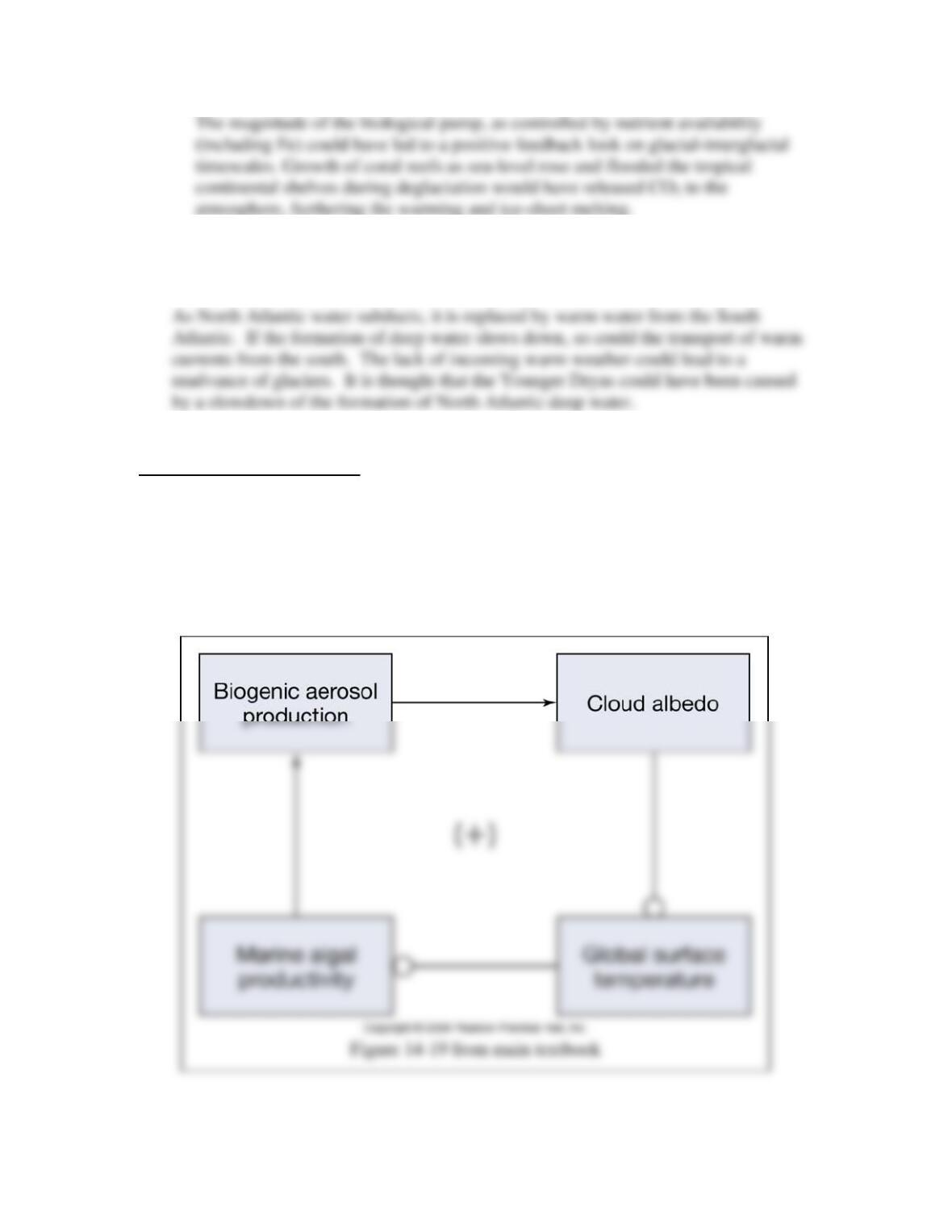
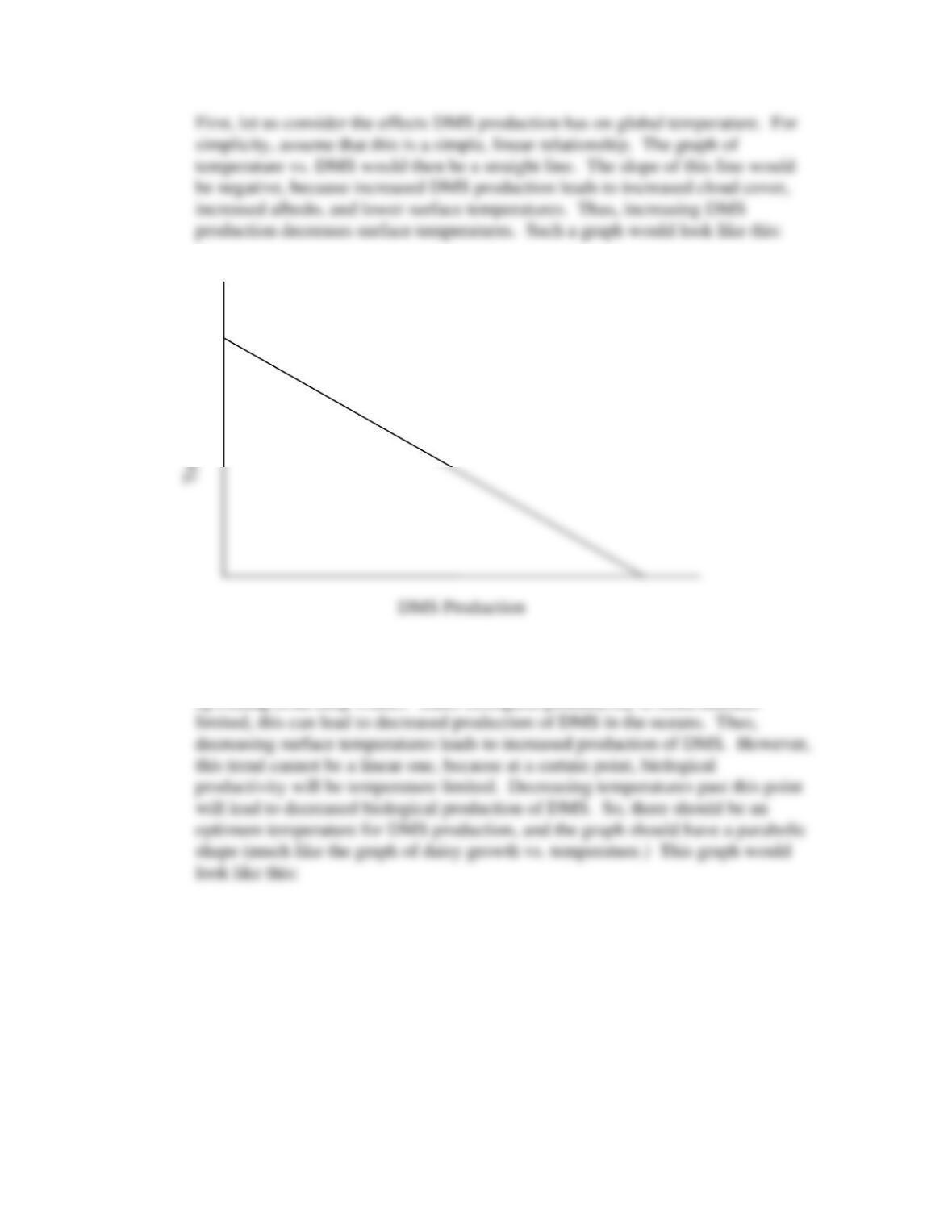
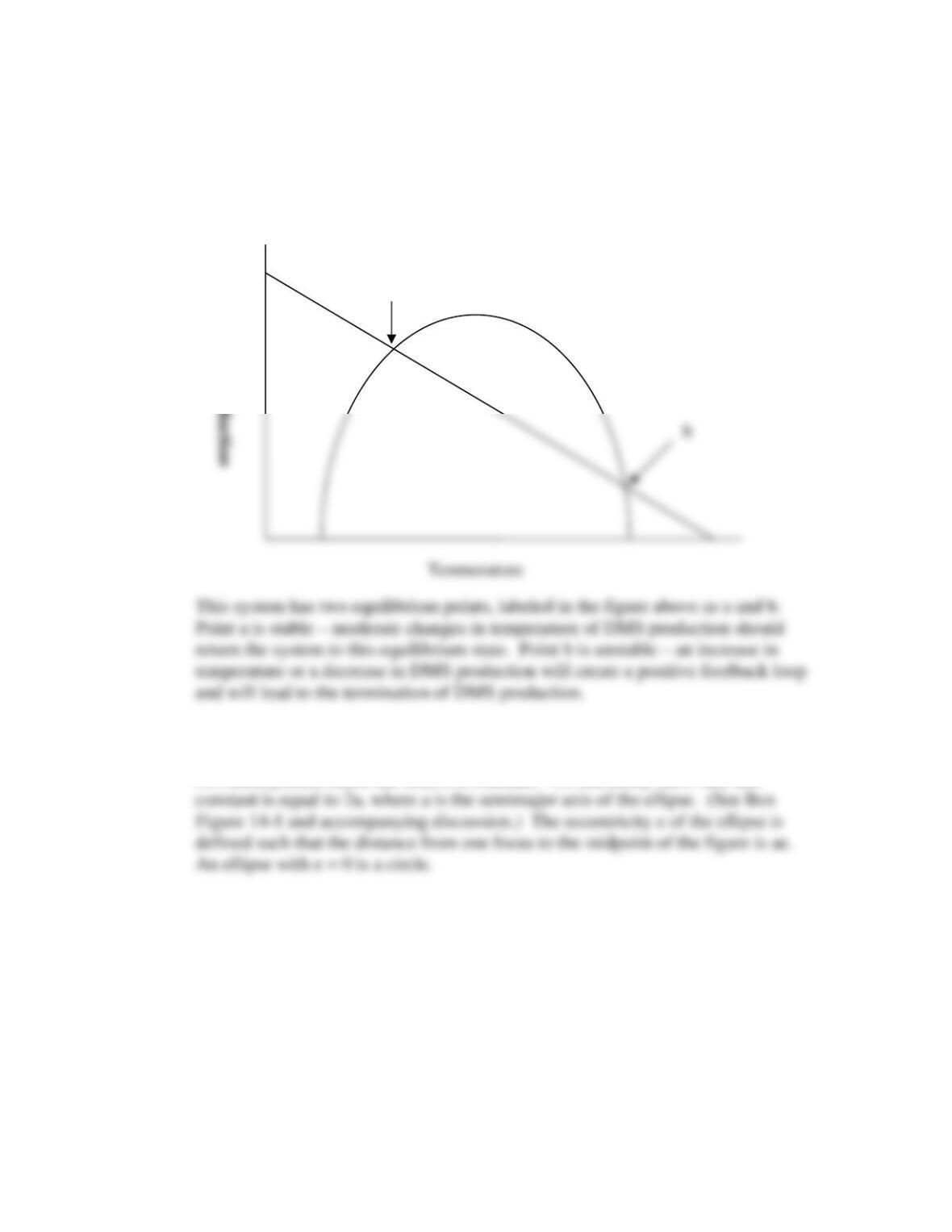
1.) Return to our Daisyworld analogy from Chapter 2. Construct a Daisyworld-like
model of the MSA-climate feedback loop shown in Figure 14-19. First sketch a
graph of how DMS production by algae would affect global temperature. Then
sketch another graph of your view of how changes in global temperature might
affect algal DMS production. Defend both graphs in writing. Then combine
these graphs, and discuss the stability of the equilibrium states achieved.
4
Now, let’s consider the effects that surface temperature changes have on
biological DMS production. Increasing surface temperature leads to decreased
upwelling from deep waters. Since biological productivity is often nutrient-
p
erature
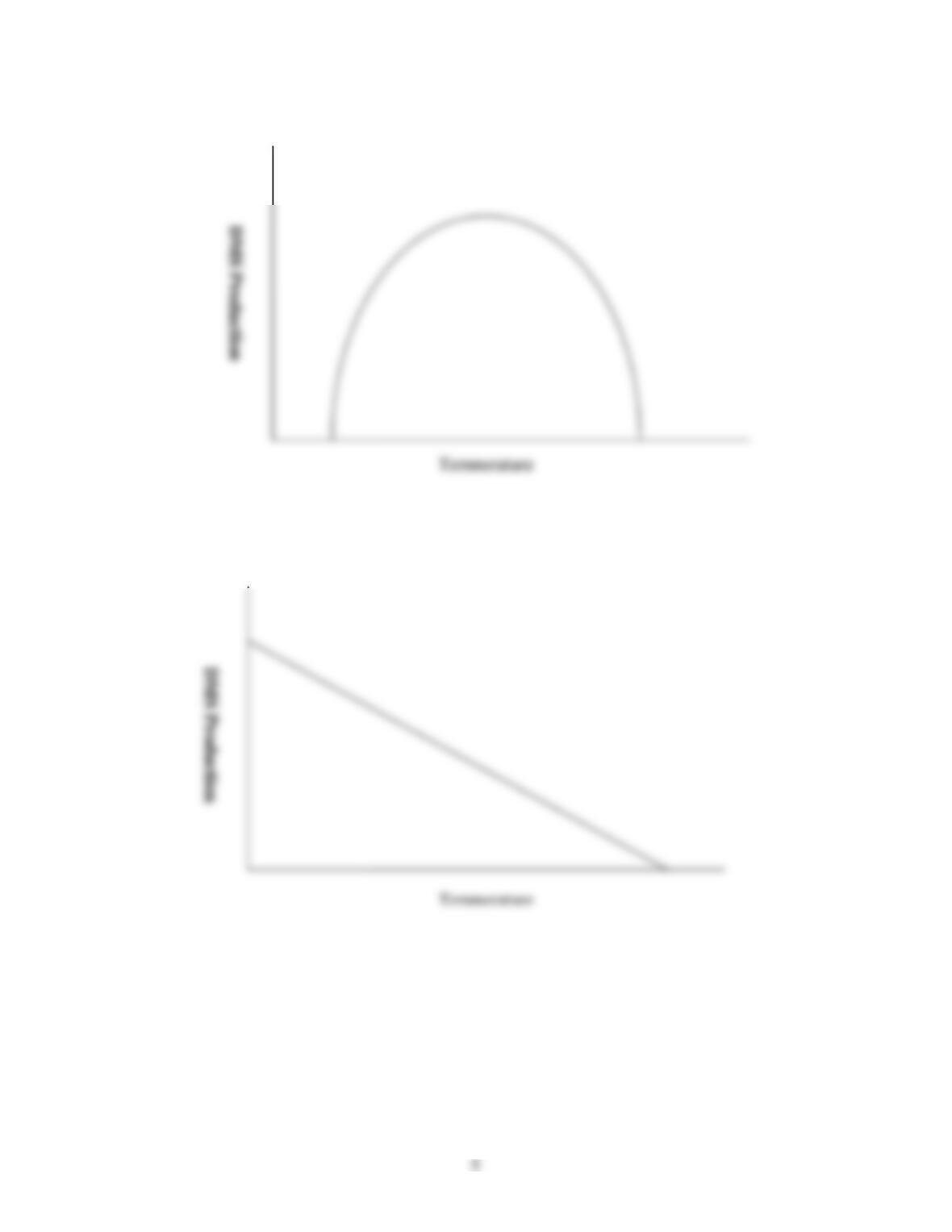
We now wish to combine the graphs. First, we will invert the graph for the
affects of DMS production on surface temperatures:
Now, we can combine the two graphs:
6
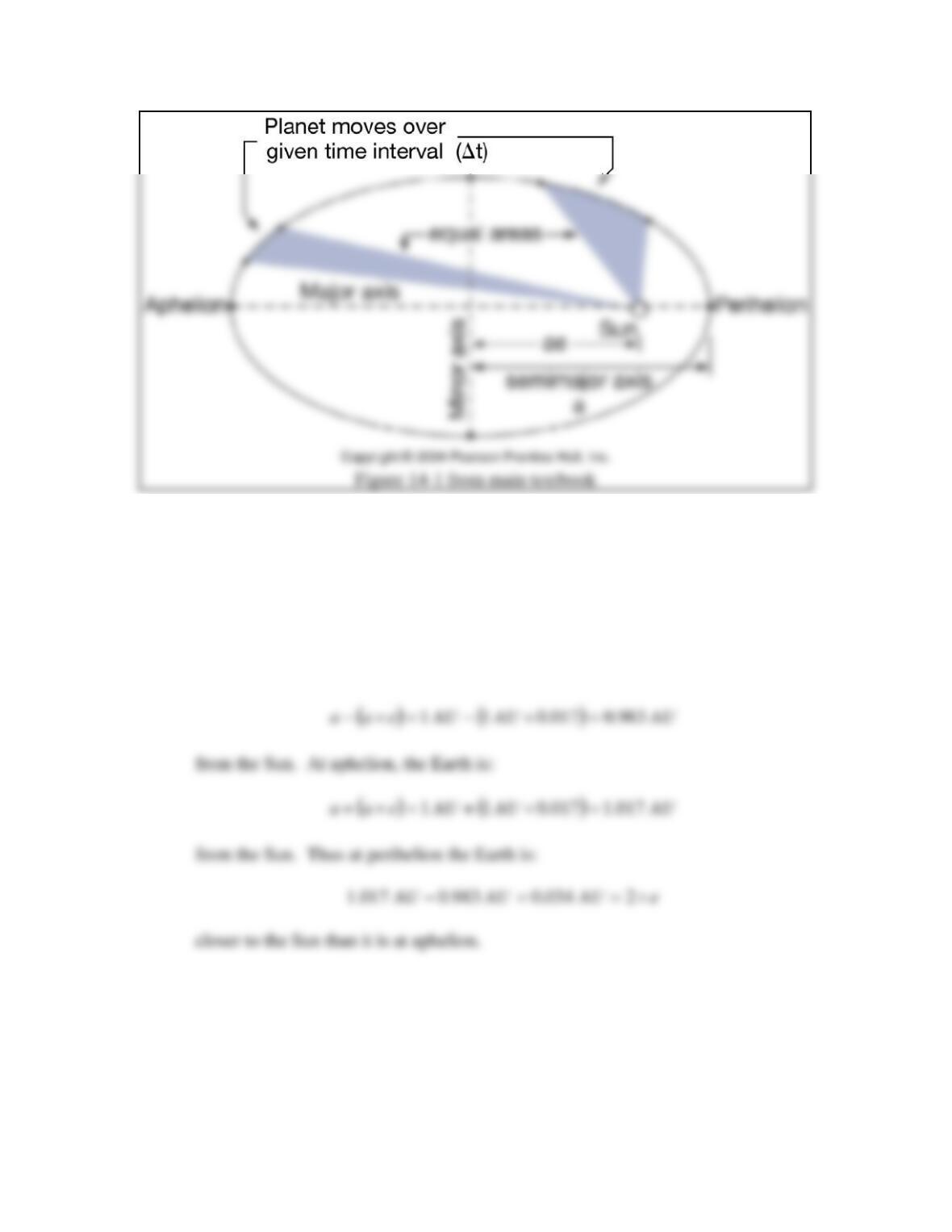
2.) An ellipse is defined as the locus of all points such that the sum of the distances to
two fixed points, called the foci, is a constant. We can easily show that this
DMS Production
a
7
a. Kepler’s first law states that the planets move around the Sun in elliptical orbits
with the Sun at one focus. Earth’s present orbit has a semimajor axis of 1 AU and
an eccentricity of 0.017. The point of closest approach to the sun is the
perihelion; the point farthest away is the aphelion. How much closer is Earth to
the Sun at perihelion than at aphelion? Express your answer in astronomical
units.
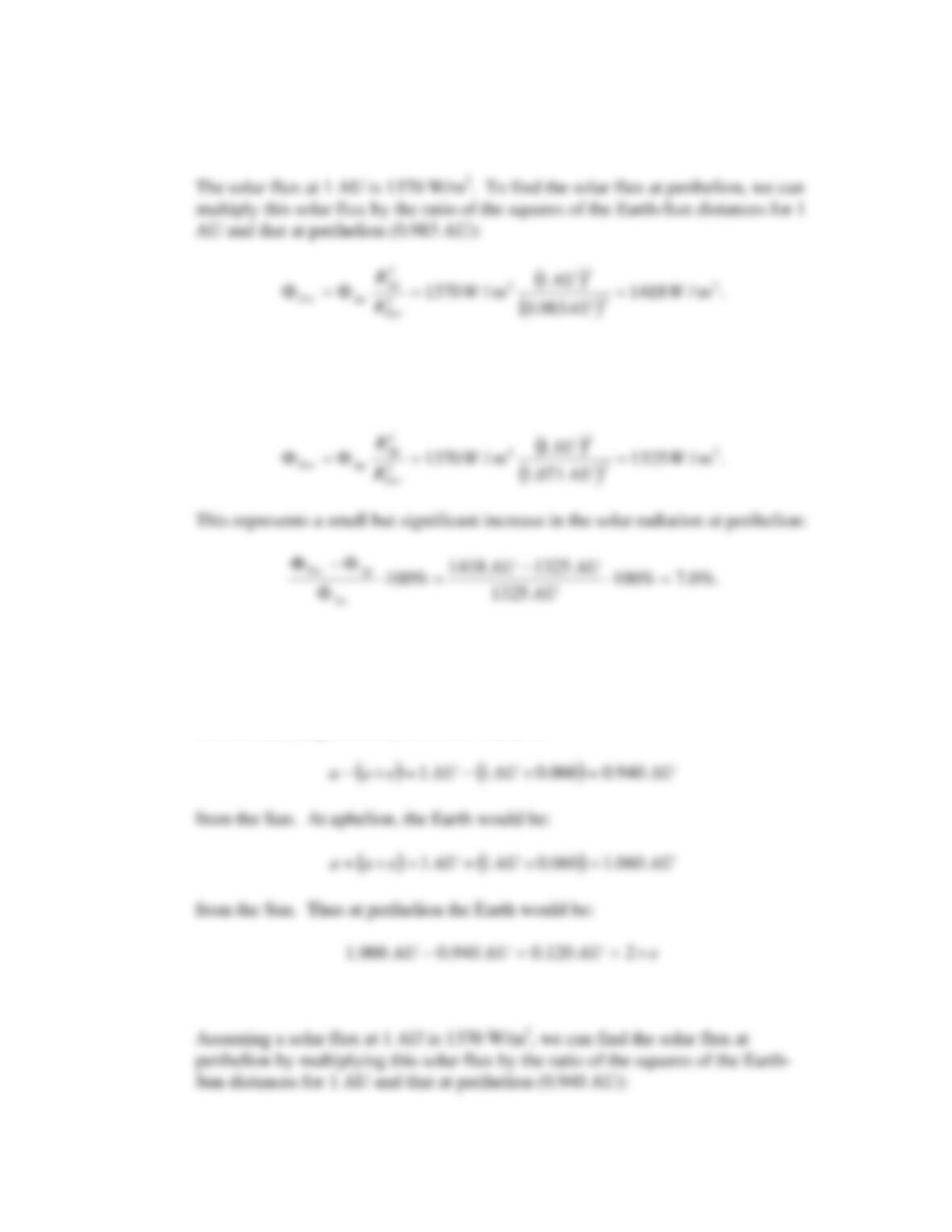
At perihelion, the Earth is:
b. The Milankovitch theory of the ice ages holds that the most important forcing
factor is the difference in solar heating at high latitudes when Northern
Hemisphere summer occurs at perihelion as opposed to aphelion. Using the
inverse square law (Chapter 3), find the solar flux at perihelion and at aphelion.
Recall that the solar flux at 1 AU is 1370 W/m2. How much higher is the solar
8
flux at perihelion than at aphelion today? Express your answer as a percentage.
How much warmer is the effective radiating temperature of Earth (Chapter 3)?
The solar flux at 1 AU is 1370 W/m2. To find the solar flux at aphelion, we can
multiply this solar flux by the ratio of the squares of the Earth-Sun distances for 1
AU and that at aphelion (1.017 AU):
c. The eccentricity of Earth’s orbit varies with time as a consequence of
gravitational perturbations caused by the other planets. Repeat Question 2b for e
at its maximum value of 0.06.
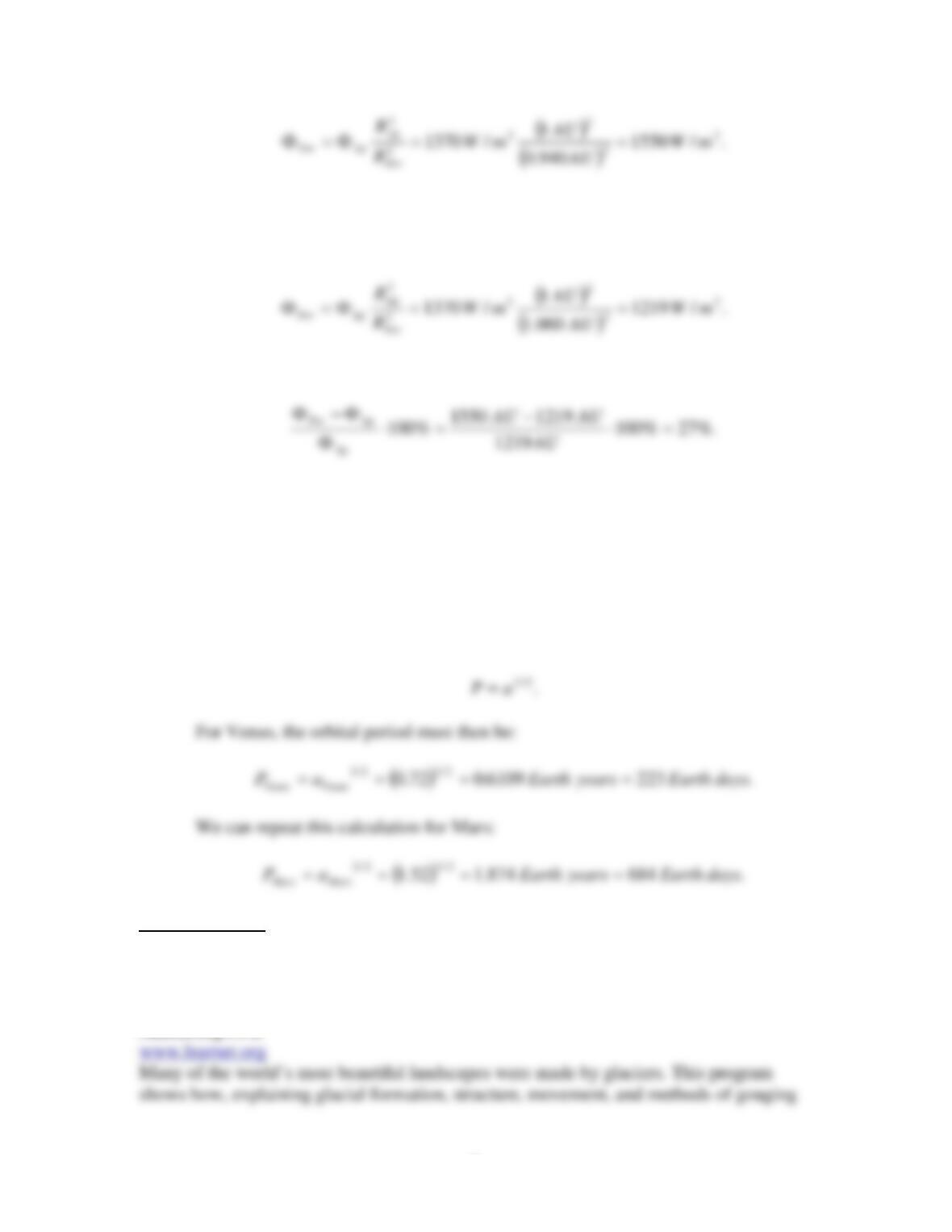
For this case, at perihelion, the Earth would be:
closer to the Sun than it is at aphelion.
9
Assuming a solar flux at 1 AU is 1370 W/m2, we can find the solar flux at
aphelion by multiplying this solar flux by the ratio of the squares of the Earth-Sun
distances for 1 AU and that at aphelion (1.060 AU):
This represents a very significant increase in the solar radiation at perihelion:
d. Kepler’s third law states that the square of a planet’s period P is proportional to
the cube of its semimajor axis a. When P is expressed in Earth years and a is in
AU, the relationship is simply P2 = a3. Venus and Mars have semimajor axes of
0.72 and 1.52, respectively. How many Earth years does it take for them to go
around the sun?
This equation can be rewritten as:
Resource Guide
Video/Film:
Earth Revealed, Episode 23. Glaciers
Annenberg/CPB

10
and accumulating earth. The program provides images of glaciers and glacial landforms
such as moraines, and discusses how study of glaciers may help us understand ice ages
and the greenhouse effect.
Glacial Deposits
Films for the Humanities and Sciences
Surviving the Ice Age
The Ice World VHS
Discovery Channel

11