12 Unit 2 Contracts and the UCC
• The drawer of a check has secondary liability. He is liable only after he has received notice that
the bank has dishonored the check.
• The drawee is the bank on which the check is drawn. The bank is not liable to the holder.
• Indorsers are only secondarily liable; they must pay if the issuer or drawee does not. But
indorsers are only liable to those who come after them in the chain of ownership.
Example: Read the back before indorsement
Before indorsing a check, beware of any contracts written on the back. Robert Beken bought a $35
software book from Computer City in San Diego. When he saw the clerk type his name and address into
the computer, he insisted that his name not be added to any mailing lists. The clerk assured him that it
would not. Beken wrote on the back of his check:
Accommodation Party
An accommodation party is someone—other than an issuer, acceptor, or indorser—who adds her
signature to an instrument for the purpose of being liable on it. The accommodation party has the same
liability to the holder as the person for whom he signed.
Additional Case: IN RE Couchot10
Facts: Jean Couchot borrowed $6,317.48 from the bank to pay her son’s funeral expenses. Kathy, the
Issue: Is an accommodation party liable for the full amount of a note when she received only a small
portion of the proceeds? Is an accommodation party liable even though the check was altered?
Holding: An accommodation party is liable whether or not she benefits from the loan. Although the
check had been altered, Jean had spent the loan proceeds as anticipated. Kathy is liable.
Question: What is an accommodation party?
Question: Why do people agree to serve as accommodation parties?
Answer: Generally for two reasons. Either there is a family relationship—parents guaranteeing a
Question: What are the differences among a guarantor, an accommodation party, and a co-maker?
Answer: An accommodation party is liable whether or not the holder has first tried to collect against
Question: Is the result in this case fair? After all, Kathy did not receive any of the money from the
check.
Chapter 14 Negotiable Instruments 13
Question: Why did Kathy agree to be an accommodation party?
husband.
Question: Was it used for that purpose?
Answer: Yes.
Question: Would Kathy have been liable if the proceeds had been used for Jean’s personal expenses?
Question: What is the moral of this story?
Warranty Liability
Basic Rules of Warranty Liability
1. The wrongdoer is always liable.
2. The drawee bank is liable if it pays a check on which the drawer’s name is forged. The bank can
The following case nicely illustrates both the liability of indorsers and transfer warranties.
Additional Case: American National Bank v. Augustine 11
Facts: John and Nancy Augustine hired Hanover Homes to build a house. They took out a construction
loan from South Bend Bank. When directed by the Augustines, South Bend would issue a check payable
to John, Nancy, and Hanover; John and Nancy would indorse it and deliver it to Hanover. However,
there was one check that John indorsed and delivered to Hanover without Nancy’s indorsement. Hanover
deposited the check in its account at St. Joseph Valley Bank. Hanover then filed for bankruptcy. South
Bend discovered the missing indorsement and demanded repayment from St. Joseph. Although St.
Joseph could have demanded repayment from Hanover, there was no point since Hanover was bankrupt.
So, instead, St. Joseph demanded repayment from Nancy and John. The lower court held that John was
liable to St. Joseph as an indorser and for violating his transfer warranties. John appealed.
Issue: Is John liable to St. Joseph as an indorser?
Holding: The appeals court held that John was not liable because only a holder has the right to demand
payment on an instrument, and St. Joseph was not a holder because the check had not been properly
indorsed to it (Nancy’s indorsement was missing).
Question: Has John violated his transfer warranty to St. Joseph?
Answer: The court held that John had not violated his transfer warranty. When John transferred the
check, he warranted that:
• He was a holder of the instrument
14 Unit 2 Contracts and the UCC
the check without Nancy’s indorsement, nothing in [the UCC] indicates that he should be held liable for
Hanover’s success. There is no warranty to the bank against the bank’s own palpable negligence.”
Transfer Warranties
When someone transfers an instrument, she warrants that:
• She is a holder of the instrument – in other words, she is a legitimate owner
You Be the Judge: Quimby v. Bank of America12
Facts: Steve Szabo, a Venezuelan resident, had a checking account with the Bank of America in Palm
Beach Gardens, Florida. Someone with an internet address in Nigeria hacked into Szabo’s accounts on–
line, called customer service to change the telephone number listed on his account and ordered blank
checks.
Someone then wrote a check on Szabo’s account for $120,000 to pay for an investment in Freddie
Quimby endorsed the check to the bank and received in return a cashier’s check for $120,000, which he
deposited to his account at Bank of America in Baker City, Oregon. [You remember that a cashier’s
check is a check drawn on the bank itself.] “Szabo” then contacted Quimby, stating that he had changed
his mind about the gold mine investment and asking Quimby to return the funds. On February 22,
You Be the Judge: Did Quimby violate his transfer warranties? Is he liable to the Bank of America for
$120,000?
Argument for the Bank: When Quimby endorsed the check to the Bank, he warranted that all signatures
were authentic and authorized. That was not true – the signature was a forgery and the check was invalid.
Moreover, he only waited two days before wiring the funds. If he had waited longer, the fraud might have
been discovered in time. The Bank had to refund $120,000 to Szabo. Quimby must repay the Bank.
Argument for Quimby: This whole problem is the Bank’s fault. Let us count the ways: the Bank (1)
Question: Assuming Quimby was not part of the scam, how could he have avoided finding himself
in this situation?
12 2009 U.S. Dist. LEXIS 98575 United States District Court For The District Of Oregon, 2009.
Chapter 14 Negotiable Instruments 15
Answer: He should have waited for the cashier’s check to clear before returning the funds via wire
transfer.
Presentment Warranties
Anyone who presents a check for payment warrants that (1) she is a holder, (2) the check has not been
Additional Case: Wachovia Bank v. Foster Bancshares13
Facts: MediaEdge wrote a check for $133,026 on its account at Wachovia, payable to CMP Media.
Before CMP received the check, someone changed the name of the payee to Sunjin Choi Choi, and
deposited the altered check into Choi’s account at Foster Bancshares. Foster presented the check for
payment to Wachovia; Wachovia paid Foster from MediaEdge’s account. When MediaEdge learned that
CMP never received the check is sued Wachovia for reimbursement. Wachovia then sued Foster.
Issues: Who is liable for paying the stolen check: Wachovia or Foster?
Holding: Foster is liable for paying the stolen check. The check was altered, meaning an unauthorized
General Questions
If students were asked to bring in checks, this would be the appropriate time to look at them. How
much space is usually left on the lines?
Question: Would it be easy or difficult to change the name of the payee on a check? Look
specifically at this case, changing the payee from CMP Media to Sunjin Choi Choi.
names of the payees without being obvious.
Question: What have students learned about how to write checks?
Example
Frances-Rose Straith received a promotional check in the mail that looked like one of those from a
sweepstakes company. The check was made out to her from the “Office of the Treasurer” in the amount
of $95,093.35. She promptly deposited it. The check said, “Non–negotiable for cash,” but the young
teller who took the check thought that phrase meant Straith could only deposit the check, not cash it.
Before the bank discovered its error, Straith wrote checks to cover the purchase prices of both a car and a
pickup truck. She claims she had no idea the check she deposited was invalid, that she thought it was
either a tax refund or a payment from her father’s estate. Furthermore, she feels that the bank owes her
the money because it cashed the check. Bank officials, on the other hand, feel she has committed fraud.14
Question: Did Straith violate her presentment warranties when she deposited the check for
$95,093.35?
16 Unit 2 Contracts and the UCC
Question: Is Straith a holder?
Answer: To be a holder (as we learned in Chapter 25, Creating a Negotiable Instrument), Straith
Question: Is the check a negotiable instrument?
Answer: To be negotiable, an instrument must (1) be in writing, (2) be signed by the maker or
Question: Was the check validly negotiated?
Question: So—has Straith violated her presentment warranties?
Question: What is the impact of violating her presentment warranties?
Other Liability Rules
Conversion Liability
Conversion means that (1) someone has stolen an instrument or (2) a bank has paid a check that has a
forged indorsement
Impostor Rule
If someone issues an instrument to an impostor, then any indorsement in the name of the payee is valid as
long as the person (a bank, say) who pays the instrument does not know of the fraud.
Example
A stranger knocked on Sam Crisp’s door one day to warn him that his lightning rod needed repair. Crisp,
who was in his late 70s, agreed to $12.50 worth of repairs. Hindered by poor eyesight and arthritis, Crisp
allowed the stranger to fill out a check in that amount. He did note, however, that the payee space was
Under the impostor rule, if someone issues an instrument to an impostor, the bank is not liable unless
it knew of the fraud. However, if both the bank and the issuer of the instrument are negligent, they share
the loss according to their negligence.
Question: Who is negligent in this case?
Answer:
The bank: The check showed no sign of having been altered, but the check was large and payable to a
15 Sy Ramsey, “The Associated Press File,” Associated Press, Aug. 31, 1979
Chapter 14 Negotiable Instruments 17
Question: Who lost?
Fictitious Payee Rule
If someone issues an instrument to a person who does not exist, then any indorsement in the name of the
payee is valid as long as the person (a bank, say) who pays the instrument does not know of the fraud.
Employee Indorsement Rule: Example
Mary Anne Nichols, a low-level clerk, embezzled almost $500,000 from the Student Services Division of
the University of California at Santa Cruz. She wrote 202 checks to imaginary speakers for conducting
non-existent workshops and then forged indorsements before depositing the checks in her own bank
account. A teller at her bank finally noticed that the clerk had deposited eight university checks in a 10–
day period. The Student Services Division had never been audited and had no budget or accounting
oversight.16
Question: The embezzler is a “low–level” clerk. Did she have responsibility for issuing checks?
What difference does it make whether or not she had responsibility?
Question: Did Nichols commit single or double forgeries?
Question: Does it matter if the bank was negligent?
Question: Was the bank negligent?
Question: Was the university negligent?
Answer: Yes. The Student Services Division had no budget or accounting oversight and had never
Question: What could Santa Cruz have done to prevent this large loss?
Negligence
Anyone who behaves negligently in creating or paying an unauthorized instrument is liable to an innocent
third party.
Additional Case/You Be the Judge: Gulf States Section, PGA, Inc. v. Whitney
National Bank of New Orleans17
Facts: Adrenetti Collins was a secretary who worked in the PGA office. During a four-month period,
she forged 18 PGA checks totaling $22,699.81. To avoid detection, she intercepted two of the bank
18 Unit 2 Contracts and the UCC
statements sent by Whitney National Bank and replaced them with forged statements that left out the
numbers of the checks she had stolen. The usual Whitney statement was printed on vanilla-colored paper
measuring a non-standard 6 ¾ 11 inches. The forged statements were on standard 8½ 11 inch white
paper. They were not dated but they did contain the Whitney logo. Collins’s boss, Robert Brown,
received two forged statements and then no statements at all for two months.
Whitney’s policy was to verify signatures on checks equal to or greater than $5,000. One of the
forged checks was in the amount of $5,000, but Whitney did not verify Brown’s signature before paying
it. Brown’s signature was a semi-legible letter or two and a long loop. The forged signature on the check
looked very similar to the real one.
Issue: Is Whitney liable to the PGA for the forged checks it paid?
Holding: Judgment for Whitney. The court held that Brown was negligent and that his negligence
Question: Aren’t banks liable if they pay forged checks?
created is liable.
Question: Was the PGA negligent in this case?
Question: Wasn’t the bank negligent, too? After all, it violated its own policy by cashing a $5,000
check without verifying the signature.
Answer: There is no rule that banks must verify checks over a certain amount. Indeed, a number of
Question: Who would be liable if both the PGA and the bank were negligent?
Multiple Choice Questions
1 Which of the following statements are true?
(a) A draft is always a check.
(b) A check is always a draft.
(c) A note must involve at least three people
(d) All of the above.
2 Which of the following standards is required for negotiability:
(a) The instrument must be signed by the payee.
(b) The instrument must be payable on demand.
(c) The instrument must be payable to order.
Chapter 14 Negotiable Instruments 19
(d) None of the above.
3 Marla is not a holder in due course if she takes an instrument:
(a) believing that the underlying contract was honest, although it turned out to be dishonest.
(b) That is a consumer credit contract
(c) That appeared commercially reasonable when made but turned out to be dishonest.
(d) All of the above.
4. CPA QUESTION In order to negotiate bearer paper, one must:
(a) indorse the paper
(b) indorse and deliver the paper with consideration
(c) deliver the paper
(d) deliver and indorse the paper
5. What is the difference between a co-maker and an accommodation party?
(a) A co-maker is liable both to the holder and the other co-maker, an accommodation party is liable
only to the holder
(b) A co-maker is liable to subsequent indorsers, an accommodation party is not
(c) A co-maker is liable only to the other co-maker, while the accommodation party is liable to the
holder
(d) A co-maker is not liable once a bank certifies a check, an accommodation party is still liable even
after certification.
Essay Questions
1. Duncan Properties, Inc. agrees to buy a car from Shifty for $25,000. The company issues a
promissory note in payment. The car that Duncan bought is defective. If Shifty still has the note, does
Duncan have to pay it?
2. Shifty sells that note to Honest Abe for $22,000. Does Duncan have to pay Abe?
20 Unit 2 Contracts and the UCC
3. Kay signed a promissory note for $220,000 that was payable to Investments, Inc. The company then
indorsed the note over to its lawyers to pay past and future legal fees. Were the lawyers holders in due
course?
Answer: The lawyers could not be holders in due course unless they had given value for the note.
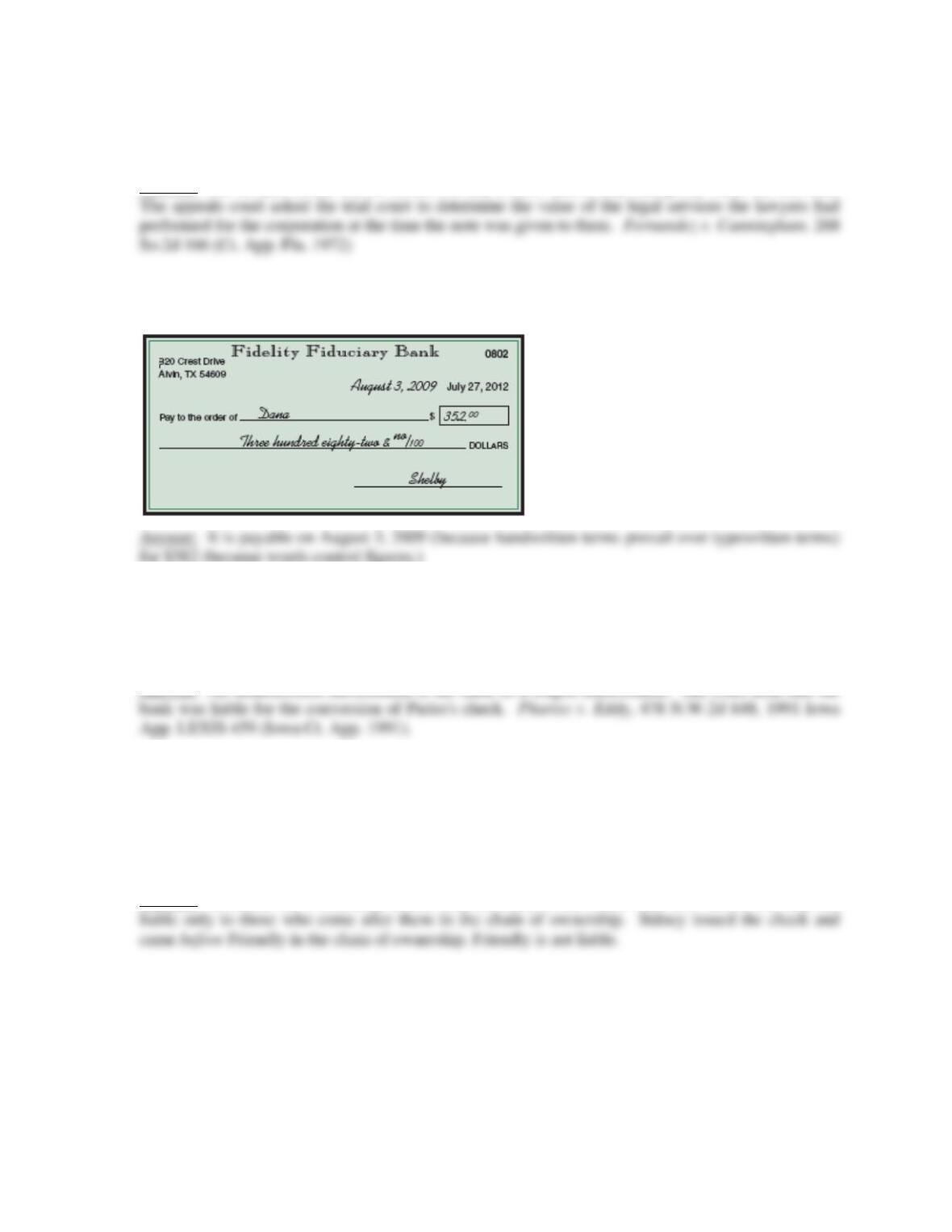
4. Shelby wrote the following check to Dana. When is it payable and for how much?
5. Railroad issued a check to Parris which, somehow, came to be in Eddy’s possession. Eddy indorsed
the check “Railroad Eddy” and deposited it in his own account at Bank. Parris sued Bank, alleging
that it was liable to him for having paid the check over an unauthorized indorsement. Is Bank liable to
Parris? On what theory?
Answer: An unauthorized indorsement is the same as a forged indorsement. The court held that the
6. Sidney entered into a contract for $35,000 with MacDonald Roofing Co., Inc., to reroof his building.
Sidney made his initial payment by writing a check for $17,500 payable to “MacDonald Roofing
Company, Inc., and Friendly Supply Company.” MacDonald took the check to Friendly and
requested an indorsement, which Friendly provided. When MacDonald failed to complete the roofing
work, Sidney filed suit for damages against Friendly. Sidney argued that Friendly was liable as an
indorser. Do you agree?
Answer: Indorsers are secondarily liable; they must pay if the issuer does not. However, they are
7. Using her company’s check-signing machine, Doris forged $150,000 of checks on the account of her
employer, Winkie, Inc. One of Doris’s jobs at the company was to prepare checks for the company
president, Willie, to sign. He did not (1) look at the sequence of check numbers; (2) examine the
monthly account statements; or (3) reconcile company records with bank statements. Willie’s bank, as
a matter of policy, did not check indorsements on checks with a face value of less than $1,000. By
accident, it paid a forged check that had not even been indorsed. Is the bank liable to Winkie, Inc., for
the forged checks?
Chapter 14 Negotiable Instruments 21
Answer: The court found for the bank on the grounds that the owner of the company had been
8. ETHICS When Steven was killed in an automobile accident, he left his wife, Debra a life insurance
policy for $60,000. She decided to move from Bunkie to Sulphur, Louisiana. Debra executed a
document authorizing her mother-in–law, Helen, to sign checks on Debra’s account at the bank. Debra
also signed several blank checks and gave them to Helen with instructions to use them to pay off the
remaining debt on Debra’s trailer. When Helen received the life insurance checks, she deposited them
in Debra’s account. So far so good. But then she immediately withdrew $50,000 from the account by
using one of the blank checks Debra had left her. She did not use these funds to pay off the trailer
debt. When Debra discovered the theft, she sued the bank for having paid an unauthorized check.
How would you rule in this case? Debra has suffered a grievous loss—her husband died tragically in
an automobile accident. She trusted her mother-in-law and counted on her help. Should the bank
show compassion? If the bank made good on the forged checks, how great would be the injury to the
bank’s shareholders compared with the harm to Debra if she loses this entire sum?
Discussion Questions
1. In the Buckeye case, the court ruled that Buckeye was not a holder in due course and the check was
not valid because Buckeye should have checked with Sheth’s bank before buying the check. Would
this remedy have worked? What could Buckeye have done to protect itself?
Answer: Buckeye bought the check on October 13. At that point, Sheth had not stopped payment.
2. In the Antuna case, the Antunas were foolish to sign an agreement with an unlicensed contractor to
install aluminum siding. There is no evidence that TMS was acting in bad faith. Why should it suffer
for the Antunas’ mistake? What could TMS have done to protect itself?
3. Recall the Quimby case. This type of fraud is increasingly common. What could Quimby have done
to protect himself?
Answer: When dealing with strangers, only accept cashier’s checks. In this case, Quimby obtained a
22 Unit 2 Contracts and the UCC
4. Catherine suffered serious physical injuries in an automobile accident and became acutely depressed
as a result. One morning, she received a check for $17,400 in settlement of her claims arising out of
the accident. She indorsed the check and placed it on the kitchen table. She then called Robert, her
long-time roommate, to tell him the check had arrived. That afternoon, she jumped from the roof of
her apartment building, killing herself. The police found the check and a note from her, stating that
she was giving it to Robert. Had Catherine negotiated the check to Robert?
Answer: The court held that Catherine had negotiated the check to Robert. By indorsing the check
5. Banks are liable for forged checks except in the case of the three rules (Imposter Rule, Fictitious
Payee Rule, and the Employee Indorsement Rule). Do you think this is the proper allocation of
liability? Why should banks be liable for forged checks, in this era of automated check machines?
Alternatively, could you argue that the three rules provide too much protection to banks?