Chapter 14
NEGOTIABLE INSTRUMENTS
1
Suggested Additional Assignments
Writing Exercise
Ask students to write their own mystery story modeled on the vignette that opens the chapter. This
exercise will help them consolidate their grasp of the material in the chapter. In class, ask them to break
into groups and share their stories with the group. They will then select the best story from their group to
read aloud to the class.
Research: Indorsements
of the indorsements to class.
Research: Literary References
Ask students to look at the pictures of the checks on pp. 559 and 561 and answer these questions: Who
Research: Biometric Authentication
Have students research biometric authentication of check-cashing and other financial transactions. What
Field Work: Completing Checks
Ask students to bring in an original or photocopy of a check that they or someone else has filled out. (The
purpose is to determine if there is a standard method for filling out checks.)
Chapter Overview
Chapter Theme
This chapter lays the foundation for the three chapters on negotiable instruments. Students will learn the
important fundamentals: the types of negotiable instruments, the concept of negotiability, and the rights of
Quote of the Day
“A negotiable bill or note is a courier without luggage.” –John B. Gibson, Overton v. Tyler, 3 Pa. 346,
347 (1846).
Commercial Paper
Commercial paper is a contract to pay money. It is used as a substitute for money or a loan of money.
2 Unit 2 Contracts and the UCC
The Role of Commercial Paper
Students use commercial paper all the time, without realizing its legal name. Everyone in the class will
have written or received a check at some point.
Question: What types of commercial paper have you used in the last month?
Answer: Possible answers include promissory notes, certificates of deposit, checks, cashier’s checks, and
traveler’s checks.
Question: Have you ever signed a promissory note? For what purpose?
Answer: Possible answers include student loans and car loans.
Types of Negotiable Instruments
Notes vs. Drafts
It is important for students to be clear on the difference between a note and a draft.
Question: What is the difference between a note and a draft? Who are the players?
Question: How many players are involved in a note and draft, respectively?
The Fundamental “Rule” of Commercial
Paper
The fundamental “rule” of commercial paper is:
The possessor of a piece of commercial paper has an unconditional right to be paid, as long as
Negotiable
Fundamental Rule Part (1): The paper is negotiable
What is the legal effect of commercial paper not being negotiable? Simply this: the possessor of non–
negotiable paper has the same rights as the person who made the original contract, and the exercise of
those rights is conditional on the rights of the original party to the contract. If the original payee loses his
rights to be paid, the holder of non-negotiable commercial paper also loses his rights to be paid. The
possessor of negotiable commercial paper has more rights than the person who made the original contract.
If the possessor is a holder in due course, his exercise of those rights is not conditional on the rights of the
original party to the contract.
Question: What does the Code require to create a negotiable instrument?
Answer: UCC §3-104(a) states that to be negotiable an instrument must:
Chapter 14 Negotiable Instruments 3
Question: Why are these requirements essential for negotiability?
Question: Why is a negotiable instrument like a courier without luggage?
Answer: The possessor of non-negotiable commercial paper has the same rights as the person who
Question: Is the quote completely accurate?
You Be the Judge: Blasco v. Money Services Center1
Facts: Christina Blasco entered into a “payday loan” with Money Services Center (MSC). MSC loaned
Blasco $500 and return Blasco left MSC with a signed check for $587.50 which it promised not to cash
for two weeks. (Note that Blasco is laying 17.5% interest for a two-week loan, which is an annual
compounded rate of 6500%.)
Before MSC could cash the check, Blasco filed for bankruptcy. Although MSC knew this, it
deposited the check. It is illegal for creditors to attempt to collect a debt once a debtor has filed for
bankruptcy, but creditors are entitled to payment on negotiable instruments.
The numerical amount on Blasco’s check was $587.50, but the amount written in words was “five
eighty-seven and 50/100 dollars.” Did the words mean “five hundred eighty-seven” or “five thousand
eighty-seven”? Was the check negotiable despite this ambiguity?
You Be The Judge: Was this check a negotiable instrument? Was it for a definite amount?
Holding: Yes, the note was negotiable, it was for a definite amount. According to the court, to
determine whether the check was a negotiable instrument, it must state a promise to pay a definite amount
of money. The numerical amount of the check was “$ 587.50″, but the amount stated in words was “five
eighty-seven and 50/100 dollars.” For the words to prevail over the numbers, the two have to be
contradictory. The words “five eighty-seven and 50/100 dollars” did not contradict the numbers $587.50;
the numbers clarified the ambiguity in the words.
Question: To be negotiable, what must a note look like?
Answer: It must:
Question: Was this note in writing?
Question: Was it signed by Blasco?
Question: Did it contain an unconditional promise or order to pay?
1 2006 Bankr. LEXIS 2899, United Stated Bankruptcy Court for the Northern District of Alabama, 2006.
4 Unit 2 Contracts and the UCC
Question: Presumably Blasco knew the amount of the check, after all she wrote it. Why then did she
sue saying the check was not negotiable?
Negotiated
Fundamental Rule Part (2): The paper has been negotiated to the possessor
Negotiation is the transfer of an instrument to a holder by someone other than the issuer. (Remember that
“issuer” means both the maker of a note and the drawer of a draft.) To be negotiable, order paper must
be indorsed and then delivered to the transferee, and bearer paper must be delivered to the transferee.
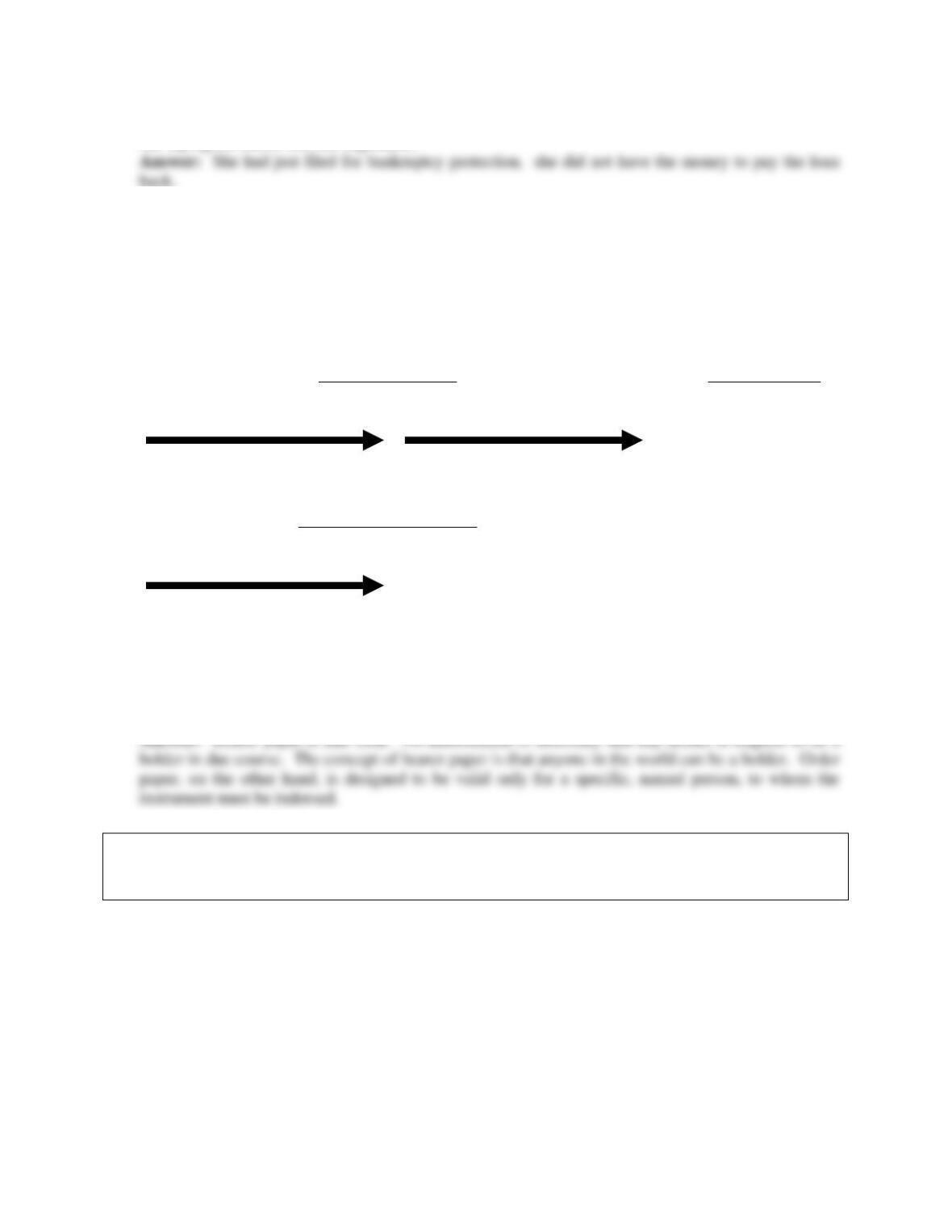
NEGOTIATED PAPER
CONSEQUENCES
Issuer (maker or
drawer)
Payee or drawee
Holder (possessor)
Note or draft
Received from issuer,
later transferred to
Issuer liable to holder
regardless of any
claims it has against
payee or drawee
NON-NEGOTIATED PAPER
Issuer (maker or
drawer)
Payee or drawee
Note or draft
Received from issuer
Issuer’s liability
subject to any claims
it has against payee
or drawee
To be negotiated, order paper must first be indorsed and then delivered to the transferee by someone other
than the issuer. Bearer paper must simply be delivered to the transferee; no indorsement is required.
Question: What are the differences between order paper and bearer paper?
Research: Indorsements
If students undertook the indorsements research, copy some samples on the board and ask students to
identify the different types.
Holder in Due Course
Fundamental Rule Part (3): The possessor is a holder in due course
A holder in due course has an automatic right to receive payment for a negotiable instrument unless the
issuer can claim a limited number of real defenses. In other words, a holder in due course has a greater
probability of being paid than a mere holder—a fact that gives negotiable instruments tremendous value
and fuels market demand for them.
Question: What are the requirements for a holder in due course?
Chapter 14 Negotiable Instruments 5
Answer: A holder in due course is a holder who has given value for the instrument, in good faith,
Question: Why are holders in due course entitled to this special treatment?
Answer: The theme throughout this chapter is that an instrument has little value unless the holder
Note in particular that in defining a holder in due course, value has a different meaning than it does in the
contract law concept of consideration (see text, Chapter 12, Consideration). Under the common law of
contracts, a promise to do something in the future can be consideration, but that would not be value
supporting a holder in due course. Here, value means that the holder has already done something in
exchange for the instrument.
Case: Buckeye Check Cashing, Inc. v. Camp2
Facts: On October 12, Shawn Sheth and James Camp agreed that Camp would provide services to Sheth
by October 15. In payment, Sheth gave Camp a check for $1,300 that was postdated October 15. On
October 13, Camp sold the check to Buckeye Check Cashing for $1,261.31. On October 14, fearing that
Camp would violate the contract, Sheth stopped payment on the check. Also, on October 14, Buckeye
deposited the check with its bank, believing that the check would reach Sheth’s bank on October 15.
Buckeye was unaware of the stop payment order. Sheth’s bank refused to pay the check. Buckeye filed
suit against Sheth.
The trial court ruled that, because Buckeye was a holder in due course, the check was valid and Sheth
had to pay Buckeye. Sheth appealed.
Issues: Was Buckeye a holder in due course? Must Sheth pay Buckeye?
Excerpts from Justice Donovan’s Decision: At issue is whether Buckeye acted in “good faith” when it
chose to honor the postdated check originally drawn by Sheth. “Honesty in fact” is defined as the absence
Check cashing is an unlicensed and unregulated business in Ohio. Thus, there are no concrete
commercial standards by which check-cashing businesses must operate. Buckeye argues that its own
internal operating policies do not require that it verify the availability of funds, nor does Buckeye
apparently have any guidelines with respect to the acceptance of postdated checks.
Under a purely subjective “honesty in fact” analysis, it is clear that Buckeye accepted the check from
2 159 Ohio App. 3d 784; 825 N.E.2d 644; 2005 Ohio App. LEXIS 929 COURT OF APPEALS OF OHIO, 2005
6 Unit 2 Contracts and the UCC
This court in no way seeks to curtail the free negotiability of commercial instruments. [However,
without] taking any steps to discover whether the postdated check issued by Sheth was valid, Buckeye
failed to act in a commercially reasonable manner and therefore was not a holder in due course.
Judgment reversed, and cause remanded.
Question: Where did Buckeye go wrong?
Question: Was Buckeye a holder in due course?
Additional Case: Rosenbaum v. Bulow3
Facts: Maude Rosenbaum wanted to post bail to get out of prison. Harvey Bowen agreed to post bail of
$7,500 in return for a $7,500 promissory note signed by Rosenbaum and secured by her house. Bowen
was not a licensed bondsman and therefore, under state law, was not entitled to any payment for posting
bail. To solve this problem, Bowen asked Rosenbaum to sign a second note to his niece’s husband, W. F.
Bulow (who was not a bondsman, either).
Issues: Did Bulow give value for the promissory note? Did he act in good faith?
Holding: Bulow cannot collect on the note. At best, Bowen was trying to make a gift to Bulow of his
illegally obtained profit. Bulow did not give value to Rosenbaum. Nor did Bulow act in good faith. He
could not have believed that Rosenbaum simply wanted to make a gift to him of $7,500. If he did not
already know why she was signing the note to him, he should have investigated.
Question: What did Rosenbaum and Bowen agree to do?
Question: What does “secured by her house” mean?
Question: Is this arrangement fair?
Answer: No. As long as Rosenbaum returns to prison when ordered by the court, Bowen will get his
Question: Is this arrangement with Rosenbaum legal?
Answer: No. Only licensed bail bondsmen can receive payment for posting bond.
Question: Why did Rosenbaum agree to Bowen’s deal?
Question: Why did Bowen ask Rosenbaum to sign a second note to Bulow?
Question: Could Bulow enforce the second note?
value nor acted in good faith.
Question: Why hadn’t he given value?
3 1997 Bankr. LEXIS 555 United States Bankruptcy Court for the Eastern District of North Carolina, 1997
Chapter 14 Negotiable Instruments 7
Question: Why hadn’t he acted in good faith?
Question: Both Bowen and Rosenbaum were wrong. She reneged on the deal; he illegally accepted
a bond fee. Why should Rosenbaum win?
Notice of Outstanding Claims or Other Defects
In certain circumstances, a holder is on notice that an instrument has an outstanding claim or other defect.
Additional Case: Hartford Accident & Indemnity Co. v. American Express Co.4
Facts: Stratford Skalkos was a manager at Avon Products. He issued Avon checks to pay his personal
debts. So that no one in the company would know what he was doing, he disguised the name of the
payees. For example, to pay his American Express bill, he issued an Avon check to “Amerex Corp.”
Avon sued the recipients of the checks, demanding that the funds be returned. The trial court ruled
against Avon and granted defendants’ motion for summary judgment, concluding that defendants were
holders in due course and thus took the checks free of any claims or defenses. Avon appealed.
Question: Is this a fair result?
Answer: As the court observed, Avon was the company that (1) had hired a dishonest employee and
Avon is certainly more at fault than American Express.
Question: Should American Express have been on notice when it received checks payable to
Amerex? Similarly, should the Metropolitan Opera Company have wondered why it got checks made
out to “Metropolitan Oprtg. Co.?”
Additional Example
A financial columnist for the Chicago Tribune received this question from a reader:
I received a promissory note and accompanying letter (copies enclosed). The letter attests to the
legitimacy and negotiability of the note, which is for $1 million. Is this really a valid document? Can I
convert this to cash before the maturity date? 5
The note was for one million dollars, payable 20 years later.
Question: If you received such a promissory note in the mail, what difficulties might you have in
enforcing it? Are you a millionaire?
Answer: First, the person who signed the note does not have to pay you anything for 20 years. Even if
4 74 N.Y.2d 153, 542 N.E.2d 1090, 1989 N.Y. LEXIS 881 New York Court of Appeals, 1989
5 “Promises, Promises! But Will They Make You a Millionaire?” by Phil Vettel, Chicago Tribune, Feb. 24, 1985, p.
2.
8 Unit 2 Contracts and the UCC
Third, suppose you sell the note to a third party. The buyer would argue that she can enforce the note
because she has given value and is, therefore, a holder in due course. The maker of the note would claim,
Defenses against a Holder in Due Course
Fundamental Rule Part (4): the issuer cannot claim any of a limited number of “real”
defenses
Real Defenses: valid against both a holder
and a holder in due course
Personal Defenses: valid only against a
holder
Forgery
Bankruptcy
Breach of contract
Lack of consideration
Real Defenses vs. Personal Defenses
Question: Why are both real and personal defenses valid against a holder; but only real defenses are valid
against a holder in due course? What is the difference between real and personal defenses?
Answer: Real defenses deal with fundamental challenges to the basic validity of the instrument itself.
Question: In the discussion of personal defenses in the text (p.547), why is Ross a “mere holder,” and
not a holder in due course?
Answer: A holder in due course must take an instrument in good faith, for value, without notice of
The Fundamental “Rule” of Commercial Paper, Revisited
If, at the beginning of class, you asked students to name examples of commercial paper that they have
used in the last month, you may want to ask the following question now.
Question: Does the holder of this commercial paper have an unconditional right to be paid?
Answer: To answer this question, students would have to decide:
• Is the paper negotiable?
Chapter 14 Negotiable Instruments 9
Consumer Exception
A consumer credit contract is one in which a consumer borrows money from a lender to purchase goods
and services from a seller who is affiliated with the lender. No one can be a holder in due course of an
instrument that contains the FTC consumer exception language.
Case: Antuna v. Nescor, Inc.6
Facts: Steven Vlohotis was a salesman for NESCOR, a home improvement company. He convinced the
Antunas to sign a consumer credit contract with NESCOR to install vinyl siding and windows. The
contract provided that the Antunas would pay for the improvements in installments. NESCOR assigned
the contract to First Consumer Credit, LLC, which reassigned it to The Money Store (TMS). In keeping
with FTC requirements, the contract contained the following language: “Any holder of this consumer
credit contract is subject to all claims and defenses which the debtor could assert against the Seller of the
goods or services pursuant hereto or with the proceeds hereof.”
Issue: Does TMS have the right to foreclose on the Antunas’ home? Was TMS a holder in due course?
Excerpts from Judge Shortall’s Decision: In employing Vlohotis to call on the plaintiffs as its salesman
NESCOR was performing an illegal act, one explicitly prohibited. Accordingly, the court finds that
NESCOR’s material noncompliance with [the statute] renders the home improvement contract invalid and
unenforceable and precludes it from enforcing the consumer credit contract against the plaintiffs.
The plaintiffs are seeking summary judgment against TMS on its counterclaim, which seeks to
foreclose upon the plaintiffs’ home because of their default under the consumer credit contract now held
Question: What caused the contract with NESCOR to be invalid?
6 2002 Conn. Super. LEXIS 1003, SUPERIOR COURT OF CONNECTICUT, 2002
10 Unit 2 Contracts and the UCC
and since NESCOR was not registered, the contract was invalid.
Question: Is this a harsh penalty for The Money Store or should they have verified that NESCOR
was in fact registered?
Additional Case: Scott v. Mayflower Home Improvement Corp.7
Facts: Mary Johnson signed a contract with Mayflower to perform repair work on her home for a fee of
$25,900. Mayflower arranged for Johnson to pay for this work by borrowing money from Sterling
Resources. The note she signed with Sterling had an unconscionably high price of $50,108.60 and an
interest rate of 17.98%.
Johnson alleges that Mayflower was running a scam, hiring unlicensed salespeople to target minority
Johnson failed to make the payments due on the note and the Lender sued, moving for summary
judgment against Johnson on the grounds that, as a holder in due course, it was entitled to enforce the
note regardless of her claims against Mayflower or Sterling. She responded that, under the FTC
consumer exception rule, the Lender was not a holder in due course and therefore subject to whatever
defenses she had against Sterling or Mayflower.
Issue: Was the Lender a holder in due course?
Holding: No, summary judgment is denied for the Lender but granted for Johnson. The purpose of the
FTC Holder Rule is to protect innocent consumers from unethical merchants and their financiers. The
note that Johnson signed contained the FTC Holder notice. Therefore, the Lender was on notice and is not
a holder in due course.
Question: What was going on in this case?
Question: Why didn’t Mayflower keep the note that Mary Johnson signed?
raise defenses against it.
Question: Was the Lender, in the end, a holder in due course?
Question: Why did Mayflower and the Lender think they could enforce a note that contained this
Suggested Additional Assignment: Writing Exercise
If you asked students to write their own mystery story modeled on the vignette that opens the chapter, this
would be an appropriate time to ask them to break into groups and share their stories with the group. They
could then select the best story from their group to read aloud to the class.
Chapter 14 Negotiable Instruments 11
Liability for Negotiable Instruments
The liability of someone who has signed an instrument is called signature liability. The liability of
someone who receives payment on an instrument is called warranty liability.
Primary versus Secondary Liability
More than one person may be liable on the same negotiable instrument. Someone with primary liability
is unconditionally liable – he must pay unless he has a valid defense. Those with secondary liability
must pay only if the person with primary liability does not.
Additional Case: You Be The Judge: Messing v. Bank of America8
Facts: Jeff Messing attempted to cash a check for $976 at a Bank of America branch office. The check
was made out to Messing and drawn on the Bank of America. A teller asked Messing to provide
identification. Messing presented his driver’s license and a major credit card but Bank of America policy
required a thumbprint signature from anyone wishing to cash a check who did not have an account at the
bank. When Messing declined, the teller refused to cash the check.
You Be the Judge: Was the bank’s thumbprint policy permissible under the UCC? Had Messing
provided reasonable identification?
Holding: Judgment for Bank of America affirmed. Providing a thumbprint signature may not confirm
Question: Why didn’t Messing just deposit the check in his own checking account instead of trying
to cash it at a bank where he had no account?
Answer: If Messing deposited the check in his account and it bounced, Messing’s bank would
Question: Is there anything wrong with that?
Answer: No, not at all.
Question: Why did Messing refuse to provide a thumbprint?
Question: What is the trade-off in this case?
Question: Who should win this case?
Biometric Authentication
Students who have completed the biometric authentication assignment should relate their findings now.
Signature Liability
Once you sign an instrument, you are potentially liable for paying it. However, liability depends upon the
capacity in which you sign–the liability of an indorser is different from that of a maker, for instance.
• The maker of a note is primarily liable. If two makers sign a note, they are both jointly and
severally liable.
8 373 Md. 672, 2003 Md. LEXIS 155 Court of Appeals of Maryland, 2003