Biodiversity through Earth History
Learning Objectives
After reading this chapter, students should be able to:
• Understand how the diversity of life has changed though Earth history.
• Understand the ways in which paleontologists measure diversity.
• Know how species origination and extinction affect diversity.
• Understand why paleontologists and biologists define organisms differently.
• Realize there is a sampling bias created by changes in the abundance of sedimentary
rocks through time.
• Know why it is important to measure diversity at various taxonomic levels.
• Know there have been at least 5 major mass extinctions in Earth’s history.
• Offer proposed explanations for the K-T (Cretaceous-Tertiary) mass extinction.
• Explain the evidence that supports an extraterrestrial impact as the most likely
cause of the K-T mass extinction.
• Realize the environmental consequences of a 10-km impact event.
• Discuss some proposals that link periodicity in extinction rates to extraterrestrial
events.
• Quantitatively understand the relationship between impact size and impact
frequency.
Review Questions
1.) How do paleontologists deal with the incomplete nature of the fossil record to
establish a geologic history of biodiversity changes?
Because the incomplete nature of the fossil record could lead to the absence of fossils
of species that were present at a given time, paleontologists measure diversity
2.) What two processes cause the diversity of life on Earth to change through time?
CH
APTER
13
2
3.) How has fossil diversity changed over time? Why do diversity trends differ
among taxonomic levels?
There has been a general increase in diversity, punctuated by more rapid intervals
of diversity decline and recovery. Diversity trends depend on taxonomic levels
4.) What explanations have been proposed for the mass extinction at the K-T
boundary? Why is a meteorite the favored theory today?
Among the suggested causes for the K-T mass extinction are changes in sea level,
5.) What are the environmental consequences of the impact of a 10-km-diameter
meteorite with Earth?
There are a number of disastrous environmental consequences, such as
6.) What are some other hypotheses for mass extinctions?
Critical-Thinking Problems
3
1.) Here you will calculate the change in a population of organisms (N) as a result of
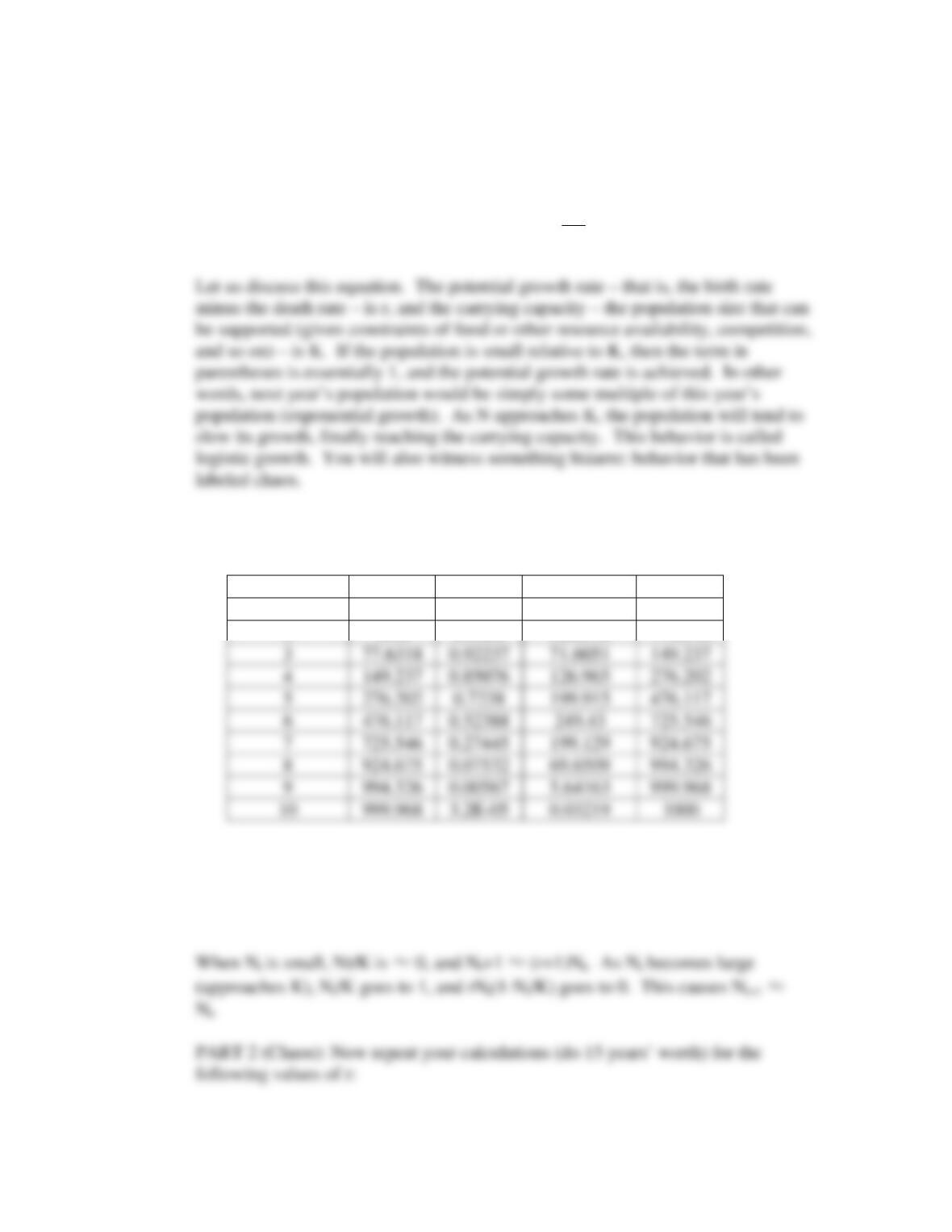
births and deaths. A mathematical expression can be used to calculate next year’s
population (Nt+1) on the basis of this year’s population (Nt), where t = years.
⎟
⎠
⎞
⎜
⎝
⎛−+=
+K
N
rNNN t
ttt 1
1
PART 1 (Logistic growth): Fill in the following table, and then graph Nt versus t;
assume that r = 1.0 and K = 1000.
Time (years) Nt 1-Nt/K rNt(1-Nt/K) Nt+1
1 20 0.98 19.6 39.6
2 39.6 0.9604 38.0318 77.6318
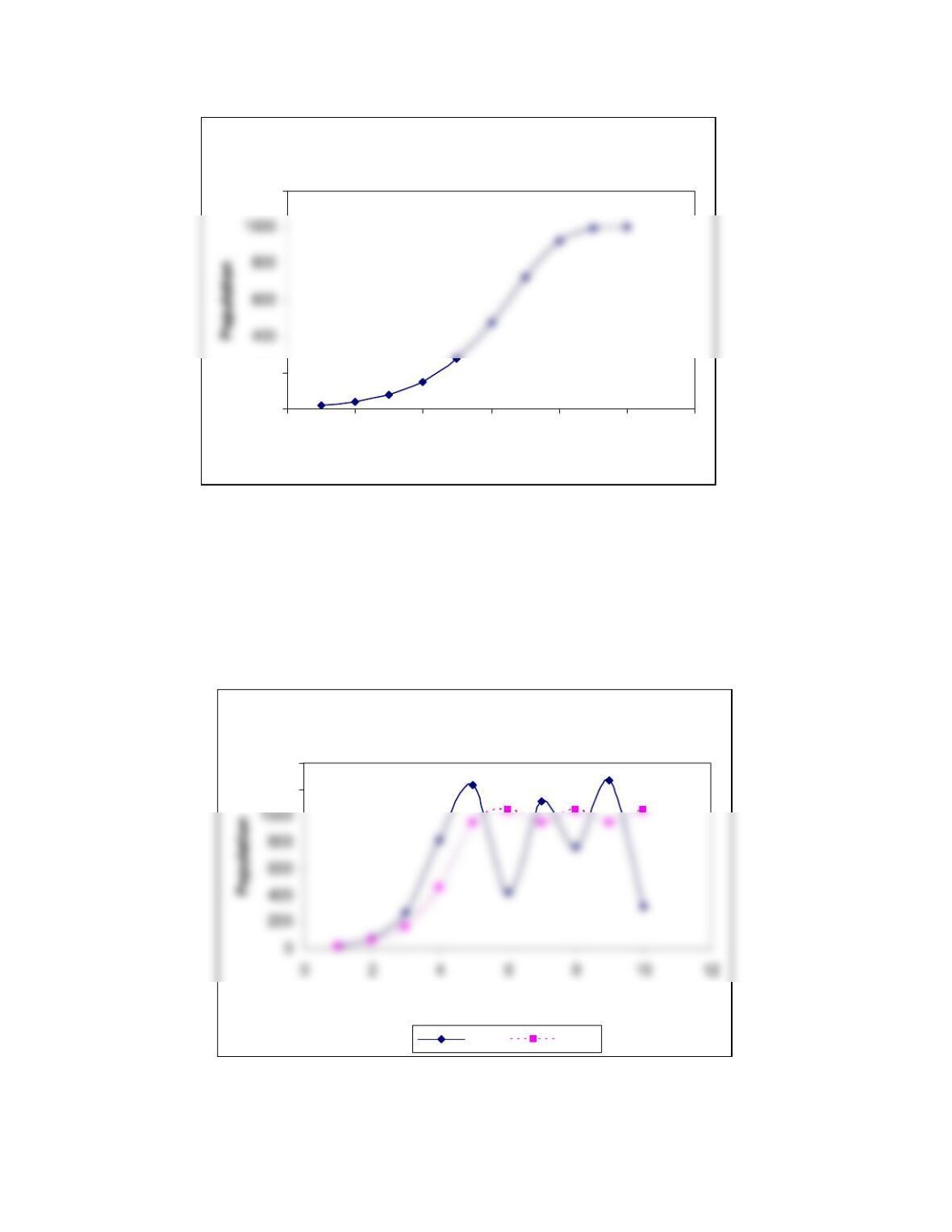
Describe the growth curve, and explain why it has the logistic growth shape (on
the basis of the numbers you calculate).
4
Population Growth vs. Time
1200
1400
Time (years)
r=2.8 r=2.0
Population Growth vs. Time, r = 1.0
0
200
1200
024681012
time (years)
r = 2.0
r = 2.8
Graph your results, either on separate graphs or using different symbols or colors
on the same graph (be sure the graph(s) is(are) legible). If the population growth
rate goes negative, call it quits on that series of calculations; the population has
gone extinct.
Describe how the behavior changes as the growth rate increases from 2.0 to 2.8.
When r = 2.8, the system is described as being chaotic. A scientist who observed
5
this population might conclude that purely random factors are controlling the size
of this population. What is wrong with this conclusion?
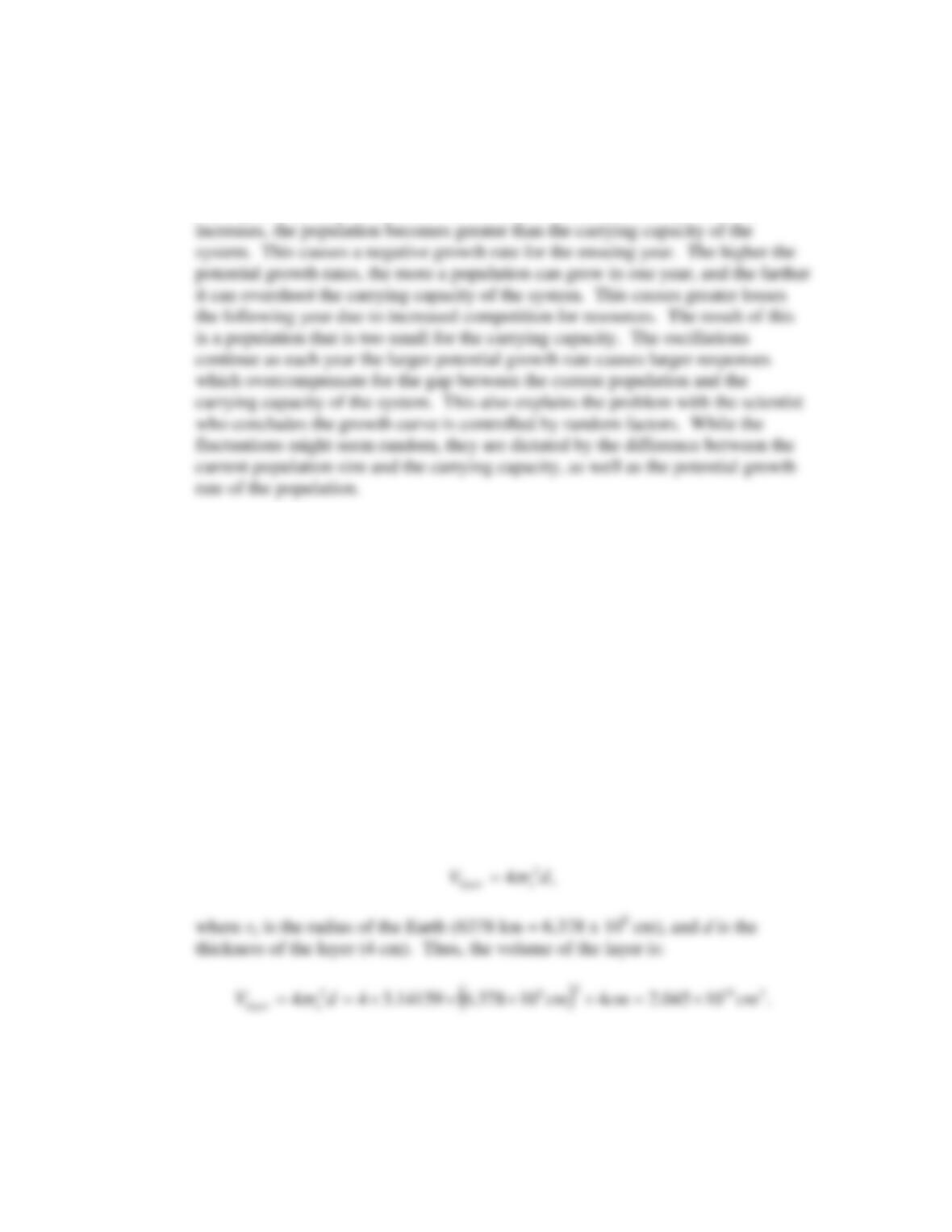
As the potential growth rate increases from 2.0 to 2.8, the population experiences
much greater yearly variations. This is because as the potential growth rate
2.) Perform the calculation that Luis Alvarez used to estimate the size of the K-T
impactor. Use the following information:
a. Assume that the iridium layer was uniformly distributed around Earth by the
impact.
b. On average, the layer had a concentration of iridium of 10 parts per billion (10
ppb) by weight.
c. On average, the layer was 4 cm thick.
d. The density of the layer was 2.5 g/cm3.
e. Assume the meteor was spherical, with a density of 6.0 g/cm3, and an iridium
content of 0.5 parts per million by weight (0.5 ppm).
f. The radius of Earth is 6378 km.
What is the diameter of the meteorite?
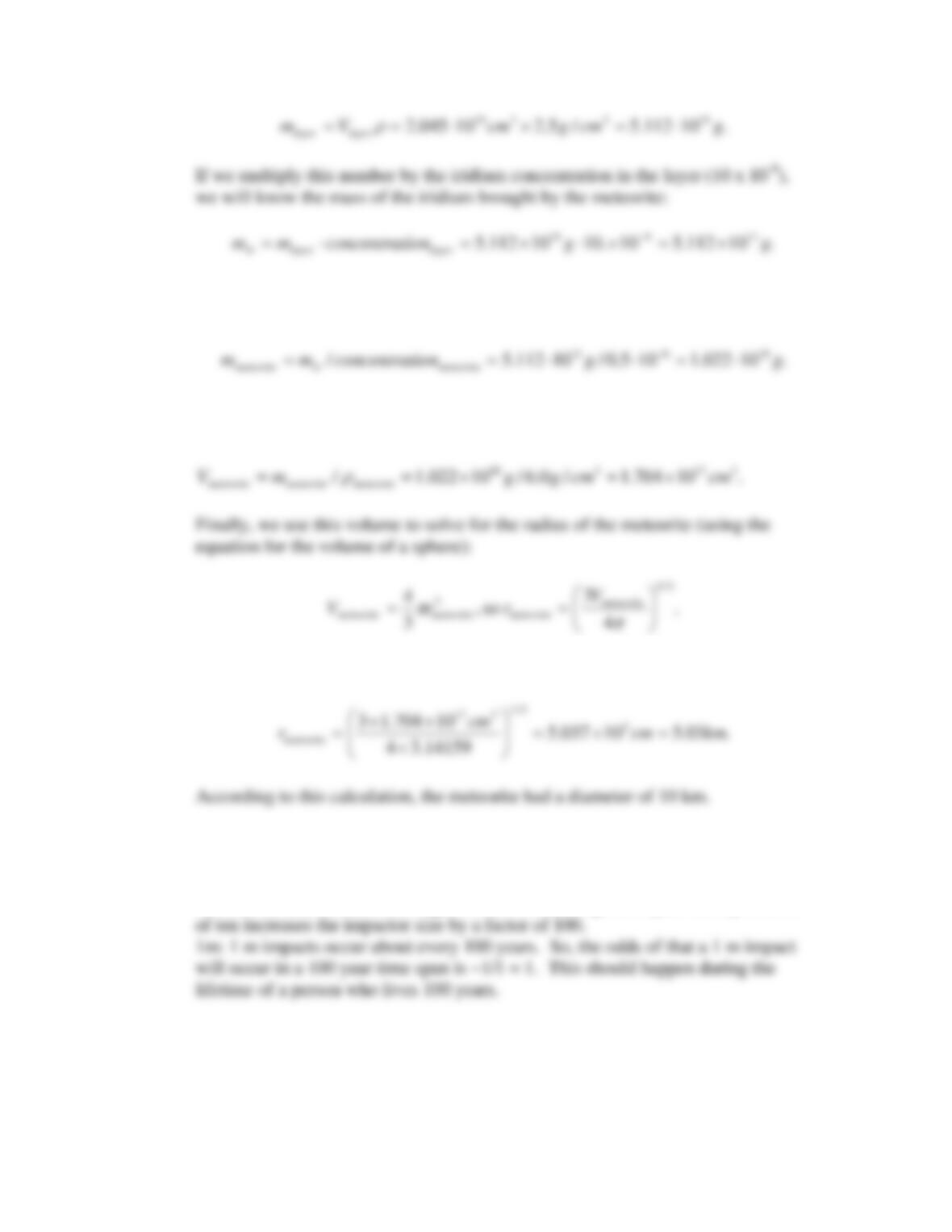
First, we should calculate the amount of iridium brought to Earth by the impactor.
The volume of the layer deposited after the impact is:
Multiplying this volume by the layer’s density (
ρ
layer = 2.5 g/cm3) will give us the
mass of the layer:
6
We can now find the mass of the meteorite by dividing the iridium mass by the
iridium concentration in the meteorite (0.5 x 10⁻⁶):
Dividing the meteorite mass by the meteorite density (
ρ
meteorite = 6.0 g/cm3) will
give us the volume of the meteorite:
Plugging in 1.704 x 1017cm3 for the volume of the meteorite, we get our answer:
3.) Determine the probability that an asteroid of the following diameters will hit
Earth during your (optimistic) 100-year-lifetime: 1 m, 100 m, 10 km.
This can be determined from Figure 13-5. Decreasing the impact rate by a factor
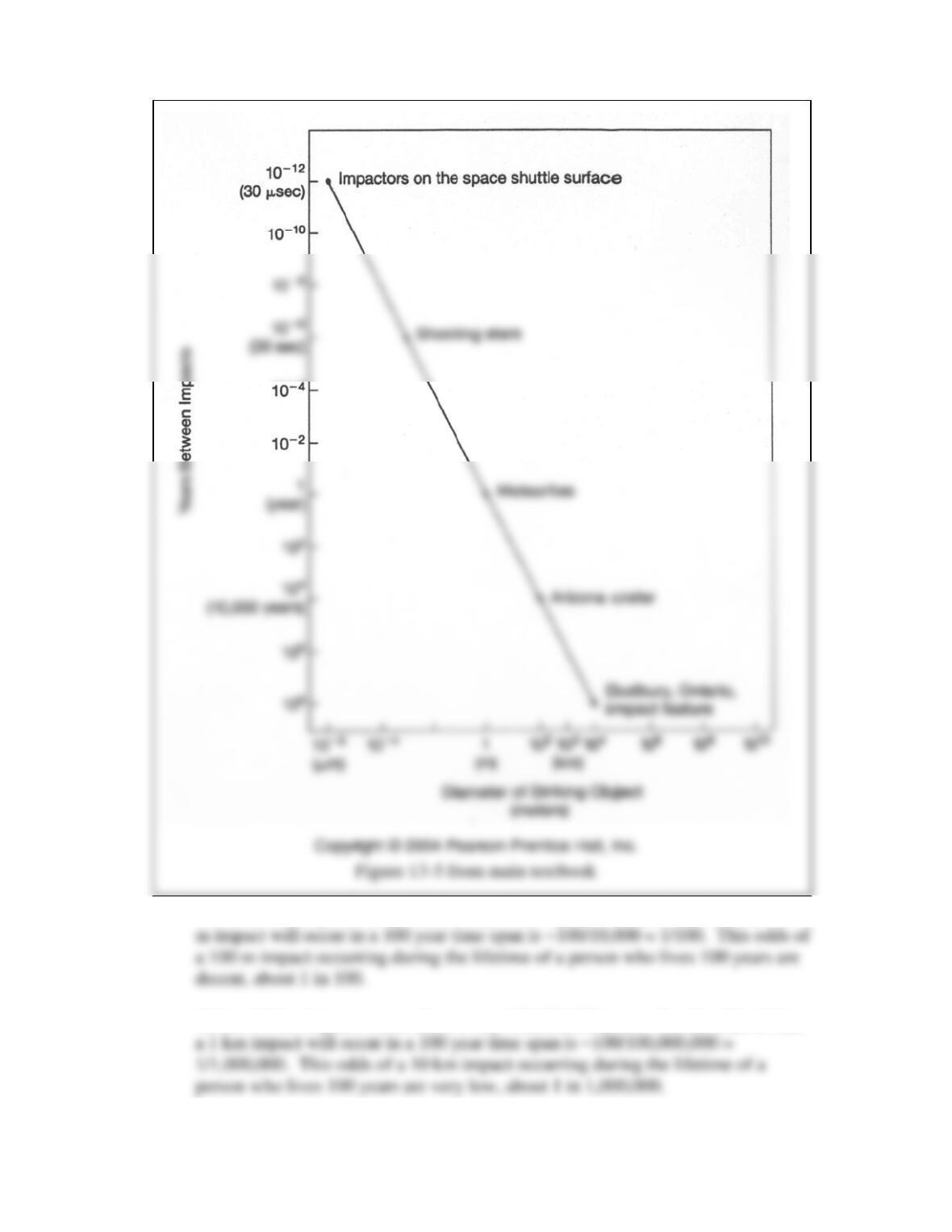
7
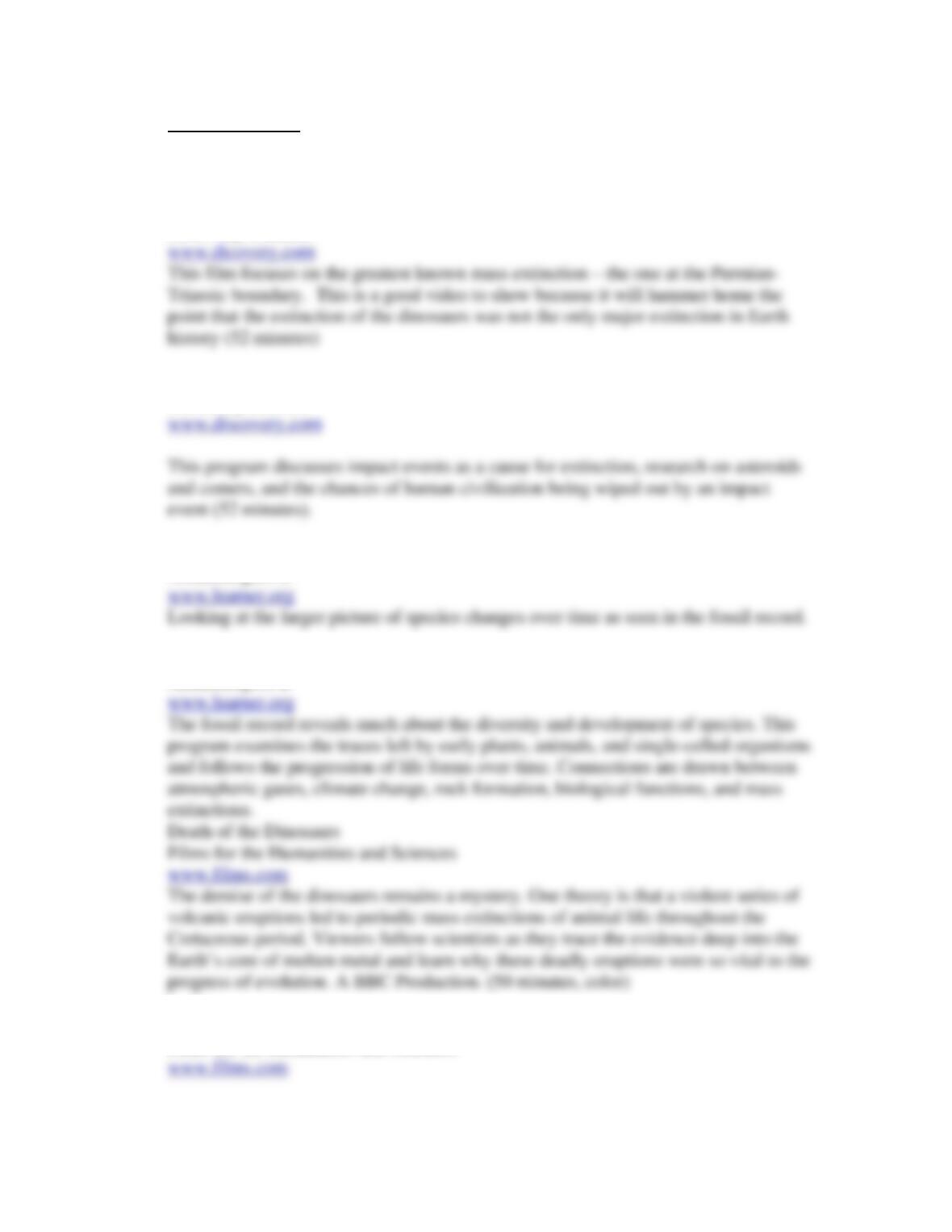
100m: 100 m impacts occur about every 10,000 years. So, the odds of that a 100
10 km: 10 km impacts occur about every 100,000,000 years. So, the odds of that
8
Other Resources
Videos/Films:
The Day the Earth Nearly Died VHS
Discovery Channel
Fireballs from Space VHS
Discovery Channel
Cycles of Life: Exporing Biology, Episode 11. Macroevolution
Annenberg/CPB
Earth Revealed, Episode 11. Evolution Through Time
Annenberg/CPB
The Catastrophic Event
Films for the Humanities and Sciences
9
Something happened on Earth 65 million years ago: the geological strata show a
transitional stage which is coincident with the disappearance of the dinosaurs. More
and more geologists are becoming proponents of the theory of catastrophism: that the
sudden transition which occurred at that time was caused by some catastrophic event,
like a giant meteorite hitting the earth. On the border of the Netherlands with Belgium
and Germany, there is a unique site—a cave, one of whose layers reveals in
considerable detail what actually happened. (14 minutes, color)
Asteroids: Deadly Impact
National Geographic Video
Websites:
The World Resources Institute’s page on biodiversity
http://www.wri.org/biodiv/