QUESTIONS 12, PART A
Groundwater Hydrology
1. What is the average water-level gradient or slope along the eastern flow line of Figure 12.3 between the
200-ft and 50-ft contour? Give your answer in ft/ft and ft/mi and show your work.
2. If an aquifer near the floodplain in the eastern part of Figure 12.3 is 30 ft thick and has a porosity of
10%, how much water is stored in a 0.1 mile by 0.1 mile area of the aquifer? Give your answer in cubic
feet and gallons; show your work (see Appendix A for Conversions).
This is a volume calculation using a simple formula that all students should know: Volume = Width x Length x
3. If the hydraulic conductivity (K) of the aquifer is 150 ft/day, and the effective porosity is 15%, what is
the average groundwater velocity in the vicinity of the eastern flow line? Show your work.
4. On Figure 12.3, construct a groundwater flow line downslope from each of sites A, B, and C. (See the
instructor for other possible sites).
See Figure 12.3; students should use the eastern flow line and the flow line through D as examples.
5. a. If gasoline were spilled at A, would it discharge with groundwater directly into the ocean? Explain.
b. If gasoline were spilled at B, would it discharge with groundwater directly into the ocean? Explain.
c. If gasoline were spilled at C, would it discharge with groundwater directly into the ocean? Explain.
6. In the western part of the aquifer, at and down gradient from D, the hydraulic conductivity is 100 feet
per day and the effective porosity is 30%.
a. What is the average velocity along the flow line from D? Show your work.
b. If the velocity of the groundwater is assumed to also represent the movement of the contaminant, what
is the time required for gasoline spilled at site D to travel to the end of the flow path? Show your work.
7. Using Darcy’s Law, what is the quantity (Q) of groundwater flowing horizontally through a 2ft x 2ft
square of an aquifer with K = 180 ft/day and an hydraulic gradient of 1 ft/1000 ft?
QUESTIONS 12, PART B
Your assignment is to interpret the well logs in Table 12.2, draw a topographic map, draw a geologic
map, draw cross sections that illustrate the subsurface geology, and answer related questions about how
water may move in the subsurface. The distribution of wells is shown on the map in Figure 12.6.
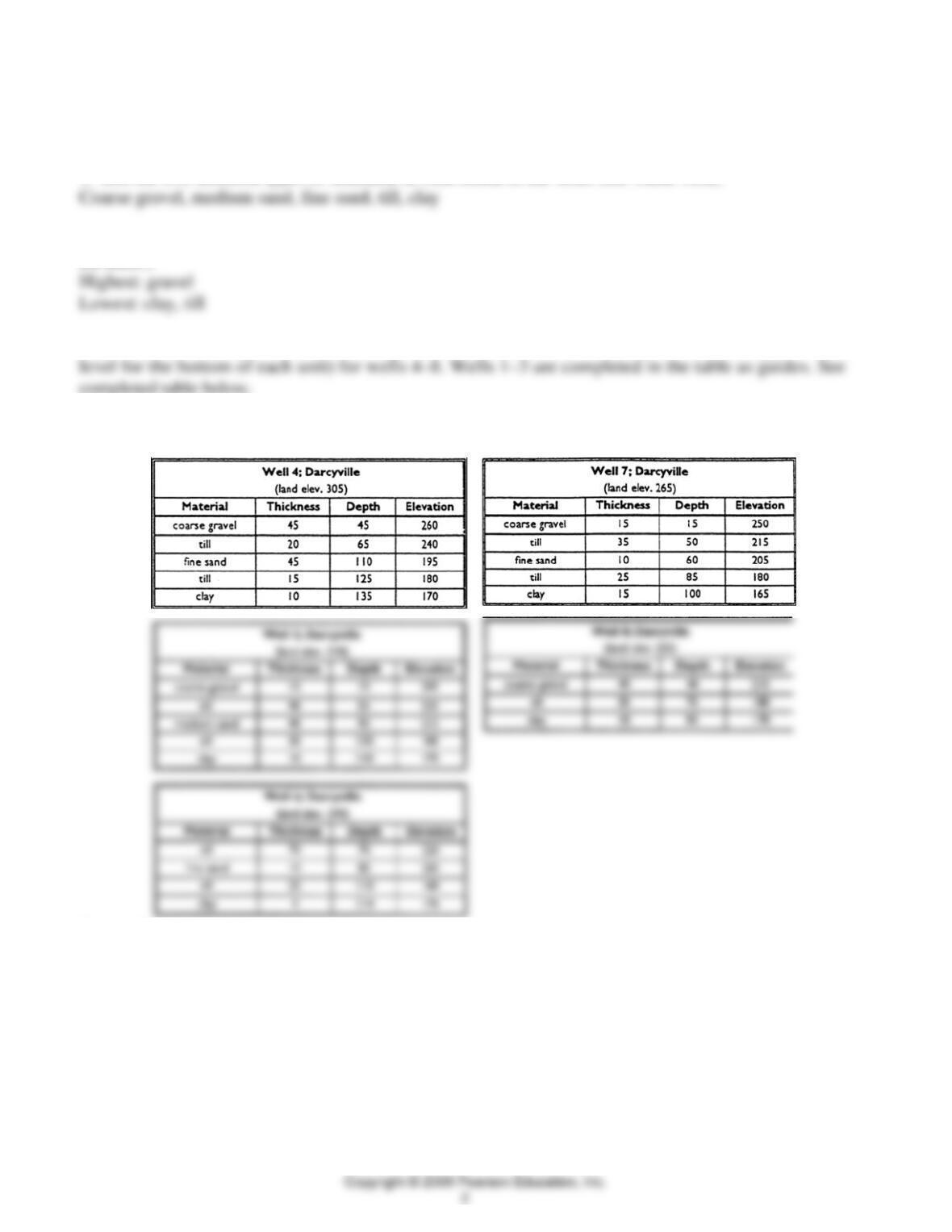
1. List the five different types of sediment or rock found in the wells (see Table 12.2).
2. Which sediment has the highest hydraulic conductivity? Which two have the lowest? (See Table 12.1
for hints.)
3. In Table 12.2, complete the data for Depth (to the bottom of each unit) and Elevation (height above sea
Table 12.2, well logs
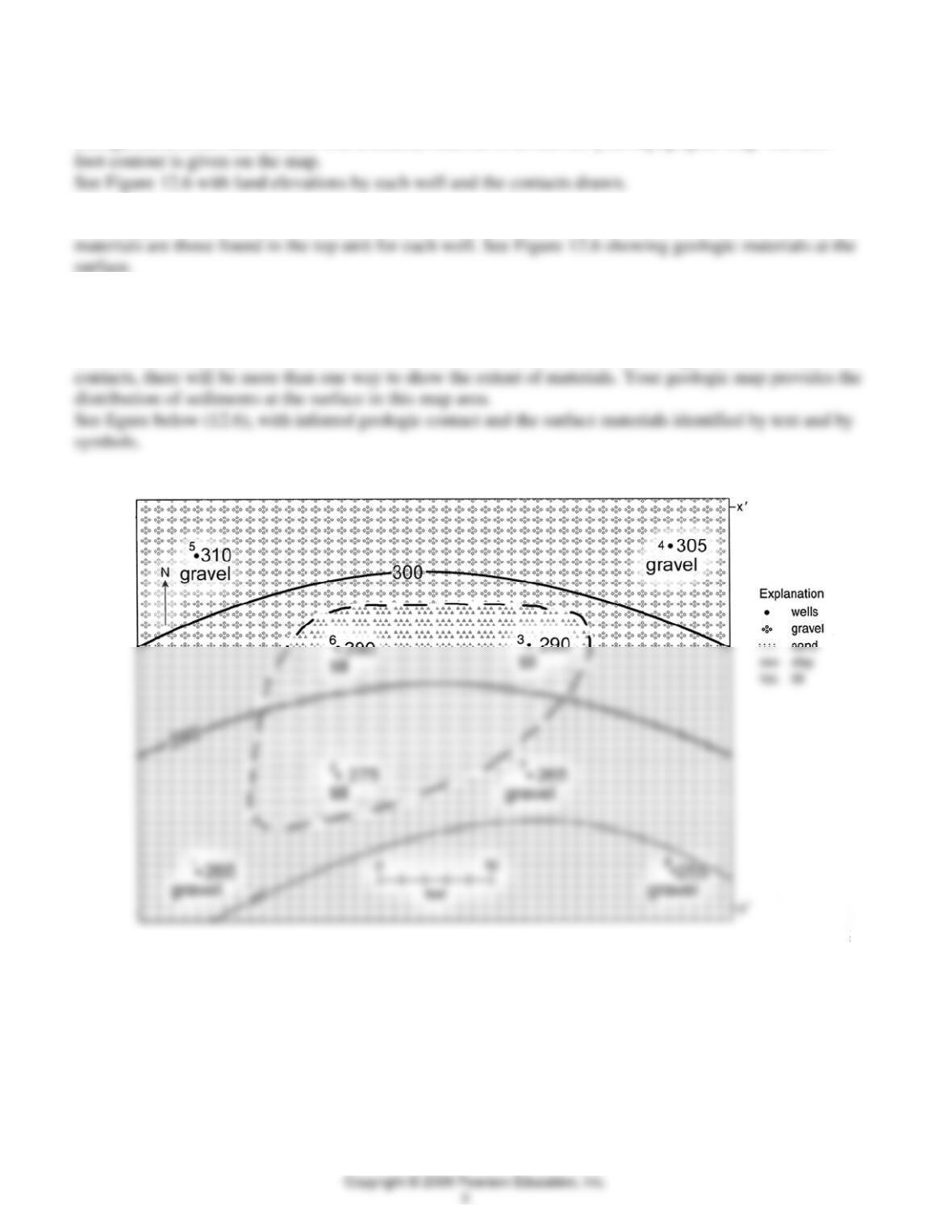
4. On Figure 12.6, put the land elevation beside each well. Draw topographic contours showing the
configuration of the land surface. Use a contour interval of 20 feet for your topographic map. The 260-
5. On Figure 12.6, beside each well, place the name of the material that is found at the land surface. These
6. Make a geologic map of the area in Figure 12.6 by interpreting the distribution of sediment (material)
types and grouping any areas with similar materials. Do this by drawing a line to show the approximate
contact between any two different materials at the surface. Without knowing the exact location of
Figure 12.6, geologic map with contours.
7. Draw two geologic cross sections. The first cross section is through wells 1, 2, 3, and 4. The second
cross section is through wells 5, 6, 7, and 8.
See profiles below. The descriptions for parts a–d will assist the grader.
a. The land surface elevations are marked on the wells and the profile has been drawn of the upper
diagram of Figure 12.7.
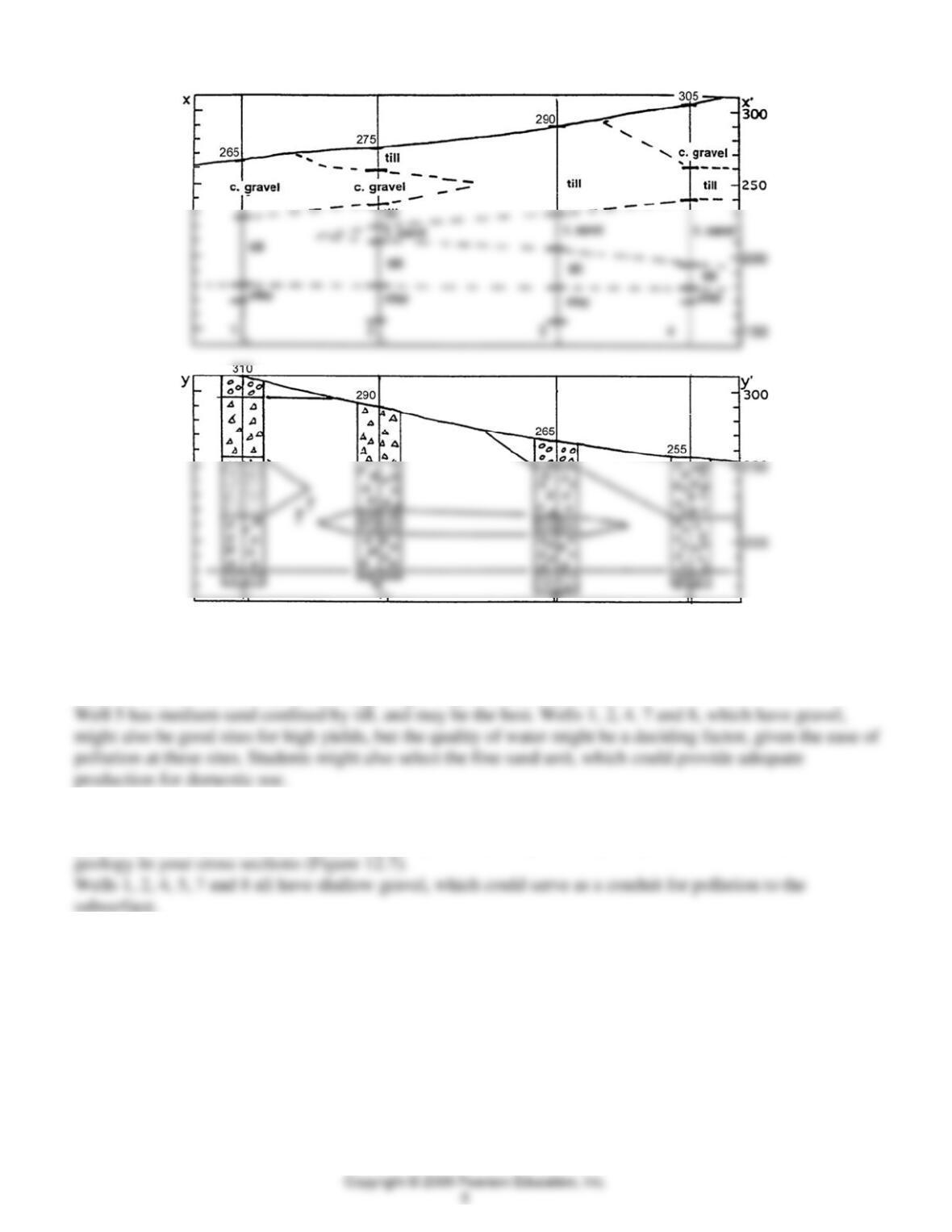
Figure 12.7, geologic profiles.
8. Where is the best location to drill a water well for a house (domestic use well)? Briefly explain your
choice based on the cross sections and geologic map that you constructed.
9. Assuming that all wells obtain water from every sand or gravel unit they intersect, which wells have the
greatest potential for pollution from a nearby spill of toxic liquids? Explain your choices on the basis of the