Long-Term Climate Regulation
Learning Objectives
After reading this chapter, students should be able to:
• Have a grasp of long term climate cycles and the processes that affect climate
fluctuations on timescales of millions of years or greater.
• Know how the sun has evolved over its history, and discuss the impacts this change
has had on the Earth’s climate and atmospheric composition.
• List the possible solutions to the faint young Sun problem and understand the strong
and weak point of each possible solution.
• Understand the impact methanogens should have had on the Archean climate.
• Understand the reasons for the use of glacial evidence as a record of long term
climate change.
• List the types of evidence used to indicate glacial episodes.
• Know what could have caused the Huronian (or Paleoproterozoic) Glaciation.
• Know what a Snowball Earth episode is and list the evidence for a Neoproterozoic
Snowball Earth.
• Understand how the Earth could have entered into and escaped from a Snowball
Earth episode.
• Offer hypotheses for how life could have survived a Snowball Earth episode.
• Know the long term climate fluctuations that occurred during the Phanerozoic.
• Explain how organic carbon burial could have led to cooling during the
Carboniferous, and describe the evidence supporting this relationship.
• Know that the climate of the Mesozoic was warm, both in terms of mean surface
temperature and equator-pole temperature gradient.
• Realize that the climate cooled during the Cenozoic, and know how the formation
of the Himalayan Mountains could have led to this cooling.
Review Questions
1.) Why does the Sun get brighter with time?
CHAPT
ER
12
2.) How might the carbonate-silicate cycle have helped to solve the faint young Sun
problem?
The carbonate-silicate cycle contains a negative feedback loop that would have
3.) Why is methane thought to have been an important greenhouse gas during the
Archean Era?
Methane is thought to be important for a number of reasons. First, methanogens
are thought to have been among the first forms of life on Earth, so there should
4.) What triggered the Huronian glaciation at 2.3 b.y. ago?
5.) What types of geologic evidence are used to infer past glaciations?
6.) How many separate episodes of glaciation have occurred during Earth’s history?
2.9 b.y. ago, the Huronian at 2.3 b.y. ago, the Snowball Earth episodes of the
7.) What types of geologic evidence support the Snowball Earth model for the Late
Precambrian glaciations?
3
8.) How are carbon isotopes used to infer past atmospheric CO2 concentrations?
9.) How are atmospheric CO2 levels affected by the presence of land plants?
10.) What mechanisms might explain the warm climate of the Mesozoic Era? How
might the equator-to-pole temperature gradient have been reduced?
11.) Why did climate cool during the past 40 million years?
One theory is that climate cooled as a result of the collision of the Indian and
Critical-Thinking Problems
1.) Evidence for low-latitude glaciation is found at both 0.6 Ga and 2.3 Ga. (“Ga”
means “giga-anna,” or billions of years ago.) These are two of the three possible
snowball Earth events mentioned in the text. (We will neglect the event at 0.75
Ga because it is similar to the first one.) Your job is to estimate how thick the ice
was at those times.
4
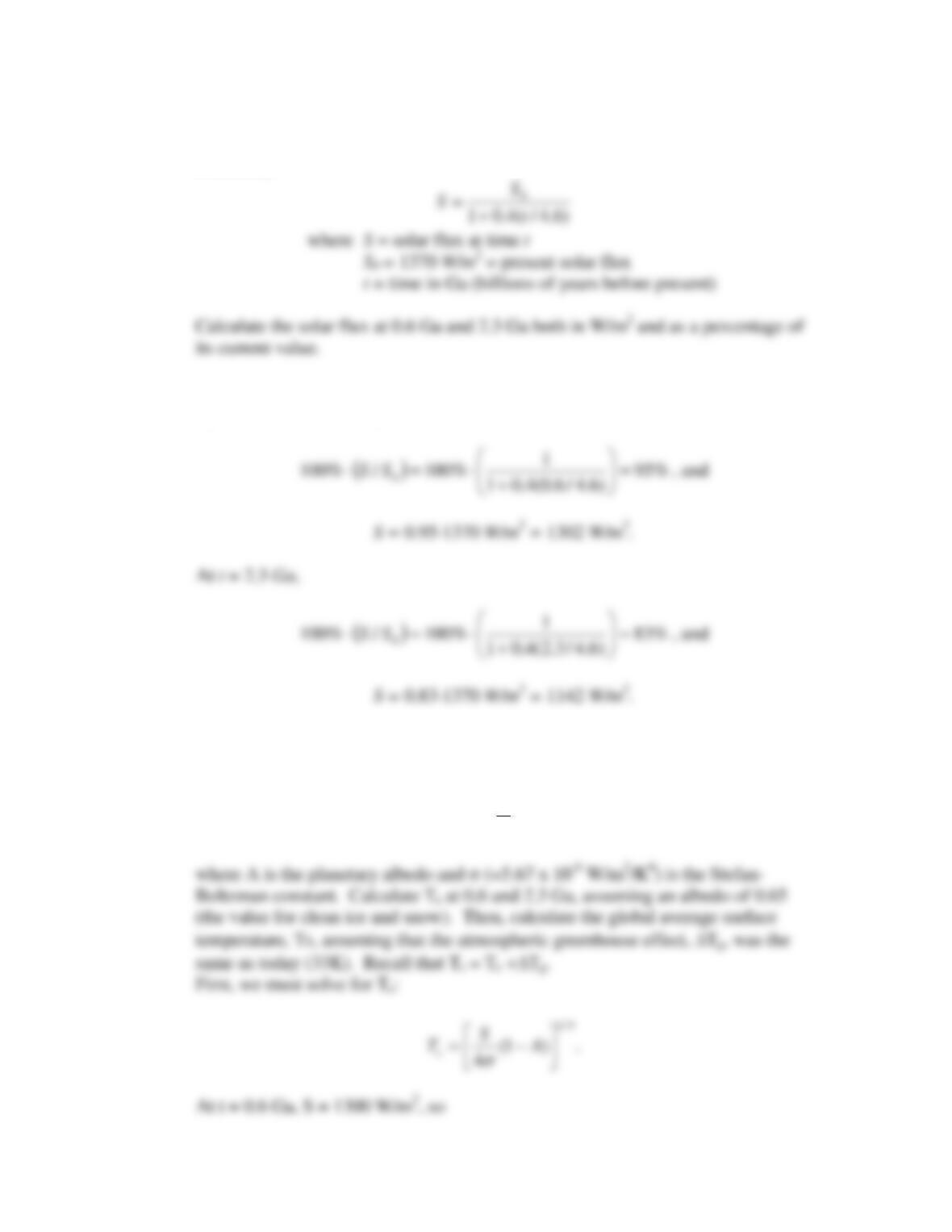
a. The variation in solar luminosity with time can be approximated by the following
formula (derived by fitting the results of a computer model of the Sun’s
evolution)
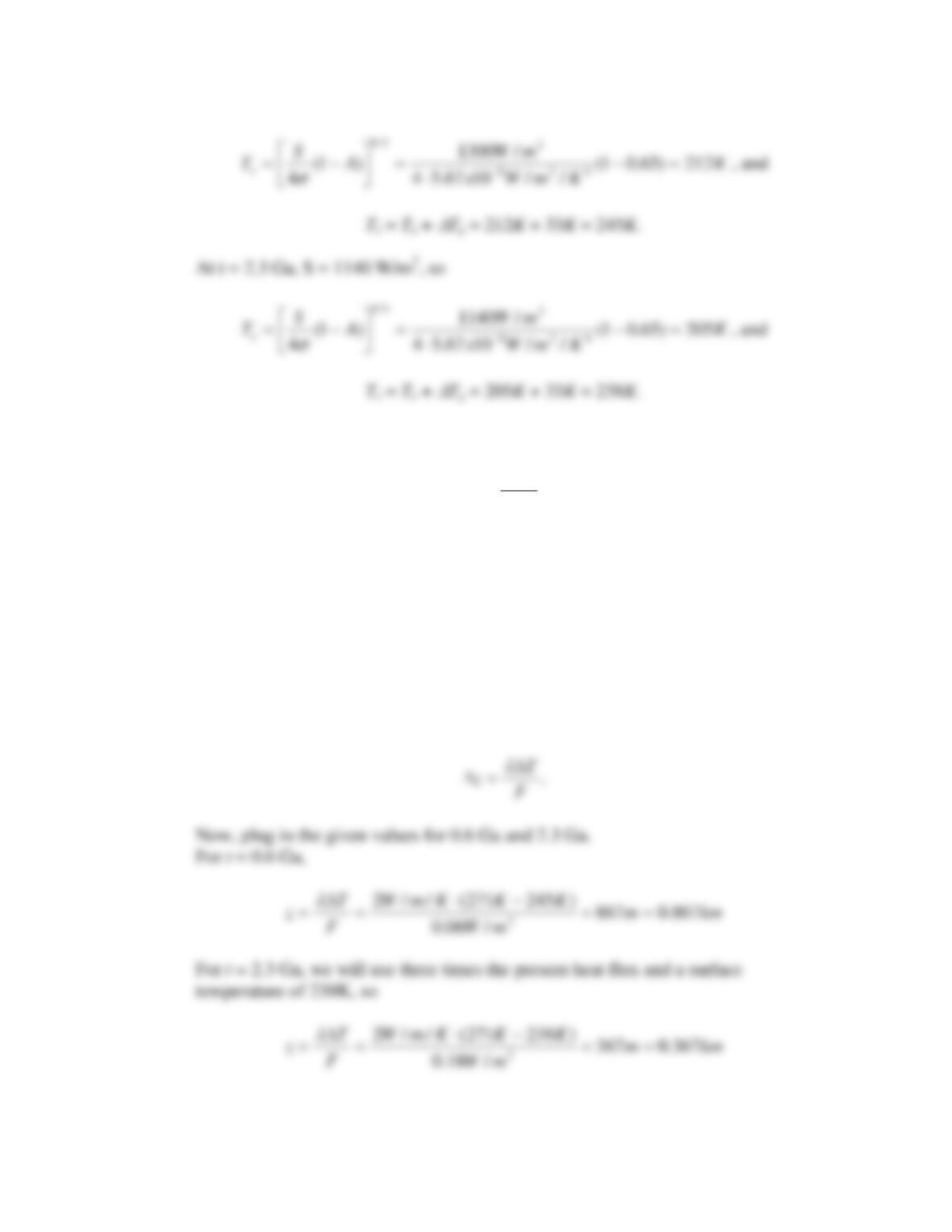
To find the percentage of its current value, plug in the values for t into the
equation for 100%·(S/S0). At t = 0.6 Ga,
b. As we have learned previously, the effective radiating temperature of the Earth
can be found from the formula
)1(
4
4A
S
Te−=
σ
5
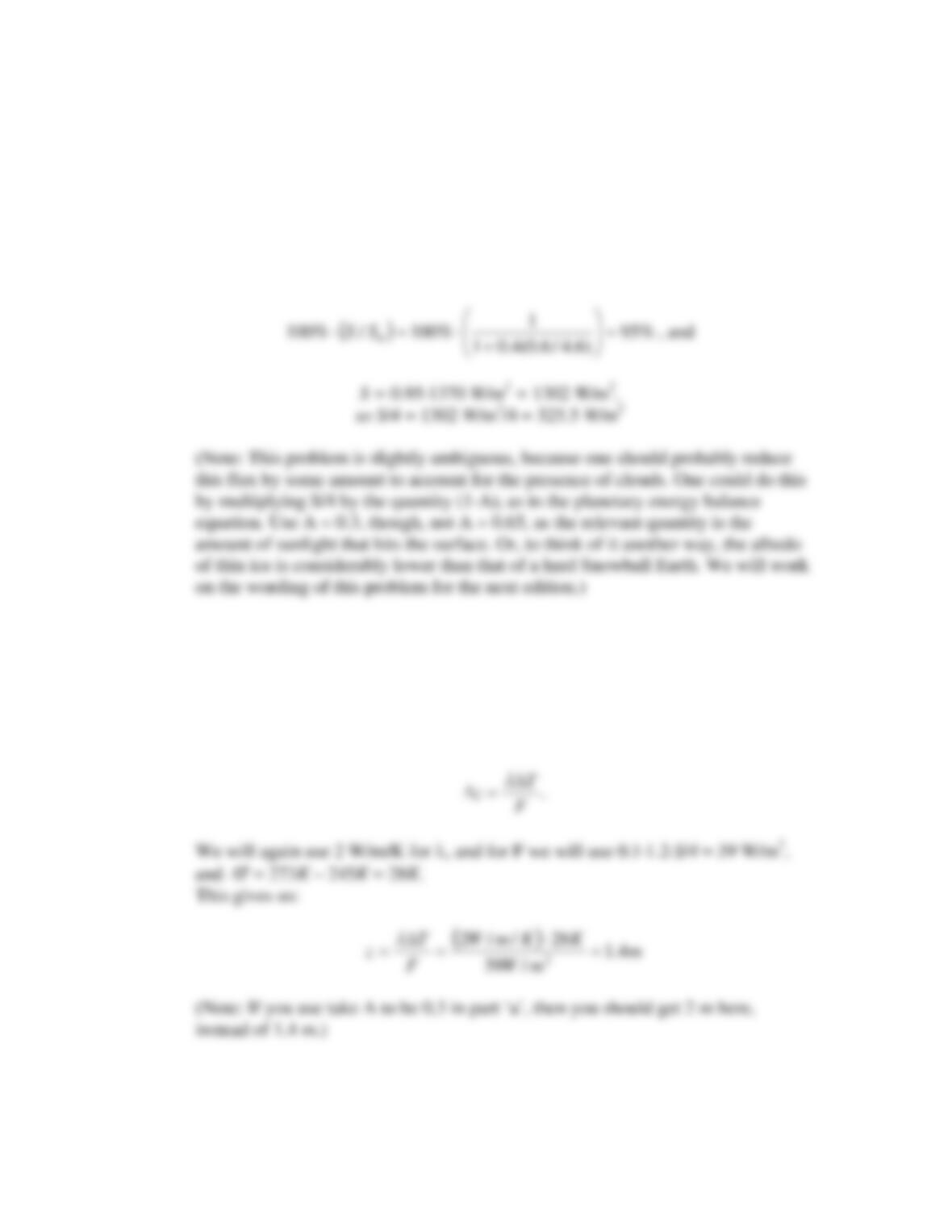
c. The conductive heat flow through ice is given by
z
T
FΔ
Δ
=
λ
where λ (= 2 W/m/K) is the thermal conductivity of ice, ΔT is the temperature
difference between the top and bottom of the ice layer, and Δz is the thickness of
the layer. We know that the current geothermal heat flux, F, is about 0.06 W/m2.
Assume that F had this same value at 0.6 Ga, but was 3 times higher at 2.3 Ga.
Assume also that the top of the ice is at temperature Ts, and that the water below
the ice has a temperature of -2°C. What is the thickness of the ice at 0.6 Ga and at
2.3 Ga?
First, solve for Δz:
−
⋅
λ
6
2.) Suppose now that the ice is transparent enough so that some sunlight makes it
through. Let’s see how that would change the ice thickness.
a. Calculate the globally-averaged solar flux incident on Earth’s surface during the
Neoproterozoic glaciation (0.6 Ga).
The globally averaged solar flux is equal to S/4. Thus, we take the answer to
question 1a and divide it by 4. At t = 0.6 Ga,
b. The solar flux at the equator is about 20% higher than the global average value.
Suppose that 10% of this incident sunlight makes it through the ice. How thin
must the ice layer be in order to conduct this heat back out? (Use the formula
from Question 1-c.)
As suggested, we will use the equation derived at the beginning of 1c:
7
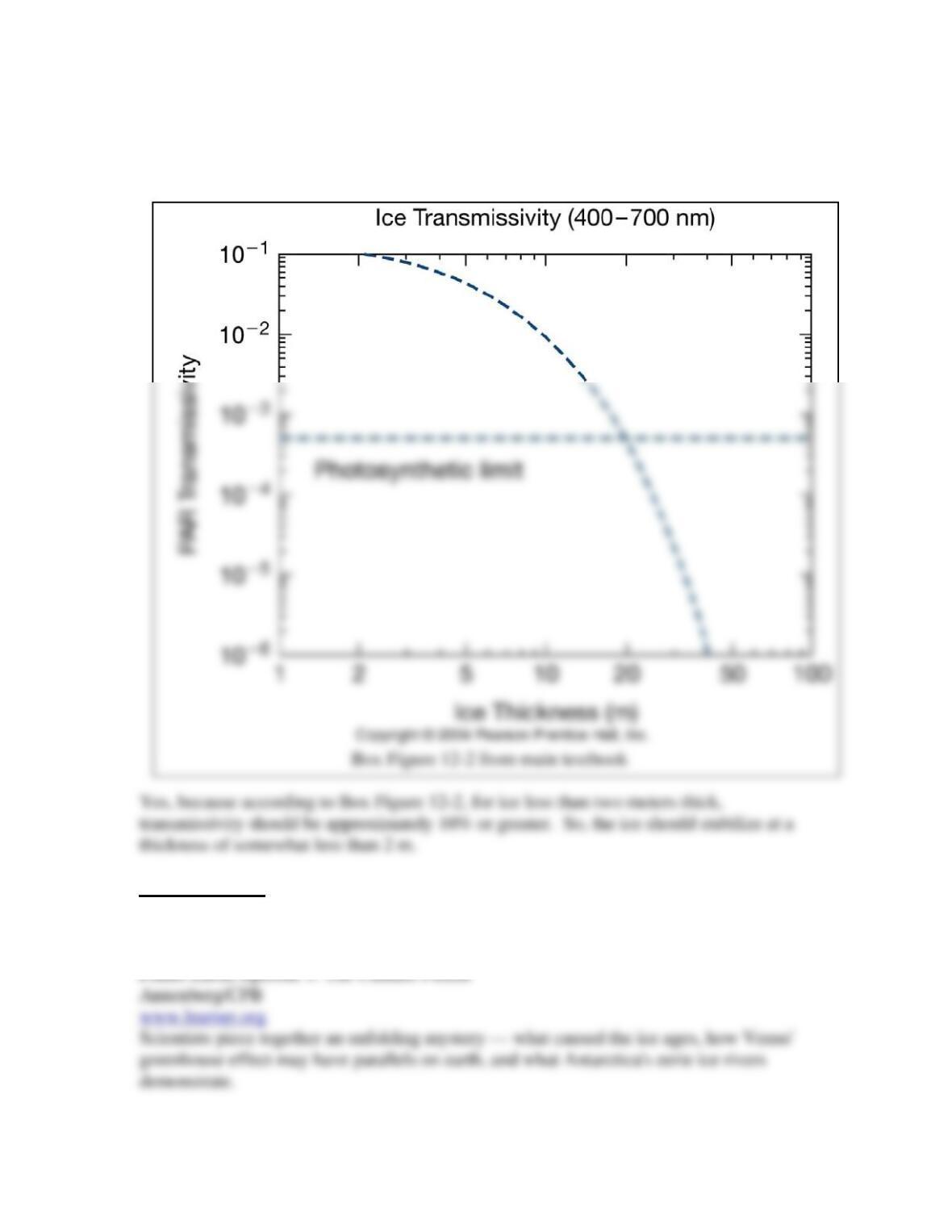
c. Is the ice thickness calculated in part (b) consistent with the assumption that it
would transmit 10% of the sunlight through it? Determine this by consulting Box
Figure 12-2.
Resource Guide
Video/Film:

8
Planet Earth, Episode 7. Fate of the Earth