3
Water, Rocks,
Solutes and Isotopes
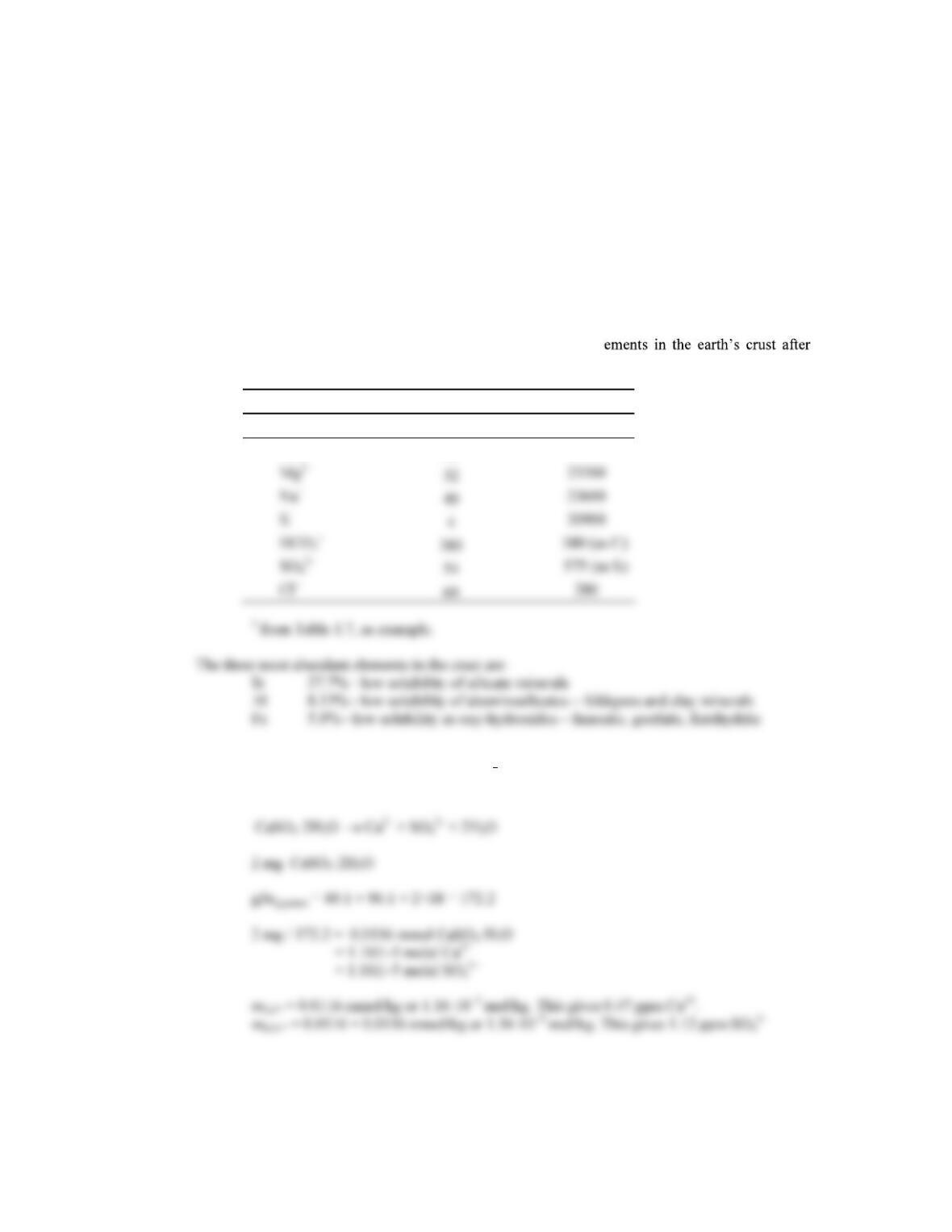
1. What are the four major cations and three major anions in most natural waters? How do these compare
with their crustal abundances. What are the three most abundant el
oxygen and why are they not abundant in most natural waters?
Abundance (ppm)
Ion/Element
Groundwater1 Crustal
Ca2+ 93 41500
2. What are the molal concentrations of Ca2+ and SO4
2 resulting from the dissolution of 2 mg of gypsum
in 1 kg of water?
1
4
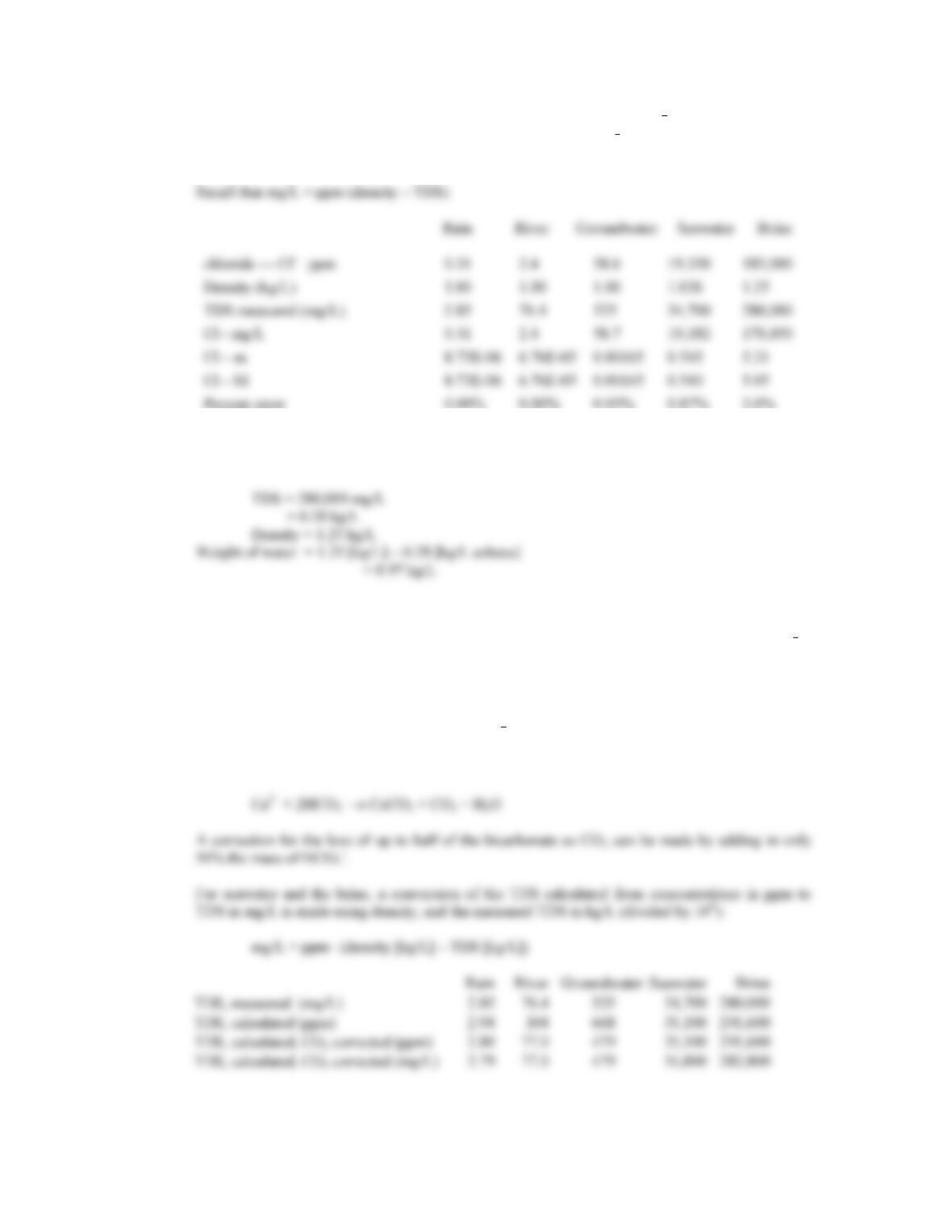
3. For each of the water samples in Table 1.7, determine the concentration for Cl in the following units:
mg/L, ppm, M and m. By what percentage for each water type does Cl in mg/L differ from the value
in ppm?
4. What is the weight of the water in 1 L of the brine in Table 1.7?
5. Calculate the TDS in mg/L for the rain, river water, groundwater, seawater and brine in Table 1.7 and
compare with the measured TDS values. A correction is required for the loss of half of the HCO3as
CO2. Note that for the high salinity waters, a correction using density is required to convert the TDS
calculated in ppm to mg/L for comparison with the measured TDS values.
The TDS is calculated by adding the concentrations for all major ions. Note that the high
concentrations of minor ions such as Sr2+ and Br make them contributors to TDS. Approximately
half of the bicarbonate will be lost as CO2 during the measurement of TDS by evaporation
according to:
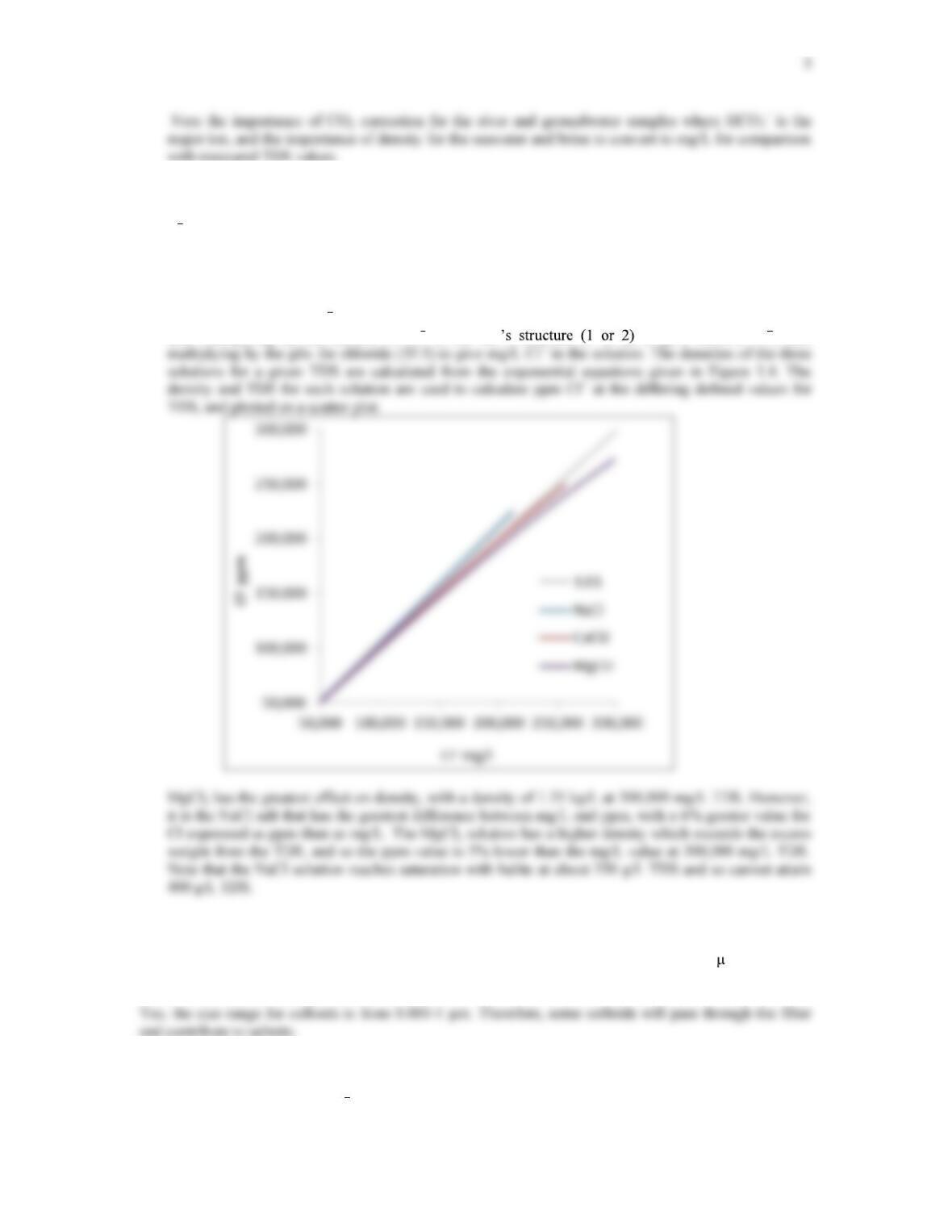
6. Using the density relationships in Figure 1.4, plot a diagram with ppm on the x-axis vs mg/L on the y-axis
for Cl concentration in solutions of NaCl, CaCl2 and MgCl2 up to solutions with 400 g/L TDS. Which
chloride salt has the greatest effect on density of the solution. Which has the greatest difference between
mg/L and ppm?
The TDS values are defined up to 400 g/L or 400,000 mg/L, at say 50 g/L intervals. For each salt, the
mg/L concentration of Cl are determined by dividing by the gfw of the salt (23+35.5=58.6 for NaCl)
then multiplying by the number of Cl in the salt to give mmol/L Cl , then
7. Colloids are amorphous clusters of ions in waters with elevated salinity. Could colloids contribute to the
measured solute concentrations if the water sample has been filtered with the standard 0.45 m pore-throat
filter paper?
8. Runoff water from a sulfur extraction plant has the following geochemical composition:
pH = 2.3; Ca2+ = 25 mg/L; SO4
2 = 300 mg/L
6
Does this analysis conform to the law of electro-neutrality?
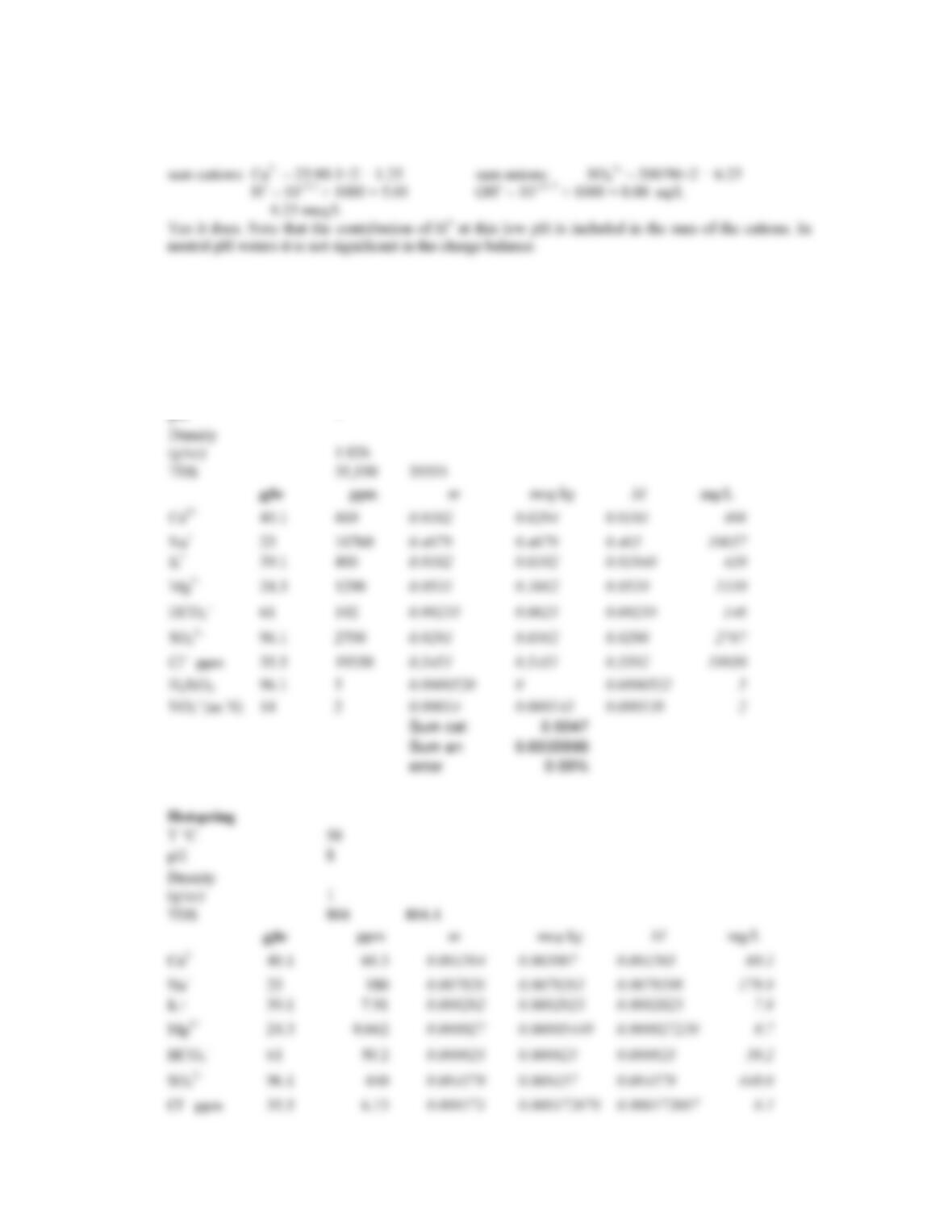
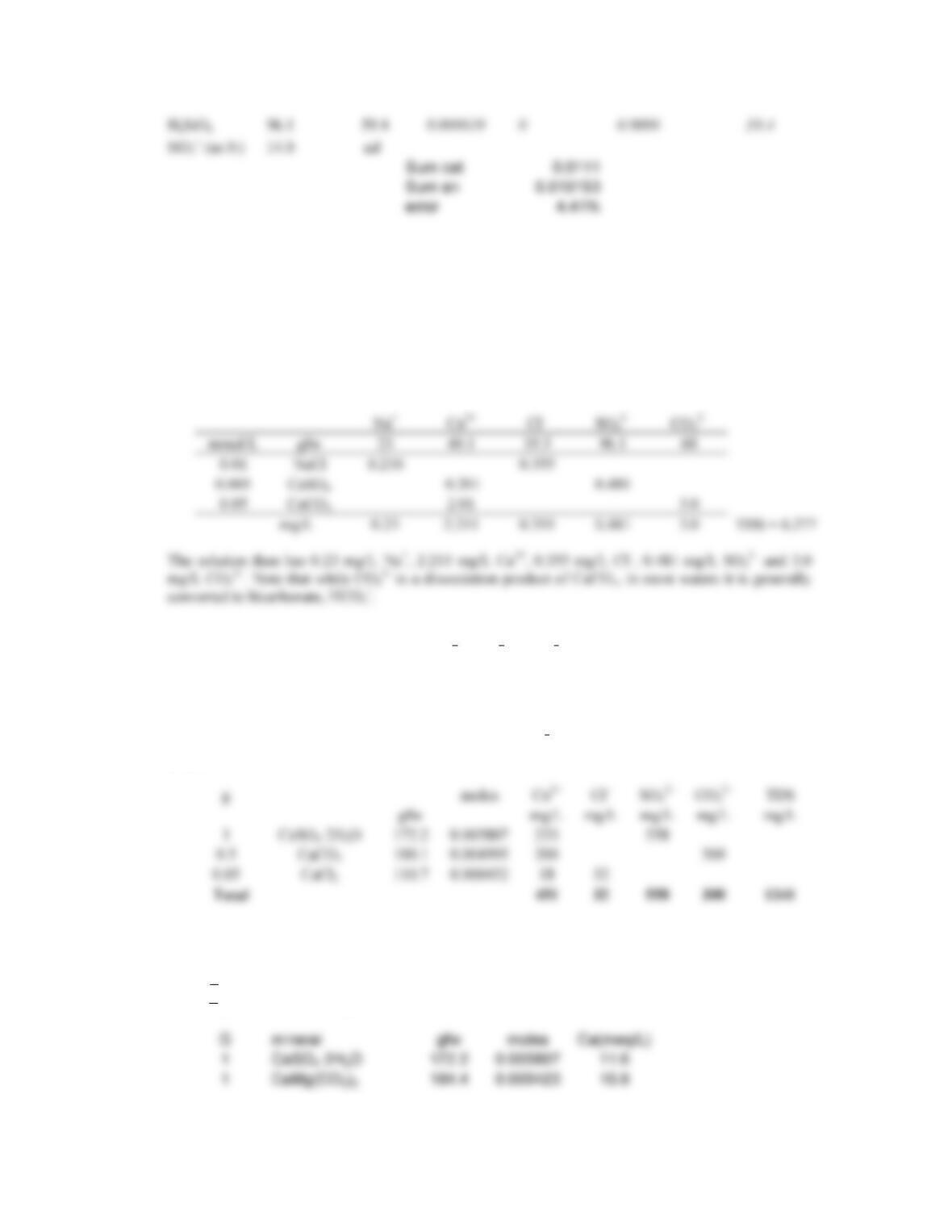
9. Convert the following geochemical analysis from the values reported in ppm into mole units and mg/L by
completing the following table. Report values to three significant digits only. Are the analytical errors
associated with these analyses acceptable?
Seawater
T °C 25
pH 7
7
10. What are the ion concentrations in mg/L and the TDS (mg/L) of a solution with 0.01 mmol/L NaCl, 0.005
mmol/L CaSO4 and 0.05 mmol/L CaCO3?
These salts in solution give the following concentrations, calculated by multiplying the amount of each
compound (in mmol/L) by the gfw of each solute and again by the number of atoms of the element per
unit of the compound (1 for all these salts in this question):
11. What are the mg/L concentrations of Ca2+, SO4
2, CO3
2 and Cl , and TDS, in groundwater which has
dissolved 1 g/L gypsum, 0.5 g calcite and 0.05 g calcium chloride?
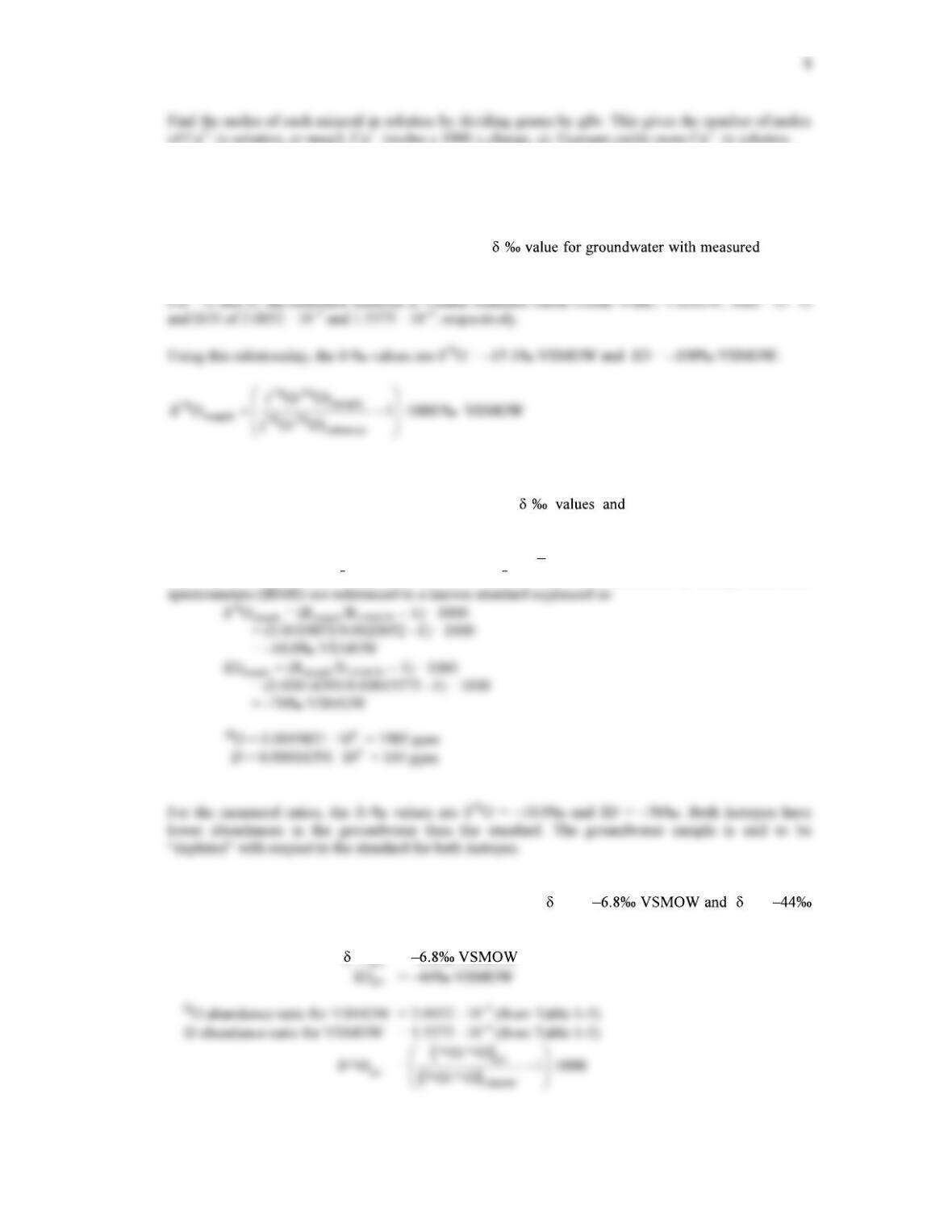
First, calculate the moles of each mineral dissolved in the groundwater. The moles of each solute is
equal to the mineral molalities multiplied by the stoichiometric representation of that element in the
mineral (for example, 1 mole of CaCl2 yields 2 moles of Cl ). TDS is then the sum of the cations and
anions.
12. Which of these two groundwaters has the higher meq/L concentration of calcium?
A groundwater with 1 g/L gypsum
B groundwater with 1 g/L dolomite
13. Stable isotopes are measured as ratios of the rare isotope to the abundant isotope, and expressed as the
permil difference between the measured ratio and the known ratio of an internationally recognized
reference material. What is the reference material for isotopes of water (18O and D)? What are the 18O/16O
and D/H ratios of this reference material? Calculate the – 18O/16O
and D/H ratios of 0.001975 and 0.000139, respectively.
14. The 18O/16O and D/H ratios for a groundwater sample were measured and determined to be 0.0019851 and
0.00014391. What are their concentrations expressed as – in parts per million of the
abundant isotope (ppm)?
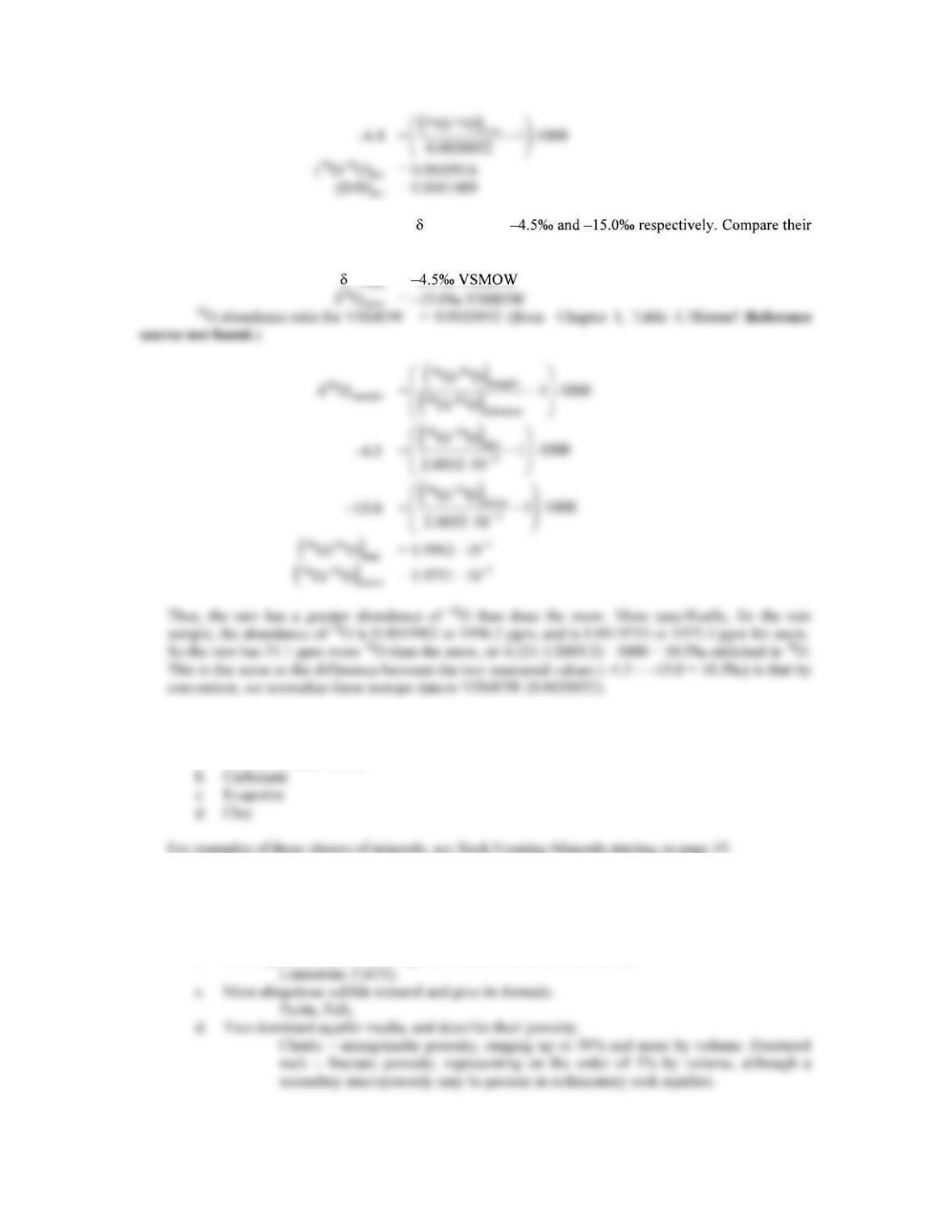
The international standard for water isotopes is VSMOW the Vienna Standard Mean Ocean Water,
with 18O/16O = 2.0052 · 10 3 and D/H = 1.5575 · 10 4. Isotope ratios measured by isotope ratio mass
15. A sample of groundwater has measured stable isotope values of 18O = D =
VSMOW. What are the isotope ratios (18O/16O and D/H) for this water?
18Ogw =
9
16. A rain water sample and snow sample have 18O values of
actual isotope abundance ratios and concentrations relative to the abundant isotope.
18Orain =
17. Give an example of a mineral and its geochemical formula for the following:
a. Primary aluminosilicate
18. Name the:
a. Three most abundant elements in silicate rocks?
O, Si, Al
b. Rock type that represents the greatest reservoir of carbon on Earth.
10
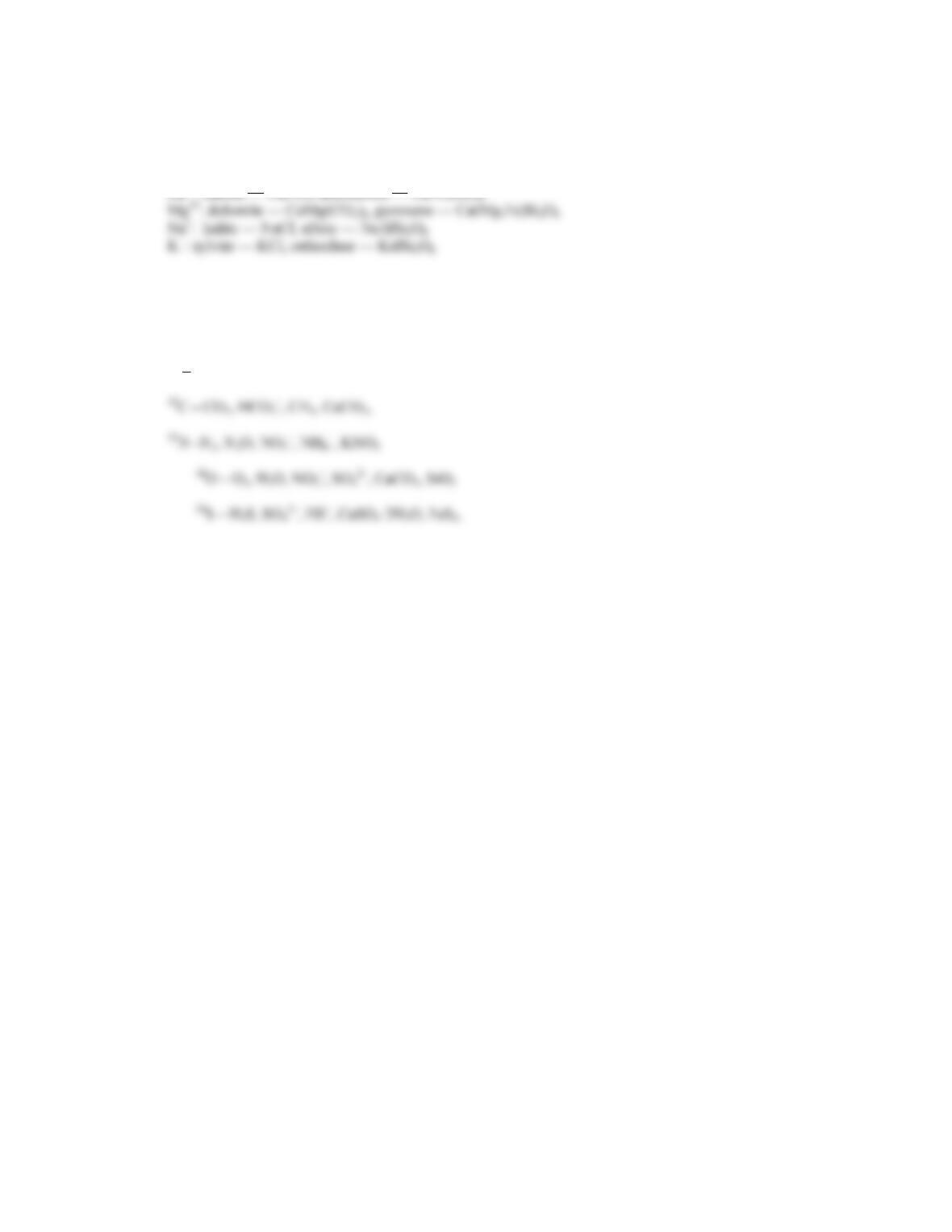
19. List the four major cations in natural waters and give two common minerals that represent a major
weathering source for each.
20. For each of the five routinely analyzed light stable isotopes (D, 13C, 15N, 18O, 34S) and referring to materials
introduced in this chapter, suggest three different compounds, with their chemical formula, that could be
analyzed.
D H2O, CH4, CH2O, Al2Si2O5(OH)4