
Exercise 1. Earth Materials, Geologic Time, and Geological Processes
INTRODUCTION AND NOTES FOR INSTRUCTOR
The goal of this exercise is to introduce students to earth materials (minerals, rocks and regolith), the concept
of geologic time, and a variety of geologic processes. This material may be review for some students, but the
processes of scientific analysis that are represented by rock and mineral identification are important in
We suggest the following specimens for mineral and rock identification. Many have environmental
implications and are mentioned in discussions of pollution, geologic hazards, or geologic resources.
Minerals: calcite, orthoclase and plagioclase feldspar, fluorite, gypsum, galena, halite, limonite, mica,
pyrite, quartz, augite, hornblende, hematite, talc, olivine.
Igneous rocks: granite, rhyolite, andesite, basalt, gabbro, obsidian, porphyritic basalt, pumice, scoria.
QUESTIONS 1, PART A
1. Examine each mineral specimen that your instructor selects for this exercise. Determine and record in
Table 1.1 all of the properties you test and/or observe. This includes determination of luster, color,
2. After you have recorded the observed physical properties, with the aid of earlier information and the
descriptive information about each mineral found in Table 1.2, determine the names of the minerals.
Record the chemical composition of each mineral and note the information regarding their geologic,
QUESTIONS 1, PART B1
1. Your instructor will provide specimens of igneous rocks for you to identify. Determine the texture,
composition, and any other important characteristics of each specimen and record your observations in
QUESTIONS 1, PART B2
1. Your instructor will provide specimens of sedimentary rocks for you to identify. Using the information
presented in Table 1.5, determine the composition and texture of each specimen. On this basis draw your
QUESTIONS 1, PART B3
1. Your instructor will provide specimens of metamorphic rocks for you to identify. Using the information
QUESTIONS 1, PART B4
1. Your instructor will provide samples of sedimentary materials for you to identify. Use information in the
description of regolith types above, and descriptions in the sedimentary rocks section of the manual, to help
identify the samples, their possible origin, and their geologic significance. For example, a dry, compact mass
2. Define each of the following terms and any others assigned by the instructor.
Regolith – Unconsolidated material that overlies bedrock.
3. List four possible environments of formation or origins of regolith. (Hint: See the introduction to the
section “Regolith.”)
4. Think of the types of materials that make up the regolith and determine which material or materials
5. If the local surficial geology map and county soil survey reports are available in lab or online,
determine:
a. The material and origin of the regolith beneath your building or campus
QUESTIONS 1, PART C
1. Which subdivision of geologic time represents the greatest length of time (era, period, epoch)?
2. What is the length in millions of years of the:
Cenozoic Era? Tertiary Period? Quaternary Period? Eocene Epoch? Pleistocene Epoch?
3. How does the Pleistocene Epoch compare in length to the Ordovician Period?
4. Approximately how many times longer is Precambrian time than the Cenozoic Era?
5. What is the age in million years (Ma) of the boundary between the Cretaceous and the Tertiary (K/T
6. Approximately how many years ago did the following geologic events occur?
Mt. St. Helens eruption ~30 y (years) (in 1980)
QUESTIONS 1, PART D
1. Figure 1.3 identifies many components of the geosystem, but does not show linkages between all of
them. Sketch on this figure links that you think might exist between various geosystem components. If
you are uncertain, it may help to refer to your text. Add to your links a few key words that explain why you
think a particular link exists.
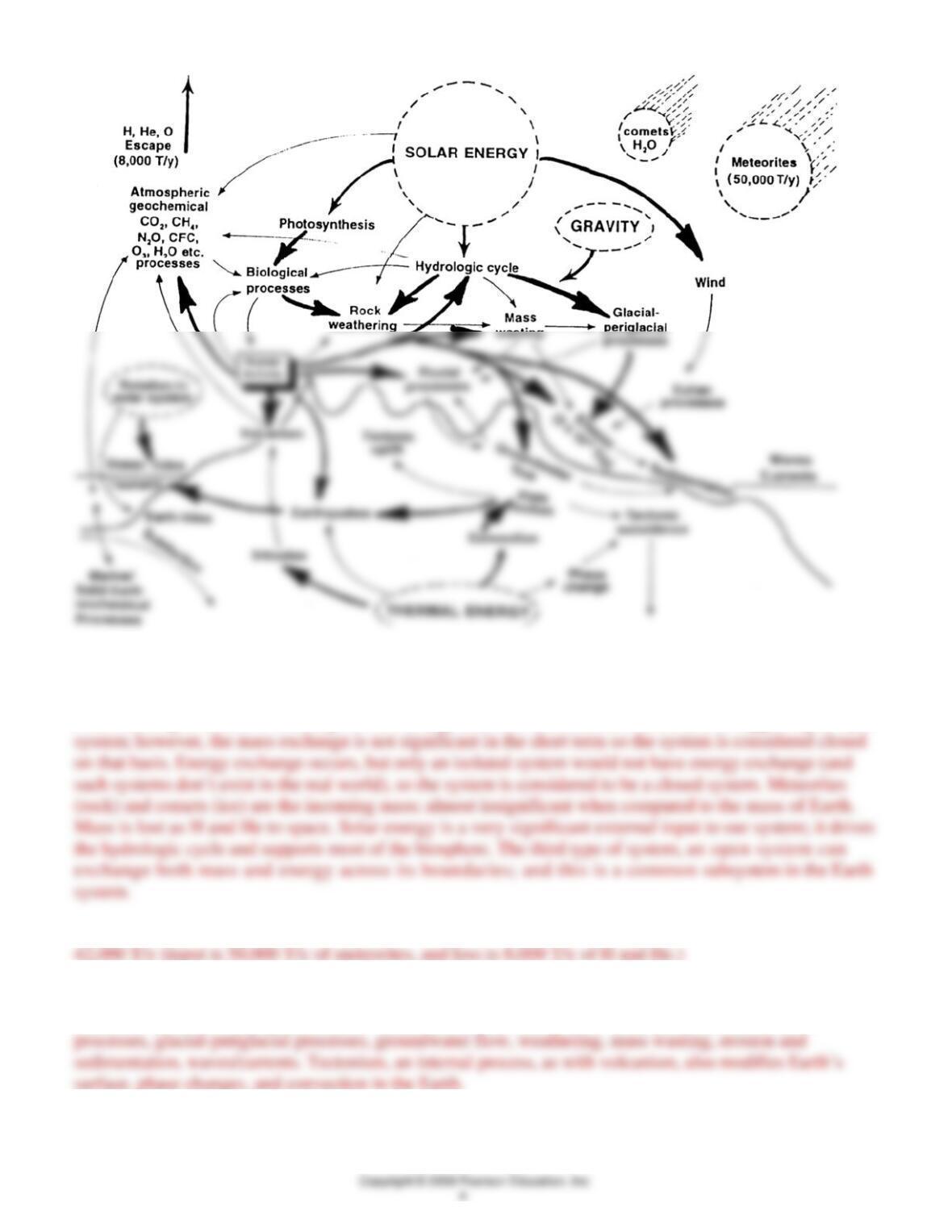
Fig 1.3. FMU3rd IM
2. Is the Earth a closed system? Explain.
From the diagram, there is exchange of both energy and mass across Earth’s boundaries, suggesting an open
3. According to this figure, what is the net annual gain in the mass of Earth?
4. List the processes acting on or flowing through the surface of Earth.
Volcanism, human activity, fluvial processes, eolian processes and other atmospheric processes, ocean
5. What two energy sources drive the hydrologic cycle?

6. What are the “greenhouse gases” and what do they do?
Carbon dioxide, methane, ozone, nitrous oxide, chlorofluorocarbons, and halons. Greenhouse Gases (GHG)
7. What benefits for humans might accompany global warming?
Climates that are currently too cold to support a long growing season might warm enough to allow new
The following questions refer to Figure 1.4.
8. If you can run a four-minute mile (only slightly slower than the world record pace), which geologic
processes will be able to catch you? (Hint: Use the conversion factors given in Appendix 1 and refer, if
needed, to exercise 3 for a discussion of unit conversion.)
A four-minute mile would be about 210,000 km/year. Therefore the following would be able to catch you:
9. If you are driving a car at 65 miles per hour, which geologic processes will be able to catch you? 65
10. If fingernails typically grow at a rate of about 15 mm per year, what geologic processes are occurring at
the same rate?
Soil flow, rise in sea level, slip on San Andreas fault, horizontal movement of continents, the slower
11. Soil profiles are about one meter thick in many parts of the world. How long, at an average rate of
erosion, will it be before all the soil is removed (assuming that it is not replenished)?
At an average rate of 0.035 mm/year for the world it would take about 30,000 years to remove a one-