Chapter 9 Time Value of Money Part II Annuities
CHAPTER OUTLINE
Learning Objectives
Future Value of an Ordinary Annuity
Future Value of an Annuity Due
Present Value of an Ordinary Annuity
Present Value of an Annuity Due
Present Value and Amortization
REVIEW AND DISCUSSION QUESTIONS
1. What is the difference between the present value of an annuity and the future value of an annuity?
2. What is the difference between an ordinary annuity and an annuity due?
3. How do banks calculate the monthly payment on a loan?
beginning of the month.
4. Describe situations in which you have an integration of future lump sums and streams of equal and
unequal payments.
When one pays or receives unequal amounts over a period of time the amount accumulated must be based on a
lump sum calculation. When one pays or receives equal payments over a period the amount accumulated is
EXERCISES AND PROBLEMS
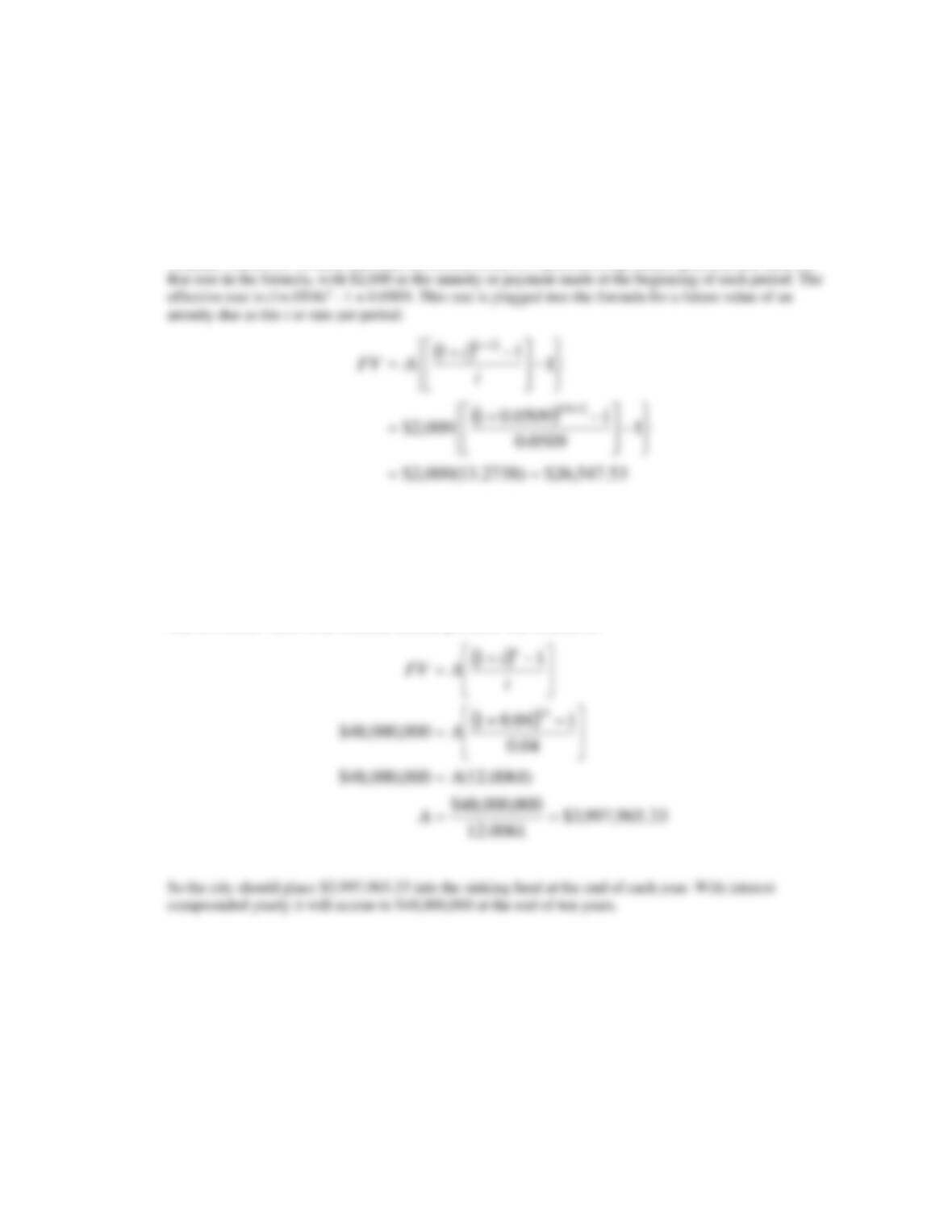
1. Ira Schwab opens up a Schwab IRA and places $2,000 in his retirement account at the beginning of
each year for 10 years. He believes the account will earn 5 percent interest per year, compounded
quarterly. How much will he have in his retirement account in 10 years?
Note, the mode of compounding and the mode of making your payments have to match in order to use the
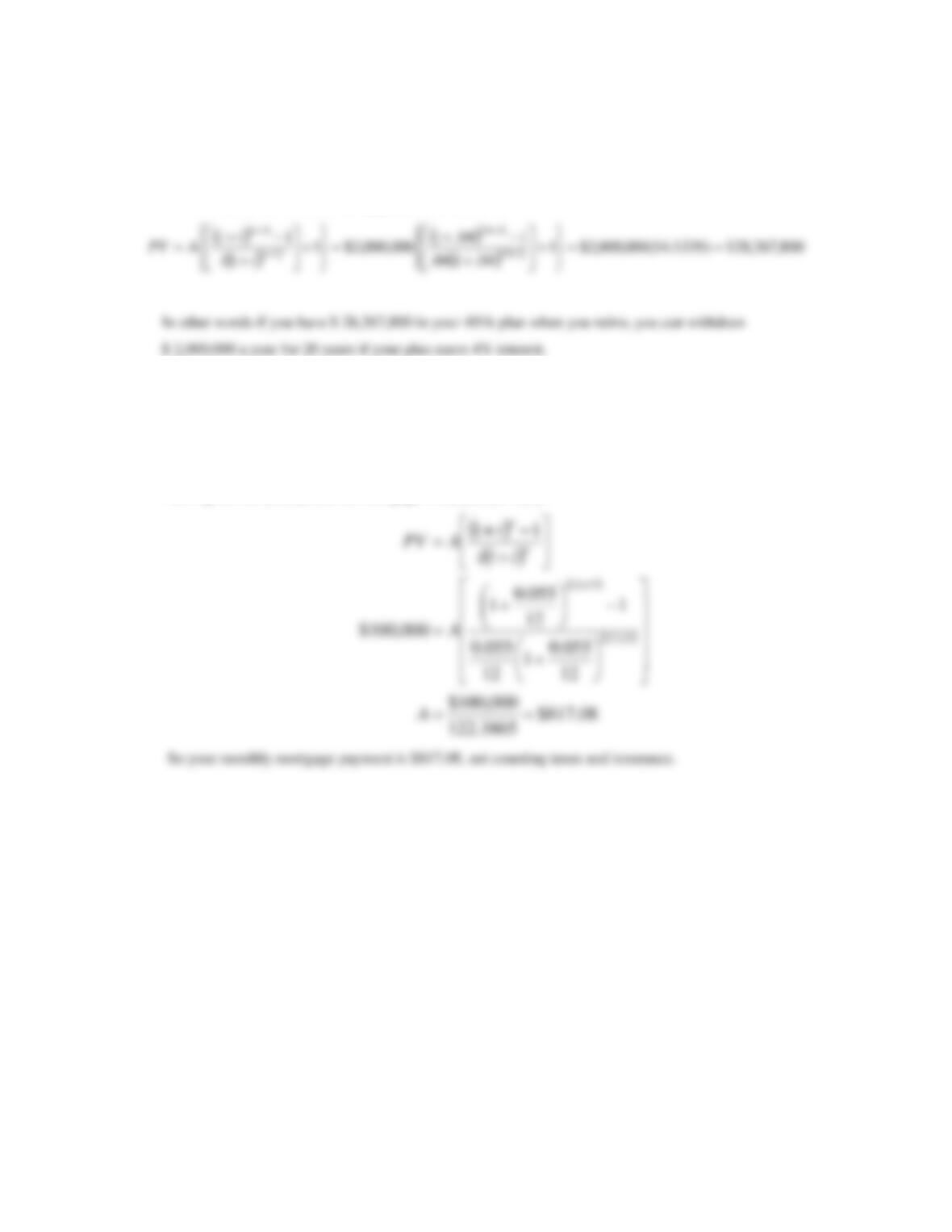
2. The city of Glendale borrows $48 million by issuing municipal bonds to help build
the Arizona Cardinals football stadium. It plans to set up a sinking fund that will
repay the loan at the end of 10 years. Assume a 4 percent interest rate per year.
What should the city place into the fund at the end of each year to have $48 million
in the account to pay back their bondholders?
This is a future value of an ordinary annuity problem. The formula is:
3. Congratulations! You have just won a $40 million lottery and have elected to receive $2 million per
year for 20 years. Assume that a 4 percent interest rate is used to evaluate the annuity and that you
receive each payment at the beginning of the year.
a. What is the present value of the lottery? This is a present value of an annuity due problem. The
factor can be found in Appendix B, Table B–6.
b. How much interest is earned on the present value to make the $2,000,000-per-year payment?
The interest earned is $40,000,000 – 28,267,800 – $11,732,200.
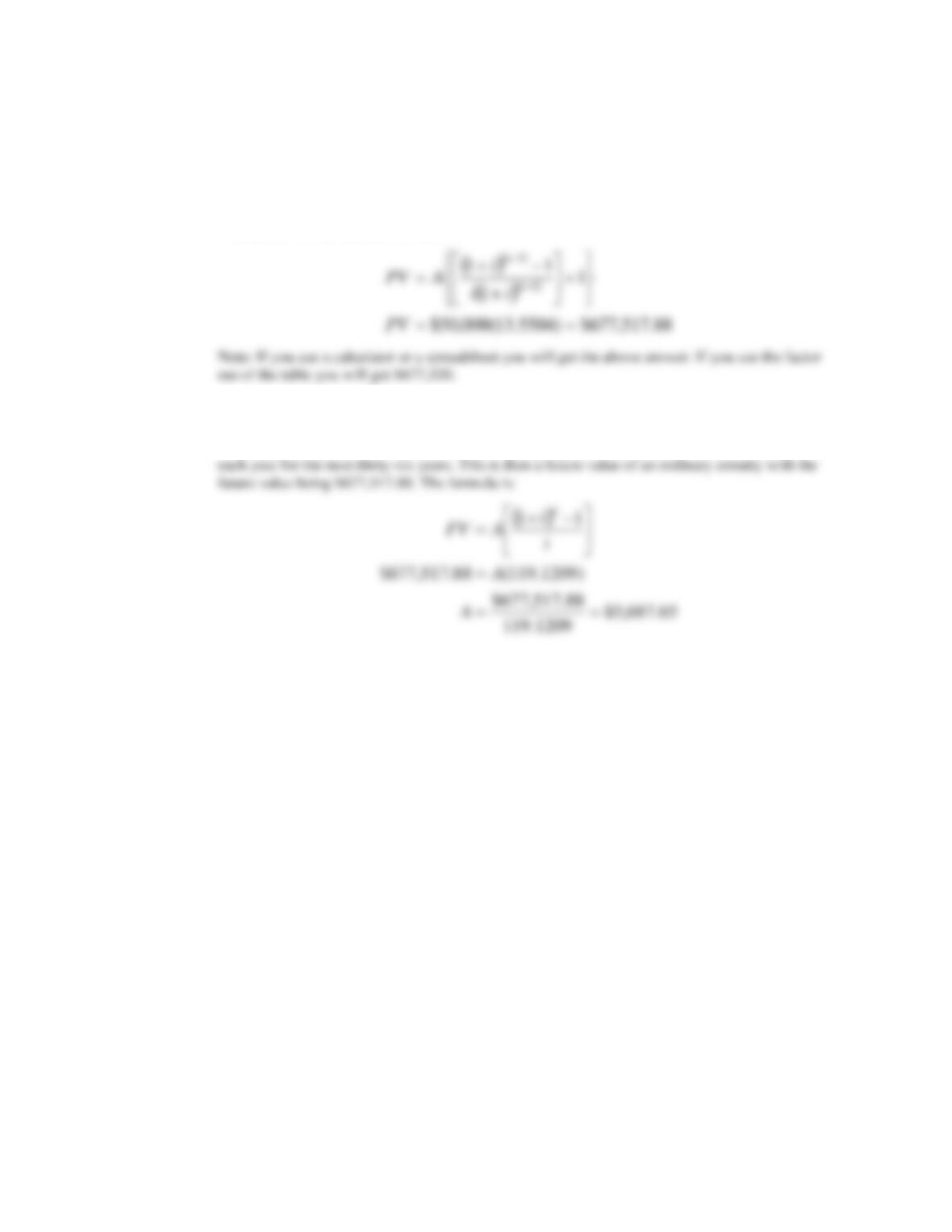
4. Calculate the monthly mortgage payment made at the beginning of each month on a $100,000
mortgage. The mortgage is for fifteen years and the interest rate is 5.5 percent.
This is also a present value of an ordinary annuity because a mortgage is a bank loan. However, we are
solving for the annuity and the mortgage is the present value.
5. EZ Leifer plans to retire at the age of 65 and believes he will live to be 90. EZ wants to receive an
annual retirement payment of $50,000 at the beginning of each year. He sets up a retirement account
that is estimated to earn 6 percent annually.
a. How much money must Easy have in the account when he reaches 65 years old?
This is a present value of an annuity due. We can use Appendix B, Table B-6 for the factor, the
time period n is 25, and the formula is:
b. Easy is currently 29 years of age. How much must he invest in this account at the end of each
year for the next 36 years to have the required amount in his account at age 65?
In this problem we assume that the investor is going to put a fixed amount into a retirement account
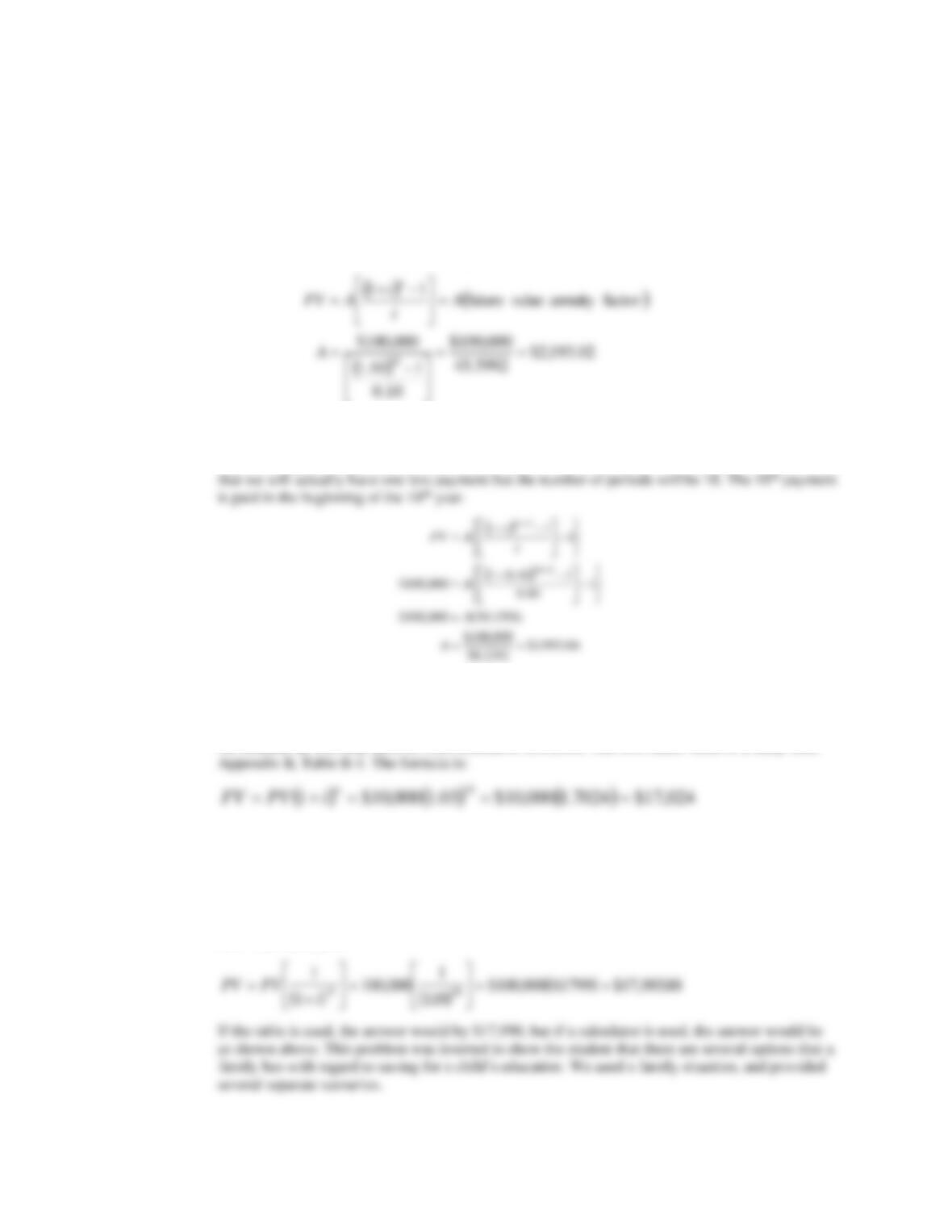
6. Tom and Mary James just had a baby. They heard that the cost of providing a college education for
this baby will be $100,000 in 18 years. Tom normally receives a Christmas bonus of $4,000 every
year in the paycheck prior to Christmas. He read that a good stock mutual fund should pay him an
average of 10 percent per year. Tom and Mary want to make sure their son has $100,000 for college.
Consider each of the following questions.
a. How much does Tom have to invest in this mutual fund at the end of each year to have
$100,000 in 18 years? This is a sinking fund problem which uses Appendix B, Table B-3, which
is the future value of an ordinary annuity. The formula for this is:
b. If the bonus is not paid until the first of the year, how much does Tom have to invest at the
beginning of each year to have $100,000 in 18 years? Because the bonus is not paid until the
first of the year, the problem becomes a future value of an annuity due for 18 years. The problem is
c. Tom’s father said he would provide for his grandson’s education. He puts $10,000 in a
government bond that pays 3 percent interest. His dad said this should be enough. Do you
agree?
d. If Mary has a savings account worth $50,000, how much must she withdraw from
savings and set aside in this mutual fund to have the $100,000 for her son’s
education in 18 years?
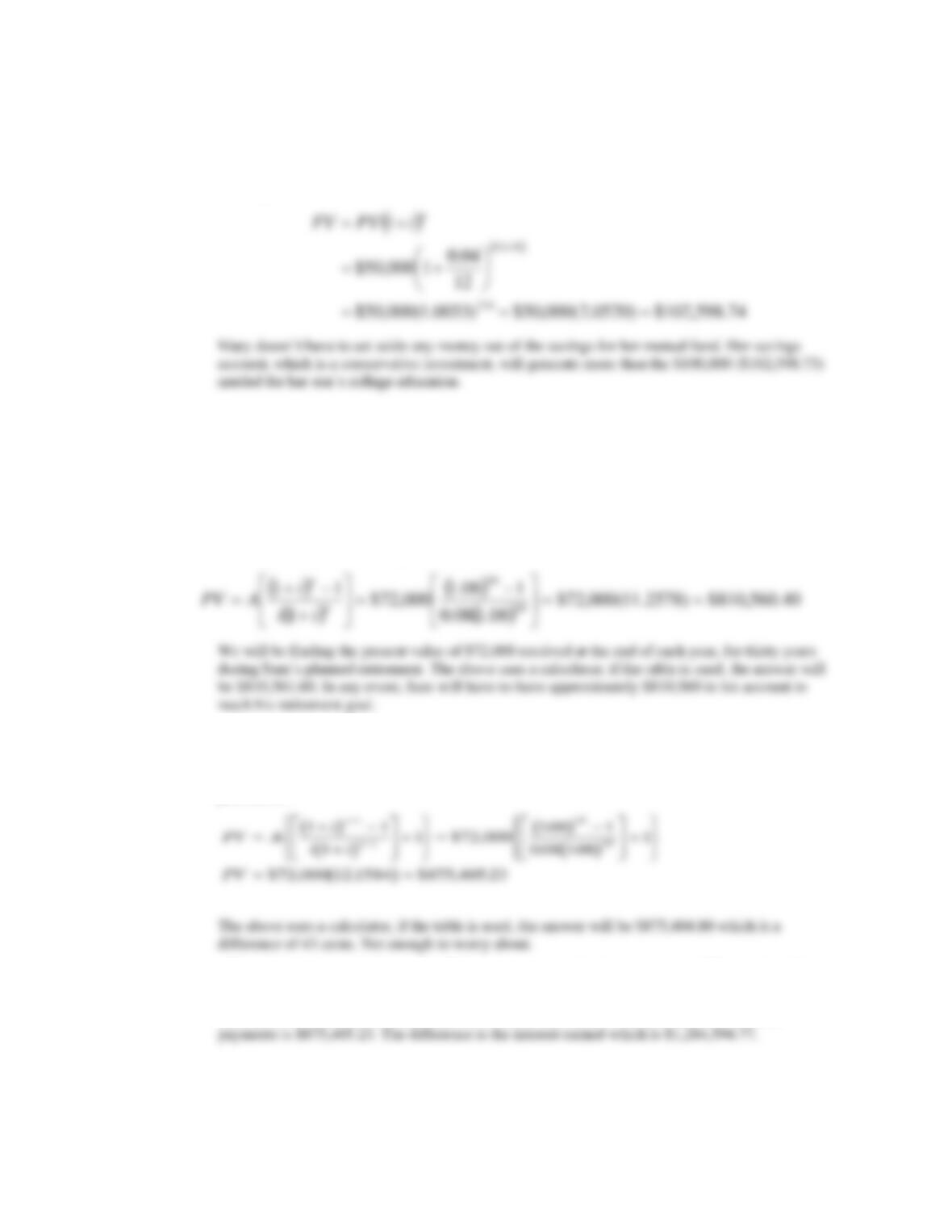
Mary is going to take money out of her savings account and set it aside in the mutual fund that will
grow to $100,000. This is the present value of a lump sum problem as shown in Appendix B, Table
B-2. The formula is:
e. If Mary has been advised to keep the $50,000 in her savings account earning 4
percent compounded monthly, how much additional money will she have to
set aside in the stock mutual fund to have the $100,000 for her son’s education
in 18 years?
7. Sam is currently 30 years of age. He owns his own business, and wants to retire at the age of 60. He
has little confidence in the current Social Security system. He wants to retire with an annual income
of $72,000 a year.
a. If Sam believes he will live to age 90, how much does he have to accumulate by the time he
reaches age 60 to receive $72,000 at the end of each year for rest of his life? Sam believes he
can earn 8 percent on his money in a stock mutual fund. This is the present value of an
ordinary annuity problem, Appendix B, Table B-5.
b. How much does he have to accumulate if he wants the payment of $72,000 at the beginning of
each year?
This is the present value of an annuity due. We use Appendix B, Table B-6. The formula for this
problem is:
c. What dollar amount of interest will Sam have earned during retirement if he receives his
$72,000 at the beginning of each year?
Sam receives $72,000 for thirty years for a total of $2,160,000. The present value of these
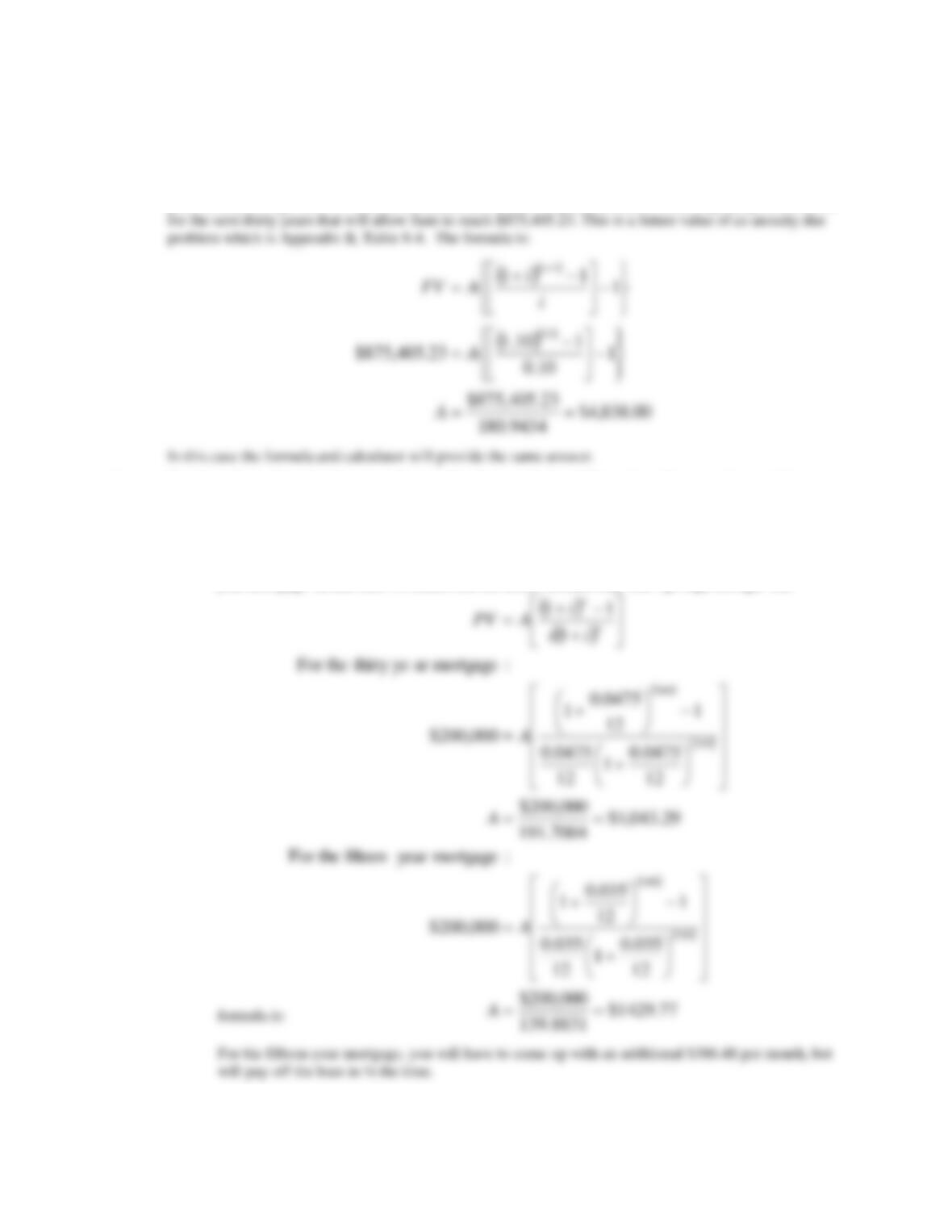
8. Regarding question 7b, if Sam believes he will earn 10 percent on his investment for retirement, how
much does he have to contribute to his retirement account at the beginning of each year to
accumulate his retirement nest egg?
In the above, Sam needs $875,405.23 in his account when he retires 30 years from now (he is age 30 and
plans to retire at age 60). We want to determine the amount of payment, made in the beginning of each year
9. You have been shopping for a new home. You have a choice of financing. You can choose either a
$200,000 mortgage at 4.75 percent for 30 years, or a $200,000 mortgage at 3.5 percent for 15 years.
a. Calculate the monthly payment for both the 30-year and 15-year mortgages. This is a present
value of an ordinary annuity problem. Since mortgage payments are made on a monthly basis, we
use 360 monthly payments for the thirty-year mortgage, and 180 monthly payments for the fifteen
year mortgage. In this case we cannot use the tables because they don’t go high enough. The
b. Calculate the amount of interest paid over the life of the loan for both mortgages.
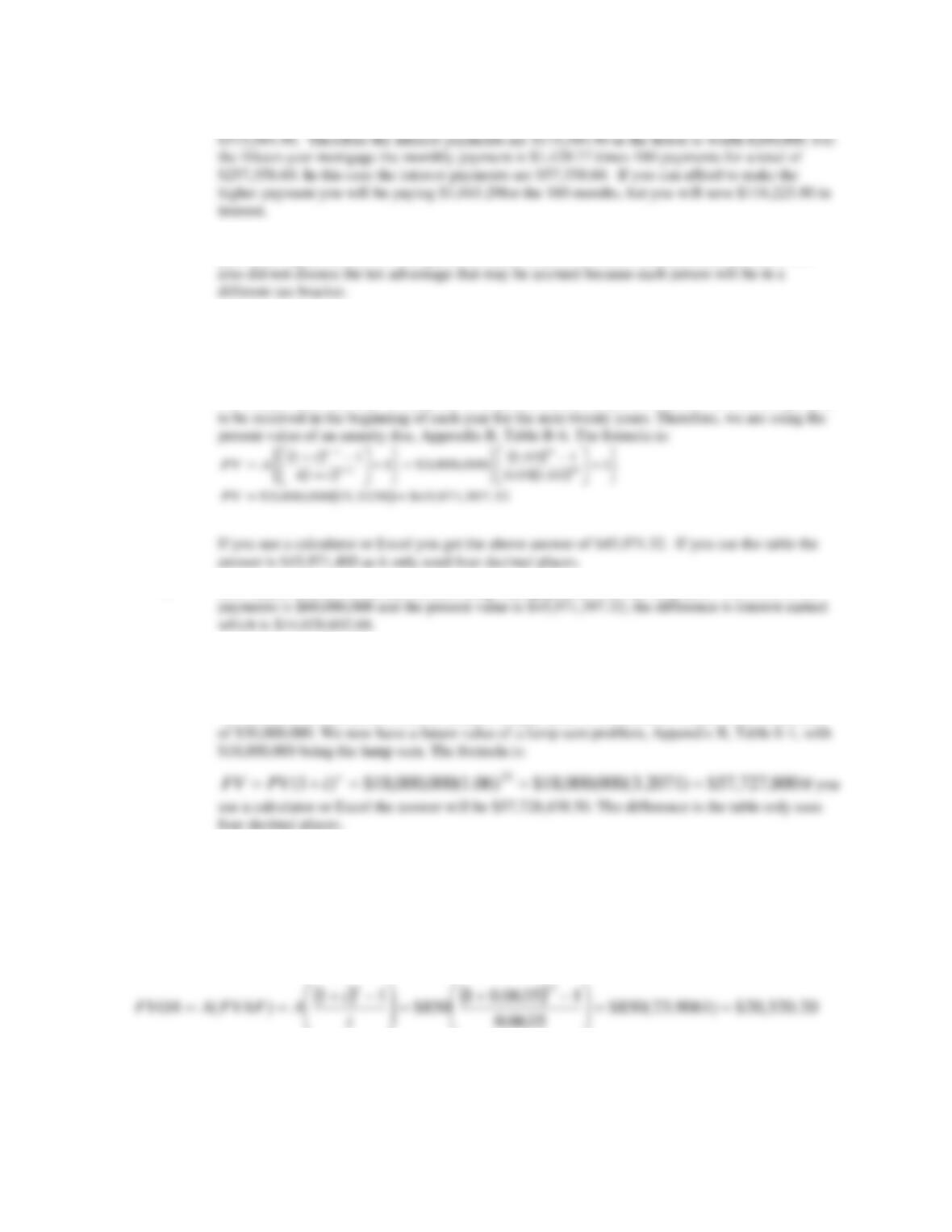
For the thirty-year mortgage the monthly payment is $1,043.29 times 360 payments for a total of
c. Choose the best mortgage for you and explain your answer. The student should be able to
provide a logical answer for this question, based on his or her own financial circumstances. We
10. You like to buy lottery tickets every week. The lottery pays an insurance company that pays the
winner an annuity. If you win a $60,000,000 lottery and elect to take an annuity, you get $3,000,000
per year at the beginning of each year for the next 20 years.
a. How much will the state have to pay the insurance company if money can earn 3 percent?
For this problem, the state will pay the insurance company the present value of $3,000,000 per year
b. How much interest is earned on this lump-sum payment over the 20 years? The total of the
c. If you take the cash, rather than the annuity, the state pays you $30,000,000 in one lump sum
today. You must pay 40 percent of this in taxes. If you are currently working and invest this
money at 6 percent, how much money will you have in a mutual fund at the end of 20 years?
We will have $18,000,000 to invest because we pay taxes of $12,000,000 which is the 40 percent
d. Are you better off with the annuity or should you take the cash? Explain.
We would advise taking the annual annuity of $3,000,000, as you will receive $60,000,000 over 20
years versus having to wait 20 years to receive $57,727,800.
11. Mr. Bates is creating a college fund for his daughter. He will put in $850 at the end of each year for
the next 15 years. He expects to earn 6.35% annually. How much money will his daughter have in her
college fund? This problem is the future value of an ordinary annuity which is solved as follows:
12. Blushing Rose invests $1,000 into her Roth IRA. She can increase this investment annually by $1,000
until she reaches the $5,000 annual contribution limit. She will then invest $5,000 per year at the end
of each year for 30 years. How much will Blushing have in her IRA at the end of 34 years if her IRA
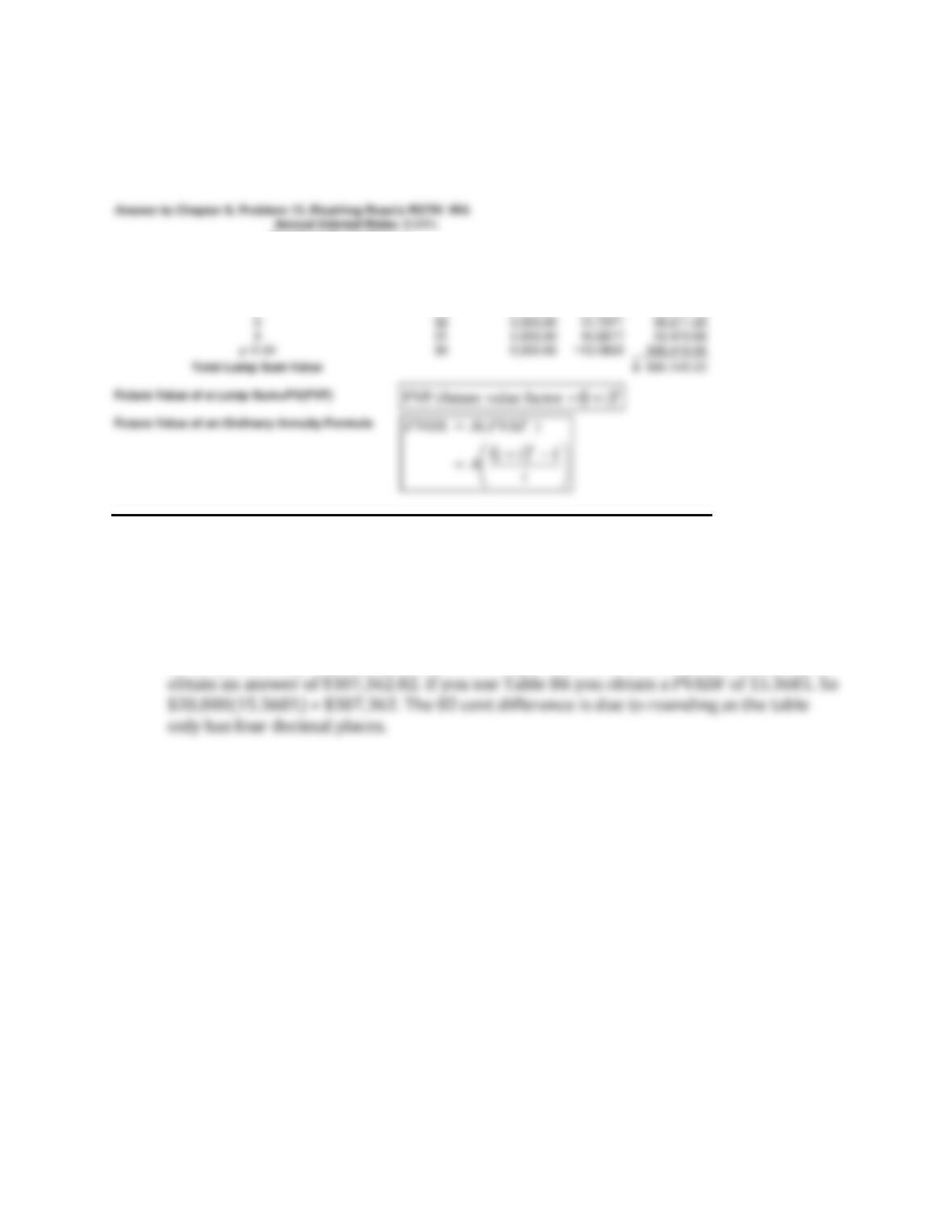
earns 8 percent? This problem requires us to build a table as it is a combination of the future value of
lump sums for contributions less than $5,000 and the future value of an ordinary annuity for contributions
of $5,000.
Compounds per Year= 1
Contribution year
Years to
retirement
Annual
Contribution
Future
Value
Factor
Future Value
134 1,000.00$ 13.6901 13,690.13$
233 2,000.00 12.6760 25,352.10
Future Value of an Ordinary Annuity Formula
13. Joe Doe is currently 65 years of age. He is currently drawing $20,000 a year out of his
IRA. He expects to live to 100 and wants to know what he needs now to insure
himself that he will be able to draw the $20,000 at the beginning of each year for
the next 35 years. He believes the account will earn 6 percent compounded
annually for the next 35 years. How much money does he need in his account
today? This is the present value of an annuity due problem with an annuity of $20,000
for 35 years at 6 percent annual interest. Using Excel or the TI BA II plus calculator you
RECOMMENDED TEAM ASSIGNMENT
1. As a team, investigate how credit information is used to produce a credit score. How is credit
information used to produce a credit score that determines what type of mortgage loan would be
granted by a lender? Include FICO scores.
2. Devise a methodology for educating the public about mortgage lending.
CASE STUDY QUESTIONS
1. Evaluate the equity that the Smiths have in their properties. What advice would you
give the Smiths with regard to their tolerance for risk? According to the case study
the Smiths have $1,449,000 in equity in their three properties. They have a high tolerance
2. Using current market interest rates for 15– and 30-year mortgages, construct an
amortization schedule for each of the Smith’s properties. What is the difference in
monthly payments if market interest rates jump to 12 percent for the 30-year
mortgage? This is easily solved if the student uses the amortization spreadsheet which is
3. If Albert’s insurance premium renewals amounted to $10,000 a year for 10 years
and the going interest rate at the time was 14 percent, find the present value of