133
Chapter 8
SECURITIES LAW CONSIDERATIONS WHEN OBTAINING
VENTURE FINANCING
FOCUS
In this chapter we introduce several major legal aspects of fundraising for the new
venture. We discuss the central role of the Securities Act of 1933 and the exemptions
available to ventures seeking to issue securities without having to register them with the
Securities and Exchange Commission.
LEARNING OBJECTIVES
LO 8.1: Discuss the types and sources of external financing available by life cycle stage.
LO 8.2: Identify five relevant components of the federal securities laws and explain what
is meant by blue sky laws.
LO 8.3: Describe the process for determining whether securities must be registered.
LO 8.4: Describe what is involved in registering securities with the SEC.
CHAPTER OUTLINE
8.1 REVIEW OF SOURCES OF EXTERNAL VENTURE FINANCING
8.2 OVERVIEW OF FEDERAL AND STATE SECURITIES LAWS
A. Securities Act of 1933
8.3 PROCESS FOR DETERMINING WHETHER SECURITIES MUST BE
REGISTERED
A. Offer and Sale Terms
B. What is a Security?
8.4
R
RE
EG
GI
IS
ST
TR
RA
AT
TI
IO
ON
N
O
OF
F
S
SE
EC
CU
UR
RI
IT
TI
IE
ES
S
U
UN
ND
DE
ER
R
T
TH
HE
E
S
SE
EC
CU
UR
RI
IT
TI
IE
ES
S
A
AC
CT
T
O
OF
F
1
19
93
33
3
B. Accredited Investor Exemption
8.7 SEC’S REGULATION D: SAFE-HARBOR EXEMPTIONS
A. Rule 504: Exemption for Limited Offerings and Sales of Securities Not
8.8 REGULATION A SECURITY EXEMPTION
8.9 JOBS ACT INNOVATIONS
SUMMARY
APPENDIX A:
Schedule A (Securities Act of 1933, as Amended)
APPENDIX B:
Selected Regulation D Materials
Regulation D’s “Preliminary Notes”
APPENDIX C:
Other Forms of Registration Exemptions and Breaks
Rule 701
Rule 1001
Regulation SB
DISCUSSION QUESTIONS AND ANSWERS
1. Briefly define the Securities Act of 1933 and Securities Exchange Act of 1934.
The Securities Act of 1933 is the main body of federal law governing the creation
2. Briefly discuss the Investment Company Act of 1940 and Investment Advisers Act of
1940.
The Investment Company Act of 1940 provides a definition of an “investment
3. Describe the Jumpstart Our Business Staertups Act of 2012.
The JOBS Act of 2012 is a federal law passed to stimulate the initiation, growth and
development of small business companies. The JOBS Act has six Titles (I through
VI) which we briefly cover in the chapter. We highlight three of the Titles here as
follows:
4. What is securities crowdfunding?
The term “crowdfunding” is sometimes used to refer to a general set of possible
approaches to raising money from the crowd, including donation solicitations,
5. What is meant by the term “blue sky” laws and how do these laws apply when issuing
securities?
Blue Sky Laws are the state laws designed to protect individuals from investing in
6. Describe the meaning of a “security” in terms of the Securities Act of 1933.
The term “security” means any note, stock, treasury stock, bond, debenture,
evidence of indebtedness, certificate of interest or participation in any profit-
sharing agreement, collateral-trust certificate, preorganization certificate or
7. Why does it matter if an investment is, or is not, viewed as being a security?
Any investment considered to be a security under the 1933 Act comes under its
8. Briefly describe what is meant by the statement “Registering securities with the
Securities and Exchange Commission (SEC) is both costly and a time-consuming
process.”
There is a great deal of expertise involved in preparing the documents and filings
associated with a public offering. Most ventures do not have the resources to employ
9. Identify some of the types of securities that are “exempt” from registration with the
SEC.
Some of the exempt securities are: government securities (federal and state),
10. Briefly describe what is meant by an intrastate offering. What are the major
difficulties in assuring that an offer is intrastate?
An intrastate offering is one where the issuer and investors are considered by federal
11. Identify and briefly describe two basic types of transactions that are exempt from
registration with the SEC.
The most widely used exemption is the private placement exemption: transactions by
12. What does the term accredited investor mean in terms of the Securities Act of 1933?
Why does the designation matter?
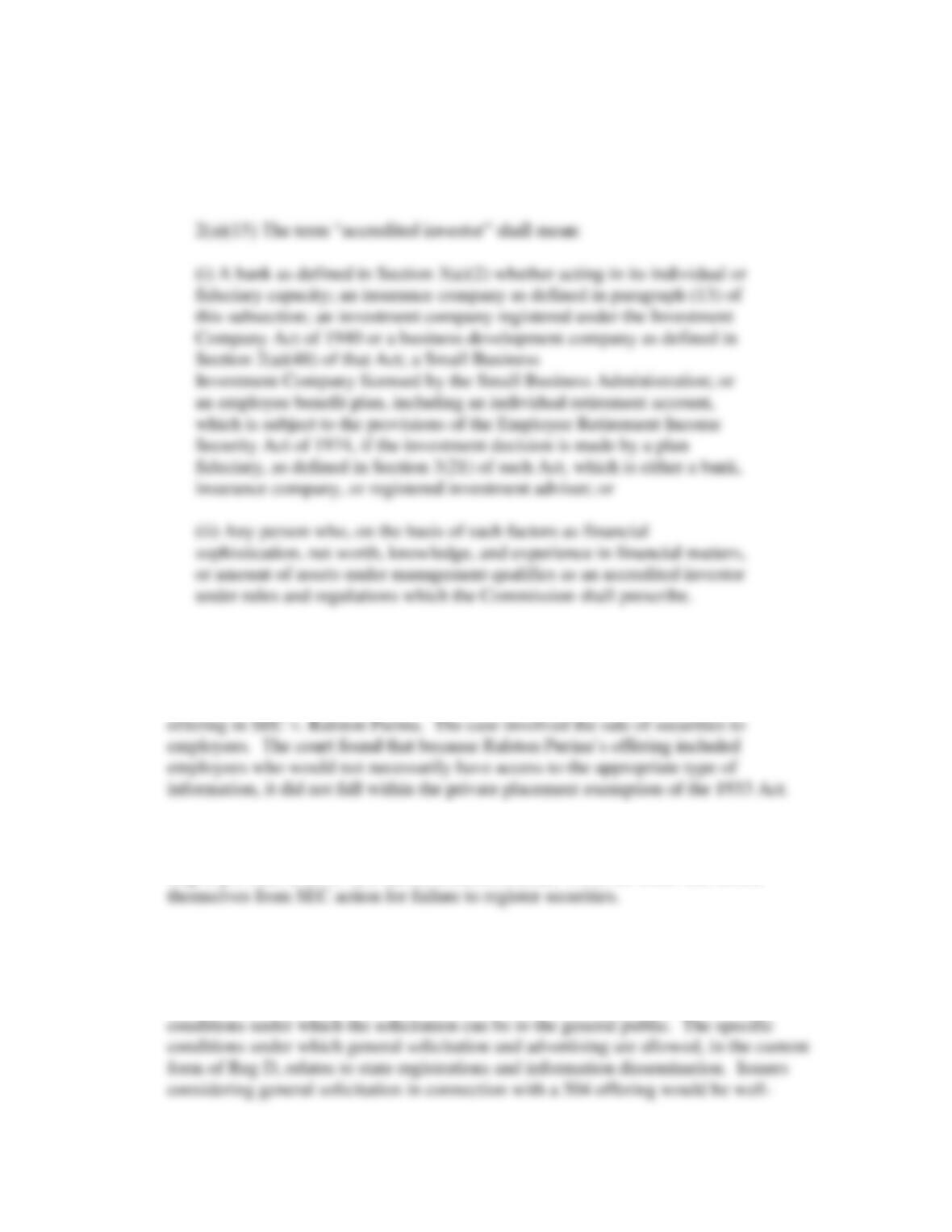
Accredited investors under the 1933 Act are assumed to have sufficient financial
expertise and wherewithal to make an intelligent and informed investment decision.
Formally:
13. Briefly describe the importance of the 1953 SEC vs. Ralston Purina case in terms of
securities registration requirements.
The U.S. Supreme Court took an important step toward defining a private (nonpublic)
14. What is the purpose of the SEC’s Regulation D?
Reg D provides a set of safe harbor conditions under which an issuer can shield
15. What are the restrictions on general solicitation and advertising covered in Rule
504?
Rule 504 is the most lenient and the only exemption in Reg D that allows for any
16. How do Rules 504 and 506 of Reg D differ from one another?
Rule 504 has a $5 million limit on the amount raised but no limit on the number or
17. Provide a brief description of the use of Regulation A when issuing securities.
Regulation A is technically an exemption from full registration, but in practice is like
[Note: The following questions 18 through 26 relate to the material presented in
Appendixes B and C.]
18. Briefly describe how the SEC’s Regulation D expanded the original Securities Act of
1933 definition of an “accredited investor.”
For the purposes of Reg D, investors are considered accredited if they fall into one of
19. What are the income and net worth requirements for being an accredited investor?
What in the requirements for designation as an accredited investor relates to the level
of sophistication? Do the criteria act as good proxies for sophistication?
The income requirements are currently $200,000 for single filers and $300,000 for
20. What are the four conditions of a Reg D offering that are covered under Rule 502?
Rule 502 (§ 230.502) deals with four conditions of a Reg D offering: integration
21. What is integration as it applies to securities offerings and why does it matter?
Integrated offerings are those that may be treated as combined into one offering. For
22. What types of information need to be disclosed to offerees under Reg D?
When required, the type of information to be disclosed varies by the venture’s status
and size. Summarizing from the Reg D text:
23. What is a restricted security? Why does this designation matter? What types of
buyers must the owner of restricted securities find?
Restricted securities cannot be freely resold. This is the typical status of securities
24. Briefly describe the purpose of Rule 144 of Reg D.
To provide conditions under which restricted securities can be resold.
25. Briefly describe Rule 508 of Reg D.
26. Briefly describe the types of exemptions from registration of securities covered under
Rules 701 and 1001.
Rule 701 is an exemption for certain types of employee compensation arrangements
27. From the Headlines – Sock It to Me: The “Internet of Feet”: Discuss the role that
Indiegogo played in the initial funding of Sensoria. Do you believe it was important
in leading up to the $5 million A round?
Answers will vary: One aspect that crowdfunding plays in the launch of niche
products is that of a credible approach to elementary market research for that niche.
INTERNET ACTIVITIES
Web-researched results vary due to constant updating of web sites.
Web-researched results vary due to constant updating of web sites.
Web-researched results vary due to constant updating of web sites.
EXERCISES/PROBLEMS AND ANSWERS
1. [Accredited Investors] The NetCare Company, which operates living assistance
facilities, is planning to issue or sell shares of stock to “accredited investors.”
Briefly explain whether each of the following individuals would qualify as an
“accredited investor” under the SEC’s Regulation D. [Note: Materials in
Appendix B are useful in answering this exercise.]
C. Jean Wu also is considering purchasing shares of stock that will be issued by
the NetCare Company. Jean’s annual income has been $250,000 in each of
the past two years and she expects to have a comparable amount of income
next year.
Yes. A minimum of $200,000 annually over the past two years and the
expectation of earning above the threshold next year is one criterion for being
accredited.
2. [Securities Law] The CareAssist Company, a web-based provider of information
for the elderly, is planning to sell $4 million in securities. Management is trying
to decide which, if any, securities laws must be complied with. For each of the
following situations, describe the securities laws that might apply.
A. A private placement
For the $4 million offering, CareAssist can consider a Rule 504 or 506, or a
3. [Regulation D Exemptions] Two Rules (504 and 506) under Regulation D relate
to the (a) amount of offerings and (b) number of investors. Match Rules 504, 506,
or “none” with each of the following:
A. $5 million offering limit (in a 12-month period)
B. $1 million offering limit (in a 12-month period)
C. No limit on the amount of offering (in a 12-month period)
MINI CASE: THE VIRTUALSTREAM COMPANY
The VirtualStream Company has developed proprietary server and control software for
providing communication and media-on-demand services via the Internet. The company
is in the process of collecting prerecorded video and audio content from clients and then
digitally transferring and storing the content on network servers. The content then is
available for replay by customers via the Internet. VirtualStream’s mission is to provide
the most dependable and user-friendly multimedia streaming service worldwide.
The Internet technology service industry is characterized by rapid revenue growth
with industry revenues predicted to exceed $300 billion in three years. Market
“securities” in the form of stock in the firm. The firm is planning to obtain $750,000 as
soon as possible from private investors.
A. Discuss whether you would recommend “registering” these “securities” with the
Securities and Exchange Commission (SEC).
Paying all of the costs (present and future) of a full public registration would most
B. Some “securities” are exempt from the SEC registration requirement. Is it likely that
VirtualStream’s “stock” would qualify for such an exemption? Why, or why not?
Virtual Stream’s issue of stock is potentially covered by the transactions exemption
C. Would you recommend that the initial $750,000 be obtained through an “intrastate”
offering? Explain.
Intrastate offerings present serious challenges to ventures seeking to acquire large
D. Briefly describe the two basic types of “transaction” exemptions that may be
available to VirtualStream that would allow the firm not to have to register its
securities with the SEC.
The two more likely transaction exemptions for VirtualStream are the private
placement exemption (Section 4(2) broadly and its Regulation D extensions) and the
E. The SEC’s Regulation D offers a “safe harbor” exemption to firms from having to
register their securities with the SEC. Describe how the VirtualStream Company
could use Reg D for issuing $750,000 in stock to private investors. In developing
your answer, describe the Reg D “rules” that would likely apply to this security issue.
Assuming that the previous round of funding falls outside the time interval where
F. Now, assume VirtualStream also is planning to issue an additional $2 million in stock
towards the end of the year. Would this decision have an impact on the Reg D
“rules” which would govern the issuance of the firm’s securities? Describe. [Note:
The material in Appendix B may be helpful in developing an answer to this question.]
Since the future issue is for the same securities and could potentially be integrated
G. The other alternative is to seek to raise the total $2,750,000 amount now by selling
securities to investors. Which Reg D “rules” and/or other securities laws would be
“triggered” by such a plan? Describe why and how.
Reg D’s 504 and 506 apply, but much care needs to be taken with a 506 offering as
the 35 unaccredited investor limit could be binding. If the offering is not targeting