Chapter 8 Time Value of Money Part I Lump Sums
CHAPTER OUTLINE
Learning Objectives
Simple Interest
Fixed Principal Commercial Loans
Bridge Loans
Compound Interest
Rounding Errors
Effective Rate
Time Value of Money Methods
Future Value of a Lump Sum
REVIEW AND DISCUSSION QUESTIONS
1. What is the relationship between the time value of money and inflation? Money has an opportunity
cost which corresponds to the time value of money. There is always a lost opportunity when a choice is
2. Compare simple interest to compound interest. Simple interest is the interest earned or paid on the
3. What are the advantages and disadvantages of a fixed principal, fixed interest loan? Advantages
include reduced overall interest as the principal amount of the loan is reduced by the equal principal
5. Distinguish between bank discount and simple interest. The bank discount is an amount of interest that
6. Differentiate between a stated rate of interest and an effective rate of interest. The stated rate of
EXERCISES AND PROBLEMS
1. Jill Kramer borrowed $25,000 to pay for a startup business. Jill must repay the loan at the end of five
months in one payment with a 6 percent simple interest rate.
a. What is the total amount that Jill must repay in five months?
Pay back =$25,000 principal + $625.00 interest = $25,625
b. How much interest does Jill repay?
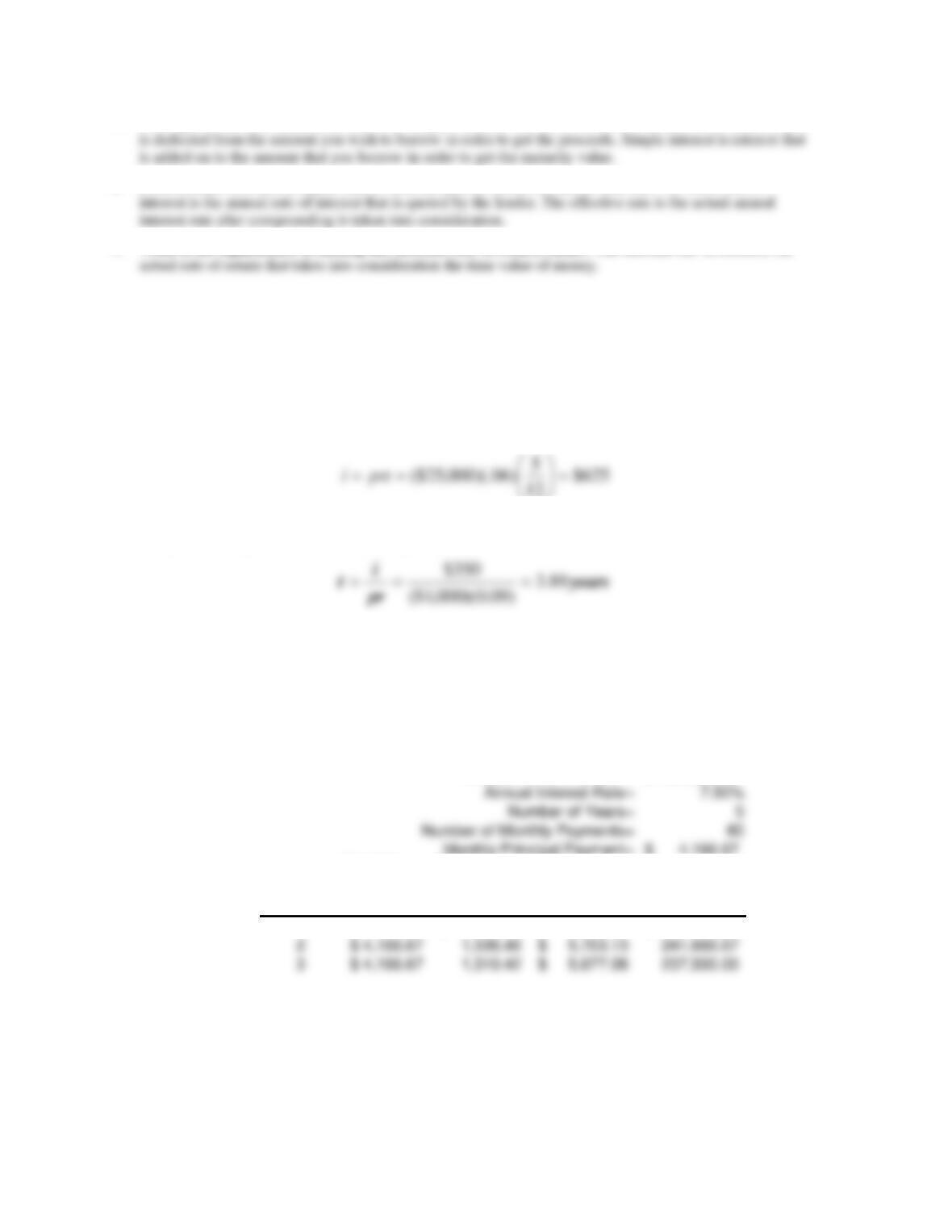
2. Joe Jones went to his bank to find out how long it will take for $1,000 to amount to $1,350 at 9
percent simple interest. Solve Joe’s problem.
3. The Fed cuts the Federal Funds rate and the Discount rate and the Prime goes down to 3.5 percent.
Al Truistyk owns an exercise center and needs to upgrade his equipment in order to meet his
customers’ needs. The equipment costs $275,000 and the lender requires a 10 percent down payment.
Al must borrow $250,000 and the lender agrees to a 60-month fixed principal fixed interst rate loan
with a rate of Prime plus 4 percent.
a. Construct an amortization table for the first 3 months of this loan.
Amortization table for problem 8-3a
250,000.00$
4,166.67$
Payment
Number
Monthly
Principal
Payment
Monthly
Interest
Payment
Monthly Loan
Payment
Loan Balance
14,166.67$ 1,562.50$ 5,729.17$ 245,833.33$
Monthly Principal Payment=
Principal Amount of loan=
b. Instead of a fixed interest loan, the lender gave Al a variable rate loan of prime plus 4 percent.
Using the Internet find the current prime lending rate. Construct an amortization
table listing Al’s interest payments for the first 3 months of this loan if he
borrowed the money on January 1, 2013.
The amortization table should look like the one for answer 3.a. above, but with the interest rate of prime
4. The Smiths purchase a $600,000 house and must sell their old home in order to make a 20 percent down
payment plus closing costs of $7,000 on the new house. Currently, they have a mortgage balance of
$100,000 on their old home, which has been appraised at $300,000 They have been pre-approved by the
lender to qualify for a $480,000 mortgage in the new home. The lender offers a bridge loan at 10
percent simple interest. The closing date on the new house is February 13, and the Smiths sell their old
home on May 15.
a. How much cash must the Smiths put down on their new house? The must put down 20
percent of $600,000, which is $120,000, plus $7,000 closing costs for a total of
$127,000.
c. How much must they borrow if they take a bridge loan? They must borrow $77,000,
which is the $127,000 cash that they need minus the $50,000 that they have in
savings.
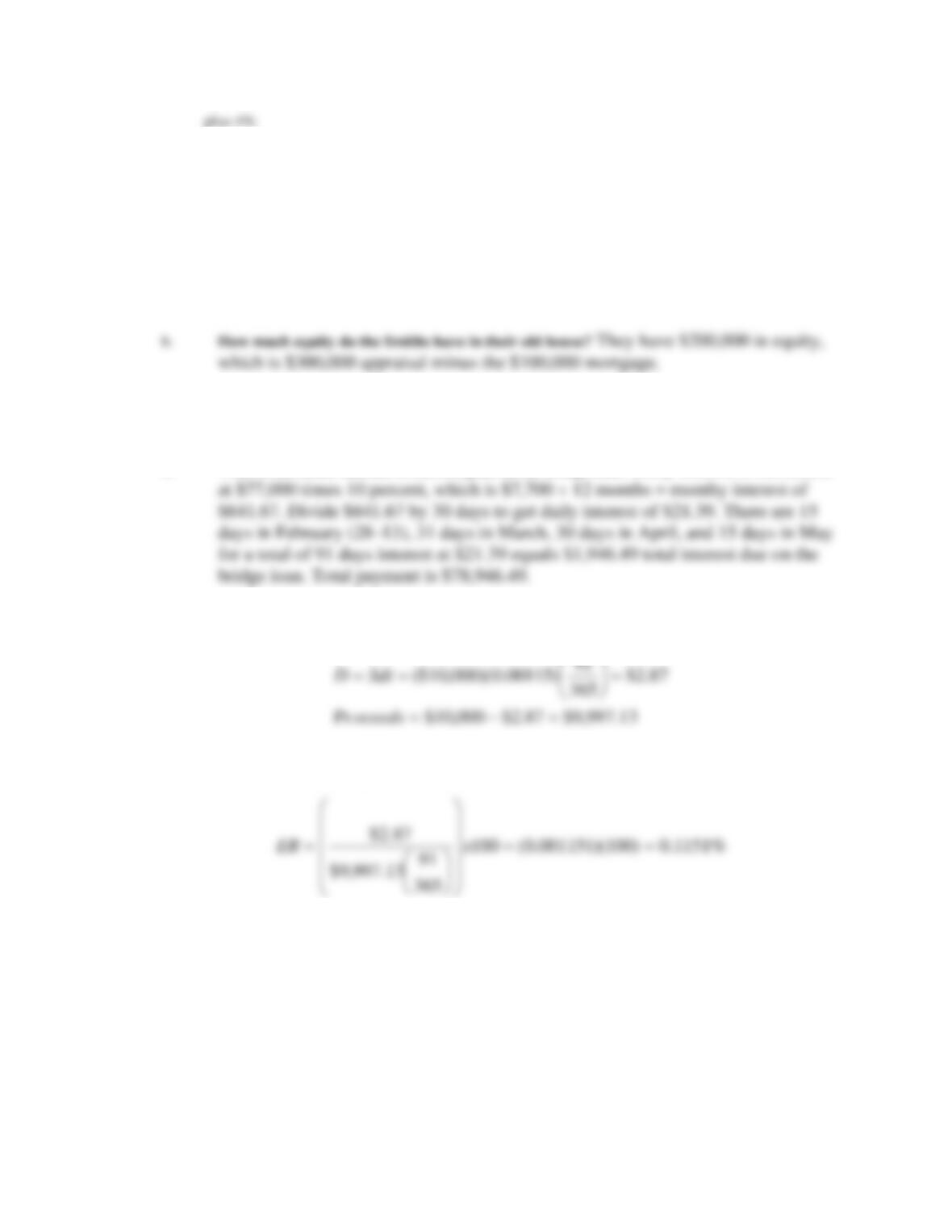
d. What is the dollar amount of interest paid on the bridge loan? Daily interest is calculated
5. Hy Potenuse bought a $10,000 Treasury bill at 0.115 percent discount for 13 weeks (91 days).
a. How much does Hy pay for the bill?
b. What is the effective rate of interest?
c. Who is the borrower?
The United States Government
6. Alana Olsen borrowed $5,000 for 90 days from First Bank. The bank discounted the note at 7
percent.
a. What proceeds did Olsen receive?
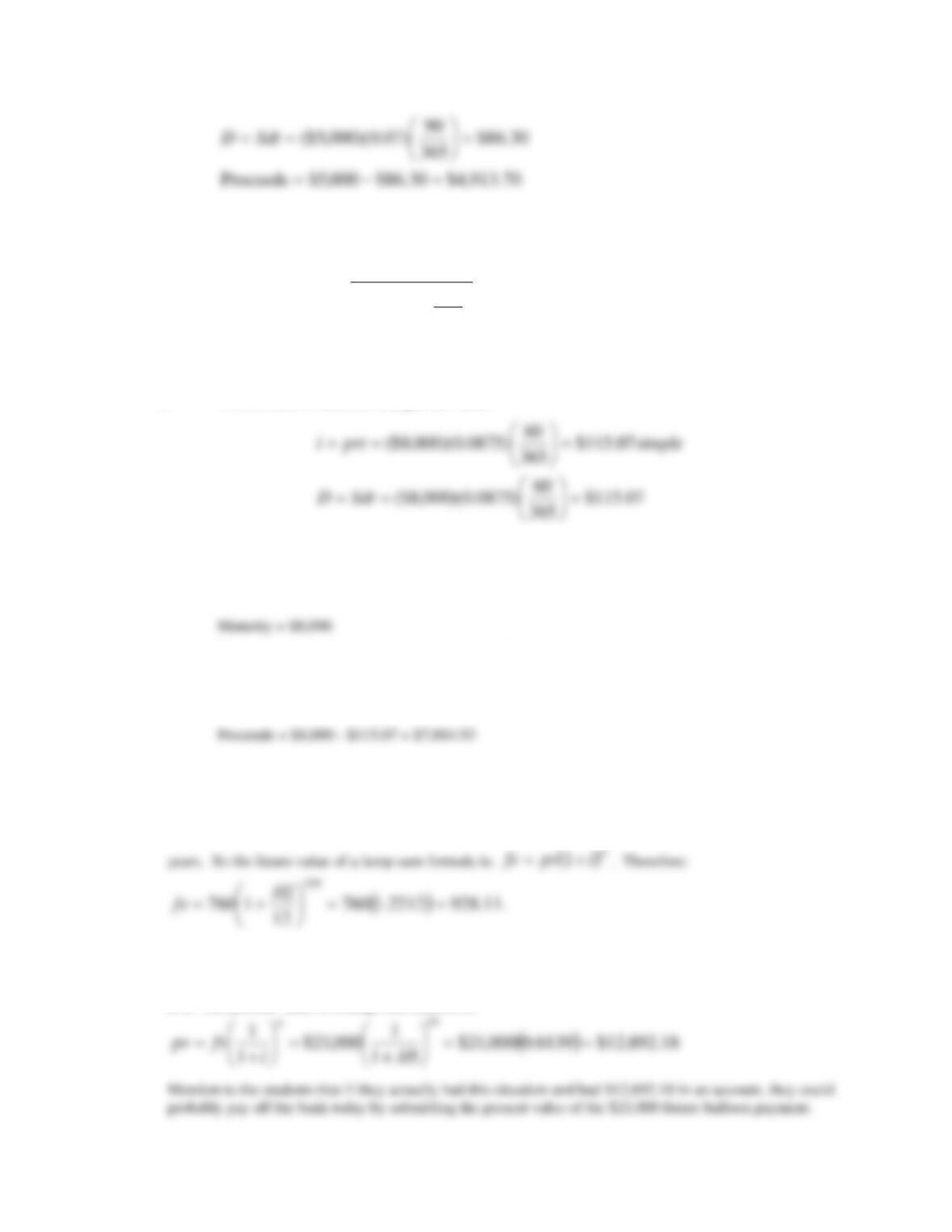
b. What is the effective rate to the nearest basis point?
%12.7)100)(0712.0(100
365
90
70.913,4$
30.86$==
=xER
7. The face values of a simple interest note and bank discount note are $8,000 each. Assume both notes
have 8.75 percent interest rates for 60 days. Calculate the following:
a. The amount of interest charged for each.
b. The maturity value of the simple interest note.
Maturity = $8,000 principal + $115.07 interest = $8,115.07
c. The maturity value of the bank discount note.
d. The amount the borrower receives for the simple interest note.
$8,000
e. The amount the borrower receives for the bank discount note.
8. You deposit $760 in an account one time that compounds monthly at 2 percent. How much will you
have in your account at the end of ten years?
This is a future value of a lump sum question which is solved as follows. There are 120 months in ten
9. A balloon payment of $21,000 on your house is due in 10 years. If you can earn an average of 5
percent per year for the 10-year period, how much will you have to place into an account today to
have the $21,000 in 10 years? This is a present value of a future lump sum problem, Appendix B, Table
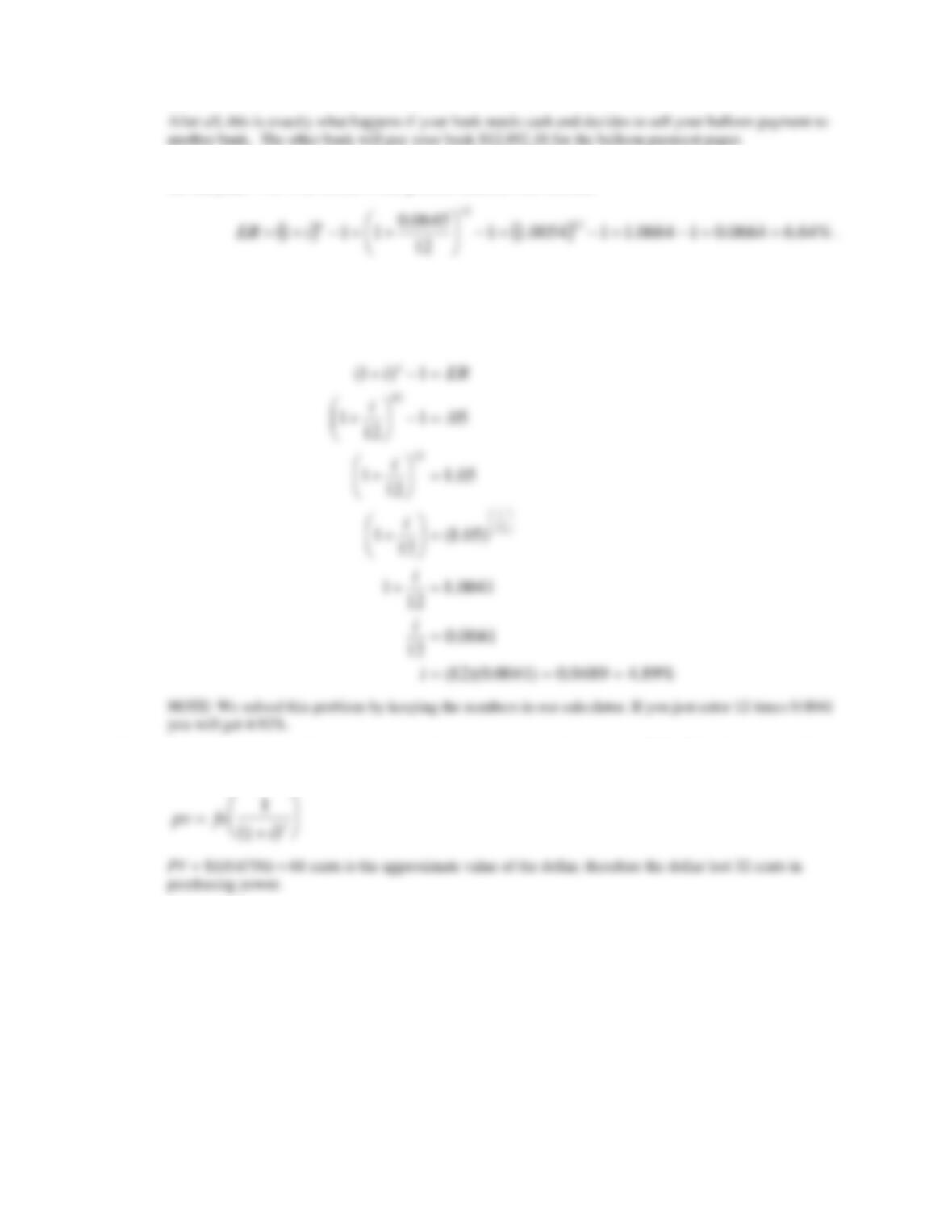
10. A financial institution quotes a rate of 6.45 percent compounded monthly. What is the effective rate
for the year? This is an effective rate problem and uses the formula:
11. If you want an effective rate of 5 percent, what is an acceptable quoted rate if money is compounded
monthly?
This is an effective rate problem using the formula for effective rate which is (1 + i)n – 1, which is solved as
follows:
12. If inflation averages 4 percent per year, how much purchasing power will $1.00 lose in ten years?
In this problem you are finding the present value of a dollar ten years from now; the formula is
13. How much will you pay for a $10,000 automobile in 20 years if the inflation rate averages 3 percent
per year for 20 years? This is a future value of a lump sum problem and the formula is:
( )
fv pv in
= +1
So fv = ($10,000)(1.03)20 = ($10,000)(1.8061) = $18,061. The factor can be confirmed by use of Appendix
B, Table B-1.
14. At the beginning of each year, you deposit the following into a growth mutual fund that earns 6
percent per year: How much should the fund be worth at the end of 5 years?
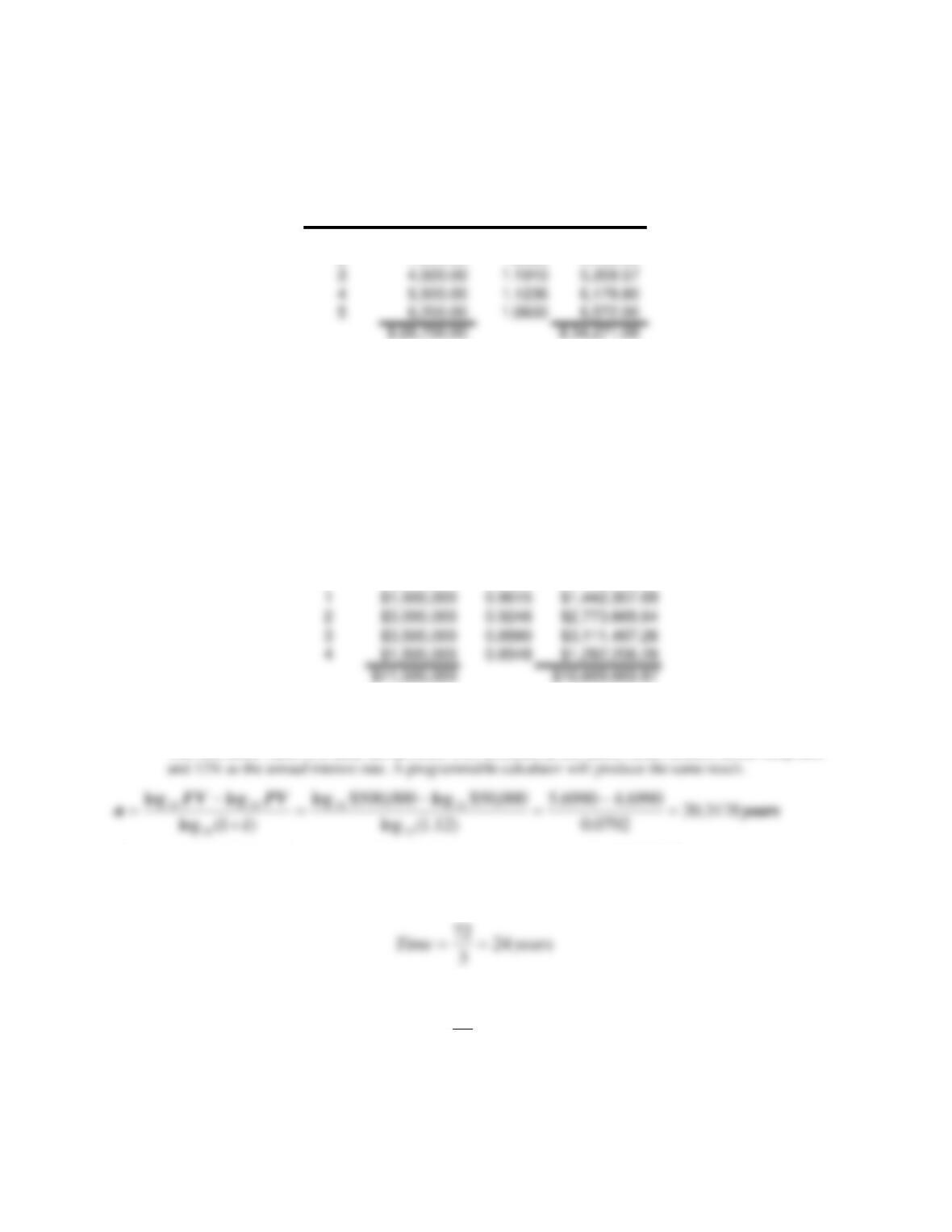
Solution to Chapter 8, Problem 14
Annual
Interest=
6.00%
Year Deposit FV Factor
Future
Value
15,000.00$ 1.3382 6,691.13$
15. Icahn Tackel just signed an $11.5 million, four year contract with an NFL team. He received a
signing bonus of $2 million; $1.5 million at the end of year one; $3 million at the end of year two; $3.5
million at the end of year three; and 1.5 million at the end of year four. What is the present value of
his contract if money can earn 4 percent per year?
Solutiion to Chapter 8, Problem 15
Interest
rete =
4.00%
Contract
Year
Future
Value
PVF Present Value
0$2,000,000 1.0000 $2,000,000.00
16. Bylo Selhi wants to know how many years it well take for his mutual fund investment of $50,000 to
reach $500,000 if his mutual fund pays an average of 12 percent per year.
17. Ira Schwab wins the lottery and decides to take the one lump sum of $500,000 minus taxes. Ira
receives a check for $300,000 after taxes. Using the rule of 72, determine
a. How long will it take him to get $600,000 if he can earn 3 percent?
b. How long will it take him to get $600,000 if he can earn 6 percent?
yearsTime 12
6
72 ==
c. How long will it take him to get $1,200,000 if he can earn 9 percent?
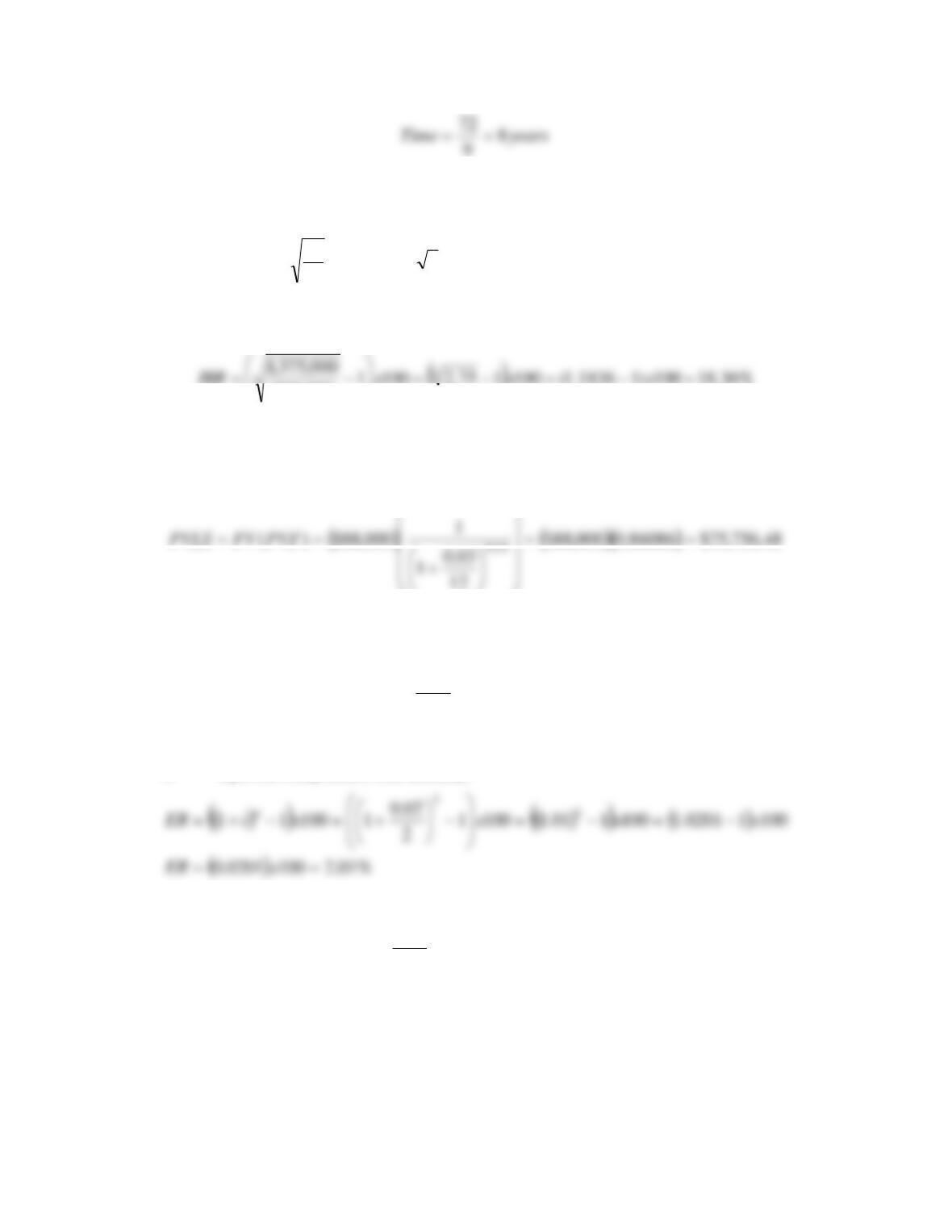
18. Felice Navidad purchases 2,000 shares of NOW Technology stock at $4 in Christmas 2008. Four
years later, in Christmas of 2012 she sells the stock at $28 per share. What is Felice’s internal rate of
return?
( )
%66.62100)16266.1(100171001
4
28 4
4=−=−=
−= xxxIRR
19. Carrie Haute buys a fast food restaurant for $500,000. She is very successful and sells the business six
years later for $1,375,000. What is Carrie’s internal rate of return?
( )
%36.18100)11836.1(100175.21001
000,500
20. Rochelle Kotter wants to attend a university five years from now. She will need $88,000. Assume
Rochelle’s bank pays 3 percent interest compounded monthly. What must Rochelle deposit today to
accumulate $88,000 in five years?
21. Compute the effective annual rates for the following:
a. 2 percent compounded yearly.
( )
( )
( )
( )
( )
( )
%00.210002.0
100102.1100102.11001
1
02.0
110011 1
1
==
−=−=
−
+=−+=
xER
xxxxiER n
b. 2 percent compounded semi-annually.
c. 2 percent compounded quarterly.
( )
( )
( )
( )
( )
( )
%015.210002015.0
100102015.110010050.11001
4
02.0
110011 4
4
==
−=−=
−
+=−+=
xER
xxxxiER n
d. 2 percent compounded monthly.
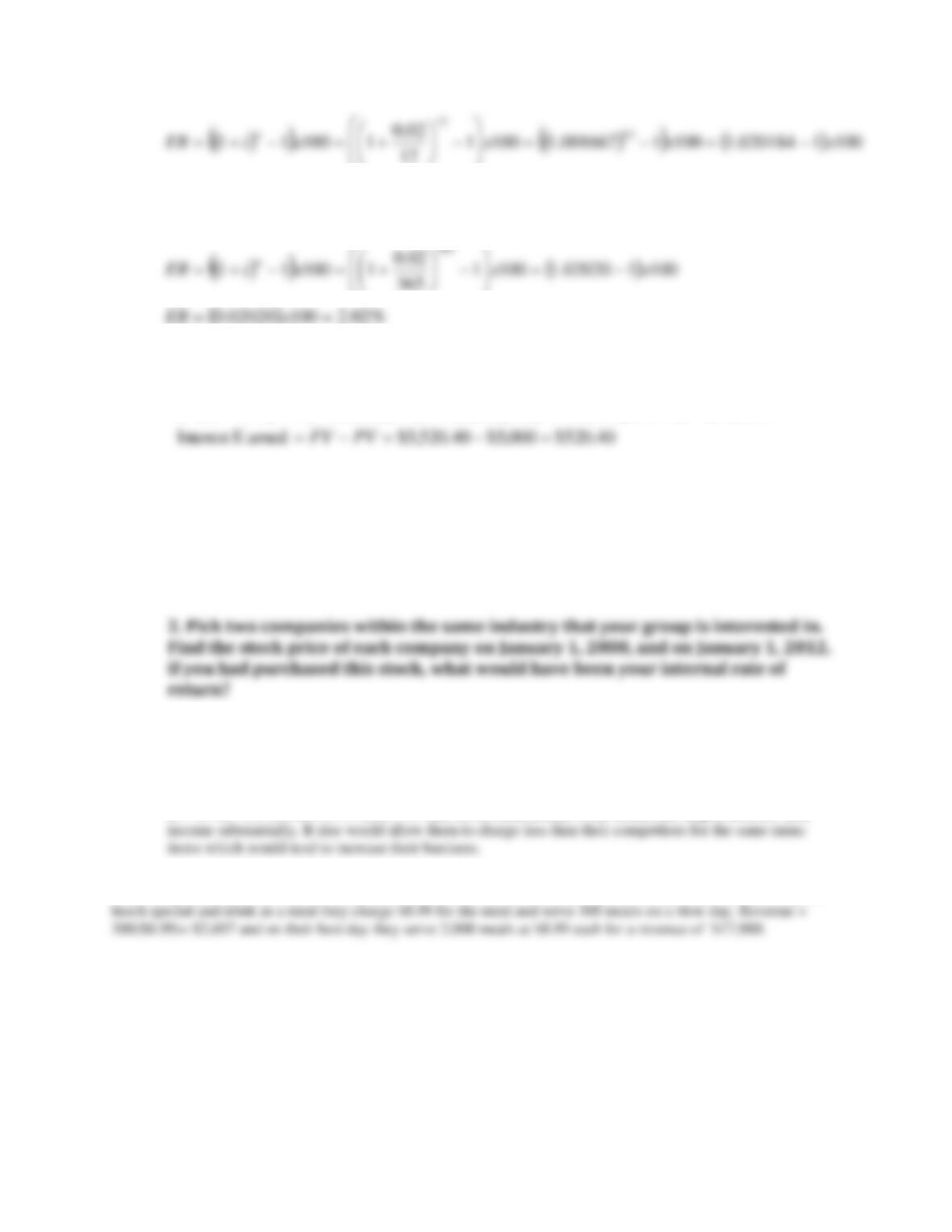
( )
%018.2100020184.0
==
xER
e. 2 percent compounded daily (use 365 days a year).
22. Mr. N invests $5,000 in a certificate of deposit in his local bank. He receives 2 percent compounded
annually for 5 years. How much interest does his investment earn during this time period?
( ) ( ) ( ) ( )
40.5520$10408.1000,5$02.1000,5$1000,5$ 5
===+==
iFVFPVFVLS n
RECOMMENDED TEAM ASSIGNMENT
We can’t really answer these questions as they require current Internet research.
1. Contact at least three separate banks within your community. Interview the
bank managers and determine how these banks provide a bridge loan to a
business. What are the interest rates charged by these banks?
CASE STUDY QUESTIONS
1. The Blue Bonnet paid only $350 rent for 17 years between 1973 and 1990. Based on a 4 percent
inflation rate, how much should their rent have been in by 1990? What advantage did this lease
provide to the Mobel family? By 1990 their rent should have been $681.77
Using the information in the case study and the current menu price of a burrito plate lunch special at $6.99
and a large soda at $2.00. How much revenue is derived on their worse day and on their best day? Using the