119
Chapter 7
TYPES AND COSTS OF FINANCIAL CAPITAL
FOCUS
In this chapter, we characterize financial markets and focus on developing an understanding of
the how one obtains and pays for financial capital. Without adequate capital, even the best
ideas and ventures cannot succeed. The cost of debt is relatively easy to understand and apply
because it is primarily captured in the stated interest rate for a loan or bond. In contrast, the
LEARNING OBJECTIVES
LO 7.1: Describe implicit and explicit financial capital costs.
CHAPTER OUTLINE
7.1 IMPLICIT AND EXPLICIT FINANCIAL CAPITAL COSTS
7.2 FINANCIAL MARKETS
7.3 DETERMINING THE COST OF DEBT CAPITAL
A. Determinants of Market Interest Rates
7.4 WHAT IS INVESTMENT RISK?
A. Measuring Risk as Dispersion around an Average
B. Historical Return Versus Risk Relationships
7.5 ESTIMATING THE COST OF EQUITY CAPITAL
7.6 WEIGHTED AVERAGE COST OF CAPITAL
A. A Life Cycle-Based WACC Example
SUMMARY
APPENDIX A:
Using WACC to Complete the Calibration of EVA
DISCUSSION QUESTIONS AND ANSWERS
1. Describe how the costs of debt and equity differ from the perspective of accounting
measures.
While accountants recognize that financial capital has a cost and recommend its complete
2. How do private and public financial markets differ?
Private financial markets are those involving direct two-party negotiations over illiquid
3. Briefly describe venture debt capital and venture equity capital.
In general, early-stage ventures raise debt capital from individuals, venture lenders, and
when profitably entering rapid-growth, possibly other financial institutions.
4. What is an interest rate? What is default risk?
5. What is a nominal interest rate? Describe a risk-free interest rate and a real rate of
interest.
A nominal interest rate is stated rate of interest. The risk-free interest rate is interest rate for
6. Define inflation. What is meant by an inflation premium?
Inflation is the general rise in prices that is not due to increases in product quality. An
7. Define the term default risk premium.
Default risk premium is the additional premium required to compensate for the possibility
8. What is meant by a prime rate?
Prime rate: interest rate charged by banks to their highest quality (lowest default risk)
9. What is a bond rating?
10. What is a liquidity risk premium? What is a maturity risk premium?
Liquidity risk premium is the additional rate charged when a debt instrument cannot be
11. What is meant by the term structure of interest rates? What is a yield curve?
Term structure of interest rates: relationship between nominal interest rates and time to
12. Describe the differences between senior debt and subordinated debt.
Senior debt: debt secured by a venture’s assets
13. Explain the meaning of investment risk of loss and describe how risk can be defined
relative to an average value.
Risk is the chance or probability of financial loss from a venture investment. More
14. Describe the following: (a) expected rate of return, (b) standard deviation, and (c)
coefficient of variation.
(a) Expected rate of return is the probability-weighted average of possible rates of return.
15. Describe the historical average annual return relationships among long-term U.S.
government bonds, corporate bonds, small firm common stocks, and large firm common
stocks.
Over the long-run (90 or so years) in the U.S., small firm common stocks had the highest
16. What is the difference between private equity investors and publicly traded stock investors?
Private equity investors own firms that are typically closely held while investors in publicly
17. How does an organized securities exchange differ from an over-the-counter market?
18. What is meant by an investment risk premium? What is a market risk premium?
An investment risk premium is the additional return above the risk-free rate that investors
19. What rates of returns have venture capitalists earned on average in recent years? How do
these returns compare against the average venture capitalists returns over the past twenty
years?
As shown in Table 7.1, venture capital holding period returns (all stages) ending in 2018
averaged 18.07% for 1-year, 9.5% for 3-year, and 12.92% for 5-year periods. These near-
20. How do we estimate the cost of equity capital for private ventures? In developing your
answer describe the major components that are considered when estimating the rates of
return required by venture investors.
21. What discount rates are typically used for development- stage, startup-stage, survival-
stage, and early-growth-stage ventures?
The discount rate for the development stage is typically above 40%, between 30% and 50%
22. What is meant by the weighted average cost of capital or WACC?
23. How is a venture’s WACC likely to change as it moves through a successful life cycle?
Most early-stage financing is high-cost equity capital. However, the opportunity to use
24. From the Headlines—Ecosphere: You have been retained as a consultant for Ecosphere and
tasked with assessing the financial viability of their commercial ventures. What types of
financial ratios would you enlist in your report to Ecosphere? What approach would you
take to determining a relevant cost of capital for those ventures?
Answers will vary: Ecosphere has a great deal of variety in the types of products and
services it targets. As it grows from tourism and handicrafts toward biofuels and other
INTERNET ACTIVITIES
1. Access the Federal Reserve Board of Governors web site at
Web-researched results vary due to constant updating of the related web sites.
Web-researched results vary due to constant updating of the related web sites.
EXERCISES/PROBLEMS AND ANSWERS
1. [Inflation and Risk Premiums] Voice River, Inc. provides media-on-demand services via the
Internet. Management has been studying current interest rates. A lender is willing to make
a two-year loan to Voice River at a 12 percent annual interest rate. The U.S. government
is currently paying 8 percent annual interest on its two-year securities.
A. If the real rate of interest is expected to be 3 percent annually, what is the inflation
premium expected at this time?
Risk free rate = real rate + inflation premium
B. What is the amount of the total risk premium that Voice River will have to pay?
Risk premium = nominal interest rate – risk free interest rate = 12% – 8% = 4%
C. If a 1 percent liquidity premium is built into the 12 percent rate, what is the default risk
premium on the loan?
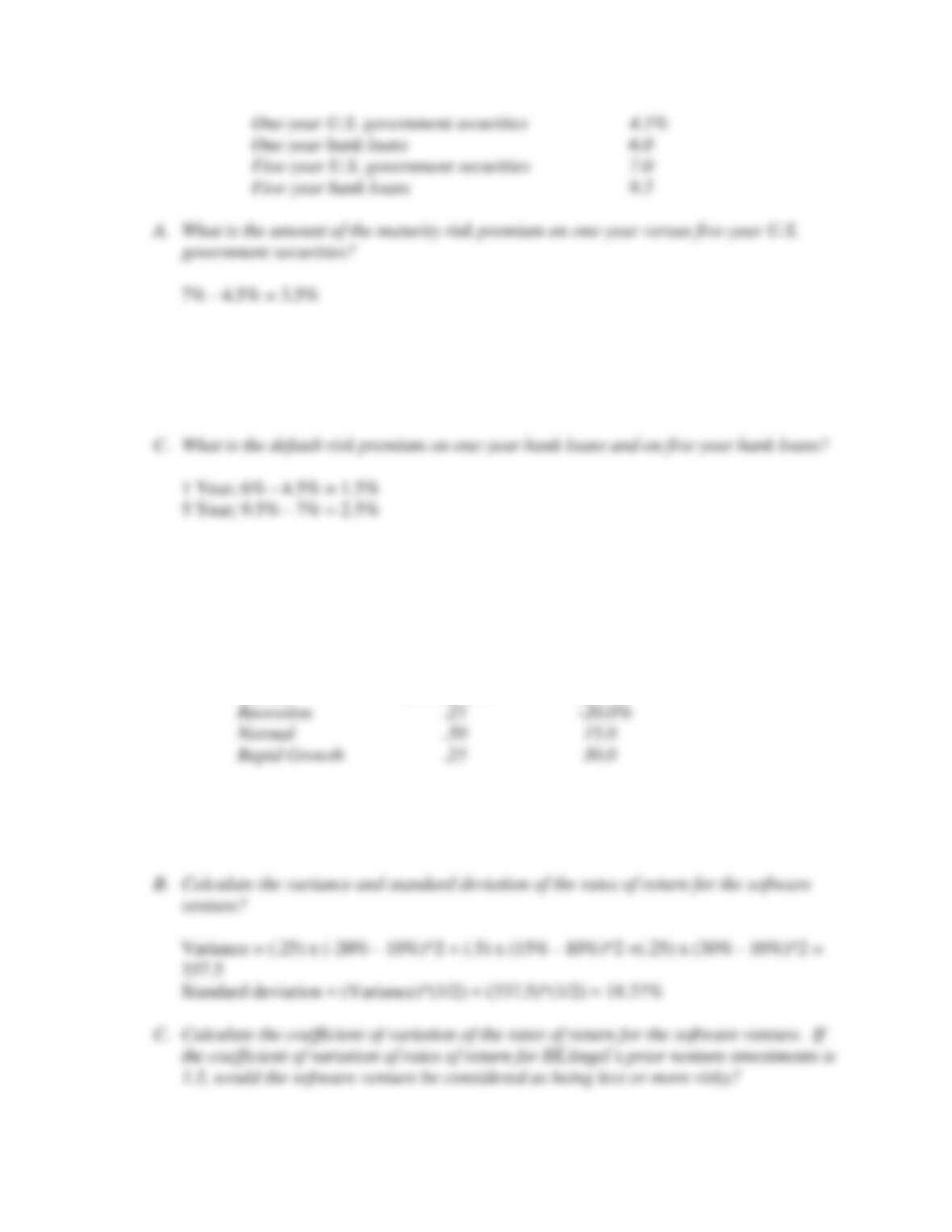
2. [Maturity and Default Risk Premiums] Following is interest rate information currently
being observed by the Electronic Publishing Corporation.
B. What is the amount of the maturity risk premium on one-year versus five-year bank
loans?
9.5% – 6% = 3.5%
3. [Expected Rate of Return and Risk Measures] A venture investor, BKAngel, is considering
investing in a software venture opportunity. However, the rate of return to be realized next
year is likely to vary with the economic climate that actually occurs. Following are three
possible economic outcomes, the probability that each one will occur, and the rate of
return projected for each outcome:
Economic Probability of Rate of
Climate Occurrence Return
A. What is the expected rate of return on the software venture?
Expected rate of return = (.25) x (-20%) + (.50) x (15%) + (.25) x (30%) = 10%
4. [Expected Rate of Return and Risk Measures] A potential venture investment has the
following possible outcomes:
Performance Probability of Rate of
Outcome Occurrence Return
Home Run (Success) .15 500.0%
A. What is the expected rate of return on the venture?
B. Calculate the variance and standard deviation of the rates of return for the venture.
Variance = (.15) x (500% – 30.25%)^2 + (.35) x (15% – 30.25%)^2 + (.50) x (-100% –
30.25%)^2 = .15 x 220,665.06 + .35 x 232.56 + .50 x 16,965.06 = 33,099.76 + 81.41 +
C. Calculate the coefficient of variation of the rates of return for the venture. If the
coefficient of variation of rates of return for your prior venture investments is 4.0,
would the new venture be considered as being less or more risky?
5. [Portfolio Expected Rate of Return and Risk Measures] Three venture investments
previously made by BKAngel, a venture investor, achieved the following outcomes for the
year just completed:
Venture Initial Cash Ending
Opportunity Value Flow Value
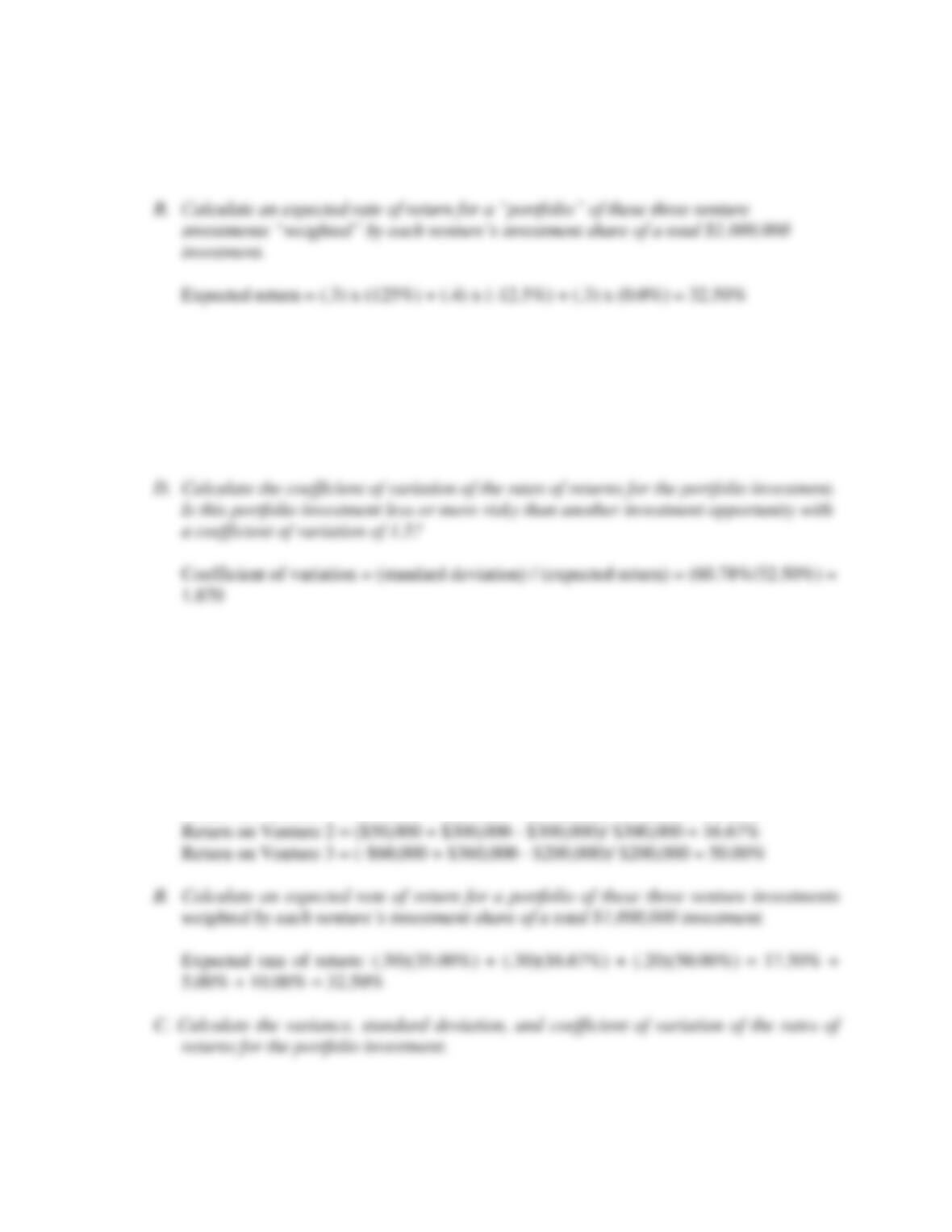
Return on VEN1 = ($75,000 + $600,000 – $300,000)/ $300,000 = 125.00%
Return on VEN2 = ($50,000 + $300,000 – $400,000)/ $400,000 = -12.50%
Return on VEN3 = (-$60,000 + $360,000 – $300,000)/ $300,000 = 0.00%
C. Calculate the variance and standard deviation of the rates of returns for the portfolio
investment.
Variance = (.3) x (125% – 32.5%)^2 + (.4) x (-12.50% – 32.5%)^2 + (.3) x (0% –
32.5%)^2 = 3,693.75
Standard deviation = (Variance)^.5 = (3,693.75)^.5 = 60.78%
6. [Portfolio Expected Rate of Return and Risk Measures] Refer to Problem 5. Assume that
BKAngel’s initial investments in the three ventures had been Venture 1 = $500,000,
Venture 2 = $300,000, and Venture 3 $200,000 with each investment having achieved the
same cash flows and ending values shown in Problem 5.
A. Calculate the percentage rate of return for each of the venture investments.
% Return = (cash flow + ending value – beginning value)/(beginning value)
Return on Venture 1 = ($75,000 + $600,000 – $500,000)/ $500,000 = 35.00%

7. [Loan Present Values] Jerry’s Tree Services is trying to raise debt funds from a
prospective venture investors, SureWay LLC. SureWay indicated to Jerry Lau that the
annual interest rate on risky venture loans is currently 15 percent. Jerry is seeking a 3-
year loan with annual payments. He is willing to pay back $100,000 at the end of 3 years.
However, due to cash flow problems, he can afford to pay interest at a 12 percent annual
rate.
A. Calculate the dollar amount that SureWay venture investors would lend to Jerry’s Tree
Services.
N = 3
I%/Yr = 15%
B. What would be the dollar amount of the loan if the loan was made for only two years?
N = 2
8. [Loan Present Values] Refer to Problem 7. Show how your answer to Part A of Problem 7
would change if Jerry were willing to pay 16 percent annual interest and a principal
payment of $100,000 at the end of three years.
N = 3
I%/Yr = 16%
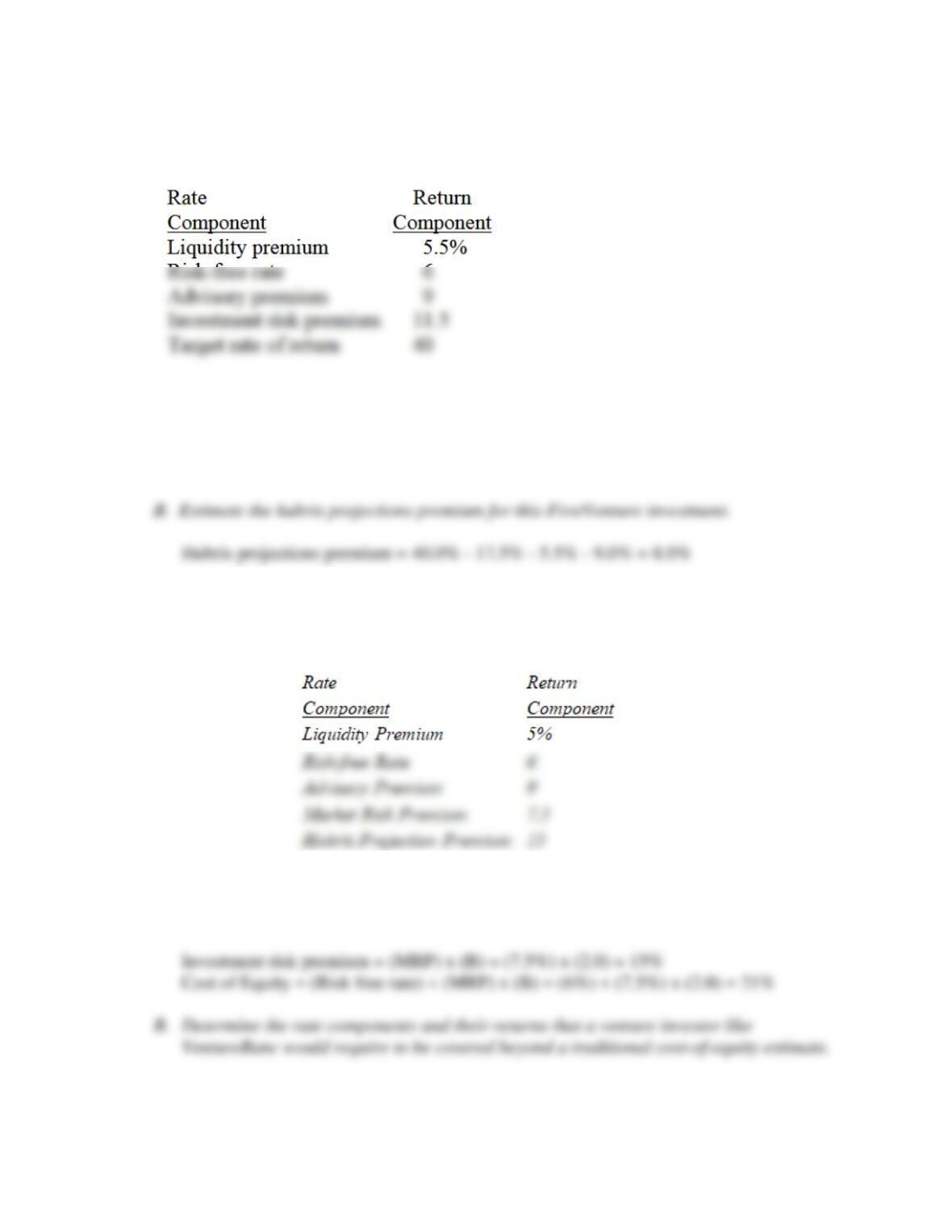
9. [Expected Rate of Return and Hubris Premiums] Following is rate of return component
information for FirstVenture investors.
A. Calculate the expected rate of return before considering premiums for illiquidity,
advisory activities, and hubris projections.
Expected rate of return = 6% + 11.5% = 17.5%
10. [Cost of Equity Capital] Use the following information to estimate the rate of return
expected by the VentureBanc Investors:
A. VentureBanc uses a systematic risk measure of 2.0. Based on the information shown,
estimate VentureBanc’s investment risk premium. Then, estimate the cost of equity
capital for VentureBanc.