Chapter 5: Evaluating Operating and Financial Performance
84
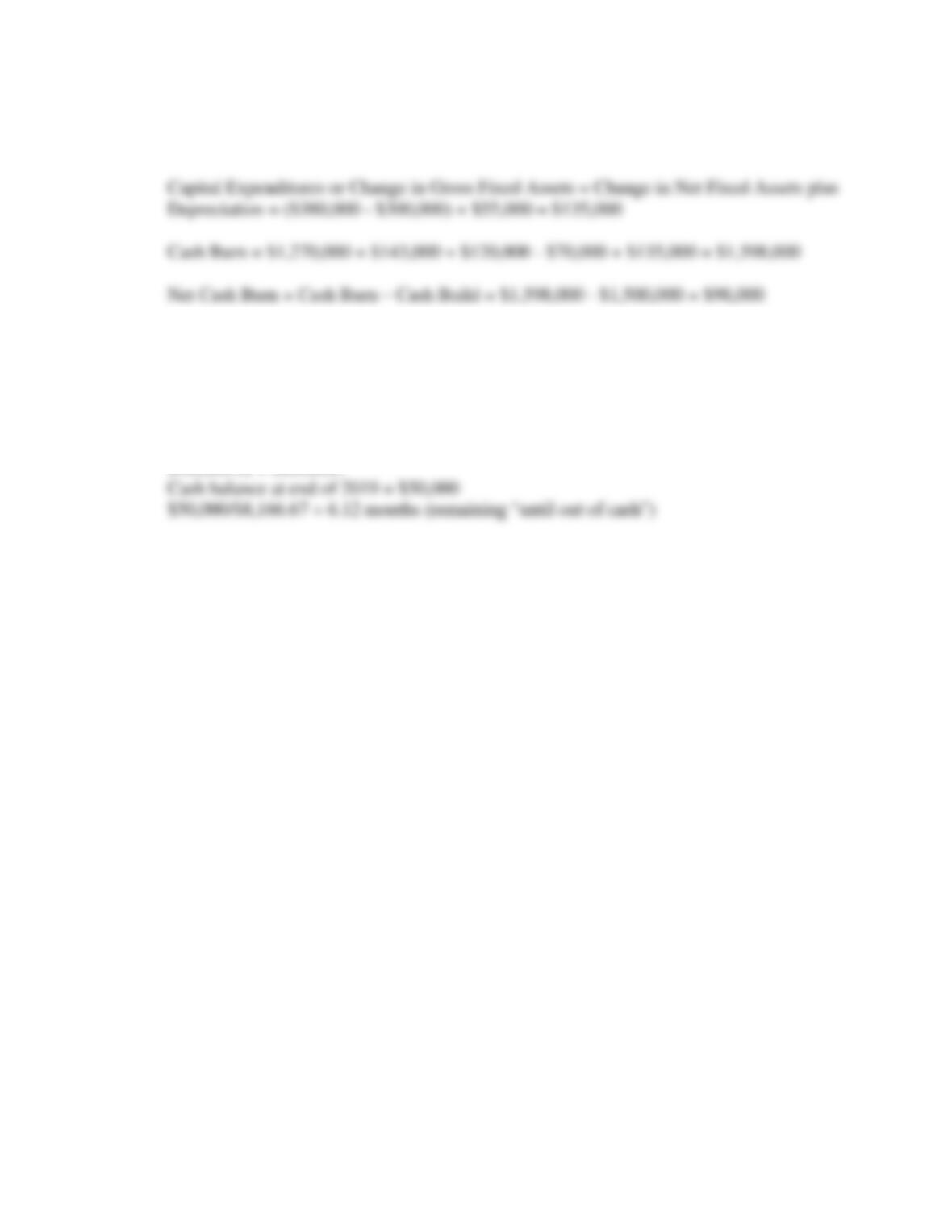
Changes in Payables and Accrued Liabilities = [($180,000 – $130,000) + ($70,000 –
$50,000)] = $70,000
B. Assume that 2020 will be a repeat of 2019. If your answer in Part A resulted in a net
cash burn position, calculate the net cash burn monthly rate and indicate the number of
months remaining “until out of cash.” If your answer in Part A resulted in a net cash
build position, calculate the net cash build monthly rate and indicate the expected cash
balance at the end of 2020.
Chapter 5: Evaluating Operating and Financial Performance
85
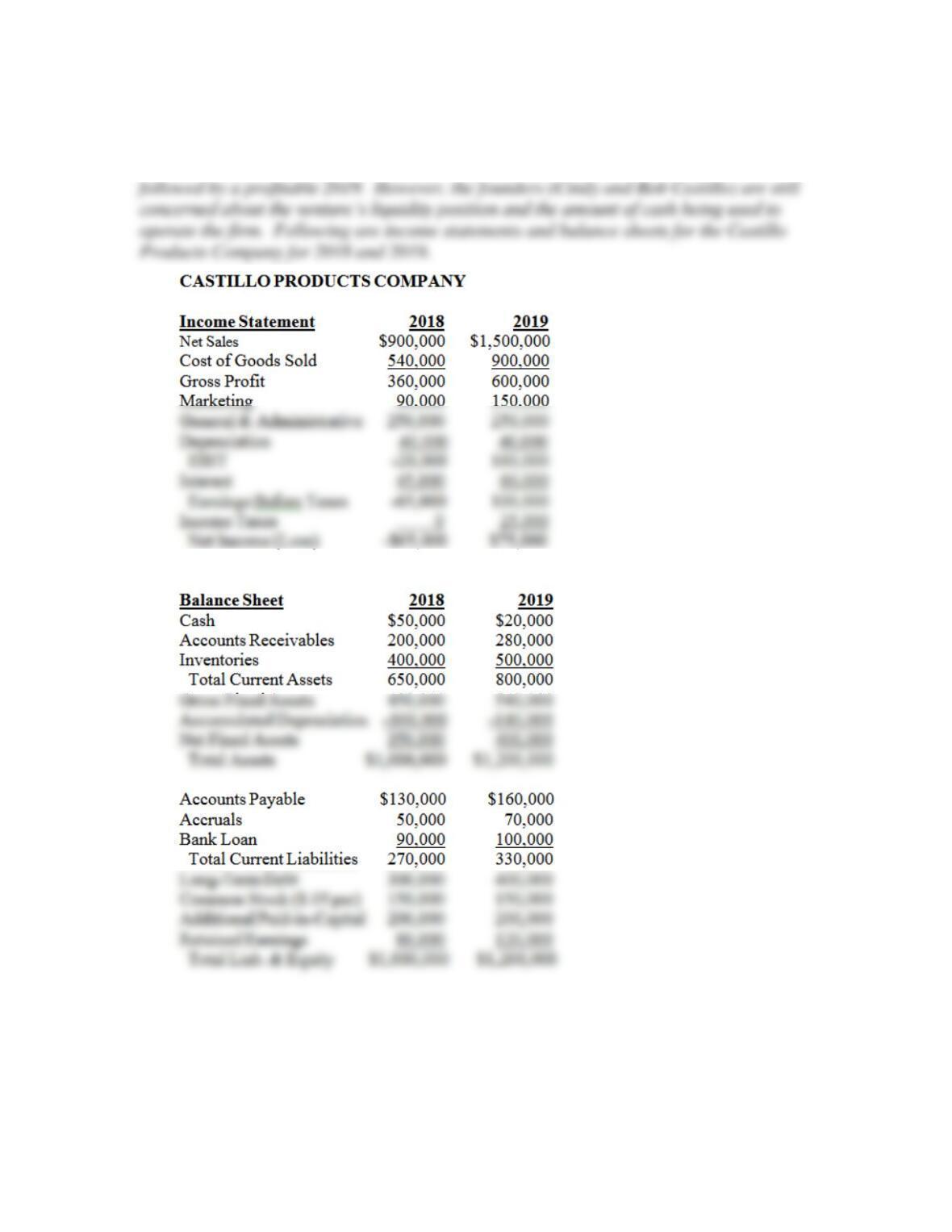
6. [Liquidity Ratios and Cash Burn or Build] The Castillo Products Company was started in
2017. The company manufactures components for personal decision assistant (PDA)
products and for other hand-held electronic products. A difficult operating year 2018 was
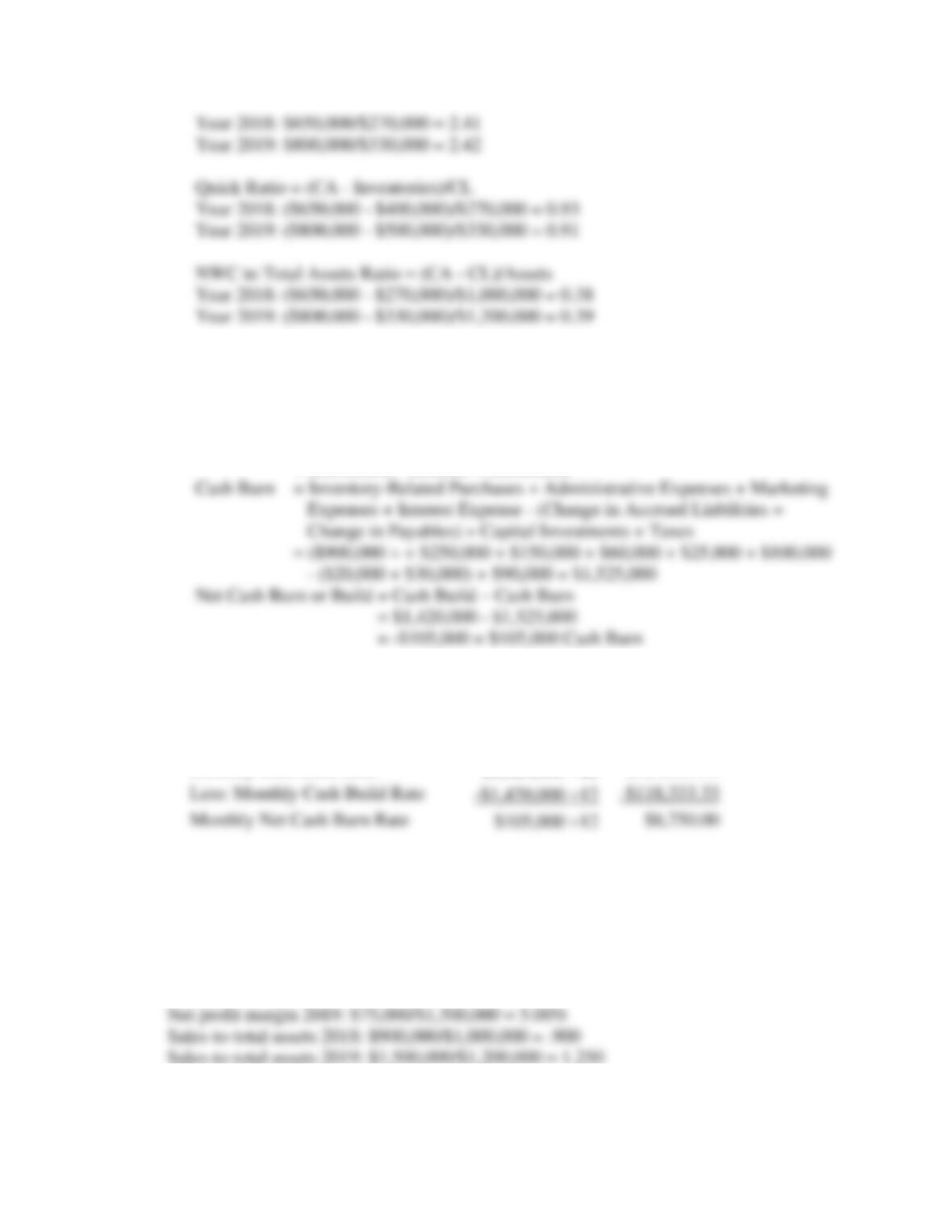
A. Use year-end data to calculate the current ratio, the quick ratio, and the net working
capital (NWC) to total assets ratio for 2018 and 2019 for the Castillo Company. What
changes occurred?
Current Ratio = Current Asset/Current Liabilities
Chapter 5: Evaluating Operating and Financial Performance
86
B. Use Castillo’s complete income statement data and the changes in balance sheet items
between 2018 and 2019 to determine the firm’s cash build and cash burn for 2019. Did
Castillo have a net cash build or net cash burn for 2019?
Cash Build = Sales – Change in Accounts Receivable
C. Convert the annual cash build and cash burn amounts calculated in Part B to monthly
cash build and cash burn rates. Also indicate the amount of the net monthly cash build
or cash burn rate.
Monthly Cash Burn Rate
Less: Monthly Cash Build Rate
$127,083.33
7. [ROA Model and Expenses Related to Sales] Use the financial statements data for the
Castillo Products presented in Problem 6.
A. Calculate the net profit margin in 2018 and 2019 and the sales–to-total-assets ratio using
yearend data for each of the two years.
Net profit margin 2018: -$65,000/$900,000 = -7.22%
Chapter 5: Evaluating Operating and Financial Performance
87
B. Use your calculations from Part A to determine the rate of return on assets in each of the
two years for the Castillo Products.
C. Calculate the percentage growth in net sales from 2018 to 2019. Compare this with the
percentage change in total assets for the same period.
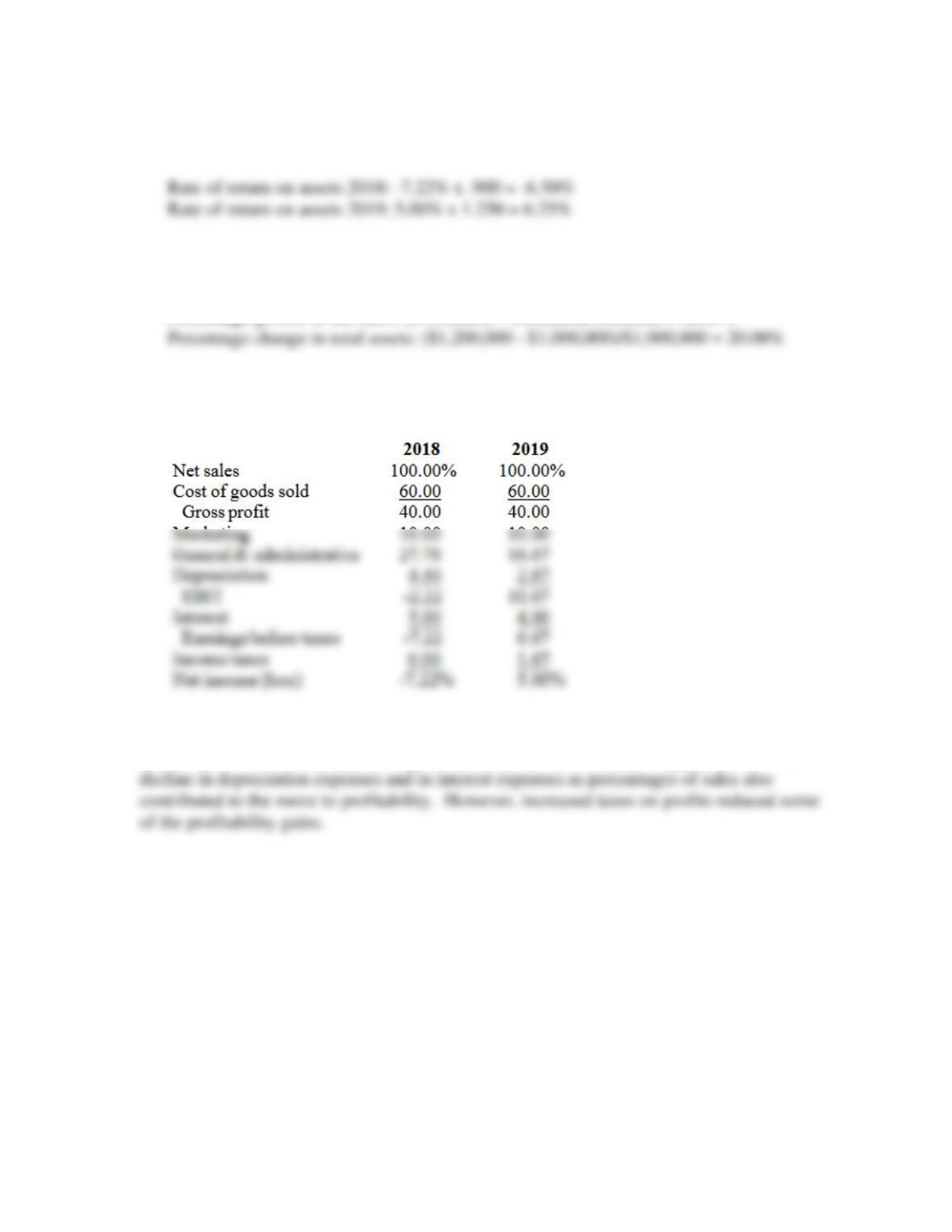
D. Express each expense item as a percentage of net sales for both 2018 and 2019. Describe
what happened that allowed Castillo Products to move from a loss to a profit between the
two years.
The decline in general and administrative expenses as a percentage of sales (i.e., the
spreading of fixed costs) was the major contributor to Castillo becoming profitable. The
Chapter 5: Evaluating Operating and Financial Performance
88
8. [ROE Component Ratios and Model] Refer to the financial statement data provided below for
Safety-First, Inc.
SAFETY-FIRST, INC.
Income Statements (in $ Thousands)
2018
2019
Net sales
3,750
4,500
Cost of goods sold
2,250
2,700
Gross profit
1,500
1,800
Operating expenses
670
860
Income before taxes
800
900
Income taxes
250
300
Net income
550
600
Balance Sheets (in $ Thousands)
2018
2019
Cash
400
150
Accounts receivable
500
800
Inventories
1,450
2,000
Total current assets
2,350
2,950
Gross fixed assets
2,000
2,800
Net fixed assets
1,050
1,550
Total assets
3,400
4,500
2018
2019
Accounts payable
300
400
Bank loan
150
250
Accrued liabilities
100
150
Total current liabilities
550
800
Long-term debt
150
150
Common stock
850
1,100
Retained earnings
1,850
2,450
Total liabilities and equity
3,400
4,500
A. Calculate the net profit margin, the sales-to-total-assets ratio, and the equity multiplier for
both 2018 and 2019 using year-end (rather than average) balance sheet data.
Net Profit Margin = Net Profit / Net Sales
2018: 550/3,750 = 14.67%
Chapter 5: Evaluating Operating and Financial Performance
89
B. Use the results from Part A to calculate the venture’s return on equity in each year.
Return on Equity = Net Profit Margin x Asset Turnover x Equity Multiplier
2018: 14.67% x 1.1029 x 1.2593 = 20.37%
C. Describe what happened in terms of the financial performance of the Safety-First, Inc.
between 2018 and 2019.
The net profit margin declined as did the asset turnover causing the return on assets
(ROA) to decline:
9. [Profitability Ratios] Make use of the financial statements data provided in Problem 8 for
Safety-First, Inc.
A. Calculate the operating profit margins and the NOPAT margins in 2018 and 2019 for
Safety-First, Inc. What changes occurred?
Operating Profit Margin = EBIT / Net Sales
B. Calculate the operating return on assets (or the venture’s basic earning power) using
year-end balance sheet information for both 2018 and 2019. Describe what happened in
terms of operating return performance.
Chapter 5: Evaluating Operating and Financial Performance
90
Operating Return on Assets = EBIT / Total Assets
C. Did the venture benefit from using interest-bearing debt in the form of bank loans and
long-term debt in 2018 and 2019?
Bank loans increased from $150,000 in 2018 to $250,000 in 2019 while long-term debt
MINI CASE: SCANDI HOME FURNISHINGS, INC.
Kaj Rasmussen founded Scandi Home Furnishings as a corporation during mid-2016. Sales
during the first full year (2017) of operation reached $1.3 million. Sales increased by 15 percent
in 2018 and another 20 percent in 2019. However, profits after increasing in 2018 over 2017 fell
sharply in 2019 causing Kaj to wonder what was happening to his “pride and joy” business
venture. After all, Kaj has continued to work as close as possible to a 24/7 pace beginning with
the startup of Scandi and through the first three full years of operation.
Chapter 5: Evaluating Operating and Financial Performance
91
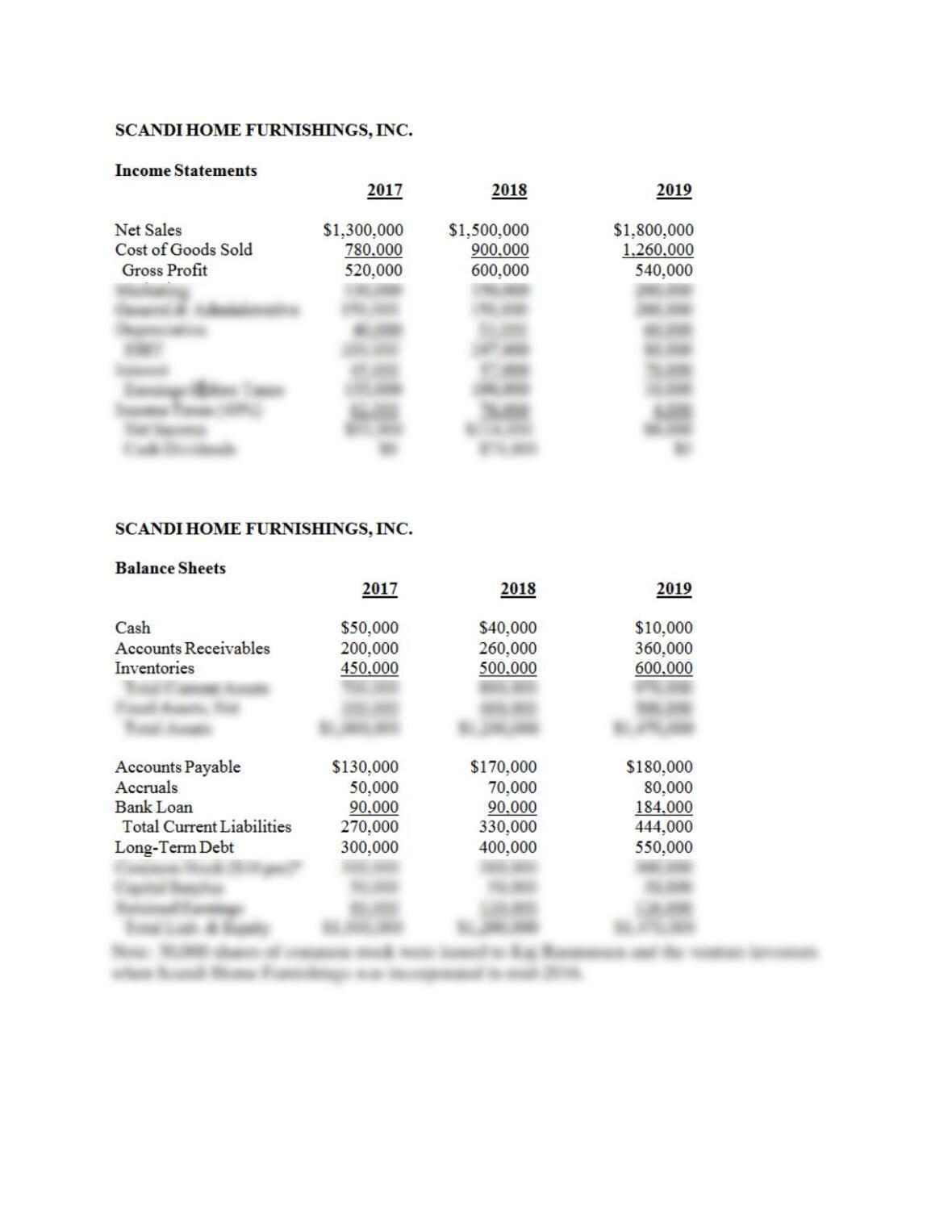
Following are the three years of income statements and balance sheets for the Scandi
Home Furnishings Corporation. Kaj has felt that in order to maintain a competitive advantage
that he would need to continue to expand sales. After first concentrating on selling Scandinavian
home furnishings in the northeast in 2017 and 2018, he decided to enter the west coast market.
Chapter 5: Evaluating Operating and Financial Performance
92
Part A
Your first challenge is to advise Kaj on what has been happening with Scandi Home Furnishings
from a liquidity perspective.
Chapter 5: Evaluating Operating and Financial Performance
93
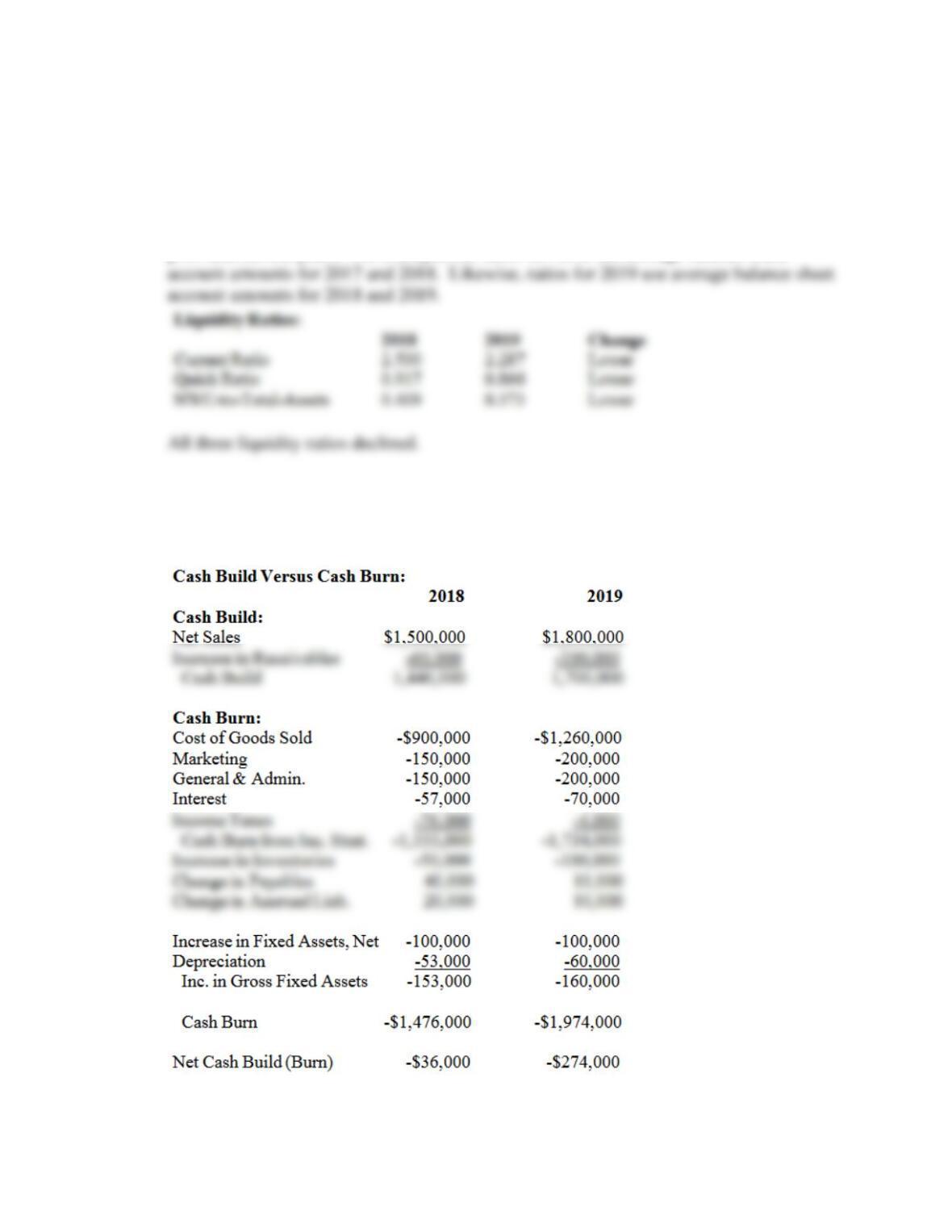
A. Kaj was particularly concerned by the drop in cash from $50,000 in 2017 to $10,000 in
2019. Calculate the average current ratio, the quick ratio, and the networking capital to
total assets ratio for 2017-2018 and 2018-2019. What has happened to Scandi’s liquidity
position?
Note: ratio calculations involving asset items on the balance sheet are averages of the
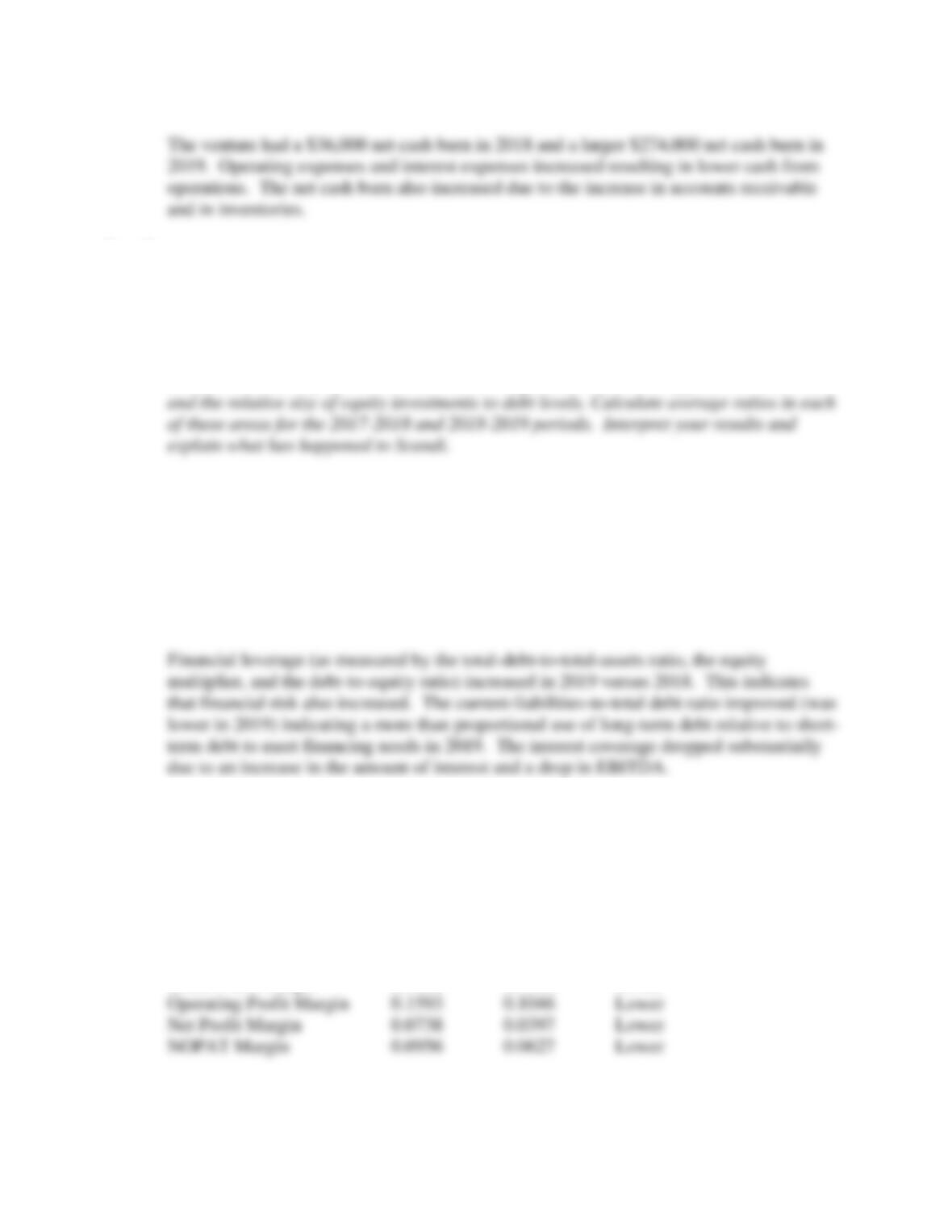
B. Kaj should be interested in knowing whether Scandi has been building or burning cash.
Compare the cash build, cash burn, and the net cash build/burn positions for 2018 and
2019. What, if any, changes have occurred?
Chapter 5: Evaluating Operating and Financial Performance
94
Part B
Your second challenge is to advise Kaj on what has been happening to Scandi from a financial
leverage, profitability, and efficiency perspective.
C. Creditors, as well as management, are also concerned about the ability of the venture to
meet its debt obligations as they come due, the proportion of current liabilities to total
debt, the availability of assets to meet debt obligations in the event of financial distress,
Financial Leverage:
2018 2019 Change
Total-Debt-to-Total-Assets 0.5909 0.6457 Higher
Equity Multiplier 2.444 2.822 Higher
Debt-to-Equity Ratio 1.444 1.822 Higher
Current-Liab.-to-Total Debt 0.4615 0.4490 Lower
Interest Coverage 5.263 2.000 Lower
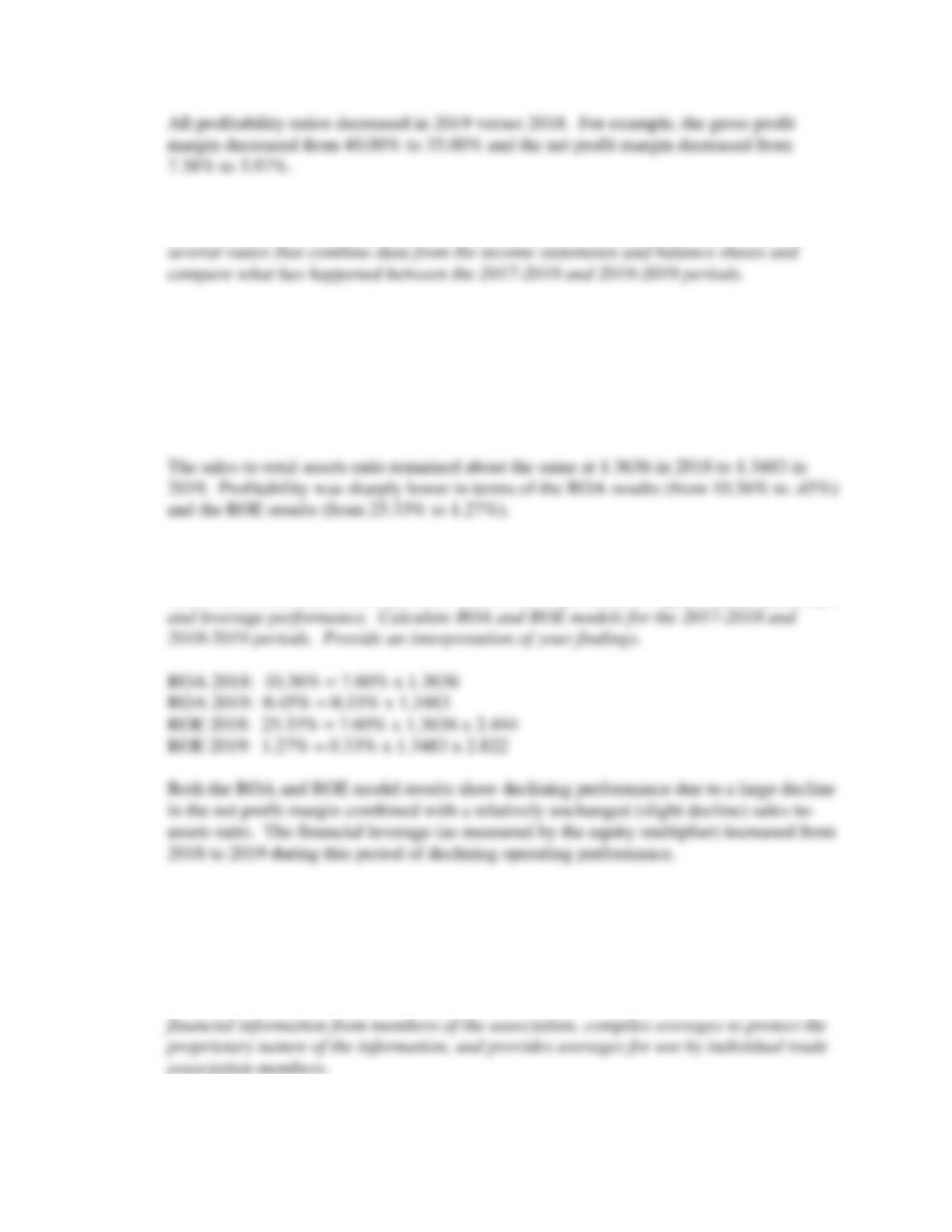
D. Of importance to Kaj and the venture investors is the efficiency of the operations of the
venture. Several profit margin ratios relating to the income statement are available to
help analyze Scandi’s performance. Calculate average profit margin ratios for 2017-
2018 and 2018-2019 and describe what is happening to the profitability of Scandi Home
Furnishings.
Profitability Ratios:
2018 2019 Change
Gross Profit Margin 0.4000 0.3500 Lower
Chapter 5: Evaluating Operating and Financial Performance
95
E. Kaj and the venture investors are also interested in how efficiently Scandi is able to
convert their equity investment, as well as the venture’s total assets, into sales. Calculate
Efficiency and Return Ratios:
2018 2019 Change
Sales-to-Total-Assets 1.3636 1.3483 Same
Operating Return on Assets 0.2245 0.0599 Lower
Return on Assets (ROA) 0.1036 0.0045 Lower
Return on Equity (ROE) 0.2533 0.0127 Lower
F. A ROA model consisting of the product of two ratios provides an overview of a venture’s
efficiency and profitability at the same time. A ROE model consists of the product of
three ratios and simultaneously shows an overview of a venture’s efficiency, profitability,
Part C
Your third challenge is to advise Kaj on what has been happening to Scandi relative to financial
developments in the home furnishings industry.
G. Kaj has been able to obtain some industry ratio data from the home furnishings industry
trade association of which he is a member. The industry association collects proprietary
Chapter 5: Evaluating Operating and Financial Performance
96
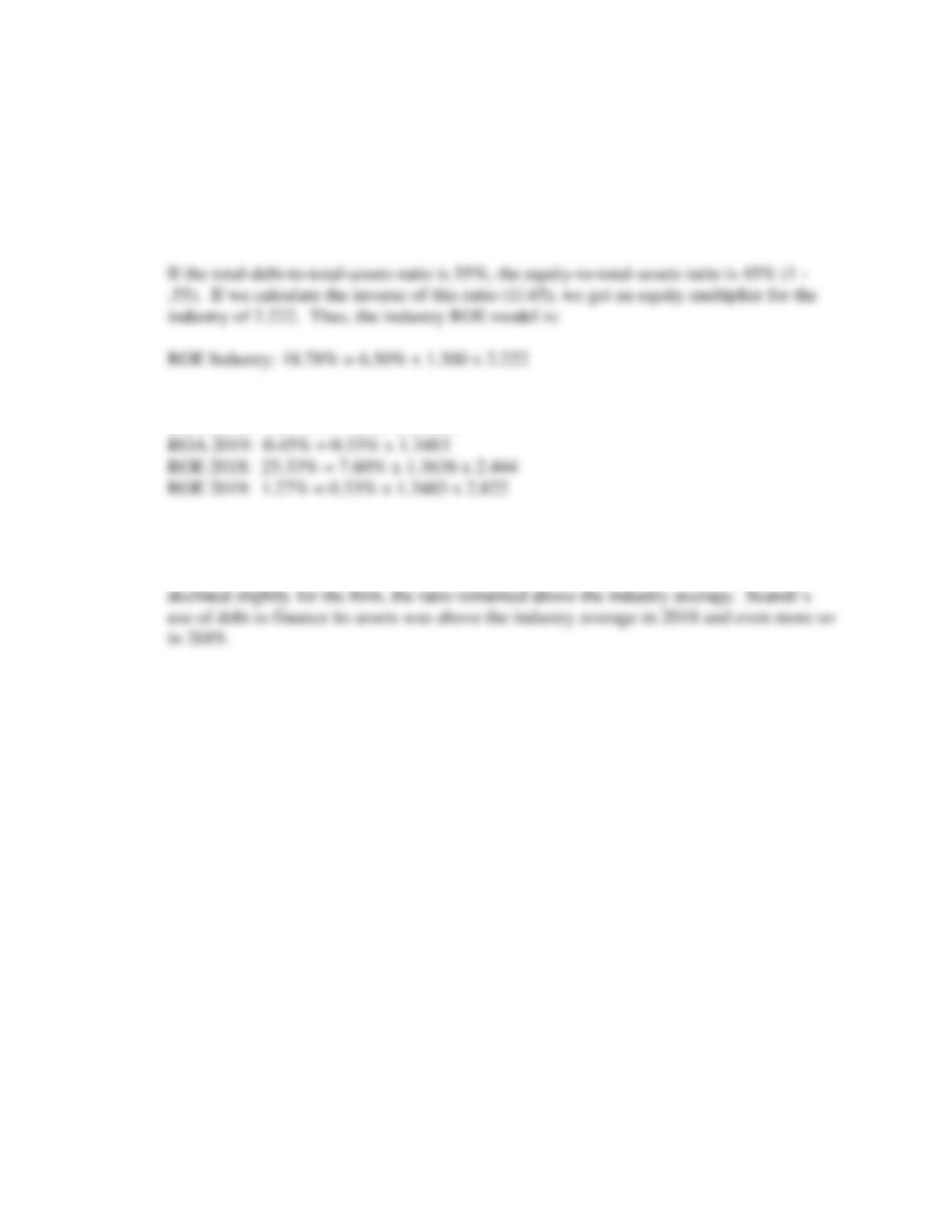
Trade association data for the home furnishings industry shows an average net profit
margin of 6.5 percent, a sales–to-assets ratio of 1.3 times, and a total-debt-to-total-assets
ratio of 55 percent over the 2017-2018 and 2018-2019 time periods. Compare and
contrast Scandi’s results with the industry average in terms of the ROA and ROE models.
Make sure you compare the components of each model as well as the product of the
components.
From Part G:
ROA 2018: 10.36% = 7.60% x 1.3636
Scandi’s ROE declined from above the industry average in 2018 to well below the
industry average in 2019. The firm’s net profit margin also declined from above the
industry average to below the industry average. Also, while the turnover of assets