56
Chapter 4
PREPARING AND USING FINANCIAL STATEMENTS
FOCUS
In this chapter, we introduce basic accounting and financial statements designed to help ventures
monitor their progress. We stress the need to understand how cash is built and burned both in
terms of financial statements and through operating breakeven analyses.
LEARNING OBJECTIVES
LO 4.1: Describe the process for obtaining and recording resources needed for an early-stage
venture.
LO 4.2: Describe and prepare a basic balance sheet.
LO 4.3: Describe and prepare a basic income statement.
CHAPTER OUTLINE
4.1 OBTAINING AND RECORDING THE RESOURCES NECESSARY TO START AND
BUILD A NEW VENTURE
4.2 BUSINESS ASSETS, LIABILITIES, AND OWNERS’ EQUITY
4.3 SALES, EXPENSES, AND PROFITS
4.4 INTERNAL OPERATING SCHEDULES
4.5 STATEMENT OF CASH FLOWS
4.6 OPERATING BREAKEVEN ANALYSES
A. Survival Breakeven
DISCUSSION QUESTIONS AND ANSWERS
Chapter 4: Preparing and Using Financial Statements
57
1. Describe the types of resources (assets) needed for a new product venture during its
development and startup stages. Comment on the likely revenues and expenses during these
early life cycle stages.
Refer to: Figure 4.1 Obtaining and Recording the Resources Necessary to Start and Build a
New Venture
2. What is accrual accounting? What are generally accepted accounting principles (GAAP)?
Accrual accounting is the practice of recording economic activity when it is recognized
rather than waiting until it is realized.
3. What is meant by the statement that a balance sheet provides a “snapshot” of a venture’s
financial position as of a point in time? Why must a balance sheet be in “balance?”
4. Briefly describe the typical types of accounts that are found in the current assets of a new
venture.
5. What is meant by the terms “depreciation” and “accumulated depreciation”?
Chapter 4: Preparing and Using Financial Statements
58
6. What types of liabilities might show up on a venture’s balance sheet?
Liabilities might include: payables, accrued wages, bank loan, other current liabilities, long–
7. What does an income statement measure or track over time?
The income statement is a performance measure of a firm’s operations over a period of time.
8. Define the term “EBIT.” How does EBIT differ from a firm’s net income or net profit?
EBIT is defined as the earnings of a company before accounting for any interest
9. What are the three internal operating schedules that most firms must prepare?
10. Briefly describe what is meant by a statement of cash flows.
A statement of cash flows shows how cash, as reflected in accrual accounting, flowed into
11. What is meant by net cash build and net cash burn?
Net Cash Build: exists when the sum of cash flows from operations and investing is positive
12. Describe the differences between variable expenses and fixed expenses.
Variable expenses depend upon the level of production while fixed expenses are items that
13. Define the term EBITDA.
The acronym EBITDA stands for earnings before interest, taxes, depreciation, and
amortization.
14. What is a venture’s contribution profit margin?
Chapter 4: Preparing and Using Financial Statements
59
15. Define the term EBDAT.
EBDAT is a firm’s earnings before taxes, depreciation and amortization.
16. Describe the meaning of EBDAT breakeven and survival revenues.
17. Describe and illustrate how an EBDAT (survival) breakeven chart is constructed.
Refer to Figure 4.2. Costs and revenues are plotted on the vertical axis and revenues (in
18. What is meant by breakeven drivers? Identify two important drivers affecting the amount of
revenues needed for ventures to break even.
Breakeven drivers are key elements of the firm’s financial statements that affect breakeven.
19. From the Headlines — “Competing to Let the Light Shine”: Describe three financial
performance measures that d.light’s venture investors might use to examine whether d.light
is measuring up financially as it achieves its “lives touched” goals.
Answers will vary widely: Margins (revenues vs. costs) will be critical in providing the
INTERNET ACTIVITIES
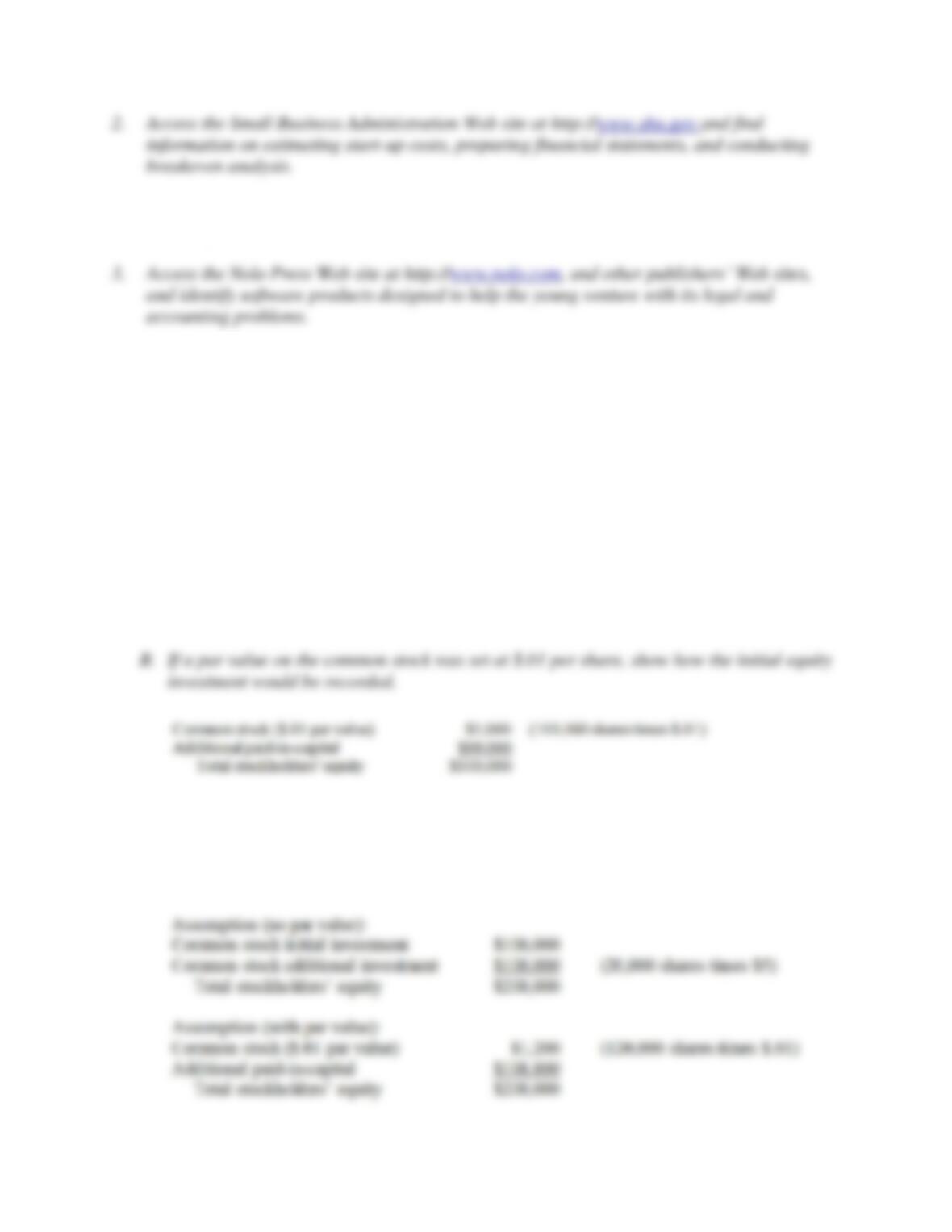
1. A number of Web sites are available to help young ventures to measure their financial
performance and to help them when they are growing and “ramping up” revenues. Access
Chapter 4: Preparing and Using Financial Statements
60
SBA provided information can be compared and integrated with the materials presented in
this chapter.
Web-researched results vary due to constant updating of the related web sites.
EXERCISES/PROBLEMS
1. [Stockholders’ equity] The owners of a new venture have decided to organize as a
corporation. The initial equity investment is valued at $100,000 reflecting contributions of
the entrepreneur and her family and friends. One hundred thousand shares of stock were
initially issued.
A. What dollar amount would initially be recorded in the common stock account?
Common stock (initial investment) $100,000
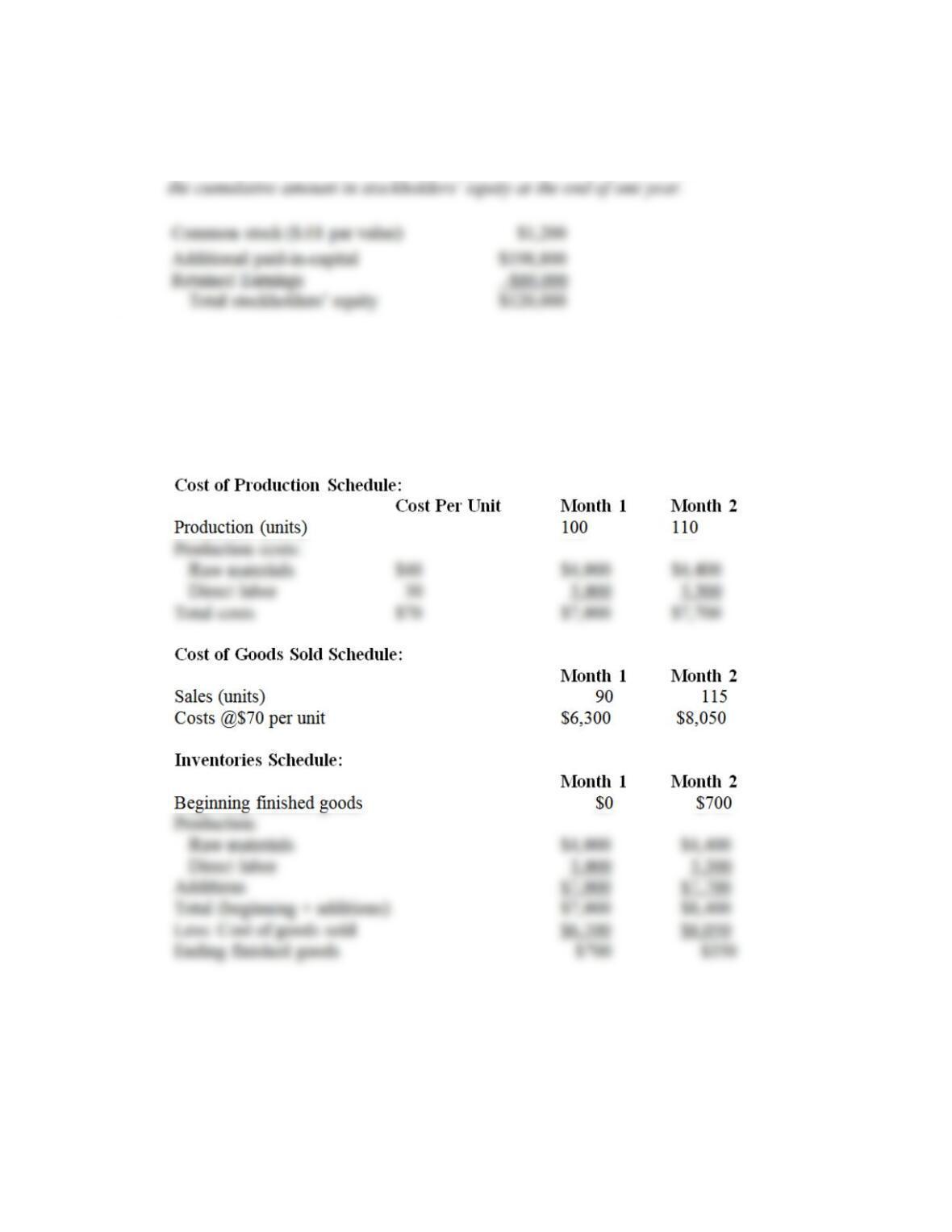
C. Now assume that 20,000 additional shares of stock are sold to an angel investor at $5 per
share six months after the initial incorporation. Show how your answer in Part A would
change if the common stock did not have a par value. Also show how your answer in
Part B would change given a par value of $.01 per share.
Chapter 4: Preparing and Using Financial Statements
61
D. At the end of the first year of operation, the venture recorded an operating loss of
$80,000. Show the dollar amounts in the common stock account, the additional paid–in–
capital account, and the retained earnings account at the end of one year. Also indicate
2. [Internal Operating Schedules] Assume you are starting a new business involving the
manufacture and sale of a new product. Raw materials costs are $40 per product. Direct
labor costs are expected to be $30 per product. You expect to sell each product for $110.
You plan to produce 100 products next month and expect to sell 90 products.
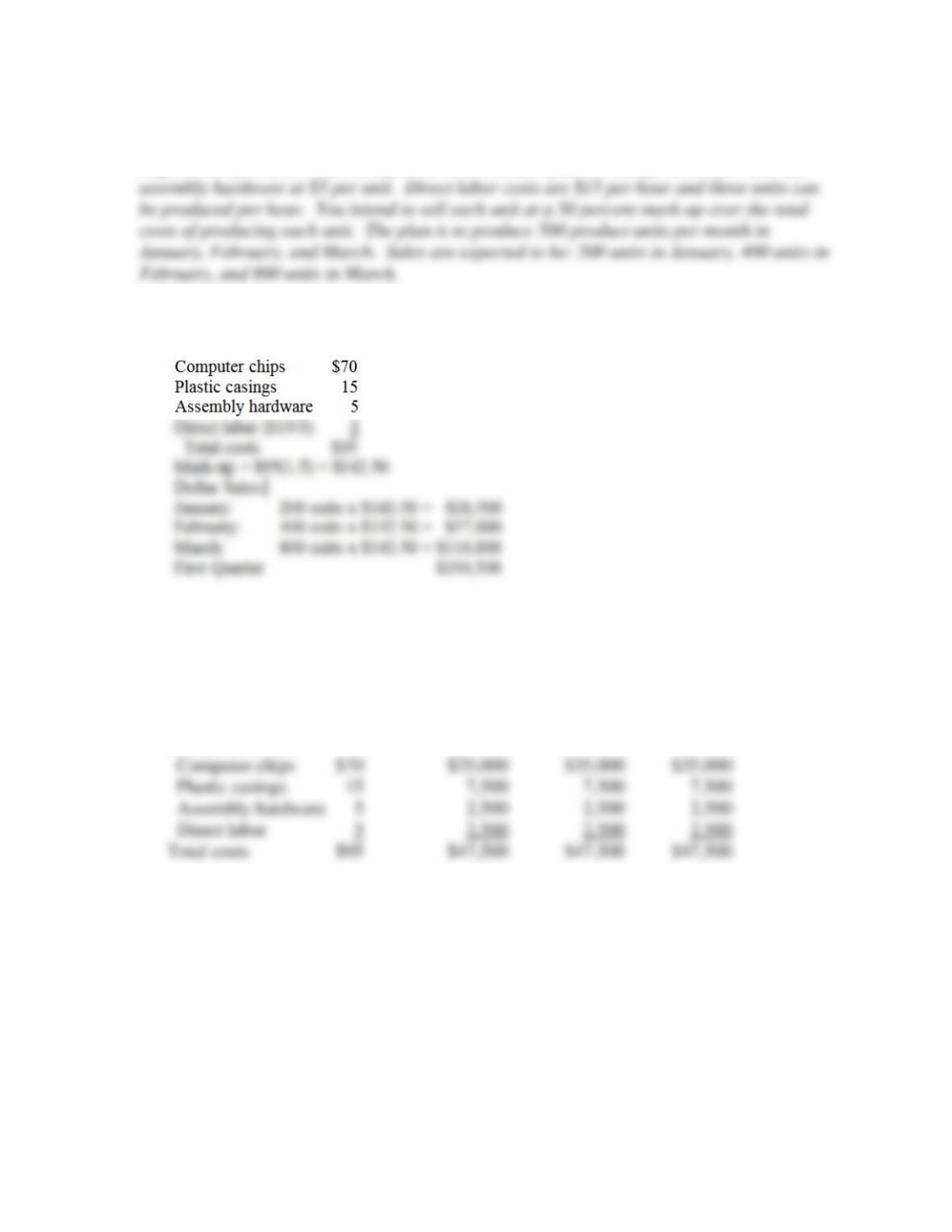
A. Prepare cost of production, cost of goods sold, and inventories schedules for next (the
first) month.
B. During the second month, you plan to produce 110 products but expect sales in the month
to be 115 products. Prepare cost of production, cost of goods sold, and inventories
schedules for the second month.
Note: the solutions for Part B are shown in Part A for Month 2.
Chapter 4: Preparing and Using Financial Statements
62
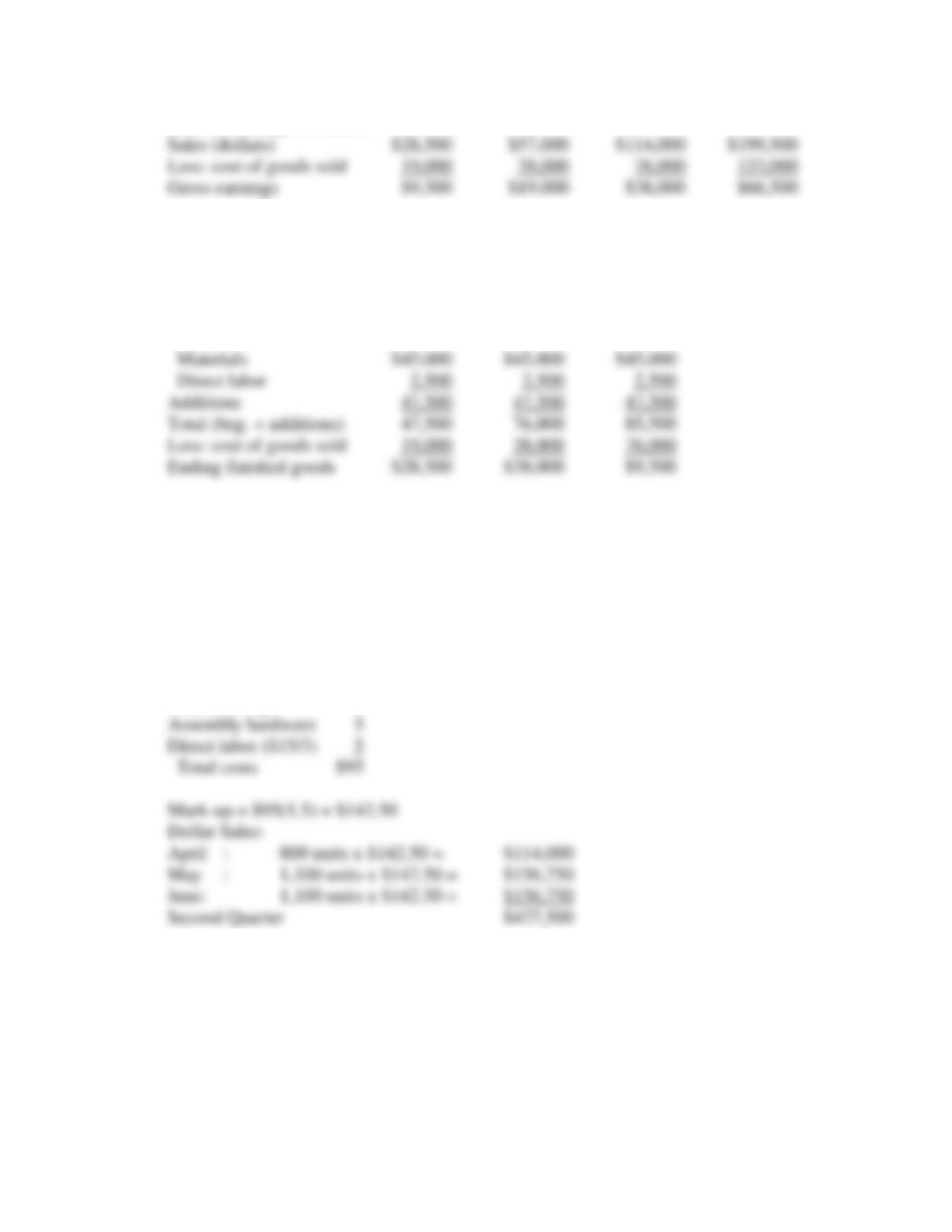
3. [Internal Operating Schedules] Assume you have developed and tested a prototype electronic
product and are about to start your new business. You purchase pre-programmed computer
chips at $70 per unit. Other component costs include: plastic casings at $15 per unit and
A. Calculate the dollar amount of sales revenue expected in each month (i.e., January,
February, and March) and for the first quarter of the year.
B. Prepare a cost of production schedule for January, February, and March.
Cost of Production Schedule:
Cost
Per Unit January February March
Production (units) 500 500 500
Production costs
C. Prepare a cost of goods sold schedule for each of the three months and for the first quarter
of the year. Using your cost of goods sold estimates and the sales revenues expected in Part
A, calculate the gross earnings for January, February, and March, as well as for the first
quarter of the year.
Cost of Goods Sold Schedule:
January February March Total
Sales (units) 200 400 800 1,400
Costs @ $95/unit $19,000 $38,000 $76,000 $133,000
Chapter 4: Preparing and Using Financial Statements
63
Gross Earnings Estimate:
D. Prepare an inventories schedule for January, February, and March.
Inventories Schedule:
January February March
Beginning finished goods $0 $28,500 $38,000
Production
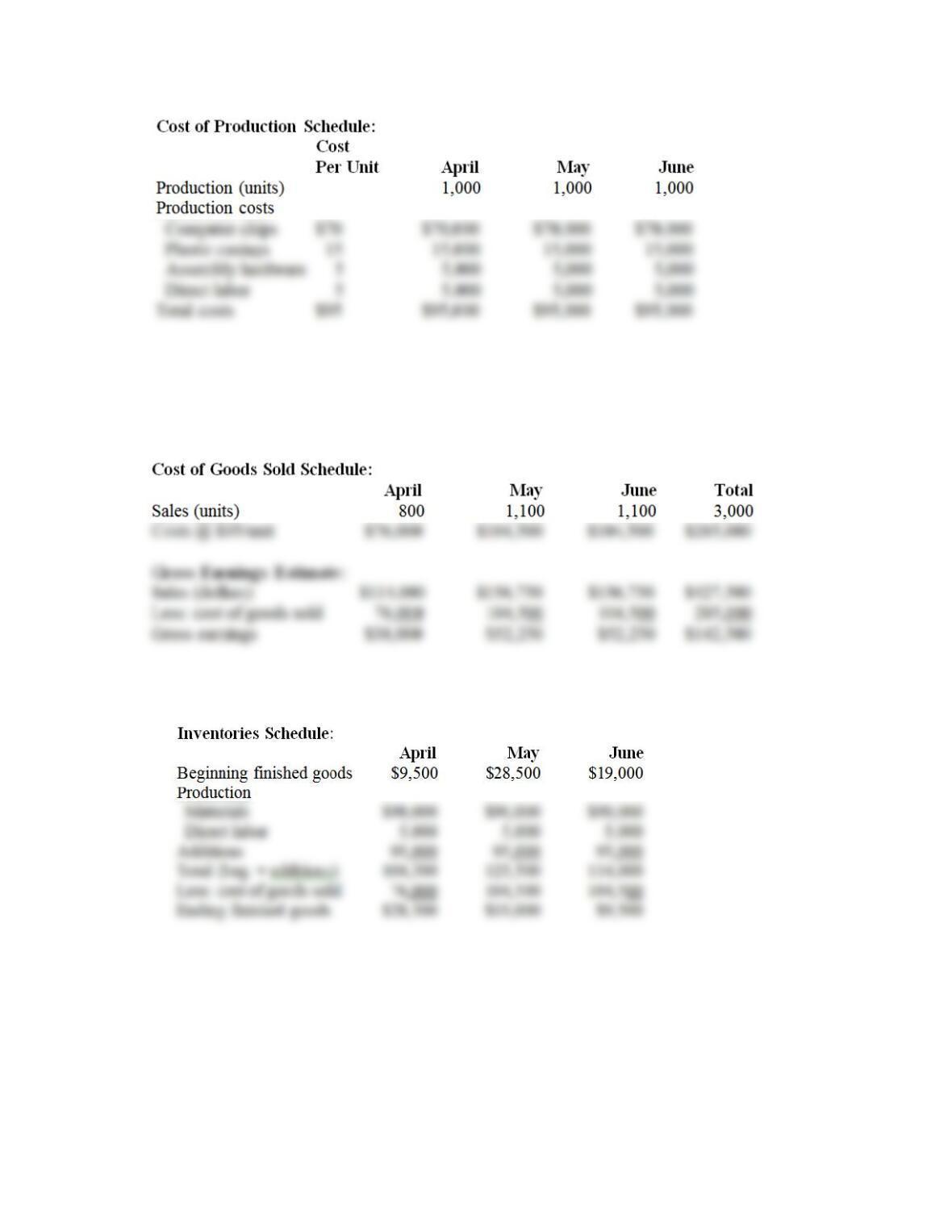
4. [Internal Operating Schedules] This problem is a continuation of Problem 3. Assume you
ramp up production to 1,000 units per month in April, May, and June. Sales are expected
to be 800 units in April and 1,100 units in each of May and June. Repeat the calculations
requested in Problem 3 for the second quarter of the year (April, May, and June).
A. Calculate the dollar amount of sales revenue expected in each month (i.e., April, May, and
June) and for the second quarter of the year.
Computer chips $70
Plastic casings 15
B. Prepare a cost of production schedule for April, May, and June.
Chapter 4: Preparing and Using Financial Statements
64
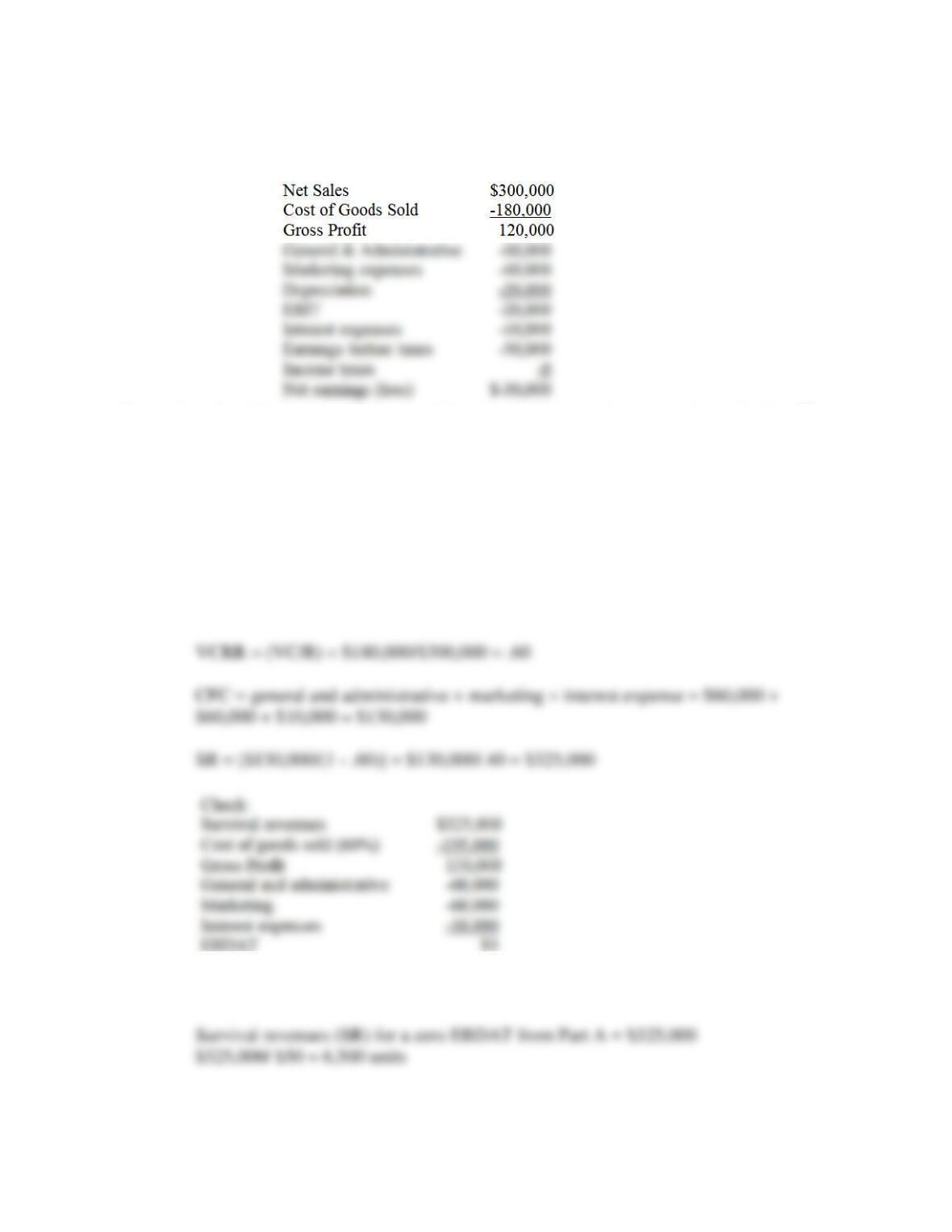
C. Prepare a cost of goods sold schedule for each of the three months and for the second
quarter of the year. Using your cost of goods sold estimates and the sales revenues
expected in Part A, calculate the gross earnings for April, May, and June, as well as for the
second quarter of the year.
D. Prepare an inventories schedule for April, May, and June.
Chapter 4: Preparing and Using Financial Statements
65
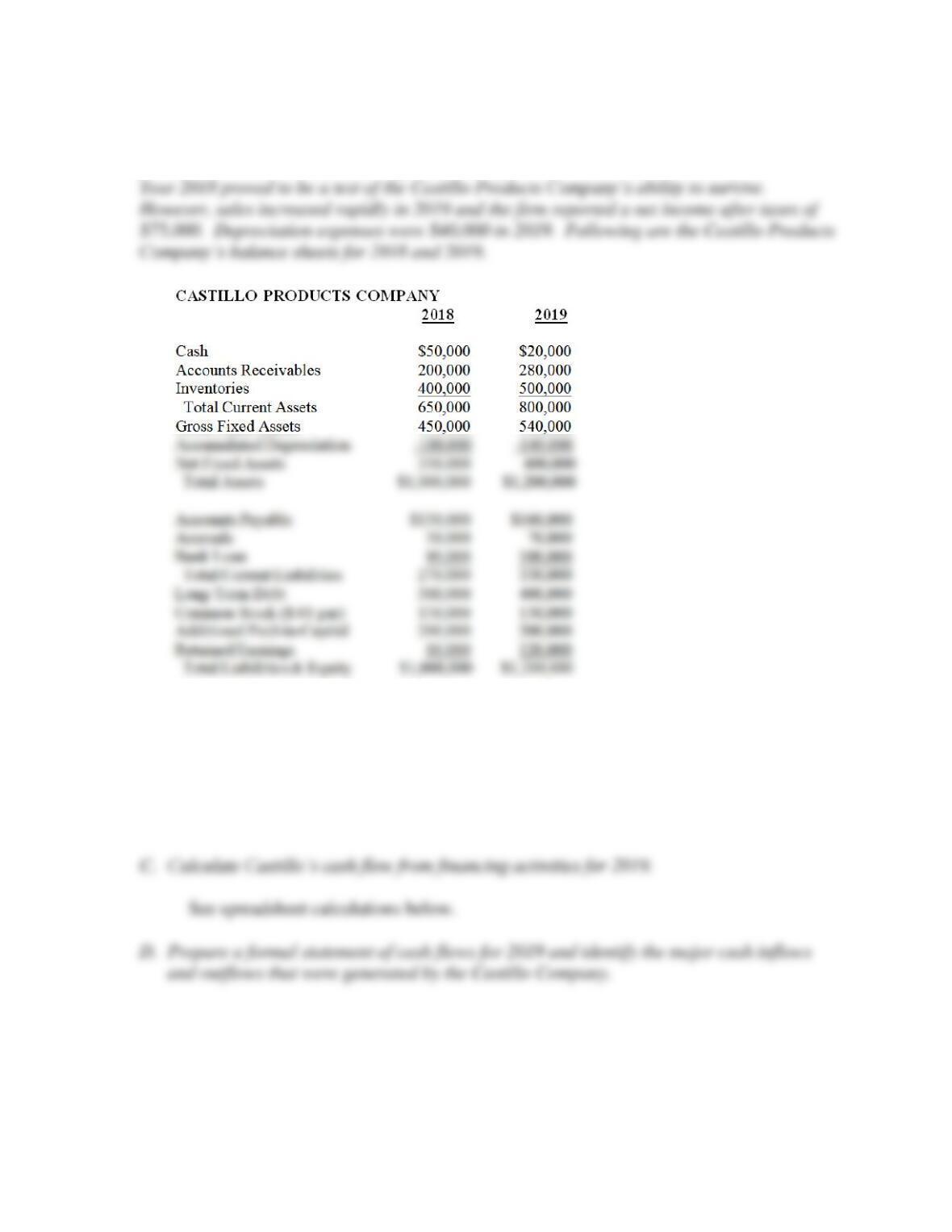
5. [Survival Revenues Breakeven] During its first year of operations, the SubRay Corporation
produced the following income statement results:
Costs of goods sold are expected to vary with sales and be a constant percentage of sales. The
general and administrative employees have been hired and are expected to remain a fixed cost.
Marketing expenses are also expected to remain fixed since the current sales staff members are
expected to remain on fixed salaries and no new hires are planned. The effective tax rate is
expected to be 30 percent for a profitable firm.
A. Estimate the survival or EBDAT breakeven amount in terms of survival revenues necessary
for the SubRay Corporation to breakeven next year.
Survival revenues (SR), when EBDAT = 0, are calculated as:
B. Assume that the product selling price is $50 per unit. Calculate the EBDAT breakeven
point in terms of the number of units that will have to be sold next year.
Chapter 4: Preparing and Using Financial Statements
66
6. [Statement of Cash Flows and Cash Burn or Build] Cindy and Robert (Rob) Castillo founded
the Castillo Products Company in 2018. The company manufactures components for
personal decision assistant (PDA) products and for other hand-held electronic products.
A. Calculate Castillo’s cash flow from operating activities for 2019.
See spreadsheet calculations below.
B. Calculate Castillo’s cash flow from investing activities for 2019.
See spreadsheet calculations below.
See spreadsheet calculations below.
E. Use your calculation results from Parts A and B above to determine whether Castillo was
building or burning cash during 2019 and indicate the dollar amount of the cash build or
burn.