Chapter 4 Analysis of Financial Statements
CHAPTER OUTLINE
Learning Objectives
Vertical Analysis
Horizontal Analysis
Ratio Analysis
Types of Business Ratios
Liquidity Ratios
Activity Ratios
REVIEW AND DISCUSSION QUESTIONS
1. What is the purpose of financial statement analysis? The purpose of financial statement analysis is to generate
information, which can be used internally by the business itself and externally by potential creditors and investors.
2. Give an example of how financial statements can be used internally by the managers of a company. Financial
3. List and briefly describe the three types of financial statement analysis. Vertical analysis is the process of
using a single variable such as net sales as a constant and determining how all other variables relate to this single
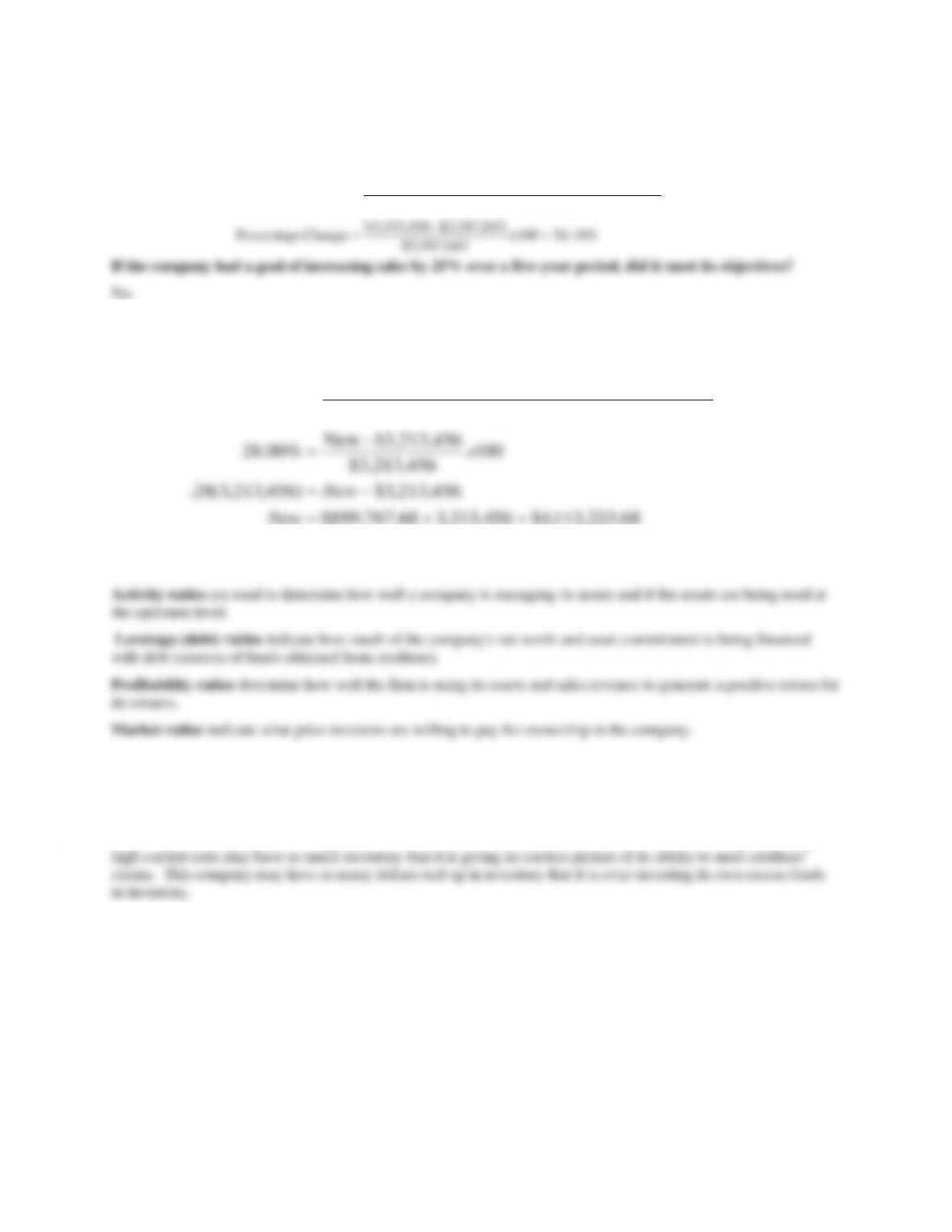
4. If a company had sales of $2,587,643 in 2008 and sales of $3,213,456 in 2013, by what percentage did sales
change during this time period?
5. If the company in question 4 had set a goal of increasing sales by 28% during the next five years, what should
be the sales goal for 2018?
6. List and briefly describe the five categories of business ratios.
Liquidity ratios are used to measure the ability of the firm to meet its short-term creditors’ claims.
7. If a company computes its current ratio to be 3.56, what does this mean in terms of the company’s current
assets and current liabilities? For every dollar of current liabilities or short-term creditor’s claims, the company
has $3.56 of current assets in order to meet these claims.
8. Why might a company have a high current ratio but a low quick ratio (acid test ratio)? A company having a
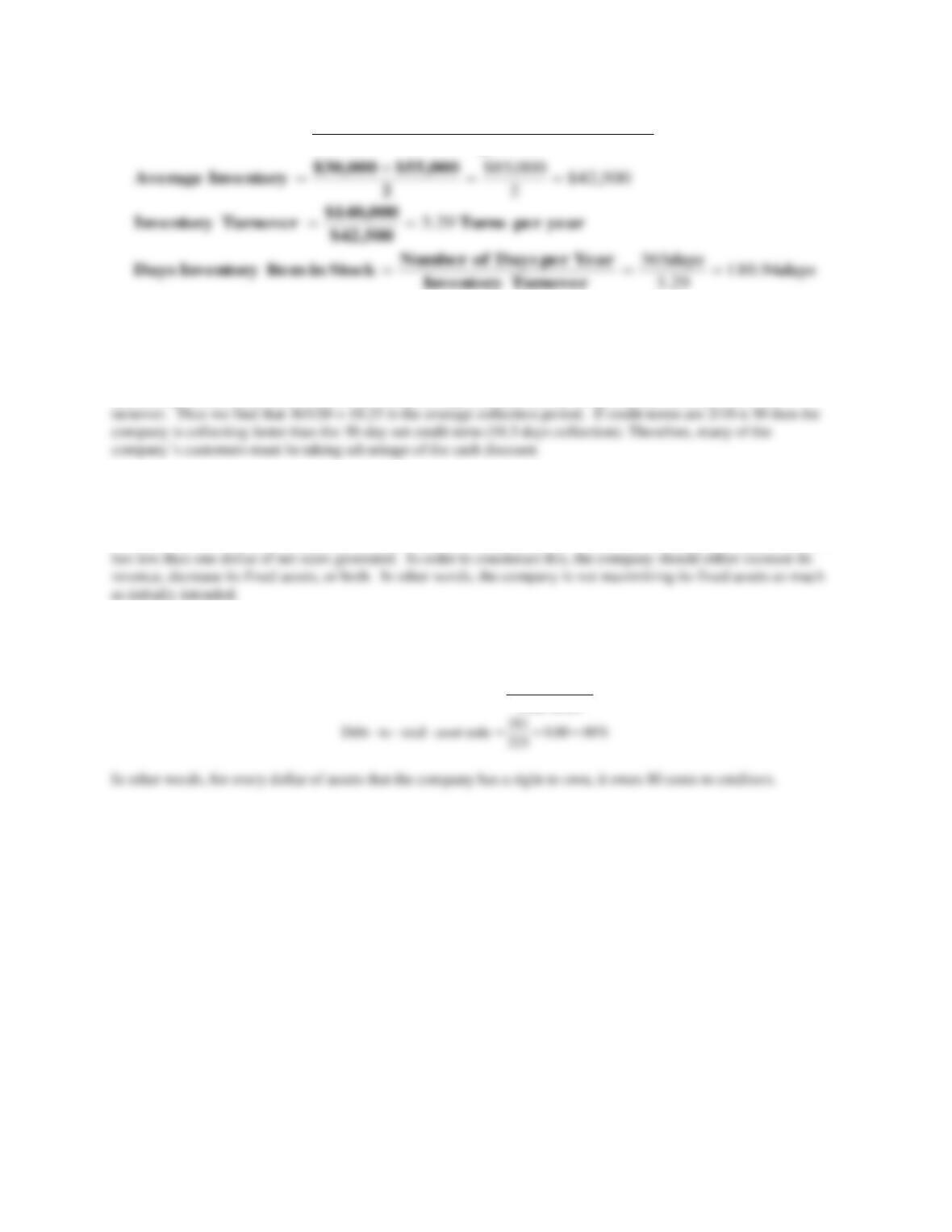
9. If a company has beginning inventory of $30,000 and ending inventory of $55,000, compute its average
inventory. If the COGS is $140,000, compute its inventory turnover and determine how many days the
average item is in stock.
x100
amount period timeOld
amount period timeOld –amount period timeNew
Change Percentage
=
100
amount period timeOld
amount period timeOld –amount period timeNew
Change Percentage
=
x
+
=
2
Inventory Ending Inventory Beginning
Inventory Average
10. A company computes its accounts receivable turnover to be 20. Based on this information, find the average
collection period. If the company has a credit collection period of 30 days, explain the relationship between
the credit collection period and the average collection period.
The average collection period is found by taking the days per year and dividing it by the accounts receivable
11. If a company finds that its fixed asset turnover (net sales/fixed assets) has fallen to less than 1, what does this
indicate?
If fixed asset turnover falls below one, it indicates that for every dollar of fixed assets committed by the company, it
12. If a company has $181,000 in total liabilities and $225,000 in total assets, what percentage of total assets is
being financed with the use of other people’s money?
sliabilitie Total
ratioasset –total–to–Debt
=
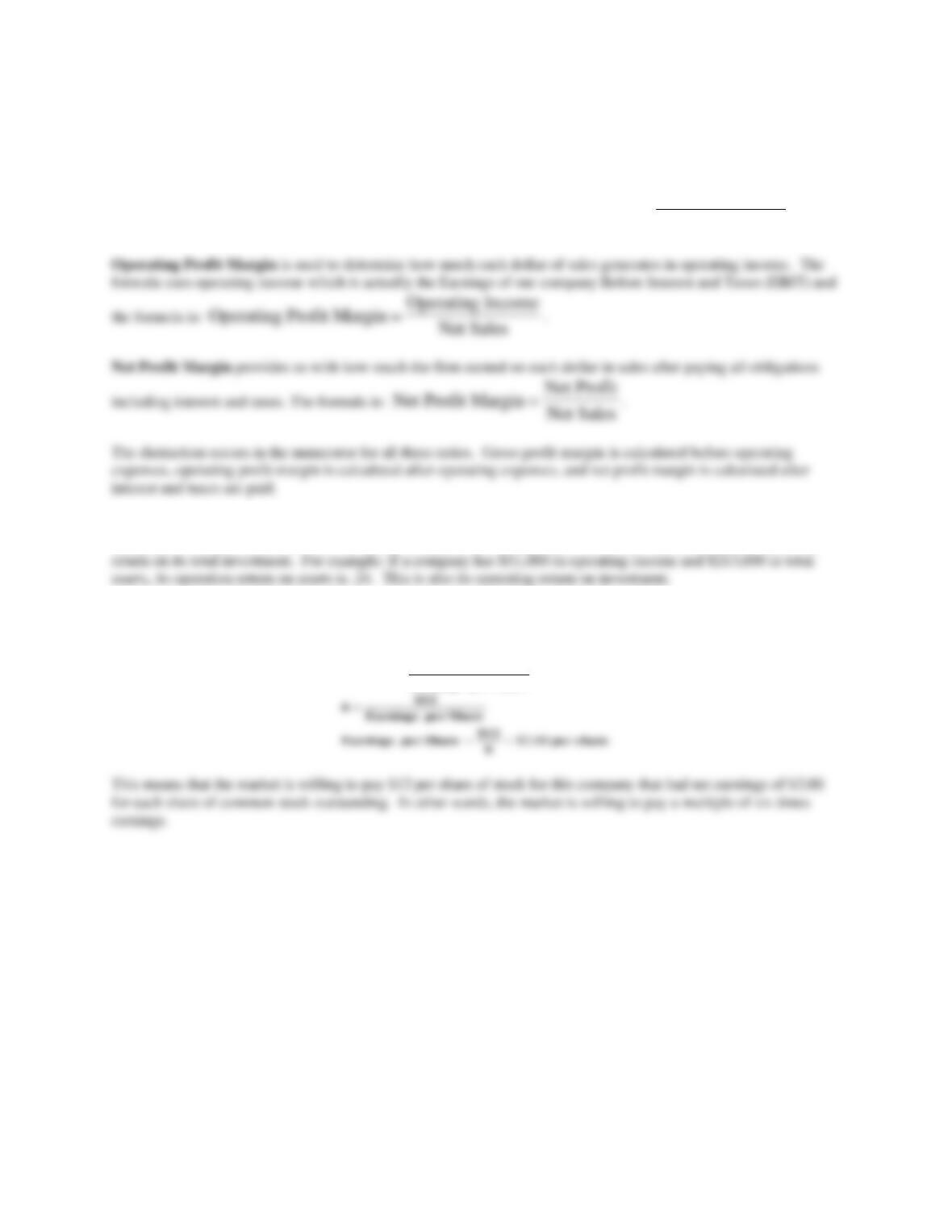
13. Distinguish between gross profit margin, operating profit margin, and net profit margin and provide the
formula for each ratio?
Gross Profit Margin is used to determine how much gross profit is generated by each dollar in net sales. To
calculate gross profit margin we use the following formula:
salesnet Average
profit Gross
=MarginProfit Gross
.
14. Why is the operating return on assets ratio also referred to as the operating return on investment? A
company’s investment is in the form of its total assets, therefore any return on its total assets can also be taken as a
15. If a company’s stock is currently selling for $12 per share and its price earnings ratio is 6, what are its
earnings per share? What does this figure mean?
Shareper Earnings
PriceMarket
ratio PE
=
EXERCISES AND PROBLEMS
1. Samantha Knight is applying for a small-business loan. She provides the bank with the following
information: cash in checking accounts, $5,000; cash in savings, $10,350; home market value, $145,500; first
mortgage on house, $25,000; home equity loan limit, $70,000; home equity loan, $10,000; automobile market
value, $19,000; automobile loan outstanding, $15,000; credit card debt, $1,500.
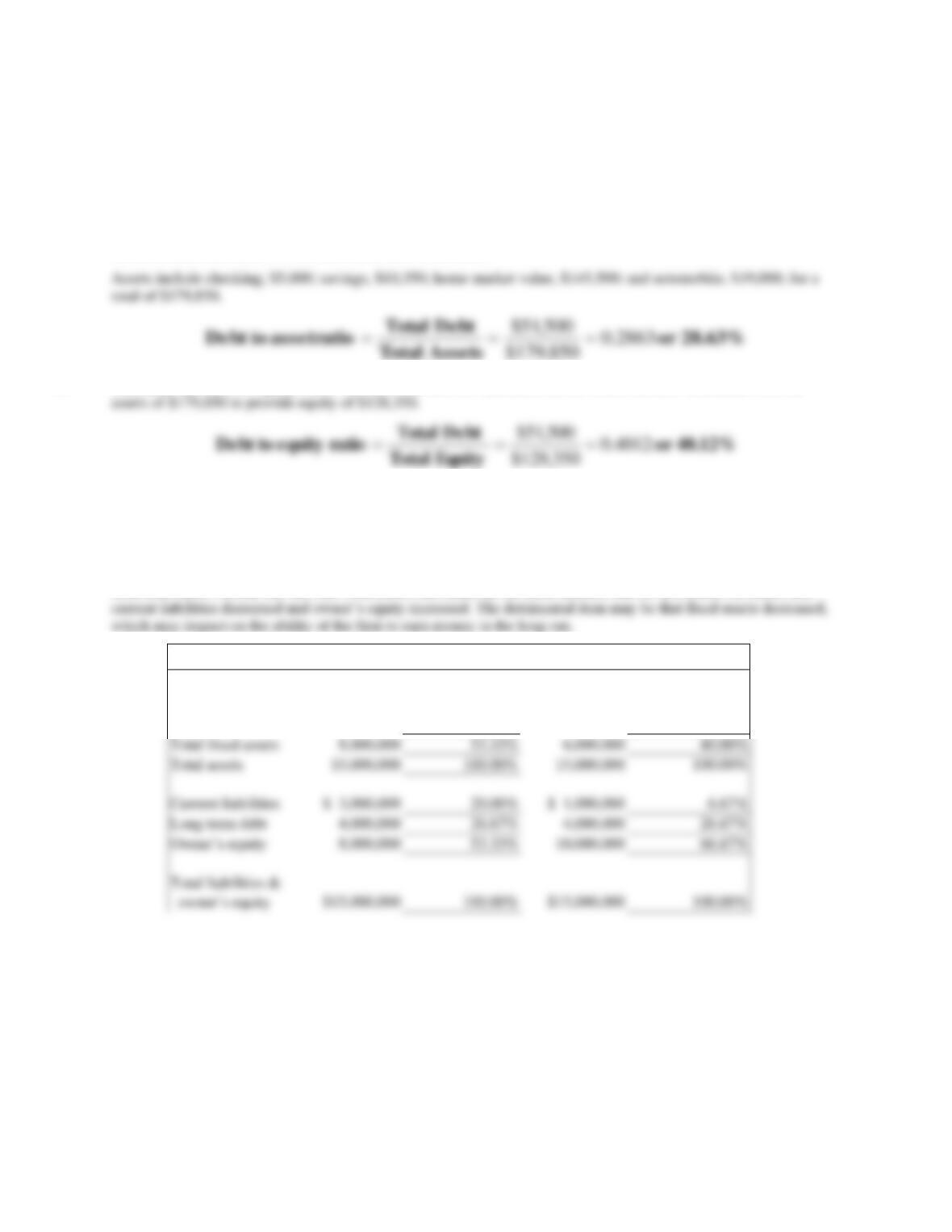
a. Calculate the debt–to-asset ratio. Debt is equal to mortgage, $25,000; home equity loan, $10,000; automobile loan,
$15,000; and credit card, $1,500; for a total debt of $51,500.
b. Calculate the debt–to-equity ratio. The debt remains the same at $51,500, which must be subtracted from the
c. What percentage of Samantha’s assets are owned by others? This is the same as the debt to asset ratio, which is
28.63%.
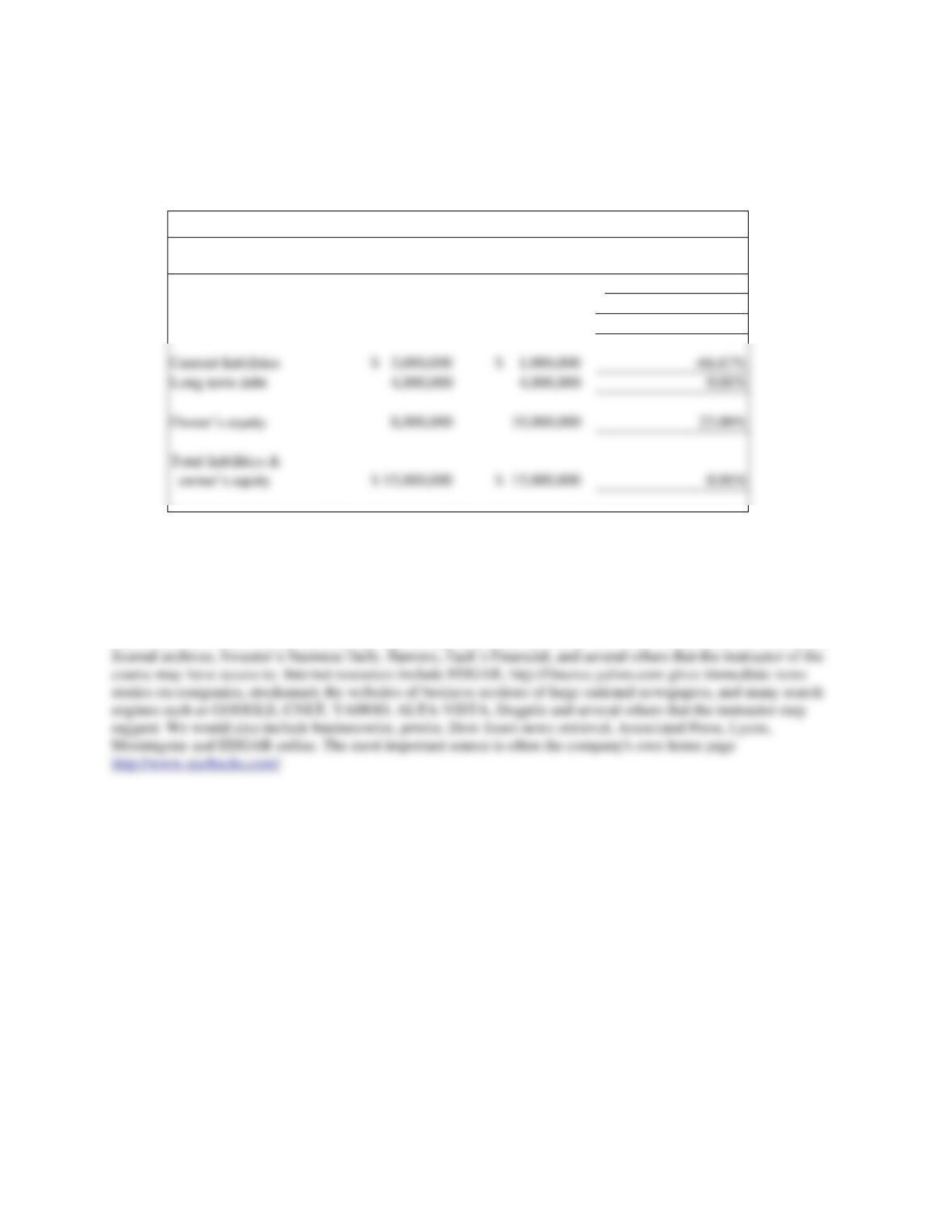
2. You receive the following partial balance sheet (Table 4-5) for 2013 and 2012 for a company that you are
considering making an investing in. Perform a vertical analysis for each year on these accounts. Compare the
two years, and in a sentence describe those changes that were beneficial or detrimental to this company. The
Table 4-5 Balance Sheet, Sample Company
Vertical
Vertical
Category
2012
Analysis 2012
2013
Analysis 2013
Current assets
$ 7,000,000
46.67%
$ 9,000,000
60.00%
Total fixed assets
53.33%
40.00%
Total assets
Current liabilities
$ 3,000,000
20.00%
$ 1,000,000
Long term debt
26.67%
26.67%
53.33%
66.67%
Total liabilities &
3. You were not totally satisfied with the vertical analysis, so you now want to run a horizontal analysis of this
company. Complete table 4-6. Perform a horizontal analysis on these accounts. Compare the changes in
accounts, and in a sentence describe those changes that were beneficial or detrimental to this company. While
reducing our current liabilities and fixed assets, current assets increased and additionally our owner’s equity
increased which are all benefits.
Table 4-6 Sample Balance Sheet
2012
2013
Horizontal Analysis
Current assets
$ 7,000,000
$ 9,000,000
28.57%
Total fixed assets
8,000,000
6,000,000
-25.00%
Total assets
15,000,000
15,000,000
0.00%
Current liabilities
$ 3,000,000
-66.67%
8,000,000
10,000,000
Total liabilities &
$ 15,000,000
0.00%
4. Last month you were vacationing in Phoenix and noticed that there were several Starbucks coffee locations.
You don’t have any coffee locations in your city, except for a few local cafes. You also have a large college in
your town and believe that, if Starbucks opened a location, they would be very successful. If you went to your
public library, what sources would you use to find out more information about this company? If you are on
the Internet, how can you obtain additional information on this company? Public library sources would include
Dun’s Review, Value Line Investment Survey, Moody’s, Standard & Poors, New York Times archives, Wall Street
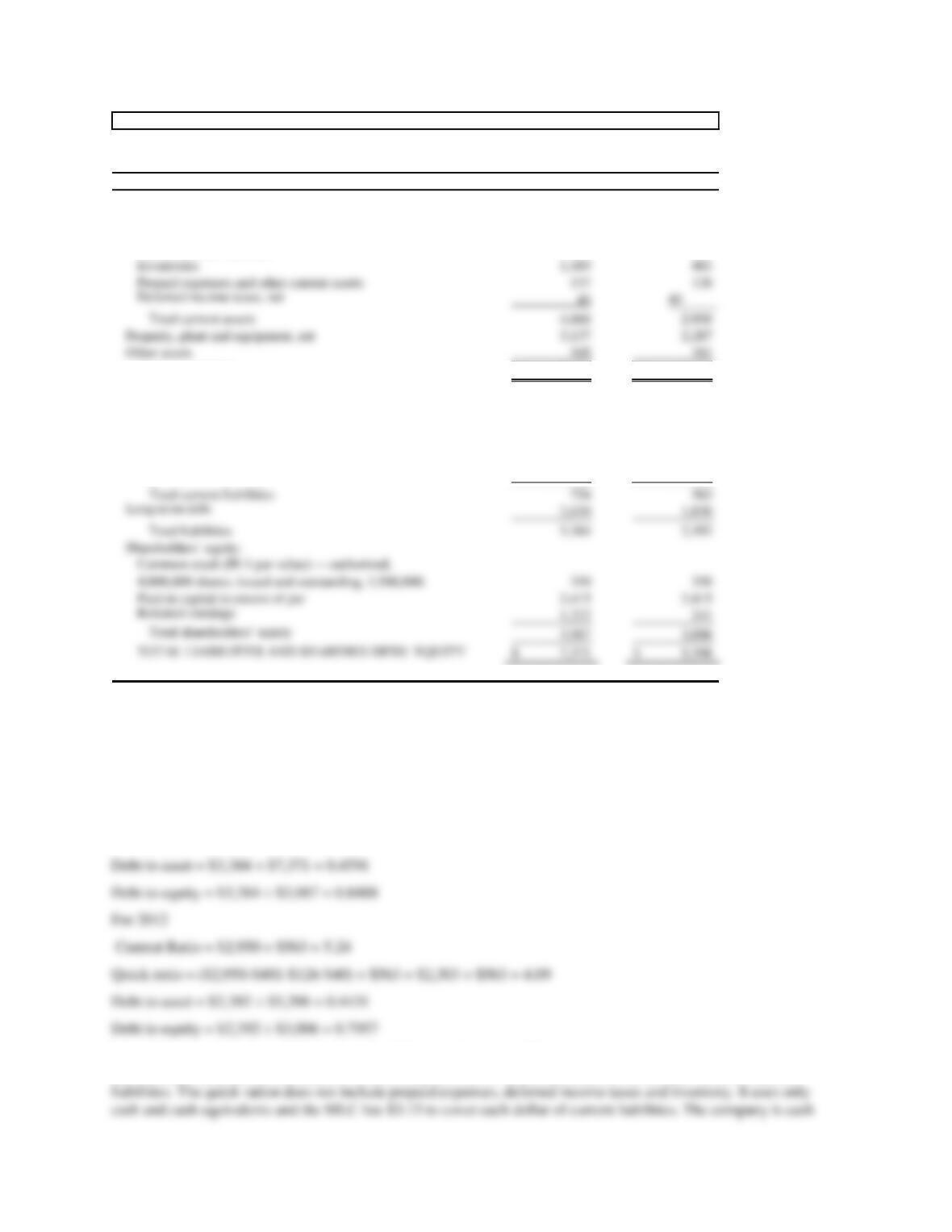
Table 4-4 Moderately Large Corporation Consolidated Balance Sheet
Fiscal Year Ended Dec. 31, 2013 Dec. 31, 2012
Current assets:
Cash and cash equivalents 1,369$ 1,427$
Accounts receivable, net 1,008 876
Prepaid expenses and other current assets 157 126
Deferred income taxes, net 44 40
TOTAL ASSETS 7,371$ 5,398$
Current liabilities:
Accounts payable 429$ 242$
Accrued compensation and related costs 104 98
Accrued taxes 132 141
Current portion of long-term debt 89 82
4,000,000 shares; issued and outstanding, 3,500,000.
Paid-in capital in excess of par 2,415 2,415
Moderately Large Corporation Consolidaed Balance Sheet
(in thousands except share data)
ASSETS
LIABILITIES AND SHAREHOLDERS’ EQUITY
5. Given the balance sheet for Moderately Large Corporation (Table 4-4) answer the following:
a. For each year calculate the following ratios: current, quick, debt–to-asset and debt-to-equity.
For 2013
Current Ratio=$4,066÷$754=5.39
Quick ratio = ($4,066-$1,489–$157-$44) ÷ $754 = $2,376 ÷ $754 = 3.15
b. In a written explanation, state what each of these ratios mean. The current ratio is the relationship between the
current assets and current liabilities. For MLC they have $5.39 in current assets to cover each dollar of current
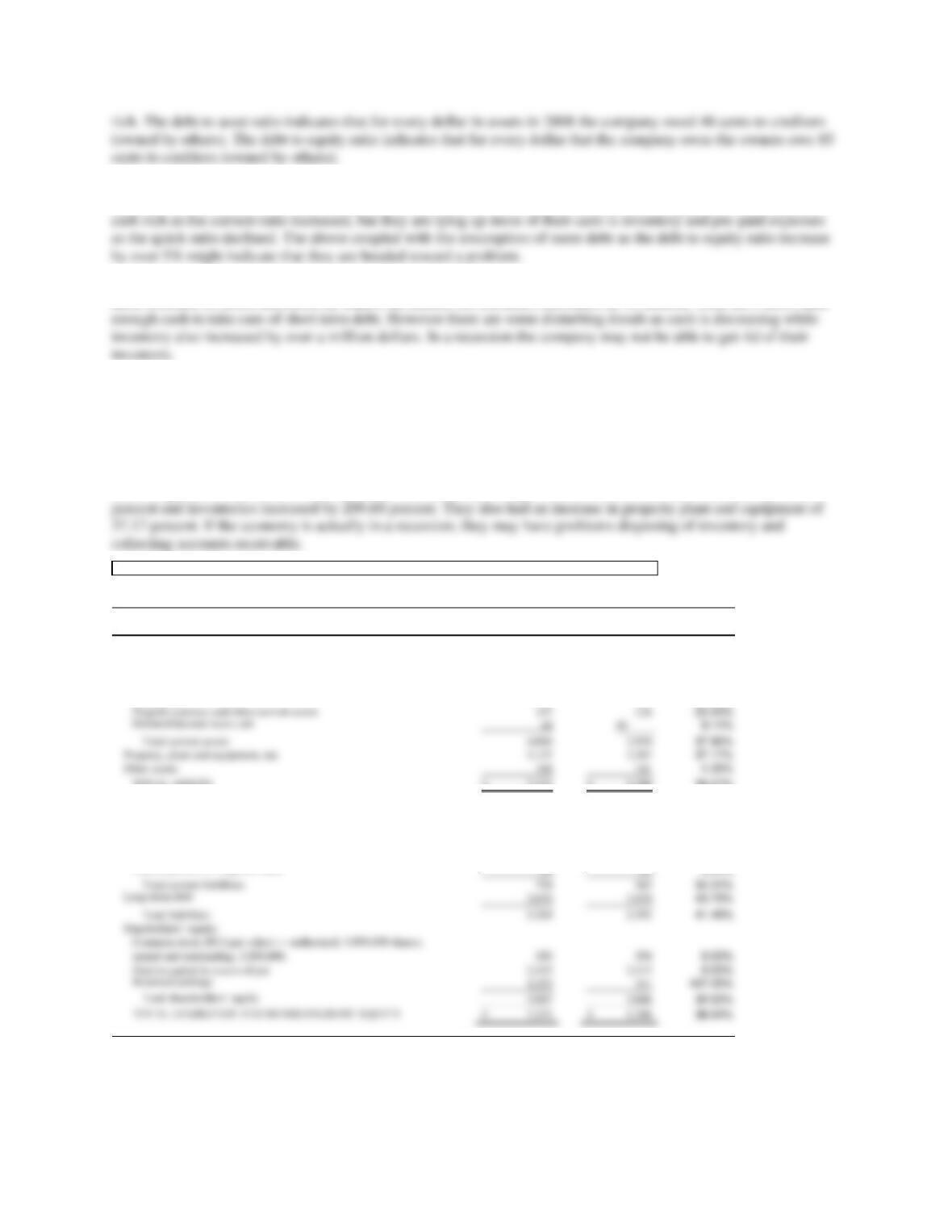
c. Compare the ratios for the two-year period and determine if the MLC is sufficiently liquid. They are definitely
liquid as they have a current ratio which is more than twice the recommended ratio. They appear to becoming more
d. How well is the MLC managing its debt? They currently are managing debt very well. They appear to be getting
6. Perform a horizontal analysis of the MLC balance sheet (Table 4-4).
a. Compare assets, liabilities, and owner’s equity from one year to the next. Assets increased by 36.57 percent,
liabilities increased by 41.46 percent and owner’s equity increased by 32.63 percent between December 31, 2012
and December 31, 2013.
b. Is the corporation better off in 2013 or in 2012? Although assets and owner’s equity have increased, there is a
disturbing trend in current assets because cash decreased by 4.04 percent, accounts receivable increased by 15.03
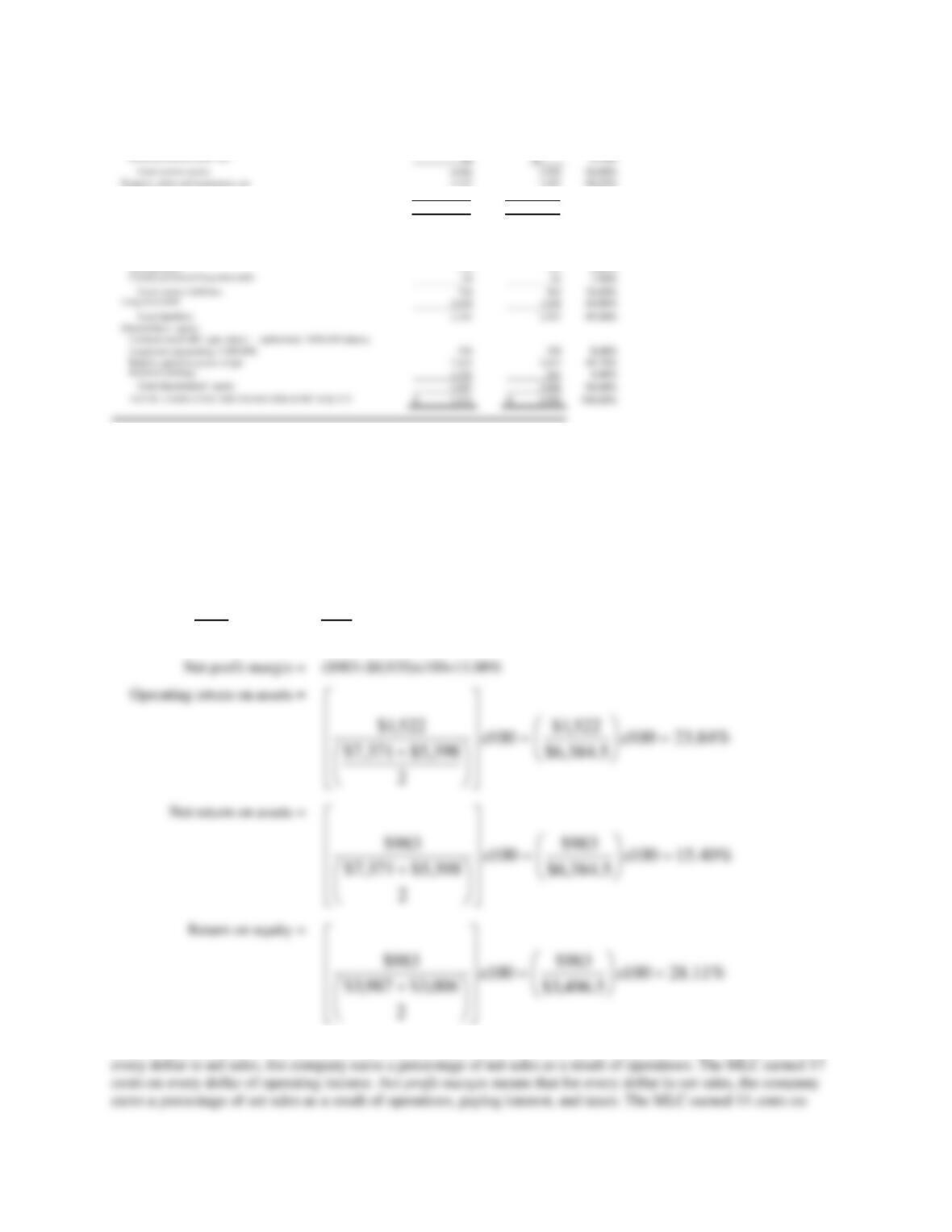
Table 4-4 Moderately Large Corporation Consolidated Balance Sheet
Fiscal Year Ended Dec. 31, 2013 Dec. 31, 2012
Horizontal
Analysis
Current assets:
Cash and cash equivalents 1,369$ 1,427$ -4.04%
Accounts receivable, net 1,008 876 15.03%
Inventories 1,489 481 209.60%
Prepaid expenses and other current assets 157 126 24.54%
TOTAL ASSETS 7,371$ 5,398$ 36.57%
Current liabilities:
Accounts payable 429$ 242$ 77.22%
Accrued compensation and related costs 104 98 6.34%
Accrued taxes 132 141 -6.21%
issued and outstanding, 3,500,000.
Paid-in capital in excess of par 2,415 2,415 0.00%
Moderately Large Corporation Consolidaed Balance Sheet
(in thousands except share data)
ASSETS
LIABILITIES AND SHAREHOLDERS’ EQUITY
7. Perform a vertical analysis of MLC balance sheet (Table 4-4) for December 31, 2012.
Inventories 1,489 481 8.91%
Prepaid expenses and other current assets 157 126 2.33%
Other assets 168 161 2.98%
TOTAL ASSETS 7,371$ 5,398$ 100.00%
Current liabilities:
Accounts payable 429$ 242$ 4.48%
Accrued compensation and related costs 104 98 1.82%
issued and outstanding, 3,500,000.
Paid-in capital in excess of par 2,415 2,415 44.74%
LIABILITIES AND SHAREHOLDERS’ EQUITY
8. Given the income statement for the MLC (Table 4-7) and balance sheet (Table 4-4), answer the following:
a. Calculate the following ratios for 2013: operating profit margin, net profit margin, operating return on
assets, net return on assets, and return on equity.
Ratio
2013
Operating profit margin =
($1,522÷$8,935)x100=17.03%
($983÷$8,935)x100=11.00%
b.In a written explanation, describe what each of these ratios means. Operating profit margin means that for
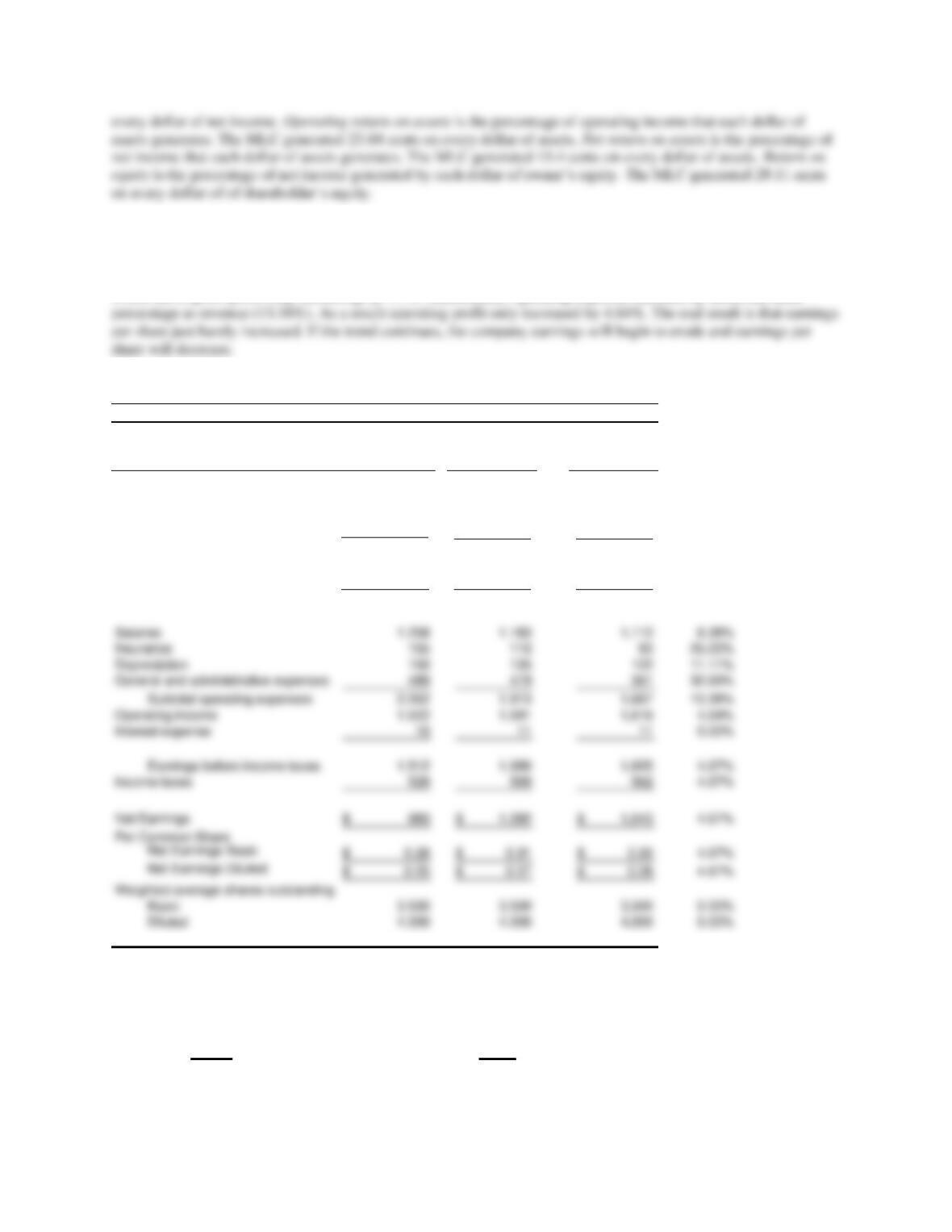
c. In a brief paragraph, describe the overall profitability of the MLC. Moderately Large Corporation’s operating
profit margin and net profit margin both increased.. They still have very good return on equity for the stockholders.
9. Perform a horizontal analysis for the MLC income statement (Table 4-7) for 2011 and 2012. Write an
explanation of this analysis. While revenue increased by 13.95%, cost of goods increased more rapidly (18.25%)
Table 4-7 Moderately Large Corporation Consolidated Statement of Earnings
Fiscal year ended: Dec. 31, 2013 Dec. 31, 2012 Dec. 31, 2011
Horizontal
Analysis
2011-12
Net revenues
Cash Sales 2,888$ 2,751$ 2,456$ 12.00%
Credit Sales 6,046 5,258 4,572 15.00%
Total Net Revenues 8,935 8,009 7,028 13.95%
Cost of Sales 5,361 4,405 3,725 18.25%
Gross Profit 3,574 3,604 3,303 9.10%
General and administrative expenses 489 479 361 32.69%
Interest expense 10 11 11 0.00%
Income taxes 529 588 562 4.67%
Net Earnings 983$ 1,092$ 1,043$ 4.67%
Consolidated Statement of Earnings
(in thousands, except earning per share)
10. Using both the balance sheet (Table 4-4) and the income statement (Table 4-7) for the MLC, answer the
following:
a. Calculate the following ratios for 2013: inventory turnover, fixed asset turnover, and total asset turnover.
Ratio
2013
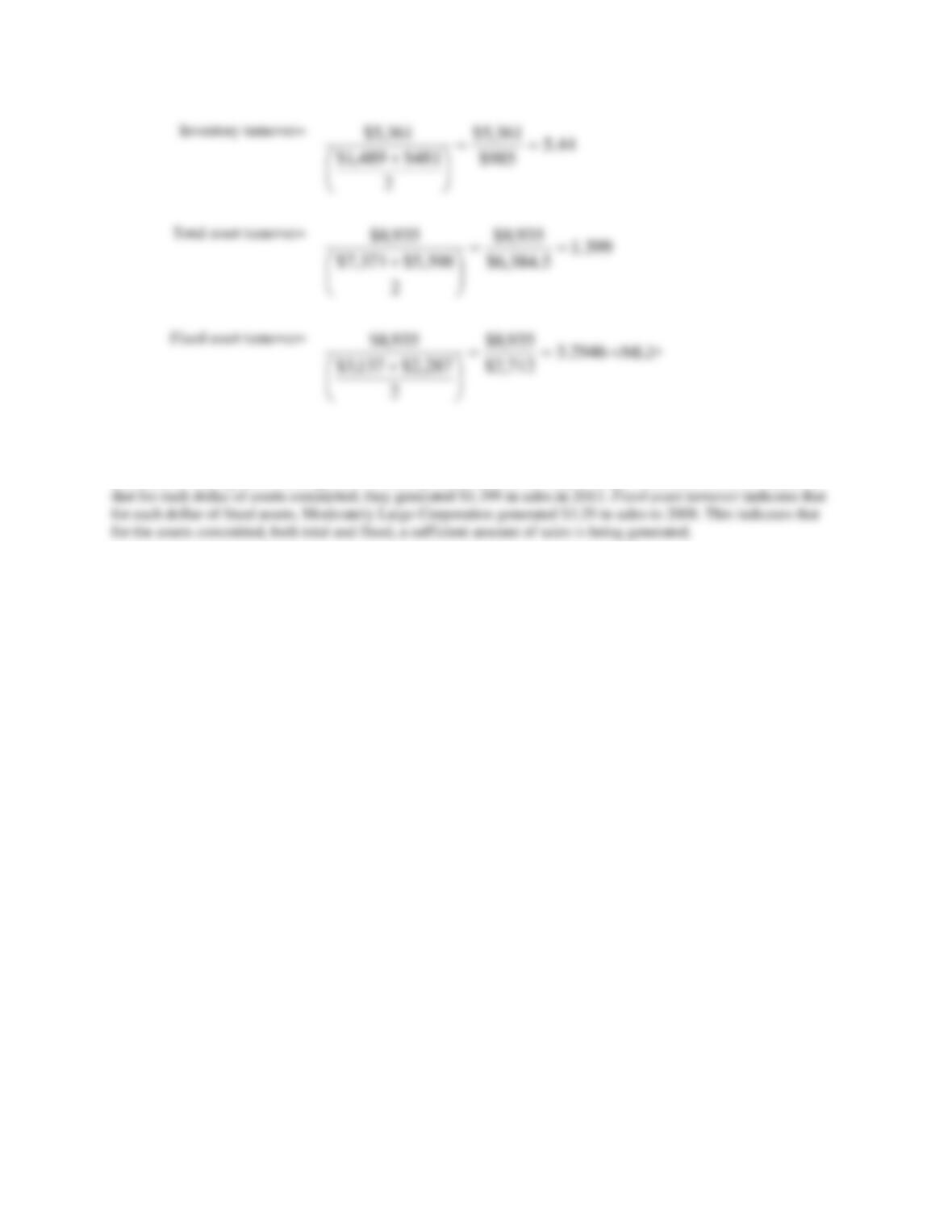
b. In a written explanation, describe what each of these ratios means. The inventory turnover ratio means that
inventory is used up on the average of 5.44 times per year in 2013or every 67 days. Total asset turnover indicates
c. In a brief paragraph, describe how well you believe the MLC is managing its assets. The student paragraph
should incorporate the data from both a) and b) above.
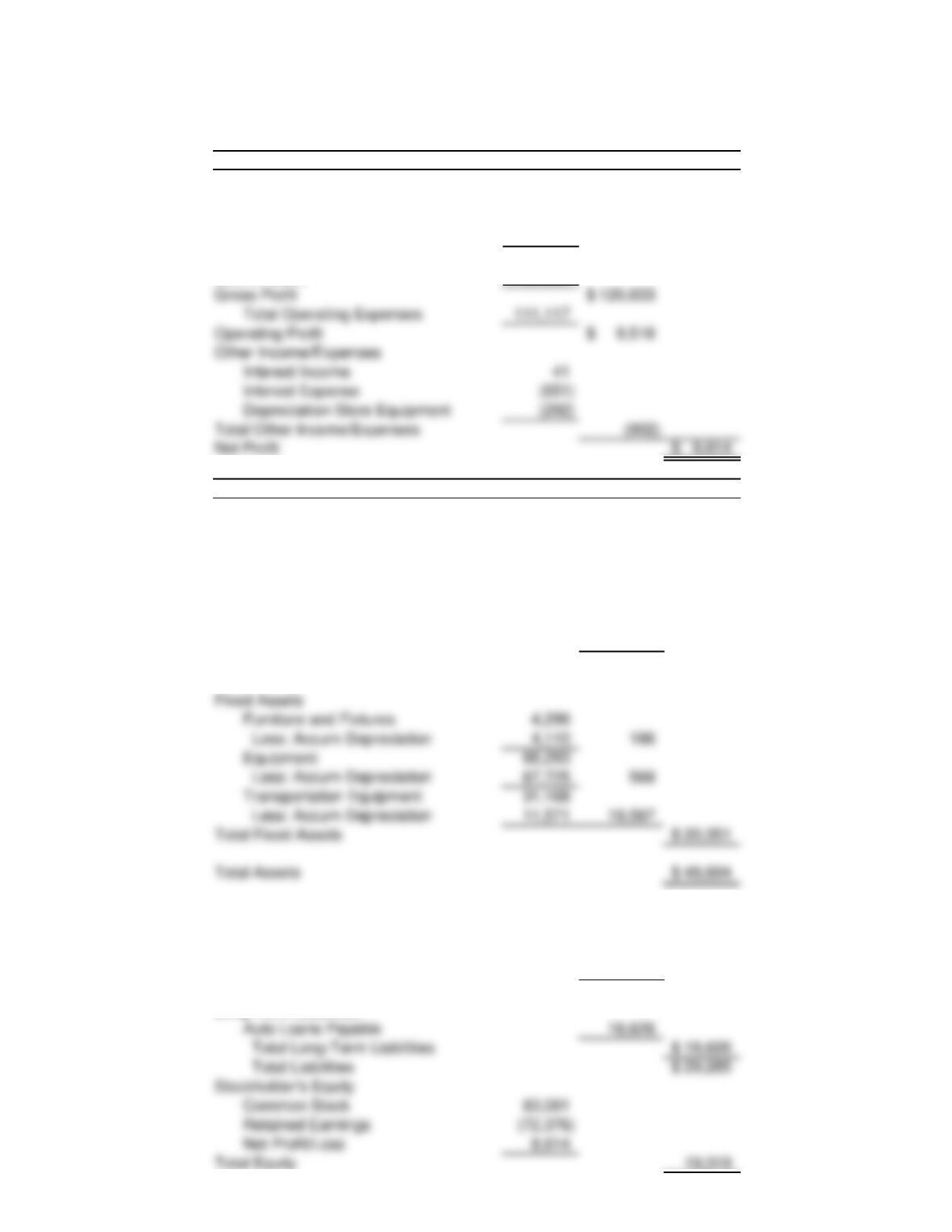
Table 4-8 Financial Statements for Sam’s Sandwich Delivery
Revenues
Retail Sales 68,283$
Wholesale Sales 104,417
Total Revenues 172,700$
Cost of Sales 52,067
Assets
Current Assets
Change Fund 569$
Cash in Bank-Checking 8,612
Cash in Bank-Savings 9,622
Accounts Receivable 6,843
Inventories 2,607
Total Current Assets 28,253$
Current Liabilities
Accounts Payable Trade 6,208
Accrued Payroll Taxes 3,464
Accrued Sales Taxes 987
Total Current Liabilities 10,659$
Balance Sheet as of 06-30-2013
Profit Loss (Income Statement) for Six Months Ending 06-30-2013
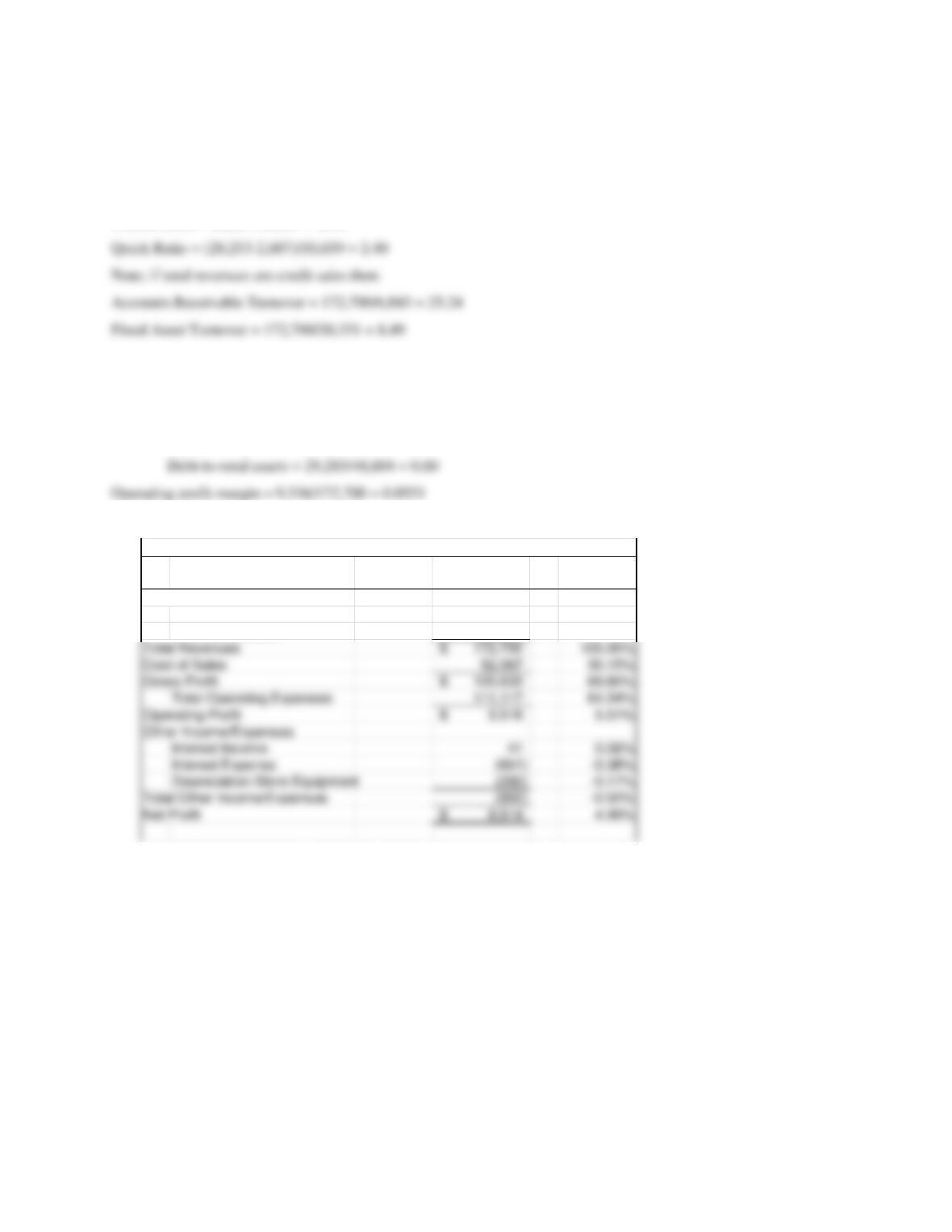
11. Given the profit loss (income statement) and balance sheet for Sam’s Sandwich Delivery (Table 4-8), answer
the following:
a. Calculate the following ratios: current, quick, accounts receivable turnover, fixed asset turnover.
Current Ratio = 28,253/10,659 = 2.65
b. Using the inventory figure on the balance sheet as average inventory, calculate the inventory turnover ratio.
Inventory Turnover Ration = 52,067/2,607 = 19.97
c. Calculate the debt–to-equity ratio, debt–to-total asset ratio, and operating profit margin ratio.
Debt-to-equity = 29,285/19,319 = 1.52
d. Perform a vertical analysis of the income statement.
Vertical
Analysis
Revenues
Retail Sales 68,283$ 39.54%
Wholesale Sales 104,417 60.46%
Profit Loss (Income Statement) for Six Months Ending 06-30-2013
e. Perform a vertical analysis of the balance sheet.
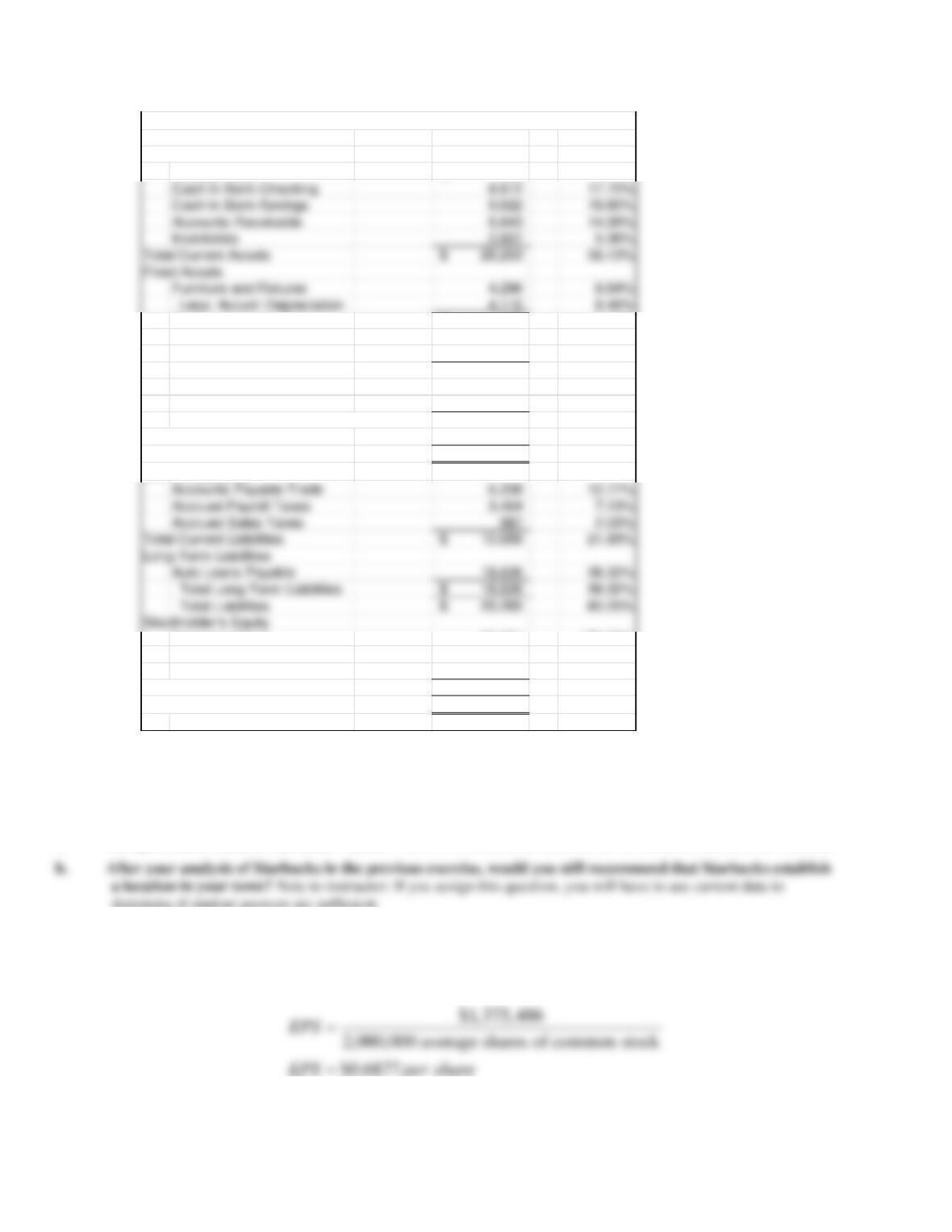
Assets
Current Assets
Change Fund 569$ 1.17%
Net Furniture and Fixtures 186$ 0.38%
Equipment 68,293 140.51%
Less: Accum Depreciation 67,725 139.34%
Net Equipment 568$ 1.17%
Transportation Equipment 31,168 64.13%
Less: Accum Depreciation 11,571 23.81%
Net Transportation Equipment 19,597$ 40.32%
Total Fixed Assets 20,351$ 41.87%
Total Assets 48,604$ 100.00%
Current Liabilities
Common Stock 83,081 170.93%
Retained Earnings (72,376) -148.91%
Net Profit/Loss 8,614 17.72%
Total Equity 19,319$ 39.75%
Total Liabilities and Equity 48,604$ 100.00%
Balance Sheet as of 06-30-2013
f. Based on your analysis, would you consider investing in Sam’s Sandwich Delivery? Yes, if he is pulling a
sufficient salary out of the operating expenses.
12. Go to your local library or the Internet and look up the industry averages for the following groups of ratios:
liquidity, activity, debt utilization, and profitability.
a. Compare these ratios to Starbucks’ ratios. There is no answer provided here as the student is asked to do research.
determine if student answers are sufficient.
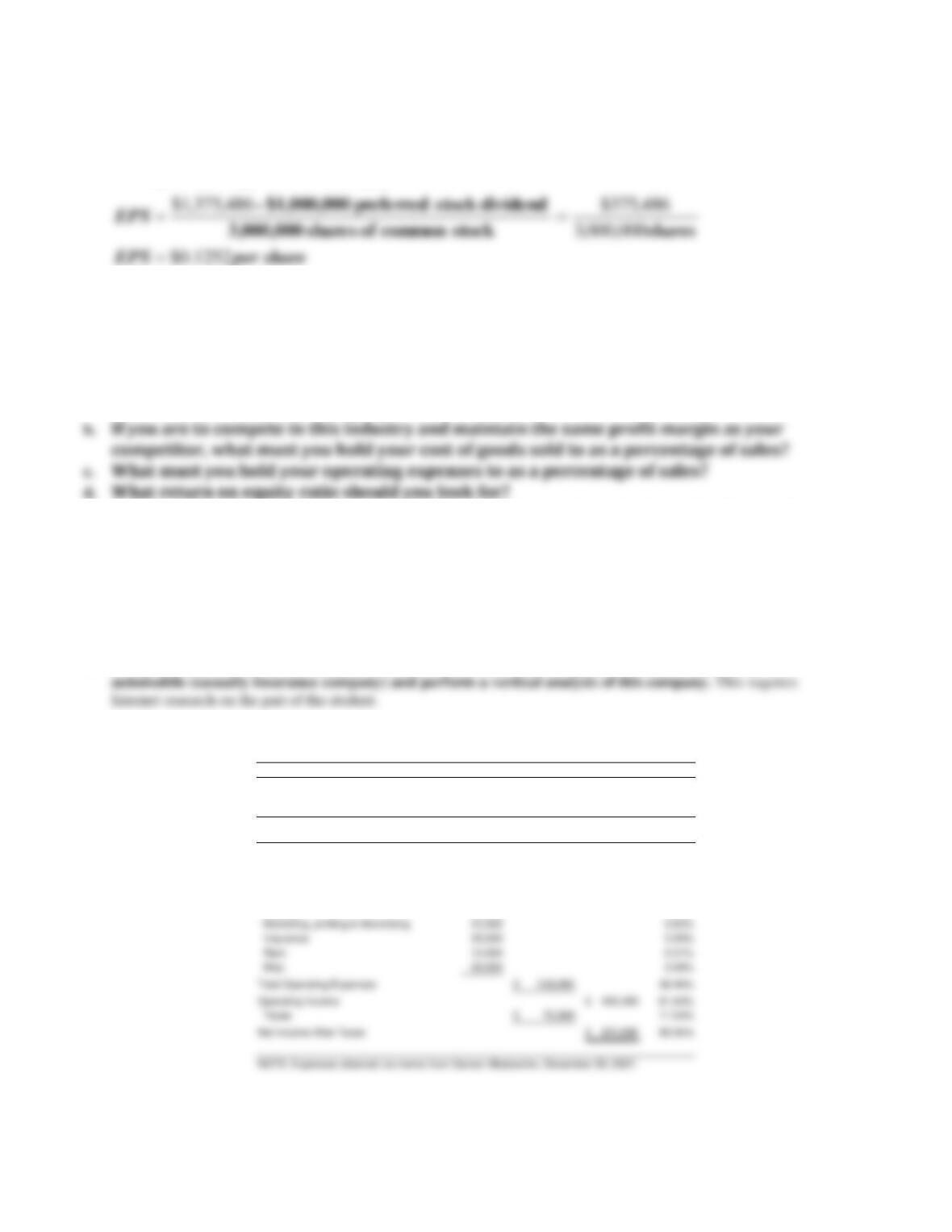
13. The Handy Dandy Corporation has an income statement that indicates that Operating Income is $2,375,486
and Net Profit is $1,375,486. In 2011, the corporation had 1 million shares of common stock outstanding; in
2012, they had 3 million shares of common stock outstanding. What is this corporation’s approximate
earnings per share?
14. The Namleda Corporation has an income statement that indicates that Operating Income is $2,375,486 and
pays interest of $100,000 and taxes of $900,000. The Corporation currently has 3 million shares of common
stock outstanding and 1 million shares of preferred stock, which pays a dividend of $1.00 per share. What is
the corporation’s approximate Earnings per Share?
RECOMMENDED TEAM ASSIGNMENT
These are Internet research questions that can’t be answered here.
1. Find the best publically traded company that is a competitor in the industry where you
would like to start a business.
a. Do a complete ratio analysis of this corporation. Based on the numbers, explain what the
future looks like for this company.
2. Evaluate the cash flow statement of the company in question. Explain why the numbers
on the cash flow statement are more feasible than the numbers on the income statement
for a potential investor. CASE STUDY QUESTIONS
1. Using Table 4–9, perform a vertical analysis of the Mosbacher Insurance Agency.
a. Using the Internet, obtain the income statement for the insurance company where you insure your
b. Compare and contrast the two companies.
Table 4-9 Income Statement for Mosbacher Insurance Agency
Category
Vertical
Analysis
Revenue
650,000$ 100.00%
Operating Expenses
Salary/Commission
150,000 23.08%
Phone, Computer, Utilities
10,000 1.54%
Postage
10,000 1.54%
25,000 3.85%
20,000 3.08%
15,000 2.31%
Mosbacher Insurance Agency
Abbreviated Average Income Statement
January 1 to December 31
Amount in Dollars
2. How did Gerson Mosbacher overcome the barriers to entrance into the market place? Gerson didn’t like to

make cold calls so he hired someone else to do this for him and only called on people who actually wanted to speak