Chapter 2
DEVELOPING THE BUSINESS IDEA
FOCUS
In this chapter we examine how one can move from an idea to a determination of the feasibility
of the related business opportunity. We present an opportunity screening system to aid in
determining whether an idea should be discarded or pursued. We conclude the chapter with an
overview of a business plan.
LEARNING OBJECTIVES
LO 2.1: Describe the process of moving from an idea to a business model/plan.
LO 2.2: Understand the components of a sound business model
LO 2.3: Identify some of the best practices for high growth, high performance firms.
CHAPTER OUTLINE
2.1 PROCESS FOR INDENTIFYING BUSINESS OPPORTUNITIES
2.2 TO BE SUCCESSFUL YOU MUST HAVE A SOUND BUSINESS MODEL
A. Component1: The Business Model must Generate Revenues
2.3 LEARN FROM THE BEST PRACTICES OF SUCCESSFUL ENTREPRENEURIAL
VENTURES
A. Best Marketing Practices
2.4 TIME-TO-MARKET AND OTHER TIMING IMPLICATIONS
2.5 INITIAL “LITMUS TEST” FOR EVALUATING THE BUSINESS FEASIBILITY OF
AN IDEA
2.6 SCREENING VENTURE OPPORTUNITIES
A. An Interview with the Founder (Entrepreneur) and Management Team: Qualitative
Screening
Chapter 2: Developing the Business Idea
18
F. Management Team Considerations
G. Opportunity-Screening Caveats
2.7 KEY ELEMENTS OF A BUSINESS PLAN
A. Cover Page, Confidentiality Statement, and Table of Contents
B. Executive Summary
SUMMARY
APPENDIX A:
Applying the VOS IndicatorTM: An Example
CSC Profile
Market Opportunity
DISCUSSION QUESTIONS AND ANSWERS
1. How do we know whether an idea has the potential to become a viable business opportunity?
The answer is that we don’t know with absolute certainty. While there is no infallible
2. Identify three types of startup firms.
Salary-replacement firms are firms that provide their owners with income levels comparable
to what they could have earned working for much larger firms.
3. Briefly describe the process involved in moving from an idea to a business model/plan.
Refer to Figure 2.1 “From Entrepreneurial Opportunities to New Businesses, Products, or
Chapter 2: Developing the Business Idea
19
4. What are the components of a sound business model?
The components of a sound business model are the abilities to generate revenues, create a
5. Describe the differences between entrepreneurial ventures and other entrepreneurial firms.
Entrepreneurial ventures are entrepreneurial firms that are flows and performance oriented as
6. Identify some of the best marketing and management practices of high growth, high
performance firms.
Successful high-growth, high-performance firms typically sell high quality products or
provide high quality services. Such firms also generally develop and introduce new products
7. Describe and discuss some of the best financial practices of high growth, high performance
firms. Why is it also important to consider production or operations practices?
High-growth, high-performance firms consider their financial practices as important as their
marketing and operating functions. To this end, they plan for future growth and unexpected
contingencies that may develop as the firm operates. They prepare realistic monthly
Chapter 2: Developing the Business Idea
20
8. Time to market is generally important, but being first to market does not necessarily ensure
success. Explain.
“Time–to–market” is particularly critical when ideas involve information technology, as a few
9. What is meant by a viable venture opportunity?
A viable venture opportunity is one that creates or meets a customer need, provides an initial
10. Describe how a SWOT analysis can be used to conduct a first-pass assessment of whether an
idea is likely to become a viable business opportunity.
A SWOT analysis is an examination of strengths, weaknesses, opportunities, and threats to
determine the business opportunity viability of an idea. One typically “begins” by asking
11. Describe the meaning of venture opportunity screening.
Venture opportunity screening is the assessment of an idea’s commercial potential to produce
revenue growth, financial performance, and value.
12. An analogy used relating to venture opportunity screening makes reference to “caterpillars”
and “butterflies.” Briefly describe the use of this analogy.
Chapter 2: Developing the Business Idea
21
13. When conducting a qualitative screening of a venture opportunity, whom should you
interview? What topics should you cover?
It is most important to interview the entrepreneur or founder. You might also want to
interview the marketing manager, the operations manager, and the financial manager. In the
14. Describe the characteristics of a viable venture opportunity. What is a VOS Indicator?
A viable venture opportunity will meet a customer need, have a competitive advantage, be
15. Describe the factor categories used by venture capitalists and other venture investors when
they screen venture opportunities for the purpose of deciding to invest.
The categories used by venture investors to screen are the industry or market, pricing and
profitability, the management team, and financial harvest indicators. The market size of the
Chapter 2: Developing the Business Idea
22
16. Describe return on assets (ROA). What are the two major components of the ROA model?
The return on assets is a metric calculated by dividing the venture’s net after-tax profit by
its venture total assets and it represents a measure of the firm’s performance relative to its
17. How do asset intensity and asset turnover differ? What is implied by a high asset intensity?
Asset intensity is calculated as total assets divided by total revenues. Asset turnover is
calculated as revenues divided by total assets. Asset intensity is the reciprocal of asset
18. How do the concepts of operating cash flow and free cash flow to equity differ?
Operating cash flow is a measure of the cash generated by the daily operations of selling the
company’s product or service; it represents the figure that remains after the cost of goods
Chapter 2: Developing the Business Idea
23
19. What is a business plan? Why is it important to prepare a business plan?
A business plan is a written document that describes the proposed venture in terms of the
product or service opportunity, current resources, and financial projections. More formal
20. What are the major elements of a typical business plan?
A typical business plan contains, in its Introduction, a cover page, confidentiality statement,
table of contents, and executive summary. The Business Description section presents some
of the considerations related to the venture opportunity-screening phase on industry/market
21. What are real options? What types of real option opportunities are available to
entrepreneurs?
Chapter 2: Developing the Business Idea
24
22. From the Headlines—Diluting the Angels’ Share: Briefly describe how the idea of a
shortened aging process can be the basis of financial profitability for Cleveland Whiskey.
Answers will vary: The barrel-aging process is extraordinarily time consuming, placing a
large gap between when money is invested in an inventory and when that inventory is
released to be sold. As with any business, in the whiskey business, time is money. The
INTERNET ACTIVITIES
Web-researched results vary due to constant updating of the related web sites.
Web-researched results vary due to constant updating of the related web sites.
Chapter 2: Developing the Business Idea
25
Web-researched results vary due to constant updating of the related web sites.
EXERCISES/PROBLEMS AND ANSWERS
1. [Basic Financial Ratios] A venture recorded revenues of $1 million last year and net profit
of $100,000. Total assets were $800,000 at the end of last year.
A. Calculate the venture’s net profit margin.
Net Profit Margin: net profit/revenues = $100,000/$1,000,000 = 10.0%
2. [Financial Ratios and Performance] Following is financial information for three ventures:
Venture XX Venture YY Venture ZZ
After-tax Profit Margins 5% 15% 25%
Asset Turnover 2.0 times 1.0 times 3.0 times
A. Calculate the return on assets (ROA) for each firm.
Venture XX: 5% x 2.0 = 10%
Venture YY: 15% x 1.0 = 15%
Venture ZZ: 25% x 3.0 = 75%
B. Which venture is indicative of a strong entrepreneurial venture opportunity?
Venture ZZ seems to represent a strong entrepreneurial venture opportunity based on a
Chapter 2: Developing the Business Idea
26
Venture ZZ would be a Case 1 type of venture opportunity (very high profit margin).
E. Use the information in Figure 2.9 relating to pricing/profitability, and “score” each
venture in terms of potential attractiveness.
Pricing/Profitability Venture XX Venture YY Venture ZZ
Gross margins NA NA NA
After-tax margins 1 2 3
3. [Revenues, Costs, and Profits] In early 2013, Jennifer (Jen) Liu and Larry Mestas founded
Jen and Larry’s Frozen Yogurt Company, which was based on the idea of applying the
microbrew or microbatch strategy to the production and sale of frozen yogurt. They began
producing small quantities of unique flavors and blends in limited editions. Revenues were
A. Determine the number of cups of frozen yogurt sold each year.
Revenue = Price per unit x units sold, and Revenue / Price per unit = units sold:
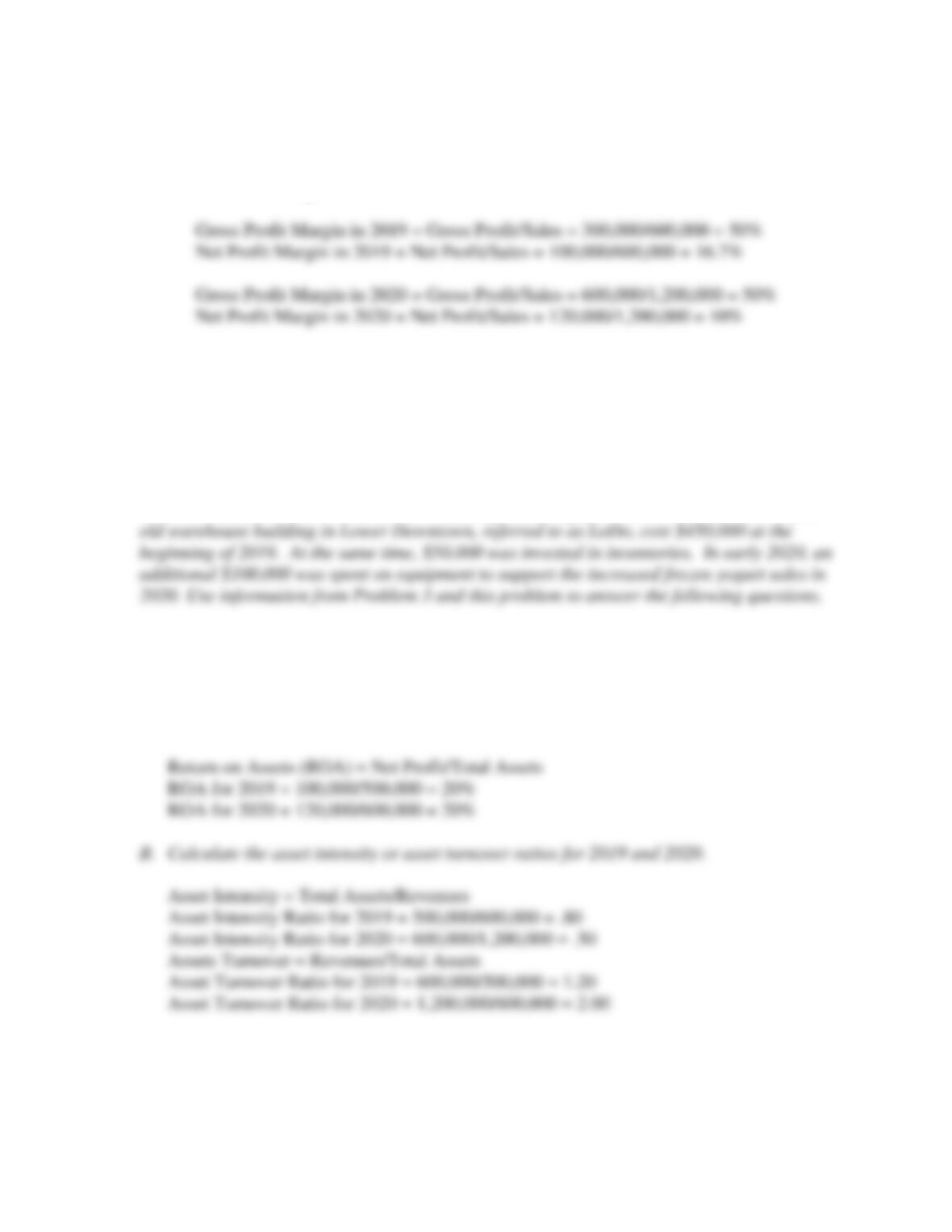
B. Estimate the dollar amounts of gross profit and net profit for Jen and Larry’s venture in
2019 and 2020.
Chapter 2: Developing the Business Idea
27
C. Calculate the gross profit margins and net profit margins in 2019 and 2020.
Gross Profit Margin = Gross Profit/Revenues
Net Profit Margin = Net Profit/Revenues
D. Briefly describe what has occurred between the two years.
The gross profit margins are the same in the two years because the “cost of goods sold
per unit” stays the same. However, 2020’s net profit margin declines because of the
increase in the other expenses category.
4. [Returns on Assets] Jen and Larry’s frozen yogurt venture described in Problem 3 required
some investment in bricks and mortar. Initial specialty equipment and the renovation of an
A. Calculate the return on assets in both 2019 and 2020.
Total Assets 2019 = Warehouse + Inventory = $450,000 + $50,000 = $500,000
Total Assets 2020 = Warehouse + Inventory + Additional Capital Expenditure
= $450,000 + $50,000 + $100,000 = $600,000
C. Apply the ROA Business Model to Jen and Larry’s frozen yogurt venture.
ROA Business Model = Net Profit Margin x Asset Turnover Ratio
Chapter 2: Developing the Business Idea
28
ROA for 2019 = 16.67% x 1.2 = 20%
ROA for 2020 = 10% x 2.0 = 20%
D. Briefly describe what has occurred between the two years.
The Returns on Assets were the same in the two years because the company’s Net Profit
Margins went down due to the increased operation expenses while Asset Intensity went
up due to additional capital expenditure on equipment.
5. [VOS IndicatorTM Screening] Jen Liu and Larry Mestas are seeking venture investors to help
fund the expected growth in their Frozen Yogurt venture described in Problems 3 and 4. Use
the VOS Indicator
guidelines presented in Figures 2.8 and 2.9 to score Jen and Larry’s
frozen yogurt venture in terms of the items in the pricing/profitability factor category.
Comment on the likely attractiveness of this business opportunity to venture investors.
Gross Margin: 50%, 50% (“High”)
After-Tax Margin: 16.7%, 10% (“Average”)
6. [Ethical Issues] Assume that you have just “run-out-of-money” and are unable to move your
“idea” from its development stage to production and the startup stage. However, you remain
convinced that with a reasonable amount of additional financial capital you will be a successful
entrepreneur. While your expectations are low, you are meeting with a loan officer of the local
bank in the hope that you can get a personal loan in order to continue your venture.
A. As you are about to enter the bank, you see a bank money bag lying on the street. No one is
around to claim the bag. What would you do?
Many entrepreneurs state that high ethical standards are one of a venture’s most important
Chapter 2: Developing the Business Idea
29
B. Now, let’s assume that what you found lying on the street was a $100 bill. The thought
crosses your mind that it would be nice to take your significant other out for a nice dinner—
something that you have not had for several months. What would you do?
Unless you see someone drop the $100 bill it will be very difficult to identify the owner of
C. Now, instead of $100 you “find” a $1 bill on the street. The thought crosses your mind that
you could buy a lottery ticket with the dollar. Winning the lottery would certainly solve all
your financing needs to start and run your venture. What would you do?
When the amount of money “found” is very small, such as $1, people often behave
differently than when the amount of money is large. First, it is virtually impossible to
SUPPLEMENTAL EXERCISES/PROBLEMS AND ANSWERS
[Note: These activities are for readers with an existing understanding of financial statements (i.e.,
income statements and balance sheets). For other readers, these exercises/problems can be
worked after covering Chapter 4.]
7. [Revenues, Profits, and Assets] Refer to the information on the three ventures in Problem 2.
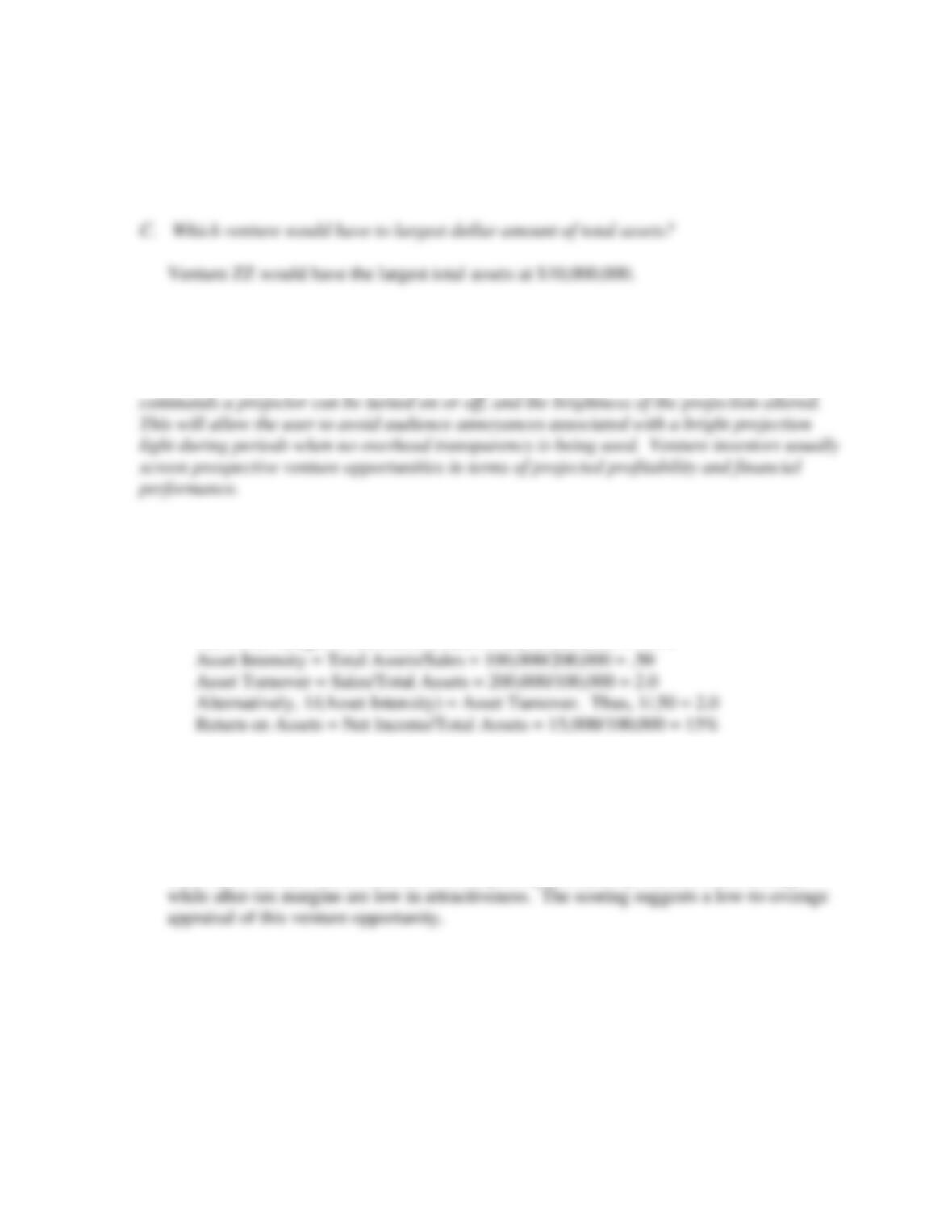
A. If each venture had net sales of $10 million, calculate the dollar amount of net profit and
total assets for Venture XX, Venture YY, and Venture ZZ.
Net Profit Total Assets
Chapter 2: Developing the Business Idea
30
B. Which venture would have the largest dollar amount of net profit?
Venture YY would have the largest net profit at $2,500,000.
8. [Ratio Calculations from Financial Statements] Ricardo Martinez has prepared the
following financial statement projections as part of his business plan for starting the
Martinez Products Corporation. The venture is to manufacture and sell electronic
components that make standard overhead projectors “smart.” In essence, through voice
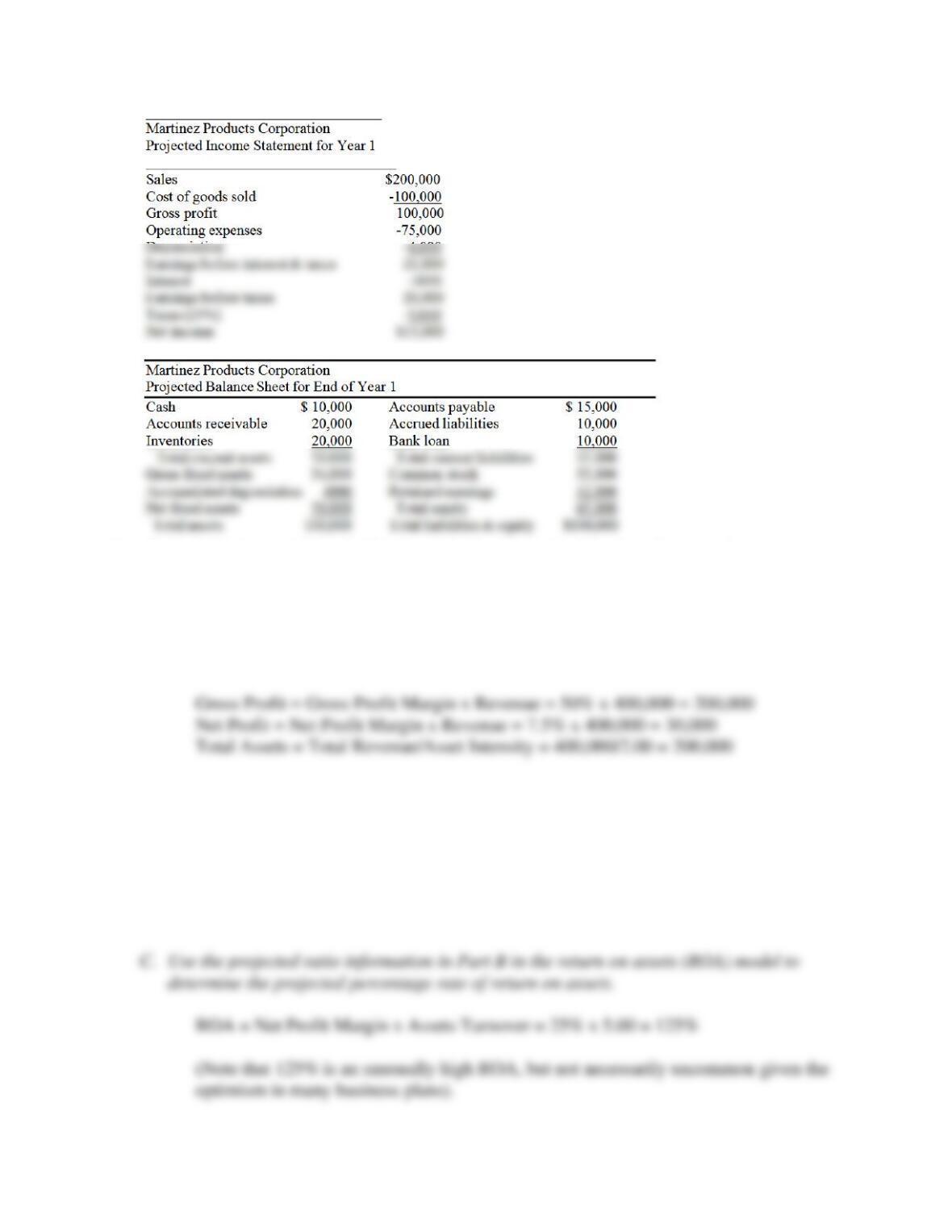
A. Use the following projected financial statements for Martinez Products and calculate
financial ratios showing the venture’s projected: (a) gross profit margin, (b) net profit
margin, (c) asset intensity, and (d) return on assets.
Gross Profit Margin = Gross Profit/Sales = 100,000/200,000 = 50%
Net Profit Margin = Net Income/Sales = 15,000/200,000 = 7.5%
B. The ratios calculated in Part A are found in the venture opportunity screening guide
discussed in the chapter. Rate the potential attractiveness of the Martinez Products
venture using the guidelines for the pricing/profitability factor category for the VOS
Indicator.
The VOS Indicator shows that three of the pricing/profitability indicators are average
Chapter 2: Developing the Business Idea
31
9. [Ratio Calculations] Ricardo Martinez, the founder of the Martinez Products Corporation
(see Problem 8), projects sales to double to $400,000 in the second year of operation.
A. If the financial ratios calculated for Year 1 in Problem 8 remain the same in Year 2, what
would be Martinez’s dollar amount projections in his business plan for: (a) gross profit,
(b) net profit or income, and (c) total assets?
B. How would your answers change in Part A if the gross profit margin in the second year
is projected to be 60%, the net profit margin 25%, and the asset intensity at a 5 times
turnover?
Gross Profit = 400,000 x 60% = 240,000
Net Profit = 400,000 x 25% = 100,000
Total Assets = 400,000/5.00 = 80,000
Chapter 2: Developing the Business Idea
32
MINI CASE: LEARNRITE.COM CORPORATION
LearnRite.com offers e-commerce service for children’s “edutainment” products and
services. The word edutainment is used to describe software that combines “educational” and
“entertainment” components. Valuable product information and detailed editorial comments are
combined with a wide selection of products for purchase to help families make their kids’
edutainment decisions. A team of leading educators and journalists provide editorial comments
on the products sold by the firm. LearnRite targets highly educated, convenience oriented, and
value conscience families with children under the age of 12, estimated to be about 35 percent of
Internet users.
LearnRite estimates that venture investors should earn about a 40 percent average annual
compound rate of return and sees an opportunity for a possible initial public offering in about six
years. If industry consolidation occurs, a merger might occur even sooner.
The management team is headed by Srikant Kapoor who serves as President of
LearnRite.com and who personally controls about 35 percent of the ownership of the firm. Mr.
Kapoor has more than twelve years experience in high-tech industries including previous
positions with US West and Microsoft. He holds a B.S. degree in electrical engineering from an
Indian technology institute and an MBA from a major U.S. university. Sean Davidson, Director
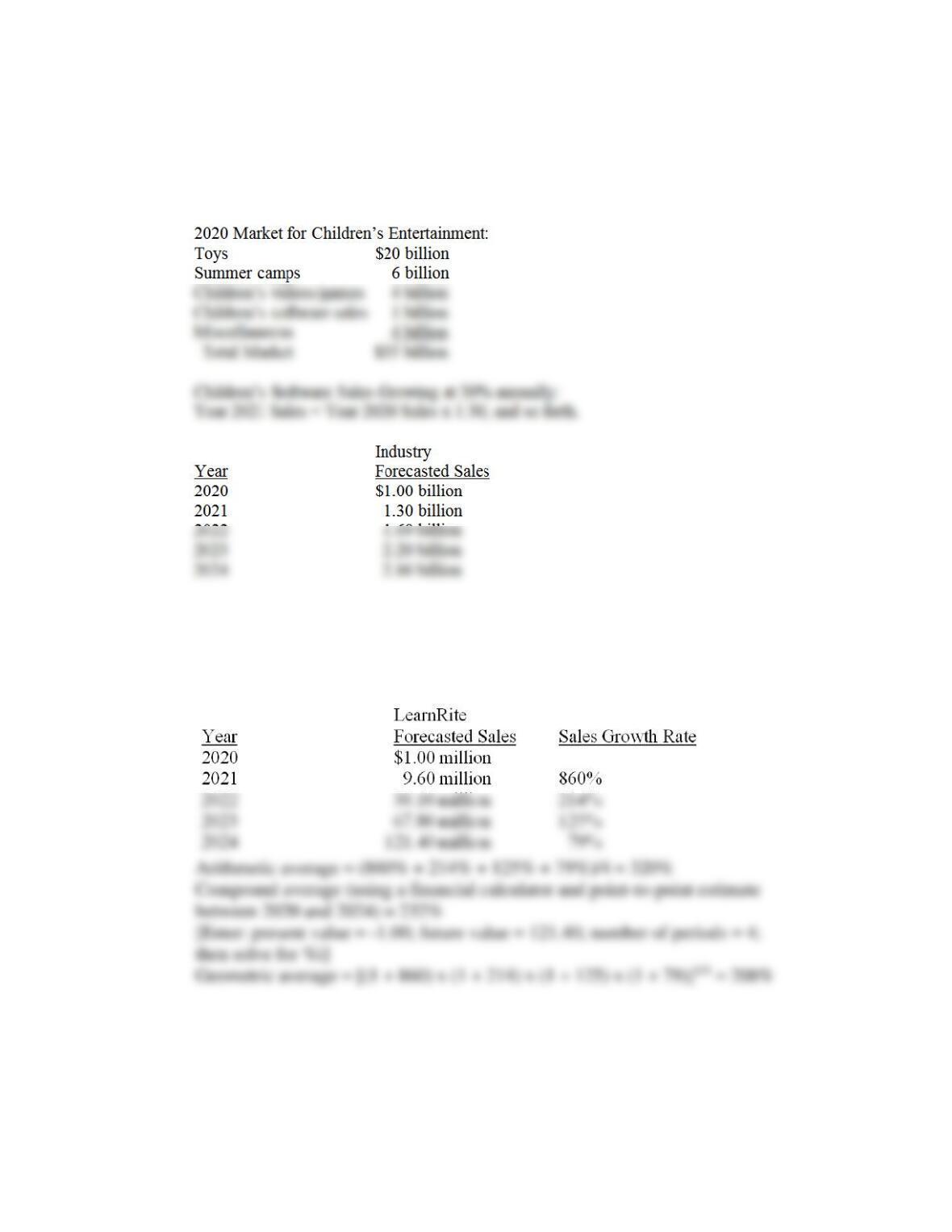
LearnRite has made the following five-year revenue projections:
Year 2020 2021 2022 2023 2024
Revenues ($M) $1.0 $9.6 $30.1 $67.8 $121.4
Chapter 2: Developing the Business Idea
33
A. Project industry sales for children’s software through the year 2024 based on the
information provided above.
B. Calculate the year-to-year annual sales growth rates for LearnRite. [Optional: Estimate the
compound growth rate over the 2020 through 2024 time period using a financial calculator
or computer software program.]
Growth Rate = [(Next Year Sales – Current Year Sales)/Current Year Sales] x 100
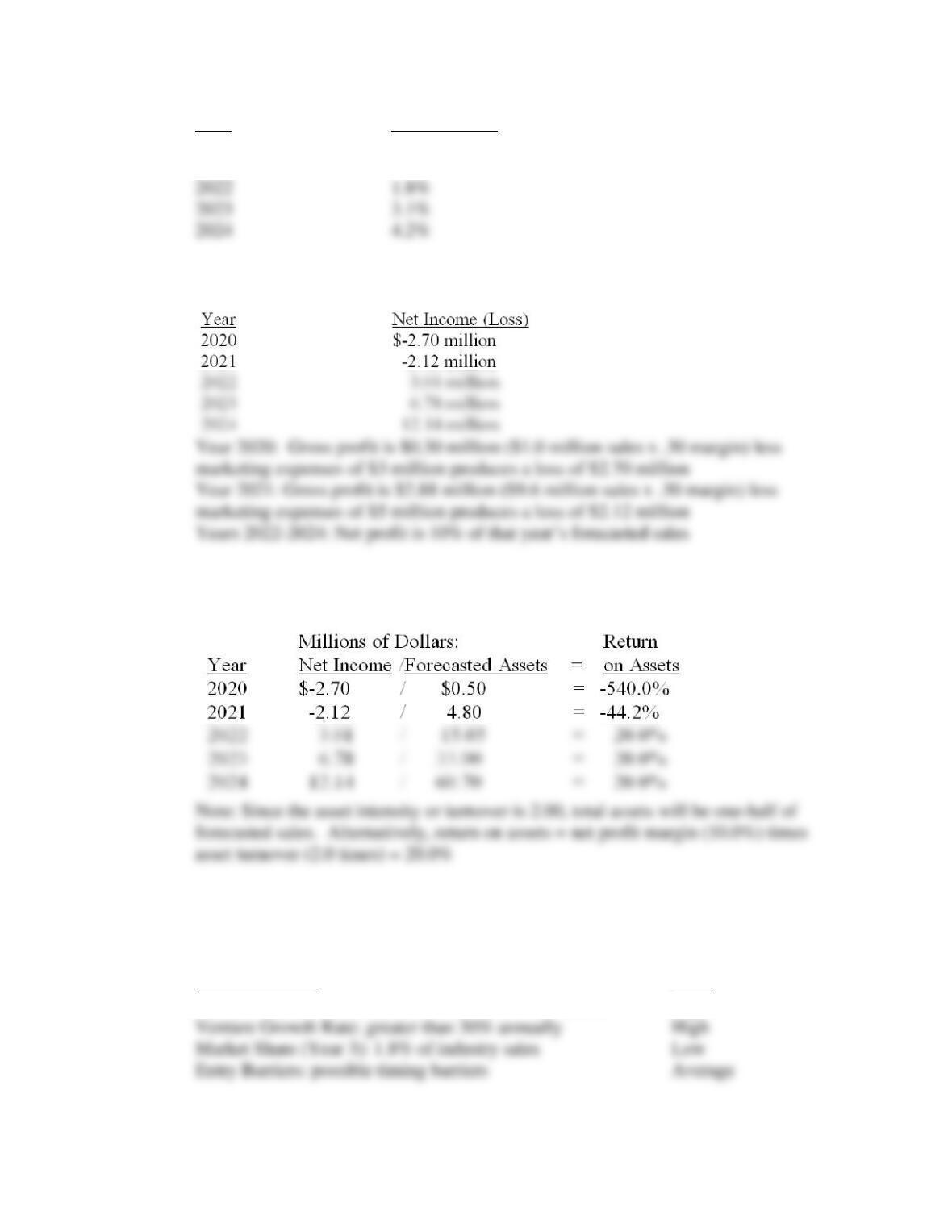
C. Estimate LearnRite’s expected market share in each year based on the above data.
Note: use data for the kid’s software industry from (A) and for LearnRite from (B).
Percent of
Chapter 2: Developing the Business Idea
34
Year Industry Sales
2020 0.1%
2021 0.7%
D. Estimate the firm’s net income (loss) in each of the five years.
E. Estimate the firm’s return on assets beginning when the net or after-tax income is expected
to be positive.
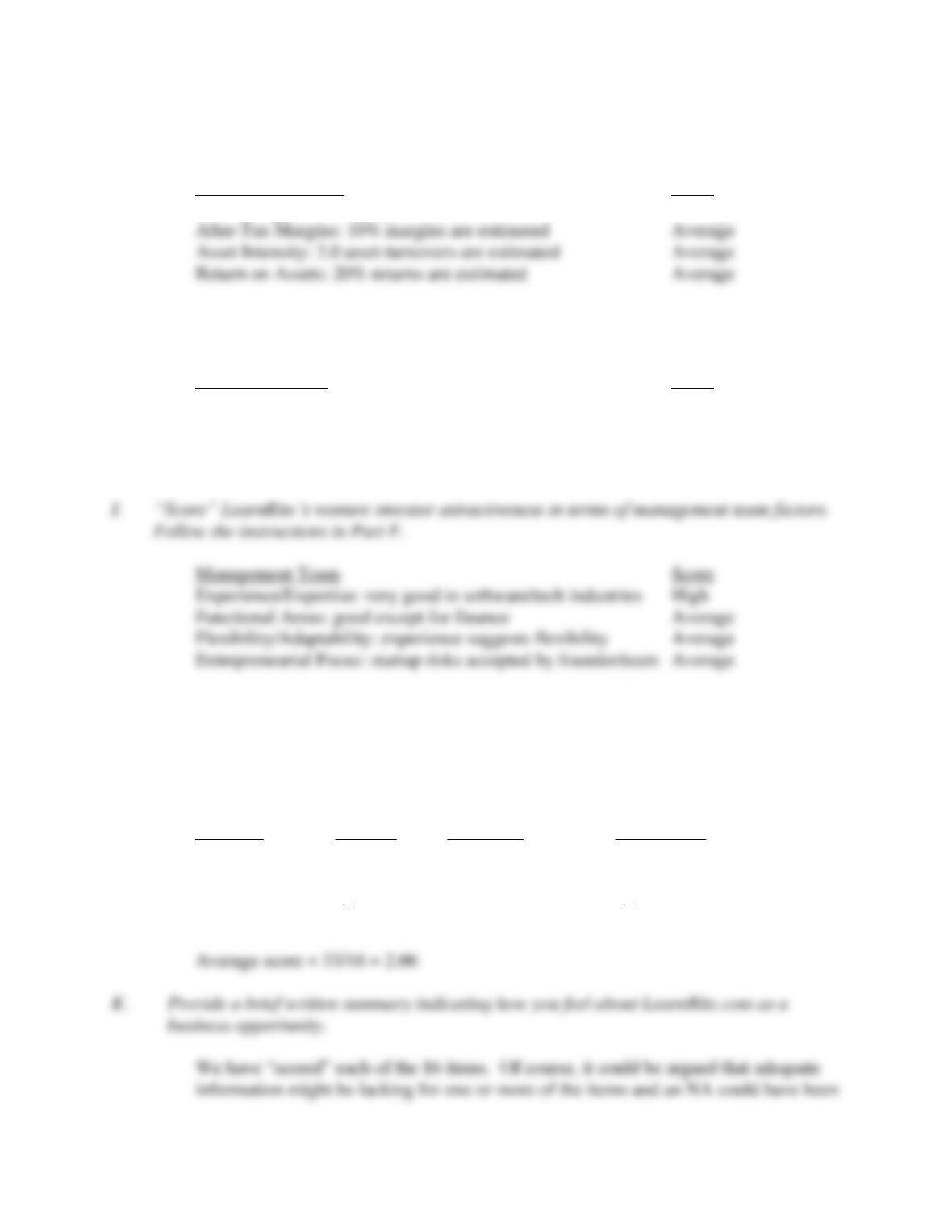
F. Score LearnRite’s venture investor attractiveness in terms of the Industry/Market Factor
Category using the VOS Indicator
guide and criteria set out in Figures 2.8 and 2.9. If
you believe there are insufficient data, indicate that decision with an “N/A.”
Industry/Market Score
Market Size Potential: kid’s software sales = $1 billion High
Chapter 2: Developing the Business Idea
35
G. Score LearnRite’s venture investor attractiveness in terms of pricing/profitability factors.
Follow the instructions in Part F.
Pricing/Profitability Score
Gross Margins: 30% margins are estimated Average
H. Score LearnRite’s venture investor attractiveness in terms of financial/harvest factors.
Follow the instructions in Part F.
Financial/Harvest Score
Cash Flow Breakeven: estimated to occur in Year 3 Average
Rates of Return: 20% investor returns are estimated Average
IPO Potential: estimated in Year 6 Low
Founder’s Control: 35% ownership by founder Average
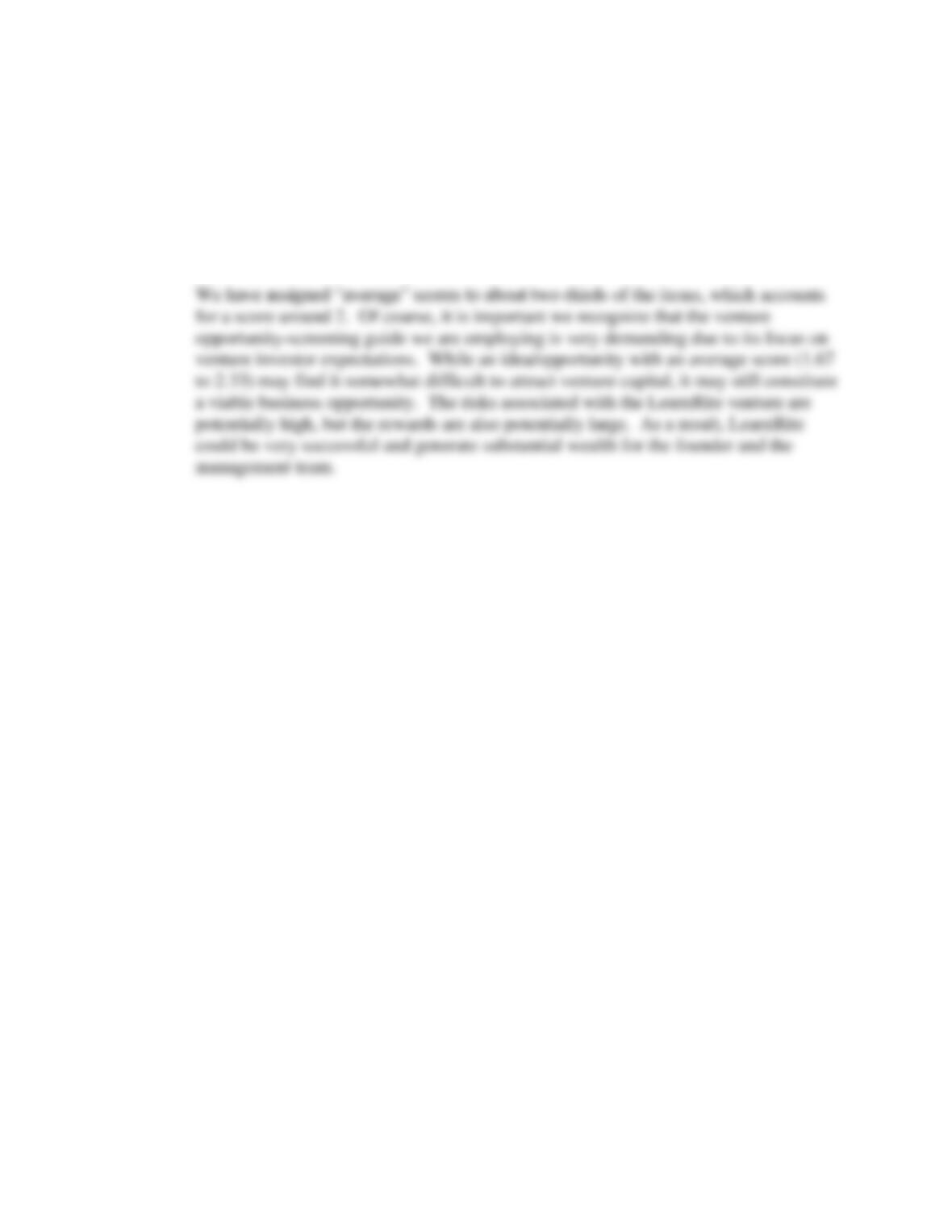
J. Determine overall total points and an average score for LearnRite as was done for the
Companion Systems Corporation in the Appendix. Items where information is judged to be
lacking and an NA is used should be excluded when calculating an average score.
The “labels” assigned in (F) through (I) for LearnRite can be summarized as follows:
Category Number x Points Per = Total Points
High 3 3 9
Average 11 2 22
Low 2 1 2
Totals 16 33
Chapter 2: Developing the Business Idea
36
assigned until the information was acquired. However, even after substantial due
diligence efforts are completed, scoring “judgments” will still have to be made. [We
note that differences in industry knowledge, attitudes towards risk preferences, etc.
might lead individual instructors and/or students to “score” certain items differently
than we have. Such differences in opinion should help enliven the discussion of the
mini case and provide recognition that deciding to become an entrepreneur is not for
everyone.]