Chapter 1
INTRODUCTION TO FINANCE FOR ENTREPRENEURS
FOCUS
The purpose of this first chapter is to present an overview of what entrepreneurial finance is
about. In doing so we hope to convey to you the importance of understanding and applying
entrepreneurial finance methods and tools to help ensure an entrepreneurial venture is successful.
We present a life cycle approach to the teaching of entrepreneurial finance where we cover
venture operating and financial decisions faced by the entrepreneur as a venture progresses from
an idea through to harvesting the venture.
LEARNING OBJECTIVES
LO 1.1: Characterize the entrepreneurial process.
LO 1.2: Describe entrepreneurship and some characteristics of entrepreneurs.
LO 1.3: Indicate several megatrends providing waves of entrepreneurial opportunities.
LO 1.4: List and describe the seven principles of entrepreneurial finance.
CHAPTER OUTLINE
1.1 THE ENTREPRENEURIAL PROCESS
1.2 ENTREPRENEURSHIP FUNDAMENTALS
A. Who is an Entrepreneur?
B. Basic Definitions
1.3 SOURCES OF ENTREPRENEURIAL OPPORTUNITIES
A. Societal Changes
B. Demographic Changes
1.4 PRINCIPLES OF ENTREPRENEURIAL FINANCE
A. Real, Human, and Financial Capital must be Rented from Owners (Principle #1)
B. Risk and Expected Reward go Hand in Hand (Principle #2)
Chapter 1: Introduction to Finance for Entrepreneurs
2
1.5 ROLE OF ENTREPRENEURIAL FINANCE
1.6 THE SUCCESSFUL VENTURE LIFE CYCLE
A. Development Stage
B. Startup Stage
1.7 FINANCING THROUGH THE VENTURE LIFE CYCLE
A. Seed Financing
B. Startup Financing
1.8 LIFE CYCLE APPROACH FOR TEACHING ENTREPRENEURIAL FINANCE
SUMMARY
DISCUSSION QUESTIONS AND ANSWERS
1. What is the entrepreneurial process?
The entrepreneurial process comprises: developing opportunities, gathering resources, and
2. What is entrepreneurship? What are some basic characteristics of entrepreneurs?
Entrepreneurship is the process of changing ideas into commercial opportunities and creating
3. Why do businesses close or cease operating? What are the primary reasons why businesses
fail?
Nearly one-half of businesses that fail do so because of economic factors including
inadequate sales, insufficient profits, and industry weakness. Many of the economic factors
Chapter 1: Introduction to Finance for Entrepreneurs
3
4. What are five megatrend sources or categories for finding entrepreneurial opportunities?
We identify five megatrend categories. They are: (1) societal changes, (2) demographic
changes, (3) technological changes, (4) emerging economies and global changes, and (5)
crises and bubbles.
5. What asset and financial bubbles have occurred recently? How can bubbles and financial
crises lead to entrepreneurial opportunities?
The “dot.com” or Internet bubble burst in 2000. An economic recession that began in 2001
was exacerbated by the 9/11 terrorist attack. The housing asset bubble, fueled by sub-prime
6. What is e-commerce? Why are the Internet economy and e-commerce here to stay?
E-commerce involves the use of electronic means to conduct business online. Activities
include marketing and selling online and electronic retailing.
7. What is meant by disruptive innovation? What is the “sharing economy” societal trend?
An innovation involves the introduction of a new idea, product, or process. A disruptive
Chapter 1: Introduction to Finance for Entrepreneurs
4
8. Identify the seven principles of entrepreneurial finance.
The seven principles are:
(1) Real, human, and financial capital must be rented from owners
(2) Risk and expected reward go hand in hand
(3) While accounting is the language of business, cash is the currency
9. Explain the statement: “The time value of money is not the only cost involved in renting
someone’s financial capital.”
The total cost of renting someone’s financial capital is typically significantly higher than just
10. How do public and private financial markets differ?
Public financial markets are markets where standardized contracts or securities are traded
11. What is the financial goal of the entrepreneurial venture? What are the major components
for estimating value?
The venture’s financial goal is to maximize the value of the venture to its owner(s). The
12. From an agency relationship standpoint, describe the possible types of problems or conflicts
of interest that could inhibit maximizing a venture’s value.
There are two basic types of conflicts. Owner-manager (agency) conflicts occur when there
are differences between managers’ self-interests and the interests of the owners who hired the
Chapter 1: Introduction to Finance for Entrepreneurs
5
of owners at the expense of debtholders.
13. Briefly discuss the likely importance of an entrepreneur’s character and reputation on the
success of a venture. What role does social responsibility plan in the operation of an
entrepreneurial venture?
A survey of successful entrepreneurs by Timmons and Stevenson indicated that a majority
felt that having high ethical standards was the most important factor in the long-term success
14. What is entrepreneurial finance and what are the responsibilities of the financial manager of
an entrepreneurial venture?
Entrepreneurial finance is the application and adaptation of financial tools and techniques to
the planning, funding, operations, and valuation of an entrepreneurial venture. The practice
15. What are the five stages in the life-cycle of a successful venture?
They are: (1) Development Stage, (2) Startup Stage, (3) Survival Stage, (4) Rapid-Growth
16. New ventures are subject to periodic introspection on whether they should continue or
abandon. Explain the types of information you would expect to gather and how it would be
used in each stage to aid an entrepreneur’s approach to the venture’s future.
Types of information to be gathered would be income statements, balance sheets, cash flow
Chapter 1: Introduction to Finance for Entrepreneurs
6
17. Identify the types of financing that typically coincide with each stage of a successful
venture’s life cycle.
Development Stage – Seed Financing
Startup Stage – Startup Financing
18. Identify the major sources, as well as the players, associated with each type of financing for
each life cycle stage.
Development Stage – Entrepreneur’s assets, family and friends
Startup Stage – Entrepreneur’s assets, family, friends, business angels, venture capitalists
Survival Stage – Business operations, venture capitalists, suppliers, customers, government
19. Describe the life cycle approach for teaching entrepreneurial finance.
The life cycle approach to entrepreneurial finance considers major operating and financial
20. From the Headlines—PopSockets: Briefly describe the market PopSockets seeks to address
and how PopSockets’ initial device addresses that market. Give some examples of how
PopSockets can expand its market and tap additional sources of capital.
Answers will vary: “PopSockets supplies products “to increase the functionality of digital
devices we use daily.” The addressable market includes anyone having such a device. Their
product offerings have already expanded to include the PopTop, PopWallet, PopThirst, and
INTERNET ACTIVITIES
1. Web-surfing exercise: Develop your own list of the five most important societal or economic
trends currently shaping our society and providing major business opportunities. Use the
Chapter 1: Introduction to Finance for Entrepreneurs
7
Web to generate potential venture ideas related to the trends and to gather commentary and
statistics on them.
Students can be directed to do generic web searches on “megatrends” or “demographics” or
“emerging technologies” or similar terms to start their process of building their own list of
3. Following are some pairs of famous entrepreneurs. Using the Web if needed, associate the
entrepreneurs with the companies they founded:
1.Steve Jobs and Steven Wozniak
A. Google
2.Bill Gates and Paul Allen
B. Ben & Jerry’s
3.Larry Page and Sergey Brin
C. Microsoft
4.Ben Cohen and Jerry Greenfield
D. Apple, Inc.
1. Steve Jobs and Steven Wozniak
[D. Apple, Inc.]
2. Bill Gates and Paul Allen
[C. Microsoft]
3. Larry Page and Sergey Brin
[A. Google]
4. Ben Cohen and Jerry Greenfield
4. Search the Web for recent developments on the part of Airbnb and Uber to disrupt the
lodging ad taxi industries, respectively. Also search the Web and attempt to identify other
possible innovations that may be disrupting existing markets and networks.
Students can be directed to conduct specific web searches on recent Airbnb and Uber
developments, write brief summaries of their findings, and be prepared to discuss their
Chapter 1: Introduction to Finance for Entrepreneurs
8
EXERCISES/PROBLEMS AND ANSWERS
1. [Financing Concepts] The following ventures are at different stages in their life cycles.
Identify the likely stage for each venture and describe the type of financing each venture is
likely to be seeking and identify potential sources for that financing.
A. Phil Young, founder of Pedal Pushers, has an idea for a pedal replacement for
children’s bicycles. The Pedal Pusher will replace existing bicycle pedals with an easy
B. Petal Providers is a firm that is trying to model the U.S. floral industry after its
European counterparts. European flower markets tend to have larger selections at
lower prices. Revenues started at $1 million last year when the first “mega” Petal
2. [Life Cycle Financing] The following ventures have supplied information on how they are
being financed. Link the type and sources of financing to where each venture is likely to be
in its life cycle.
A. Voice River provides media-on-demand services via the Internet. Voice River raised
$500,000 of founder’s capital in April 2019 and “seed” financing of $1 million in
September 2019 from the Sentinak Fund. The firm is currently seeking $6 million for a
growth round of financing.
Voice River received development funds in the form of founders’ capital and seed
financing. It is currently seeking first round financing at the startup stage.
Chapter 1: Introduction to Finance for Entrepreneurs
9
3. [Venture Financing] Identify a successful entrepreneurial venture that has been in business
at least three years.
The instructor can assign a specific entrepreneurial venture or allow students to identify and
A. Use historical revenues information to examine how this particular venture moved
through its life cycle stages. Determine the length of the development stage, the startup
stage, and so forth.
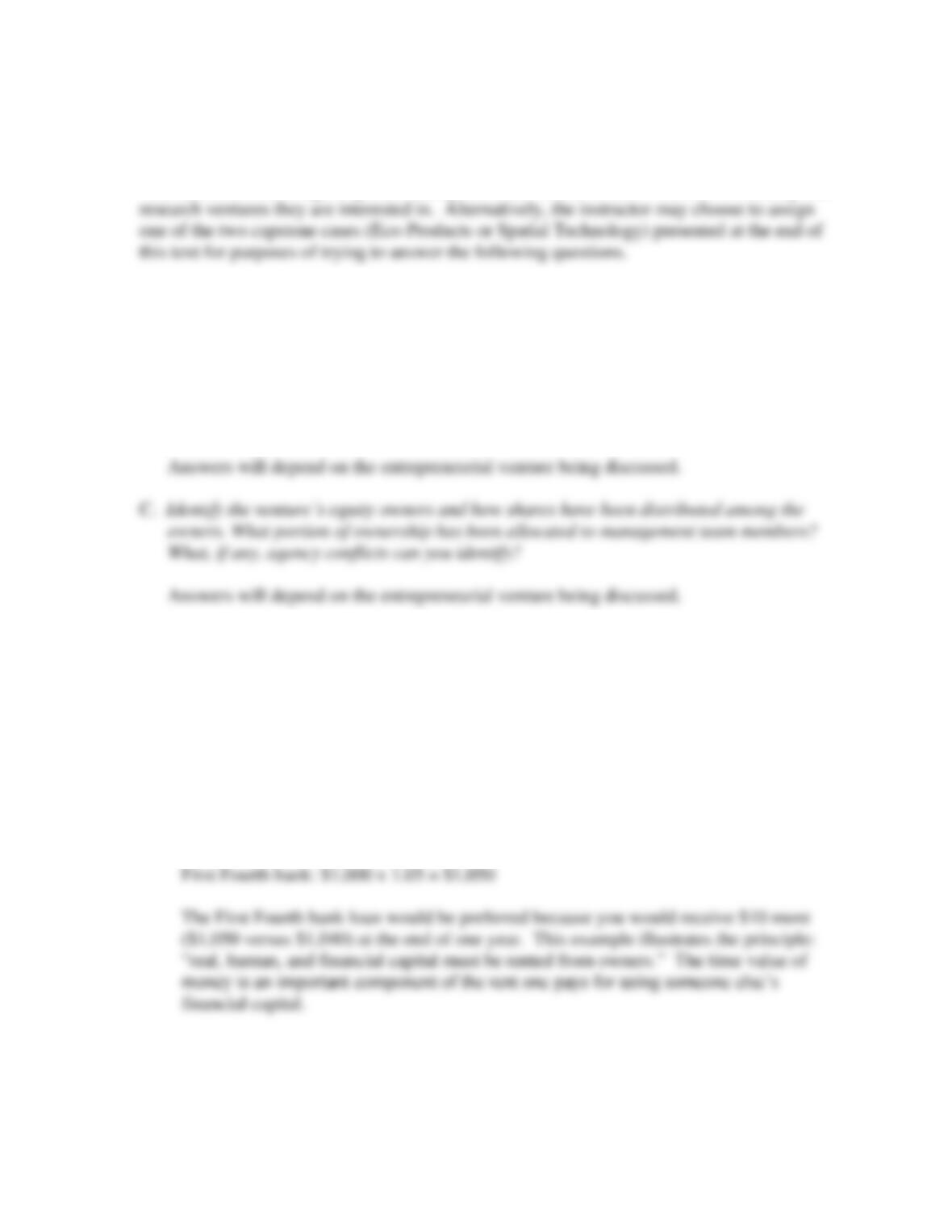
Answers will depend on the entrepreneurial venture being discussed.
B. Determine the financing sources used during the various stages of the venture’s life cycle.
4. [Financial Risk and Return Considerations] Explain how you would choose between the
following situations. Develop your answers from the perspective of the principles of
entrepreneurial finance presented earlier in the chapter. You may arrive at your answers
with or without making actual calculations.
A. You have $1,000 to invest for one year (this would be a luxury for most entrepreneurs).
You can earn a 4% interest rate for one year at the Third First bank or a 5% interest
rate at the First Fourth bank. Which savings account investment would you choose and
why?
Third First bank: $1,000 x 1.04 = $1,040
B. A “friend” of yours will lend you $10,000 for one year if you agree to repay him
$1,000 interest plus returning the $10,000 investment. A second “friend,” has only

Chapter 1: Introduction to Finance for Entrepreneurs
10
$5,000 to lend to you but wants total funds of $5,400 in repayment at the end of one
year. Which loan would you choose and why?
First friend: $1,000/$10,000 = 10% interest rate
C. You have the opportunity to invest $3,000 in one of two investments. The first
investment would pay you either $2,700 or $3,300 at the end of one year depending on
the success of the venture. The second investment would pay you either $2,000 or
$4,000 at the end of one year depending on the success of the venture. Which
investment would you choose and why? Now, would your answer change if your
investment were only $1?
Low Result High Result Expected Value
First investment: $2,700 $3,300 ($2,700 + $3,300)/2 = $3,000

Chapter 1: Introduction to Finance for Entrepreneurs
11
D. An outside venture investor is considering investing $100,000 in either your new
venture or in another venture, or invest $50,000 in each venture. At the end of one
year, the value of the venture might be either $0 or $1,000,000. The other venture is
expected to be worth either $50,000 or $500,000 at the end of one year. Which
investment choice (yours, the other venture, or half-and-half) do you think the venture
investor would choose to invest in? Why?
Low Result High Result Expected Value
Your venture: $0 $1,000,000 ($0 + $1,000,000)/2 = $500,000
5. [Ethical Issues] Assume that you have been working on a first-generation “prototype” for
a new product. An angel investor is waiting in the “wings” wanting to invest in a second–
generation model or prototype. Unfortunately you have run out of money and aren’t able to
finish the initial prototype. The business angel has previously said that she would “walk” if
you cannot produce a working first generation prototype.
A. What would you attempt to do to “save” your entrepreneurial venture?

Chapter 1: Introduction to Finance for Entrepreneurs
12
B. Now let’s assume that the angel investor will advance you the financing needed for the
second-generation prototype based on your “word” that the first-generation prototype
has been completed and is working? What would you do?
The situation has not changed from the suggested actions noted in Part A. Inform the
business angel that the initial prototype has not yet been completed because you are out
SUPPLEMENTAL EXERCISES/PROBLEMS AND ANSWERS
[Note: These activities are for readers who have an understanding of financial statements.
Accountants record the flow of revenues and expenses over a time period such as a year in the
income statement. Accounts also record the amount in asset accounts at the end of each
accounting period in the balance sheet. For readers who need to review basic financial
statements, the following problems can be completed after the materials in Chapter 4 have been
covered.]
6. [Costs or Expenses] Phil Young, founder of Pedal Pushers, expects to spend the next one-
half year developing and testing prototypes for a pedal replacement for children’s bicycles.
(See Part A of Problem 1 for a description of the proposed product.) Phil anticipates paying
monthly rent of $700 for space in a local warehouse where the Pedal Pusher product will be
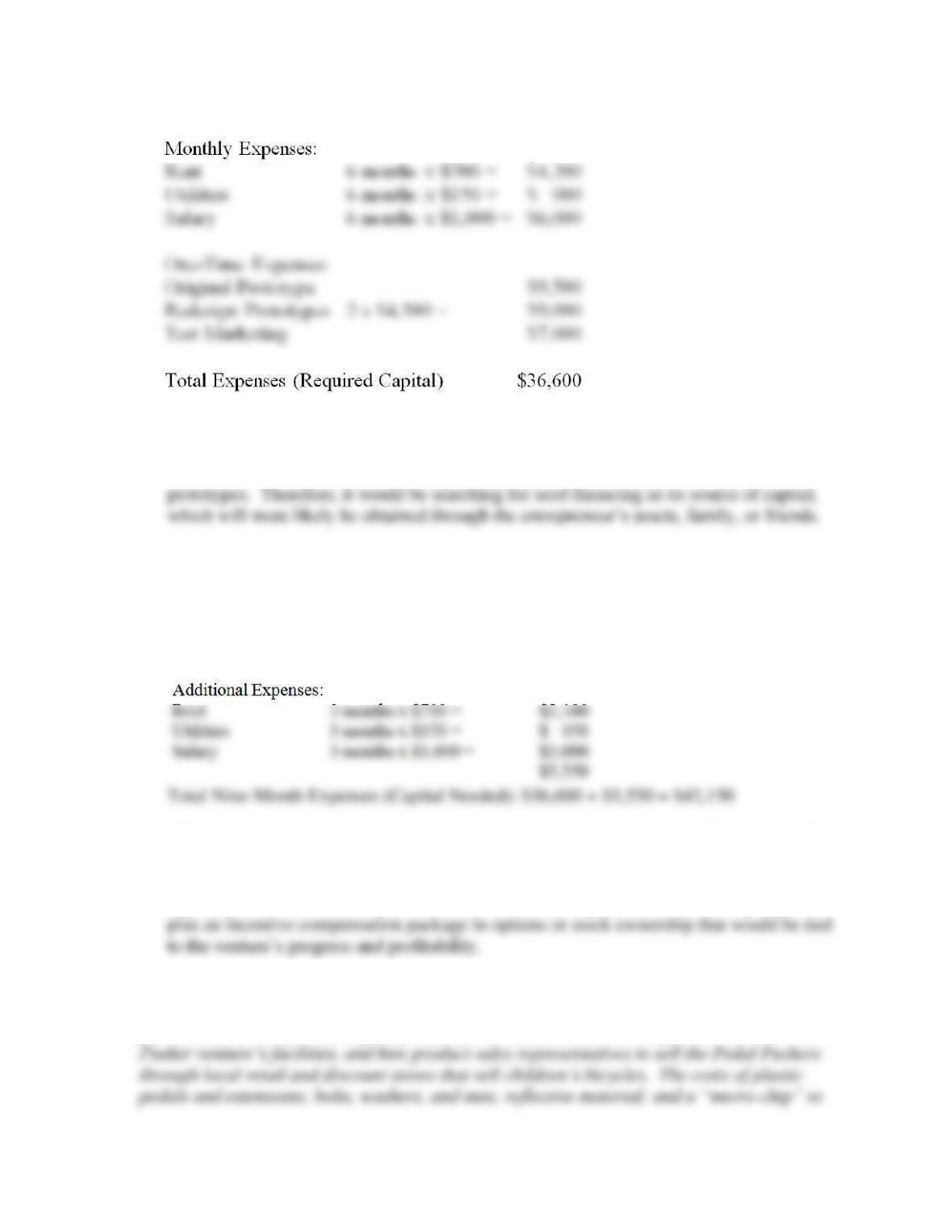
A. Determine the amount of financial capital that Phil Young will need during the six-
months it will take to develop and test market the Pedal Pusher.
Chapter 1: Introduction to Finance for Entrepreneurs
13
B. What type of financial capital is needed and what are the likely sources of that capital for
Phil Young?
The venture is in the development stage since it is still developing the product via
C. What would be your estimate of the amount of financial capital needed if the product
development period lasted nine months?
The total expenses would be the $36,600 as in (A) plus an additional three months of
expenses:
D. What compensation arrangements would you recommend as he hires additional members
of the management team?
Typically he would want to provide some base salary to provide normal living expenses
7. [Expenses and Revenues] Let’s assume that Phil Young does indeed develop and successfully
market the Pedal Pusher product discussed in Problems 1 and 6. Phil’s venture will
purchase materials for making the product from others, assemble the products at the Pedal
Chapter 1: Introduction to Finance for Entrepreneurs
14
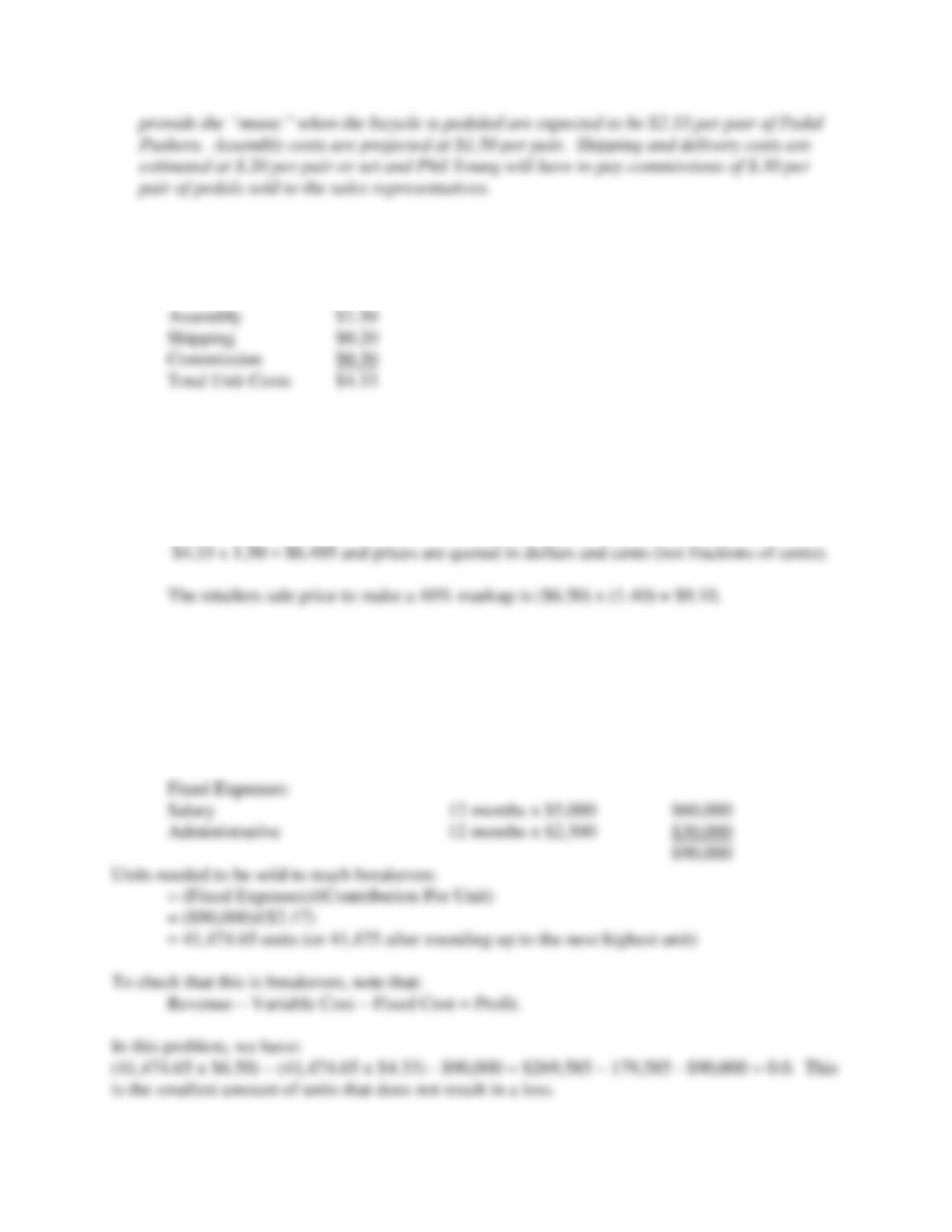
A. What will it cost to produce and sell a pair of Pedal Pushers?
Unit Costs:
Materials $2.33
B. What price will Phil Young have to charge for a pair of Pedal Pushers if he wants a
“markup” of 50 percent on each sale? Now, what would the retailers have to ultimately
sell a pair of Pedal Pushers for if they, in turn, desired a mark-up before their expenses
of 40 percent?
Phil Young’s sale price to achieve a 50% markup would need to be $6.50 because
C. Now that Pedal Pushers is up and operating, Phil Young feels he should be paid a salary
of $5,000 per month. Other administrative expenses will be $2,500 per month. How
many units (pairs) of Pedal Pushers will the venture have to sell to cover all operating
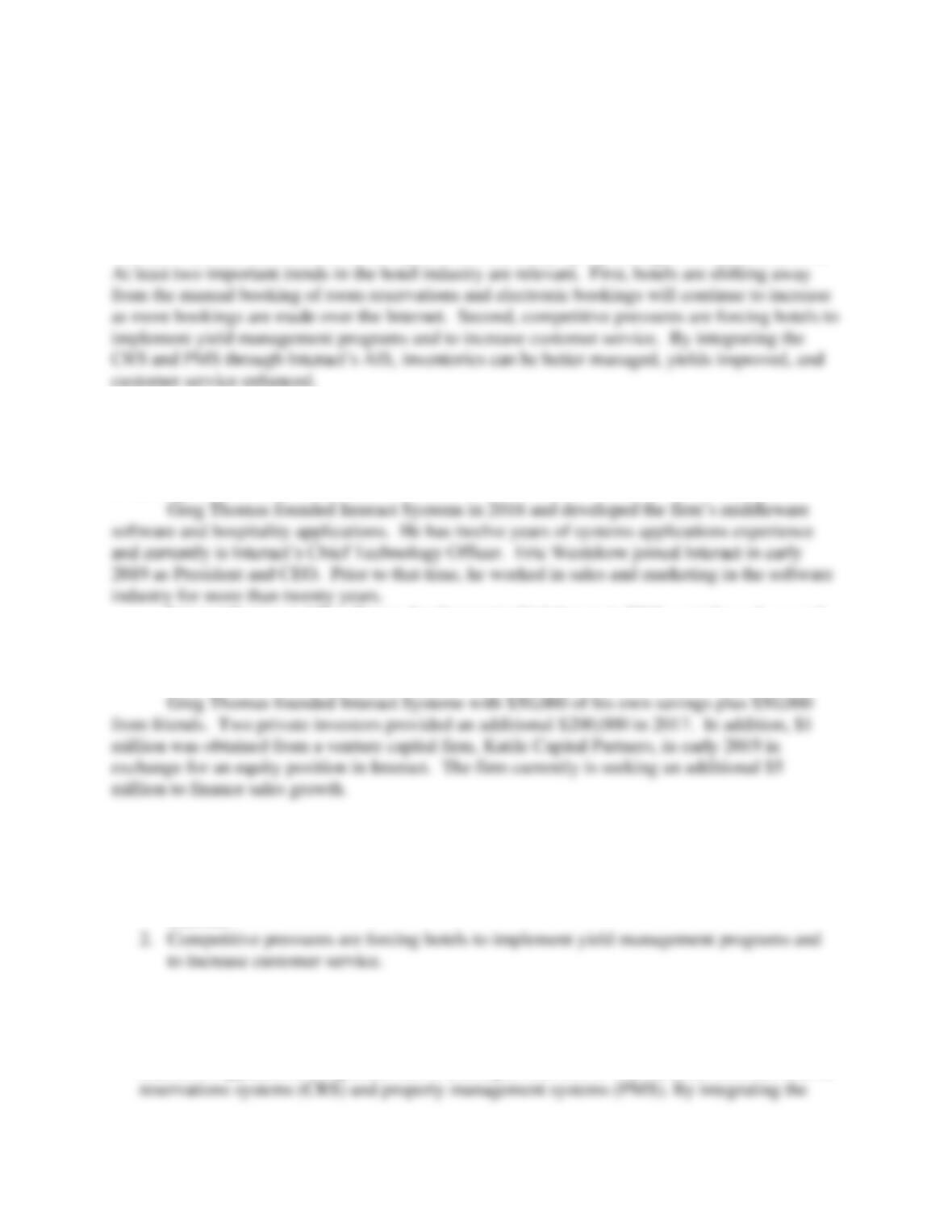
and administrative costs during the first year of operation?
Unit contribution before additional expenses = $6.50 – $4.33 = $2.17
Chapter 1: Introduction to Finance for Entrepreneurs
15
MINI CASE: INTERACT SYSTEMS, INC.
Interact Systems, Inc. has developed software tools that help hotel chains solve application
integration problems. Interact’s Application Integration Server (AIS) provides a two-way
interface between central reservations systems (CRS) and property management systems (PMS).
customer service enhanced.
All reservation traffic is routed from the CRS to individual hotel properties. This allows
Interact Systems to create a database that can be used to track customers and to facilitate
marketing programs, such as frequent stay or VIP programs, as a way of increasing customer
satisfaction. Interact forecasts application integration expenditures in the hospitality industry
exceeding $1 billion by 2022.
Interact Systems’ AIS software development which began in 2016 went through several
design changes in 2017. The first product was sold and installed in 2018. Sales were only
$500,000 in 2018. However, now that the firm has dependable market-tested AIS products ready
to be shipped, revenues are expected to reach $20.8 million in 2022.
A. Verify the two important trends that are developing in the hotel industry.
1. Hotels are shifting away from the manual booking of room reservations to electronic
bookings. This trend will continue to increase as more bookings are made over the
B. Describe how Interact Systems’ AIS software products are to benefit the hotel industry from
a profitability standpoint.
Interact’s Application Integration Server (AIS) provides a two-way interface between central

Chapter 1: Introduction to Finance for Entrepreneurs
16
C. Describe how Interact Systems’ AIS software is to help hotels improve customer satisfaction.
All reservation traffic is routed from the CRS to individual hotel properties. This allows
D. Describe the life cycle stages that Interact Systems has progressed through to date.
Interact Systems’ AIS software development which began in 2016, went through several
E. What types of venture financing have been obtained, or are being sought, by Interact?
Seed Financing: Greg Thomas founded Interact Systems in 2016 with $50,000 of his own
savings plus $50,000 from friends. Two private investors provided $200,000 in 2017.
F. Relate major sources or players with the venture financing described in Part E.
Major sources or players include:
G. What types of agency problems or conflicts should the founding entrepreneur have
anticipated?
Agency relationships arise when principals hire agents to perform specified activities or
Chapter 1: Introduction to Finance for Entrepreneurs
17
H. What, if anything, should the founding entrepreneur have done in anticipation of agency
conflicts?
In order to minimize a possible owner-manager conflict, the president and CEO, Erick
I. Assuming the venture succeeds, what are the potential advantages to other stakeholders
(customers, employees, and society more broadly)?
The goal of maximizing the entrepreneurial venture’s value is not inconsistent with ethical
behavior in business practices. Actions by entrepreneurs to increase the value of their
J. If internal sales growth projections are revised downward after the current financing round,
what, if any, disclosure to stakeholders (investors, employees, customers, etc.) should occur?
Why?
The entrepreneur-manager has the responsibility to inform investors in a timely and